
Research | Open Access | Volume 9 (Suppl 15): Article 02 | Published: 04 Sep 2026

Views: 435
Menu, Tables and Figures
Table 1: Clinical and socio-demographic characteristics of humans bitten, Guinea, January 2018 – August 2019
| Variable | n (%) |
|---|---|
| Clinical features | |
| Post exposure vaccination (n=1,953) | |
| Yes | 1,458 (75) |
| No | 495 (25) |
| Rabies | |
| Yes | 10 (0.5) |
| No | 1,943 (99.5) |
| Socio-demographic characteristics | |
| Age groups (n = 1,950) | |
| 0 – 14 | 981 (50) |
| 15 – 29 | 400 (21) |
| 30 – 44 | 288 (15) |
| 45 and older | 281 (14) |
| Sex (n = 1,950) | |
| Female | 858 (44) |
| Male | 1,092 (56) |
| Occupation (n = 1,797) | |
| No profession (e.g., students) | 1,064 (59) |
| Housekeeper | 323 (18) |
| Other (worker, shopkeeper, administrator) | 304 (17) |
| Cultivator | 106 (6) |
Table 1: Clinical and socio-demographic characteristics of humans bitten, Guinea, January 2018 – August 2019
Table 2: Characteristics of biting animals, Guinea, January 2018 – August 2019
| Features | n (%) |
|---|---|
| Biting animals | 1,821 |
| Species (n = 1,821) | |
| Dogs | 1,815 (99.7) |
| Cats | 2 (0.1) |
| Monkey | 4 (0.2) |
| Animal condition (n = 1,662) | |
| Kept for quarantine | 937 (56) |
| Not kept for quarantine or stray dogs | 725 (44) |
| Dogs showing signs of rabies (n = 937) | 159 (17) |
| Euthanized (n = 159) | 159 (100) |
| Sampled (n = 159) | 27 (17) |
| Positive for canine rabies (n = 27) | 20 (74) |
| Animal-level data were available for 1,821 biting animals; animal condition was documented for 1,662. | |
Table 2: Characteristics of biting animals, Guinea, January 2018 – August 2019
Fassou Kourouma1, Patrick Mavungu Ngoma2, Salomon Corvil2,&, Daouda Bangoura3, Briana Lucido4, Kristin Baskerville4,5, Lise Diane Martel4
1Ministry of Health of Guinea, Conakry, Guinea, 2African Field Epidemiology Network in Guinea, Conakry, Guinea, 3Ministry of Livestock of Guinea, Conakry, Guinea, 4U.S. Centres for Disease Control and Prevention, Atlanta, United States, 5Association of Schools and Programs of Public Health, Washington, DC, United States
&Corresponding author: Salomon Corvil, African Field Epidemiology Network in Guinea, Conakry, Guinea, salomoncorvils2000@gmail.com ORCID: https://orcid.org/0009-0008-0966-0888
Received: 08 May 2025, Accepted: 30 Aug 2026, Published: 04 Sep 2026
Domain: Zoonosis
Keywords: Epidemiological profile, FETP, rabies, bites, dog, Guinea, vaccination
©Fassou Kourouma et al. Journal of Interventional Epidemiology and Public Health (ISSN: 2664-2824). This is an Open Access article distributed under the terms of the Creative Commons Attribution International 4.0 License (https://creativecommons.org/licenses/by/4.0/), which permits unrestricted use, distribution, and reproduction in any medium, provided the original work is properly cited.
Cite this article: Fassou Kourouma et al. Epidemiological profile of dog bite cases and rabies in Guinea, 2018-2019. Journal of Interventional Epidemiology and Public Health. 2026; 9(Suppl 15):02. https://doi.org/10.37432/jieph-d-25-00111
Introduction: In Guinea, between 2011 and 2017, there were 95 clinical canine rabies cases, 10,153 cases of bites recorded in the health facilities, and 50 clinical human rabies cases recorded in the veterinary post. The profile of the disease is not well known. This study describes the epidemiological profile of rabies to guide the decision-making of the Ministries of Health and Livestock.
Methods: A descriptive incidence study was carried out using January 2018–August 2019 bite and rabies databases of the Ministries of Health and Livestock. We calculated median age, frequency, and district bite incidence per 100,000 population.
Results: Overall, 1,953 bite cases were recorded, with an incidence of 10 per 100,000 population and a median age of 14 years. Of those bitten, 75% (1458/1953) benefited from post-exposure vaccination (PEV); none of the 10 rabid humans sought vaccination, and all died. Of the 1,662 biting dogs followed up, 937 (56%) were observed, of which 159 (17%) developed rabies symptoms and were euthanised, and 27 (17%) were sampled, 20 (74%) of which were confirmed for rabies by PCR test. N’Zérékoré and Fria had an incidence of >50 bites per 100,000 inhabitants; 40% of canine rabies cases were from Faranah. Fifteen thousand dogs were vaccinated in districts with high incidence and percentage of confirmed rabies cases.
Conclusion: People under 15 years old were most affected. We suggest improving dog bite and rabies surveillance in the district with low incidence, building laboratory sampling capacity, testing suspected canine cases, and conducting an exhaustive census among the dog population.
Rabies is a zoonotic disease which can affect all mammals, including humans and many wild and domestic animals [1,2]. Humans are usually infected by bites, scratches, or licks from an infected animal on excoriated skin or mucous membranes (excoriated or healthy) [3,4]. Over 99% of human rabies cases are due to bites from infected dogs, the main global reservoir of the virus [2]. Controlling rabies in dogs, especially stray dogs, is a priority for preventing rabies in humans. By sustaining a 70% routine vaccination coverage in dogs over several years, rabies can be eliminated in endemic areas [2,4].
The two main immunisation strategies recommended by the World Health Organization (WHO) for the prevention of human rabies are post-exposure prophylaxis and pre-exposure prophylaxis, with the latter recommended for individuals at higher risk of potential exposure to the rabies virus. In 2018, WHO updated its position paper on the use of rabies vaccines to focus on programmatic feasibility, simplification of vaccination schedules, and improved cost-effectiveness [5].
The incubation period for rabies varies according to the site of virus penetration, the nature of the bite wound, and the viral load, ranging from a few days to several months [2,4]. In the absence of post-exposure vaccination (PEV), rabies is fatal in both humans and animals once clinical signs appear [2]. The disease initially manifests itself as fever, pain, or unusual or unexplained paresthesia (tingling, itching, burning) at the site of injury, and encephalomyelitis, and is usually accompanied by signs of excitement and aggression [6].
In humans, it evolves in two forms: 1) the paralytic form, observed in around 20% of cases, with less typical symptoms that are often misdiagnosed, contributing to the underreporting of this form of the disease, and 2) the furious form, with symptoms of hyperactivity, excitability, hydrophobia, and sometimes aerophobia [7-8]. Diagnosis of rabies relies on laboratory tests for the direct detection of the rabies virus or its components, or for the indirect detection of antibodies generated during infection. It is strongly suspected in the presence of exposure to rabies risk and encephalitis associated with aerophobia and hydrophobia [3]. In animals, rabies is diagnosed using several testing methods such as DRIT, polymerase chain reaction (PCR), and direct fluorescent antibody (DFA). The DFA test looks for the presence of rabies virus antigens in brain tissue. In humans, several tests are required. Rapid and accurate laboratory diagnosis of rabies in humans and other animals is essential for timely administration of PEV. In addition, laboratory identification of positive rabies cases may aid in defining current epidemiologic patterns of the disease and provide appropriate information for the development of rabies control programs [4, 9].
Few studies discuss rabies in Guinea. A retrospective study conducted with all health and veterinary structures of Conakry, Guinea found that over an 11-year period from 2002 to 2012, 2,916 biting dogs were put under observation, of which 15 were diagnosed with rabies based on clinical signs [10]. During the same period, 7,994 humans bitten by dogs were noted. Of this total number of humans bitten, 2,634 received PEV and only half of these completed the full course of PEV [10]. Furthermore, according to records from the Ministry of Livestock, between 2011 and 2017, there were a total of 10,153 case reports of dogs that bit humans, 95 cases of rabies confirmed in dogs, and 50 clinically confirmed cases of rabies in humans [11]. Rabies outbreaks have not been well documented in Guinea.
In Guinea, dog bites and human or animal rabies cases are immediately notifiable events or diseases. Guinea’s rabies surveillance objectives are to: detect animal bite cases in real time and report cases immediately, so that bitten humans can rapidly receive PEV; detect rabies epidemics; identify high-risk areas; and produce systematic monthly summary notifications [11]. When a dog bites a person, the dog is isolated for 21 days. Every two days, a veterinarian examines the dog for signs of rabies. After 21 days, if the dog has not developed any symptoms, the veterinarian reports on the status of the dog. If the dog was not recently vaccinated for rabies, it is vaccinated and released. If the dog developed any symptoms, the veterinarian proceeds with euthanasia.
Animal rabies surveillance data are maintained by the Veterinary Services Division of the Ministry of Livestock (DNVS in French). The DNVS is responsible for the surveillance of and response to zoonoses and animal epidemic-prone diseases. Historically, the DNVS has conducted canine rabies vaccination campaigns during World Rabies Day. However, the location of these vaccination campaigns did not rely on surveillance data. The National Agency for Health Security (ANSS in French) of the Ministry of Health (MoH) maintains surveillance data for cases of humans bitten by dogs and human rabies.
Guinea is committed to eliminating rabies by 2030, yet the epidemiological profile of rabies in Guinea remains poorly documented, and no information was available on the population or vaccination coverage of dogs at the time of this study [12]. Based on fieldwork conducted by a Field Epidemiology Training Program (FETP) participant, this study describes the epidemiological profile of dog bite and rabies cases in Guinea from January 2018 to August 2019. It suggests that enhanced surveillance is needed to better understand the burden of rabies in Guinea. This information is necessary to guide the national strategy and monitor whether control activities are working or not, ultimately helping Guinea work towards achieving its elimination goals.
Study design and settings
A descriptive retrospective incidence study was conducted using Guinea’s surveillance data from January 2018 to August 2019. Guinea is a West African Francophone country. According to the National Institute of Statistics of Guinea (INS in French), Guinea has a population of 13,531,966 inhabitants and an area of 250,000 square kilometres. Guinea has eight regions and 38 districts, which are the operational level for the surveillance of rabies and people bitten by dogs [13].
Human bitten by dog case definition
According to Guinea’s rabies surveillance guideline, a human bitten by a dog case is someone bitten by a domestic or unknown dog. If the dog is owned, it’s isolated for 21 days, and if the dog is unowned, there is no way to isolate it for observation. In both cases, the person bitten by the dog should receive PEV.
Rabies case definition
In humans, a suspected rabies case is defined as a person reported on the Early Warning System database line list who has been bitten, scratched, or licked by an animal suspected of rabies, and presents at least one of the following signs: headache, neck pain, nausea, aerophobia, fever, hydrophobia, anxiety, agitation, abnormal tingling sensations or pain at a bite site [1-3,6-7]. In animals, a suspected rabies case is defined as an animal showing one of the following symptoms: signs of anxiety, excitability, hyperaggressiveness, depression, phobia of water and light, paralysis, or biting two or more people or animals for no apparent reason [2]. Suspected animal rabies cases are confirmed by laboratory tests [2]. In Guinea, the diagnosis of rabies is done using two testing methods: DFA or PCR.
Sources of data
The data for humans bitten by dogs and for human rabies cases were collected through passive surveillance on paper-based case notification forms from health facilities and private veterinarians. The completed case notification form was transmitted by transport to a surveillance officer at the district level. The surveillance officer captured the data in the Early Warning System of the ANSS.
For suspected animal rabies cases, data were captured at the district level by DNSV staff on a paper-based form and entered monthly in the DNSV database at the national level by the surveillance data manager. Testing to confirm animal rabies cases was done at the National Laboratory of Veterinary Medicine (NLVM). When the result was available, it was transmitted to the DNSV, which distributed it among the districts.
Data analysis
The following human variables were analysed: age, sex, occupation, date of dog bite, date on which the person received each dose of PEV, outcome (died or alive), epidemiological week, and district of notification. The following animal variables were analysed: animal species, stray or owned, in quarantine or not, rabies symptoms or not, euthanized or not. We calculated the median age of people bitten by animals suspected of rabies, the incidence of people bitten by animals suspected of rabies per 100,000 inhabitants per district, and the frequency of human rabies cases per district. The DNVS database was used to calculate the frequency of notification of laboratory-confirmed canine rabies cases per district. Data analysis was performed in Epi Info 7.2.
Ethics approval
Permission was obtained from the MoH and DNSV to analyse the data. All data used in this study were kept confidential, and records in the databases were de-identified for analyses.
Clinical and socio-demographic characteristics of humans bitten by dogs
A total of 1953 cases of humans bitten by dogs were recorded between January 2018 and August 2019. Of the total cases, 1458 (75%) received PEV, and 10 suspected cases of human rabies were reported. Among humans bitten, the median age was 14 years old and 56% were male (Table 1).
Characteristics of human rabies cases
Analyzing the database for human rabies, we noted that 10 human clinical rabies cases were reported and among them, 7 (70%) were males, and 6 (60%) were <15 years of age. None had received PEV.
Clinical and socio-demographic characteristics of animal rabies cases
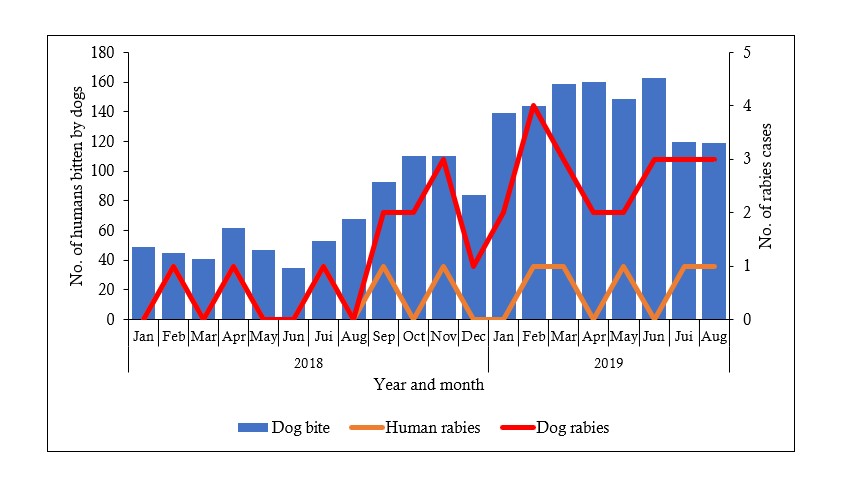
Almost all the 1,821 biting animals identified were dogs. Of the 937 (51%) biting dogs that were kept under observation, 159 (17%) showed signs of rabies and were euthanized. Only 27 (17%) of the euthanised dogs’ brains were sampled, of which 20 (74%) tested positive for rabies (Table 2). There was an increase in dog bite cases reported between January 2018 and August 2019. Confirmed cases of canine rabies were only reported between September 2018 and August 2019, as the NLVM was not functional before September 2018. The number of clinical rabies cases in humans remained the same over these months (Figure 1).
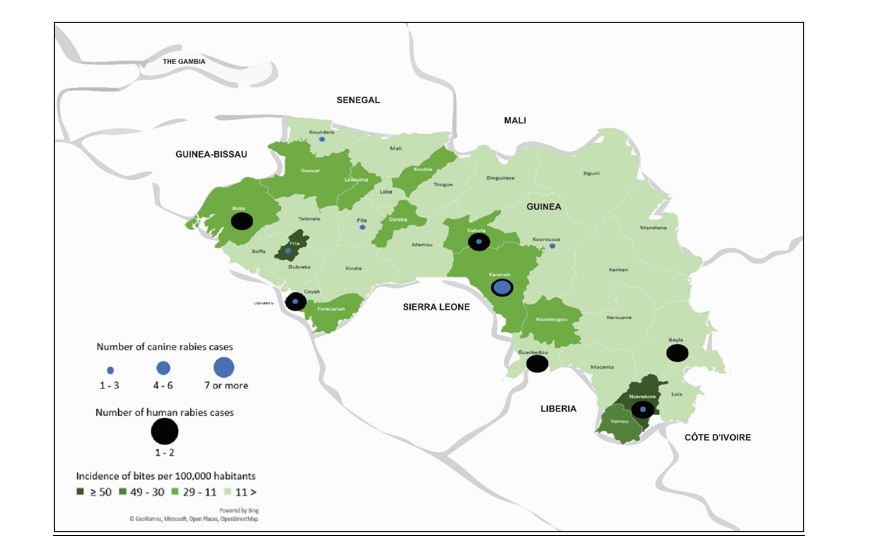
The overall incidence of humans bitten by dogs reported by health facilities in Guinea was 10 per 100,000 inhabitants. However, two of Guinea’s 38 districts (Fria and N’Zérékoré) had an incidence of 50 bites per 100,000 inhabitants during the study period. Ten districts had an incidence between 30–49 cases. Of the 20 canine rabies cases, 8 (40%) were from Faranah, 3 (15%) from N’Zérékoré, 3 (15%) from Dabola, and 2 (10%) from Pita. Matam, Fria, Koundara, and Kouroussa each had one case. Two (20%) of the 10 human rabies cases were from Dabola, 2 (20%) from Faranah, and 2 (20%) from Boke. Matam, Gueckedou, Beyla, and N’Zérékoré each had one case (Figure 2).
The main purpose of this study was to describe the epidemiological profile of dog bite cases and rabies in Guinea, given the limited existing scientific literature. Only a little over half of biting animals, for which individual data were available, were ever kept under observation for rabies symptoms. All 159 showing symptoms were euthanized but only 27 (17%) were sampled. This could be explained by a lack of availability of sampling kits for animal health surveillance and the fact that the lab was functional only starting in October 2018. Still, 20 (74%) of those sampled were confirmed for canine rabies.
Considering that in Guinea only slightly over half of biting animals are kept under observation for signs of rabies, it is likely that the data presented here underestimate bites and rabies incidence. All dogs that were not quarantined were stray dogs that remained in the environment after biting.
The number of reported cases of humans bitten by dogs increased in 2019. Part of this increase can be explained by improved public health surveillance. This improvement could be due to the implementation of the One Health approach to surveillance and rapid response teams’ field investigations. FETP trained participants from animal and human health sectors together, and they worked at the district level to improve data reporting timeliness and completeness.
Furthermore, FETP graduates in the same district or region analyzed surveillance data of humans bitten by dogs for timely identification of suspected rabies exposures. This led to immediate public health action, including the administration of PEV to prevent rabies infection and thus a human case. In addition, FETP invited animal health sector specialists to join investigations of rabies outbreaks to promote better coordination between sectors. Additional longitudinal analyses are needed to confirm that this factor alone can explain the increase in cases and to generate a more accurate estimation of rabies incidence.
Guinea’s high proportion of bites and rabies from dogs among children under 15 is consistent with other studies conducted in other African countries [12,14-21], including the neighbouring countries of Mali and Ivory Coast [22-26], and information provided by the World Health Organization [4]. Children are more likely to handle and play with domestic and stray animals, especially dogs. Children might also be less aware than adults of the signs of rabies in animals and unable to protect themselves when confronted with rabid animals.
Even if 75% of people bitten by animals suspected of rabies benefited from PEV, none of the 10 humans suspected of rabies sought PEV at a health facility, and they all died. This highlights a weakness in the community referral system and case management for people bitten by dogs suspected of having rabies. In addition, considering Guinea’s gross domestic product (GDP) per capita of just over $1,000 during the study period and the comparatively high cost of PEV, ensuring that 100% of bitten people receive PEV is a challenge. Most of the time, when PEV is not available, people must obtain it from a private pharmacy, and it is an out-of-pocket expense.
Additionally, the quality of PEV from private pharmacies is unknown because the cold chain is not regulated by the government. The country’s heavy infectious disease burden and the PEV’s short shelf life compound the issue. Furthermore, in Guinea, as in most countries, the public health system is based on a treatment rather than a prevention model.
According to Guinea’s surveillance data, the reported bite incidence during the study period was 10 per 100,000 inhabitants. This incidence is high compared to other African countries [3,16]. More research is needed to assess the differences between Guinea and other African countries’ surveillance systems and to better understand why the incidence is higher in Guinea. When the number of canine rabies cases, incidence of bites per 100,000 inhabitants, and number of human rabies cases are considered, some areas of concern can be identified. For example, in the study period, Faranah recorded more than seven cases of canine rabies, two cases of human rabies, and a bite incidence of 30–49 bites per 100,000 inhabitants.
Nevertheless, some of these results could partly be explained by factors such as hypervigilance and consistent reporting by the surveillance officer, who was a veterinarian very active in sampling suspected rabies dogs and sending these samples to the lab.
Limitations
One limitation is the underreporting of humans bitten by dogs and rabies cases. Some districts have low incidence because cases are not reported. After considering the limitations of this study, suggestions were made to the Ministries of Health and Livestock. One suggestion included conducting an evaluation of the rabies and human bites by dogs’ surveillance systems to detect weaknesses and strengths and identify improvements for animal and human rabies surveillance. Additionally, we suggested improving public health surveillance in the district where the incidence of humans bitten by dogs was low and reinforcing surveillance countrywide through the establishment of an individual database of human and animal rabies cases.
Public health action
This study was carried out when the Ministry of Livestock was about to launch a major vaccination campaign in the districts of Matoto and Faranah. Following the presentation of the results of this study, the Ministry of Livestock vaccinated 15,000 dogs in the districts with a high incidence of dog bites and reporting of human and animal rabies cases. This decision to shift approach represents the first time in Guinea that the location of the canine vaccination campaign was determined using epidemiologic surveillance data. Applying a One Health approach, this vaccination campaign was accompanied by a sensitisation of the human population most affected, those under 15 years old, by the Ministry of Health.
Some suggestions targeted only one of the two ministries.
Suggestions to the Ministry of Livestock focused on the three components of a strong canine rabies control program: epidemiological surveillance, mass dog vaccination, and dog population control [4]. We suggested conducting a census of Guinea’s dog population, including the owned and unowned dogs. This census could facilitate vaccination planning and implementation of strategies to reduce the number of stray dogs. Based on census findings, canine vaccination campaigns should be organized to reach the 70% immunisation benchmark needed for elimination.
Furthermore, it is necessary to ensure regular stocks of vaccines at the district level, strengthen animal health diagnostic laboratory capacity, and make sampling kits available in all districts to collect euthanised dog heads. While some of these measures are already in the process of being implemented, others, such as maintaining a dog census and identifying vaccinated dogs, both important elements of well-planned vaccination campaigns [4], should be prioritised. These measures would require a substantial investment of financial resources that exceed what is currently available, even with collaborative funding from both ministries, to meet the 2030 goals. Nevertheless, the changes made to the recent dog vaccination and sensitization campaigns are a step in the right direction and clearly demonstrate the willingness of both ministries to plan interventions using empirical data and to collaborate to eliminate rabies from Guinea.
People under 15 years old were most affected. Although few symptomatic animals were sampled, nearly three-quarters of tested samples were positive for canine rabies, indicating high positivity among sampled suspected cases. We suggest improving dog bite and rabies surveillance in the district with low incidence, building laboratory sampling capacity, testing suspected canine cases, and conducting an exhaustive census among the dog population. FETP plays a leading role in promoting a One Health approach to the resolution of health problems such as rabies [27]. As 75% of FETP is fieldwork and more FETP graduates hold senior positions at the district, regional, and national levels, human and animal health staff will increasingly have opportunities to work together on problems like rabies at all levels of government [28]. In the meantime, much remains to be done in Guinea to ensure that the country can reach its rabies elimination goals by 2030.
What is already known about the topic
What this study adds
This publication was supported by Cooperative Agreement Number NU36OE000014-01-00 from the Centres for Disease Control and Prevention and the Association of Schools and Programs of Public Health. The findings and conclusions of this publication do not necessarily represent the official views of U.S. CDC or ASPPH.
Disclaimer
The conclusions, findings, and opinions expressed by authors contributing to this journal do not necessarily reflect the official position of the U.S. Centers for Disease Control and Prevention, or the authors’ affiliated institutions.
Table 1: Clinical and socio-demographic characteristics of humans bitten, Guinea, January 2018 – August 2019
| Variable | n (%) |
|---|---|
| Clinical features | |
| Post exposure vaccination (n=1,953) | |
| Yes | 1,458 (75) |
| No | 495 (25) |
| Rabies | |
| Yes | 10 (0.5) |
| No | 1,943 (99.5) |
| Socio-demographic characteristics | |
| Age groups (n = 1,950) | |
| 0 – 14 | 981 (50) |
| 15 – 29 | 400 (21) |
| 30 – 44 | 288 (15) |
| 45 and older | 281 (14) |
| Sex (n = 1,950) | |
| Female | 858 (44) |
| Male | 1,092 (56) |
| Occupation (n = 1,797) | |
| No profession (e.g., students) | 1,064 (59) |
| Housekeeper | 323 (18) |
| Other (worker, shopkeeper, administrator) | 304 (17) |
| Cultivator | 106 (6) |
Table 2: Characteristics of biting animals, Guinea, January 2018 – August 2019
| Features | n (%) |
|---|---|
| Biting animals | 1,821 |
| Species (n = 1,821) | |
| Dogs | 1,815 (99.7) |
| Cats | 2 (0.1) |
| Monkey | 4 (0.2) |
| Animal condition (n = 1,662) | |
| Kept for quarantine | 937 (56) |
| Not kept for quarantine or stray dogs | 725 (44) |
| Dogs showing signs of rabies (n = 937) | 159 (17) |
| Euthanized (n = 159) | 159 (100) |
| Sampled (n = 159) | 27 (17) |
| Positive for canine rabies (n = 27) | 20 (74) |
| Animal-level data were available for 1,821 biting animals; animal condition was documented for 1,662. | |