
Lessons from the Field | Open Access | Volume 9 (Suppl 15): Article 5 | Published: 12 Sep 2026

Views: 21
Menu, Tables and Figures
| Table 1: COVID-19 Strategic Preparedness and Response Plan 10 Pillars | |
| Pillar | Pillar name |
|---|---|
| 1 | Coordination, planning, financing, and monitoring |
| 2 | Risk communication, community engagement, and infodemic management |
| 3 | Surveillance, epidemiological investigation, contact tracing, and adjustment of public health and social measures |
| 4 | Points of entry, international travel and transport, and mass gathering |
| 5 | Laboratories and diagnostics |
| 6 | Infection prevention and control, and protection of health workforce |
| 7 | Case management, clinical operations, and therapeutics |
| 8 | Operational support and logistics, and supply chains |
| 9 | Maintaining essential health services and systems |
| 10 | Vaccination |
Table 1: COVID-19 Strategic Preparedness and Response Plan 10 Pillars
| Table 2: Characteristics of FETP COVID-19 responders, Guinea, March 2021 | |
| Socio demographic characteristic | N (%) |
|---|---|
| Highest FETP level (n=121) | |
| Frontline | 104 (86) |
| Intermediate | 11 (9) |
| Advanced | 6 (5) |
| Education (n=137) | |
| High school | 29 (21) |
| University graduate | 73 (53) |
| Post-graduate | 35 (26) |
| Profession (n=121) | |
| Nurse assistant | 8 (7) |
| Nurse | 25 (20) |
| Doctor | 82 (68) |
| Veterinary | 4 (3) |
| Laboratory | 2 (2) |
| Sector of work (n=140) | |
| Public | 134 (96) |
| Private | 6 (4) |
| Organization of work (n=131) | |
| Ministry of health | 122 (93) |
| Ministry of livestock | 4 (3) |
| Other sector | 5 (4) |
| Level of health pyramid (n=140) | |
| Sub-district | 25 (18) |
| District | 83 (59) |
| Region | 18 (13) |
| National | 14 (10) |
| Current title of work (n=115) | |
| Disease control and prevention officer | 41 (29) |
| Disease control and prevention deputy officer | 30 (21) |
| Data manager | 14 (10) |
| Head of facility | 15 (11) |
| Planning and training lead | 9 (6) |
| Livestock agent | 4 (3) |
| Laboratory agent | 2 (1) |
| Others* | 25 (18) |
*Others include healthcare managers, COVID-19 treatment center leaders, and incident managers
Table 2: Characteristics of FETP COVID-19 responders, Guinea, March 2021
Salomon Corvil1, Claude Ngona Mandro1, Jolie Kasongo Kayembe1, Patrick Mavungu Ngoma1, Gbamou Nouonan2, Sakoba Keita2, Sara Albanna3, Lise Diane Martel4
1African Field Epidemiology Network in Guinea, Conakry, Guinea, 2Ministry of Health of Guinea, Conakry, Guinea, 3Oak Ridge Institute for Science and Education, Oak Ridge, United States, 4U.S. Centres for Disease Control and Prevention, Atlanta, United States
&Corresponding author: Salomon Corvil, African Field Epidemiology Network in Guinea, Conakry, Guinea, Email: salomoncorvils2000@gmail.com ORCID: https://orcid.org/0009-0008-0966-0888
Received: 08 May 2025, Accepted: 08 Sep 2026, Published: 22 Sep 2026
Domain: Field Epidemiology
Keywords: COVID-19, FETP, emergency response, surveillance, Guinea, trainings
©Salomon Corvil, et al. Journal of Interventional Epidemiology and Public Health (ISSN: 2664-2824). This is an Open Access article distributed under the terms of the Creative Commons Attribution International 4.0 License (https://creativecommons.org/licenses/by/4.0/), which permits unrestricted use, distribution, and reproduction in any medium, provided the original work is properly cited.
Cite this article: Salomon Corvil et al., Contributions of Guinea’s FETP trainees and graduates to the fight against COVID-19, March 2021. Journal of Interventional Epidemiology and Public Health. 2026; 9 (Suppl 15):5. https://doi.org/10.37432/jieph-d-25-00112
Introduction: Field Epidemiology Training Programs (FETPs) are Ministry of Health (MoH)-based programs that build the capacity of public health professionals to respond to public health emergencies globally. FETP in Guinea covers seven of the ten pillars of the COVID-19 Strategic Preparedness and Response Plan. After the first cases of COVID-19 were detected in Guinea in March 2020, FETP trainees and graduates responded. We assessed their contributions to the response and provided recommendations to improve Guinea’s emergency response capacity.
Methods: In March 2021, all 221 FETP trainees and graduates were invited to complete an emailed survey about individual contributions to response activities of the 10 pillars. We calculated the median and the range for quantitative variables, and the proportion for qualitative variables.
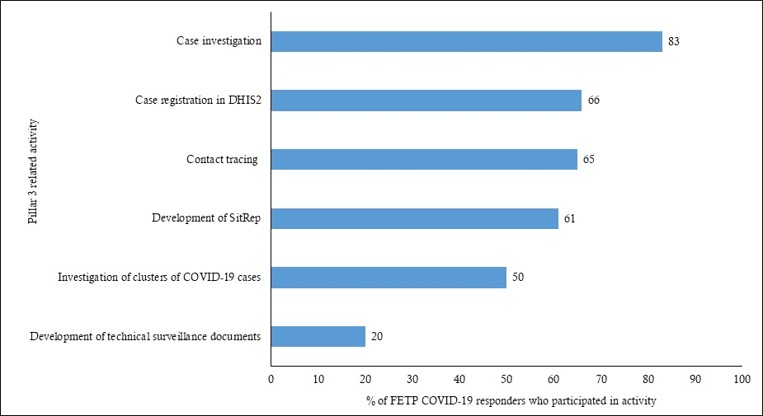
Results: Among 221 survey recipients, 148 (67%) responded. Of these, 140 (95%) were COVID-19 responders, of whom 108 (77%) worked at district or sub-district levels. Among 131 (94%) who specified where they worked in March 2021, 122 (93%) worked for the MoH. Survey recipients reported involvement in all pillar activities as part of the COVID-19 response, most commonly Pillar 3 (123; 88%). Of those engaged in Pillar 3 activities, 102 (83%) participated in case investigations, 81 (66%) in case registration in DHIS2, 80 (65%) in contact tracing, 75 (61%) in creating daily epidemiological bulletins, and 61 (50%) in cluster investigations.
Conclusion: FETP responders played a key role in Guinea’s COVID-19 response. Consideration should be given to training FETP alumni on response pillar competencies not covered by FETP.
The Field Epidemiology Training Program (FETP) was created more than 40 years ago by the U.S. Centers for Disease Control and Prevention (CDC) to build countries’ public health workforce capacity to prevent, detect, and respond to epidemics [1]. FETP was first established as a 2-year program, now referred to as the “FETP-Advanced” tier, which was modelled on CDC’s Epidemic Intelligence Service (EIS) program [2]. Today, two additional FETP tiers are available: the 9-month FETP-Intermediate and the 3-month FETP-Frontline. Graduates from the FETP-Intermediate and Advanced tiers count towards the Joint External Evaluation (JEE) surveillance target of one trained field epidemiologist per 200,000 of the population [3].
In Guinea, the FETP-Frontline tier was initiated in 2017, and the FETP-Intermediate tier in 2019. In addition, Guineans have participated in FETP-Advanced regional programs in other countries before returning to Guinea to work. Enrollees in Guinea’s FETP are selected among the surveillance officers from the Ministries of Health (MoH), Livestock, and Environment. Trainees must complete FETP-Frontline before being eligible to enrol in FETP-Intermediate, and some of the graduates from the Advanced and Intermediate tiers serve as mentors for the trainees in shorter tiers. At the time of this study, three graduates from the Democratic Republic of Congo worked as FETP mentors in Guinea. Since the establishment of FETP in Guinea, trainees and graduates play a key role in the prevention and control of diseases of epidemic potential and in the management of epidemiological data at the national, regional, and district levels.
The first cases of COVID-19 were detected in Guinea in March 2020 [4]. FETP-Frontline and FETP-Intermediate in Guinea cover skills needed to perform activities of seven of the 10 COVID-19 Response Pillars [5], while FETP-Advanced covers skills in all 10 pillars. FETP trainees and graduates from Frontline, Intermediate, and Advanced tiers were mobilized by the MoH to respond to the epidemic. This survey was conducted to assess their contribution to COVID-19 response activities and to identify FETP training needs to further strengthen the country’s capacity to manage epidemics.
Study period
This study was carried out in March 2021. Graduates and trainees from the three tiers in Guinea received the questionnaire on March 1 and were asked to complete it by March 5. Those who did not complete the questionnaire by March 5 were reminded through email and given until March 12 to complete it.
Operational definitions
In this paper, “trainee” refers to someone who was in training in March 2021, and “graduate” refers to someone who had completed any tier of FETP before the beginning of the study. The three mentors from the Democratic Republic of Congo were all FETP-Advanced graduates and are therefore included as “graduates.” “Respondent” refers to persons who completed the electronic survey. “Responder” refers to survey respondents who reported participating in the COVID-19 response.
Study population
The target population of this study was FETP trainees and graduates. Graduates had completed at least one of the three tiers (Frontline, Intermediate, or Advanced) of FETP and were working in Guinea during the COVID-19 response. From January 2017 to March 2021, Guinea trained 211 healthcare workers in FETP-Frontline; among these, 35 subsequently graduated from FETP-Intermediate. An additional 10 Guinean healthcare workers graduated from a regional FETP-Advanced program in Burkina Faso before returning to work in Guinea; among these, three were also FETP-Frontline graduates. The three mentors who graduated from the Democratic Republic of Congo’s FETP-Advanced program were also in Guinea during this period and participated in Guinea’s COVID-19 response.
Data collection and analysis
A survey developed by the Training Programs in Epidemiology and Public Health Interventions Network (TEPHINET) and CDC [6] was adapted to the Guinean context. The survey was developed in French in Epi Info 7.2 and emailed to the 221 FETP Frontline, Intermediate, and Advanced trainees and graduates on March 1, 2021. We used the FETP-Guinea database, which included contact information (email and telephone number) for all trainees and graduates of the Guinea FETP. Respondents were asked about their roles in the response, including activities in each pillar of the COVID-19 Strategic Preparedness and Response Plan: 1) coordination, planning, financing, and monitoring; 2) risk communication, community engagement, and infodemic management; 3) surveillance, epidemiological investigation, contact tracing, and adjustment of public health and social measures; 4) points of entry, international travel and transport, and mass gathering; 5) laboratories and diagnostics; 6) infection prevention and control, and protection of health workforce; 7) case management, clinical operations, and therapeutics; 8) operational support and logistics, and supply chains; 9) maintaining essential health services and systems; and 10) vaccination [5] (Table 1). In each of the eight regions of Guinea, a trained focal person offered telephone assistance to anyone who had difficulty completing the questionnaire or who had submitted an incomplete questionnaire. The focal persons clarified the meaning of any questions that the respondent did not understand and provided technical assistance in the use of the electronic tool (Epi Info) used for the survey. We calculated proportions for qualitative variables and medians and ranges for quantitative variables using Excel.
Ethical considerations
Written informed consent was obtained from each respondent prior to questionnaire administration. An agreement on acceptable study ethics from the National Security Agency of the MoH of Guinea was obtained for this study. In addition, all data used in this study were kept confidential and were de-identified for analysis.
Demographics
Of the 221 FETP trainees and graduates in Guinea, 148 (67%) answered the survey. Of these, 140 (95%) were responders during the COVID-19 pandemic. Of the 121 (86%) COVID-19 responders who answered the question about the highest tier of FETP they completed, 104 (86%) had completed FETP-Frontline, 11 (9%) FETP-Intermediate, and six (5%) FETP-Advanced. Responders ranged in age from 31 to 65 years, with a median age of 41 years. Of the 137 responders who responded to the question about their highest level of education, 73 (53%) completed university and 35 (26%) completed a postgraduate program. Of the 121 (86%) responders who answered the question about their profession, 82 (68%) were medical doctors and four (3%) were veterinarians (Table 2).
Of the 140 COVID-19 responders, 134 (96%) worked in the public sector. Respondents worked across all levels of the public sector, with most working at the district level (83, 59%) and at the sub-district level (25, 18%). Forty-one (29%) were disease prevention and control officers, and four (3%) were livestock agents. Of the 131 responders who specified where they worked, 122 (93%) worked for the MoH (Table 2).
Contribution to the COVID-19 response
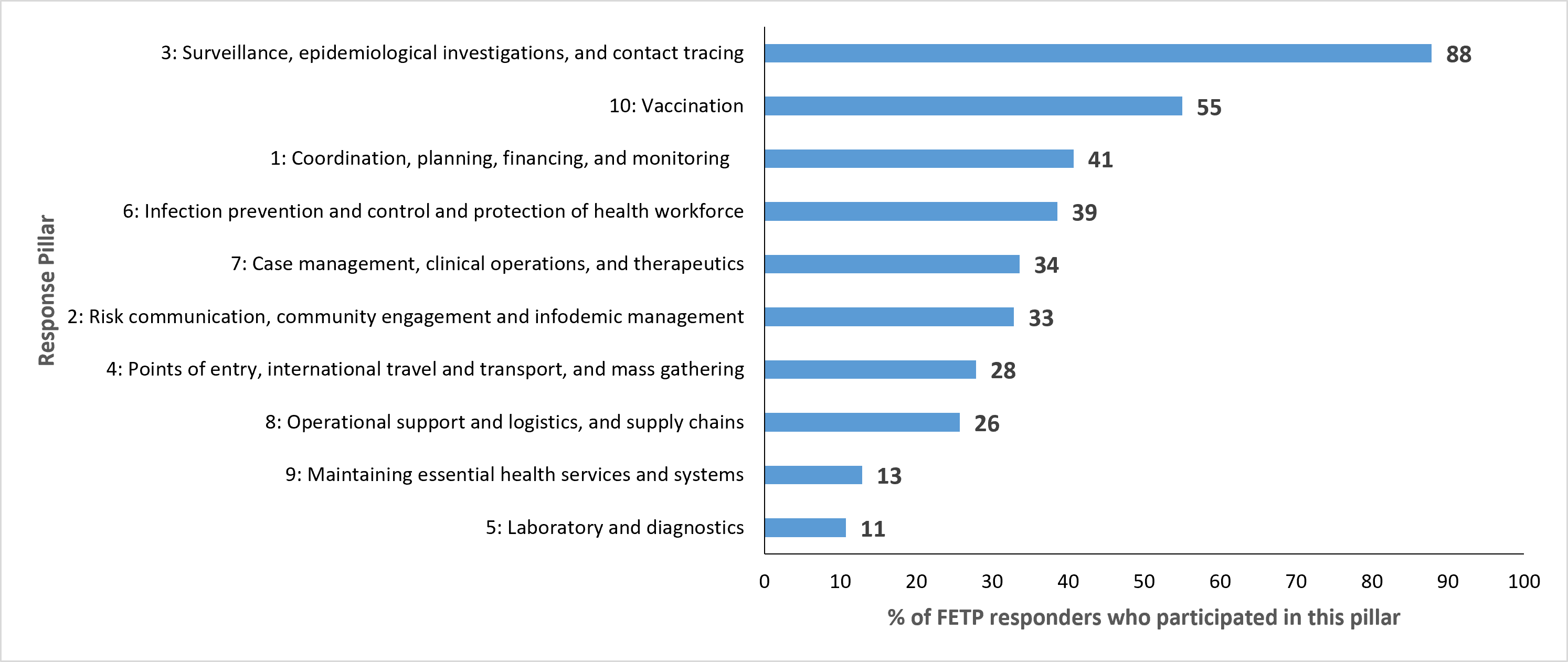
FETP responders participated in activities related to all pillars of the Guinean COVID-19 response. One hundred and twenty-three (88%) participated in Pillar 3 activities (surveillance, epidemiological investigations, and contact tracing); 77 (55%) in Pillar 10 activities (vaccination); and 57 (41%) in Pillar 1 activities (coordination, planning, finance, and monitoring) (Figure 1).
Contribution by pillar
One hundred and twenty-three (88%) of the 140 FETP responders participated in surveillance, epidemiological investigation, contact tracing, and adjustment of public health and social measures activities (Pillar 3); 102 (83%) participated in case investigations, and 61 (50%) in cluster investigations. Eighty-one (66%) of those who participated in this pillar entered cases into the District Health Information Software-2 (DHIS2), and 80 (65%) performed contact tracing. Seventy-five (61%) contributed to the elaboration of daily situation reports (SitReps). Twenty-five (20%) were involved in developing technical epidemiological surveillance documents (Figure 2).
Seventy-seven (55%) of the 140 FETP responders contributed to vaccination activities (Pillar 10). All were involved in the deployment and supervision of vaccination teams, including 75 (97%) in training vaccination staff and 63 (82%) in the development of vaccination micro-plans.
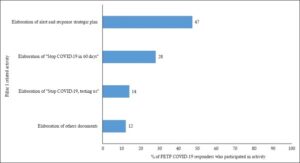
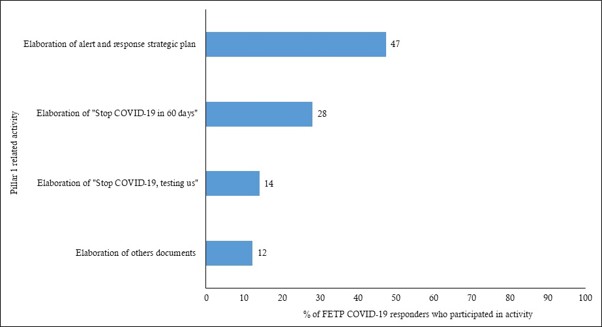
Fifty-seven (41%) of the 140 FETP responders participated in the coordination, planning, financing, and monitoring activities (Pillar 1). All activities revolved around the elaboration of documents, mostly response plans. Twenty-seven (47%) of these 57 responders participated in the development of the overall national strategic plan [7] and 16 (28%) in the development of a campaign plan called “Stop COVID-19 in 60 days” [8] (Figure 3).
A total of 54 (39%) of the 140 FETP responders were involved in infection prevention and control (IPC) activities (Pillar 6). Of these, seven (13%) were involved in the development of IPC strategic documents. Forty-seven (34%) FETP responders participated in case management, clinical operations, and therapeutics activities (Pillar 7), of whom 18 (38%) participated in meetings of the case management commission and eight (17%) in the development of COVID-19 case management strategic documents. Of the 140 responders, 46 (33%) participated in risk communication, community engagement, and infodemic management activities (Pillar 2).
Thirty-nine (28%) responders participated in activities related to points of entry, international travel and transport, and mass gathering activities (Pillar 4). Of these, 37 (95%) trained airport agents on the detection of COVID-19 cases and 21 (54%) trained them in the registration of COVID-19 cases in DHIS2. Eight (21%) were involved in developing technical documents for border surveillance.
Thirty-six (26%) of the 140 respondents were involved in the operational support, logistics, and supply chain activities (Pillar 8). All 36 participated in the review of the supply chain management and control system for medical and other supplies under logistics; 28 (79%) participated in logistics coordination, and 27 (75%) in strengthening staff capacity and deployment mechanisms.
Eighteen (13%) of the 140 responders were involved in the maintenance of essential health services and systems activities (Pillar 9). All 18 participated in setting up governance and coordination mechanisms to develop the response protocols to COVID-19, and 17 (94%) were involved in optimising parameters and service delivery platforms.
Fifteen (11%) of the 140 responders participated in the laboratories and diagnostics activities (Pillar 5). All 15 participated in the development of guidance documents for the collection and transport of diagnostic samples to the laboratory, and 10 (67%) contributed to the development of surge plans to manage the increased demand for laboratory tests.
FETP trainees and graduates were involved in all aspects of Guinea’s COVID-19 response and activities from the response pillars. They participated predominantly in Pillar 3 (surveillance, epidemiological investigations, and contact tracing); Pillar 10 (vaccination); and Pillar 1 (coordination, planning, finance, and monitoring). These findings are similar to those of two other studies on the participation of FETP trainees in the COVID-19 response, except for Pillar 10; studies conducted before ours did not include vaccination as a pillar because vaccines were not available yet [6-9].
In Guinea, when FETP was implemented, the objective of the MoH was to strengthen public health systems by training public health workers in disease surveillance, emergency response, and outbreak investigations. The involvement of the FETP responders in activities related to these demonstrates that FETP is in alignment with this MoH objective.
For Pillar 3, FETP responders were primarily involved in case and outbreak investigation, including contact tracing, and in the management of data in DHIS2. Data collected during outbreak investigation and contact tracing were entered in real time in DHIS2, an open-source software [10]. In Guinea, DHIS2 was the platform used for routine data and became operational for surveillance data in 2017. During the same year, DHIS2 modules were added to the country’s FETP-Frontline and Intermediate tier curricula, resulting in FETPs playing a leading role in the institutionalization of DHIS2 as the only platform used by the government for the management of epidemiological data [11]. All data related to the COVID-19 response were available in this platform, facilitating the triangulation between surveillance, laboratory, and vaccination data.
The COVID-19 response provided the MoH an opportunity to demonstrate its capability to use its DHIS2 platform to manage complex data for public health decision-making in real time during an epidemic. DHIS2 data were displayed in decision-makers’ offices at the national, regional, and district levels, and regularly referred to for decision-making. The efficiency of FETP responders in DHIS2 data management was such that the MoH selected FETP graduates at the regional and district level to support health structure data managers and continue to improve data quality and decision-making after the end of the COVID-19 response. These selected graduates were further trained by the African Field Epidemiology Network (AFENET) and called DHIS2 “superusers.”
The standard CDC FETP-Frontline and Intermediate curriculum includes lessons related to Pillars 3 (surveillance, epidemiological investigations, and contact tracing), 5 (laboratories and diagnostics), 7 (case management, clinical operations, and therapeutics), and 10 (vaccination). In consideration of its experience with the Ebola response of 2014-2017, in 2017, Guinea added a border surveillance module developed by CDC to its FETP-Frontline and Intermediate curricula [12]. Participation of FETP responders in activities related to point of entry, international travel and transport, and mass gatherings (Pillar 4) during the COVID-19 response suggests that this module, similar to the DHIS2 module, was relevant and helpful in the local context and therefore should continue to be used in Guinea. However, areas in which FETP trainees and graduates participated but did not have FETP training included Pillars 1 and 2. Considering that 40% of responders participated in activities of coordination, planning, financing, and monitoring of the COVID-19 response (Pillar 1), and 32% of them participated in risk communication, community engagement, and infodemic management activities (Pillar 2), modules on these topics may also be useful to include or use before any deployment in outbreak investigation and response. Furthermore, in Guinea, many of the participants in FETP-Frontline who completed the tier as disease control and prevention officer or deputy officer were later promoted to the position of health district director. In this position, they are expected to contribute to Pillar 1 and Pillar 2 activities.
The participation of FETP trainees and graduates in pillar activities is not unique to Guinea. For example, surveys conducted in 2021 and 2022 with FETPs worldwide, including all three tiers of the program, confirmed that most FETP responders performed communication, management, and leadership activities in their COVID-19 response work [6, 9]. Nevertheless, these topics are only covered in the FETP-Advanced tier, a tier targeting decision-makers at the national level. In Guinea, as in many countries, less than 5% of FETP responders completed the Advanced tier of FETP, and most FETP responders are Frontline trainees and graduates. Therefore, they performed these tasks without having been formally trained by their FETP.
FETP does not aim to provide trainees of all tiers with expertise and experience in all activities included in the 10 COVID-19 response pillars. Integrating material on all pillars into the core FETP training would be impractical, defeat the overall purpose of FETP to provide an experience-based program specialised in field epidemiology, and extend the in-class training time for fellows beyond the allotted time for FETPs (25% or less of the program time). Nevertheless, considering the increased risk of pandemics in today’s interconnected world and the central role FETP responders played in COVID-19 responses globally in many activities of the 10 pillars that are not included in the standard FETP curriculum [5, 6], modules targeting competencies to complete these activities could be developed for FETP alumni, or concerted efforts could be made to inform FETP alumni of related trainings offered by CDC or organizations outside of CDC. These trainings could be used to provide just-in-time training during epidemics.
Considering that a large proportion of FETP responders were involved in Pillar 1 and Pillar 2 activities during the COVID-19 response, these pillars could be the first to be targeted for the development of additional modules or the identification of existing ones. It is also likely that, as in Guinea with the border health and DHIS2 modules, many countries have developed additional modules related to these pillars that have been integrated into their FETP tiers. Facilitating the evaluation and sharing of these modules should be considered.
A limitation of our study is that focal points established in the eight regions were instructed to clarify the meaning of questions not understood and provide technical assistance in the use of Epi-Info. We did not collect information from them and therefore do not know what questions were asked by respondents and how many people took advantage of this assistance. It is possible that their interaction with the respondents introduced a response bias. Nevertheless, this would not change the overall recommendations regarding alumni training or change the conclusion that FETP trainees and graduates participated extensively in the COVID-19 response in Guinea.
FETP trainees and graduates contributed to all response pillars during the COVID-19 epidemic in Guinea. They predominantly participated in coordination; planning and monitoring; epidemiological surveillance; and vaccination activities. Consideration should be given to developing modules for FETP alumni related to response pillars not covered by FETP.
What is already known about the topic
What this study adds
This project was supported in part by an appointment to the Research Participation Program at the U.S. Centers for Disease Control and Prevention administered by the Oak Ridge Institute for Science and Education through an interagency agreement between the U.S. Department of Energy and the U.S. Centers for Disease Control and Prevention.
| Table 1: COVID-19 Strategic Preparedness and Response Plan 10 Pillars | |
| Pillar | Pillar name |
|---|---|
| 1 | Coordination, planning, financing, and monitoring |
| 2 | Risk communication, community engagement, and infodemic management |
| 3 | Surveillance, epidemiological investigation, contact tracing, and adjustment of public health and social measures |
| 4 | Points of entry, international travel and transport, and mass gathering |
| 5 | Laboratories and diagnostics |
| 6 | Infection prevention and control, and protection of health workforce |
| 7 | Case management, clinical operations, and therapeutics |
| 8 | Operational support and logistics, and supply chains |
| 9 | Maintaining essential health services and systems |
| 10 | Vaccination |
| Table 2: Characteristics of FETP COVID-19 responders, Guinea, March 2021 | |
| Socio demographic characteristic | N (%) |
|---|---|
| Highest FETP level (n=121) | |
| Frontline | 104 (86) |
| Intermediate | 11 (9) |
| Advanced | 6 (5) |
| Education (n=137) | |
| High school | 29 (21) |
| University graduate | 73 (53) |
| Post-graduate | 35 (26) |
| Profession (n=121) | |
| Nurse assistant | 8 (7) |
| Nurse | 25 (20) |
| Doctor | 82 (68) |
| Veterinary | 4 (3) |
| Laboratory | 2 (2) |
| Sector of work (n=140) | |
| Public | 134 (96) |
| Private | 6 (4) |
| Organization of work (n=131) | |
| Ministry of health | 122 (93) |
| Ministry of livestock | 4 (3) |
| Other sector | 5 (4) |
| Level of health pyramid (n=140) | |
| Sub-district | 25 (18) |
| District | 83 (59) |
| Region | 18 (13) |
| National | 14 (10) |
| Current title of work (n=115) | |
| Disease control and prevention officer | 41 (29) |
| Disease control and prevention deputy officer | 30 (21) |
| Data manager | 14 (10) |
| Head of facility | 15 (11) |
| Planning and training lead | 9 (6) |
| Livestock agent | 4 (3) |
| Laboratory agent | 2 (1) |
| Others* | 25 (18) |