
Research | Open Access | Volume 9 (3): Article 119 | Published: 21 Jul 2026

Views: 829
Menu, Tables and Figures
| Variable | Frequency (n) | Percentage (n/N, %) |
|---|---|---|
| Age (years) | ||
| ≤ 35 | 52 | 10.8 |
| 36–44 | 93 | 19.2 |
| ≥ 45 | 335 | 70.0 |
| Mean age (SD) | 50.3 (± 13.9) | |
| Education | ||
| Never attended school | 25 | 5.2 |
| Primary School | 426 | 88.0 |
| Tertiary education | 33 | 6.8 |
| District | ||
| Kigamboni | 32 | 6.6 |
| Kinondoni | 42 | 8.7 |
| Temeke | 173 | 35.7 |
| Ilala | 218 | 45.0 |
| Ubungo | 19 | 3.9 |
| Occupation | ||
| Blue collar job | 445 | 91.9 |
| White collar job | 39 | 8.1 |
| Marital status | ||
| Single | 125 | 25.8 |
| Married | 359 | 74.2 |
| Diabetes status per blood sugar levels (mmol/L) © | ||
| Diabetic (>7) | 39 | 8.1 |
| Pre-diabetic (5.6–6.9) | 136 | 28.1 |
| Non-diabetic (<5.6) | 309 | 63.8 |
| Median blood sugar (IQR) | 5.2 (4.8–5.9) | |
| BMI (Kg/m²) | ||
| Underweight (<18.5) | 15 | 3.1 |
| Normal (18.5–24.9) | 257 | 53.1 |
| Overweight (25.0–29.9) | 137 | 28.3 |
| Obesity (≥30) | 75 | 15.5 |
| Median (IQR) | 24.2 (21.8–27.3) | |
| Use of Ivermectin and Albendazole | ||
| Yes | 115 | 23.8 |
| No | 369 | 76.2 |
Note: BMI = Body Mass Index; SD = Standard Deviation. Occupation: “White collar job” = professional, administrative, or managerial roles; “Blue collar job” = manual labor roles involving physical tasks. © Fasting Blood Sugar (mmol/L).
Table 1: Social and demographic characteristics of patients with hydrocele in Dar es Salaam, 2022 (N=484)
| Variable | With hypertension n (%) | Without hypertension n (%) | Chi-Square P-Value |
|---|---|---|---|
| Age (years) | <0.001 | ||
| ≤ 35 | 9 (17.3) | 43 (82.7) | |
| 36–44 | 29 (31.2) | 64 (68.8) | |
| ≥ 45 | 173 (51.0) | 166 (49.0) | |
| Education | 0.075 | ||
| Never attended school | 14 (56.0) | 11 (44.0) | |
| Primary School | 188 (44.1) | 238 (55.9) | |
| Tertiary education | 9 (27.3) | 24 (72.7) | |
| Occupation | 0.500 | ||
| Blue collar job | 196 (44.0) | 249 (56.0) | |
| White collar job | 15 (38.5) | 24 (61.5) | |
| Marital status | 0.002 | ||
| Married | 171 (47.6) | 188 (52.4) | |
| Single | 40 (32.0) | 85 (68.0) | |
| Diabetes status per blood sugar levels (mmol/L) | 0.002 | ||
| Diabetic (>7) | 27 (69.2) | 12 (30.8) | |
| Pre-diabetic (5.6–6.9) | 62 (45.6) | 74 (54.4) | |
| Non-diabetic (<5.6) | 122 (39.5) | 187 (60.5) | |
| BMI (Kg/m²) | 0.005 | ||
| Underweight (<18.5) | 04 (26.7) | 11 (73.3) | |
| Normal (18.5–24.9) | 97 (37.7) | 160 (62.3) | |
| Overweight (25.0–29.9) | 67 (48.9) | 70 (51.1) | |
| Obesity (≥ 30) | 43 (57.3) | 32 (42.7) | |
| Use of Ivermectin and Albendazole | 0.537 | ||
| Yes | 53 (46.1) | 62 (53.9) | |
| No | 158 (42.8) | 211 (57.2) |
Table 2: Association of hypertension and its risk factors among patients with hydrocele in Dar es Salaam, 2022 (N=484)
| Variable | Hypertension n (%) | Crude PR (95% CI) | P | Adjusted PR (95% CI) | P |
|---|---|---|---|---|---|
| Age (years) | |||||
| ≤ 35 | 9 (17.3) | Ref | Ref | ||
| 36–44 | 29 (31.2) | 1.80 (0.92–3.51) | 0.084 | 1.66 (0.85–3.23) | 0.135 |
| ≥ 45 | 173 (51.0) | 2.95 (1.61–5.39) | <0.001 | 2.50 (1.35–4.64) | 0.004 |
| Education | |||||
| Never attended school | 14 (56.0) | Ref | Ref | ||
| Primary School | 188 (44.1) | 0.79 (0.55–1.13) | 0.200 | 0.80 (0.56–1.14) | 0.214 |
| Tertiary education | 9 (27.3) | 0.49 (0.25–0.94) | 0.032 | 0.60 (0.32–1.13) | 0.115 |
| Occupation | |||||
| Blue collar job | 196 (44.0) | Ref | Ref | ||
| White collar job | 15 (38.5) | 0.87 (0.58–1.32) | 0.518 | 0.85 (0.60–1.22) | 0.387 |
| Marital status | |||||
| Married | 171 (47.6) | Ref | Ref | ||
| Single | 40 (32.0) | 0.67 (0.51–0.89) | 0.005 | 0.78 (0.60–1.02) | 0.074 |
| Diabetes status per blood sugar levels (mmol/L) | |||||
| Non-diabetic (<5.6) | 122 (39.5) | Ref | Ref | ||
| Pre-diabetic (5.6–6.9) | 62 (45.6) | 1.15 (0.92–1.45) | 0.220 | 1.09 (0.87–1.37) | 0.430 |
| Diabetic (>7) | 27 (69.2) | 1.75 (1.36–2.25) | <0.001 | 1.52 (1.17–2.00) | 0.002 |
| BMI (Kg/m²) | |||||
| Normal (18.5–24.9) | 97 (37.7) | Ref | Ref | ||
| Underweight (<18.5) | 04 (26.7) | 0.71 (0.30–1.66) | 0.426 | 1.18 (0.61–2.28) | 0.629 |
| Overweight (25.0–29.9) | 67 (48.9) | 1.30 (1.03–1.63) | 0.029 | 1.25 (1.00–1.57) | 0.053 |
| Obesity (≥30) | 43 (57.3) | 1.52 (1.18–1.95) | 0.001 | 1.36 (1.05–1.75) | 0.002 |
| Use of Ivermectin and Albendazole | |||||
| No | 158 (42.8) | Ref | Ref | ||
| Yes | 53 (46.1) | 1.08 (0.85–1.36) | 0.531 | 1.08 (0.87–1.35) | 0.459 |
| Duration of living with hydrocele (Years) | 1.01 (1.00–1.02) | 0.299 | 1.00 (0.99–1.01) | 0.408 |
Note: PR = Prevalence Ratio; CI = Confidence Interval; Ref = Reference category. Bolded adjusted PRs indicate statistically significant associations (P<0.05).
Table 3: Factors associated with hypertension among patients with hydrocele in Dar es Salaam Region, 2022 (N=484)
Sephord Saul Ntibabara1,2,&, Khadija Yahaya Malima3, Evelyne Ngoli1,2, Godbless Henry Mfuru1,2, Farida Ollomi4, Roza Ernest2, Ibrahimu Makongwa5, Dorica Burengelo6, Stephen Mbwambo4, Nsiande Lema2, Clarer Jones4, Omary Ubuguyu7, Faraja Lyamuya4
1Department of Epidemiology and Biostatistics, Muhimbili University of Health and Allied Sciences, P. O. Box 65001, Dar es Salaam, Tanzania, 2Tanzania Field Epidemiology and Laboratory Training Program (TFELTP), Ministry of Health, P.O. Box 743, Dodoma, 3Department of Nursing Management, Muhimbili University of Health and Allied Sciences, P.O. Box 65001, Dar es Salaam, Tanzania, 4Neglected Tropical Diseases Control Program (NTDCP), Ministry of Health, P.O. Box 743, Dodoma, 5Research and Training Committee, Amana Regional Referral Hospital, P.O. Box 25411, Ilala, Dar es Salaam, 6Research Triangle Institute (RTI International), P.O. Box 369, Dar es Salaam, Tanzania, 7Non-communicable diseases section, Ministry of Health, Ministry of Health, P.O. Box 743, Dodoma.
&Corresponding author: Sephord Saul Ntibabara, P.O.Box 65001, Dar es Salaam, Tanzania. Email: sephordsaul@gmail.com, ORCID: https://orcid.org/0009-0001-4487-512X
Received: 22 Jun 2025, Accepted: 09 Jul 2026, Published: 21 Jul 2026
Domain: Non-Communicable Disease Epidemiology
Keywords: Hypertension, Hydrocele, Lymphatic Filariasis, integrated approach, management
©Sephord Saul Ntibabara et al. Journal of Interventional Epidemiology and Public Health (ISSN: 2664-2824). This is an Open Access article distributed under the terms of the Creative Commons Attribution International 4.0 License (https://creativecommons.org/licenses/by/4.0/), which permits unrestricted use, distribution, and reproduction in any medium, provided the original work is properly cited.
Cite this article: Sephord Saul Ntibabara et al. Prevalence and risk factors of hypertension among patients with hydrocele in Dar es Salaam, Tanzania, 2022. Journal of Interventional Epidemiology and Public Health. 2026; 9(3):119. https://doi.org/10.37432/jieph-d-25-00146
Introduction: Hypertension is one of the leading causes of premature death worldwide. The last national survey reveals that in Tanzania, about 26% of all young adults aged 25-64 were estimated to have hypertension in 2013. Patients with Lymphatic Filariasis (LF) who develop hydrocele may be at high risk of developing hypertension due to their physically inactive lifestyle. Magnitude and factors associated with hypertension among hydrocele patients have not been determined. The study was done to determine the prevalence of hypertension and its associated factors among individuals with hydrocele due to LF in the Dar es Salaam region.
Methods: A cross-sectional analysis of secondary data was conducted among patients with lymphatic filariasis–related hydrocele undergoing pre-surgical screening. Hypertension was defined as systolic blood pressure (BP) ≥ 140 mmHg and/or diastolic BP ≥90 mmHg. A chi-square test was performed to determine the significance of differences in hypertension across variables. A modified multivariate Poisson regression analysis was performed to determine the association between variables while adjusting for confounders. P-value ≤0.05 at 95% CI was statistically considered significant.
Results: Among 484 patients with Lymphatic Filariasis hydrocele analysed, the prevalence of hypertension among the patients was 43.4% (n=211, 95%CI 39.2-48.1). Patients aged 45 years had a higher risk [Adjusted Prevalence Ratio (APR) 2.5, 95%CI: 1.35 – 4.64] of developing hypertension. Being diabetic (>7mmol/L) had a 52% (APR=1.52, 95% CI: 1.17-2.00) higher prevalence of hypertension. Obese patients had a 36% higher risk (APR =1.36, 95% CI: 1.05-1.75) of developing hypertension as compared to those with a normal body mass index. Other factors, including education, occupation, marital status, ivermectin/albendazole use, and duration of hydrocele, were not statistically significant after adjustment.
Conclusion: The findings highlight a potential link between hydrocele due to lymphatic filariasis and hypertension, with its elevated risk. Integrating non-communicable disease management, particularly hypertension screening and care, into existing lymphatic filariasis programs could enhance patient outcomes. The LF elimination program is encouraged to consider such integrated approaches in affected regions.
Lymphatic filariasis (LF) is among the neglected tropical diseases in Sub Saharan Africa affecting poor communities [1–3]. In Tanzania, it is most prevalent in coastal regions, where a 5.8% prevalence has been reported [4]. Individuals with LF can live with the disease for about 6-8 years, during which most of them develop hydrocele [4]. This wide duration exposes them to a long inactive lifestyle, which exposes them to the risk of hypertension and other non-communicable diseases. The few available studies have revealed lymphatic hypertension due to obstruction of the lymphatic system [5].
Globally, about 1.28 billion individuals aged between 30 and 79 are estimated to have hypertension [6]. The burden of the disease is rapidly increasing in Africa, with the prevalence reaching 27.9% in 2019 [7]. This is attributed to changes in lifestyle with increasing practices of risky behaviours such as high alcohol intake and cigarette smoking. In low-income countries in 2019, alcohol consumption was reported to be higher (45.4%) compared to high-income countries (38.7%) [7].
The only national hypertension survey done in 2012 revealed that 26% of Tanzanians aged between 25 and 64 years of age have hypertension [8,9]. The same survey reported that 32.4% of the Tanzanian population does not engage in vigorous activity [8]. In 2020, in Tanzania, 4 million Tanzanians were reported to have hypertension, of whom 82.4% were not screened, and only 0.1 million individuals were on management strategies [10]. The burden of disease was believed to be high among the rich and also among those who live in urban areas; however, the pattern of disease has currently changed with the increasing burden in rural areas. Studies have revealed a 48.3% prevalence of hypertension in rural areas in Tanzania, showing the shift over a short period [11].
There is an increasing risk of hypertension among individuals with comorbidities such as Human Immuno-Deficiency Virus (HIV) and diabetes [12,13]. In Tanzania, a study reported that about 6.9% of individuals with diabetes mellitus had hypertension comorbidities [14]. Up-to-date studies that explain the association between hypertension and LF are very limited.
We therefore examined the prevalence of hypertension and associated factors among patients with hydrocele residing in Dar es Salaam, Tanzania. The findings may inform integration of hypertension screening and non-communicable disease care into lymphatic filariasis morbidity management services.
Study design and data collection
This study was a secondary analysis of data obtained from a cross-sectional survey conducted among patients with lymphatic filariasis-related hydrocele in Dar es Salaam, Tanzania. The original survey collected data from patients presenting for hydrocelectomy during a hydrocele surgery campaign. Prior to surgery, eligible patients were screened, provided written informed consent, and completed a pre-tested, structured questionnaire administered by trained healthcare workers. The anonymized dataset from the parent survey was subsequently used for the present analysis.
The dataset included socio-demographic characteristics (age, occupation, residence, education, and marital status), clinical characteristics (duration of living with hydrocele, diabetes status, and history of ivermectin and albendazole use), anthropometric measurements (height and weight), and blood pressure measurements. During the original survey, blood pressure was measured using calibrated digital blood pressure monitors, while height and weight were measured using WHO-certified weighing scales and stadiometers available at the participating health facilities, following the standardized data collection protocol.
For the present study, hypertension was defined as a systolic blood pressure ≥140 mmHg and/or a diastolic blood pressure ≥90 mmHg, in accordance with the Tanzania Standard Treatment Guidelines [15]. Body mass index (BMI) was calculated from the recorded height and weight measurements and categorized according to the WHO adult classification as underweight (<18.5 kg/m²), normal weight (18.5–24.9 kg/m²), overweight (25.0–29.9 kg/m²), and obese (≥30.0 kg/m²) [16]. Occupation was categorized as blue-collar or white-collar using established definitions [17]. Financial hardship was defined based on the parent survey records indicating that participants were unable to afford treatment for hydrocele before the surgery campaign. Hydrocele was analyzed as a single clinical entity irrespective of laterality (unilateral or bilateral), as this information was not disaggregated in the parent dataset.
Study setting
Dar es Salaam region is located in the eastern part of Tanzania along the Indian Ocean and covers an area of 1,393km2. The region is bordered by the Pwani region on all sides, except to the east, where it is borders the Indian Ocean. Dar es Salaam is a densely populated commercial city, with several areas comprising informal settlements marked by substandard living conditions and inadequate access to healthcare services. According to the 2022 census, the Dar es Salaam region has a population of 5 million people [18].
Study population
This secondary analysis used data from a cross-sectional survey conducted among patients with lymphatic filariasis (LF)-related hydrocele who were identified during community-based Transmission Assessment Surveys (TAS) conducted in Dar es Salaam and Pwani regions between 2021 and 2022. The parent survey enrolled patients with hydrocele who had clinical indications for hydrocelectomy and were scheduled to receive surgery during the hydrocele surgery campaign. The present analysis was restricted to participants residing in Dar es Salaam.
Sample size and sampling procedure
The present study utilized an existing dataset generated from the pre-surgical procedure assessment. All participants residing in Dar es Salaam with complete data on the study outcome and key explanatory variables were eligible for inclusion. Of the available records, 484 participants met the inclusion criteria and were included in the analysis. Records from participants residing outside Dar es Salaam or with missing data on variables required for the analysis were excluded.
Data collection procedures in the parent survey
During the assessment, data were collected by trained research assistants who were nurses under the supervision of the principal investigator. The research assistants received standardized training on participant recruitment, informed consent procedures, questionnaire administration, anthropometric measurements, blood pressure measurement, and data quality assurance. Ethical principles, including participant privacy and confidentiality, were emphasized throughout the training.
Eligible participants provided written informed consent before data collection. Information was collected using a structured, pre-tested questionnaire administered before surgery. Blood pressure was measured using calibrated digital blood pressure monitors following the study protocol. Three blood pressure readings were obtained after the participant had rested appropriately, and the average of the two closest readings was recorded. Height and weight were measured using standardized WHO-certified equipment available at the participating health facilities according to the survey protocol.
Definition of key variables
The primary outcome was hypertension. In the present analysis, hypertension was defined as an average systolic blood pressure ≥140 mmHg and/or an average diastolic blood pressure ≥90 mmHg, based on the measurements recorded during the assessment and in accordance with the Tanzania Standard Treatment Guidelines [15].
Data cleaning and data analysis
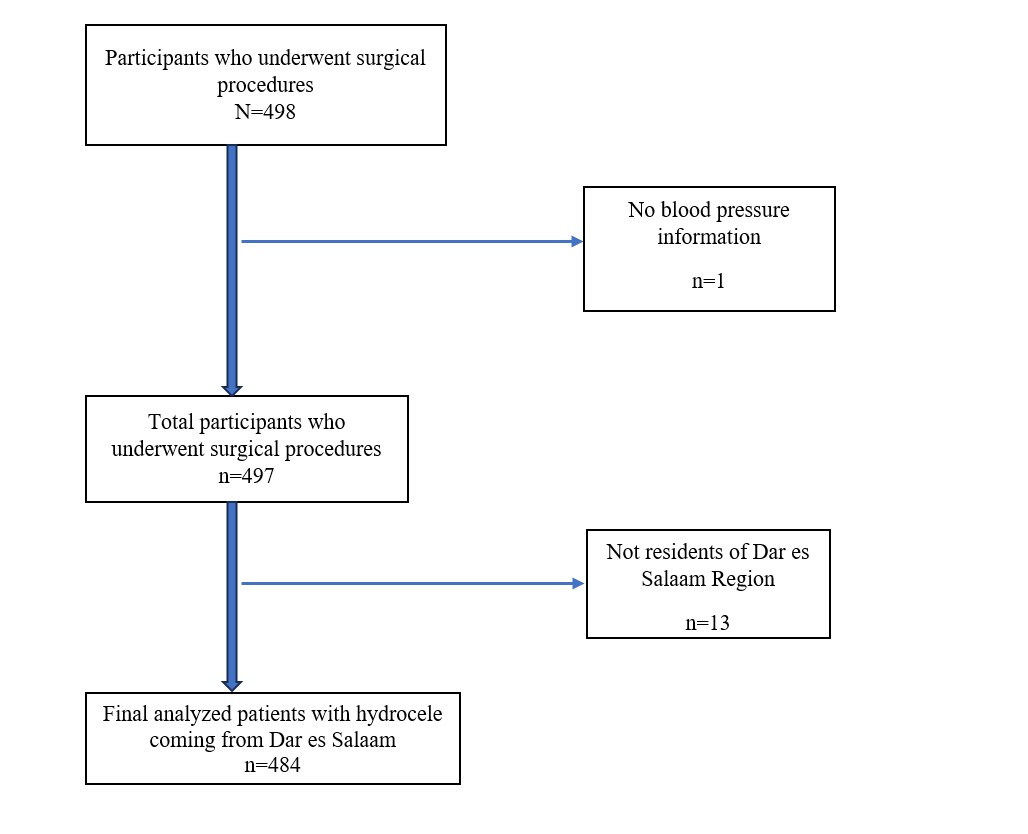
Data was cleaned using Microsoft Excel version 2013. About 498 patients’ data were obtained from the surgical registry dataset. Of them, 1 (0.2%) had no diastolic measurement and was removed. Of the 497, 13 (2.7%) were removed from the analysis because the participants were from other regions apart from the Dar es Salaam region (Figure 1).
Data analysis
Descriptive analysis was performed by computing frequency and proportions for categorical variables. A measure of central tendency for asymmetrically distributed continuous variables, median with interquartile range (IQR), whereas for normally distributed data, the mean and standard deviation were calculated. The chi-square test was used to compare the distribution of categorical variables according to hypertension status. Modified Poisson regression with robust standard errors was used to estimate prevalence ratios (PRs) for factors associated with hypertension. First, bivariable analyses were performed to examine the crude association between each independent variable and hypertension. Variables considered epidemiologically relevant based on prior evidence, biological plausibility, and data availability in the parent dataset (age, education, occupation, marital status, residence, body mass index, diabetes status, duration of hydrocele, and history of ivermectin/albendazole use) were subsequently included in the multivariable model irrespective of their statistical significance in the bivariable analysis. Because the number of candidate explanatory variables was limited relative to the sample size, all were retained in the final model to ensure adequate adjustment for potential confounding. Crude and adjusted prevalence ratios with their corresponding 95% confidence intervals (CI) were presented. A significance level was set at p-value < 0.05.
Ethical Considerations
From the assessment documents, written informed consent was obtained from all participants prior to data collection, including consent for anonymized publication of study findings. Only de-identified data were accessed and analyzed. Ethical approval was waived by the Ministry of Health’s Ethics Review Committee under the National Institute for Medical Research, as the study utilized routine program data collected during a morbidity management campaign for neglected tropical diseases. The study was conducted in accordance with the principles of the revised Declaration of Helsinki for research involving human subjects. Administrative approval to conduct the study was obtained from the National Neglected Tropical Diseases Control Program (NTDCP). All authors reviewed and approved the final manuscript for publication.
Social demographic characteristics of the study participants
A total of 484 patients with Lymphatic Filariasis Hydrocele were analysed. The mean age (SD) was 50.3(+13.9) years, and 335 patients (70.0%) were 45 years. Of all the patients, 426 (88.0%) had primary education. Of all patients, 445 (91.9%) were of blue-collar jobs. Among all the patients, about three-quarters 359, 74.2%) were married. The median fasting blood sugar level in mmol/L(IQR) was 5.2, ranging between 4.8 and 5.9. Only 39 (8.1%) were found to be diabetic. The median Body Mass Index (IQR) was 24.2 (21.8-27.3). Majority of patients (369; 76.2%) never participated in MDA and never took ivermectin and albendazole medication in their lifetime (Table 1)
Distribution of Hypertension Prevalence among patients with hydrocele in Dar es Salaam
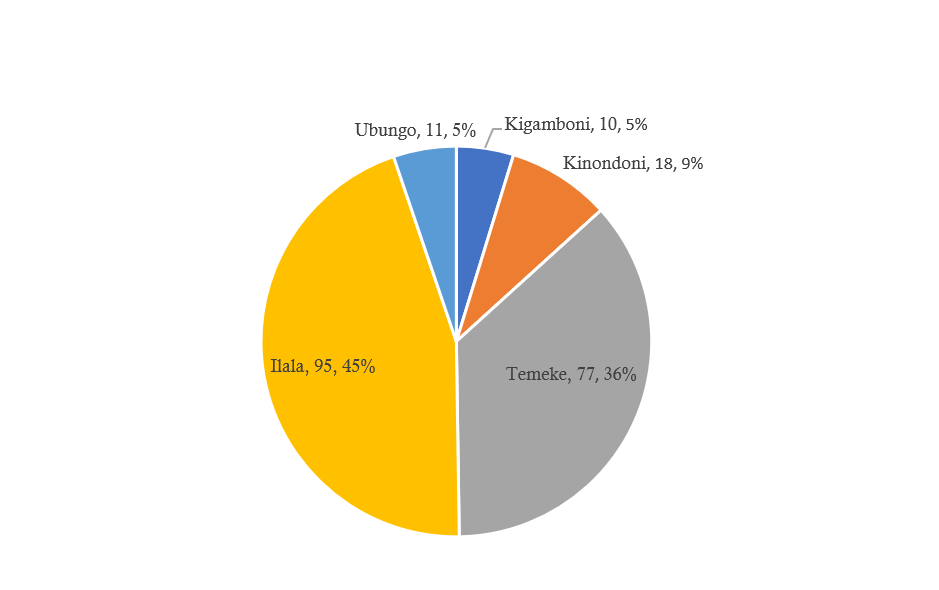
Among 484 patients with hydrocele analysed, the prevalence of hypertension in Dar es Salaam was 43.4% (n=211, 95% CI 39.2-48.1). Among the five districts of Dar es Salaam, Ilala District accounted for 95 patients with hypertension (45.0%; 95% CI: 40.6%–49.5%) (Figure 1). In Dar es Salaam, the prevalence of hypertension increased with age, from 17.3% (9/52) among participants aged ≤35 years to 31.2% (29/93) among those aged 36–44 years, and 51.0% (173/339) among those aged 45 years. Hypertension was more prevalent among participants with no formal education (56.0%, 14/25) compared to those with primary (44.1%, 188/426) and tertiary education (27.3%, 9/33). By occupation, 44.0% (196/445) of blue-collar workers and 38.5% (15/39) of white-collar workers had hypertension. Married participants had a higher prevalence of hypertension (47.6%, 171/359) compared to single participants (32.0%, 40/125). Additionally, hypertension was more common among diabetic individuals (69.2%, 27/39) and those with obesity (57.3%, 43/75), compared to non-diabetic (39.5%, 122/309) and normal BMI participants (37.7%, 97/257) (Table 2).
Factors associated with hypertension among patients with hydrocele in Dar es Salaam in 2022
Patients aged ≥ 45 years had 2.5 times the prevalence of hypertension compared with patients aged ≤35 years (APR=2.50; 95% CI: 1.35–4.64). Patients with obesity had 36% higher prevalence of hypertension (APR 1.36, 95% CI: 1.05-1.75) compared with those who had a normal BMI. Patients with diabetes (>7mmol/L) had 52% higher prevalence of hypertension (APR=1.52, 95% CI: 1.17-2.00), compared with those with normal blood sugar levels. Other factors, including education, occupation, marital status, ivermectin/albendazole use, and duration of hydrocele, were not statistically significant after adjustment (Table 3).
A high prevalence of hypertension was observed among patients with hydrocele (43.4%), with prevalence increasing markedly with age. Age ≥45 years, diabetes, and obesity were independently associated with hypertension. These findings suggest a clustering of metabolic risk factors within this population, potentially exacerbated by reduced physical activity and chronic morbidity associated with lymphatic filariasis [19].
The observed prevalence of hypertension among patients with hydrocele was higher than that reported in community-based populations, including pastoralists [9] and individuals without comorbidities [20,21] but lower than estimates from hospital-based studies in Tanzania [22,23]. These differences may reflect variations in study populations and underlying risk profiles. In particular, hospital-based studies are more likely to overestimate prevalence due to selection bias, as they include individuals seeking care who may have a higher burden of comorbid conditions, including non-communicable diseases [24,25].
In contrast, community-based studies may underestimate prevalence due to inclusion of healthier individuals [26]. The intermediate prevalence observed in this study likely reflects the unique clinical profile of patients with hydrocele, who may not be acutely ill but experience chronic morbidity.
On risk factors, our study revealed that ≥ 45 years of age was associated with a higher prevalence of hypertension. This is similar to other studies done, which showed the age of above 30 years to be associated with hypertension [6,11,25]. This underscores the importance of routine hypertension screening in older LF patients, especially those with additional risk factors such as obesity.
During the study, it was found that using ivermectin and albendazole, which are the key preventive chemotherapy, was not associated with hypertension. Although Ivermectin has demonstrated neuroprotective effects in several studies, its potential role in causing hypertension remains only partially investigated [27]. The observation is similar to another study which was done in Tanga region, which showed that hypertension was not among the adverse effects of the drugs [28].
Diabetes was also independently associated with hypertension in this study. This is biologically plausible, as diabetes mellitus contributes to endothelial dysfunction, increased arterial stiffness, and activation of the renin–angiotensin–aldosterone system, all of which elevate blood pressure [29–31]. The coexistence of diabetes and hypertension in this population underscores the growing burden of non-communicable diseases and the need for integrated management approaches.
From our analysis, it was observed that obesity was associated with hypertension; this was also reported in hospital based studies done in Dodoma and Morogoro, Tanzania[6,32]. Excess adiposity contributes to hypertension through multiple mechanisms, including increased sympathetic nervous system activity, insulin resistance, and altered sodium handling [33–35]. However, another study done in northern Tanzania revealed that obesity was not associated with hypertension [26]. However, contrasting findings from other studies [33] may be explained by differences in study populations, measurement approaches, and residual confounding. In the present study, the focus on patients with hydrocele, characterised by reduced mobility and chronic inflammation, may have amplified the observed association between obesity and hypertension.
Moreover, the study did not assess other known risk factors for hypertension, such as alcohol use as revealed to be a significant hypertension risk factor [26] for they were not collected. Surgical morbidity management has been documented to provide permanent relief for patients with hydrocele. However, in Tanzania, misconceptions have been reported as a significant barrier limiting access to care among affected individuals [36].
Strengths and Limitations
This study identified a distinct pattern of hypertension among patients with hydrocele, providing novel evidence from a population that has received limited research attention. By examining the intersection between an infectious disease-related condition and a non-communicable disease, the study contributes to the growing body of evidence supporting integrated approaches to disease prevention and management. Furthermore, the findings provide important baseline data that can inform the design and implementation of integrated healthcare interventions and guide future research in similar settings. However, the cross-sectional design of the study limits the ability to establish temporal or causal relationships between the identified factors and hypertension in patients with hydrocele.
Hypertension is highly prevalent among patients with hydrocele in Dar es Salaam, indicating a substantial co-morbidity burden within this population. Hypertension was more common among older individuals and those with obesity and diabetes, highlighting the importance of metabolic risk factors in this group. These findings suggest that patients receiving hydrocele care represent an important high-risk group requiring integrated hypertension screening and referral, in addition to surgical management. Addressing hypertension within this population may help reduce long-term cardiovascular complications.
Recommendations
The Ministry of Health Tanzania, should integrate routine hypertension screening and management into hydrocele care and lymphatic filariasis programs. Regional and district health management teams should strengthen capacity for early detection and management of non-communicable diseases at primary healthcare level. Targeted health education campaigns should be implemented to address modifiable risk factors, particularly obesity and diabetes, among affected populations. Additionally, the National Neglected Tropical Diseases (NTDs) program manager should incorporate NCD surveillance into existing neglected tropical disease platforms to support continuous monitoring and policy planning.
What is already known about the topic
What this study adds
The authors acknowledge the Tanzania Neglected Tropical Disease Program (NTDCP) for approving the use of program data for this analysis. We also thank USAID, Research Triangle Institute (RTI), for supporting the hydrocele surgery camps and related lymphatic filariasis elimination activities. We are grateful to supervisors from the National Neglected Tropical Diseases Control Program and the Tanzania Field Epidemiology and Laboratory Training Program for their technical support.
Sephord Saul Ntibabara contributed to conceptualization, data curation, formal analysis, investigation, methodology, software, validation, visualization, writing of the original draft, and review and editing of the manuscript. Khadija Yahaya Malima contributed to validation, visualization, and manuscript review and editing. Evelyne B. Ngoli contributed to conceptualization, data curation, formal analysis, methodology, resources, validation, visualization, and writing of the original draft. Godbless Mfuru contributed to conceptualization, data curation, formal analysis, methodology, writing of the original draft, and review and editing. Ibrahimu Makongwa contributed to conceptualization, validation, visualization, writing of the original draft, and review and editing. Farida Ollomyi contributed to conceptualization, data curation, formal analysis, methodology, and manuscript review and editing. Roza Ernest contributed to conceptualization, data curation, formal analysis, methodology, and manuscript review and editing. Dorica Burengelo contributed to project administration, validation, and manuscript review and editing. Jonathan Stephen Mbwambo contributed to conceptualization, formal analysis, investigation, methodology, project administration, supervision, and manuscript review and editing. Nsiande Lema contributed to conceptualization, project administration, supervision, validation, and manuscript review and editing. Clarer Jones contributed to project administration, supervision, visualization, and manuscript review and editing. Omary Ubuguyu contributed to supervision, validation, visualization, and manuscript review and editing. Faraja Lyamuya contributed to conceptualization, project administration, supervision, validation, and manuscript review and editing.
Data availability statement
The datasets generated and analyzed during the current study are available from the corresponding author on reasonable request. All data were anonymized to ensure participant confidentiality.
| Variable | Frequency (n) | Percentage (n/N, %) |
|---|---|---|
| Age (years) | ||
| ≤ 35 | 52 | 10.8 |
| 36–44 | 93 | 19.2 |
| ≥ 45 | 335 | 70.0 |
| Mean age (SD) | 50.3 (± 13.9) | |
| Education | ||
| Never attended school | 25 | 5.2 |
| Primary School | 426 | 88.0 |
| Tertiary education | 33 | 6.8 |
| District | ||
| Kigamboni | 32 | 6.6 |
| Kinondoni | 42 | 8.7 |
| Temeke | 173 | 35.7 |
| Ilala | 218 | 45.0 |
| Ubungo | 19 | 3.9 |
| Occupation | ||
| Blue collar job | 445 | 91.9 |
| White collar job | 39 | 8.1 |
| Marital status | ||
| Single | 125 | 25.8 |
| Married | 359 | 74.2 |
| Diabetes status per blood sugar levels (mmol/L) © | ||
| Diabetic (>7) | 39 | 8.1 |
| Pre-diabetic (5.6–6.9) | 136 | 28.1 |
| Non-diabetic (<5.6) | 309 | 63.8 |
| Median blood sugar (IQR) | 5.2 (4.8–5.9) | |
| BMI (Kg/m²) | ||
| Underweight (<18.5) | 15 | 3.1 |
| Normal (18.5–24.9) | 257 | 53.1 |
| Overweight (25.0–29.9) | 137 | 28.3 |
| Obesity (≥30) | 75 | 15.5 |
| Median (IQR) | 24.2 (21.8–27.3) | |
| Use of Ivermectin and Albendazole | ||
| Yes | 115 | 23.8 |
| No | 369 | 76.2 |
Note: BMI = Body Mass Index; SD = Standard Deviation. Occupation: “White collar job” = professional, administrative, or managerial roles; “Blue collar job” = manual labor roles involving physical tasks. © Fasting Blood Sugar (mmol/L).
| Variable | With hypertension n (%) | Without hypertension n (%) | Chi-Square P-Value |
|---|---|---|---|
| Age (years) | <0.001 | ||
| ≤ 35 | 9 (17.3) | 43 (82.7) | |
| 36–44 | 29 (31.2) | 64 (68.8) | |
| ≥ 45 | 173 (51.0) | 166 (49.0) | |
| Education | 0.075 | ||
| Never attended school | 14 (56.0) | 11 (44.0) | |
| Primary School | 188 (44.1) | 238 (55.9) | |
| Tertiary education | 9 (27.3) | 24 (72.7) | |
| Occupation | 0.500 | ||
| Blue collar job | 196 (44.0) | 249 (56.0) | |
| White collar job | 15 (38.5) | 24 (61.5) | |
| Marital status | 0.002 | ||
| Married | 171 (47.6) | 188 (52.4) | |
| Single | 40 (32.0) | 85 (68.0) | |
| Diabetes status per blood sugar levels (mmol/L) | 0.002 | ||
| Diabetic (>7) | 27 (69.2) | 12 (30.8) | |
| Pre-diabetic (5.6–6.9) | 62 (45.6) | 74 (54.4) | |
| Non-diabetic (<5.6) | 122 (39.5) | 187 (60.5) | |
| BMI (Kg/m²) | 0.005 | ||
| Underweight (<18.5) | 04 (26.7) | 11 (73.3) | |
| Normal (18.5–24.9) | 97 (37.7) | 160 (62.3) | |
| Overweight (25.0–29.9) | 67 (48.9) | 70 (51.1) | |
| Obesity (≥ 30) | 43 (57.3) | 32 (42.7) | |
| Use of Ivermectin and Albendazole | 0.537 | ||
| Yes | 53 (46.1) | 62 (53.9) | |
| No | 158 (42.8) | 211 (57.2) |
| Variable | Hypertension n (%) | Crude PR (95% CI) | P | Adjusted PR (95% CI) | P |
|---|---|---|---|---|---|
| Age (years) | |||||
| ≤ 35 | 9 (17.3) | Ref | Ref | ||
| 36–44 | 29 (31.2) | 1.80 (0.92–3.51) | 0.084 | 1.66 (0.85–3.23) | 0.135 |
| ≥ 45 | 173 (51.0) | 2.95 (1.61–5.39) | <0.001 | 2.50 (1.35–4.64) | 0.004 |
| Education | |||||
| Never attended school | 14 (56.0) | Ref | Ref | ||
| Primary School | 188 (44.1) | 0.79 (0.55–1.13) | 0.200 | 0.80 (0.56–1.14) | 0.214 |
| Tertiary education | 9 (27.3) | 0.49 (0.25–0.94) | 0.032 | 0.60 (0.32–1.13) | 0.115 |
| Occupation | |||||
| Blue collar job | 196 (44.0) | Ref | Ref | ||
| White collar job | 15 (38.5) | 0.87 (0.58–1.32) | 0.518 | 0.85 (0.60–1.22) | 0.387 |
| Marital status | |||||
| Married | 171 (47.6) | Ref | Ref | ||
| Single | 40 (32.0) | 0.67 (0.51–0.89) | 0.005 | 0.78 (0.60–1.02) | 0.074 |
| Diabetes status per blood sugar levels (mmol/L) | |||||
| Non-diabetic (<5.6) | 122 (39.5) | Ref | Ref | ||
| Pre-diabetic (5.6–6.9) | 62 (45.6) | 1.15 (0.92–1.45) | 0.220 | 1.09 (0.87–1.37) | 0.430 |
| Diabetic (>7) | 27 (69.2) | 1.75 (1.36–2.25) | <0.001 | 1.52 (1.17–2.00) | 0.002 |
| BMI (Kg/m²) | |||||
| Normal (18.5–24.9) | 97 (37.7) | Ref | Ref | ||
| Underweight (<18.5) | 04 (26.7) | 0.71 (0.30–1.66) | 0.426 | 1.18 (0.61–2.28) | 0.629 |
| Overweight (25.0–29.9) | 67 (48.9) | 1.30 (1.03–1.63) | 0.029 | 1.25 (1.00–1.57) | 0.053 |
| Obesity (≥30) | 43 (57.3) | 1.52 (1.18–1.95) | 0.001 | 1.36 (1.05–1.75) | 0.002 |
| Use of Ivermectin and Albendazole | |||||
| No | 158 (42.8) | Ref | Ref | ||
| Yes | 53 (46.1) | 1.08 (0.85–1.36) | 0.531 | 1.08 (0.87–1.35) | 0.459 |
| Duration of living with hydrocele (Years) | 1.01 (1.00–1.02) | 0.299 | 1.00 (0.99–1.01) | 0.408 |
Note: PR = Prevalence Ratio; CI = Confidence Interval; Ref = Reference category. Bolded adjusted PRs indicate statistically significant associations (P<0.05).