
Lessons from the Field | Open Access | Volume 9 (Suppl 15): Article 01 | Published: 02 Sep 2026

Views: 1,024
Menu, Tables and Figures
Table 1. Number of data agents trained per type of site
| Type of site | Number of data agents trained (%) |
|---|---|
| Testing sites | 56 (8.6) |
| Laboratories | 24 (3.7) |
| Treatment centers | 29 (4.5) |
| Vaccination sites | 485 (74.8) |
| Regional health surveillance offices | 16 (2.5) |
| District health surveillance offices | 38 (5.9) |
| Total | 648 (100.0) |
Table 1: Number of data agents trained per type of site
Table 2. Data completeness and case data breakdown, COVID-19 suspected, confirmed cases, and deaths, March 2020-December 2022, Guinea
| Suspected case outcome data completeness (n=557,886) | ||
| Variable | n | % |
| Classified | 406,088 | 73 |
| Confirmed | 40,961 | 10 |
| Non-confirmed cases | 365,127 | 90 |
| Unclassified | 151,798 | 27 |
| Confirmed case outcome data completeness (n=40,961) | ||
| Variable | n | % |
| Not completed | 18,079 | 44 |
| Completed | 22,882 | 56 |
| Recovered | 22,207 | 97 |
| Died | 575 | 2.5 |
| Lost during follow-up | 100 | 0.5 |
| Symptom severity data completeness (n=40,961) | ||
| Variable | n | % |
| Not completed | 16,260 | 40 |
| Completed | 24,707 | 60 |
| Asymptomatic | 16,613 | 67 |
| Mild | 4,806 | 19 |
| Moderate | 2,563 | 10 |
| Severe | 646 | 2.6 |
| Critical | 73 | 0.3 |
| Death severity of symptoms data completeness (n=575) | ||
| Variable | n | % |
| Not completed | 179 | 31 |
| Completed | 396 | 69 |
| Severe | 276 | 70 |
| Critical | 48 | 12 |
| Asymptomatic | 34 | 9 |
| Moderate | 26 | 7 |
| Mild | 12 | 3 |
| Death diabetes data completeness (n=575) | ||
| Variable | n | % |
| Not completed | 495 | 86 |
| Completed | 80 | 14 |
| No | 60 | 75 |
| Yes | 20 | 25 |
| Death hypertension and cardiovascular diseases data completeness (n=575) | ||
| Variable | n | % |
| Not completed | 487 | 85 |
| Completed | 88 | 15 |
| No | 50 | 57 |
| Yes | 38 | 43 |
Table 2: Data completeness and case data breakdown, COVID-19 suspected, confirmed cases, and deaths, March 2020-December 2022, Guinea
Table 3. COVID-19 vaccination of high-risk populations before and after July-September 2022, Conakry
| Target | Before July 2022 | After September 2022 | Total | ||||||
|---|---|---|---|---|---|---|---|---|---|
| Dose 1 | Dose 2 | Dose 3 | Dose 1 | Dose 2 | Dose 3 | Dose 1 | Dose 2 | Dose 3 | |
| PLHIV | 190 | 61 | 4 | 23,418 | 8,691 | 6,689 | 23,608 | 8,752 | 6,693 |
| TB | 12,413 | 6,161 | 3,006 | 12,413 | 6,161 | 3,006 | |||
| Chronic diseases | 32,112 | 9,371 | 21 | 99,420 | 50,475 | 38,608 | 131,532 | 59,846 | 38,629 |
| Hypertension | 13,678 | 4,834 | 4 | 38,587 | 18,082 | 16,236 | 52,265 | 22,916 | 16,240 |
| Diabetes | 25,634 | 11,122 | 8,656 | 25,634 | 11,122 | 8,656 | |||
| Aged ≥50 years old | 552,509 | 159,091 | 5,336 | 102,762 | 48,453 | 43,562 | 655,271 | 207,544 | 48,898 |
Table 3: COVID-19 vaccination of high-risk populations before and after July-September 2022, Conakry
Table 4. Full COVID-19 vaccine coverage among high-risk populations before and after CIVIE project in Conakry
| Target | Population | Two doses | COVID-19 vaccine coverage after CIVIE project | COVID-19 vaccine coverage before CIVIE project |
|---|---|---|---|---|
| PLHIV | 38,939 | 8,752 | 22% | 0% |
| TB | 8,544 | 6,161 | 72% | 0% |
| Chronic diseases | 237,551 | 59,846 | 25% | 4% |
| Aged ≥50 years old | 218,160 | 207,544 | 95% | 73% |
Table 4: Full COVID-19 vaccine coverage among high-risk populations before and after CIVIE project in Conakry
Salomon Corvil1,&, Sakoba Keita2, Mamadou Moussa Balde1, Souare Boubacar Biro1, Sidibe N’Valy1, Mariama Boubacar Bah1, Almamy Karamokoba Kaba1, Sory Conde2, Fode Amara Traore2, Enogo Koivogui2, Boubacar Diallo3, Ruth Kallay3, Sara Albanna3,4, Kristin Baskerville3, Lise Martel3
1African Field Epidemiology Network, Conakry, Guinea, 2Agence Nationale de Sécurité Sanitaire/Ministry of Health of Guinea, Conakry, Guinea, 3U.S.Centers for Disease Control and Prevention, Atlanta, United States, 4Oak Ridge Institute for Science and Education, Oak Ridge, United States
&Corresponding author: Salomon Corvil, African Field Epidemiology Network, Conakry, Guinea, Email: salomoncorvils2000@gmail.com ORCID: https://orcid.org/0009-0008-0966-0888
Received: 5 Sep 2025, Accepted: 30 Aug 2026, Published: 02 Sep 2026
Domain: Field Epidemiology
Keywords: COVID-19, DHIS2, electronic platform, surveillance, decision-making, sustainability, epidemic-prone diseases
©Salomon Corvil et al. Journal of Interventional Epidemiology and Public Health (ISSN: 2664-2824). This is an Open Access article distributed under the terms of the Creative Commons Attribution International 4.0 License (https://creativecommons.org/licenses/by/4.0/), which permits unrestricted use, distribution, and reproduction in any medium, provided the original work is properly cited.
Cite this article: Salomon Corvil et al., Adapting health information systems in crisis settings: The implementation of DHIS2 during the COVID-19 pandemic in Guinea. Journal of Interventional Epidemiology and Public Health. 2026; 9(Suppl 15):01. https://doi.org/10.37432/jieph-d-25-00186
Introduction: Guinea adopted the University of Oslo’s DHIS2 COVID-19 Surveillance Package in March 2020 to capture all COVID-19 data, marking the first large-scale deployment of DHIS2 in Guinea for a public health emergency response. This paper describes the implementation of the COVID-19 package, including the role of DHIS2 in public health decision-making, in Guinea from March 2020 to December 2022.
Methods: Implementation was organized around four interconnected components: data collection during the response, training and equipment, data quality and innovations, and data use and public health decision-making. A multidisciplinary committee guided package configuration and customization to fit the Guinean epidemiological context.
Results: In total, 648 data agents were trained across 43 week-long sessions, and 500 devices were provided to support data collection at testing sites, laboratories, treatment centres, and vaccination sites. Two country-specific innovations were developed: automated SMS notification of negative test results to patients and automated COVID-19 travel certificates for authorized travelers. From March 2020 to December 2022, data on 557,886 persons tested for COVID-19 were entered in DHIS2; 406,088 records were classified, of which 40,961 were confirmed cases, representing 10% of classified records. Data completeness was 56% for confirmed case outcomes and 60% for symptom severity variables, highlighting ongoing data quality challenges during large, rapidly scaled operations. A total of 4,045 situation reports were produced, and 155 national-level meetings were held, with dashboards and situation reports supporting real-time decision-making at district, regional, and national levels. DHIS2 data directly informed a targeted vaccination campaign that reached over 500,000 high-risk individuals between July and September 2022.
Conclusion: Guinea’s experience demonstrates that DHIS2 can be adapted and deployed for large-scale epidemic response when supported by early preparedness, strong multi-partner collaboration, continuous data quality monitoring, and sustained institutional investment.
Numerous platforms capture routine public health surveillance data. In low-income countries, data management systems need to be standardized, interoperable with other frequently used tools, user-friendly, adapted to function when there is sporadic internet connection, and affordable.
The University of Oslo’s District Health Information System Version 2 (DHIS2) meets all these criteria. DHIS2 is an open-source configurable web-based platform [1, 2] for data collection, visualization, analysis, sharing, and management of aggregate and individual-level data, including mobile Android and offline data collection applications. DHIS2 is interoperable with other software and data sources that can serve as a data warehouse and platform for triangulation and cross-program data analysis. The University of Oslo coordinates a global network of 17 in-country and regional groups providing long-term DHIS2 support and capacity building to ministries of health (MoH) and local implementers [3]. DHIS2 is implemented in over 70 low- and middle-income countries for routine health information reporting [2, 4]. In several of these countries, it is also used for epidemic-prone disease surveillance [5].
Until 2016, Guinea relied exclusively on a Microsoft Excel-based early warning system for weekly aggregate data reporting. District-level data managers called a central national data manager each week to report the number of immediately reportable disease cases, which were then manually entered into the Excel database at the national level [6]. In 2016, the Guinean MoH adopted DHIS2 as its national health management information system (HMIS) platform and began the process for configuration, piloting, and scale-up for routine monthly health data reporting [7]. In 2017, the MoH piloted DHIS2 in two regions for aggregate weekly and case-based surveillance of epidemic-prone diseases and events, based on Guinea’s validated list of 17 priority diseases and events [6,7]. From 2018 to 2019, DHIS2 for routine surveillance of epidemic-prone diseases was scaled up to all districts in Guinea, operating in parallel with the Excel database reporting. By 2020, DHIS2 was used for both individual and aggregate case reporting, while the Excel database continued to be used for parallel aggregate reporting [7].
In March 2020, the MoH opted to use the University of Oslo’s DHIS2 COVID-19 Surveillance Package [8] to capture COVID-19 data, marking the first use of DHIS2 in Guinea to support a large public health emergency response since implementation. Guinea’s first COVID-19 case was detected on March 12, 2020 [7]. This paper describes the implementation of the DHIS2 COVID-19 Surveillance Package, including the role of DHIS2 in public health decision-making, in Guinea from March 2020 to December 2022.
Configuration and Customization of the DHIS2 COVID-19 Surveillance Package
Guinea adopted the standard DHIS2 COVID-19 Surveillance Package [8], which included programs for COVID-19 case-based surveillance (patient-level data), contact registration and follow-up, ports of entry screening and follow-up, COVID-19 surveillance event (a simplified line-list for rapid analysis when case-based reporting capacity is exceeded), and COVID-19 aggregate surveillance. A five-member information technology (IT) team from the African Field Epidemiology Network (AFENET) evaluated whether the COVID-19 package could be effectively integrated into Guinea’s existing DHIS2 system. Guinea’s DHIS2 system, version 2.30, was not fully compatible with the COVID-19 package, which had been developed using DHIS2 version 2.32. Until Guinea’s DHIS2 system was upgraded to version 2.32 in January 2021, the IT team adapted version 2.30 to enable the use of selected components of the COVID-19 package.
A multidisciplinary committee—including the AFENET IT team, the MoH’s National Agency of Health Security (ANSS) surveillance unit, data quality managers, Field Epidemiology Training Program (FETP) super users, and the Centers for Disease Control and Prevention (CDC)—met regularly to guide package modifications, consider technical limitations, surveillance needs, and the local epidemiological context. Based on these discussions, the MoH implemented three components of the standard package using DHIS2 version 2.30: COVID-19 case-based surveillance, contact registration and follow-up, and ports of entry screening and follow-up. The COVID-19 surveillance event and aggregate surveillance programs were not implemented. Partners updated the forms in the three implemented programs to fit the Guinean epidemiological context, such as demographic variables, drawing on existing paper-based data collection forms used for epidemic-prone disease investigations.
To enhance functionality, automatic COVID-19 data analyses were programmed into DHIS2 at each MoH level (district, regional, national), to generate situation reports (SitReps) and real-time dashboard displays. To ensure system reliability and security, remedial scripts of code to automate the identification and correction of software bugs and corrupted data were deployed, and preventive maintenance was implemented, including system patches, updates, and virtual server monitoring. Data were backed up weekly on two servers in different locations. When the COVID-19 vaccination program launched in February 2021, new variables—including vaccination date and dose number—were added to DHIS2, as these were not included in the University of Oslo’s DHIS2 toolkit for COVID-19 vaccine delivery [9]. Two country-specific innovations, described later, were also developed.
Ethical considerations
This manuscript did not require approval from the ethical board of Guinea since it describes routine surveillance activities. However, permission was obtained from the National Agency of Health Security (ANSS) of the Ministry of Health in Guinea, which is the owner of the data. Data security and case confidentiality were maintained. For this manuscript, only aggregated data were analyzed in DHIS2, and no personally identifiable information was used.
Implementation of the DHIS2 COVID-19 Surveillance Package
Implementation of the DHIS2 COVID-19 Surveillance Package in Guinea was organized around four interconnected components: 1) data collection during the response, 2) training and equipment, 3) data quality and innovation, and 4) data use and public health decision-making.
Data collection during the response
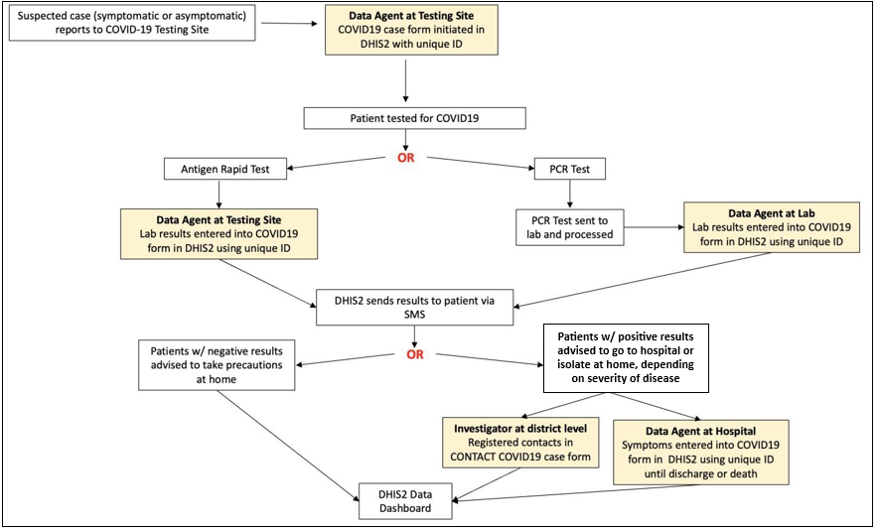
The DHIS2 platform was installed on a variety of electronic devices, including government-owned tablets, laptops, and computers, and some personal Android phones. MoH data agents who did not have the required electronic equipment were provided a tablet or laptop during training to use during the response. An electronic COVID-19 case notification form was completed at testing sites, capturing sociodemographic, clinical, laboratory, and risk factor data. For antigen rapid tests, results were entered into DHIS2 immediately at the testing site. For PCR tests, the laboratory processed the sample, and the laboratory data agent entered results into DHIS2. Figure 1 outlines the original data flow for Guinea’s COVID-19 package. Initially, as part of an innovation introduced during implementation, both negative and positive PCR test results were communicated to patients by short message service (SMS) through DHIS2. Later, only negative test results were sent by SMS. Positive results were instead delivered in person at the testing site for rapid tests and at home by a health agent for PCR tests. Depending on the severity of disease, the case was either isolated at home or hospitalized. Following the World Health Organization’s guidance for clinical management of COVID-19 [10], disease severity was categorized by the treating physician as mild, moderate, severe, or critical. Severe and critical cases were hospitalized, while mild and moderate cases were typically isolated at home unless a comorbidity required hospitalization. For hospitalized cases, a data agent recorded additional case management information, including symptoms and clinical progress based on disease severity and outcome (recovered or deceased). District-level investigators interviewed confirmed cases to obtain and enter contact tracing information into DHIS2 (Figure 1).
Training and equipment
Training on the use of the COVID-19 package was instructor-led and held in person at the district level, covering data entry, analysis, and visualization based on each trainee’s role in the response. The IT team developed the training curriculum with accompanying practical exercises and provided supportive supervision. Trainees who could not attend in person participated in virtual sessions led by the IT team.
Tailored training was developed for each data agent role: laboratory data agents received training on laboratory result entry, quality control, and notification variables; hospital data agents on data entry related to hospitalization, complications of COVID-19 cases, and outcomes; investigation teams on case investigations and contact tracing ; and vaccination teams on vaccination and side effects variables. Training was also provided to super users, whose role was to resolve technical problems that could not be resolved by data agents at the district level, with AFENET staff also available for technical assistance eight hours a day, seven days a week by phone, email, or in person. Small group and one-on-one training sessions were provided to approximately 20 ANSS managers for an overview of the COVID-19 package, data analysis, dashboard use, and DHIS2’s capability to provide real-time data. Additional sessions were used to reach new staff and provide corrective action for sites or users experiencing technical problems.
Forty-three week-long training sessions were held in person in Conakry, the capitol city, and the regions of Dubreka and Coyah, which together accounted for more than 90% of Guinea’s COVID-19 cases. In total, 648 data agents were trained (Table 1). A total of 500 tablets, laptops, and computers were provided to the trainees, with laptops and computers primarily used at the national level and by super users, and tablets mainly used at the regional and district levels by data agents and at testing sites. DHIS2 was also installed on the personal smartphones of some data agents, primarily from vaccination teams, and mobile internet data credits were provided. When the COVID-19 vaccination program launched, additional training was provided to all data agents on the vaccination data collection tool.
Data quality and innovations
IT specialists used real-time dashboards to identify sites with poor-quality data (missing data and illogical data) and provided feedback to data agents and super users. To support data quality, key variables such as demographic information were made mandatory. The database was routinely assessed for duplications at the district and national level using patient name, phone number, and date of birth. To ensure that the data were valid, a weekly data modernization meeting was held with COVID-19 surveillance officers, data managers at the national level, laboratory staff, and vaccination staff. Bringing these teams together allowed the DHIS2 COVID-19 data to be triangulated against a range of field experience and confirmed as accurate and consistent across different perspectives before sharing further with partners.
Data completeness was assessed for key variables in the COVID-19 database. The completeness of final determination of suspected cases was calculated by determining the proportion of suspected cases classified as confirmed, non-confirmed, or unclassified. For confirmed cases, symptom severity completeness was calculated by dividing the number of cases with severity recorded by the total number of confirmed cases. Among deaths, severity completeness was calculated by dividing the number of deaths with severity recorded by the total number of deaths. Comorbidity completeness was assessed by dividing the number of cases with any comorbidity data recorded by the total number of cases with comorbidities.
From March 2020 to December 2022, data on 557,886 people tested for COVID-19 were entered in DHIS2, of whom 406,088 (73%) were classified, of which 40,961 (10%) were confirmed cases. The remaining 151,798 (27%) records were unclassified and therefore incomplete. The percentage of unclassified cases increased over time, rising from 7% in 2020 to 43% in 2022 in the Conakry region, and from 6% in 2020 to 34% in 2022 in other regions. Among confirmed cases, 575 deaths (fatality rate=1.4%) were registered in DHIS2. Data completeness was 56% for confirmed case outcomes (recovered or deceased) and 60% for symptom severity variables. Among deaths, completeness was 96% for age, 69% for severity of symptoms, 14% for diabetes, and 15% for hypertension (Table 2).
Two country-specific innovations were implemented within the COVID-19 surveillance package. First, DHIS2 was integrated with Orange Guinea’s mobile phone application—provided to the implementation team at no cost—enabling automated SMS notification of negative test results to patients. As soon as a negative test result was entered by a data agent, an automated SMS message was sent to the patient’s phone informing them of their result and providing COVID-19 prevention guidance. Second, an automated COVID-19 travel certificate was developed for people being tested for travel reasons. An ANSS data agent verified the traveler’s information in DHIS2, after which a certificate was automatically populated with the traveler’s details, confirmation of a negative test result and vaccination status, and the MoH’s signature, and then printed on security paper to prevent falsification. Through these innovations, which were implemented soon after the response began and continued throughout its duration, 100% of negative results were immediately communicated via SMS when entered in DHIS2, and COVID-19 travel certificates were produced and printed for eligible travelers.
Data use and public health decision-making
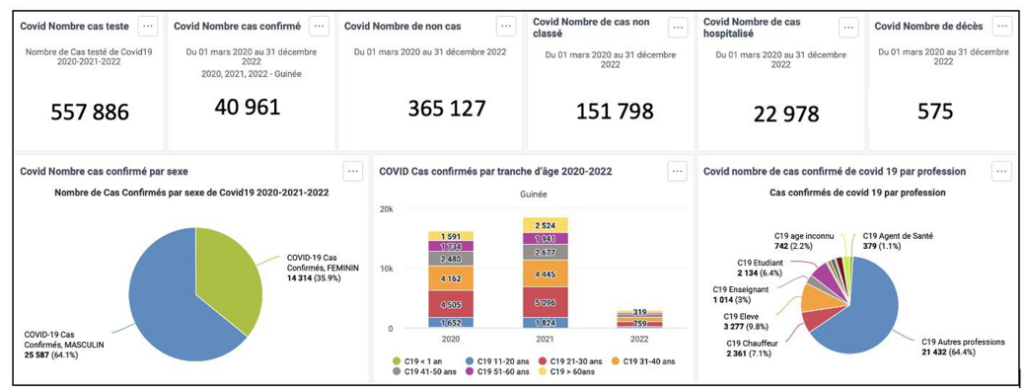
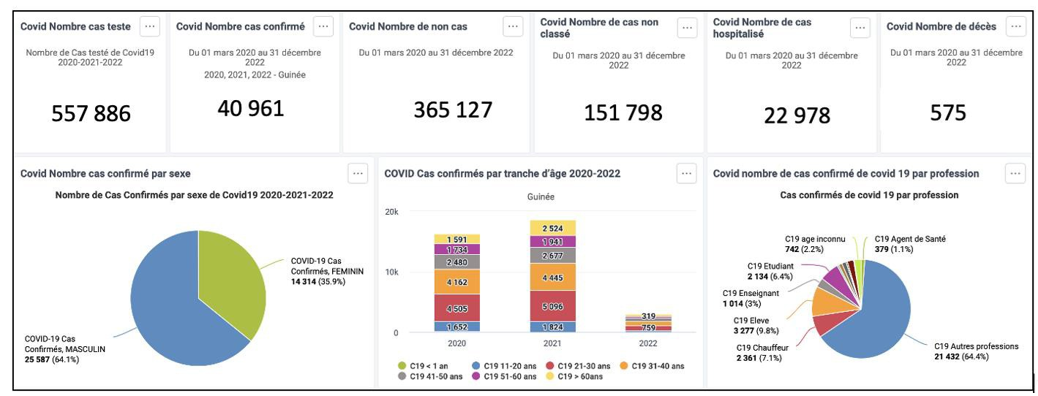
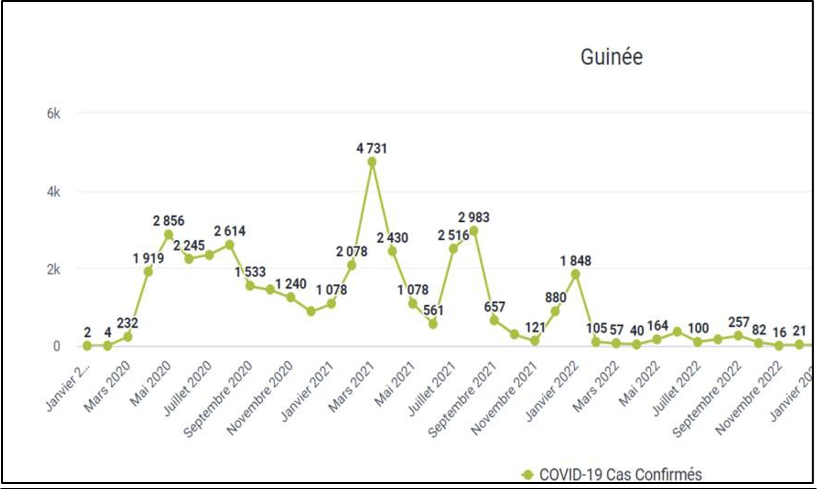
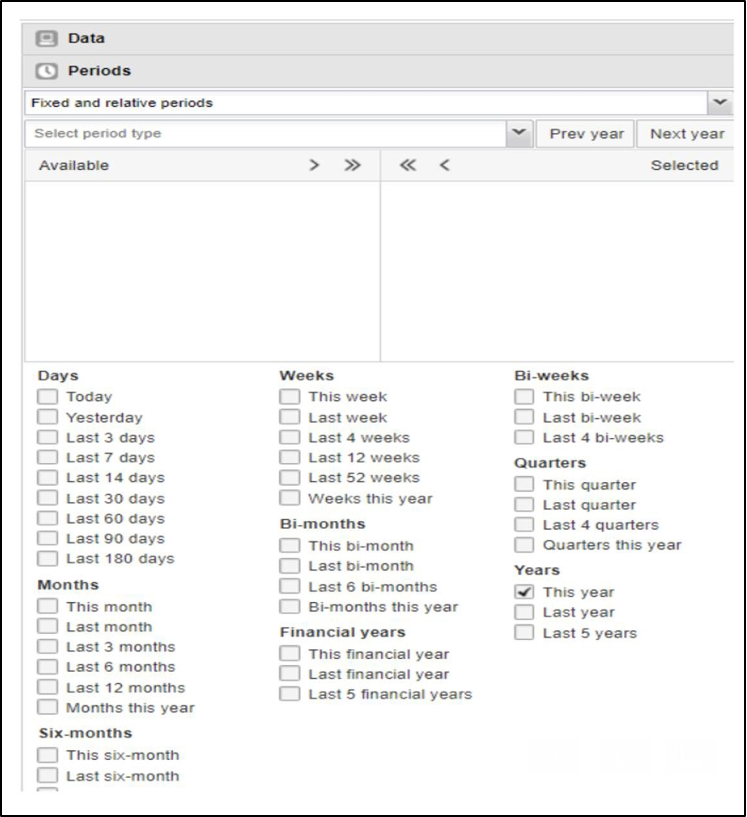
Dashboards and SitReps were configured to display surveillance data on person, time, place, and risk factors, including comorbidities such as diabetes, hypertension, HIV, and TB. Sociodemographic characteristics, including sex, profession, and age (Figure 2), and trends for confirmed cases were displayed (Figure 3). At the district level, each of the 38 dashboards displayed weekly and cumulative data, and each district produced its own SitRep by selecting the relevant district and time period in DHIS2 (Figure 4). At the national level, dashboards provided information on the total number of cases tested, confirmed, and investigated, by age group, sex, and district, as well as confirmed cases and deaths with comorbidities and vaccination status. Dashboards and SitReps were easily modifiable by users to meet their specific needs, including adjusting the date range for any period between 2020 and 2022.
Dashboards were displayed in all district and regional health department offices, the minister’s office, the ANSS departments of surveillance and case management, the emergency operations center (EOC), and the offices of the director and deputy director. Decision makers were given DHIS2 access to dashboards and SitReps and trained in their use. Dashboard and SitRep information were discussed in daily MoH meetings with the COVID-19 response lead and used to prepare weekly presentations for Guinea’s president, the inter-ministerial committee, and funding partners. In total, 4,045 SitReps were produced across all 38 districts, 8 regions, and the national level, and 155 national-level meetings were held between March 2020 and December 2022. DHIS2 COVID-19 data identified high-risk groups, enabling targeted vaccination and education efforts, which resulted in substantial coverage gains among priority populations. Specific examples of these data-driven successes are highlighted in the next section.
The MoH capitalized on the substantial investments made by partners to sustain DHIS2 capacity beyond the COVID-19 response. The implementation triggered a renewed interest in data management among public health actors across the MoH, resulting in the integration of non-COVID-19 laboratory results into DHIS2 and requests for the integration of data on other epidemic-prone and vaccine-preventable diseases at the sub-district level. To this end, the MoH created permanent data entry and super user positions at various levels of the health system, provided regular equipment maintenance, discouraged investment in competing tools, and encouraged partners to direct funds and technical assistance toward data collection, management, and analysis in DHIS2.
Successes
Guinea’s implementation of the DHIS2 COVID-19 Surveillance Package from March 2020 to December 2022 demonstrates DHIS2 as an effective and flexible platform for evidence-based decision-making, even during a complex and rapidly evolving epidemic response, with successes evident across all four components of implementation.
The near-immediate data collection built into the response made a real difference for timely decision-making. Test results were entered as soon as they were complete, and case management and contact tracing information was entered as it was gathered, so data reached DHIS2 close to the point of collection. This immediacy directly supported the automated generation of SitReps, ensuring their timely availability and reducing the workload on surveillance teams. Rather than routing paperwork through a district-level staff member responsible for entering data from multiple facilities, data entry occurred directly at the facility level, freeing up district staff to focus on data quality rather than data entry.
Timely, facility-level data entry in DHIS2 also depended on a workforce that was trained and equipped to handle it. The scale and adaptability of the training approach meant it could be built upon as needs emerged over the course of the response, including additional training provided to all data agents once the COVID-19 vaccination program launched.
The two country-specific innovations demonstrated DHIS2’s capacity for context-specific adaptation. The decision to deliver positive results in person rather than by SMS, while automatically sending only negative results, was an important programmatic adjustment that gave healthcare providers the opportunity to counter misconceptions, encourage appropriate isolation or care-seeking, and ensure rapid identification of contacts. The automated delivery of negative results also freed health agent time, allowing them to focus on positive cases and their contacts. The automated production and printing of travel certificates supported the MoH’s efforts to minimize the travel of cases who tested positive for COVID-19 and encourage vaccination. Countries such as Sierra Leone, Sri Lanka, and Uganda reported similar implementation experiences during the COVID-19 pandemic, where prior investments in DHIS2 enabled adaptations, local innovations, and data-driven responses [11,12].
The DHIS2 dashboards proved flexible enough to serve as effective decision-support tools. Users could adjust time periods, person-level variables, and place to suit their specific needs, a range of variation that was often referred to for decision-making (Figure 4). MoH staff and partners alike regularly referred to the dashboards and proposed interventions. For example, UNICEF requested a COVID-19 dashboard specific to children, which they and the MoH used for vaccination planning. DHIS2 case management data similarly informed targeted public health action by identifying high-risk groups, including unvaccinated individuals, older adults, those with comorbidities, and military personnel. Analysis of data from weeks 1 to 13 of 2022 showed that of the 47 cases admitted to the intensive care unit, 42 (89.4%) had not been vaccinated against COVID-19, 22 were hypertensive (46.8%), 10 had HIV and TB (21.3%), and 3 were diabetic (6.4%). Among the 21 deaths recorded in the same period, 7 were hypertensive (33.3%), 6 had HIV and TB (28.6%), and 3 were diabetic (14.3%), with 67% of all deaths occurring among persons aged 50 years or older. Using these data, the ANSS in collaboration with CDC developed and implemented CDC’s COVID-19 International Vaccine Implementation and Evaluation Program (CIVIE) between July and September 2022, reaching over 500,000 people in the Conakry region at high risk of severe COVID-19 outcomes due to age or comorbidity (Table 3). Among this group, 22% of persons with TB, 72% of people living with HIV (PLHIV), 25% of persons with other chronic diseases, and 75% of individuals aged ≥50 years were fully vaccinated for COVID-19 [13]. CIVIE helped increase vaccine coverage from 0% to 22% among PLHIV, 0% to 72% among people with TB, 4% to 25% among people with chronic diseases, and 73% to 95% among individuals aged ≥50 years (Table 4). Nationally, 5,499,528 doses of COVID-19 vaccines administered between February 2021 and December 2022 were captured in DHIS2, including 2,523,218 people (approximately 18% of the population) who received two doses. Occupational data also informed the response, showing that military members were disproportionately affected and prompting focused educational efforts for this group.
These successes across data collection, training, innovations, and data use illustrate how Guinea’s investment in DHIS2 enabled an adaptable and evidence-driven emergency response. Guinea’s experience further demonstrates how a large-scale emergency response can drive lasting investment in health information systems. Rather than treating the COVID-19 response as an isolated deployment, the MoH leveraged it as an opportunity to position DHIS2 as the primary platform for health data in Guinea.
Challenges
Data quality, a key consideration throughout implementation, was also where Guinea’s deployment of DHIS2 faced notable challenges during a large, rapidly scaled operation. Although training was provided to data agents, completeness was low for some key variables, including confirmed case outcomes and comorbidities among cases who died (Table 2). Continuous data quality monitoring and close engagement with data agents are needed to address these gaps. The implementation further underscored the importance of strong collaboration between the MoH and partners to support tool adaptation, training, and equipment provision, and the critical role of early preparedness—including rapid deployment of adapted case investigation forms and timely training of field users—for effective emergency response. This lesson is consistent with broader analyses of health information system deployment, which also highlighted the importance of establishing integrated surveillance systems to prevent redundant parallel systems during emergencies [14].
While the COVID-19 package itself was free to download, its initial implementation required significant financial resources, including equipment, training, and the hiring of IT specialists, data agents, and consultants. After two years of substantial investment in DHIS2 development during the COVID-19 response, the gains achieved remain fragile. Equipment reliability and upgrading pose ongoing challenges, particularly given dependence on aging generators.
Guinea’s deployment of the DHIS2 COVID-19 Surveillance Package demonstrated that DHIS2 can be effectively adapted and deployed for large-scale epidemic response. Automated dashboards and SitReps supported real-time decision-making across district, regional, and national levels, while country-specific innovations—including automated SMS dissemination of negative test results and COVID-19 travel certificates—extended the platform’s value beyond standard surveillance functions. Countries, particularly those already using DHIS2 for routine surveillance, could benefit from adopting automated SitReps and dashboards and developing country-specific innovations tailored to their epidemiological context. Now that the parallel Excel system has been phased out, prioritizing DHIS2 data quality is essential. Continued investment in super user training to provide technical assistance at the sub-district, district, regional, and national levels will be critical to supporting Guinea’s efforts to use DHIS2 for all routine public health surveillance data. Key lessons from Guinea’s DHIS2 experience include the importance of early preparedness, strong multi-partner collaboration, continuous data quality monitoring, and sustained institutional investment to ensure that the DHIS2 capacity built endures beyond the response period.
The authors of this work declare no competing interests.
Disclaimer
The conclusions, findings, and opinions expressed by authors contributing to this journal do not necessarily reflect the official position of the U.S. Centres for Disease Control and Prevention, or the authors’ affiliated institutions. The authors used the HHS instance of Claude 4.6 to support editing and synthesis of existing manuscript text; all content was reviewed and approved by the authors.
This project was supported in part by an appointment to the Research Participation Program at the U.S. Centers for Disease Control and Prevention administered by the Oak Ridge Institute for Science and Education through an interagency agreement between the U.S. Department of Energy and the U.S. Centres for Disease Control and Prevention.
Table 1. Number of data agents trained per type of site
| Type of site | Number of data agents trained (%) |
|---|---|
| Testing sites | 56 (8.6) |
| Laboratories | 24 (3.7) |
| Treatment centers | 29 (4.5) |
| Vaccination sites | 485 (74.8) |
| Regional health surveillance offices | 16 (2.5) |
| District health surveillance offices | 38 (5.9) |
| Total | 648 (100.0) |
| Suspected case outcome data completeness (n=557,886) | ||
| Variable | n | % |
| Classified | 406,088 | 73 |
| Confirmed | 40,961 | 10 |
| Non-confirmed cases | 365,127 | 90 |
| Unclassified | 151,798 | 27 |
| Confirmed case outcome data completeness (n=40,961) | ||
| Variable | n | % |
| Not completed | 18,079 | 44 |
| Completed | 22,882 | 56 |
| Recovered | 22,207 | 97 |
| Died | 575 | 2.5 |
| Lost during follow-up | 100 | 0.5 |
| Symptom severity data completeness (n=40,961) | ||
| Variable | n | % |
| Not completed | 16,260 | 40 |
| Completed | 24,707 | 60 |
| Asymptomatic | 16,613 | 67 |
| Mild | 4,806 | 19 |
| Moderate | 2,563 | 10 |
| Severe | 646 | 2.6 |
| Critical | 73 | 0.3 |
| Death severity of symptoms data completeness (n=575) | ||
| Variable | n | % |
| Not completed | 179 | 31 |
| Completed | 396 | 69 |
| Severe | 276 | 70 |
| Critical | 48 | 12 |
| Asymptomatic | 34 | 9 |
| Moderate | 26 | 7 |
| Mild | 12 | 3 |
| Death diabetes data completeness (n=575) | ||
| Variable | n | % |
| Not completed | 495 | 86 |
| Completed | 80 | 14 |
| No | 60 | 75 |
| Yes | 20 | 25 |
| Death hypertension and cardiovascular diseases data completeness (n=575) | ||
| Variable | n | % |
| Not completed | 487 | 85 |
| Completed | 88 | 15 |
| No | 50 | 57 |
| Yes | 38 | 43 |
Table 3. COVID-19 vaccination of high-risk populations before and after July-September 2022, Conakry
| Target | Before July 2022 | After September 2022 | Total | ||||||
|---|---|---|---|---|---|---|---|---|---|
| Dose 1 | Dose 2 | Dose 3 | Dose 1 | Dose 2 | Dose 3 | Dose 1 | Dose 2 | Dose 3 | |
| PLHIV | 190 | 61 | 4 | 23,418 | 8,691 | 6,689 | 23,608 | 8,752 | 6,693 |
| TB | 12,413 | 6,161 | 3,006 | 12,413 | 6,161 | 3,006 | |||
| Chronic diseases | 32,112 | 9,371 | 21 | 99,420 | 50,475 | 38,608 | 131,532 | 59,846 | 38,629 |
| Hypertension | 13,678 | 4,834 | 4 | 38,587 | 18,082 | 16,236 | 52,265 | 22,916 | 16,240 |
| Diabetes | 25,634 | 11,122 | 8,656 | 25,634 | 11,122 | 8,656 | |||
| Aged ≥50 years old | 552,509 | 159,091 | 5,336 | 102,762 | 48,453 | 43,562 | 655,271 | 207,544 | 48,898 |
Table 4. Full COVID-19 vaccine coverage among high-risk populations before and after CIVIE project in Conakry
| Target | Population | Two doses | COVID-19 vaccine coverage after CIVIE project | COVID-19 vaccine coverage before CIVIE project |
|---|---|---|---|---|
| PLHIV | 38,939 | 8,752 | 22% | 0% |
| TB | 8,544 | 6,161 | 72% | 0% |
| Chronic diseases | 237,551 | 59,846 | 25% | 4% |
| Aged ≥50 years old | 218,160 | 207,544 | 95% | 73% |