
Outbreak Investigation | Open Access | Volume 9 (Suppl 13): Article 7 | Published: 30 Sep 2026

Views: 88
Menu, Tables and Figures
Table 1: Summary of selected outbreaks investigated across the six districts
| Outbreak/ district | Number of Suspects | Cases confirmed | Mortality | Status |
|---|---|---|---|---|
| Yellow fever/Bundibugyo | 6 | 6 | 1 | Ended |
| Yellow fever/Ngora | 20 | 5 | 1 | Ended |
| Measles/Moroto | 180 | 180 | 0 | Ended |
| Anthrax/Kween | 6 | 6 | 0 | Ended |
| Mpox / Kasese | 46 | 2 | 0 | Ended |
| Cholera/ Kyotera | 28 | 14 | 0 | Ended |
Table 1: Summary of selected outbreaks investigated across the six districts
Table 2: Timeliness of detection across the six outbreaks
| Indicator definition | District/Outbreak | Date of emergence | Date of detection | Timeliness in days | Target performance |
|---|---|---|---|---|---|
| Timeliness of Detection | Yellow fever/Bundibugyo | 08/08/23 | 16/01/24 | 155 | Not met |
| Yellow fever/Ngora | 11/04/24 | 20/04/24 | 9 | Not met | |
| Measles/Moroto | 05/04/24 | 26/04/24 | 21 | Not met | |
| Anthrax/Kween | 19/06/24 | 21/06/24 | 2 | Met | |
| Cholera/ Kyotera | 20/04/24 | 25/04/24 | 5 | Met | |
| Mpox / Kasese | 12/07/24 | 15/07/24 | 3 | Met | |
| Median (IQR) | 7 (3-21) | Met |
Table 2: Timeliness of detection across the six outbreaks
Table 3: Timeliness of notification across the six outbreaks
| Indicator definition | District/Outbreak | Date of detection | Date of notification | Timeliness in days | Target performance |
|---|---|---|---|---|---|
| Timeliness of Notification | Yellow fever/Bundibugyo | 16/01/24 | 12/03/24 | 55 | Not met |
| Yellow fever/Ngora | 20/04/24 | 17/06/24 | 58 | Not met | |
| Measles/Moroto | 26/04/24 | 26/04/24 | 0 | Met | |
| Anthrax/Kween | 21/06/24 | 26/06/24 | 5 | Not met | |
| Cholera/ Kyotera | 25/04/24 | 26/04/24 | 1 | Met | |
| Mpox / Kasese | 15/07/24 | 16/07/24 | 1 | Met | |
| Median (IQR) | 3 (1-55) | Not met |
Table 3: Timeliness of notification across the six outbreaks
| Indicator definition | District/Outbreak | Date of outbreak notification | Date response team dispatched | Timeliness in days | Target performance |
|---|---|---|---|---|---|
| Timeliness of Response | Yellow fever (Bundibugyo) | 12/03/24 | 14/03/24 | 2 | Met |
| Yellow fever (Ngora) | 17/06/24 | 1/07/24 | 14 | Not met | |
| Measles (Moroto) | 26/04/24 | 08/07/24 | 72 | Not met | |
| Anthrax (Kween) | 26/06/24 | 27/06/24 | 1 | Met | |
| Cholera (Kyotera) | 26/04/24 | 08/08/24 | 11 | Not met | |
| Mpox (Kasese) | 16/07/24 | 25/07/24 | 9 | Not met | |
| Median (IQR) | 10 (2-14) | Not met |
Table 4: Time to response to outbreak
| District/Outbreak | Detection | Notification | Response |
|---|---|---|---|
| Yellow fever/Bundibugyo | Existence of sentinel surveillance site | Existence of reporting system from UVRI to MoH | Coordination between sectors Experience from previous YF outbreaks in the district Logistical support Commitment from the district health office |
| Yellow fever/Ngora | Existence of sentinel surveillance site | Existence of reporting system from UVRI to MoH | Logistical support from partners Commitment from the district health office to do RCCE |
| Measles/Moroto | Knowledgeable health workers in measles case definition | Existence of e-surveillance system and SMS alert system Existence of district rapid response team Existence of regional PHEOC | Support from implementing partners in the initial response MoH support with the EMT |
| Anthrax/Kween | Community-based surveillance Health worker knowledge Experience from previous outbreaks | Coordination between UVRI and district health office | Existence of district task force to respond to outbreaks Availability of human resources |
| Cholera/ Kyotera | Health worker awareness | Functional and/or proper communication channels between health facilities and DHT | Presence of rapid response team and MoH division of PHE Quick mobilization of medical supplies to cases and contacts of confirmed cases Risk communication by village health teams Good multi-sectoral coordination Timely provision of counter countermeasures such as water treatment tablets Prohibition of food vendors. |
| Mpox/ Kasese | Existence of e- surveillance alert system SMS 6767 Health worker awareness | Timely retrieval of laboratory results | Existence of regional PHEOC Support from partners |
Table 5: Facilitators of timely detection, notification and response
| District/Outbreak | Detection | Notification | Response |
|---|---|---|---|
| Yellow fever/Bundibugyo | Syndromic similarity with malaria, which is endemic, delays detection Comorbidity with malaria and other diseases Private facilities as the first point of access to care have low capacity to detect. Limited laboratory testing capacities | Lapse in communication between district, sentinel surveillance site and UVRI Communication goes upward to national level but rarely back downwards to facilities | Limited financial and human resource support to facilitate quick response |
| Yellow fever/Ngora | Private facilities as the first point of access to care have low capacity to detect. Limited laboratory testing capacities Delay in sample transportation to UVRI Syndromic similarity with malaria | Delayed communication and coordination between sentinel site and district health office Unclear reporting structures from the sentinel surveillance site | Logistical challenges in accessing distant communities where cases were reported Low staffing of surveillance officers |
| Measles/Moroto | Poor health-seeking behaviour of mobile pastoral community Poor health worker training on IDSR Hard-to-reach areas with low access to health services 56 | Long laboratory turnaround times | Insecurity in the region delayed response teams Inadequate resources, both human and financial Escape of cases from isolation due to lack of food |
| Anthrax/Kween | Limited laboratory testing capacity Private facilities as the first point of access to care have low capacity to detect Low / less routine surveillance for anthrax | Delays between sample collection, transportation and testing | Management of cases at private clinics with limited treatment capacities Low staffing of surveillance officers Human behaviour and negative attitudes |
| Cholera/ Kyotera | Lack of health worker training/awareness Lack of RDTs for testing | Long turnaround time for diagnosis from laboratory | Duplication of coordination roles among partners Limited funding to procure essential medicines and supplies Low commitment from VHTs to support outbreak response |
| Mpox/ Kasese | Few laboratory testing kits | Long turnaround time for laboratory diagnosis | Capacity gaps among response teams |
Table 6: Barriers to timely performance on 7-1-7 across the six outbreaks
Suzanne Namusoke Kiwanuka1,&, Angela Nakanwagi Kisakye1,2, Wilson Tusiime1, Alex Mulyowa1, Bernard Lubwama3, Allan Niyonzima Muruta3, Simon Nyovuura Antara2
1Department of Health Policy Planning and Management, College of Health Sciences, Makerere University School of Public Health, Kampala, Uganda, 2African Field Epidemiology Network, Kampala, 3Ministry of Health, Uganda
&Corresponding author: Suzanne Namusoke Kiwanuka, Department of Health Policy Planning and Management, College of Health Sciences, Makerere University School of Public Health, Kampala, Uganda, Email: skiwanuka@musph.ac.ug ORCID: https://orcid.org/0000-0003-4729-4897
Received: 30 Sep 2025, Accepted: 25 Sep 2026, Published: 30 Sep 2026
Domain: Field Epidemiology
Keywords: Detection, Notification, Response, Capacity, Outbreaks, 7-1-7 Framework
©Suzanne Namusoke Kiwanuka et al. Journal of Interventional Epidemiology and Public Health (ISSN: 2664-2824). This is an Open Access article distributed under the terms of the Creative Commons Attribution International 4.0 License (https://creativecommons.org/licenses/by/4.0/), which permits unrestricted use, distribution, and reproduction in any medium, provided the original work is properly cited.
Cite this article: Suzanne Namusoke Kiwanuka et al., Timeliness of outbreak response and associated facilitators and barriers: Application of the 7-1-7 framework across six infectious disease outbreaks in Uganda, March-July 2024. Journal of Interventional Epidemiology and Public Health. 2026; 9(Suppl 13):7. https://doi.org/10.37432/jieph-d-25-00214
Introduction: Frequent outbreaks pose major public health risks, especially when detection, notification and response are delayed. The 7-1-7 framework provides benchmarks for timely outbreak management, but evidence on its application remains limited. We assessed the 7-1-7 timeliness metrics of six outbreaks in Uganda and explored barriers and facilitators influencing performance.
Methods: We conducted a retrospective observational study with an embedded qualitative component between March and July 2024. Quantitatively, we reviewed records to assess timeliness metrics. Qualitatively, data were analysed to identify facilitators and barriers influencing performance.
Results: No outbreak met all 7-1-7 targets. Three outbreaks (50%) met the seven-day detection target, with a median detection time of 7 days (IQR: 3-21). Three outbreaks (50%) met the one-day notification target, with a median notification time of 3 days (IQR: 1-55), while two outbreaks (33%) met the 7-day response target, with a median response time of 10 days (IQR: 2-14). Health worker awareness and the existence of sentinel surveillance sites facilitated timely detection. Alert systems were critical for notification. Multi-sectoral coordination enhanced response timeliness. Poor health worker awareness and limited laboratory capacities delayed detection. Unclear reporting structures delayed notification. Timely response was constrained by logistical challenges.
Conclusion: None of the six outbreaks met all targets; 50% met detection and notification targets, while 33% met response targets. Timeliness was facilitated by health worker awareness but delayed by logistical constraints. Targeted training for both public and private sector providers is needed. Streamlined communication across structures is important for timely notification. Rapid response teams are critical for coordinated multi-sectoral response.
In recent years, the frequency of disease outbreaks has increased globally, posing significant risks for rapid in-country transmission and cross-border effects [1, 2]. This has been in part, a result of increased globalization due to cross-border movements and trade [3]. For instance, in December 2019, a single outbreak of COVID-19 in Wuhan, China was reported and spread across international borders through travel. By March 2020, COVID-19 was declared a global pandemic that overwhelmed the healthcare system and disrupted day-to-day activities worldwide [4]. Other outbreaks that quickly spread across borders include the 2014-2016 West Africa Ebola Epidemic that originated from Guinea and spread to Liberia, Sierra Leone, Nigeria, Mali, and beyond, resulting in over 28,000 cases and more than 11,000 deaths, with an estimated mortality of 500 health workers [5].
While the COVID-19 pandemic and Ebola outbreak in West Africa were significant global health emergencies, it is evident that these were not the last epidemics. Between 31st December 2023 and 31st October 2024, eighteen outbreaks were reported and confirmed in Uganda. Outbreaks of cholera and anthrax were the first to be recorded within the first week of the year 2024. Within four weeks, an outbreak of Crimean-Congo hemorrhagic fever was identified through routine surveillance of viral hemorrhagic fevers, and a total of four deaths were recorded [6]. Uganda’s position in the tropical belt of the Congo basin makes it particularly vulnerable to epidemic disease outbreaks, including, over the years, Sudan Ebola virus, Marburg, Yellow Fever, Congo Crimean Hemorrhagic Fever, and Anthrax [7]. These outbreaks have significant public health risks, particularly when detection, notification and response are delayed.
The 7-1-7 framework, proposed in 2021 [8], is a performance improvement approach which enables countries to monitor outbreaks in real time by establishing specific targets: outbreaks must be detected within 7 days of emergence, notified to public health authorities within 1 day of detection, and early response actions to be completed within 7 days of notification [8]. Statistical evidence confirms that faster detection leads to fewer cases, fewer deaths, and shorter outbreaks [9]. Despite this, delays across the three stages of the 7-1-7 framework remain common across low- and middle-income countries, including Uganda [10]. The resultant effects may encompass increased risk of disease transmission and adverse outcomes.
In 2001, Uganda adopted the Integrated Disease Surveillance and Response (IDSR) strategy to strengthen surveillance and response for priority diseases, conditions, and events across all levels of the health system [11]. IDSR integrates surveillance functions from community to national level, with Village Health Teams supporting community-based surveillance and health facilities and district health teams responsible for detection, response and reporting [11]. The country also has established laboratories that play a major role in confirmation of reported disease cases during outbreaks. Despite the existing strategies for surveillance and rapid response, challenges such as delayed reporting, coordination gaps and limited capacity for detection and response to disease outbreaks continue to affect Uganda’s timely outbreak control.
We applied the 7-1-7 framework to assess the timeliness of six selected outbreak investigations in Uganda. In addition, we explored facilitators for effective response and explored the bottlenecks to timely and effective response towards the six outbreaks.
Study design
This was a retrospective observational study with an embedded qualitative component. The quantitative component involved retrospective analysis of outbreak timelines to assess timeliness of detection, notification and response using the 7-1-7 framework, while the qualitative component explored facilitators and barriers to timeliness performance.
Study setting
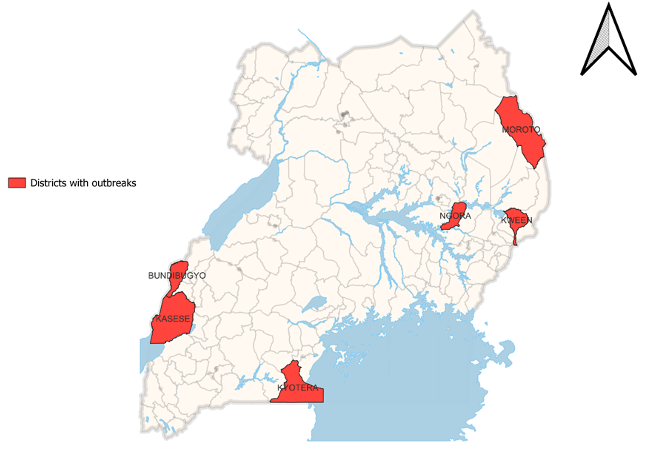
The study was conducted across six districts in Uganda: Bundibugyo, Kasese, Ngora, Moroto, Kyotera and Kween. Six outbreaks [mpox in Kasese District which emerged on 12th July 2024, yellow fever in Ngora and Bundibugyo which emerged on 11th April 2024 and 8th August 2023 respectively, measles in Moroto which emerged on 5th April 2024, anthrax in Kween which emerged on 19th June 2024, and cholera in Kyotera District which emerged on 20th April 2024 (Figure 1) that occurred in these districts were purposively selected based on availability and completeness of outbreak investigation records. This study was restricted to these six selected outbreaks in the respective districts and did not include any other outbreaks that may have occurred in these districts during the study period. All six outbreaks had ended by the time of the study.
The districts of Bundibugyo and Kasese are located in the Western region of Uganda, bordering the Democratic Republic of Congo (DRC). Bundibugyo specifically is a recurrent hotspot for yellow fever, characterised by an equatorial type of climate, dense forests, and continuous human-monkey interactions. Bundibugyo has 25 government facilities (one Hospital, two Health Centre IVs (HCIVs), 15 HCIIs and 7HCIIIs) and 6 private facilities (3 HCIIs, 1 HCIII, 1 HCIV and 1 clinic). Bundibugyo General Hospital is the arboviral sentinel surveillance site within the district.
Kasese district, currently with 146 health facilities, both private and public (85 HC IIs, 51 HC IIIs, 4 HC IVs and 6 hospitals), has been a focal point for Uganda’s public health surveillance efforts due to its proximity to the DRC, a country which has faced numerous infectious disease outbreaks in the past. By May 2024, the DRC had reported 7,851 cases and 348 deaths (CFR 4.5%). One of the most affected areas in the DRC was North Kivu, a region near the Ugandan border [12]. This makes Kasese particularly vulnerable to potential outbreaks, requiring sustained surveillance to ensure that any emerging threats are promptly identified and contained.
Ngora district, in the Teso sub-region, Eastern Uganda, is a district characterized by erratic and unreliable rainfall patterns, poor vegetation cover, and flat rocky terrain, all of which, if they interact, create stagnant pools for mosquito breeding or increase human exposure to mosquitoes if they breed near human settlements. Yellow fever vaccination coverage in the district is estimated at 86%. The district has 15 health facilities (10 government, 3 private-for-profit and 2 private-not-for-profit). Moroto district is located in the Karamoja sub-region, North-Eastern Uganda. The district is largely rural, but with nineteen health facilities, both public and private, spread out across each of the 8 district sub-counties (i.e., Lotisa, Rupa, Nadunget, Loputuk, Katikekile, Tapac). These facilities provide primary health care services, including routine immunization services, both static and outreach. Moroto had a mass measles-rubella vaccination campaign from 6th to 10th July 2024, resulting in a vaccination coverage of 91.2% (Moroto district reports, unpublished). However, there was low utilization of routine immunization services in most of the communities in the listed sub-counties. Specifically, Tapac subcounty had a coverage of about 42% for MR2.
Kyotera District is located in the Central region of Uganda. It has 73 health facilities (39 government, 21 PFPs, and 13 PNFPs). The district has historically been prone to cholera outbreaks due to its proximity to Lake Victoria, with fishing communities that suffer from limited access to safe water and sanitation facilities. Kasensero Landing Site, a vibrant fishing community situated along the shores of Lake Victoria, is one such community that is at risk of cholera outbreaks. The landing site has few toilet/latrine facilities, lacks proper infrastructure for waste disposal and water treatment, thus increasing the risk of exposure to and ingestion of contaminated matter.
Kween district is located in North-Eastern Uganda and is bordered by Kenya. The main economic activities in the district include livestock farming, characterized by significant movement of livestock into and out of the district and across borders into Kenya. The district has had regular and consistent anthrax outbreaks reported since 2018 to date [13]. Anecdotal evidence suggests that inadequate vaccination of livestock, human behaviour (e.g., consuming meat from dead animals), seasonality peaks in April-June and the presence of 5 disease hotspots in the district position it for recurrent outbreaks.
Data collection
Quantitative data
We adopted the Resolve to Save Lives 7-1-7 assessment tool to collect the data. The tool captured key dates and events required to determine performance against the 7-1-7 milestones. Data were extracted from the district health outbreak response records, which included line lists, outbreak investigation reports, and laboratory reports. Additional records from health facilities that reported cases were also reviewed and data extracted. For each outbreak, we extracted dates corresponding to emergence, detection, notification and initiation of the first response.
Qualitative data
Twelve face-to-face key informant interviews were conducted, comprising one health worker from the sentinel surveillance site and one member of the district health team in each of the six districts. Participants were purposively selected based on their roles in, and knowledge of, outbreak response within the respective districts. The number of participants was determined a priori to ensure representation of both health facility and district-level perspectives in providing contextual explanations for the observed timeliness performance rather than to achieve thematic saturation. The WHO‑validated Early Action Review (EAR) matrix was used to guide data collection on facilitators and bottlenecks influencing timely outbreak identification and response. The EAR matrix structures assessment across three core domains aligned with the WHO 7‑1‑7 target: detection, notification, and early response. Data collection examined the functioning and timeliness of IDSR surveillance, laboratory confirmation, and frontline health‑worker alertness. The notification domain focused on reporting pathways and decision‑making across facility, district, and national levels, while the early response domain assessed coordination and initiation of response actions following notification. Participant responses were documented through interviewer notes taken during the interviews.
Data analysis
Descriptive statistics were computed from the quantitative data, using STATA version 17. To summarize the timeliness of actions for each outbreak, we computed the number of days taken from symptom onset among the index case to detection, the time interval between detection and notification and the duration from notification to the initiation of appropriate public health responses. We calculated timeliness of detection, defined as the interval (days) between the onset of a suspected outbreak and its recognition by the health system. Notification was defined as the difference in time (days) from the detection of the suspected outbreak to when it was formally reported to the health authorities. Response was defined as the difference in time (days) from the notification of an outbreak to initiation of response activities. These were then compared with the standard benchmarks of the 7-1-7 EAR matrix to assess the overall timeliness of the outbreak actions. The results were summarized using medians and interquartile ranges and presented as tables and figures.
Qualitatively, data were analyzed using a deductive thematic approach, guided by the detection, notification and response domains. Codes were developed based on predefined themes, and emerging patterns were synthesized to identify barriers and facilitators to timely outbreak response.
Ethical considerations
Ethical approval for this study was obtained from the Research and Ethics Committee of Makerere University School of Public Health (REC No: SPH-2024-591). All participants provided verbal informed consent and were assured of confidentiality. No unique identifying information on participants is presented.
Description of outbreaks
Six disease outbreaks (i.e., yellow fever, measles, anthrax, mpox and Cholera) were investigated across 6 districts in the period March to July 2024. In two districts, an outbreak of yellow fever was reported. Table 1 below shows the confirmed cases and mortality due to the outbreaks as of July 31st, 2024.
Timeliness of detection across the six outbreaks
The time to detection was calculated as the difference in time (days) from the emergence of the suspected outbreak to its detection. The median time to detection was 7 days (IQR: 3-21). According to the 7-1-7 framework, detection should occur within 7 days. However, timeliness varied widely across districts, ranging from 2 days for Anthrax to 155 days for yellow fever (Table 2).
Timeliness of notification across the six outbreaks
The time to notification was calculated as the difference in time (days) from the detection of the suspected outbreak to its notification. The median time to notification was 3 days (IQR:1-55). According to the 7-1-7 framework, notification should occur within 1 day. The timeliness of notification varied across districts from 0 days for measles to 58 days for yellow fever (Table 3).
Timeliness of response
The time to response was calculated as the difference in time (days) from the notification of an outbreak to initiation of response activities. The median response time was 10 days (IQR:2-14). According to the 7-1-7 framework, response time should be within 7 days. The timeliness of response varied across districts from 1 day for anthrax to 72 days for measles (Table 4).
Facilitators of good performance
For detection, the main facilitators across districts were health worker awareness, the existence of a testing laboratory, and a sentinel surveillance site. For notification timeliness, a functional reporting system such as an alert system, and good communication between facilities and District Health Teams (DHTs) were critical. For response timeliness, the existence of a regional PHEOC and district rapid response teams, the existence of a district laboratory focal person, provision of tests and treatment, as well as good multi-sectoral coordination evidenced by the mobilization and provision of logistical support from both MOH and implementing partners, were identified as critical (Table 5).
Barriers to outbreak timeliness
The barriers to timely detection included the existence of private sector providers as the first point of entry for care, co-morbidity of some diseases like Yellow Fever and malaria (with similar symptoms causing mis/delayed diagnosis), poor health worker awareness of some diseases and limited/delayed laboratory testing capacities. Barriers to timely notification included poor communication across relevant levels and a long turnaround time for laboratory diagnosis. Timely response was constrained by limited financial and human resource support to facilitate immediate responses, logistical challenges in accessing distant communities where cases were reported, limited workforce/partner support within the district and insecurity in the region, which delayed response teams (Table 6).
The 7-1-7 metric is a relatively recent framework, proposed in 2021, aimed at improving and monitoring progress towards the early detection and rapid control of health threats arising from suspected infectious disease outbreaks or pandemics [8]. However, there is a paucity of research on the extent to which countries have adopted this metric and how they are performing. Our study is one of the few studies that have applied the 7-1-7 framework to assess outbreak preparedness and response performance across countries and outbreaks. Other studies include a retrospective observational study by Bochner et al (2023), which examined implementation of the 7-1-7 target for detection, notification, and response to public health threats in five countries [14], a study by Ssemanda et al (2024) which evaluated the initial response to a cholera outbreak in Elegu Town on the Uganda-South Sudan border using the 7–1–7 timeliness metrics [15], and a mixed-methods study in Cambodia which evaluated adoption, implementation, and operational use of the 7-1-7 framework within the country’s public health system [16]. Other operational applications of the framework include a study by Katumba et al. (2025) which applied the 7-1-7 framework in a prototypical anthrax outbreak to identify missed opportunities for early detection in Southwestern Uganda [13], as well as a study that estimated the impact of decreasing vaccination response times for outbreaks of vaccine-preventable diseases in low- and middle-income countries [17].
In general, the findings on the 7-1-7 performance in our study are lower than previously reported in Uganda, where 52% of the events met the 7-day target for detection, 74% met the 1-day notification target and 45% met the 7-day early response target [10] and Liberia where 71% of events met the 7-day target for detection, 98% met the 1-day notification target and 59% met the 7-day response target [18]. The outbreaks assessed in our study occurred in districts with varying levels of capacity and preparedness, which might have influenced the timeliness of appropriate actions. Moreover, unlike the former assessments, which relied largely on data from national assessments with more diverse samples of public health events, our study focused on a very small sample of six outbreaks, which may introduce methodological differences in comparison and interpretation, hence affecting the external validity of our findings.
Our findings reveal substantial delays across all stages of the 7-1-7 framework, with median times exceeding recommended targets and wide variability across districts. While the capacity to detect and respond to outbreaks exists at the district level, the observed delays point to localised pockets of deficiencies within the system, as well as contextual drivers of delays. This pattern is consistent with evidence from multi-country assessments, where bottlenecks to detection were most often concentrated at the health facility level, while delays in notification and early response were predominantly found at the district level [14]. These findings suggest that persistent gaps in preparedness, coordination and resource availability exist across settings, all of which were identified through the application of the 7-1-7 framework. Taken together, the findings underscore the need to move beyond assessing system preparedness in isolation, toward strengthening the timeliness and coordination of core outbreak response functions (detection, notification and response) which are critical to containing emerging public health threats.
The target for timely detection in our study was only met by three outbreaks. This is comparable to a wider study which retrospectively assessed detection across 41 public health events in Brazil, Ethiopia, Liberia, Nigeria, and Uganda [19] although our study assessed fewer events. Having competent health workers to undertake the role of disease surveillance at the frontline plays an important role because they are often the first to detect suspect cases [20]. In this study, marked inter-district variation in detection timeliness was observed. Particularly, yellow fever detection took 155 days in Bundibugyo district compared to 9 days in Ngora district. These findings suggest that beyond overall system-level gaps, there might be important district-specific constraints which need to be addressed. Secondly, we posit that because yellow fever presents with symptoms similar to malaria, potential for misdiagnosis is high, hence late detection. This suggests a need for clear standard case definitions, as well as capacity building for health workers to quickly detect yellow fever based on differential diagnoses, especially in settings which are prone to yellow fever outbreaks.
The delayed detection of measles in Moroto compounds all the above issues, in addition to the fact that Moroto is a border district with a migrant pastoral community. This may increase the risk of missed detection. Moreover, this migrant population is more likely to patronize multiple health providers including private health providers, leading to poor reporting. Enhanced health worker capacities to detect, and clear reporting lines are critical especially for epidemic prone border districts.
In this study, knowledgeable health workers were instrumental for the quick detection of outbreaks but incapable health workers were also highlighted as a barrier to outbreak detection efforts. Similar studies by Zalwango et al., [21] and Bochner A et al.,[14] corroborate this. Studies conducted in Uganda report that the lack of knowledge among health workers is a major cause of delay in the detection of Sudan Ebola virus disease while in Kenya, Toda et al., [22] report that the knowledge of health workers regarding standard case definitions was not adequate among health workers and their supervisors, which affected the reliability of routine surveillance reports generated from health facilities. Health worker capacity to diagnose, promptly and appropriately report an outbreak is the lynchpin of outbreak detection and containment, thus underscores the need to build awareness through training a workforce of disease detectives across all levels.
On the systems side, the strengthening of laboratory diagnostic capacity cannot be over emphasized because it augments health worker capacity to engage in disease surveillance, appropriate sample collection and efficient diagnostics. In this study however, limited laboratory testing capacities and the delay in sample transportation to UVRI emerged as barriers to timely detection. These weaknesses likely contributed to detection times exceeding the recommended 7-day target, suggesting that the delay was not driven solely by the failure of health workers to correctly recognize symptoms, but were also compounded by systemic bottlenecks in laboratory access and sample referral pathways.
Furthermore, in a pluralistic healthcare system like Uganda, where almost 50% are private providers, the risk of missing a suspected case is amplified. This may partly be due to the fact that health worker capacity building for disease and mortality surveillance has been predominantly geared towards workers in government owned (public facilities). Moreover, many private facilities do not make routine reports into the central IDSR system. Private facilities have been identified in several studies as a gap in the prompt detection and response to disease outbreaks. Studies in Uganda highlighted that the patronage of private facilities by suspected cases contributed to the delay in detecting the 2024 Sudan Ebola Outbreak [22]. The same study revealed that 91% of the facilities did not report to DHIS2 while 85% did not have any health worker trained on IDSR [22]. On the contrary, these indicators scored 100% in all participating public facilities. The strengthening of the private sector as a frequent first point of entry for suspected cases should thus be prioritised. Emphasis should be placed on training health workers as well as mandatory reporting into the IDSR system.
Half of the events assessed in our study met the criteria of timely notification. These included Measles in Moroto district, Cholera in Kyotera and mpox in Kasese district. The other three outbreak notifications fell beyond the set timelines, with a range of 5-58 days. Our findings are, however, lower than evidence from Bochner et al [14], who reported that most events, 71% (29/41), had met a target of 1 day to notify, with a range of 0-24. Plausible reasons emerge from the qualitative data: among the facilitators of timely notification were the existence of an e-surveillance system, an SMS alert system, as well as functional and/or proper communication channels between health facilities, sentinel surveillance sites and the DHT. In settings where some or any of these systems are dysfunctional, notification is likely to be delayed.
However, our findings also revealed that there was a tendency for sentinel sites to report exclusively to Uganda Virus Research Institute, neglecting to communicate to the district authorities. This is a distortion of the mandatory reporting of any suspected case via the district authorities and represents a major barrier to timely notification. It also underpins the importance of clear communication structures within the system to enhance surveillance and follow-up of suspected cases.
Other barriers were also noted. For measles, cholera and mpox, delayed diagnosis was evidenced by long turnaround times from laboratories, an important factor contributing to delayed notification. This highlights the need for well-equipped and functional laboratories to support disease investigations for enhanced health security.
Based on the target of timely response within the seven-day timeline, only a third of the outbreaks had prompt response. This is much lower compared to the 49% (20/41) outbreaks which met a target of 7 days to complete all early response actions. However, the median response times were comparable 10 days versus 8 days [19]. This could point towards inadequate cross-sector collaboration, district support and availability of human and logistical resources. The delayed response could also suggest systemic challenges in coordination, logistics or resource mobilization. Similar delays have been reported in other settings [14] and thus suggest the need for targeted investments aimed at strengthening district emergency preparedness and response actions.
Our study was not without limitations. We relied largely on retrospective data, and some key event dates may have been incompletely or inaccurately documented in the available records. This may have affected the accuracy of the reconstructed outbreak timelines. Importantly, given the small sample size, our study was not powered to make meaningful statistical conclusions, which limits the external validity of our findings. Moreover, analysis was based on unequal outbreak numbers across diseases, introducing a selection bias where diseases with higher event counts might have contributed disproportionately to the aggregate findings. Findings therefore ought to be interpreted with caution. Secondly, the qualitative insights presented may not necessarily capture the full breadth of all contextual facilitators and barriers to timely detection, notification and response to disease outbreaks in Uganda, and therefore, it underscores the need for further research. Thirdly, while we explored barriers to timely detection, notification and response, we did not explore the root causes of these barriers. Lastly, the reported median timelines were calculated across multiple diseases, which may mask important disease-specific differences. Also, substantial variability across districts further limits the generalizability of the aggregated estimates. The limitations notwithstanding, the primary strength of our study is the triangulation of quantitative outbreak timelines with qualitative insights from key informant interviews which was intended to strengthen interpretation of the 7‑1‑7 matrix with contextual understanding. In addition, triangulation enhanced the credibility of our findings and enabled interpretations of system bottlenecks and facilitators rather than only relying on timelines. Additionally, our study is among the few evaluations that have applied the 7-1-7 framework to assess the timeliness in outbreak response in Uganda. We believe our findings will inform targeted improvements in Uganda’s public health emergency preparedness and response actions.
None of the six outbreaks fully met all targets; 50% met detection and notification targets, while 33% met response targets, with median times of seven, three, and 10 days, respectively. Timeliness was facilitated by health worker awareness, surveillance systems, and coordination, but delayed by private sector entry points, diagnostic challenges, weak reporting structures, and logistical constraints. On the basis of these findings, cross-sectoral coordination, logistical support, district commitment and the existence of rapid response teams appear to contribute to enhancing performance on 7-1-7 parameters. However systemic gaps such as low health worker capacities, poor engagement of the private sector, inadequate laboratory capacities and poor coordination between districts sentinel surveillance sites and UVRI continue to constrain performance. Targeted interventions to address these gaps are thus warranted. Specifically, to support detection timeliness, there is need to train both public and private sector frontline providers on identification of notifiable disease syndromes of public health importance, and to provide clinical case definitions that distinguish conditions which present with syndromic similarity to others as well as awareness creation for VHTs and communities. To improve notification timeliness, there is a need to enhance laboratory capacity for timely diagnostics as well as maintain an alert system for rapid notification. Equally important is streamlined communication across structures. In addition, while not assessed in our study, the integration of digital surveillance tools may be an important consideration for improving early detection and prompt notification while minimising delays brought about by poor coordination and communication, thereby improving overall timeliness in outbreak response. Finally, to support response timelines, regional public health emergency operation centres (PHEOCS) and rapid response teams at district level are critical for ensuring and coordinated multi-sectoral response to provide logistical support for outbreak response.
What is already known about the topic
What this study adds
We would like to acknowledge the African Field Epidemiology Network (AFENET) for the financial support during the outbreak investigation. We thank the Ministry of Health, Uganda, for the guidance during the outbreak investigations. We also acknowledge the District Health Teams of Kasese, Bundibugyo, Ngora, Moroto, Kween, and Kyotera Districts for their guidance during the time the outbreak investigations were conducted. Special thanks go to the surveillance focal persons who worked tirelessly with the outbreak investigation teams.
Conceptualization: Suzanne Namusoke Kiwanuka
Formal analysis: Suzanne Namusoke Kiwanuka, Alex Mulyowa
Investigation: Suzanne Namusoke Kiwanuka, Angela Nakanwagi Kisakye, Wilson Tusiime, Alex Mulyowa, Bernard Lubwama
Writing – original draft: Suzanne Namusoke Kiwanuka
Writing – review & editing: Angela Nakanwagi Kisakye, Wilson Tusiime, Alex Mulyowa, Bernard Lubwama, Allan Muruta, Simon Nyovuura Antara
| Outbreak/ district | Number of Suspects | Cases confirmed | Mortality | Status |
|---|---|---|---|---|
| Yellow fever/Bundibugyo | 6 | 6 | 1 | Ended |
| Yellow fever/Ngora | 20 | 5 | 1 | Ended |
| Measles/Moroto | 180 | 180 | 0 | Ended |
| Anthrax/Kween | 6 | 6 | 0 | Ended |
| Mpox / Kasese | 46 | 2 | 0 | Ended |
| Cholera/ Kyotera | 28 | 14 | 0 | Ended |
| Indicator definition | District/Outbreak | Date of emergence | Date of detection | Timeliness in days | Target performance |
|---|---|---|---|---|---|
| Timeliness of Detection | Yellow fever/Bundibugyo | 08/08/23 | 16/01/24 | 155 | Not met |
| Yellow fever/Ngora | 11/04/24 | 20/04/24 | 9 | Not met | |
| Measles/Moroto | 05/04/24 | 26/04/24 | 21 | Not met | |
| Anthrax/Kween | 19/06/24 | 21/06/24 | 2 | Met | |
| Cholera/ Kyotera | 20/04/24 | 25/04/24 | 5 | Met | |
| Mpox / Kasese | 12/07/24 | 15/07/24 | 3 | Met | |
| Median (IQR) | 7 (3-21) | Met |
| Indicator definition | District/Outbreak | Date of detection | Date of notification | Timeliness in days | Target performance |
|---|---|---|---|---|---|
| Timeliness of Notification | Yellow fever/Bundibugyo | 16/01/24 | 12/03/24 | 55 | Not met |
| Yellow fever/Ngora | 20/04/24 | 17/06/24 | 58 | Not met | |
| Measles/Moroto | 26/04/24 | 26/04/24 | 0 | Met | |
| Anthrax/Kween | 21/06/24 | 26/06/24 | 5 | Not met | |
| Cholera/ Kyotera | 25/04/24 | 26/04/24 | 1 | Met | |
| Mpox / Kasese | 15/07/24 | 16/07/24 | 1 | Met | |
| Median (IQR) | 3 (1-55) | Not met |
| Indicator definition | District/Outbreak | Date of outbreak notification | Date response team dispatched | Timeliness in days | Target performance |
|---|---|---|---|---|---|
| Timeliness of Response | Yellow fever (Bundibugyo) | 12/03/24 | 14/03/24 | 2 | Met |
| Yellow fever (Ngora) | 17/06/24 | 1/07/24 | 14 | Not met | |
| Measles (Moroto) | 26/04/24 | 08/07/24 | 72 | Not met | |
| Anthrax (Kween) | 26/06/24 | 27/06/24 | 1 | Met | |
| Cholera (Kyotera) | 26/04/24 | 08/08/24 | 11 | Not met | |
| Mpox (Kasese) | 16/07/24 | 25/07/24 | 9 | Not met | |
| Median (IQR) | 10 (2-14) | Not met |
| District/Outbreak | Detection | Notification | Response |
|---|---|---|---|
| Yellow fever/Bundibugyo | Existence of sentinel surveillance site | Existence of reporting system from UVRI to MoH | Coordination between sectors Experience from previous YF outbreaks in the district Logistical support Commitment from the district health office |
| Yellow fever/Ngora | Existence of sentinel surveillance site | Existence of reporting system from UVRI to MoH | Logistical support from partners Commitment from the district health office to do RCCE |
| Measles/Moroto | Knowledgeable health workers in measles case definition | Existence of e-surveillance system and SMS alert system Existence of district rapid response team Existence of regional PHEOC |
Support from implementing partners in the initial response MoH support with the EMT |
| Anthrax/Kween | Community-based surveillance Health worker knowledge Experience from previous outbreaks |
Coordination between UVRI and district health office | Existence of district task force to respond to outbreaks Availability of human resources |
| Cholera/ Kyotera | Health worker awareness | Functional and/or proper communication channels between health facilities and DHT | Presence of rapid response team and MoH division of PHE Quick mobilization of medical supplies to cases and contacts of confirmed cases Risk communication by village health teams Good multi-sectoral coordination Timely provision of counter countermeasures such as water treatment tablets Prohibition of food vendors. |
| Mpox/ Kasese | Existence of e- surveillance alert system SMS 6767 Health worker awareness |
Timely retrieval of laboratory results | Existence of regional PHEOC Support from partners |
Table 6: Barriers to timely performance on 7-1-7 across the six outbreaks
| District/Outbreak | Detection | Notification | Response |
|---|---|---|---|
| Yellow fever/Bundibugyo | Syndromic similarity with malaria, which is endemic, delays detection Comorbidity with malaria and other diseases Private facilities as the first point of access to care have low capacity to detect. Limited laboratory testing capacities | Lapse in communication between district, sentinel surveillance site and UVRI Communication goes upward to national level but rarely back downwards to facilities | Limited financial and human resource support to facilitate quick response |
| Yellow fever/Ngora | Private facilities as the first point of access to care have low capacity to detect. Limited laboratory testing capacities Delay in sample transportation to UVRI Syndromic similarity with malaria | Delayed communication and coordination between sentinel site and district health office Unclear reporting structures from the sentinel surveillance site | Logistical challenges in accessing distant communities where cases were reported Low staffing of surveillance officers |
| Measles/Moroto | Poor health-seeking behaviour of mobile pastoral community Poor health worker training on IDSR Hard-to-reach areas with low access to health services 56 | Long laboratory turnaround times | Insecurity in the region delayed response teams Inadequate resources, both human and financial Escape of cases from isolation due to lack of food |
| Anthrax/Kween | Limited laboratory testing capacity Private facilities as the first point of access to care have low capacity to detect Low / less routine surveillance for anthrax | Delays between sample collection, transportation and testing | Management of cases at private clinics with limited treatment capacities Low staffing of surveillance officers Human behaviour and negative attitudes |
| Cholera/ Kyotera | Lack of health worker training/awareness Lack of RDTs for testing | Long turnaround time for diagnosis from laboratory | Duplication of coordination roles among partners Limited funding to procure essential medicines and supplies Low commitment from VHTs to support outbreak response |
| Mpox/ Kasese | Few laboratory testing kits | Long turnaround time for laboratory diagnosis | Capacity gaps among response teams |