
Outbreak Investigation | Open Access | Volume 9 (Suppl 13): Article 08 | Published: 05 Oct 2026

Views: 21
Menu, Tables and Figures
| Variable | Frequency (n=6) n (%) |
|---|---|
| Age (years) | |
| 18-24 years | 1 (16.7) |
| 25-49 years | 1 (16.7) |
| 50+ years | 4 (66.7) |
| Sex | |
| Male | 6 (100) |
| Occupation | |
| Business | 1 (16.7) |
| Farmer/peasant | 5 (83.3) |
| Education level | |
| None | 1 (16.7) |
| Primary | 4 (66.7) |
| Secondary | 1 (16.7) |
| Religion | |
| Catholic | 3 (50.0) |
| Anglican | 2 (33.3) |
| SDA | 1 (16.7) |
| Sub county | |
| Kikiri | 2 (33.3) |
| Kaptoyoy | 1 (16.7) |
| Korite | 1 (16.7) |
| Kapnarkut | 1 (16.7) |
| Giriki | 1 (16.7) |
Table 1: Socio-demographic characteristics of outbreak-associated human anthrax cases, Kween District, Uganda, June–July 2024
| Reported exposure | Frequency n (%) |
|---|---|
| Contact with animals that had died or their body fluids | 5 (83.3) |
| Skinning animals | 5 (83.3) |
| Dissecting/dressing animals (removing internal organs) | 5 (83.3) |
| Contact with sick animals or their body fluids | 4 (66.7) |
| Carrying a sick animal | 4 (66.7) |
| Participated in slaughter of an animal in previous 14 days | 4 (66.7) |
| Slaughtering animals | 4 (66.7) |
| Participated in slaughter of an animal that was already dead in previous 14 days | 4 (66.7) |
| Consumed meat in previous 14 days | 4 (66.7) |
| Consumed the same meat as another anthrax case | 4 (66.7) |
| Skinned an animal that was already dead | 3 (50.0) |
| Carried dissected animal parts | 3 (50.0) |
| Dressed an animal that was already dead (removed internal organs) | 2 (33.3) |
| Contact with animal hides/skin in previous 14 days | 2 (33.3) |
Table 2: Reported animal- and carcass-related exposures among outbreak-associated human anthrax cases, Kween District, Uganda, June–July 2024
Tushabe Josephine1,&, George Oryongatum1,*,&, Namubiru Rebecca1, Faith Ayesiga1, Roseline Nuwamanya1, Wilson Tusiime1, Bernard Lubwama2, Suzanne Namusoke Kiwanuka1
*Tushabe Josephine and George Oryongatum are joint first authors
1Department of Health Policy, Planning and Management, School of Public Health, Makerere University, Kampala, Uganda, 2Division of Integrated Epidemiology and Surveillance, Ministry of Health, Kampala, Uganda
&Corresponding author: Josephine Tushabe, George Oryongatum, Department of Health Policy, Planning and Management, School of Public Health, Makerere University, Kampala, Uganda, Email tushabejosephine03@gmail.com; oryongatummakchs@gmail.com; ORCID: https://orcid.org/0009-0001-5240-6454
Received: 17 Oct 2025, Accepted: 22 Sep 2026, Published: 05 Oct 2026
Domain: Field Epidemiology
Keywords: Anthrax, outbreak, Uganda, One Health, Zoonotic diseases
©Tushabe Josephine et al. Journal of Interventional Epidemiology and Public Health (ISSN: 2664-2824). This is an Open Access article distributed under the terms of the Creative Commons Attribution International 4.0 License (https://creativecommons.org/licenses/by/4.0/), which permits unrestricted use, distribution, and reproduction in any medium, provided the original work is properly cited.
Cite this article: Tushabe Josephine et al. Human anthrax outbreak linked to livestock carcass exposure in Kween District, Uganda, June–July 2024. Journal of Interventional Epidemiology and Public Health. 2026; 9(Suppl 13):08. https://doi.org/10.37432/jieph-d-25-00241
Introduction: In June 2024, a human anthrax case was laboratory-confirmed in Kween District, Eastern Uganda, prompting declaration of an outbreak. We investigated the outbreak to characterize affected persons, describe reported exposures and the spatial distribution of cases, and identify implications for anthrax prevention and control.
Methods: We conducted a descriptive outbreak investigation in Kween District from 26th June to 27th July 2024. Cases were identified through health-facility records and active case finding in affected communities. Demographic, clinical, and exposure information was obtained using structured outbreak investigation questionnaires and available records. Geographic coordinates of case locations were collected and mapped in relation to selected geographic and ecological features. Data were analysed descriptively using frequencies and proportions.
Results: Six outbreak-associated human cases were identified. Five were laboratory-confirmed for Bacillus anthracis by PCR, and one was epidemiologically linked. All cases were male, four were aged 50 years or older, and five were farmers/peasants. All six reported itching of affected skin areas, while five reported general body weakness, loss of appetite, neck swelling, headache, and neck pain or stiffness. Five cases reported contact with animals that had died or their body fluids. Five reported skinning and dissecting or dressing animals, four reported slaughtering animals, and four had participated in slaughtering an animal that was already dead during the preceding 14 days. Four cases reported consuming meat during the same period. Several cases reported more than one animal- or carcass-related exposure. No deaths were reported.
Conclusion: Multiple animal- and carcass-related exposures were reported among cases during this outbreak. Although the investigation could not determine the independent contribution of individual exposures to illness, the findings reinforce the importance of preventing contact with animals that die suddenly and their products. Strengthened livestock vaccination, prompt reporting and investigation of sudden animal deaths, safe carcass disposal, community engagement, and coordinated human and animal health surveillance are important for preventing recurrent human anthrax in Kween District
Anthrax remains an important zoonotic disease in Uganda, affecting livestock and posing a continuous threat to human health. Anthrax, caused by the rod-shaped spore forming bacterium Bacillus anthracis primarily infects herbivores and is transmitted to humans through contact with infected animal products [1]. It is naturally present in soil and exhibits a distinctive pattern of endemicity in certain regions of Uganda, particularly the cattle keeping corridor, where periodic outbreaks occur due to environmental and ecological factors [1, 2]. Historically, outbreaks have been linked to the specific geographical areas with factors such as seasonal variations in rainfall, soil conditions, livestock management practices and human behavior influencing its prevalence [2]. Human anthrax incidence varies widely between countries, ranging from 0.03 per 100,000 in Ghana to 1.4 per 100,000 in Georgia [3]. Available literature from 30 countries in Europe, the Middle East, Asia, the Caribbean and Sub-Saharan Africa shows that 95% of all cases are cutaneous, with a mortality rate of 5–20% when left untreated [3].
From 2017 to 2023, Uganda experienced nineteen anthrax outbreaks in the districts of Kiruhura, Bududa, Ibanda, Kyotera and Kween [4]. Human infections during previous outbreaks have frequently followed handling, processing, or consumption of meat from livestock that died suddenly or were suspected to have anthrax [4, 5]. Similar patterns have been documented in Kween District, where anthrax outbreaks have been reported since 2018. Previous investigations in the district have highlighted practices such as handling and consuming meat from animals that die suddenly, livestock movement, and inappropriate disposal or butchering of carcasses as potential opportunities for exposure [5, 6]. The occurrence of human and livestock cases within the same settings further underscores the importance of preventing infection in animals and limiting human contact with potentially infected carcasses [6].
In June 2024, a human anthrax case was laboratory-confirmed in Kween District, prompting declaration of an outbreak and initiation of a field investigation. The occurrence of the outbreak in a district with previously reported anthrax outbreaks raised concerns about continued human exposure to potentially infected animals and animal products and highlighted the need to understand the circumstances surrounding the new cases. We therefore investigated the outbreak to characterize affected persons, describe reported exposures and the spatial distribution of cases, and identify implications for anthrax prevention and control in Kween District.
Study setting
The outbreak investigation was conducted in Kween District in the Sebei sub-region of eastern Uganda. Kween District borders Kenya and had a population of 129,277 persons according to the 2024 National Population and Housing Census [7]. The district is predominantly rural, with crop farming and livestock rearing as major livelihood activities. Livestock are raised under systems that include communal grazing and movement between grazing areas and watering points. Kween District lies between two protected areas, Mount Elgon National Park and Pian Upe Wildlife Reserve, which are important habitats for diverse wildlife. Livestock movement, communal grazing, cross-border livestock movement, and proximity to protected areas create opportunities for interaction among livestock, people, and wildlife. Anthrax outbreaks have previously been reported in Kween District, making the district an important setting for anthrax surveillance and prevention [4, 5, 6].
Outbreak investigation
Following laboratory confirmation of human anthrax in Kween District in June 2024, an outbreak investigation was conducted from 26th June to 27th July 2024. The investigation aimed to characterize the outbreak, describe the demographic and clinical characteristics of affected persons, identify reported exposures associated with illness, and describe the geographic distribution of cases. The investigation included case finding, interviews with identified cases, review of available outbreak and health records, and geospatial mapping of case locations and selected geographic and ecological features. Historical outbreak records were reviewed separately to describe previously reported anthrax outbreaks and provide context for recurrence in Kween District and Uganda.
Case definition and case finding
Cases were identified through health facility records and active case finding was conducted in affected communities with support from district surveillance personnel and community health workers. Individuals with clinical features suggestive of anthrax and a history of relevant exposure to animals or animal products were assessed during the investigation. A laboratory-confirmed case was based on detection of Bacillus anthracis by polymerase chain reaction (PCR). Available investigation records documented six human cases associated with the outbreak. Laboratory specimens were collected from five of the six identified cases, all of whom tested positive for Bacillus anthracis by PCR. The remaining case was epidemiologically linked to the outbreak but did not have a documented laboratory specimen. An epidemiologically linked case was defined as a person with clinically compatible illness who had a documented epidemiological link to a laboratory-confirmed case or to a common suspected anthrax exposure during the outbreak, but who did not have laboratory confirmation. All six outbreak-associated cases were included in the descriptive epidemiological assessment, while laboratory confirmation is reported separately.
Data collection
Information on demographic characteristics, clinical presentation, and potential exposures was obtained from identified cases using structured outbreak investigation questionnaires and review of available investigation records. Exposure information included contact with animals that had died suddenly and participation in activities involving carcasses or animal products, including carrying, skinning, slaughtering, dressing, preparing, cooking, or consuming meat. Field observations were also conducted in affected communities to document relevant environmental and livestock-related characteristics, including communal grazing areas, livestock movement routes, carcass locations where available, and proximity to selected geographic features.
Geospatial data collection and analysis
Geographic coordinates of case households and selected locations relevant to the outbreak investigation were collected in affected communities using a handheld Global Positioning System (GPS) device. Coordinates were imported into ArcGIS and used to map the spatial distribution of outbreak-associated cases. Spatial layers included administrative boundaries, rivers, Mount Elgon National Park, Pian Upe Wildlife Reserve, and case locations. An 8-km buffer around the protected areas was included as an exploratory representation of the potential interface between affected communities and adjacent wildlife areas. Spatial analysis was purely descriptive due to the limited number of cases.
Review of historical anthrax outbreak records
Available national surveillance reports, outbreak investigation reports, and published sources were reviewed to describe previously reported human anthrax outbreaks in Uganda and provide historical context for the 2024 Kween District outbreak. Information extracted included year and location of reported outbreaks, number of suspected and confirmed cases, and reported deaths where available. This review was purely descriptive and was used to relate potential causes and patterns observed in previous outbreaks to the 2024 Kween District outbreak.
Data management and analysis
Data were entered into Microsoft Excel, cleaned, and checked for completeness and consistency before analysis. Descriptive analysis was conducted using Stata version 14. Categorical variables were summarized using frequencies and proportions. Given the small number of outbreak-associated cases and the absence of a defined comparison group, inferential measures of association were not estimated. Reported exposures were therefore summarized descriptively among the six cases. Geospatial findings were similarly interpreted descriptively.
Ethical consideration
Approval was granted by the Higher Degrees Research and Ethics Committee of Makerere University School of Public Health (REC No: SPH-2024-591). Verbal informed consent was obtained from all participants. No identifying information on the participants is presented. The investigation was carried out in compliance with the Helsinki Declaration.
Outbreak detection and case identification
On 19th June 2024, a 40-year-old man presented to Giriki Health Centre with skin lesions following reported exposure to an animal carcass. A specimen collected on 21st June tested positive for Bacillus anthracis by PCR, and an anthrax outbreak was subsequently declared in Kween District on 26th June 2024. Six outbreak-associated human cases were identified during the investigation. Laboratory specimens were collected from five cases, all of whom tested positive for Bacillus anthracis by PCR. One additional case was epidemiologically linked to the outbreak but did not have a documented laboratory specimen. No deaths were reported among the six cases.
Demographic characteristics of cases
All six outbreak-associated cases were male. Four were aged 50 years or older, while one was aged 18–24 years and one was aged 25–49 years. Five of the six cases were farmers or peasants. Four had attained primary-level education, one had secondary education, and one had no formal education (Table 1).
Clinical manifestations
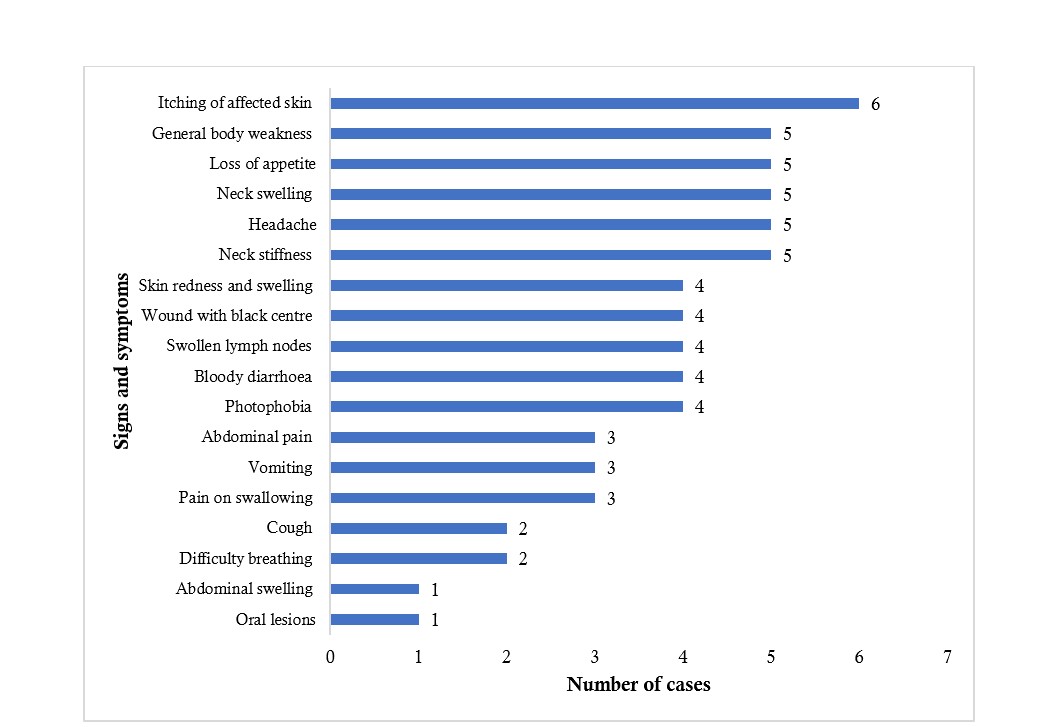
All six cases reported itching of affected skin areas. General body weakness, loss of appetite, neck swelling, headache, and neck pain or stiffness were each reported by five cases. Four cases reported skin redness, swelling, a wound with a black centre, swollen lymph nodes, bloody diarrhoea, and photophobia. Other clinical manifestations were reported less frequently (Figure 1).
Reported animal- and carcass-related exposures
Animal- and carcass-related exposures were common among the six outbreak-associated cases. Five reported contact with animals that had died or their body fluids. Five reported participating in skinning and in dissecting or dressing animals, while four reported slaughtering animals. Four cases had participated in slaughtering an animal that was already dead during the preceding 14 days, three reported skinning an animal that was already dead, and four reported consuming meat during the preceding 14 days. Several cases reported more than one exposure (Table 2).
Spatial distribution of cases
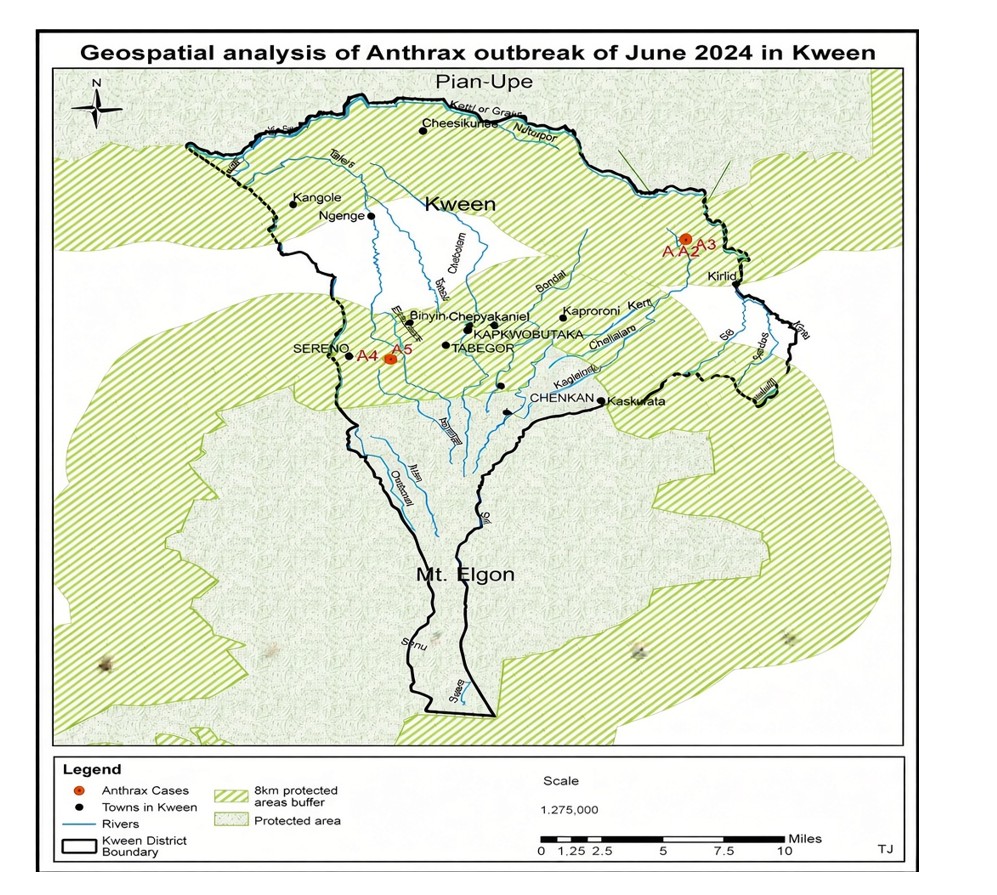
Outbreak-associated cases were identified from five locations in Kween District. Geographic coordinates collected during the investigation were used to map the case locations in relation to administrative boundaries, rivers, Mount Elgon National Park, and Pian Upe Wildlife Reserve (Figure 2). The cases were found in two areas: one near Sereno (Cases A4 and A5) and another near Kiriid (Cases A1, A2 and A3). All mapped case locations fell within predominantly livestock-rearing areas and are inside an 8-km buffer of the protected areas, consistent with communal grazing environments (Figure 2). The map was used to describe the geographic distribution of cases and potential human–livestock–environment interface. No spatial clustering analysis or statistical assessment of proximity to protected areas was conducted due to the small number of case locations.
This investigation describes a human anthrax outbreak in Kween District in June–July 2024 in which six outbreak-associated cases were identified, five of whom were laboratory-confirmed. The cases were all male and predominantly farmers, and multiple exposures involving animals, carcasses, and animal products were reported. Contact with animals that had died or their body fluids, skinning and dressing carcasses, slaughtering animals, and consumption of meat were commonly reported. Together, these findings point to direct interaction with animals and their products as important opportunities for human exposure during the outbreak, although the absence of an unexposed comparison group precluded estimation of associations between individual exposures and illness.
The prominence of carcass-related exposures is consistent with previous anthrax investigations in Uganda. During a 2018 outbreak in Kween District, handling a cow that had died suddenly, including skinning and carrying the carcass, was associated with cutaneous anthrax, while consumption of meat from the affected animal was associated with gastrointestinal anthrax [5]. Similarly, an outbreak in Isingiro District in 2017 was linked to consumption of beef from an animal that had died suddenly [8]. More recently, an investigation in Kanungu District identified handling carcasses and consuming meat from livestock that died suddenly as important exposures [9]. The recurrence of similar exposure patterns across settings suggests that prevention of human anthrax in Uganda depends substantially on preventing the handling, processing, distribution, and consumption of livestock that die suddenly or from unexplained causes [1, 5, 9].
The occurrence of all six cases among men, most of whom were farmers/peasants, may reflect occupational and social roles that increase opportunities for contact with livestock and carcasses. Livestock herding, slaughtering, skinning, carcass transportation, and meat processing can result in direct contact with infected tissues, body fluids, or contaminated animal products [1, 5]. However, because this investigation included only affected persons and did not include a comparison population, neither male sex nor occupation can be interpreted as an independent risk factor for infection. Rather, the findings highlight the importance of directing prevention messages towards persons who routinely undertake high-exposure livestock and carcass-handling activities.
The spatial distribution of cases also needs to be interpreted within the broader ecological and livelihood context of Kween District. Livestock rearing, communal grazing, livestock movement, and proximity of some communities to protected areas create opportunities for interaction at the human-livestock-wildlife-environment interface. Previous animal investigations in Kween have documented anthrax in livestock and implicated practices such as butchering infected carcasses on or near pastureland and inadequate carcass disposal [6]. Environmental studies elsewhere in Uganda have also shown that anthrax occurrence can be shaped by local ecological conditions [2]. However, the present investigation did not include laboratory testing of livestock, wildlife, or environmental samples and therefore cannot establish whether wildlife interaction, environmental contamination, or particular livestock movement routes contributed directly to the 2024 human outbreak. The mapped distribution should consequently be viewed as descriptive rather than evidence of spatial clustering or specific transmission corridors.
These circumstances nevertheless highlight the relevance of a One Health approach to anthrax prevention and control. Human cases may represent downstream consequences of infection and control failures in animal populations, while persistence of Bacillus anthracis spores in the environment makes control difficult through human-health interventions alone [1, 10]. Evidence from African anthrax surveillance also points to persistent gaps arising from fragmented human, animal, wildlife, and environmental surveillance systems [11]. Effective prevention therefore requires coordination between human health, veterinary, wildlife, and environmental sectors. Such coordination is particularly relevant for early notification of sudden livestock deaths, investigation of suspected animal cases, safe carcass disposal, identification of potentially exposed persons, and timely implementation of control measures [1, 11].
The recurrence of anthrax in Kween District suggests a need to move beyond outbreak-specific responses towards sustained prevention. National surveillance data identified 39 human anthrax outbreaks in Uganda during 2017–2024, with Kween recording eight outbreaks, the highest number among affected districts [5]. Historical surveillance data can therefore be used to identify recurrent high-risk areas and prioritize preventive interventions. Livestock vaccination is particularly important because preventing infection in animals reduces the source from which human exposure occurs [1, 5]. Vaccination strategies should prioritize recurrent outbreak areas alongside strengthened veterinary surveillance and rapid investigation of unexplained livestock deaths [1, 4].
Community engagement is equally important because many immediate exposure opportunities occur between the death of an animal and notification of veterinary or public health authorities. Risk communication should extend beyond general awareness of anthrax symptoms to practical decisions following sudden livestock death. Livestock owners, herders, butchers, meat traders, community leaders, and community health workers should be engaged in recognizing and promptly reporting unexplained livestock deaths, avoiding opening or processing suspect carcasses, preventing distribution or consumption of meat from such animals, and facilitating safe carcass disposal [1, 5]. Evidence from recurrently affected communities in Uganda suggests that knowledge alone may not ensure safer practices; economic constraints, the value of livestock and meat, and limited access to vaccination and veterinary services can influence decisions to handle or consume animals that die suddenly [12]. Community engagement and prevention strategies should therefore address both knowledge and the livelihood constraints that shape these practices.
This investigation had some limitations. Only six outbreak-associated human cases were identified, limiting the precision and generalizability of the findings. Exposure information was available only for affected persons. Consequently, associations between reported exposures and illness could not be estimated. Additionally, laboratory confirmation was documented for five of the six cases, while one epidemiologically linked case did not have a documented specimen. Further, the investigation did not include microbiological testing of livestock, wildlife, or environmental samples, limiting our ability to determine the source of infection or establish transmission pathways across the human-livestock-wildlife-environment interface. Finally, the spatial assessment was descriptive and based on a small number of case locations, therefore, proximity to protected areas or other geographic features should not be interpreted as evidence of causation. Despite these limitations, the investigation documents recurring carcass-related exposure patterns in a district with a history of anthrax outbreaks and identifies practical opportunities for strengthening prevention and response.
This outbreak involved six outbreak-associated human anthrax cases in Kween District, five of whom were laboratory-confirmed, and multiple cases reported direct animal- and carcass-related exposures. Although the investigation could not estimate independent risk factors or establish livestock, wildlife, or environmental transmission pathways, the findings are consistent with exposure patterns documented in previous Ugandan anthrax outbreaks. Preventing recurrent human anthrax in Kween District requires strengthened livestock vaccination, prompt reporting and investigation of sudden animal deaths, safe carcass disposal, community engagement, and coordinated human and animal health surveillance.
What is already known about the topic
What this study adds
The authors of this work declare no competing interests.
Availability of data and materials
Anonymised data supporting the findings of this investigation may be made available by the corresponding author upon reasonable request, subject to applicable ethical and privacy requirements. The data are not publicly available because the small number of cases and detailed outbreak information may create a risk of participant identification.
TJ and GO share first authorship, and together wrote the first draft of the manuscript, contributed to methodology design and performed formal analysis. NR, FA, RN contributed to methodology design and field data collection. WHT and BL supervised field data collection. SNK supervised, reviewed and edited the manuscript. All authors approved the final version prior to submission.
| Variable | Frequency (n=6) n (%) |
|---|---|
| Age (years) | |
| 18-24 years | 1 (16.7) |
| 25-49 years | 1 (16.7) |
| 50+ years | 4 (66.7) |
| Sex | |
| Male | 6 (100) |
| Occupation | |
| Business | 1 (16.7) |
| Farmer/peasant | 5 (83.3) |
| Education level | |
| None | 1 (16.7) |
| Primary | 4 (66.7) |
| Secondary | 1 (16.7) |
| Religion | |
| Catholic | 3 (50.0) |
| Anglican | 2 (33.3) |
| SDA | 1 (16.7) |
| Sub county | |
| Kikiri | 2 (33.3) |
| Kaptoyoy | 1 (16.7) |
| Korite | 1 (16.7) |
| Kapnarkut | 1 (16.7) |
| Giriki | 1 (16.7) |
| Reported exposure | Frequency n (%) |
|---|---|
| Contact with animals that had died or their body fluids | 5 (83.3) |
| Skinning animals | 5 (83.3) |
| Dissecting/dressing animals (removing internal organs) | 5 (83.3) |
| Contact with sick animals or their body fluids | 4 (66.7) |
| Carrying a sick animal | 4 (66.7) |
| Participated in slaughter of an animal in previous 14 days | 4 (66.7) |
| Slaughtering animals | 4 (66.7) |
| Participated in slaughter of an animal that was already dead in previous 14 days | 4 (66.7) |
| Consumed meat in previous 14 days | 4 (66.7) |
| Consumed the same meat as another anthrax case | 4 (66.7) |
| Skinned an animal that was already dead | 3 (50.0) |
| Carried dissected animal parts | 3 (50.0) |
| Dressed an animal that was already dead (removed internal organs) | 2 (33.3) |
| Contact with animal hides/skin in previous 14 days | 2 (33.3) |
