Research | Open Access | Volume 9 (3): Article 126 | Published: 30 Jul 2026

Views: 699
Menu, Tables and Figures
| Table 1: Characteristics of study participants in Koboko and Nebbi Districts, West Nile Region, Uganda, 2025 | ||||
|---|---|---|---|---|
| Variable | Total (N=275) n (%) | Cases (n=73) n (%) | Controls (n=202) n (%) | p-value |
| Age group (years) | ||||
| <15 | 16 (6) | 6 (8) | 10 (5) | 0.307 |
| ≥15 | 259 (94) | 67 (92) | 192 (95) | |
| Sex | ||||
| Male | 136 (49) | 26 (36) | 110 (54) | 0.0058* |
| Female | 139 (51) | 47 (64) | 92 (46) | |
| Education | ||||
| None | 43 (16) | 25 (34) | 18 (9) | <0.0001* |
| Primary | 168 (61) | 37 (51) | 131 (65) | |
| Secondary | 50 (18) | 10 (14) | 40 (20) | |
| Tertiary | 14 (5) | 1 (1) | 13 (6) | |
| Occupation | ||||
| Peasant farmer | 231 (84) | 48 (66) | 183 (91) | <0.0001* |
| Health worker | 4 (1) | 3 (4) | 1 (0) | |
| Other | 17 (6) | 7 (10) | 10 (5) | |
| Unemployed | 23 (8) | 15 (21) | 8 (4) | |
| Poverty status | ||||
| ≤ USD 3/day (Below poverty line) | 96 (35) | 45 (62) | 51 (25) | <0.0001* |
| > USD 3/day (Above poverty line) | 179 (65) | 28 (38) | 151 (75) | |
| Residence | ||||
| Koboko | 182 (66) | 46 (63) | 136 (67) | 0.504 |
| Nebbi | 93 (34) | 27 (37) | 66 (33) | |
| Nationality | ||||
| Ugandan | 271 (99) | 70 (96) | 201 (100) | 0.0586 |
| Foreigner | 4 (1) | 3 (4) | 1 (0) | |
| Time to Seeking Care (Years) | ||||
| 0–1 year (Early) | — | 40 (60)a | — | — |
| 2–4 years (Moderate) | — | 12 (18)a | — | — |
| 5–9 years (Long) | — | 5 (7)a | — | — |
| ≥10 years (Very long) | — | 6 (9)a | — | — |
| *Exchange rate used: 1 USD = 3,800 UGX (Bank of Uganda, mid-2025). According to the World Bank, the international poverty line is USD 3/day (~UGX 342,000 per person per month). aTime to seeking care categories was calculated among cases with complete onset and diagnosis dates. | ||||
Table 1: Characteristics of study participants in Koboko and Nebbi Districts, West Nile region, Uganda, 2025
| Table 2: Clinical presentation of leprosy case-patients in Koboko and Nebbi districts, West Nile region, Uganda, 2025 | ||
|---|---|---|
| Characteristics | Frequency (n) | Proportion (%) |
| Clinical Features | ||
| Patches on the skin with loss of sensation | 51 | 70 |
| Wounds on hands and feet | 8 | 11 |
| Painful swellings on the legs and hands | 6 | 8 |
| Shiny or oily/smooth appearance of the skin | 4 | 6 |
| Floppiness / Paralysis of hands and feet | 2 | 3 |
| Painless swellings/nodules over the body | 2 | 3 |
| Disease Classification | ||
| Multibacillary (MB) | 37 | 51 |
| Paucibacillary (PB) | 36 | 49 |
| Disability Status | ||
| Grade 0 Disability (G0D) | 50 | 68 |
| Grade 2 Disability (G2D) | 23 | 32 |
Table 2: Clinical presentation of leprosy case-patients in Koboko and Nebbi districts, West Nile region, Uganda, 2025
| Table 3: Risk factors for leprosy transmission in Koboko and Nebbi Districts, West Nile region, Uganda, 2025 | |||||
|---|---|---|---|---|---|
| Exposure variables | Cases n (%) | Controls n (%) | cOR (95% CI) | aOR (95% CI) | p-value |
| Age group | |||||
| <15 years | 6 (8%) | 10 (5%) | Ref | Ref | — |
| ≥15 years | 67 (92%) | 192 (95%) | 0.46 (0.16–1.36) | 0.62 (0.21–1.84) | 0.388 |
| Education* | |||||
| Lower level | 62 (85%) | 149 (74%) | Ref | Ref | — |
| Higher level | 11 (15%) | 53 (26%) | 0.48 (0.23–1.02) | 0.87 (0.37–2.02) | 0.741 |
| Poverty status** | |||||
| > USD 3/day | 28 (38.4%) | 151 (74.8%) | Ref | Ref | — |
| ≤ USD 3/day | 45 (61.6%) | 51 (25.2%) | 4.76 (2.71–8.33) | 3.57 (1.84–7.14) | 0.0002* |
| Occupation | |||||
| Employed | 60 (82%) | 194 (96%) | Ref | Ref | — |
| Unemployed | 13 (18%) | 8 (4%) | 5.25 (2.08–13.28) | 0.35 (0.12–1.05) | 0.061 |
| Close contact with a leprosy patient | |||||
| No close contact | 24 (33%) | 133 (66%) | Ref | Ref | — |
| Close contact | 49 (67%) | 69 (34%) | 3.94 (2.23–6.95) | 3.83 (2.07–7.09) | <0.0001* |
| Sex | |||||
| Male | 26 (36%) | 110 (54%) | Ref | Ref | — |
| Female | 47 (64%) | 92 (46%) | 0.46 (0.27–0.80) | 0.67 (0.35–1.27) | 0.218 |
Close contact with a leprosy patient was categorized as close contact (history of living in the same household or having frequent, close physical interaction with a confirmed leprosy case for approximately three years or more before diagnosis) and no close contact (reference). **Poverty status was categorized as ≤ USD 3/day (below the international poverty line, i.e., no reported source of income or monthly household income < USD 3 per person per day, equivalent to ~UGX 342,000 in 2025) and > USD 3/day (above the poverty line, reference). *Education level was categorized as low education level (only primary education attained, with or without a certificate, or not completing primary education) and high education level (secondary education and above, reference). | |||||
Table 3: Risk factors for leprosy transmission in Koboko and Nebbi Districts, West Nile region, Uganda, 2025
Gertrude Abbo1,&, Richard Migisha1, Emmanuel Mfitundinda1, Lilian Bulage1, Annet Namusisi1, Joyce Owens Kobusingye1, Emmanuel Okiror Okello1, Charity Mutesi1, Benon Kwesiga1, Muzamiru Bamuloba2, Geofrey Amanya2, Alex Mulindwa2, Rose Kengonzi2, Emmanuel Tweyongyere2, Stavia Turyahabwe2, Henry Luzze2, Alex Riolexus Ario1
1Uganda Public Health Fellowship Program, Uganda National Institute of Public Health, Kampala, Uganda, 2National TB and Leprosy Program, Ministry of Health, Kampala, Uganda
&Corresponding author: Gertrude Abbo, Uganda Public Health Fellowship Program, Uganda National Institute of Public Health, Kampala, Uganda, Email: abbog@uniph.go.ug ORCID: https://orcid.org/0009-0007-9072-5783
Received: 21 Nov 2025, Accepted: 24 Jul 2026, Published: 30 Jul 2026
Domain: Infectious Disease Epidemiology
Keywords: Leprosy, Socio-economic factors, Case-control studies, Uganda
©Gertrude Abbo et al. Journal of Interventional Epidemiology and Public Health (ISSN: 2664-2824). This is an Open Access article distributed under the terms of the Creative Commons Attribution International 4.0 License (https://creativecommons.org/licenses/by/4.0/), which permits unrestricted use, distribution, and reproduction in any medium, provided the original work is properly cited.
Cite this article: Gertrude Abbo et al. Factors associated with leprosy transmission, West Nile region, Uganda, January 2024–April 2025: A case-control study. Journal of Interventional Epidemiology and Public Health. 2026; 9(3):126. https://doi.org/10.37432/jieph-d-25-00295
Introduction: In April 2024, Koboko and Nebbi Districts in the West Nile Region of Uganda reported 48 newly diagnosed leprosy cases within a short period, representing a fivefold increase compared to the annual average of fewer than 8 cases reported in 2020. This unexpected rise in new case notifications raised concerns about ongoing transmission in the region. We assessed factors associated with leprosy transmission in these districts to inform targeted interventions.
Methods: We conducted an unmatched case-control study involving 73 cases and 202 controls in Koboko and Nebbi Districts. Cases were persons with a documented leprosy diagnosis based on clinical assessment and health-facility records, with slit-skin smear examination for acid-fast bacilli performed where clinically indicated. Controls were persons without any signs or history of leprosy (no hypopigmented or reddish skin lesions with definite sensory loss or thickened peripheral nerves) residing in the same neighborhoods as the cases. All identified cases from the medical records were enrolled, and approximately three neighborhood controls were selected per case. We collected data on sociodemographic characteristics, clinical history, household contacts, and care-seeking behavior using interviewer-administered questionnaires. Risk factors for leprosy transmission were identified using multivariable logistic regression.
Results: We enrolled 275 participants, including 73 cases and 202 controls. Among the cases, 67/73 (92%) were aged ≥15 years, 47/73 (64%) were female, 48/73 (66%) were peasant farmers, 45/73 (62%) lived below the poverty line, and 37/73 (51%) had multibacillary disease. In multivariable analysis, close contact with a leprosy patient (aOR=3.83, 95% CI: 2.07–7.09) and living below the poverty line (aOR=3.57, 95% CI: 1.84–7.14) were independently associated with leprosy.
Conclusion: The investigation identified socioeconomic vulnerability and close contact with a confirmed leprosy patient as factors independently associated with leprosy in the Nebbi and Koboko districts. Enhancing active case finding, contact tracing, and community awareness, especially among high-risk groups, is crucial to accelerate progress toward leprosy elimination in Uganda.
Leprosy is an infectious chronic disease and a neglected tropical disease caused by Mycobacterium leprae. It mainly affects the skin, peripheral nerves, upper respiratory mucosa, and eyes [1]. The incubation period is long and variable; it is assumed to be 5 years on average, but could be up to 20 years [2]. Transmission of leprosy is primarily through the respiratory route [3]. Clinically, leprosy presents with loss of skin sensation and characteristic hypopigmented or hyperpigmented anesthetic or hypo esthetic lesions [4]. Case detection and multidrug therapy (MDT) alone have proven insufficient to interrupt transmission. To strengthen prevention, the World Health Organization (WHO) recommends tracing household, neighborhood, and social contacts and providing a single dose of rifampicin as preventive chemotherapy [5].
Several risk factors have been associated with leprosy transmission; however, these warrant further evaluation [6]. Household contacts of leprosy patients remain at the highest risk [7]; living with multibacillary (MB) patients results in a 5–10-fold higher risk of developing the disease compared to the general population [8]. Additionally, persons residing in endemic regions, especially those with poor hygiene and nutritional status, are also at increased risk [9].
Leprosy still occurs in about 120 countries, with approximately 200,000 new cases reported every year [10]. Elimination of leprosy as a public health problem globally (defined as prevalence of less than 1 per 10,000 population) was declared in the year 2000 (as per World Health Assembly resolution 44.9), and most countries achieved this by 2010[5]. Globally, the prevalence of leprosy at the end of 2021 was 16.9/1,000,000 people [11]. Accurate diagnosis and proper classification remain essential for effective patient management and control of the disease [12]. In 2022, the African region detected 3,319 new cases with G2D (corresponding to a rate of 2.8 per million population), accounting for 15% of all new cases detected during the year [5].
Leprosy is endemic in Uganda, with 40% of the districts in the country affected [13]. The northern region of Uganda has consistently identified more leprosy cases compared to the other regions [13]. The National TB and Leprosy Program (NTLP) has implemented interventions to reduce the burden, such as community skin camps (community outreaches with free leprosy screening), refresher training of health workers, and contact tracing visits, particularly in areas endemic for leprosy [14]. The focus for the program is to reduce leprosy notifications among children from 8% to <3% and to reduce G2D rates to <5%. Despite these efforts, new cases are still being reported in Uganda, with increasing child leprosy cases being notified from 13% to 15% an indicator of ongoing transmission [15]. The increase in child leprosy cases is still much higher than the 3% NSP target [16]. Despite the intensive efforts underway by the NTLP to boost case finding and contact tracing, the West Nile region still observes an increase in leprosy cases notified, particularly in Nebbi and Koboko Districts. In April 2024, Koboko and Nebbi Districts in the West Nile Region of Uganda reported 48 newly diagnosed leprosy cases within a short period, representing a fivefold increase compared to the annual average of fewer than 8 cases reported in 2020. This unexpected rise in new case notifications raised concerns about ongoing transmission in the region. This study aimed to assess exposures associated with leprosy occurrence in Koboko and Nebbi Districts to inform targeted prevention and control interventions.
Study area
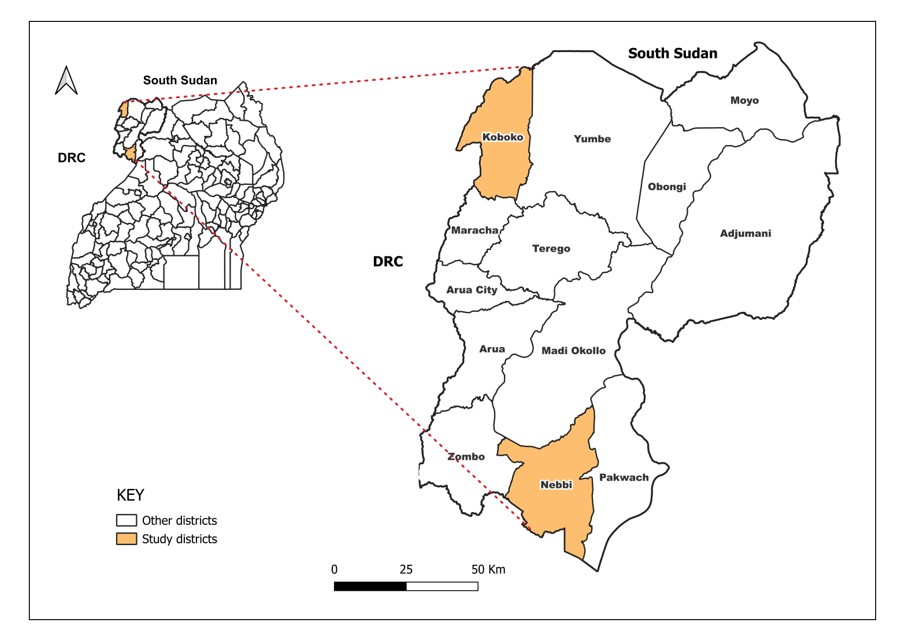
The study was conducted in Koboko and Nebbi Districts in the West Nile Region of Northern Uganda. Koboko borders South Sudan and the Democratic Republic of Congo (DRC), with a diverse and mobile population that includes cross-border communities and refugees (Figure 1). The district’s healthcare infrastructure comprises Health Center IIs, IIIs, IVs, and Koboko Hospital, which plays a central role in surveillance and treatment. The population has grown from 62,337 in 1991 to approximately 271,781 in 2024 due to increased healthcare demand (Figure 1).
Nebbi District on the other hand borders Arua, Zombo, and Pakwach Districts, and the DRC, with a population of about 259,300 as of 2024 (Figure 1). Its proximity to the DRC facilitates cross-border movement, increasing the risk of undetected leprosy cases, particularly among underserved groups. Both districts were selected due to their cross-border dynamics, the increase in the number of new cases notified each year and functional surveillance systems (Figure 1).
Study design and population
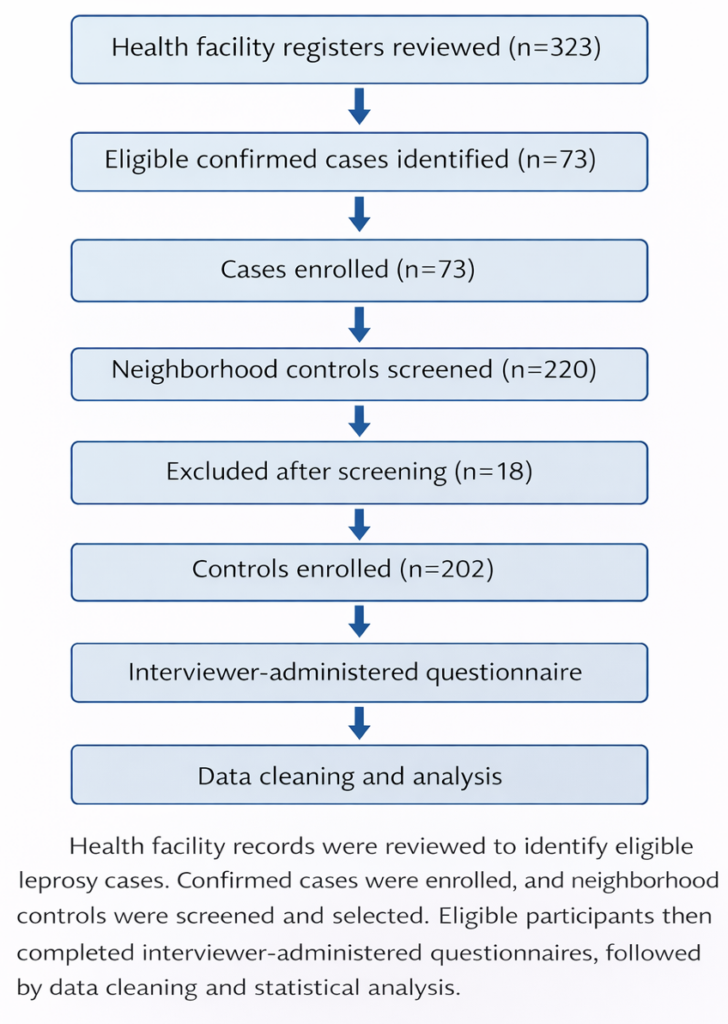
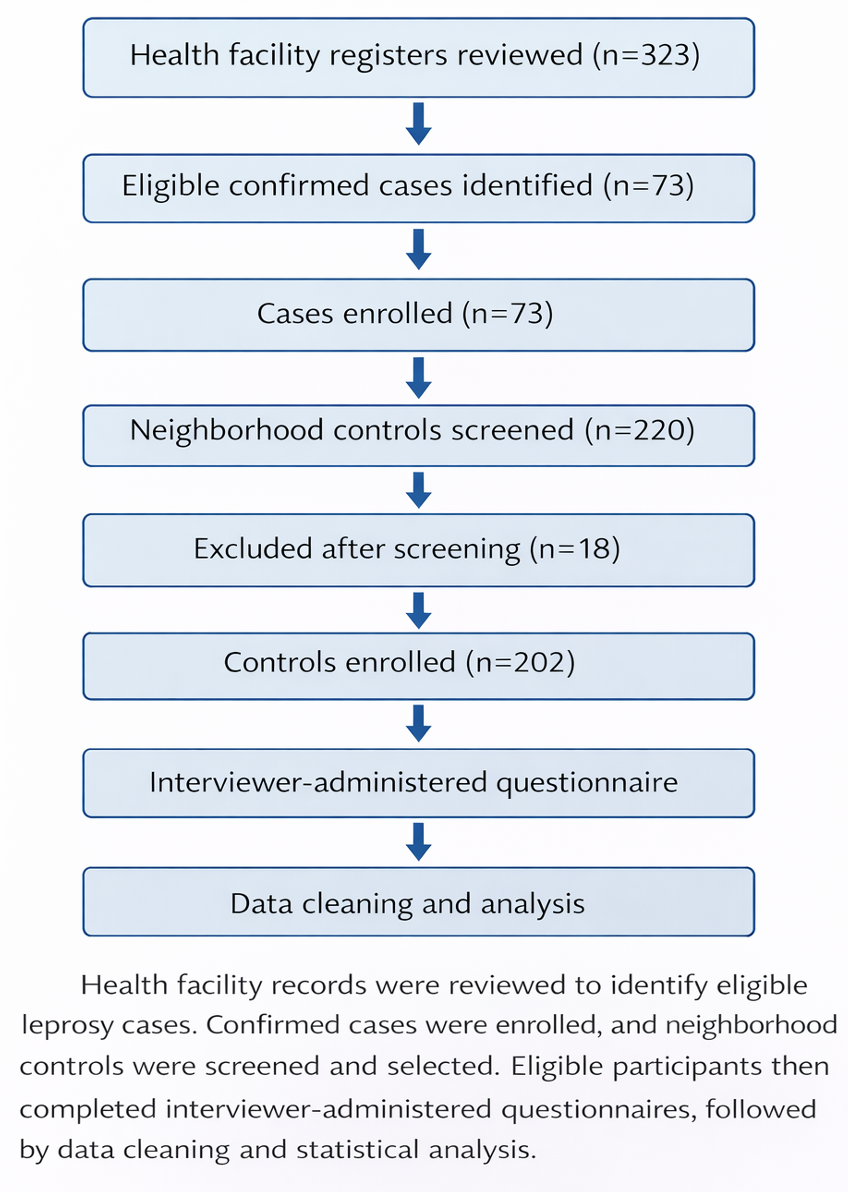
We conducted a community-based case-control study from April 1 to April 20, 2025, in Koboko and Nebbi Districts. A case–control design was chosen because leprosy is a relatively rare outcome in the general population and has a long incubation period. This design allowed efficient identification of associations between past exposures (e.g., close contact and poverty) and disease status within a short timeframe. A cohort design would have required long-term follow-up given the prolonged incubation period of leprosy, while a cross-sectional design would not adequately establish temporal relationships between exposure and disease. Therefore, a case–control approach was the most practical and methodologically appropriate design for investigating risk factors in this outbreak context. (Figure 2)
Sample size estimation and control group selection
The sample size was estimated using the Kelsey method for unmatched case-control studies, assuming that 30% of cases and 10% of controls would be exposed, with 80% power, a 95% confidence level, and a 1:3 case-to-control ratio to detect an association between the exposure of interest and leprosy. Using these assumptions, the estimated sample size was 275 participants (73 cases and 202 controls)[17].
We defined a case as a person with a documented leprosy diagnosis from health facility records who had not completed a full course of treatment from January 2024 to April 2025. Controls were persons without any signs or history of leprosy (no hypopigmented or reddish skin lesions with definite sensory loss or thickened peripheral nerves) residing in the same neighborhoods as the cases. All eligible leprosy cases identified through health facility registers between January 2024 and April 2025 were enrolled. Approximately three neighborhood controls were selected for each enrolled case. Selecting control-persons from the same neighborhood as case-persons helped to control for shared environmental and socio-economic factors, reducing confounding from geographic or community-level differences.
To minimize misclassification of controls, all potential control participants underwent symptom screening and clinical assessment by trained health workers before enrollment. Screening included evaluation for the three cardinal signs of leprosy: (1) hypopigmented or reddish skin lesions with definite sensory loss assessed using light touch testing; (2) thickened peripheral nerves with sensory or motor impairment; and (3) presence of acid-fast bacilli on slit-skin smear, where clinically indicated. (Slit-skin smear was performed only where clinical suspicion existed). Individuals with suspicious lesions or neurological signs were excluded and referred for further diagnostic evaluation. No controls met criteria suggestive of subclinical or active leprosy at the time of recruitment.
Data collection and study variables
Data were collected using a structured questionnaire. The questionnaire was designed to capture socio-demographic characteristics and possible risk factors such as prolonged contact with known leprosy cases. Health-seeking behavior, leprosy classification, disability status, and comorbidities (e.g., HIV, malnutrition). Exposure history was assessed by asking participants whether they had ever lived with or been in close contact with a person diagnosed with leprosy. Participants were also asked about the duration of residence in their current community and whether they had lived in or traveled to areas known to have a high burden of leprosy. For this study, close contact was operationally defined as a history of living in the same household as, or having frequent interaction with, a confirmed leprosy patient for approximately three years or more before diagnosis. This definition was informed by existing literature, indicating that prolonged exposure to untreated leprosy patients increases the risk of transmission [18-19].
Poverty status was operationally defined as having no reported source of income or reporting a monthly household income below the international poverty line of USD 3 per person per day (equivalent to approximately UGX 342,000 per month in 2025) [20]. Additionally, we captured information on clinical factors, including the presence of a comorbidity, disability grading, and any leprosy reactions due to medication among cases.
Data management and analysis
We performed statistical analyses using STATA version 14 (StataCorp LP, College Station, Texas, USA). Descriptive statistics, including frequencies, proportions, medians, and interquartile ranges, were used to summarize the sociodemographic and health characteristics of participants.
Differences in categorical characteristics between cases and controls were assessed using Pearson’s chi-square test or Fisher’s exact test, as appropriate. Bivariable logistic regression was used to assess associations between individual independent variables and leprosy status, and crude odds ratios (cORs) with 95% confidence intervals (CIs) were reported. Variables with p<0.20 at bivariable analysis were considered for inclusion in the multivariable logistic regression model to avoid excluding potentially important confounders. Multivariable logistic regression was used to identify factors independently associated with leprosy. Adjusted odds ratios (aORs) with 95% CIs and p-values were reported.
Ethical considerations
This study was conducted as a response to a public health emergency by the National Rapid Response Team. The Ministry of Health, Uganda, provided administrative clearance to conduct this investigation. The US Centers for Disease Control and Prevention (CDC) provided the non-research determination (NRD) for non-human subjects. In agreement with the International Guidelines for Ethical Review of Epidemiological Studies by the Council for International Organizations of Medical Sciences (1991) and the Office of the Associate Director for Science, US CDC/Uganda, it was determined that this activity was not human subject research and that its primary intent was public health practice or disease control activity (specifically, epidemic or endemic disease control activity). This activity was reviewed by the US CDC and was conducted consistent with applicable federal law and CDC policy. §§See, e.g., 45 C.F.R. part 46, 21 C.F.R. part 56; 42 U.S.C. §241(d); 5 U.S.C. §552a; 44 U.S.C. §3501 et seq. The investigation was conducted in accordance with applicable CDC policies and Ugandan Ministry of Health guidelines. Participation was voluntary; verbal informed consent was obtained from all participants (and from parents or legal guardians for participants aged <18 years); interviews were conducted in private; and all collected data were de-identified and securely stored to maintain confidentiality.
Characteristics of study participants
A total of 275 participants were enrolled, including 73 cases and 202 controls. Overall, most participants were aged ≥15 years, female, had primary education, and were peasant farmers, reflecting the largely rural population of the study area. About one-third of participants lived below the international poverty line (≤ USD 3/day), and most resided in Koboko District (Table 1).
Compared with controls, cases were more likely to be children aged <15 years (8% vs. 5%; p = 0.307), although this difference was not statistically significant, female (64% vs. 51%; p=0.0058), have no formal education (34% vs. 9%; p<0.0001), be unemployed (21% vs. 4%; p<0.0001), and live below the poverty line (62% vs. 25%; p<0.0001). Residence and nationality distributions were similar between the two groups. Among cases with available information, the median delay from symptom onset to seeking care was three years (range: 0–24) (Table 1).
Clinical presentation of leprosy case-patients
Among the 73 leprosy case-patients, the most commonly reported symptom was hypopigmented or reddish skin patches with loss of sensation. By disease classification, slightly more than half of the patients had multibacillary (MB) leprosy, while the remainder had paucibacillary (PB) disease. Nearly one-third of the cases presented with Grade 2 disability at diagnosis (Table 2).
Risk factors for leprosy transmission
In the multivariate analysis, having close contact with a leprosy patient significantly increased the odds of developing leprosy compared to those without close contact (aOR=3.83, 95% CI: 2.07–7.09, p<0.0001) (Table 3). Participants who earned ≤3 USD were also more likely to develop leprosy infection compared to those who earned >3 USD (aOR=3.57, 95% CI:1.84–7.14, p=0.0002) (Table 3).
This case-control study investigated factors associated with leprosy transmission in Koboko and Nebbi Districts, Uganda, during 2024–2025. Close contact with a leprosy patient and living below the poverty line emerged as the main factors associated with infection. Many case-patients also reported prolonged delays in seeking medical care after symptom onset. These findings suggest that socioeconomic vulnerability and prolonged household exposure are important factors associated with leprosy in Koboko and Nebbi districts.
A history of close contact with a person affected by leprosy was independently associated with higher odds of leprosy. This finding is consistent with global evidence indicating that household and neighborhood contacts of multibacillary patients face increased risk of infection [21]. Studies from Brazil and India report a 5–10-fold higher risk among household contacts compared to the general population [22], while research from Ethiopia suggests that the intensity and duration of exposure contribute to sustained transmission [23]. To effectively address the rising burden of leprosy in the region, we recommend strengthening active case finding and contact tracing through targeted community-based outreach, especially in known endemic areas.
Individuals living below the international poverty line were more than three times as likely to develop leprosy compared to those above it. Poverty has long been recognized as a determinant of leprosy, contributing to vulnerability through overcrowded housing, poor hygiene, malnutrition, and barriers to accessing timely healthcare [24,25]. Similar findings have been reported in studies from Bangladesh, Nepal, and Madagascar, where low socioeconomic status significantly predicted leprosy incidence [26]. Leprosy has long been known as a disease of poverty, as most of the affected countries are underdeveloped; people affected by leprosy are born and raised in poor environments and continue being pushed into poverty due to stigma and disabilities [26]. Poverty means more than just a lack of income; it also encompasses the multiplicity of non-monetary aspects that often combine and intensify the negative effects of being poor, including lack of access to proper food and nutrients. Correspondingly, food shortage, food insecurity, and lower dietary diversity are several aspects of poverty that are more commonly found in those struggling with leprosy [27]. The strong association observed in this study emphasizes that leprosy is not only a biomedical condition but also a disease of poverty where structural disadvantages perpetuate both transmission and stigma. Tackling poverty and its associated barriers is therefore central to interrupting the cycle of disease and disability. Strengthening contact tracing, promoting early case detection, and providing socioeconomic support to vulnerable populations may contribute to reducing the burden of leprosy in endemic communities.
Delayed care-seeking was notable in this study. The median time from symptom onset to diagnosis was three years, and nearly one-third of patients presented with Grade 2 Disability, indicating late detection. Prolonged delays extend the period during which infectious individuals remain untreated, increasing the likelihood of household and community transmission [28]. Barriers to early diagnosis in endemic regions may include stigma, misinterpretation of early skin lesions, limited diagnostic capacity at peripheral health facilities, and financial barriers to accessing care [29]. Strengthening community awareness, improving decentralization of diagnostic services, and integrating leprosy screening into routine outreach activities may help reduce diagnostic delays and interrupt transmission chains [30].
Although the majority of cases occurred among individuals aged ≥15 years, age was not independently associated with leprosy after adjustment for confounding factors. The relatively low proportion of child cases (<15 years) observed in this study contrasts with national reports from Uganda, where child cases account for approximately 13–15% of new notifications and are considered an indicator of recent transmission [31]. The predominance of adult cases in our study may reflect cumulative lifetime exposure, delayed diagnosis, or potential under-detection among children [32]. Continued monitoring of pediatric cases remains important for assessing ongoing transmission dynamics.
Sex and education level were not independently associated with leprosy after multivariable adjustment. While some studies have reported higher male prevalence [33], possibly due to occupational exposure or gender-related differences in health-seeking behavior, our findings suggest that transmission in this setting is more strongly influenced by household exposure and socioeconomic conditions than by demographic characteristics alone. The absence of a strong association with education may indicate that poverty and household exposure mediate much of the observed risk.
Overall, these findings call for targeted public health interventions focusing on early detection, improved contact management, and social support for vulnerable populations. Strengthening community-based surveillance and integrating leprosy screening into routine outreach programs could enhance early identification. Additionally, addressing structural barriers such as poverty, including livelihood support programs, is essential to reducing transmission and achieving national and global leprosy elimination targets.
Our study has some limitations. First, the use of retrospective health facility data to identify cases, which may have resulted in underreporting, particularly in hard-to-reach areas with low health-seeking behavior. To minimize this, we complemented facility data with community-based follow-up to ensure case data completeness. Second, exposure information such as duration and frequency of contact was self-reported, which may have introduced recall bias. Finally, the study was conducted in two districts within the West Nile Region, which may limit the generalizability of the findings to other settings in Uganda or beyond. Despite these limitations, this study has notable strengths. It is among the few analytical investigations of leprosy in Uganda in recent years, providing empirical evidence from a region with rising case notifications; it provides valuable insights to guide targeted interventions and inform national leprosy control strategies in Uganda.
Our study found that poverty and close contact with persons affected by leprosy were independently associated with leprosy in Koboko and Nebbi Districts. The strong association between socioeconomic vulnerability and leprosy highlights the need to address the disease not only as a biomedical condition but also as a social and economic challenge. We recommend implementation research evaluating socioeconomic interventions such as poverty alleviation, nutrition support, and livelihood programs integrated within leprosy control efforts to address structural drivers of transmission to reduce disability, and accelerate Uganda’s progress toward national and global leprosy elimination targets. In addition, future studies should consider longitudinal cohort designs to understand transmission dynamics among household contacts. Molecular epidemiology and immunological screening tools may also help identify transmission pathways and detect subclinical infection among high-risk populations.
What is already known about the topic
What this study adds
The authors of this work declare no competing interests. Lilian Bulage is an Associate Editor at the Journal of Interventional Epidemiology and Public Health (JIEPH) and a co-author of this manuscript. In line with the journal’s conflict of interest policy, she was fully recused from the peer review process and had no involvement in editorial handling or decision-making for this submission.
Disclosure
The funders had no role in the study design, data collection, data analysis, or decision to prepare or publish this manuscript.
The project was supported by the President’s Emergency Plan for AIDS Relief (PEPFAR) through the United States Centers for Disease Control and Prevention Cooperative Agreement number GH001353-01 through Makerere University School of Public Health to the Uganda Public Health Fellowship Program, Ministry of Health. The contents of this manuscript are solely the responsibility of the authors and do not necessarily represent the official views of the US Centers for Disease Control and Prevention, the Department of Health and Human Services, Makerere University School of Public Health, or the Uganda Ministry of Health.
Data availability
The datasets upon which our findings are based belong to the Uganda Public Health Fellowship Program. For confidentiality reasons, the datasets are not publicly available. The datasets can be made available upon reasonable request from the corresponding author with permission from the Uganda Public Health Fellowship Program.
GA, RM, BK, EM, CM, AM, ET, RK, AM, EOO, JOK participated in the conception, design, data collection, analysis, and interpretation of the study. GA wrote the draft manuscript; RM reviewed the report, reviewed the drafts of the manuscript for intellectual content and made multiple edits to the draft manuscript; RM, LB, and ARA reviewed the manuscript to ensure intellectual content and scientific integrity. All authors read and approved the final manuscript.
| Table 1: Characteristics of study participants in Koboko and Nebbi Districts, West Nile Region, Uganda, 2025 | ||||
|---|---|---|---|---|
| Variable | Total (N=275) n (%) | Cases (n=73) n (%) | Controls (n=202) n (%) | p-value |
| Age group (years) | ||||
| <15 | 16 (6) | 6 (8) | 10 (5) | 0.307 |
| ≥15 | 259 (94) | 67 (92) | 192 (95) | |
| Sex | ||||
| Male | 136 (49) | 26 (36) | 110 (54) | 0.0058* |
| Female | 139 (51) | 47 (64) | 92 (46) | |
| Education | ||||
| None | 43 (16) | 25 (34) | 18 (9) | <0.0001* |
| Primary | 168 (61) | 37 (51) | 131 (65) | |
| Secondary | 50 (18) | 10 (14) | 40 (20) | |
| Tertiary | 14 (5) | 1 (1) | 13 (6) | |
| Occupation | ||||
| Peasant farmer | 231 (84) | 48 (66) | 183 (91) | <0.0001* |
| Health worker | 4 (1) | 3 (4) | 1 (0) | |
| Other | 17 (6) | 7 (10) | 10 (5) | |
| Unemployed | 23 (8) | 15 (21) | 8 (4) | |
| Poverty status | ||||
| ≤ USD 3/day (Below poverty line) | 96 (35) | 45 (62) | 51 (25) | <0.0001* |
| > USD 3/day (Above poverty line) | 179 (65) | 28 (38) | 151 (75) | |
| Residence | ||||
| Koboko | 182 (66) | 46 (63) | 136 (67) | 0.504 |
| Nebbi | 93 (34) | 27 (37) | 66 (33) | |
| Nationality | ||||
| Ugandan | 271 (99) | 70 (96) | 201 (100) | 0.0586 |
| Foreigner | 4 (1) | 3 (4) | 1 (0) | |
| Time to Seeking Care (Years) | ||||
| 0–1 year (Early) | — | 40 (60)a | — | — |
| 2–4 years (Moderate) | — | 12 (18)a | — | — |
| 5–9 years (Long) | — | 5 (7)a | — | — |
| ≥10 years (Very long) | — | 6 (9)a | — | — |
| *Exchange rate used: 1 USD = 3,800 UGX (Bank of Uganda, mid-2025). According to the World Bank, the international poverty line is USD 3/day (~UGX 342,000 per person per month). aTime to seeking care categories was calculated among cases with complete onset and diagnosis dates. | ||||
| Table 2: Clinical presentation of leprosy case-patients in Koboko and Nebbi districts, West Nile region, Uganda, 2025 | ||
|---|---|---|
| Characteristics | Frequency (n) | Proportion (%) |
| Clinical Features | ||
| Patches on the skin with loss of sensation | 51 | 70 |
| Wounds on hands and feet | 8 | 11 |
| Painful swellings on the legs and hands | 6 | 8 |
| Shiny or oily/smooth appearance of the skin | 4 | 6 |
| Floppiness / Paralysis of hands and feet | 2 | 3 |
| Painless swellings/nodules over the body | 2 | 3 |
| Disease Classification | ||
| Multibacillary (MB) | 37 | 51 |
| Paucibacillary (PB) | 36 | 49 |
| Disability Status | ||
| Grade 0 Disability (G0D) | 50 | 68 |
| Grade 2 Disability (G2D) | 23 | 32 |
| Table 3: Risk factors for leprosy transmission in Koboko and Nebbi Districts, West Nile region, Uganda, 2025 | |||||
|---|---|---|---|---|---|
| Exposure variables | Cases n (%) | Controls n (%) | cOR (95% CI) | aOR (95% CI) | p-value |
| Age group | |||||
| <15 years | 6 (8%) | 10 (5%) | Ref | Ref | — |
| ≥15 years | 67 (92%) | 192 (95%) | 0.46 (0.16–1.36) | 0.62 (0.21–1.84) | 0.388 |
| Education* | |||||
| Lower level | 62 (85%) | 149 (74%) | Ref | Ref | — |
| Higher level | 11 (15%) | 53 (26%) | 0.48 (0.23–1.02) | 0.87 (0.37–2.02) | 0.741 |
| Poverty status** | |||||
| > USD 3/day | 28 (38.4%) | 151 (74.8%) | Ref | Ref | — |
| ≤ USD 3/day | 45 (61.6%) | 51 (25.2%) | 4.76 (2.71–8.33) | 3.57 (1.84–7.14) | 0.0002* |
| Occupation | |||||
| Employed | 60 (82%) | 194 (96%) | Ref | Ref | — |
| Unemployed | 13 (18%) | 8 (4%) | 5.25 (2.08–13.28) | 0.35 (0.12–1.05) | 0.061 |
| Close contact with a leprosy patient | |||||
| No close contact | 24 (33%) | 133 (66%) | Ref | Ref | — |
| Close contact | 49 (67%) | 69 (34%) | 3.94 (2.23–6.95) | 3.83 (2.07–7.09) | <0.0001* |
| Sex | |||||
| Male | 26 (36%) | 110 (54%) | Ref | Ref | — |
| Female | 47 (64%) | 92 (46%) | 0.46 (0.27–0.80) | 0.67 (0.35–1.27) | 0.218 |
| Close contact with a leprosy patient was categorized as close contact (history of living in the same household or having frequent, close physical interaction with a confirmed leprosy case for approximately three years or more before diagnosis) and no close contact (reference). **Poverty status was categorized as ≤ USD 3/day (below the international poverty line, i.e., no reported source of income or monthly household income < USD 3 per person per day, equivalent to ~UGX 342,000 in 2025) and > USD 3/day (above the poverty line, reference). *Education level was categorized as low education level (only primary education attained, with or without a certificate, or not completing primary education) and high education level (secondary education and above, reference). | |||||