
Outbreak Investigation | Open Access | Volume 9 (4): Article 195 | Published: 16 Nov 2026

Views: 41
Menu, Tables and Figures
| Event | Date | Comment |
|---|---|---|
| Symptom onset, probable primary case (49-year-old man) | Mid-September 2023 | |
| Symptom onset, wife (39 years) and daughter (6 years) | October 2023 | About one month after the man’s onset (self-reported) |
| Travel through church camps in Côte d’Ivoire | August–December 2023 | Self-reported route (Figure 1) |
| Arrival in Ghana (Dumasua) | 18 December 2023 | |
| First clinical contact in Ghana and scabies suspected | 20 December 2023 | |
| Skin scrapings collected and examined; scabies confirmed | 20 December 2023 | Private laboratory |
| Treatment started (ivermectin and benzyl benzoate) | 20 December 2023 | Same day as diagnosis |
| Investigation team dispatched | 20 December 2023 | |
| Field investigation (briefing, interviews, environmental assessment, survey) | 21–25 December 2023 | |
| Active case search (case definitions applied) | 18 December 2023 – 29 January 2024 | |
| Contact follow-up | December 2023 – April 2024 | About four months |
| End of investigation | 30 April 2024 | End of contact follow-up |
Table 1: Timeline of events for the three imported scabies cases and the investigation, Dumasua, Ghana, 2023–2024
Jamin Godswill Agbazo1, Samuel Nii Amaah-Quao1, Mbangba Benjamin1, Aguba Felicia1, Prince Quashie2, Daniel Konka3, Dora Dadzie1, Donne Kofi Ameme1, Charles Lwanga Noora1,&, Ernest Kenu1
1Ghana Field Epidemiology and Laboratory Training Programme, School of Public Health, University of Ghana, Accra, Ghana, 2Bono Regional Health Directorate, Ghana Health Service, 3Dormaa Municipal Health Directorate, Ghana Health Service
&Corresponding author: Charles Lwanga Noora, Ghana Field Epidemiology and Laboratory Training Programme, School of Public Health, University of Ghana, Accra, Ghana, Email: nooralwanga@gmail.com
Received: 30 Nov 2025, Accepted: 13 Nov 2026, Published: 16 Nov 2026
Domain: Infectious Disease Epidemiology
Keywords: scabies, imported cases, case-cluster investigation, contact tracing, cross-border, Ghana
©Jamin Godswill Agbazo et al. Journal of Interventional Epidemiology and Public Health (ISSN: 2664-2824). This is an Open Access article distributed under the terms of the Creative Commons Attribution International 4.0 License (https://creativecommons.org/licenses/by/4.0/), which permits unrestricted use, distribution, and reproduction in any medium, provided the original work is properly cited.
Cite this article: Jamin Godswill Agbazo et al. Imported scabies cases in Dumasua, Ghana: Findings from a case-cluster investigation, 2023. Journal of Interventional Epidemiology and Public Health. 2026; 9(4):195. https://doi.org/10.37432/jieph-d-25-00306
Introduction: Scabies is a neglected tropical disease that spreads readily in overcrowded settings, and human mobility can carry it across borders. In December 2023, three Ivorian nationals (a man, his wife and their six-year-old daughter) with generalised itchy skin lesions were diagnosed with scabies in Dumasua, Sunyani West Municipality, Ghana, after travelling to attend a church programme. We investigated the cases, followed their contacts, and assessed living conditions and community awareness of scabies.
Methods: We conducted a descriptive case-cluster investigation from December 21 to 25, 2023. The case definitions were applied from December 18, 2023, to January 29, 2024. We interviewed the cases, identified household and church contacts, and followed the contacts for four months. Skin scrapings were examined by microscopy. Living conditions were assessed with a checklist, and a convenience sample of 120 adult residents was surveyed on scabies awareness. Categorical variables are presented as frequencies and percentages, and continuous variables as median and interquartile range (IQR).
Results: Three cases were laboratory-confirmed: a 49-year-old man, a 39-year-old woman and a 6-year-old girl. The man was the first to develop symptoms, with onset in mid-September 2023, before the family arrived in Ghana on December 18, 2023. Twenty contacts (13 household and 7 church contacts) with a median age of 25.5 years, IQR 14.5–37.5 and 70% (14/20) being males were identified. No secondary cases were identified during follow-up. Sixteen people, including the three cases, shared a 25-m² space, and 75% (15/20) of contacts reported sharing bedding or towels; no soap or running water was available at the church. Among the 120 survey respondents, 35% (42/120) could identify the cause of scabies, 41.7% (50/120) its symptoms, 31.7% (38/120) its mode of transmission and 25% (30/120) preventive methods.
Conclusion: Three imported scabies cases were identified, and no secondary cases were found among 20 monitored contacts. Overcrowding, sharing of bedding and towels, and limited hygiene facilities were observed as potential risk-related exposures, and awareness of scabies was low in the surveyed sample. Infestation was probably acquired before arrival in Ghana, with Côte d’Ivoire the probable place of acquisition. Better risk communication, access to diagnosis, and cross-border information sharing are needed.
Scabies is a highly contagious, neglected tropical parasitic disease caused by the mite Sarcoptes scabiei var. hominis. It is characterised by intense itching and redness due to the mites burrowing into the skin and laying eggs [1]. Scabies manifests in various skin lesions, including nodules, pustules, papules, and, less commonly, urticarial lesions, with pruritus being the most prevalent symptom surrounding the infected areas [2]. Globally, scabies is estimated to affect more than 200 million people at any one time and over 400 million people cumulatively each year [3]. It occurs in every country but is most common in resource-poor tropical settings, particularly among children and older people, and prevalence in children in such settings is reported to range from 5% to 50% [3]. A 2015 systematic review of population-based surveys found community prevalence ranging from 0.2% to 71.4%, depending on the population studied [4]. The burden falls mainly on low- and middle-income countries, where crowded living conditions and limited access to effective treatment sustain transmission and recurrent outbreaks [2].
Frequent, less regulated cross-border migration in sub-Saharan Africa poses significant challenges to public health systems, as it facilitates the rapid spread of infectious diseases across national boundaries [5,6]. This fluidity complicates the ability of individual countries to manage outbreaks effectively, as cases may originate in one country and spread to another before detection and response measures are implemented [7]. Outbreaks often disrupt community life and expose weaknesses in the health systems of affected countries, especially in rural areas where diagnostic facilities and effective treatment options are inadequate [8]. Factors associated with risk of spread and outbreaks include larger household sizes, lower socioeconomic status, limited access to healthcare, younger age, having an itchy family member, and poor bathing practices [9]. Despite these increased risks and the porousness of Ghana’s borders, there is a paucity of documented scabies outbreak investigations in Ghana, particularly those involving imported cases with potential for cross-border spread [10].
In December 2023, three Ivorian nationals: a man, his wife, and their six-year-old daughter who had arrived in Ghana on December 18, 2023, for a Christmas church programme, presented to a hospital on December 20, 2023, with intense itching and generalised rashes. Investigation showed that all three cases had generalised, itchy skin rashes with crusted lesions. The attending Physician Assistant, suspecting scabies, collected skin samples for laboratory analysis. The results confirmed the presence of Sarcoptes scabiei eggs in the skin scrapings, indicating a positive diagnosis of scabies. The investigation further revealed that the affected family had travelled from neighbouring Côte d’Ivoire and, at the time of the investigation, were staying in an apartment with 13 other people, raising concerns about the potential for further transmission. Although only three cases were initially confirmed, an intensive investigation was warranted due to the highly contagious nature of scabies. Furthermore, the family’s participation in large-scale church gatherings necessitated a proactive response to prevent the imported cluster from evolving into a community-wide outbreak. Given the porousness of Ghana’s borders and the lack of documented investigations into imported scabies cases, this response was considered necessary for local containment and public health surveillance. The team, made up of Ghana Health Service officials and members of the Ghana Field Epidemiology and Laboratory Training Program (GFELTP), was dispatched on December 20, 2023, to investigate the case cluster. The objectives were to assess the magnitude of the cluster, describe environmental and behavioural conditions that could facilitate spread, and institute preventive and control measures.
Design and setting
This descriptive case-cluster investigation was conducted in Dumasua in the Sunyani West Municipality of the Bono Region, Ghana, from December 21 to 25, 2023. Dumasua is a rural town located within the Sunyani West Municipality. The town lies along the Sunyani-Berekum Road, bordered by Fiapre and Mentukwa. The population is predominantly farmers, with an estimated population of 8,823. The area is characterised by a relatively warm, humid climate with limited access to piped water and other essential health services. No prior scabies clusters or outbreaks have been reported in this community recently, and routine disease surveillance is conducted through a combination of health facility reporting and community-based surveillance volunteers.
Key dates are summarised in Table 1. In this report, arrival refers to entry into Ghana (December 18, 2023); detection refers to the first clinical suspicion and laboratory confirmation of scabies; the investigation period refers to the field investigation (21–25 December 2023); active case search refers to the period during which the case definitions were applied (18 December 2023 to 29 January 2024; and contact follow-up refers to the period during which contacts were monitored for symptoms (December 2023 to April 2024).
Stakeholder engagement
An initial briefing was held on December 21, 2023, with the Sunyani West Municipal Health Management Team (MHMT) led by the Municipal Director of Health Services. The meeting provided an overview of the cluster, including discussions on the immediate actions needed to contain the cluster, the role of the local health officials, and the available resources. Subsequent meetings were held with the midwife in charge of Dumasua Health Centre, selected community leaders, key stakeholders from the church that the family attended, and the head of the household where the family lodged.
Cluster case definition
The following case definitions were developed based on WHO guidelines for scabies outbreaks in resource-limited settings and adapted to the local context.
Suspected case: Any person residing in or visiting Dumasua who, between December 18, 2023, and January 29, 2024, presented with signs and symptoms consistent with scabies, such as burrows, intense pruritus (itching), especially at night, or a generalised rash and secondary infections on the head, face, neck, armpits, elbows, wrists, palms, buttocks, and soles.
Confirmed case: Any person residing in or visiting Dumasua who has skin scrapings in which mites, mite eggs, or mite faeces have been identified by a trained healthcare professional [11]. In this report, the three laboratory-confirmed family members are referred to as “the cases”. The 49-year-old man, the first family member to develop symptoms, is considered the probable primary case, and his wife and daughter are subsequent cases. All three are described as imported cases because, on the reported timeline, the infestation was probably acquired before arrival in Ghana.
Active case search
The team conducted individual interviews with all members of the household and identified the cases and potential contacts. We used the case definition to assess for symptoms of scabies. We gathered detailed information about their interactions with the cases. In addition, we identified the church where the cases had participated in Christmas activities. The individuals who had close interaction with the cases were identified and interviewed and were then monitored for the development of scabies symptoms.
Contact definition and follow-up
A contact was defined as any person who shared a room, bed, bedding, towels or clothing with a case, or had prolonged skin-to-skin contact with a case, from symptom onset or arrival until treatment was started. Household contacts were the other occupants of the apartment where the family lodged. Church contacts were attendees who met the contact definition and were identified through interviews with the cases and church leaders. Contacts were followed up from December 2023 to April 2024 using scheduled visits by the investigation team and Community Health Officers at weekly intervals. At each contact, they were asked about itching and rash, and symptoms were assessed using self-report and examination by health workers. Any contact meeting the suspected case definition was to be examined and tested. The four months were chosen to cover more than two typical incubation periods of scabies (about 2–6 weeks after a first infestation) and to allow for possible second-generation cases.
Data collection tools and process
A semi-structured interview guide was used to conduct in-depth interviews with two of the cases (the husband and wife). A structured questionnaire was designed and used to collect demographic, clinical, and behavioural information from affected individuals and their contacts. These questionnaires included sections on personal details, symptoms, onset dates, potential exposure, and travel histories. A checklist was also used for behavioural and environmental assessments of living conditions, hygiene practices, and the availability of hand hygiene facilities such as running water and soap. A line list was used to systematically record and organise information about all identified cases and contacts. The line list captured data on demographics, clinical features, treatment, and outcomes.
Environmental and behavioural assessment
The team used a checklist to assess the residence where the family lodged, focusing on household hygiene, sanitation, and shared living spaces. We assessed the overall community hygiene practices and the presence of hand hygiene facilities like running water, soap, and paper towels in the houses and public places, such as the health facilities.
Case management
The team assessed the health center’s capacity to manage and treat cases, including diagnostic capability, the availability of medications, isolation places, WASH facilities, and the ability to conduct contact tracing.
Laboratory assessment
Skin scrapings were collected from all three cases on December 20, 2023, using sterile scalpel blades. The samples were collected and processed at a private laboratory, as government-owned laboratories lacked the resources to carry out the investigation. Samples were taken from the edges of active lesions, including burrows and papules. The skin surface was first cleaned with 70% alcohol, and mineral oil was applied to enhance the adherence of the material to the scalpel blade during scraping. The collected material was transferred into sterile containers labelled with the patients’ details. A small portion of each sample was placed on a glass slide, mixed with two drops of 20% potassium hydroxide (KOH) solution to dissolve keratin and other debris, and covered with a coverslip. The sample was then placed in a Petri dish and allowed to sit for 20 minutes. The slides were examined under a light microscope (Olympus CH20i) at 10x and 40x magnification to identify Sarcoptes scabiei eggs, larvae, or mites.
Assessment of community awareness and knowledge of scabies
Study design and contextual timing
To evaluate general community awareness and establish the initial reach of public health messaging during the emergency response, a rapid cross-sectional survey was conducted in Dumasua from 21 to 25 December 2023. Data collection was carried out concurrently alongside active emergency risk communication and community engagement activities to capture real-time population knowledge during ongoing containment efforts.
Sampling Strategy and Eligibility
A rapid convenience sampling design was employed to recruit a sample of 120 adult community residents. Field investigators systematically approached prospective participants in high-traffic public hubs, specifically within the premises of the Dumasua Health Centre and the immediate vicinity of the church attended by the index cases. Eligible participants comprised community residents aged 18 years or older who provided voluntary informed consent. Individuals previously identified as primary household or church contacts of the index cases were excluded from the survey to differentiate general population awareness from targeted contact-tracing health education.
Questionnaire instrument and data collection
Data were collected using a structured questionnaire adapted from World Health Organization guidance on scabies outbreak management. The instrument was pre-tested locally and administered face-to-face in the local language (Twi) by the investigation team. The survey evaluated participant understanding across four discrete knowledge domains: aetiology (identification of the parasitic mite cause), transmission (modes of direct and indirect spread), clinical manifestations (recognition of cardinal signs and nocturnal pruritus), and prevention and control (personal hygiene and preventive measures).
Scoring system and operational definitions
Domain-specific responses were scored against standardised criteria derived from World Health Organization benchmarks. In accordance with a pre-defined 75% cut-off threshold, respondents who correctly answered at least 75% of indicator items within a domain were categorised as knowledgeable, whereas those scoring below 75% were designated as not knowledgeable. Categorical knowledge outcomes across all four domains were summarised using absolute counts and percentages.
Data Analysis
The data were cleaned in Microsoft Excel, and the analysis was done in Stata V17. Descriptive analysis was done, and the data were described by person, place, and time. The categorical variables were expressed as frequencies and proportions, while continuous variables were expressed as medians and interquartile ranges (IQR). The spatial distribution of cases was mapped using spot maps to highlight affected households. We calculated the secondary attack rate as the number of secondary cases among monitored contacts divided by the number of contacts monitored. Because the cases were imported, community-level attack rates were not calculated. Results were presented in text, a table, a chart, and a map.
Ethical consideration
This investigation was conducted as a primary public health response to a suspected disease cluster and not a planned study. In accordance with national guidelines for outbreak investigations and emergency response efforts, formal ethical review board approval was not required. The investigation was conducted under the administrative mandate of the Ghana Health Service, with formal approvals obtained from the Bono Regional Health Directorate and the Sunyani West Municipal Health Directorate. Nevertheless, ethical principles were strictly followed: informed consent was obtained from all adult participants prior to interviews and clinical assessments; for the six-year-old child and other participants younger than 18 years, consent was obtained from a parent or guardian, and all data were anonymised and stored securely to ensure confidentiality.
Descriptive analysis
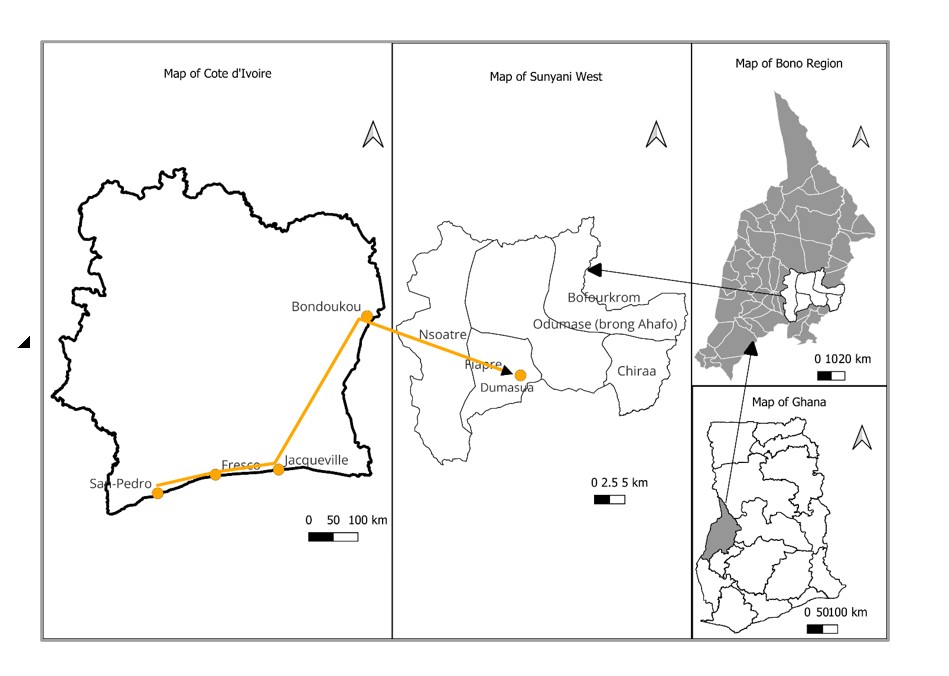
The cluster comprised three laboratory-confirmed imported cases, all Ivorian nationals who had travelled to Ghana for Christmas festivities. The cases were detected after their arrival in Ghana on December 18, 2023. They reported having developed itching and skin rashes while still in Côte d’Ivoire, before travelling to Ghana. Despite seeking medical care, their condition remained untreated until December 20, 2023, when a clinician in Ghana suspected scabies through clinical examination and confirmed it with laboratory testing. The cases were a 49-year-old man, a 39-year-old woman, and a 6-year-old girl. They reported prior contact with people in Côte d’Ivoire who had similar symptoms. They also reported travelling through areas with limited water availability and overcrowded places. They shared beds, towels, and living spaces with other individuals. The family reported overcrowded conditions and limited water availability during their transit through four church camps in Côte d’Ivoire between August and December 2023. In Ghana, they lodged in Dumasua and participated in Christmas church activities involving 100 attendees. The movement of the family is indicated in Figure 1, which illustrates the spatial trajectory of the Ivorian family across four church camps before their entry into Ghana. The map details a transit path through San-Pedro, Fresco, Jacqueville, and Bondoukou, before arriving in Dumasua, Ghana.
The probable primary case, a 49-year-old male pastor, was the first family member to become symptomatic; approximately three months (Mid-September 2023) before he arrived in Ghana. His condition began with itchy lesions between his fingers and later spread to other parts of his body. Despite worsening symptoms, he continued his travels due to his pastoral duties and interacted frequently with large groups during religious gatherings. About a month after his symptoms began (October 2023), his wife and 6-year-old daughter also started showing similar signs. Upon arrival in Ghana, the family sought medical attention, and scabies was confirmed through laboratory detection of Sarcoptes scabiei eggs. All three cases had generalised, itchy skin lesions with crusting. The timeline of events is shown in Table 1.
During their time in Ghana, the family lived in a shared apartment with 13 other household members and had close interaction with seven additional church members. A total of 20 contacts were identified, assessed, and placed under close monitoring during the disease’s incubation period. No contact developed symptoms during follow-up, so no secondary cases were identified: the secondary attack rate was 0% (0/20) among the 13 household and 7 church contacts. The median age of the 20 contacts was 25.5 years (interquartile range, 14.5 –37.5 years), with a majority (70%, 14/20) being male. No further scabies cases were identified or reported outside the immediate family during the case-search period.
Behavioural and environmental assessment
In the household with the cases, 16 individuals (the three cases and 13 other household members) shared a crowded 25-square-meter space. Visits to three other contacts’ households revealed one with a single occupant, another with two people sharing 18 square meters, and a third with three individuals sharing 20 square meters. Among the 20 contacts interviewed, 75% (15/20) reported sharing personal items such as bedding and towels. At the church premises, congregants interacted freely, with an average interaction time of two hours. There was no provision for soap and running water for handwashing.
Laboratory assessment
Skin scrapings from the three cases were collected and analysed at a private laboratory, which confirmed the presence of Sarcoptes scabiei eggs in all three samples. No additional samples were collected from contacts, as none developed symptoms.
Case management
Health centre assessments revealed adequate capacity to manage scabies cases and sufficient medication stock, including Ivermectin from a previous deworming project. However, the health centre and other bigger health facilities in the district lack diagnostic capabilities. All confirmed cases were treated with Ivermectin and topical benzyl benzoate. Personal hygiene education was provided, which emphasised the importance of avoiding shared use of bedding and towels. Isolation spaces and WASH (Water, Sanitation, and Hygiene) facilities were available at the health facility, and the facility can conduct contact tracing.
Assessment of community awareness and knowledge of scabies
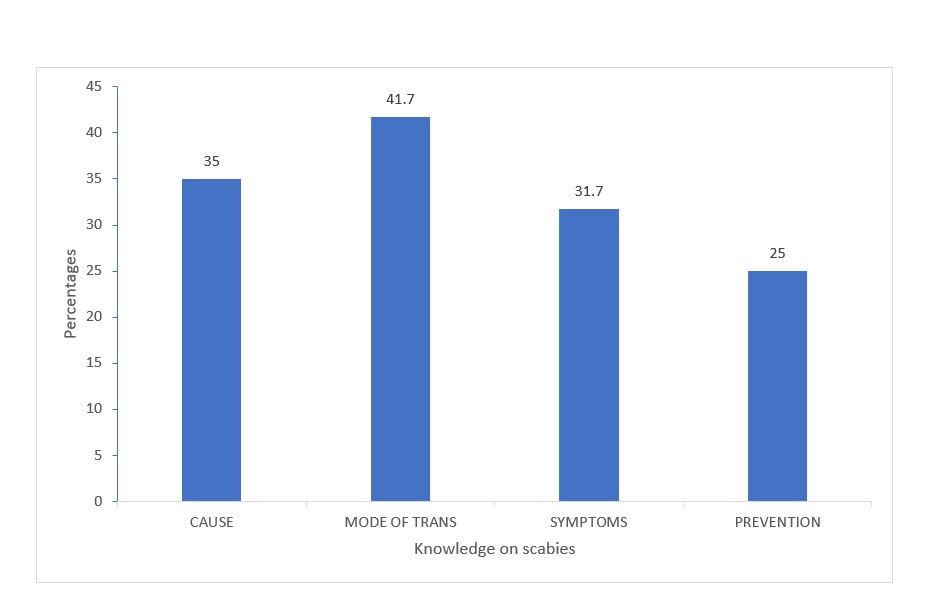
The survey conducted among 120 adult residents of Dumasua using convenience sampling revealed that only 35% (42/120) were aware of the cause of scabies, 41.7% (50/120) could correctly identify its symptoms, 31.7% (38/120) understood its mode of transmission, and 25% (30/120) were aware of effective prevention methods (Figure 2).
This investigation describes three laboratory-confirmed scabies cases whose infestation was probably acquired before arrival in Ghana. The cluster is best understood as imported rather than locally acquired. The family’s self-reported travel through four church camps in Côte d’Ivoire points to that country as the probable place of acquisition, consistent with the broader role of population mobility in the cross-border spread of neglected tropical diseases across West African national boundaries [6,10]. The source of the cluster was not confirmed, because bureaucratic delays prevented a coordinated cross-border investigation. This highlights the necessity for formalised regional surveillance strategies and information sharing between neighbouring health directorates [12].
No secondary cases were identified among the 20 monitored contacts. With so few contacts, this finding does not exclude a small risk of transmission. Possible explanations for the absence of detected secondary cases include prompt treatment of the cases and limited intensity of contact for most church attendees. Larger community-wide outbreaks have been reported elsewhere in Ghana, such as in the Northeast Region, where a prevalence of 71% was recorded, which was attributed to the lack of a systematic approach to treatment [13]. In Dumasua, no secondary cases were identified after prompt clinical suspicion, laboratory confirmation, treatment of the cases, and implementation of control measures; these measures may have contributed to limiting transmission [14].
Several conditions that may facilitate scabies transmission were observed. The household where the family lodged shared a 25-square-meter space among 16 individuals, far exceeding the UN-Habitat standard of no more than three persons per habitable room [15,16]. Overcrowding is widely recognised as favouring scabies transmission [14]. Furthermore, 75% of contacts reported sharing personal items such as bedding and towels. Scabies spreads mainly through prolonged skin-to-skin contact, and sharing of clothing and bedding has been associated with scabies in previous studies [17,18]. The absence of soap and running water at the church premises was a marker of limited hygiene infrastructure since the principal mechanism of scabies transmission depends mainly on close, prolonged contact and shared bedding or clothing rather than on hand hygiene. Awareness of scabies was also low among the 120 survey respondents, and only a few were able to identify its cause and preventive measures. This knowledge gap may represent a public health vulnerability since without the ability to recognize symptoms or understand transmission, communities are less likely to report cases early, which could facilitate the transition from a cluster to an outbreak [17]. Low knowledge has also been documented in Ethiopia: only 16.8% of schoolchildren in Dabat district had good knowledge of scabies [19], and low caregiver knowledge was independently associated with scabies among children in Lay Gayent district [17]. The low level of knowledge in this convenience sample similarly suggests a need for targeted risk communication and community engagement.
The reliance on a private laboratory for diagnosis suggests limited access to microscopy-based confirmation at primary-care level in the Sunyani West Municipalities. Without accessible diagnostic facilities at primary care centres, many cases may be misdiagnosed as other dermatoses, leading to delayed treatment and continued spread [9]. This investigation illustrates the value of confirming the diagnosis, where possible, through identification of the mite or eggs [20]. The cases were treated with oral Ivermectin and topical benzyl benzoate, and no secondary cases were identified. This approach is consistent with the recommendations of Richardson et al. and WHO[11,21], which advocate for oral Ivermectin as a pragmatic tool for managing clusters in resource-limited or overcrowded settings where topical application compliance may be low [14,21]. Taken together, these findings point to the value of accessible diagnostic capacity and of cross-border surveillance mechanisms for detecting and managing imported clusters before they can spread locally.
Limitations
One limitation of the cluster investigation was our inability to extend the investigation to Côte d’Ivoire. We contacted the Dormaa Municipal Health Directorate to collaborate with local health authorities in Côte d’Ivoire to trace the source of the cluster. However, prolonged bureaucratic processes prevented the cross-border investigation. This limited the investigation to only Ghana; hence, the true magnitude and source of the cluster could not be assessed. Consequently, the origin of the cluster and the broader transmission chain rely entirely on self-reported travel and contact history, which is subject to recall bias or inaccuracies.
Furthermore, without diagnostic data from the Ivorian church camps visited by the family, the imported nature of this cluster remains a clinical inference rather than an epidemiologically verified cross-border link. Furthermore, the community awareness survey was limited by potential selection bias. Because a rapid assessment was conducted using convenience sampling, the 120 respondents may not be fully representative of the entire Dumasua population. Additionally, the small number of identified contacts limits inference about transmission. There was no comparison group, so the effect of the response on transmission cannot be established, and no analytical comparison of cases and non-cases was made, so the conditions we observed cannot be regarded as demonstrated risk factors.
This investigation identified three imported, laboratory-confirmed scabies cases in one family, and no secondary cases were identified among 20 monitored contacts (0/20). Twenty contacts, including household members and church attendees, were identified and placed under close monitoring. No secondary cases were identified during follow-up after control measures were implemented; because there were few contacts and no comparison group, the effect of these measures on transmission cannot be established. The response, which included treatment of the cases and health education on personal hygiene and on avoiding the sharing of personal items, may have contributed to limiting transmission. The investigation observed overcrowding, the sharing of bedding and towels, and limited access to hygiene facilities, including running water and soap, as potential risk-related exposures: overcrowding and sharing of personal items were observed in the household where the family lodged, there was no soap or running water at the church premises, and the family reported similar conditions in the church camps in Côte d’Ivoire. Additionally, low awareness and knowledge of scabies among the 120 survey respondents suggest a need for risk communication in the community. The investigation also showed that confirmation of the diagnosis depended on a private laboratory.
On the reported timeline, the infestation was probably acquired before arrival in Ghana, and the family’s self-reported travel points to Côte d’Ivoire as the probable place of acquisition, although the source was not confirmed; this illustrates the role of population movement in the spread of neglected tropical diseases. However, the lack of a collaborative investigation in Côte d’Ivoire highlights a critical gap in regional surveillance that must be addressed to confirm such transmission pathways in the future. We recommend that the Sunyani West Municipal Health Directorate strengthen community education and hygiene practices, enhance diagnostic and laboratory capacity, ensure sustained follow-up of cases and contacts, and improve cross-border collaboration to prevent and control future scabies clusters or outbreaks. The Sunyani West Municipal Health Directorate should collaborate with Ivorian health authorities to develop a unified strategy for cross-border surveillance and outbreak response.
What is already known about the topic
What this study adds
We sincerely thank the Sunyani West Municipal Health Management Team and the staff of the Dumasua Health Center for their collaboration and support during the scabies cluster investigation. We are also grateful to the Dormaa Municipal Health Directorate for their collaboration in reaching the Ivorian health officials. We are also grateful to the community leaders, church authorities, and residents of Dumasua for their cooperation during the field activities. Special appreciation goes to the Dormaa Municipal Health Directorate for facilitating cross-border communication with health authorities in Côte d’Ivoire. Finally, we acknowledge the cooperation of the index family, contacts, and all Dumasua residents who were interviewed during the cluster investigation.
Conceptualization: Jamin Godswill Agbazo, Samuel Nii Amaah-Quao, Mbangba Benjamin, Aguba Felicia, Prince Quashie, Daniel Konka, Dora Dadzie, Donne Kofi Ameme, Charles Lwanga Noora
Data curation: Jamin Godswill Agbazo, Samuel Nii Amaah-Quao, Mbangba Benjamin, Aguba Felicia
Formal analysis: Aguba Felicia
Investigation: Jamin Godswill Agbazo, Samuel Nii Amaah-Quao, Mbangba Benjamin, Aguba Felicia, Prince Quashie, Daniel Konka, Dora Dadzie, Charles Lwanga Noora
Methodology: Jamin Godswill Agbazo, Samuel Nii Amaah-Quao, Mbangba Benjamin, Donne Kofi Ameme
Project administration: Charles Lwanga Noora
Visualization: Dora Dadzie
Project administration: Ernest Kenu
Resources: Ernest Kenu
Supervision: Prince Quashie, Daniel Konka, Donne Kofi Ameme, Charles Lwanga Noora, Ernest Kenu
Writing – original draft: Jamin Godswill Agbazo, Samuel Nii Amaah-Quao
Writing – review & editing: Jamin Godswill Agbazo, Dora Dadzie, Charles Lwanga Noora, Donne Kofi Ameme, Ernest Kenu
| Event | Date | Comment |
|---|---|---|
| Symptom onset, probable primary case (49-year-old man) | Mid-September 2023 | |
| Symptom onset, wife (39 years) and daughter (6 years) | October 2023 | About one month after the man’s onset (self-reported) |
| Travel through church camps in Côte d’Ivoire | August–December 2023 | Self-reported route (Figure 1) |
| Arrival in Ghana (Dumasua) | 18 December 2023 | |
| First clinical contact in Ghana and scabies suspected | 20 December 2023 | |
| Skin scrapings collected and examined; scabies confirmed | 20 December 2023 | Private laboratory |
| Treatment started (ivermectin and benzyl benzoate) | 20 December 2023 | Same day as diagnosis |
| Investigation team dispatched | 20 December 2023 | |
| Field investigation (briefing, interviews, environmental assessment, survey) | 21–25 December 2023 | |
| Active case search (case definitions applied) | 18 December 2023 – 29 January 2024 | |
| Contact follow-up | December 2023 – April 2024 | About four months |
| End of investigation | 30 April 2024 | End of contact follow-up |