
Research | Open Access | Volume 9 (3): Article 136 | Published: 18 Aug 2026

Views: 1,000
Menu, Tables and Figures
| Variable | Overall (N=569) | Current alcohol and other drug use | Chi-square / p value | |
|---|---|---|---|---|
| Yes (n=103) | No (n=466) | |||
| Age^⁋ (Years) | 0.27 | |||
| <18 | 146 (26%) | 22 (21%) | 124 (27%) | |
| ≥18 | 423 (74%) | 81 (79%) | 342 (73%) | |
| Sex | 0.7 | |||
| Female | 169 (30%) | 29 (28%) | 140 (30%) | |
| Male | 400 (70%) | 74 (72%) | 326 (70%) | |
| Religion | 0.16 | |||
| Catholic | 216 (37%) | 37 (35%) | 179 (39%) | |
| Protestant | 239 (42%) | 40 (39%) | 199 (42%) | |
| Muslim | 55 (10%) | 12 (12%) | 43 (9%) | |
| Other | 59 (11%) | 14 (14%) | 45 (10%) | |
| Class level* | 0.037 | |||
| Ordinary (senior 1-4) | 240 (42%) | 34 (33%) | 206 (44%) | |
| Advanced (Senior 5-6) | 329 (58%) | 69 (67%) | 260 (56%) | |
| Nature of the school | 0.045 | |||
| Boys only | 163 (29%) | 21 (20%) | 142 (30%) | |
| Girls only | 225 (39%) | 40 (39%) | 185 (40%) | |
| Mixed (Boys and Girls) | 181 (32%) | 42 (41%) | 139 (30%) | |
| School ownership | 0.002 | |||
| Faith-based | 285 (50%) | 40 (39%) | 245 (53%) | |
| Government | 211 (37%) | 40 (39%) | 171 (36%) | |
| Private | 73 (13%) | 23 (22%) | 50 (11%) | |
| Ever used AOD | – | |||
| No | 414 (73%) | 0 (0%) | 414 (89%) | |
| Yes | 155 (27%) | 103 (100%) | 52 (11%) | |
| Mean age (standard deviation): 18 (1.9); Median=19 (17-20) years Abbreviation: AOD = Alcohol and Other Drugs ⁋ Age was classified as under 18 years to represent children and ≥18 to represent adults as per the Uganda’s constitution * Class level was divided into ordinary class level, classifying students from senior 1 to 4, while the advanced class level referred to students from senior 5 and 6 | ||||
Table 1: Characteristics of secondary student leaders, by current alcohol and other drug use status, Uganda, July 2024
| Variable | Frequency (n=103) | Percentage (%) |
|---|---|---|
| Number of days AOD were used | ||
| 1–2 | 50 | 49 |
| 3–5 | 9 | 9 |
| 6–9 | 9 | 9 |
| 10–19 | 10 | 9 |
| 20–29 | 10 | 9 |
| All 30 | 15 | 15 |
| Frequency of use in a day | ||
| 1 | 73 | 71 |
| 2 | 21 | 20 |
| 3 | 9 | 9 |
| With whom they use the AOD | ||
| With friends | 55 | 53 |
| With family | 22 | 21 |
| With friends and family | 12 | 12 |
| Alone | 14 | 14 |
| Where AOD were used | ||
| Home | 57 | 55 |
| School | 20 | 19 |
| Home and school | 11 | 11 |
| Other places e.g. bars, outings | 15 | 15 |
| Circumstances for introduction to AOD | ||
| Peer pressure | 74 | 72 |
| Curiosity | 14 | 13 |
| Mental Health disorders like anxiety, depression | 5 | 5 |
| Family environment | 8 | 8 |
| Media | 2 | 2 |
Table 2: Patterns of alcohol and other drug use among current users
| Variable | cPR | aPR | ||||
|---|---|---|---|---|---|---|
| cPR | 95% CI | p-value | aPR | 95% CI | p-value | |
| Sex | ||||||
| Female | Ref | Ref | ||||
| Male | 1.09 | 0.68-1.8 | 0.704 | 1.07 | 0.66-1.7 | 0.791 |
| Age group | ||||||
| <18 | Ref | Ref | ||||
| ≥18 | 1.3 | 0.79-2.2 | 0.271 | 0.8 | 0.39-1.6 | 0.535 |
| Class level | ||||||
| O’level | Ref | Ref | ||||
| A’level | 1.6 | 1.03-2.5 | 0.038 | 1.6 | 0.9-3.0 | 0.107 |
| School type | ||||||
| Boarding | 1 | Ref | ||||
| Day | 1.5 | 0.83-2.6 | 0.193 | 1.4 | 0.76-2.6 | 0.28 |
| Mixed (Day&Boarding) | 2.04 | 0.015 | 1.6 | 0.89-3.0 | 0.111 | |
| School ownership | ||||||
| Faith-based | Ref | Ref | ||||
| Government | 1.4 | 0.89-2.3 | 0.142 | 1.2 | 0.70-1.9 | 0.567 |
| Private | 2.8 | 1.6-5.1 | 0.001 | 2.4 | 1.3-4.5 | 0.005 |
| Nature of the school | ||||||
| Single sex | Ref | Ref | ||||
| Mixed sex | 3.3 | 1.2-9.4 | 0.024 | 2.4 | 0.83-7.1 | 0.106 |
| Peer pressure | ||||||
| No | Ref | Ref | ||||
| Yes | 1.01 | 0.86-1.13 | 0.908 | 1.01 | 0.89-1.2 | 0.878 |
| Abbreviations: cPR = Crude Prevalence Ratio; aPR = Adjusted Prevalence Ratio; CI = Confidence Interval *Class level was divided into ordinary classifying students from senior 1 to 4, while the advanced class level referred to students from senior 5 and 6 | ||||||
Table 3: Multivariable analysis for factors associated with current alcohol and other drug use among secondary school student leaders in Uganda, July 2024
Charity Mutesi1,&, Byamah Mutamba2, Kenneth Kalani3, Richard Migisha1, Emmanuel Mfitundinda1, Emmanuel Okello Okiror1, Joanita Nalwanga1, Hannington Katumba1, Patrick Kwizera1, Lilian Bulage1, Benon Kwesiga1, Daniel Kadobera4, Alex Riolexus Ario1, Hafsa Sentongo3
1Uganda Public Health Fellowship Program, Uganda National Institute of Public Health, Kampala, Uganda, 2Butabika National Mental Hospital, Kampala, Uganda; 3Mental Health Division, Ministry of Health, Kampala, Uganda; 4Division of Global Health Protection, U.S. Centers for Disease Control and Prevention, Kampala, Uganda
&Corresponding author: Charity Mutesi, Uganda Public Health Fellowship Program, Uganda National Institute of Public Health, Kampala, Uganda, Email: charitymutesi@uniph.go.ug ORCID: https://orcid.org0009-0003-5986-2211
Received: 15 Dec 2025, Accepted: 10 Aug 2026, Published: 18 Aug 2026
Domain: Mental Health
Keywords: Alcohol and Other Drugs, Substance Use, Prevalence, Secondary School, Student Leaders, Risk Factors, Uganda
©Charity Mutesi et al. Journal of Interventional Epidemiology and Public Health (ISSN: 2664-2824). This is an Open Access article distributed under the terms of the Creative Commons Attribution International 4.0 License (https://creativecommons.org/licenses/by/4.0/), which permits unrestricted use, distribution, and reproduction in any medium, provided the original work is properly cited.
Cite this article: Charity Mutesi et al. Prevalence and factors associated with alcohol and other drug use among secondary school student leaders in Uganda, 2024. Journal of Interventional Epidemiology and Public Health. 2026; 9(3):136. https://doi.org/10.37432/jieph-d-25-00324
Introduction: Alcohol and other drug (AOD) use among adolescents is a growing public health concern, affecting their health, academic performance, and cognitive development. This study aimed to determine the prevalence, types, and factors associated with AOD use among secondary school student leaders in Uganda, 2024.
Methods: We conducted a cross-sectional study among secondary school student leaders attending the 2024 annual prefects’ conference in Kampala. Participants were selected systematically from registration lists. Data were collected using self-administered questionnaires. Ever use was defined as lifetime AOD use, and current use as use within the past 30 days. Modified Poisson regression was used to identify factors associated with current AOD use.
Results: Among the 569 participants, 70% (400) were male, 74% (423) were ≥18 years (median: 19 years, interquartile range: 17–20), and 58% (329) were in an advanced class level. Twenty-seven per cent (155/569) had ever used AOD, while 18% (103/569) reported current use. Alcohol was the most commonly used substance (55% of ever users, (86/155). Current use was mainly with friends [53% (55/103)] and at home [55% (57/103)]. Attending a private school (aPR=2.4, 95% CI=1.3–4.5) was associated with higher AOD use.
Conclusion: Alcohol and other drug use among student leaders was high, with nearly one-fifth reporting current use. School-based prevention efforts should focus on strengthening oversight in private schools and enhancing parental engagement across all class levels.
Globally, alcohol and other drug (AOD) use among adolescents remains a significant public health concern. The Global Status Report on Alcohol and Health (2018) has estimated that approximately 5.6% of adolescents are engaged in heavy episodic drinking, defined as consuming at ≥ 60 grams of pure alcohol on a single occasion within the past 30 days [1]. The United Nations Office on Drugs and Crime (UNODC) 2022 also reports that nearly 3.5% of adolescents worldwide use illicit drugs [2].
Alcohol and other drug use—encompassing substances such as cannabis, tobacco products (including cigarettes and shisha), opioids, inhalants, and other stimulants—contributes substantially to morbidity and mortality, particularly among older adolescents [3]. In 2019, alcohol use accounted for nearly 60,000 deaths and 5.9 million disability-adjusted-life-years (DALYs) among adolescents and young adults. Other drug use contributed over 16,000 deaths and 4.1 million DALYs globally [3,4]. Adolescents aged 15–19 years experience a disproportionately higher burden of drug-related mortality compared to older age groups, with increased risks observed among males than females [5]. Beyond health outcomes, AOD use is associated with school drop-out, interpersonal violence, risky sexual behavior, road traffic injuries, and long-term cognitive and emotional impairment [1,2,6].
In sub-Saharan Africa (SSA), adolescent AOD use remains widespread but varies across regions. Estimates suggest that 11%–12% of adolescents are regular users, while 15%–56% report ever use of at least one AOD [7,8,9]. Southern Africa reports the highest prevalence of adolescent AOD use (up to 44% ), followed by Western Africa (31–33%), while Eastern Africa demonstrates heterogeneous patterns, with alcohol use among adolescents reported to be as high as 51% in Uganda [7,8,9,10]. Alcohol remains the most frequently used AOD across the region, with approximately 22.5 million adolescents aged 12–19 years identified as current drinkers (defined as alcohol consumption within the past 30 days). Among adolescents who consume alcohol, the average intake is estimated at 32.8g of pure alcohol per day [1,7].
Across studies, adolescent AOD use shows wide variability largely due to differences in recall periods and measurement definitions (e.g., past 12-month or lifetime use). Reported past 12-month alcohol use ranges from 11%–44%, while lifetime use has been estimated at approximately 15.9%. Tobacco use ranges from 18%–20% (past 12-month estimates), and cannabis or marijuana use from 4%–6%. Other AOD, such as tramadol (30%), codeine (11%), kolanut (39%), and cocaine or heroin use (≤5%), are reported as lifetime or ever use depending on the study design. Polysubstance use is also common, with alcohol and tobacco being the most frequently reported combination (43%), followed by illicit drugs with tobacco (27%), alcohol with tobacco and illicit drugs (19%), and illicit drugs with alcohol (12%), although these estimates also vary depending on study definitions and recall periods [7,11–13].
In Uganda, community- and facility-based studies indicate a rising burden of AOD use among adolescents. Programmatic data from the Uganda Youth Development Link (UYDEL) and studies in urban informal settlements report that up to one-third of adolescents have used AOD, often initiating use before the age of 15 [13,14]. Facility-based assessments further suggest a high prevalence of AOD use disorders among adolescents, with alcohol, tobacco, cannabis, and khat being the most commonly used AODs [15,16].
Uganda’s education system comprises primary education, secondary education, Business, Technical and Vocational Education and Training (BTVET), and tertiary education [17,18]. Secondary education includes four years of ordinary level (O-level) and two years of advanced level (A-level) schooling following completion of primary education [18,19]. Adolescents enrolled in secondary schools represent a critical population for AOD use prevention efforts.
In June 2024, the Uganda Ministry of Health raised concerns regarding increasing AOD use among secondary school students and requested an assessment of AOD use by the Uganda Public Health Fellowship Program. Existing studies in Uganda have largely focused on specific geographic areas or vulnerable urban populations. They have also inadequately captured the expanding range of AODs currently used by students, such as shisha and emerging psychoactive products [13,20,21].
Student leaders constitute a distinct subgroup within secondary schools, owing to their influence on peer behaviour and school culture [22]. While leadership roles may offer protective benefits, they may also expose students to heightened social pressures that increase vulnerability to risky behaviours. Generating evidence on AOD use among student leaders—an influential yet under-studied group—is essential for informing targeted prevention strategies. This study aimed to determine the prevalence, types, and factors associated with AOD use among secondary school student leaders in Uganda.
Study design and setting
A cross-sectional study was conducted among secondary school student leaders who attended the 3rd Annual National Prefects Conference held at Hotel Africana in Kampala, Uganda, in July 2024. The conference brought together student leaders from secondary schools in Kampala and Wakiso districts to discuss leadership, academic matters, and social challenges affecting schools and communities. The 2024 conference focused on the theme “Drug Abuse and Its Effect on Mental Health.”
Sample size and sampling
The sample size was calculated using the Kish–Leslie formula, assuming a conservative prevalence of 50%, a 95% confidence level, and a 5% margin of error [23]. After adjusting for a 10% non-response rate, a minimum sample size of 423 participants was obtained.
However, a total of 569 student leaders were ultimately included based on their availability and willingness to participate.
Systematic sampling was applied using the conference registration list as the sampling frame. A sampling interval of three was calculated from the total number of registered participants (1,707). The first participant was selected at random from the first three names on the list, after which every third student was enrolled until the desired sample size was reached.
Data collection and study variables
Data were collected using a structured, self-administered questionnaire programmed into the Kobo Collect toolbox. The questionnaire was developed through a review of literature and peer-reviewed by the investigators [24,25,26,27]. It was then pilot-tested among 30 student leaders in a secondary school in Kampala that did not participate in the conference to assess clarity and contextual relevance. Internal consistency reliability of the questionnaire had a Cronbach’s alpha of 0.80.
Information was obtained on socio-demographic characteristics (age, sex, religion), school-related factors (class level, school type, and ownership), and patterns of AOD use. Age was categorized as <18 and ≥18 years to reflect the legal age and programmatic distinction between minors and adults in Uganda, particularly in relation to alcohol use.
Peer pressure was measured using items adapted from the peer pressure inventory (PPI) developed by Clasen and Brown, a multidimensional instrument designed to assess adolescents’ perceptions of AOD use across five domains: peer involvement, school engagement, family involvement, conformity to peer norms, and misconduct [27,28]. The PPI has demonstrated acceptable psychometric properties in adolescent populations, with reported internal consistency coefficients ranging from approximately 0.70 to 0.85 across domains [28]. Respondents rated the extent of peer influence on each item, and item scores were summed to generate a composite peer pressure score. Total scores were converted into percentages, with higher scores indicating greater perceived peer pressure. Given the absence of a universally validated cut-off for the PPI in similar settings, the composite score was treated as a continuous variable in both bivariate and multivariable analyses.
Knowledge about AOD use was assessed using 10 questions covering types of AODs, associated risks, and effects. For the 10 knowledge questions, “yes” was indicated as a correct answer and scored 1, and “no or don’t know” answers were scored 0. The scores were summed to yield a total knowledge score ranging from 0 to 10. Overall knowledge was categorized using a modified Bloom’s cut-off point, and an adequate knowledge score was ≥60%. Attitudes towards AOD use were assessed using 26 items that were scored on a 3-point Likert scale (disagree, agree, and don’t know). The responses were scored 2 for agree, 1 for disagree, and 0 for don’t know or non-response. Total attitude scores were summed and categorized using Bloom’s cut-off point; adolescents had a positive AOD use attitude if they scored ≥60%.
Research assistants were trained on participant selection procedures and ethical conduct before data collection. Ever use of AODs was assessed using the question “Have you ever used or tried alcohol or other drugs?” while current use was defined as use within the past 30 days.
Participants were asked to report AODs they had used without restriction to capture a broad range of commonly used and emerging AODs. Reported AODs were then grouped into the following categories for analysis: alcohol; tobacco products (cigarettes and shisha); cannabis (marijuana); inhalants (aviation fuel and tar); opioids (e.g., codeine-containing products and other non-medical use of prescription or over-the-counter analgesics); and stimulants (miraa/khat, and cocaine).
Data management and analysis
Data were entered into Kobo Collect and exported to Stata version 17 (StataCorp, Texas, USA) for analysis. Descriptive statistics were used to summarize participants’ sociodemographic characteristics, including age, sex, school-related factors, and AOD use. Data were checked for completeness at the time of collection through built-in validation rules in Kobo Collect. There were no missing data for variables included in the analysis.
At the bivariate level, associations between current AOD use and independent variables were assessed using chi-square tests. Variables with p-value <0.20 in the bivariate analysis, as well as those identified a priori from the literature as important, were considered for inclusion in the multivariable model. At the multivariable level, modified Poisson regression with robust standard errors was used to estimate adjusted prevalence ratios (aPR) and 95% confidence intervals (CI), given the high prevalence of the outcome (>10%), to avoid overestimation of effect sizes that may arise from logistic regression [29].
Multicollinearity among independent variables was assessed during model building using variance inflation factors (VIF). All variables had VIF values below 5, indicating no significant multicollinearity. All selected variables were retained in the final model. Alternative model specifications were evaluated using Akaike Information Criterion (AIC) and Bayesian Information Criterion (BIC) to assess model fit, and the best-fitting model (with the lowest AIC and BIC) was selected as the final model. To assess the robustness of findings obtained from models using categorized variables, sensitivity analyses were conducted. Independent sample t-tests were used to compare mean age and knowledge scores between participants who reported current AOD use and those who did not.
Ethical considerations
Administrative clearance to conduct the study and access anonymised data was granted by the Ministry of Health of Uganda through the Office of the Director General of Health Services. Additional authorisation was obtained from school administrators and the organizing committee of the national prefects’ conference. Written informed consent was obtained from participants aged 18 years and above, while assent was secured from minors alongside prior written consent from parents or guardians through the respective school administrations. The activity was reviewed by the U.S. Centers for Disease Control and Prevention and determined not to constitute research. It was implemented in accordance with applicable U.S. federal laws and CDC policies, including 45 C.F.R. part 46.102(l)(2), 21 C.F.R. part 56, 42 U.S.C. §241(d), 5 U.S.C. §552a, and 44 U.S.C. §3501 et seq.
A total of 569 student leaders were included in the analysis. Their mean age was 18 years (standard deviation: 1.9) with a median age of 19 years (IQR: 17–20). Most participants were male (70%, n = 400), were aged 18 years or older (74%, n = 423), and were in advanced-level classes (58%, n = 329). Half of the students attended faith-based schools (50%, n = 285). Overall, 27% (n = 155) reported ever using alcohol or other drugs, while 18% (n=103) reported current use (Table 1).
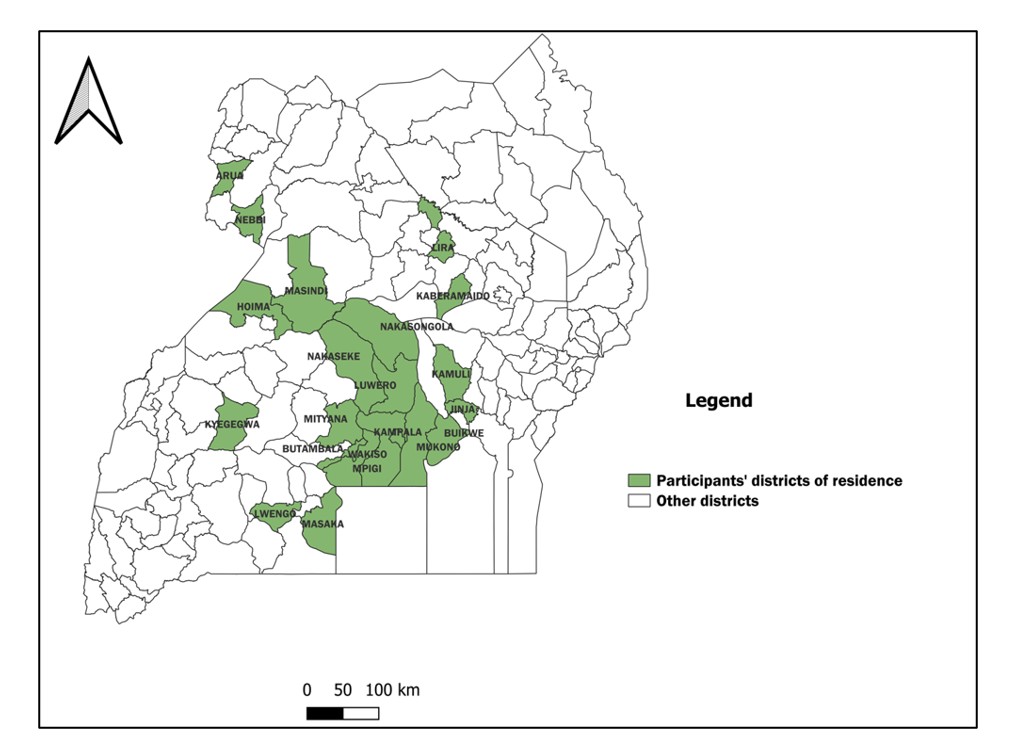
Patterns of current AOD use varied across several demographic and school characteristics. A higher proportion of advanced-level students reported current AOD use compared with those in ordinary-level classes (p=0.037). Students from mixed-gender schools (p=0.045) and those attending private schools reported higher levels of current use (p = 0.002). No significant differences were observed by age, sex, or religion. Among those who had ever used AODs, approximately two-thirds (103/155) were current users (Table 1). Participants reported residence in 22 districts across Uganda (Figure 1).
Nature of alcohol and other drugs ever used by secondary school student leaders in Uganda, July 2024
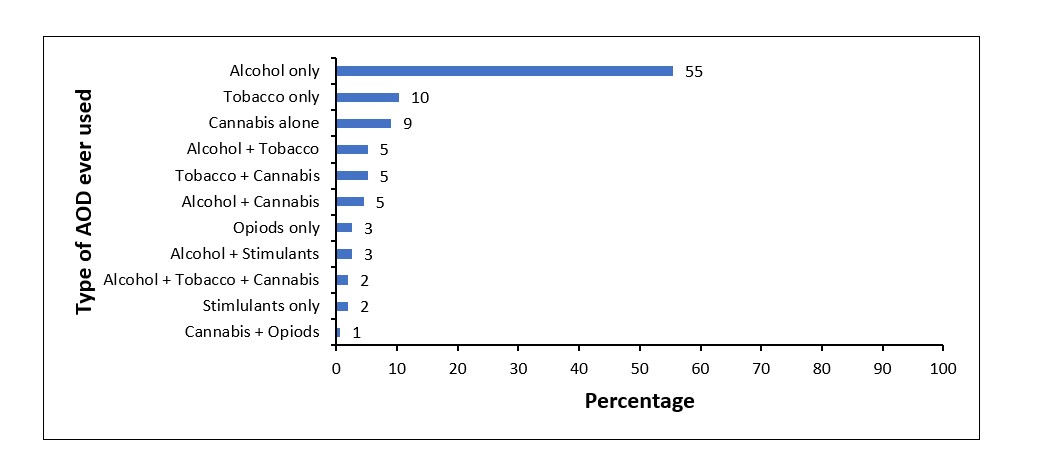
Among those who had ever used AODs (155), alcohol was the most commonly used AOD, with more than half of respondents reporting alcohol use alone (86; 55%). Use of other AODs in isolation was less common, including tobacco alone (16; 10%) and cannabis alone (14; 9%).
Polysubstance use was also evident. The most reported combinations of AOD used by students were alcohol and tobacco (8; 5%), tobacco and cannabis (8; 5%), and alcohol and cannabis (7; 5%). Triple AOD use was reported by 3 students (2%) for alcohol, tobacco, and cannabis (Figure 2).
Patterns of alcohol and other drug use among current users
Among the 103 current AOD users, nearly half (50, 49%) reported using AODs on 1–2 days per month, and most (73, 71%) used AODs once per day. Use was primarily social, with 55 (53%) student leaders consuming AODs with friends, 22 (21%) with family, and 14 (14%) alone. The majority of use occurred at home (57, 55%), though some took place at school (20, 19%) or other locations such as bars and outings (15, 15%). Peer pressure was the leading circumstance for initiation (74, 72%), followed by curiosity (14, 13%) and the family environment (8, 8%) (Table 2).
Factors associated with current alcohol and other drug use among secondary school student leaders in Uganda, July 2024
At the multivariable level, attending a private school (aPR = 2.4, 95% CI: 1.3–4.5) was independently associated with a higher prevalence of current AOD use (Table 3).
Sensitivity analysis using continuous variables
Sensitivity analyses using independent samples t-tests showed that the mean age did not significantly differ between current AOD users and non-users (18.9 vs 18.6 years, p = 0.13). Similarly, knowledge scores were not significantly different between the two groups (68.6% vs 70.1%, p = 0.20).
Nearly one-third of the student leaders surveyed reported having ever used AODs, while one-fifth were current users. Student leaders reported having ever used a range of AODs, including alcohol, tobacco, cannabis, opioids, inhalants, and stimulants. Initiation was most commonly attributed to curiosity and peer influence, and consumption frequently occurred in home environments and social settings with friends. Alcohol remained the predominant AOD used. Higher prevalence of current AOD use was observed among student leaders who were enrolled in private schools.
Student leaders reported having ever used a wide range of AODs, with alcohol emerging as the most commonly used AOD. The dominance of alcohol use mirrors findings from previous Ugandan studies, which consistently identify alcohol as the most accessible and socially accepted AOD among adolescents [20]. These results reinforce the need for school-based prevention efforts that emphasize the health and social consequences of alcohol use, alongside stronger enforcement of existing regulatory frameworks.
Our study found that one-fifth of the participants were current AOD users, while one-third reported ever use. The prevalence of AOD use in our study was lower than in previous studies, such as that in Botswana, where the prevalence of AOD use was 42% among students [30]. This difference may reflect contextual variations between study populations, including the inclusion of student leaders in the current study. Student leaders are often selected based on leadership qualities, academic performance, discipline, or trust from the school administration, and may differ from the general student population in several ways [31].
They may experience greater supervision and accountability, which could reduce engagement in risk behaviors or willingness to report such behaviours. Although causality cannot be inferred from this cross-sectional design, the presence of AOD use among student leaders remains a concern, as they occupy influential positions within the school environment. Their reported behaviors may be associated with peer norms within their networks and could potentially contribute to the normalization of AOD use among peers.
Students in private schools had nearly three times higher prevalence of current AOD use compared to those in faith-based schools. This finding is consistent with a study in Kampala that reported higher exposure to alcohol among students in urban and more affluent schools, many of which are privately owned [16]. Differences in AOD use by school ownership may reflect variations in school environments, students’ socioeconomic backgrounds, parental monitoring, peer influences, or implementation of AOD use prevention and disciplinary policies [32]. Strengthening the implementation of national AOD prevention guidelines across all school types, including private schools, may help reduce the use of AODs among student leaders.
Several implications for public health and policy emerge from our study. First, the high prevalence of AOD use among student leaders signals a need to integrate this influential group into school-based prevention strategies. Because student leaders often serve as role models and intermediaries between students and school administration, their behaviours and attitudes may influence peer norms within the schools. The association between private schools and higher AOD use highlights gaps in school-level regulation and supervision, calling for targeted interventions that address these structural differences. Future studies could evaluate the effectiveness of peer-led, school-based AOD prevention programs that engage student leaders as change agents and further explore other drivers of AOD use, such as family environment and mental health among student leaders.
Study limitations
The cross-sectional design limited our ability to establish causal relationships between AOD use and its risk factors examined. It was not possible to determine whether observed exposures preceded AOD use or resulted from it. Second, the study sampled student leaders who attended a national prefects’ conference, potentially introducing selection bias. In addition, student leaders may differ from the broader student population. Leadership positions are often associated with greater academic engagement, stronger disciplinary records, closer interaction with teachers, and increased supervision. Conversely, leadership responsibilities may expose students to unique social pressures and peer networks. These differences may influence both AOD use behaviours and reporting patterns. Findings from our study should be interpreted as representative of the student leader population studied rather than all secondary school students in Uganda. The study relied on self-reported data for alcohol consumption and other drugs, which may have been influenced by social desirability bias, as participants could have modified their responses to align with perceived societal expectations due to stigma. This may have underestimated the prevalence of AOD in this study population and biased our associations towards null. Nevertheless, this was minimized during the consenting process, during which participants were assured of confidentiality and that no risks would arise from their participation. In addition, there could have been potential for misclassification of AODs, as some locally reported terms, such as oris and tar, may not have been uniformly understood by participants. We focused on the student leader population, which is an influential but under-researched group, offering valuable insights into peer-driven behaviors around AOD use in secondary schools.
This study demonstrated a substantial burden of AOD use among secondary school student leaders in Uganda. Among this population, attendance at private schools was significantly associated with a higher prevalence of current AOD use. Most current users reported frequent use, primarily occurring at home and in social settings with friends, with peer pressure and curiosity commonly reported as reasons for initiation. These findings support the need for peer-led prevention strategies that actively engage student leaders as a distinct and influential group within schools, combined with strengthened oversight in private schools and sustained prevention efforts across all class levels. Enhancing parental involvement may further reduce adolescents’ exposure to alcohol and other drugs.
What is already known about the topic
What this study adds
The authors of this work declare no competing interests. Lilian Bulage is an Associate Editor at the Journal of Interventional Epidemiology and Public Health (JIEPH) and a co-author of this manuscript. In line with the journal’s conflict of interest policy, she was fully recused from the peer review process and had no involvement in editorial handling or decision-making for this submission.
Disclosure
The funding agencies were not involved in the study design, data collection, data analysis, interpretation of findings, or the decision to submit the manuscript for publication.
This work was supported by the President’s Emergency Plan for AIDS Relief (PEPFAR) through the U.S. Centers for Disease Control and Prevention under Cooperative Agreement number GH001353-01, implemented through Makerere University School of Public Health in collaboration with the Uganda Public Health Fellowship Program, Ministry of Health. The views expressed in this manuscript are those of the authors and do not necessarily reflect the official positions of the U.S. Centers for Disease Control and Prevention, the Department of Health and Human Services, Makerere University School of Public Health, or the Uganda Ministry of Health.
Data availability
The data supporting the findings of this study are owned by the Uganda Public Health Fellowship Program and are not publicly accessible due to confidentiality considerations. However, access to the datasets may be granted upon reasonable request to the corresponding author, subject to approval from the Uganda Public Health Fellowship Program.
We express our appreciation to the Ministry of Health and Butabika National Mental Hospital for identifying the programmatic need that informed this study and for providing technical guidance throughout its implementation. We also acknowledge the Uganda Public Health Fellowship Program for overall technical oversight and the U.S. Centers for Disease Control and Prevention for funding and coordination support. We thank the organizers of the national prefects’ conference, school administrators, and student leaders for their cooperation and support during data collection.
CM, BBM, KK, EM, EOO, JN, DK, and HLS conceptualized and designed the study. CM, JN, EM, EOO, HK, and PK participated in data collection, data management, analysis, and implementation of the study. CM led the data analysis and drafting of the initial manuscript. CM, BBM, KK, HLS, BK, RM, LB, DK, and ARA contributed to manuscript revision and are accountable for the final content. All authors reviewed and approved the final manuscript.
| Variable | Overall (N=569) | Current alcohol and other drug use | Chi-square / p value | |
|---|---|---|---|---|
| Yes (n=103) | No (n=466) | |||
| Age^⁋ (Years) | 0.27 | |||
| <18 | 146 (26%) | 22 (21%) | 124 (27%) | |
| ≥18 | 423 (74%) | 81 (79%) | 342 (73%) | |
| Sex | 0.7 | |||
| Female | 169 (30%) | 29 (28%) | 140 (30%) | |
| Male | 400 (70%) | 74 (72%) | 326 (70%) | |
| Religion | 0.16 | |||
| Catholic | 216 (37%) | 37 (35%) | 179 (39%) | |
| Protestant | 239 (42%) | 40 (39%) | 199 (42%) | |
| Muslim | 55 (10%) | 12 (12%) | 43 (9%) | |
| Other | 59 (11%) | 14 (14%) | 45 (10%) | |
| Class level* | 0.037 | |||
| Ordinary (senior 1-4) | 240 (42%) | 34 (33%) | 206 (44%) | |
| Advanced (Senior 5-6) | 329 (58%) | 69 (67%) | 260 (56%) | |
| Nature of the school | 0.045 | |||
| Boys only | 163 (29%) | 21 (20%) | 142 (30%) | |
| Girls only | 225 (39%) | 40 (39%) | 185 (40%) | |
| Mixed (Boys and Girls) | 181 (32%) | 42 (41%) | 139 (30%) | |
| School ownership | 0.002 | |||
| Faith-based | 285 (50%) | 40 (39%) | 245 (53%) | |
| Government | 211 (37%) | 40 (39%) | 171 (36%) | |
| Private | 73 (13%) | 23 (22%) | 50 (11%) | |
| Ever used AOD | – | |||
| No | 414 (73%) | 0 (0%) | 414 (89%) | |
| Yes | 155 (27%) | 103 (100%) | 52 (11%) | |
| Mean age (standard deviation): 18 (1.9); Median=19 (17-20) years Abbreviation: AOD = Alcohol and Other Drugs ⁋ Age was classified as under 18 years to represent children and ≥18 to represent adults as per the Uganda’s constitution * Class level was divided into ordinary class level, classifying students from senior 1 to 4, while the advanced class level referred to students from senior 5 and 6 | ||||
| Variable | Frequency (n=103) | Percentage (%) |
|---|---|---|
| Number of days AOD were used | ||
| 1–2 | 50 | 49 |
| 3–5 | 9 | 9 |
| 6–9 | 9 | 9 |
| 10–19 | 10 | 9 |
| 20–29 | 10 | 9 |
| All 30 | 15 | 15 |
| Frequency of use in a day | ||
| 1 | 73 | 71 |
| 2 | 21 | 20 |
| 3 | 9 | 9 |
| With whom they use the AOD | ||
| With friends | 55 | 53 |
| With family | 22 | 21 |
| With friends and family | 12 | 12 |
| Alone | 14 | 14 |
| Where AOD were used | ||
| Home | 57 | 55 |
| School | 20 | 19 |
| Home and school | 11 | 11 |
| Other places e.g. bars, outings | 15 | 15 |
| Circumstances for introduction to AOD | ||
| Peer pressure | 74 | 72 |
| Curiosity | 14 | 13 |
| Mental Health disorders like anxiety, depression | 5 | 5 |
| Family environment | 8 | 8 |
| Media | 2 | 2 |
| Variable | cPR | aPR | ||||
|---|---|---|---|---|---|---|
| cPR | 95% CI | p-value | aPR | 95% CI | p-value | |
| Sex | ||||||
| Female | Ref | Ref | ||||
| Male | 1.09 | 0.68-1.8 | 0.704 | 1.07 | 0.66-1.7 | 0.791 |
| Age group | ||||||
| <18 | Ref | Ref | ||||
| ≥18 | 1.3 | 0.79-2.2 | 0.271 | 0.8 | 0.39-1.6 | 0.535 |
| Class level | ||||||
| O’level | Ref | Ref | ||||
| A’level | 1.6 | 1.03-2.5 | 0.038 | 1.6 | 0.9-3.0 | 0.107 |
| School type | ||||||
| Boarding | 1 | Ref | ||||
| Day | 1.5 | 0.83-2.6 | 0.193 | 1.4 | 0.76-2.6 | 0.28 |
| Mixed (Day&Boarding) | 2.04 | 0.015 | 1.6 | 0.89-3.0 | 0.111 | |
| School ownership | ||||||
| Faith-based | Ref | Ref | ||||
| Government | 1.4 | 0.89-2.3 | 0.142 | 1.2 | 0.70-1.9 | 0.567 |
| Private | 2.8 | 1.6-5.1 | 0.001 | 2.4 | 1.3-4.5 | 0.005 |
| Nature of the school | ||||||
| Single sex | Ref | Ref | ||||
| Mixed sex | 3.3 | 1.2-9.4 | 0.024 | 2.4 | 0.83-7.1 | 0.106 |
| Peer pressure | ||||||
| No | Ref | Ref | ||||
| Yes | 1.01 | 0.86-1.13 | 0.908 | 1.01 | 0.89-1.2 | 0.878 |
| Abbreviations: cPR = Crude Prevalence Ratio; aPR = Adjusted Prevalence Ratio; CI = Confidence Interval *Class level was divided into ordinary classifying students from senior 1 to 4, while the advanced class level referred to students from senior 5 and 6 | ||||||