
Research | Open Access | Volume 9 (4): Article 160 | Published: 01 Oct 2026

Views: 23
Menu, Tables and Figures
Emmanuel Mfitundinda1,&, Richard Migisha1, Joyce Owens Kobusingye1, Benon Kwesiga1, Hildah Tendo Nansikombi1, Lilian Bulage1, Deo Migadde2, Chris Ebong2, Richard Mugahi2, Alex Riolexus Ario1
1Uganda Public Health Fellowship Program, Uganda National Institute of Public Health, Kampala, Uganda, 2Reproductive and Child Health Department, Ministry of Health, Kampala, Uganda
&Corresponding author: Emmanuel Mfitundinda, Uganda Public Health Fellowship Program, Uganda National Institute of Public Health, Kampala, Uganda, Email: emmamfitundinda@uniph.go.ug ORCID: https://orcid.org/0009-0002-5435-3824
Received: 22 Dec 2025, Accepted: 21 Sep 2026, Published: 01 Oct 2026
Domain: Maternal and Child Health
Keywords: Low birth weight, Kangaroo Mother Care Method, Uganda
©Emmanuel Mfitundinda et al. Journal of Interventional Epidemiology and Public Health (ISSN: 2664-2824). This is an Open Access article distributed under the terms of the Creative Commons Attribution International 4.0 License (https://creativecommons.org/licenses/by/4.0/), which permits unrestricted use, distribution, and reproduction in any medium, provided the original work is properly cited.
Cite this article: Emmanuel Mfitundinda et al. Temporal and spatial trends of low birth weight and Kangaroo Mother Care initiation in Uganda, 2015–2023. Journal of Interventional Epidemiology and Public Health. 2026; 9(4):160. https://doi.org/10.37432/jieph-d-25-00333
Background: Over 80% of global neonatal deaths occur among low birth weight (LBW) births, with the highest prevalence in low-and middle-income countries. Kangaroo Mother Care (KMC) is a low-cost, effective intervention for the survival of LBW babies. We assessed trends and spatial distribution of LBW births and their KMC initiation in Uganda, 2015–2023.
Methods: We analyzed surveillance data on total deliveries, LBW babies, and their initiation on KMC, 2015–2023, from the District Health Information Software Version 2. We calculated LBW prevalence as the proportion of LBW births among total deliveries. Coverage of KMC was computed as the proportion of live LBW babies started on KMC. We used the Mann-Kendall test to assess the significance of trends.
Results: During 2015–2023, 605,876 of 10,952,463 births (5.5%) were LBW, with no trend (p=0.8). The highest prevalence of LBW was in Karamoja and West Nile (7.4%) in northern Uganda, with no trend (p=0.14). Bukedi (p=0.05) and Busoga (p=0.003) subregions had an increasing trend, whereas Kigezi subregion had a declining trend (p=0.003). Among the 296,421 live LBW births during 2020–2023, 188,596 (64%) received KMC. Its coverage increased from 60% in 2020 to 68% in 2023 (p=0.01). Ankole (p=0.005), Bunyoro (p=0.017), and West Nile subregions (p=0.024) had increasing trends, whereas Bukedi (p=0.024) and Kampala (p<0.001) had declining trends. Karamoja had low KMC coverage (60%) with no trend (p=0.96). KMC initiation increased at Health Centre IIIs (p=0.006) but declined at national referral hospitals (p<0.01).
Conclusion: There were regional disparities in trends of LBW births. While KMC initiation improved in certain regions and at lower-level health facilities, challenges persist in Karamoja and national referral hospitals. Further studies are needed to understand the determinants of LBW births, and initiation to KMC, to better guide region-specific interventions.
The World Health Organization (WHO) estimates that about 15–20% of all births in the world are LBW, and this proportion is even higher in sub-Saharan Africa (SSA) [1, 2]. Low birth weight (LBW) refers to babies who are born with <2500 grams of body weight regardless of their gestational age at birth. These comprise preterm births (<37 weeks of completed gestation) and term births (≥37 weeks of gestation) born with <2500 grams of body weight [3, 4]. It is a derivative of both gestational age and fetal growth [5]. Low birth weight is a key determinant of neonatal mortality and morbidity, with LBW babies having the highest risk of death during pregnancy, infancy, and early childhood. Over 80% of all newborn deaths occur among LBW babies in Southern Asia and SSA [2].
According to the Uganda Demographic and Health Survey (UDHS), 2022, 10% of all babies born in Uganda had LBW, and >50% of perinatal deaths were due to LBW-related complications [6]. Additionally, LBW babies are at an increased risk of long-term complications and chronic diseases such as cognitive impairments, neurodevelopmental disorders, cardiovascular diseases, diabetes and others [7].
Kangaroo mother care (KMC) is an affordable and highly effective method for LBW babies, especially in resource-limited settings. It involves prolonged skin-to-skin contact, promotion of exclusive breastfeeding, and allowing early discharge from health facilities. It enhances growth and reduces complications such as hypothermia, hypoglycemia, and sepsis, but also fosters maternal bonding and stimulation [8]. Furthermore, KMC improves outcomes among LBW babies, reducing neonatal mortality by 32% and six-month mortality by 25%. It also decreases hypothermia by 68%, reduces sepsis by 15%, and increases exclusive breastfeeding duration by 48%. Beyond that, KMC promotes better growth and development among LBW infants [8]. KMC can contribute towards Uganda’s achievement of the Sustainable Development Goal (SDG) target 3.2, which aims to reduce the neonatal mortality rate (NMR) to <12 deaths per 1,000 live births by 2030. Uganda’s NMR stands at 22 deaths per 1,000 live births, indicating that progress towards this goal has been slow [6,9].
KMC is part of the WHO level 2 care for sick and small newborns (SSN), which recommends that at least 80% of districts in a country offer this level of care [10]. Uganda is currently in early phase III of the NMR transition framework, a stage for countries with NMR ranging between 30 and 16 deaths per 1000 live births [11]. Currently, KMC is included in the essential maternal and newborn care guidelines of Uganda and is recommended for LBW babies [12]. Despite KMC being a low-cost and high-impact innovation, its use and distribution across Uganda are not well documented [13]. We described the trends and spatial distribution of LBW prevalence and the application of KMC in Uganda during 2015–2023.
Study setting
This was a national study in Uganda, with a population of approximately 45.9 million people in 2024 [14]. It is one of the countries with a high fertility rate and poor maternal and neonatal health indices [15]. The country is divided into 15 non-administrative health regions, each comprising nine to thirteen districts. The health regions are: Acholi, Ankole, Bugisu, Bukedi, Bunyoro, Busoga, Kampala, Karamoja, Kigezi, Lango, North Central, South Central, Teso, Tooro, and West Nile. There are 135 districts and 10 cities countrywide. Kampala City is both a health region and a district [6]. Health care services are organised from the national referral hospital level, which is the highest level, to health centre II, which is the lowest level; maternal and child health services are provided from health centre III level, health centre IV, general hospital, regional referral hospital to the national referral hospital level. The health care package increases with the level of care, with higher-level health facilities managing more referrals and complicated cases.
Study design and data source
We conducted a nationwide descriptive analysis of facility-reported LBW prevalence and KMC initiation using routinely aggregated District Health Information Software Version 2 (DHIS2). Data on LBW babies and LBW babies initiated on KMC are routinely generated at registered health facilities (all public health facilities and most private health facilities) that offer delivery services, aggregated at the district level, and then forwarded to the national database, DHIS2, to make decisions and plan interventions on reproductive and infant health. Data entry is done at the health facility level; validation and cleaning are done both at the district and national levels by biostatisticians alongside other health personnel.
Study variables, data abstraction and analysis
We defined the prevalence of LBW babies as a proportion of total deliveries in a given period. LBW babies delivered were summed to obtain the total number of LBW babies reported in a given month. We defined KMC initiation coverage as the proportion of live births, either occurring in or presented at the health facility with a birth weight <2500g initiated in the kangaroo position anywhere in the facility during the reporting period. Kangaroo position refers to the baby being placed skin-to-skin with the caregiver in an upright position, with the baby tied in place.
We abstracted monthly data for each health facility in the country, all districts, and at the national level for the analysis period of 2015–2023. To assess reporting quality, we calculated national annual reporting rates of LBW prevalence by dividing the available monthly reports per year for all regions by the expected monthly reports for all regions per year. We also calculated national quarterly reporting rates of KMC coverage by dividing the available monthly reports per quarter for all regions by the expected monthly reports for all districts per quarter. No imputation was performed for missing monthly reports; analyses were based on the available DHIS2 data as reported, and annual reporting rates were used to contextualise the findings.
Monthly data were abstracted using pivot tables in DHIS2 on LBW babies, LBW babies initiated on KMC, and total deliveries, 2015–2023. We disaggregated the data into national, regional and district levels. We obtained data on LBW babies, LBW babies initiated on KMC, and total deliveries.
We described the prevalence of LBW babies as a proportion of total deliveries in Uganda, 2015–2023. Additionally, we described the spatial distribution of the LBW prevalence in all districts across the country. We described the initiation of KMC as a proportion of total live LBW babies that were initiated on KMC, 2020–2023. We plotted the annual LBW prevalence against the study period in years to present the trends in prevalence at the national level, 2015–2023. We also plotted the quarterly KMC coverage against the study period in years to demonstrate the trends in coverage at the national level and at the health facility level, 2015–2023. Choropleth maps for LBW babies and their initiation on KMC were generated using Quantum Geographic Information System (QGIS) to show the distribution in Uganda. We analysed trends using the Mann-Kendall test and Sen’s slope test for the direction of the trends.
Ethical considerations
Our study utilized routinely aggregated surveillance data with no personal identifiers in health facility outpatient and inpatient monthly reports, obtained from the DHIS2. The Uganda Public Health Fellowship Program is part of the National Rapid Response Team and has been granted permission to access and analyze surveillance data in the DHIS2 and other data such as survey and field investigation data, to inform decision-making in the control and prevention of outbreaks and public health programming. Additionally, the Ministry of Health (MoH) has also granted the Program permission to disseminate the information through scientific publications. We stored the abstracted dataset on a password-protected computer and only shared it with the investigation team. In addition, the Office of the Associate Director for Science, U.S. 144 Centers for Disease Control and Prevention, determined that this study was not a human subjects research with the primary intent of improving the use of surveillance data to guide public health planning and practice. This activity was reviewed by the CDC and was conducted consistent with applicable federal law and CDC policy. § 149 §See e.g., 45 C.F.R. part 46, 21 C.F.R. part 56; 42 U.S.C. §241(d); 5 U.S.C. §552a; 44 U.S.C. §3501 et seq.
Trends of proportion of low birth weight babies at the national level, Uganda, 2015–2023
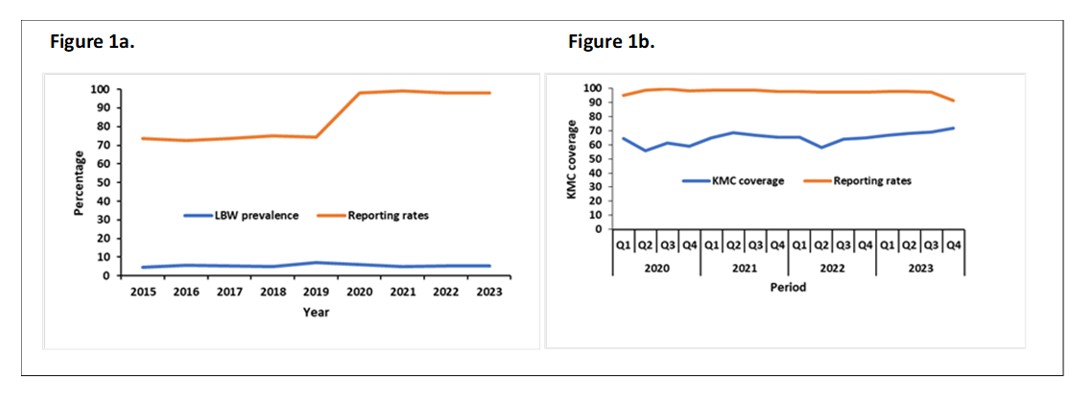
During the study period, a total of 605,876 LBW babies were recorded out of 10,952,463 babies (5.5%). Facility-reported LBW prevalence was 5.5% overall and showed no evidence of a monotonic trend (p=0.8, Sen’s slope = 0.055, 95%CI: -0.23 to 0.20). The reporting rate increased from 72% in 2015 to 98% in 2023 (average of 85%) (Figure 1a).
Trends of low birth weight babies initiated on Kangaroo Mother Care at national and regional levels, Uganda, 2020–2023
Of the 296,421 LBW babies born during the four-year analysis period, 188,596 (64%) babies were initiated on KMC. KMC initiation increased from 60% in January–March 2020 to 68% in October–December 2023, representing a significant upward trend(Sen’s slope=0.47 percentage points per quarter; 95% CI: 0.15 to 0.86; p=0.01) (Figure 1b). Reporting rates remained high, decreasing slightly from 95% in 2020 to 91% in 2023.
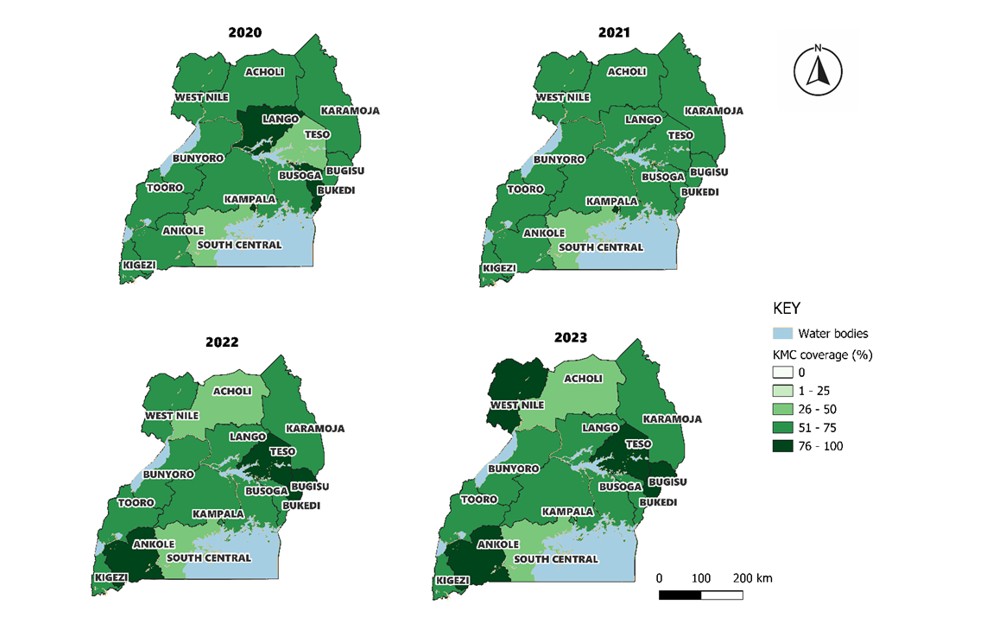
At the regional level, 5 regions showed a trend. In Ankole subregion, KMC coverage improved from 53% in January–March 2020 to 70% in October–December 2023, with an average of 70% (p=0.005, Sen’s slope=1.6, 95%CI=0.66 to 2.2). In Bunyoro, the coverage improved from 45% in January–March 2020 to 70% in October–December 2023, with an average of 60% (p=0.017, Sen’s slope=1.1, 95%CI=0.34 to 2.7). In the West Nile subregion, the coverage improved from 80% in January–March 2020 to 88% in October–December 2023, with an average of 73% (p=0.024, Sen’s slope=1.3, 95% CI=0.26 to 2.1). The coverage declined in Bukedi subregion from 80% in January–March 2020 to 71% in October–December 2023, with an average of 66% (p=0.024, Sen’s slope=-1.6, 95%CI=-2.9 to -0.32). Similarly, the coverage declined in Kampala from 74% in January–March 2020 to 49% in October–December 2023, with an average of 71% (p<0.001, Sen’s slope=-2.3, 95%CI=-3.6 to -1.0). The remaining 10 regions had no trend. Acholi region (54%), followed by North Central (58%), Bunyoro (60%) and Karamoja (60%) region had the lowest KMC coverage (Figure 2).
Distribution and trends of the proportion of low birth weight babies initiated on Kangaroo Mother Care by health facility level, Uganda, 2015–2023
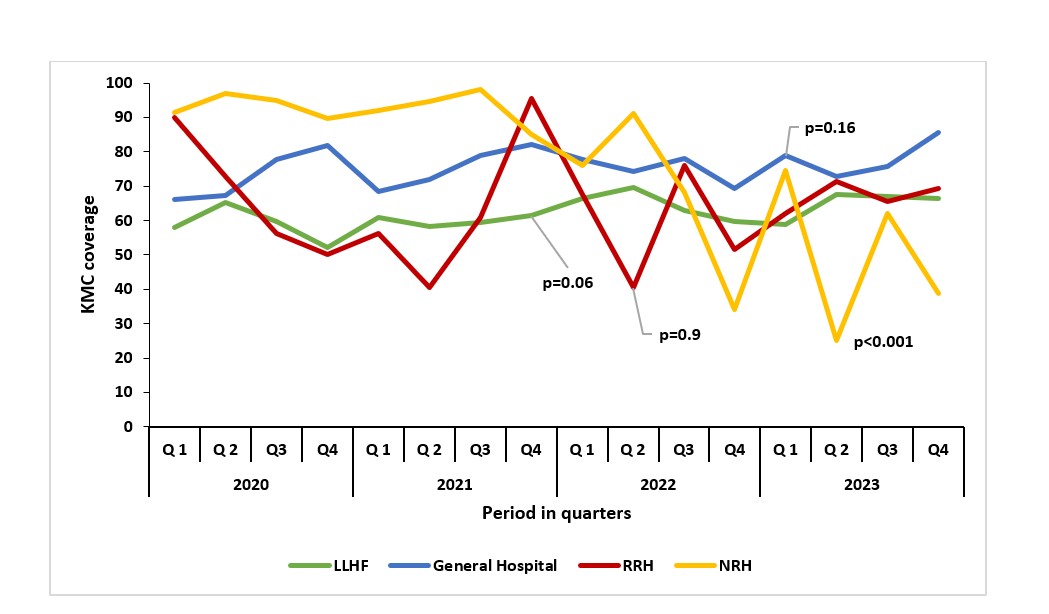
Of the 2,536,064 babies delivered at HC IIIs, 99, 648 (3.9%) were LBW, and 58,161(58%) were initiated on KMC from 2020–2023. Out of the 1,127,754 babies delivered at HC IVs, 58,251 (5.2%) were LBW, and 38,126 (65%) of these were initiated on KMC. At general hospitals, out of the 938,473 babies delivered, 72,344 (7.7%) were LBW, and out of these, 54,546 (75%) were initiated on KMC. At RRH level, out of 323,880 babies that were delivered, 28,972 (8.9%) were LBW, and out of these, 18,232 (63%) were initiated on KMC. At NRH level, out of the 127,508 babies delivered, 14,817 (11.6%) were LBW, and 11,176 (75%) were initiated on KMC (Figure 3).
There was a significant increase in KMC initiation coverage at HC III from January–March 2020 at 50% to 68% in October–December 2023 period (p=0.006, Sen’s slope=0.95, 95%CI=0.54 to 1.5) with an average of 59%, a non-significant increase in coverage at HC IV level from 66% in January–March 2020 to 64% in October–December 2023 with an average of 65% (p=0.9, Sen’s slope=0.0042, 95%CI=-0.69 to 0.65). At the general hospital level, KMC coverage increased from 66% in January–March 2020 to 85% in October–December 2023, with an average of 75% and no trend (p=0.16, Sen’s slope=0.47, 95%CI=-0.35 to 1.6). At RRH level, KMC initiation coverage decreased from 90% in January–March 2020 to 69% in October–December 2023. However, there was no evidence of a significant temporal trend over the study period (average coverage, 64%; Sen’s slope=0.20 percentage points per quarter; 95% CI: −2.10 to 2.10; p=0.90). At NRH level, coverage declined from 91% to 39%, with a significant downward trend (average coverage, 79%; Sen’s slope = −4.20 percentage points per quarter; 95% CI: −6.30 to −2.20; p < 0.001) (Figure 3).
Distribution of low birth weight babies in Uganda, 2015–2023
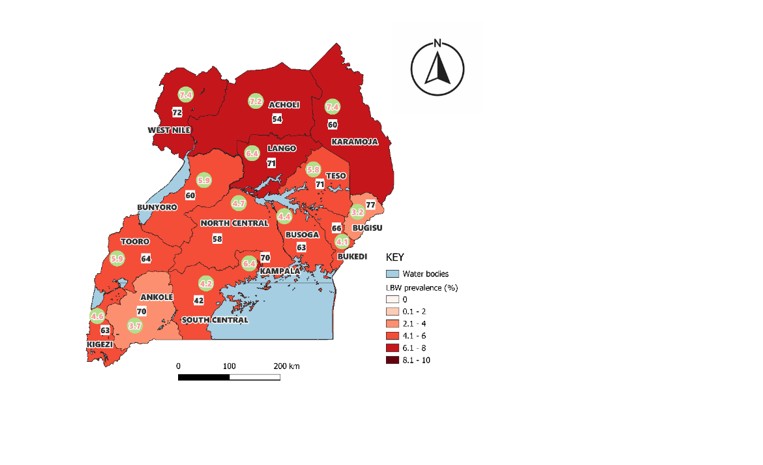
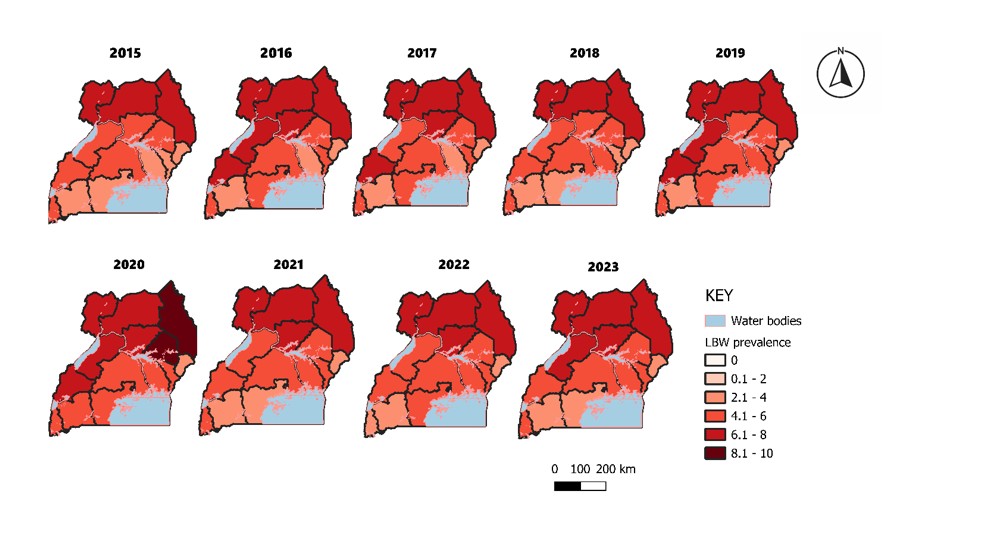
LBW prevalence varied across regions. Karamoja (p=1, Sen’s slope= 0.017, 95%CI=-0.2 to 0.37) and West Nile subregions (p=0.14, Sen’s slope=-0.1, 95%CI=-0.17 to 0.033), located in northeastern and northwestern Uganda, respectively, had the highest prevalence (7.2%) with no trend (Figure 4).
Acholi, in northern Uganda, had a prevalence of 7.2% and no trend (p=0.11, Sen’s slope=0.083, 95%CI=-0.013, 0.18), while Lango, also in northern Uganda, had 6.4% with no trend (p=0.2, Sen’s slope=0.17, 95%CI=-0.086, 0.5). Kampala, in central Uganda, had a similar average prevalence of 6.4% (p=0.076, Sen’s slope=0.58, 95%CI=-0.033, 1.0). Bukedi, in eastern Uganda, and Busoga, also in the east, had increasing trends, with Bukedi rising from 3.4% to 5.1% (p=0.05, Sen’s slope=0.15, 95%CI=0.0 to 0.275) and Busoga from 3.3% to 5.6% (p=0.003, Sen’s slope=0.15, 95%CI=0.15 to 0.32) (Figure 5). In Kigezi, LBW prevalence increased slightly from 4.4% in 2015 to 4.6% in 2023, although the overall annual trend was significantly downward (Sen’s slope = −0.10; 95% CI: −0.22 to −0.04; p = 0.003).
The LBW prevalence remained stable during the study period, 2015–2023, with substantial regional heterogeneity. Karamoja and West Nile subregions in the northern part of the country consistently reported the highest prevalence, whereas regions such as Bukedi and Busoga in eastern Uganda experienced increasing rates. There was a decline in some districts in Kigezi and Ankole subregions. Although there was an increase in KMC uptake, especially at lower‐level health centres, there was low coverage in Karamoja and a significant decline at national referral hospitals. Overall, these trends highlight the importance of additional studies to understand the local determinants of LBW births and barriers to KMC uptake for better targeted interventions for each region.
The observed LBW prevalence was lower than the 10% reported in the 2022 Uganda Demographic and Health Survey (UDHS), and the estimated 13% for sub-Saharan Africa [6, 16]. Although the study could not identify the drivers of the stagnant trend, household food insecurity is a plausible contributor because it has been associated with LBW and preterm birth in Uganda [17]. We therefore hypothesise that increasing food insecurity in countries in Sub-Saharan Africa could be contributing to the stagnant LBW prevalence [18].
We observed variations in the prevalence of LBW and KMC initiation coverage across the country, with the highest prevalence found in the Karamoja and West Nile subregions. A study on factors associated with LBW in Ethiopia found a positive association with maternal nutritional status, with mothers who had MUAC < 23 cm 1.6 times more likely to give birth to LBW babies [19]. We therefore hypothesize that the variations in LBW prevalence across the regions could possibly be linked to the differing maternal nutritional status. Food insecurity may partly contribute to this pattern; however, it was not measured in this study [20, 19, 21]. The disparities in KMC coverage across regions are likely due to differences in access to newborn care, particularly in districts without general district hospitals, which typically offer better resources for newborn care than lower-level health facilities [22]. To improve KMC coverage, it is essential to involve leaders at all administrative levels, provide targeted training for health workers, allocate dedicated spaces for KMC, manage mothers and babies, and implement robust education and counselling programs for mothers on the benefits and practice of KMC [23].
We observed low average KMC coverage compared to the near-100% target, despite the recent Operationalizing Kangaroo Mother Care before stabilisation amongst low birth weight neonates (OMWaNA) trial recommending KMC for all LBW babies, irrespective of clinical stability [24]. However, the increasing trend suggests that Uganda may be on track to meet the WHO’s target of at least 75% KMC initiation coverage by 2025. Additionally, the OMWaNA trial was conducted in Uganda, and this possibly had a positive policy influence towards the positive trend of KMC initiation that could be linked to improvements in small and sick newborn care services at the study sites and a possible increase in awareness among policymakers and possibly improved attitudes towards KMC among health workers [24, 25]. Achieving this target is crucial for reducing the neonatal mortality rate (NMR) to 12 deaths per 1,000 live births by 2025, from the current 22 deaths per 1,000 live births [26]. To meet this goal, scaling up KMC coverage will require stronger political and leadership commitment, allocation of human and financial resources, training of health workers, integration of KMC guidelines into curricula, reorganisation of space for KMC, provision of basic equipment, and leveraging locally generated data. Furthermore, the use of KMC champions among health workers has been shown to accelerate coverage improvements in similar settings [26].
We found differing KMC coverage trends at different health facility levels observed in this study. This could be due to the country’s focus on empowering lower-level health facilities to offer more service packages to the populations within their catchment area. This could explain the increasing trend of KMC coverage at the HC III level. The declining coverage at NRH could be due to managing more complicated LBW babies that require neonatal intensive care [9]. Furthermore, higher-level facilities often face overcrowding and high workloads, which can hinder effective KMC implementation [27]. Our study was primarily descriptive and could therefore not identify the reasons for this decline. However, a systematic review on facilitators and barriers of KMC found mothers’ medical condition, including cesarean birth, as one of the barriers to KMC implementation [28]. Clinical complexity, postoperative maternal limitations, overcrowding, and workload may hinder KMC in tertiary facilities, but these mechanisms were not assessed [29].
Study limitations
Our study has some limitations that should be considered. Firstly, the reliance on secondary data restricted the analysis to the available variables related to LBW and KMC in Uganda. This may limit the depth of understanding regarding the underlying factors influencing LBW prevalence. Additionally, our dependency on secondary, routinely generated, and aggregated data was susceptible to delayed reporting, duplicate reporting, under-reporting, or missing data from some health facilities. This can lead to underestimation or overestimation. However, these challenges are routinely overcome through routine data cleaning at the district and national levels to remove duplicate records and wrong entries. Additionally, we added reporting rates to provide context on the quality of abstracted data over time. Future studies utilising primary data would be more effective in exploring these factors and providing a more robust estimate of LBW prevalence. Additionally, it is important to recognise that some deliveries occur outside health facilities, which suggests that the reported LBW prevalence and KMC coverage in this study may be underreported. The national level estimates of outside health facility delivery ranged from 37% in 2022/2023 to 29% in 2023/2024 [9]. Furthermore, our study included the period during COVID-19 that might possibly have had an effect on both LBW prevalence and/or utilisation of primary healthcare services, including KMC, and we were not able to include statistical adjustments for this period in our analysis.
Our study found disparities in trends of LBW births in the different regions of the country with no trend at the national level. Whereas KMC initiation improved in certain regions and at lower-level health facilities, coverage was low in Karamoja, and national referral hospitals had a declining trend. The low KMC coverage in some regions, yet with a high prevalence of LBW, and the declining trend at NRH reveal opportunities to strengthen KMC implementation. Further studies are also needed to understand the determinants of LBW births and initiation of KMC to better guide region-specific interventions.
What is already known about the topic
What this study adds
The authors of this work declare no competing interests. Lilian Bulage is an Associate Editor at the Journal of Interventional Epidemiology and Public Health (JIEPH) and a co-author of this manuscript. In line with the journal’s conflict of interest policy, she was fully recused from the peer review process and had no involvement in editorial handling or decision-making for this submission. An independent editor oversaw the review and decision-making process.
This study was supported by the President’s Emergency Plan for AIDS Relief (PEPFAR) through the United States Centers for Disease Control and Prevention Cooperative Agreement number GH001353-01 through Makerere University School of Public Health to the Uganda Public Health Fellowship Program, Ministry of Health. The contents of this manuscript are solely the responsibility of the authors and do not necessarily represent the official views of the US Centers for Disease Control and Prevention and the Department of Health and Human Services, Makerere University School of Public Health, or the Uganda Ministry of Health.
Availability of data and materials
The data upon which our findings are based belong to the government of Uganda, Ministry of Health and cannot be shared publicly. However, the data can be made available by the corresponding author with permission from the Ministry of Health, Uganda, Division of Health Information.
We would like to thank the Ministry of Health for the permission to access the data. We thank the US-CDC for funding the Uganda Public Health Fellowship Program (UPHFP) activities. Finally, we thank the UPHFP secretariat for the technical support from the inception of the study to final product.
Conceptualization: Richard Migisha
Methodology: Emmanuel Mfitundinda
Data Curation: Emmanuel Mfitundinda, Joyce Owens Kobusingye
Formal Analysis: Emmanuel Mfitundinda, Richard Migisha, Joyce Owens Kobusingye
Visualization: Emmanuel Mfitundinda
Supervision: Richard Migisha
Writing – Original Draft: Emmanuel Mfitundinda
Writing – Review & Editing: Emmanuel Mfitundinda, Richard Migisha, Joyce Owens Kobusingye, Benon Kwesiga, Hildah Tendo Nansikombi, Lilian Bulage, Deo Migadde, Chris Ebong, Richard Mugahi, Alex Riolexus Ario