
Research | Open Access | Volume 9 (4): Article 177 | Published: 03 Nov 2026

Views: 25
Menu, Tables and Figures
Table 1: Characteristics and diagnostic case mix of outpatient prescription encounters
| Characteristic | Baseline (N=350) | Endline (N=198) | SMD | P value |
|---|---|---|---|---|
| Age, years, mean (SD) | 33.1 (22.2) | 30.8 (16.6) | -0.12 | 0.170 |
| Age, years, median [IQR] | 30.5 [16.0-49.0] | 31.5 [17.2-41.8] | – | – |
| Age <18 years | 104 (29.7%) | 50 (25.3%) | -0.10 | 0.264 |
| Female sex | 220 (62.9%) | 153 (77.3%) | 0.32 | <0.001 |
| Diagnosis group | <0.001 | |||
| Acid-peptic disease | 36 (10.3%) | 18 (9.1%) | -0.04 | |
| Chronic medical condition | 15 (4.3%) | 11 (5.6%) | 0.06 | |
| Febrile/infectious illness | 4 (1.1%) | 16 (8.1%) | 0.34 | |
| Gastrointestinal infection | 16 (4.6%) | 8 (4.0%) | -0.03 | |
| Multiple diagnoses | 54 (15.4%) | 8 (4.0%) | -0.39 | |
| Musculoskeletal/trauma | 16 (4.6%) | 9 (4.5%) | -0.00 | |
| Other | 70 (20.0%) | 19 (9.6%) | -0.30 | |
| Reproductive/STI | 9 (2.6%) | 28 (14.1%) | 0.43 | |
| Respiratory infection | 85 (24.3%) | 32 (16.2%) | -0.20 | |
| Skin/allergic disease | 19 (5.4%) | 29 (14.6%) | 0.31 | |
| Urinary tract infection | 26 (7.4%) | 20 (10.1%) | 0.09 |
IQR, interquartile range; SD, standard deviation; SMD, standardized mean difference; STI, sexually transmitted infection. SMDs are presented with their signs; values closer to zero indicate greater case-mix similarity. P values are descriptive baseline-endline comparisons. Welch t test was used for mean age; Pearson chi-square or Fisher exact test for binary variables; the diagnosis-group P value is from an overall Monte Carlo Fisher exact test with 100,000 replicates and a fixed random seed.
Table 1: Characteristics and diagnostic case mix of outpatient prescription encounters
Table 2: Prescribing problems, contributing factors, and change-package components implemented at Itojo Hospital
| Prescribing problem | Contributing factors identified | Change-package components implemented |
|---|---|---|
| Use of trade rather than generic names | Limited access to essential medicines lists; prescribing by staff outside the recognized clinician group | Prescriber education; restricted prescribing to recognized clinicians; authorized prescriber signatures for dispensing staff; prescription audit and feedback |
| Prescriptions not concordant with UCG | Limited access to UCG materials; inconsistent guideline use | Soft-copy PDF UCGs to OPD clinicians; face-to-face prescriber education; periodic prescription audit and feedback |
| Medicines prescribed outside the essential medicines list | Limited prescriber access to essential medicines lists | Essential medicines lists provided to clinicians and updated periodically |
| Excessive/unnecessary multiple medicines, particularly antibiotics | Non-use of clinical guidelines; diagnostic limitations encouraging empirical treatment | Soft-copy PDF UCGs; continuing medical education on rational medicine use |
All changes were implemented from May through November 2021. OPD, outpatient department; QI, quality improvement; UCG, Uganda Clinical Guidelines. Quantitative process/fidelity measures were not sufficiently complete for retrospective analysis.
Table 2: Prescribing problems, contributing factors, and change-package components implemented at Itojo Hospital
Richard Migisha1,&, Sharon Namasambi1, Benon Kwesiga1, Lilian Bulage1, Alex Riolexus Ario1
1Uganda Public Health Fellowship Program, Uganda National Institute of Public Health, Ministry of Health, Kampala, Uganda
&Corresponding author: Richard Migisha, Uganda Public Health Fellowship Program, Uganda National Institute of Public Health, Ministry of Health, Kampala, Uganda, Email: rmigisha@uniph.go.ug ORCID: https://orcid.org/0000-0003-1709-9521
Received: 11 Dec 2025, Accepted: 04 Mar 2026, Published: 03 Nov 2026
Domain: Antimicrobial Resistance
Keywords: Quality improvement, Rational prescribing, Antimicrobial stewardship, Uganda Clinical Guidelines, Uganda
©Richard Migisha et al. Journal of Interventional Epidemiology and Public Health (ISSN: 2664-2824). This is an Open Access article distributed under the terms of the Creative Commons Attribution International 4.0 License (https://creativecommons.org/licenses/by/4.0/), which permits unrestricted use, distribution, and reproduction in any medium, provided the original work is properly cited.
Cite this article: Richard Migisha et al., Improving rational prescribing at a public district hospital in southwestern Uganda, January-November 2021: A quality improvement initiative. Journal of Interventional Epidemiology and Public Health. 2026; 9(4):177. https://doi.org/10.37432/jieph-d-25-00344
Introduction: Inappropriate prescribing can compromise patient safety, medicine availability, and antimicrobial stewardship. At Itojo Hospital in southwestern Uganda, a 2019 internal audit identified high medicine burden and frequent antibiotic prescribing. We evaluated changes in rational prescribing during a facility-led quality improvement initiative designed to strengthen concordance with the Uganda Clinical Guidelines.
Methods: We conducted a single-facility uncontrolled before-and-after evaluation from January to November 2021. Systematically sampled outpatient prescriptions were reviewed at baseline and during a three-week endline assessment approximately six months after implementation began. The change package combined prescriber education, electronic treatment guidelines, essential medicines lists, prescriber accountability, and prescription audit and feedback. After source-record re-audit, all 198 endline encounters were retained. Adjusted analyses accounted for age, sex, and a broader six-category diagnostic grouping.
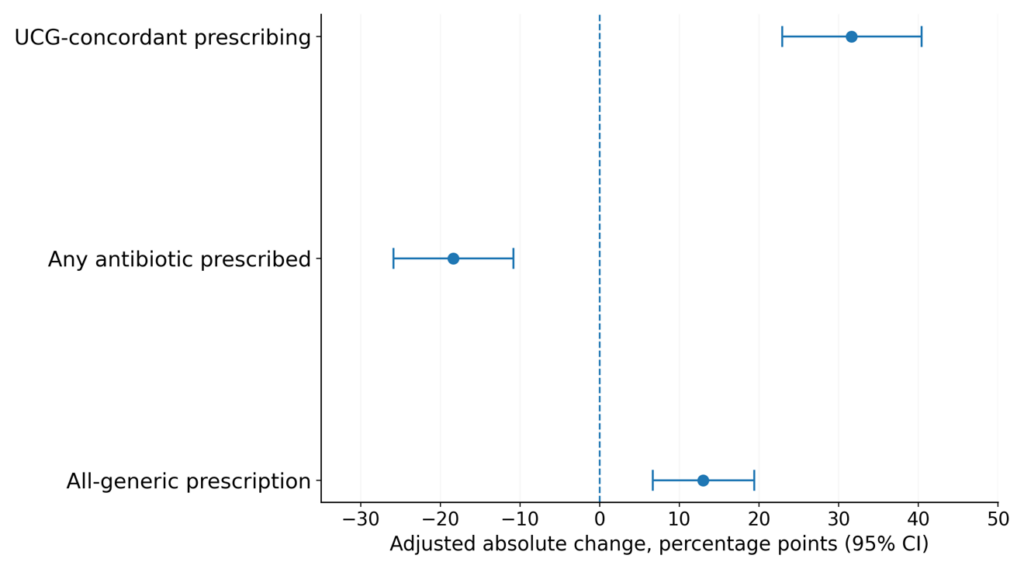
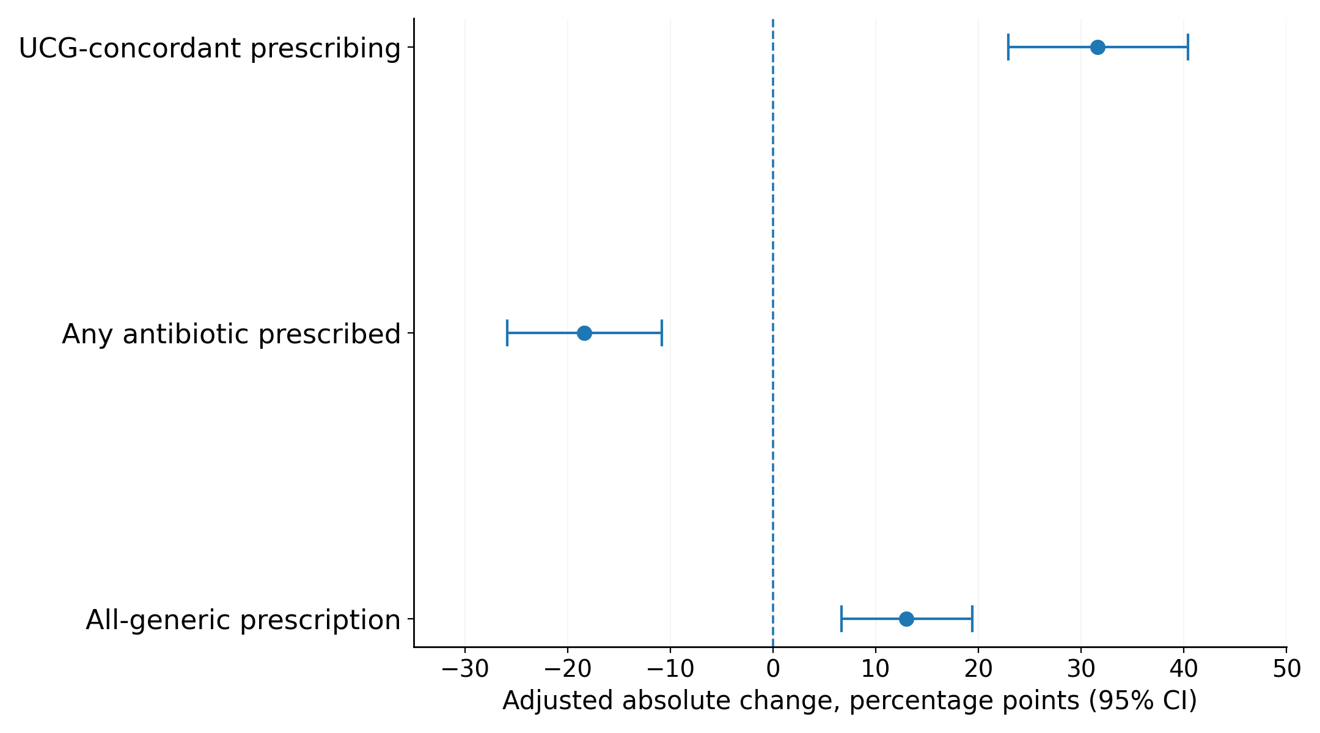
Results: We analyzed 350 baseline and 198 endline prescriptions. Guideline-concordant prescribing was 43.7% at baseline and 74.2% at endline (adjusted change, +31.6 percentage points; 95% CI: 22.9 – 40.4; adjusted prevalence ratio, 1.76; 95%CI: 1.50 – 2.06). Antibiotic prescribing was 83.4% and 64.1% at baseline and endline, respectively (adjusted change, -18.4 percentage points; 95% CI: -25.9 – -10.8; adjusted prevalence ratio, 0.79; 95% CI: 0.71 – 0.88). Mean medicines per encounter was 3.35 at baseline and 2.60 at endline (adjusted mean difference, -0.65; 95% CI: -0.80 – -0.49), while prescriptions containing only generic medicines were 78.6% and 94.4% (adjusted change, +13.0 percentage points; 95% CI: 6.7 – 19.4).
Conclusion: Several prescribing indicators were more favourable at endline than at baseline during the quality improvement period. Because the evaluation lacked a concurrent comparator and used unequal sampling windows, these temporal differences cannot be attributed specifically to the intervention package. Antibiotic use remained common, supporting continued stewardship, diagnostic support, audit, and repeated measurement.
Rational prescribing is central to patient safety, medicine availability, and efficient use of health-system resources. The World Health Organization defines rational medicine use as providing patients with medicines appropriate to their clinical needs, in suitable doses and duration, and at the lowest cost to patients and communities [1]. Inappropriate medicine use commonly includes polypharmacy, unnecessary antimicrobial prescribing, excessive injection use, failure to follow treatment guidelines, and avoidable use of expensive medicines [1,2]. In resource-constrained settings, these practices can worsen medicine shortages, increase treatment costs and adverse effects, and accelerate antimicrobial resistance.
Prescribing gaps remain common in African health systems. Across 43 studies from 11 countries in the WHO African Region, the median number of medicines prescribed per encounter was 3.1, nearly half of encounters included an antibiotic, and only 68% of medicines were prescribed generically [3]. In Uganda, prescribing was the lowest-performing medicines-management domain in the national Supervision, Performance Assessment, and Recognition Strategy baseline assessment [4]. More recently, only 34.2% of nearly 10,000 antibiotic prescriptions in lower-level facilities in southwestern Uganda were concordant with the Uganda Clinical Guidelines (UCG), and approximately half were written by cadres not authorized to prescribe [5]. High antibiotic use has also been reported elsewhere in the country [5–7].
At Itojo Hospital, recurrent medicine stock-outs during 2018-2019 raised concern about potentially avoidable medicine use. A 2019 internal audit found approximately three medicines per outpatient prescription, four per inpatient prescription, and antibiotics in about 60% of outpatient prescriptions. The UCG provide national guidance for management of common conditions [8], while previous Ugandan experience suggests that prescribing improvement may require more than education alone and can benefit from combining standardized guidance, supervision, measurement, and feedback [4,9]. We therefore implemented a facility-led change package to address locally identified prescribing barriers and evaluated temporal changes in prescribing during the implementation period. The experience was also examined for lessons that may be adaptable to similar resource-constrained district hospitals, while recognizing that the intervention and evaluation were context-specific.
Study design and setting
We conducted a single-facility, uncontrolled before-and-after QI evaluation at Itojo General Hospital in Ntungamo District, southwestern Uganda, from January to November 2021. Itojo is a government general hospital providing inpatient and outpatient services with approximately 120 beds [10]. The QI initiative focused on prescribing in the general outpatient department (OPD); the 2021 baseline assessment was the initial measurement phase of the improvement process.
QI team and intervention
An inception meeting with the Ntungamo District Health Office and hospital leadership established institutional support. The existing hospital QI team was expanded to include medical, clinical, nursing, pharmacy, dispensing, laboratory, and administrative staff. Team members were oriented to improvement aims and measures and used fishbone analysis, the five-whys technique, and process mapping after the baseline assessment to identify modifiable contributors to inappropriate prescribing.
From May through November 2021, the hospital implemented a multifaceted change package comprising prescriber education and continuing medical education on rational medicine use; provision of soft-copy PDF versions of the UCG to OPD clinicians; provision and periodic updating of essential medicines lists; restriction of prescribing to recognized clinicians; provision of authorized prescriber signatures to dispensing staff; and periodic prescription audit and feedback. Components were implemented as a package, so the evaluation assessed overall change during the implementation period rather than effects of individual components. Quantitative fidelity measures, including training attendance, measured guideline availability, and the number and timing of audit-feedback cycles, were incomplete and were not analyzed.
Prescription sampling and outcomes
The unit of analysis was an outpatient prescription encounter. Routine OPD prescription and dispensing records were reviewed before and after implementation, with eligible records selected using systematic random sampling at both assessments. Baseline records covered January-March 2021; endline prescribing was assessed during a three-week period in November 2021, approximately six months after implementation began. Encounter-level dates sufficient to reconstruct the exact endline calendar weeks were not retained in the analytic file; consequently, an equivalent three-week baseline window could not be reconstructed. For each sampled encounter, we extracted age, sex, documented diagnosis, number of medicines and antibiotics prescribed, injection prescribing, generic prescribing, and concordance with the UCG. No personally identifying information was collected.
The primary outcome was the proportion of prescriptions concordant with the UCG, defined by the contemporaneous QI audit record as treatment consistent with UCG recommendations for the documented diagnosis. Secondary outcomes were any antibiotic prescribed; number of medicines per encounter; a prescription containing only generic medicines, defined as all prescribed medicines recorded by generic name; and any injection prescribed. Diagnoses were harmonized into respiratory infection, urinary tract infection, reproductive tract infection/sexually transmitted infection, gastrointestinal infection, febrile/infectious illness, acid-peptic disease, chronic medical conditions, skin/allergic disease, musculoskeletal/trauma, multiple diagnoses, and other conditions.
At both baseline and endline, the principal investigator, a field epidemiologist, reviewed prescription records and collected data, including assessment of UCG concordance based on the documented diagnosis and treatment. These assessments were conducted during the respective QI phases, and the investigator was therefore aware of the assessment period. The same investigator assessed both periods, providing continuity of assessment but not an independent assessment of inter-rater reliability.
Data quality and management
Data were checked for completeness, implausible values, identifier inconsistencies, and repeated record patterns. An automated screen flagged 97 endline observations; source-record re-audit confirmed that these represented distinct encounters, and all 198 endline records were retained. Where antibiotic indicators were discordant, antibiotic prescribing was defined consistently as one or more recorded antibiotics.
Statistical analysis
Age was summarized using mean (standard deviation [SD]) and median (interquartile range [IQR]); number of medicines per encounter using mean (SD); and categorical variables using frequencies and percentages. Baseline-endline differences in age, sex, and diagnostic case mix were described using standardized mean differences (SMDs) and descriptive p values. Mean age was compared using Welch’s t test; categorical variables using Pearson’s chi-square or Fisher’s exact test; and the overall detailed diagnostic distribution using a Monte Carlo Fisher exact test with 100,000 replicates and a fixed random seed.
For binary prescribing outcomes, we estimated baseline and endline proportions, crude absolute percentage-point differences, and 95% confidence intervals (CIs). Adjusted absolute differences were obtained from logistic regression using marginal standardization with HC3 heteroscedasticity-consistent covariance estimates. Adjusted prevalence ratios (aPRs) and 95% CIs were estimated using modified Poisson regression with HC0 robust covariance estimates. Age and sex were included as basic demographic case-mix variables, while diagnosis was included because clinical indication is a major determinant of prescribing and the diagnostic distribution differed between assessment periods. Primary adjusted models therefore included study period, continuous age, sex, and six broader clinically coherent diagnostic groups (respiratory infection; genitourinary/reproductive; gastrointestinal/acid-peptic; other infectious/skin; chronic/musculoskeletal; and multiple/other) to reduce sparse diagnostic strata. Number of medicines per encounter was analyzed using linear regression with HC3 covariance estimates and the same covariates. Injection prescribing was analyzed without multivariable adjustment because events were sparse. Prescriber identifiers were not retained, so standard errors could not be clustered by prescriber. All tests were two-sided; interpretation emphasized effect estimates and 95% CIs. Analyses were conducted in R version 4.6.1 (R Foundation for Statistical Computing, Vienna, Austria).
Ethical considerations
Administrative clearance for the QI activity was obtained from the Ntungamo District Health Office and Itojo Hospital administration. The project underwent a public-health project-determination process by the Office of the Director of Science, U.S. Centers for Disease Control and Prevention (CDC), and was classified as non-research public-health practice because its primary intent was local service improvement using routine clinical records. The evaluation retrospectively reviewed routine outpatient prescription and dispensing records; no personally identifying information was collected or included in the analytic dataset, and individual informed consent was not required for the record review. Data were handled confidentially and stored on password-protected computers accessible only to authorized project personnel.
Prescription encounters and case mix
The baseline assessment included 350 outpatient prescription encounters and the endline assessment included 198. Mean age was similar at baseline and endline (33.1 vs 30.8 years; SMD -0.12; p=0.170), while female patients comprised a larger proportion of endline encounters (77.3% vs 62.9%; SMD 0.32; p<0.001). Diagnostic case mix differed between periods (p<0.001), particularly for reproductive tract infection/sexually transmitted infection, multiple diagnoses, febrile/infectious illness, skin/allergic disease, and respiratory infection (Table 1).
Root-cause findings and QI implementation
Root-cause analysis identified limited access to UCG materials and essential medicines lists, inconsistent guideline use, prescribing by staff outside the recognized clinician group, absence of routine prescription audit and feedback, and diagnostic limitations that encouraged empirical treatment. These findings informed the change package implemented between May and November 2021 (Table 2).
Prescribing outcomes
UCG-concordant prescribing was 43.7% (153/350) at baseline and 74.2% (147/198) at endline. The crude difference was 30.5 percentage points (95% CI: 22.5 – 38.5); after adjustment for age, sex, and the broader diagnostic grouping, the difference was 31.6 percentage points (95% CI: 22.9 – 40.4), corresponding to an aPR of 1.76 (95% CI: 1.50 – 2.06; p<0.001) (Figure 1).
Antibiotic prescribing was 83.4% (292/350) at baseline and 64.1% (127/198) at endline. The adjusted difference was -18.4 percentage points (95% CI: -25.9 – -10.8), with an aPR of 0.79 (95% CI: 0.71 – 0.88; p<0.001) (Figure 1).
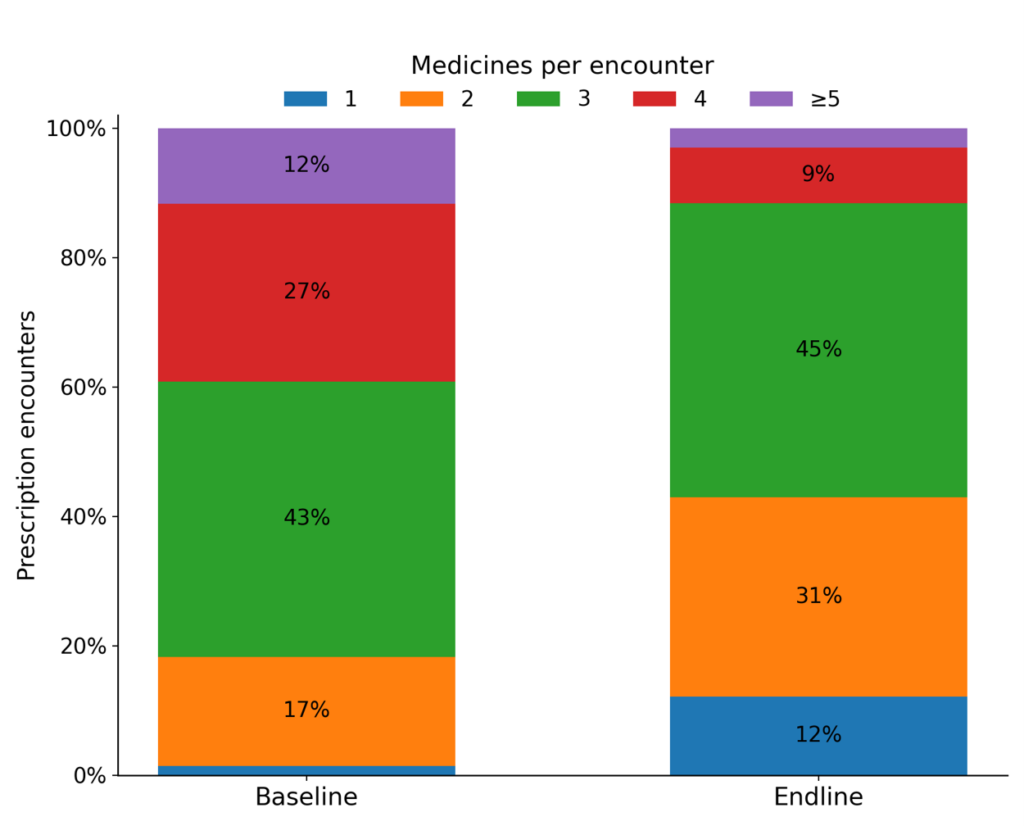
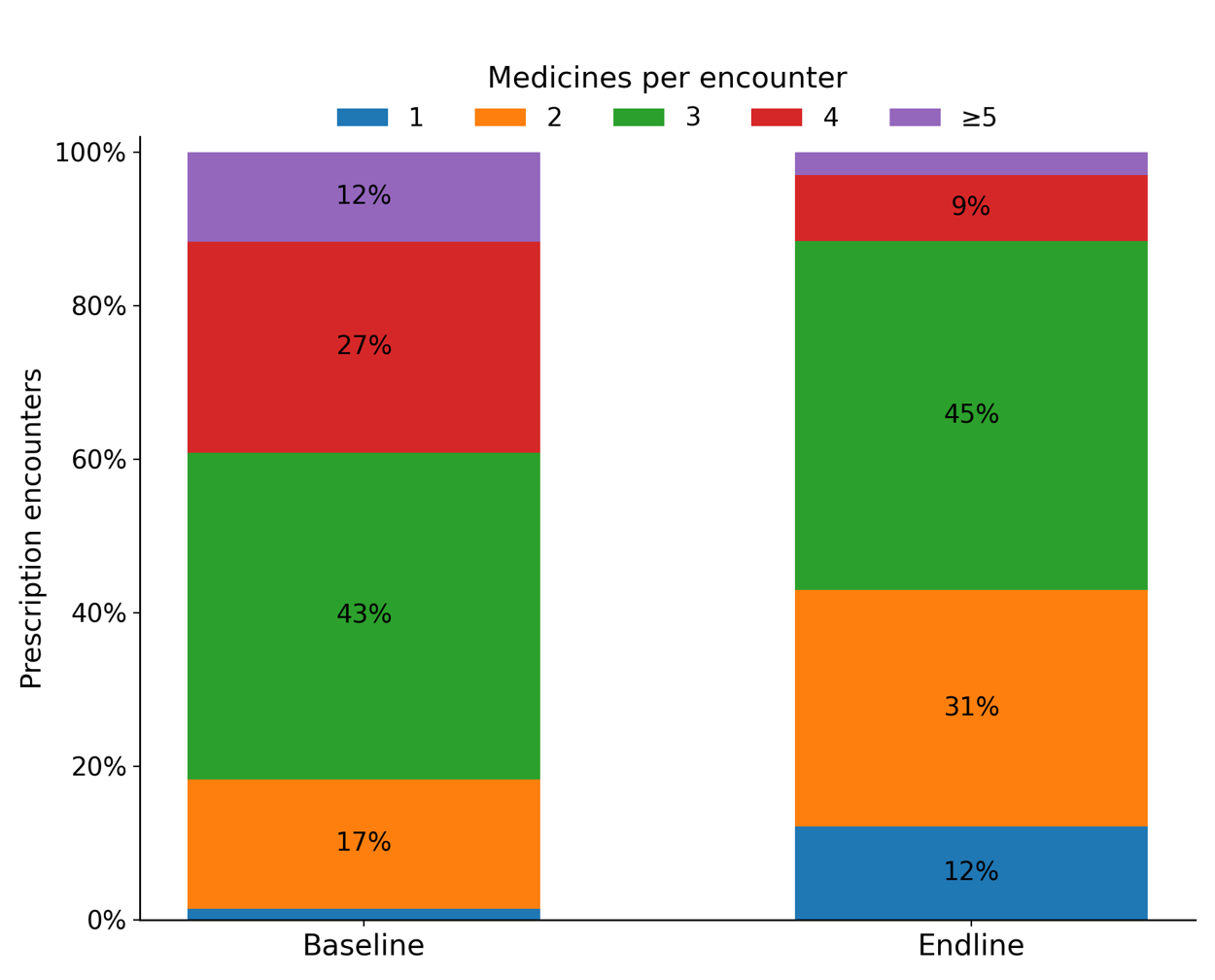
Mean medicines per encounter was 3.35 (SD 1.02) at baseline and 2.60 (SD 0.92) at endline, with an adjusted mean difference of -0.65 medicines (95% CI: -0.80 – -0.49; p<0.001). The distribution shifted toward prescriptions containing fewer medicines at endline (Figure 2).
Prescriptions containing only generic medicines were 78.6% (275/350) at baseline and 94.4% (187/198) at endline, an adjusted difference of 13.0 percentage points (95% CI: 6.7 – 19.4; aPR 1.15; 95% CI: 1.07 – 1.24; p<0.001) (Figure 1). Injection prescribing remained uncommon (3.1% [11/350] vs 3.5% [7/198]).
Several prescribing indicators were more favorable at endline than at baseline during the QI period. UCG concordance was higher, while antibiotic prescribing and the number of medicines per encounter were lower and generic prescribing was more consistent. These findings should not, however, be interpreted as causal effects of the change package because the evaluation had no concurrent comparator and was vulnerable to secular and measurement-related influences.
The higher endline UCG concordance is relevant in a context where adherence to national guidance has remained suboptimal. UCG concordance was 34.2% among nearly 10,000 antibiotic prescriptions in lower-level facilities in southwestern Uganda [5] and approximately 30% in a national survey of 13 hospitals [11]. These external estimates use different settings and outcome definitions and are therefore contextual rather than direct benchmarks for our prescription-level concordance outcome. The Itojo experience nevertheless illustrates one way a district hospital can embed national guidance within routine prescribing and review processes.
The change package combined education, electronic UCG access, role clarification, signature verification, and prescription audit and feedback. Because quantitative implementation fidelity and component-level exposure were not measured, neither effectiveness nor feasibility can be attributed to any individual component. The package as a whole is consistent with evidence from low- and lower-middle-income countries showing that guideline-adherence and antibiotic-use interventions commonly combine education with monitoring, review, or feedback [12,13]. Uganda’s SPARS experience similarly illustrates the broader principle of linking measurement with supervision, feedback, and capacity building [4]. These stewardship functions may be adaptable to similar district hospitals, although the specific configuration used at Itojo was context-dependent.
Antibiotic prescribing was lower at endline but remained common. Comparable levels of antibiotic use have been reported at a secondary-care hospital in western Uganda [6] and among respiratory-tract infection encounters in eastern Uganda [7]. Persistent use may reflect determinants beyond prescriber knowledge. Qualitative evidence from Uganda shows that antibiotic decisions are shaped by diagnostic uncertainty, medicine availability, clinician judgement, patient expectations, and norms of care [14]. The stewardship gap remains important because bacterial antimicrobial resistance imposes substantial mortality across the WHO African Region [15], and Uganda’s current antimicrobial resistance action plan continues to prioritize stewardship, appropriate prescribing, improved diagnostics, training, and surveillance [16]. Further improvement at district hospitals may therefore require audit and feedback to be paired with stronger diagnostic stewardship and review of antibiotic indication and selection.
Although fewer medicines were prescribed at endline, medicine count alone does not indicate prescribing quality because appropriate treatment depends on clinical need. In addition, generic prescribing was measured as the proportion of prescriptions in which all medicines were written generically, rather than as the proportion of individual medicines prescribed by generic name; comparisons with WHO/INRUD benchmarks should therefore be made cautiously. Injection use was already low and changed little.
Several limitations should inform interpretation. First, the uncontrolled single-facility before-and-after design cannot distinguish intervention-related change from secular changes in staffing, medicine supply, referral patterns, other facility activities, or Hawthorne effects. Second, baseline sampling covered January-March whereas endline sampling covered only three weeks in November; exact encounter dates were not retained, precluding a seasonally matched three-week baseline comparison, and residual seasonal confounding is therefore possible. Third, UCG concordance was assessed by the same investigator at baseline and endline without blinding to assessment period; therefore, some classification or observer bias cannot be excluded. Fourth, prescriber identifiers were not retained, so within-prescriber clustering could not be modeled and confidence intervals may be narrower than under a prescriber-clustered analysis. Fifth, the detailed diagnostic categories contained sparse cells; we therefore used broader diagnostic categories for the revised primary models. Finally, intervention fidelity was not quantified, so individual components cannot be linked to the observed changes, and patient outcomes, medicine stock-outs, antimicrobial resistance, adverse events, and costs were not measured. The findings are therefore best interpreted as temporal differences observed during the QI period rather than proof of intervention effects.
At endline, guideline concordance and generic prescribing were higher, while antibiotic prescribing and the number of medicines per encounter were lower than at baseline. These temporal differences persisted after adjustment for measured case mix, but the uncontrolled design, unequal sampling windows, and measurement limitations preclude attributing them specifically to the QI package. The stewardship functions used at Itojo – accessible clinical guidance, role clarification, prescriber education, and audit-feedback within existing hospital structures – may offer an adaptable approach for similar resource-constrained district hospitals. Persistent antibiotic use supports continued diagnostic stewardship, repeated measurement, and evaluation of sustainability.
What is already known about the topic
What this study adds
The authors of this work declare no competing interests. Lilian Bulage is an Associate Editor at the Journal of Interventional Epidemiology and Public Health (JIEPH)and a co-author of this manuscript. In line with the journal’s conflict of interest policy, she was fully recused from the peer review process and had no involvement in editorial handling or decision-making for this submission. An independent editor oversaw the review and decision-making process.
This work was supported by the U.S. Centers for Disease Control and Prevention through Cooperative Agreement GH001353 awarded to Makerere University School of Public Health and supporting the Uganda Public Health Fellowship Program. No author was a direct recipient of the institutional award. The U.S. Centers for Disease Control and Prevention provided financial and technical support for the quality improvement activity and manuscript development. The findings and conclusions are those of the authors and do not necessarily represent the official position of the U.S. Centers for Disease Control and Prevention or the U.S. Government.
We thank the Itojo Hospital quality improvement team, hospital administration, clinicians, pharmacy and dispensing staff, laboratory staff, and records personnel for their participation in identifying prescribing gaps and implementing the improvement activities. We also acknowledge the Ntungamo District Health Office for administrative support.
Conceptualization: Richard Migisha, Alex Riolexus Ario
Methodology: Richard Migisha, Benon Kwesiga, Lilian Bulage
Data Curation: Richard Migisha, Sharon Namasambi
Formal Analysis: Richard Migisha, Sharon Namasambi,
Investigation: Richard Migisha
Funding Acquisition: Alex Riolexus Ario
Project Administration: Richard Migisha
Visualization: Richard Migisha
Supervision: Richard Migisha, Benon Kwesiga, Alex Riolexus Ario
Writing – Original Draft: Richard Migisha, Sharon Namasambi,
Writing – Review & Editing: Richard Migisha, Benon Kwesiga, Lilian Bulage, Alex Riolexus Ario
Table 1: Characteristics and diagnostic case mix of outpatient prescription encounters
| Characteristic | Baseline (N=350) | Endline (N=198) | SMD | P value |
|---|---|---|---|---|
| Age, years, mean (SD) | 33.1 (22.2) | 30.8 (16.6) | -0.12 | 0.170 |
| Age, years, median [IQR] | 30.5 [16.0-49.0] | 31.5 [17.2-41.8] | – | – |
| Age <18 years | 104 (29.7%) | 50 (25.3%) | -0.10 | 0.264 |
| Female sex | 220 (62.9%) | 153 (77.3%) | 0.32 | <0.001 |
| Diagnosis group | <0.001 | |||
| Acid-peptic disease | 36 (10.3%) | 18 (9.1%) | -0.04 | |
| Chronic medical condition | 15 (4.3%) | 11 (5.6%) | 0.06 | |
| Febrile/infectious illness | 4 (1.1%) | 16 (8.1%) | 0.34 | |
| Gastrointestinal infection | 16 (4.6%) | 8 (4.0%) | -0.03 | |
| Multiple diagnoses | 54 (15.4%) | 8 (4.0%) | -0.39 | |
| Musculoskeletal/trauma | 16 (4.6%) | 9 (4.5%) | -0.00 | |
| Other | 70 (20.0%) | 19 (9.6%) | -0.30 | |
| Reproductive/STI | 9 (2.6%) | 28 (14.1%) | 0.43 | |
| Respiratory infection | 85 (24.3%) | 32 (16.2%) | -0.20 | |
| Skin/allergic disease | 19 (5.4%) | 29 (14.6%) | 0.31 | |
| Urinary tract infection | 26 (7.4%) | 20 (10.1%) | 0.09 |
IQR, interquartile range; SD, standard deviation; SMD, standardized mean difference; STI, sexually transmitted infection. SMDs are presented with their signs; values closer to zero indicate greater case-mix similarity. P values are descriptive baseline-endline comparisons. Welch t test was used for mean age; Pearson chi-square or Fisher exact test for binary variables; the diagnosis-group P value is from an overall Monte Carlo Fisher exact test with 100,000 replicates and a fixed random seed.
| Prescribing problem | Contributing factors identified | Change-package components implemented |
|---|---|---|
| Use of trade rather than generic names | Limited access to essential medicines lists; prescribing by staff outside the recognized clinician group | Prescriber education; restricted prescribing to recognized clinicians; authorized prescriber signatures for dispensing staff; prescription audit and feedback |
| Prescriptions not concordant with UCG | Limited access to UCG materials; inconsistent guideline use | Soft-copy PDF UCGs to OPD clinicians; face-to-face prescriber education; periodic prescription audit and feedback |
| Medicines prescribed outside the essential medicines list | Limited prescriber access to essential medicines lists | Essential medicines lists provided to clinicians and updated periodically |
| Excessive/unnecessary multiple medicines, particularly antibiotics | Non-use of clinical guidelines; diagnostic limitations encouraging empirical treatment | Soft-copy PDF UCGs; continuing medical education on rational medicine use |