
Short Communication | Open Access | Volume 9 (4): Article 192 | Published: 13 Nov 2026

Views: 203
Menu, Tables and Figures
| Table 1: Demographic characteristics of respondents of maternal death system evaluation in Zambezi region, 2021-2024 | ||
| Variables | Frequency (N=27) | Percentage (%) |
|---|---|---|
| Sex | ||
| Female | 21 | 77.8 |
| Male | 6 | 22.2 |
| Age group (years) | ||
| 20-30 | 4 | 14.8 |
| 31-40 | 9 | 33.3 |
| 41-50 | 9 | 33.3 |
| 51-60 | 5 | 18.6 |
| Occupation | ||
| Nurses | 17 | 63.0 |
| Doctors | 2 | 7.4 |
| Surveillance officers | 3 | 11.1 |
| Health program officers | 3 | 11.1 |
| Support staff | 2 | 7.4 |
| Level | ||
| District | 15 | 55.6 |
| Region | 12 | 44.4 |
| Number of years in service (years) | ||
| < 10 years | 10 | 37.0 |
| 10-20 | 12 | 44.4 |
| 21-30 | 2 | 7.4 |
| 30+ | 3 | 11.1 |
Table 1: Demographic characteristics of respondents of maternal death system evaluation in Zambezi region, 2021-2024
| Table 2: Knowledge on maternal death of key informants in the maternal death surveillance system evaluation for Zambezi region, 2021-2024 | ||
| Variables | Frequency (N=27) | Percentage (%) |
|---|---|---|
| Correctly defined maternal death | ||
| Yes | 22 | 81.5 |
| No | 5 | 18.5 |
| Knew the main objective of maternal death | ||
| Yes | 26 | 96.3 |
| No | 1 | 3.7 |
| Correctly indicated that maternal death is notified within 24 hours | ||
| Yes | 22 | 81.5 |
| No | 5 | 18.5 |
| Correctly indicated that there are two forms of maternal deaths | ||
| Yes | 5 | 18.5 |
| No | 22 | 81.5 |
| Correctly answered two types of maternal deaths | ||
| Yes | 19 | 70.4 |
| No | 8 | 29.6 |
| Overall knowledge score | ||
| Poor knowledge | 3 | 11.1 |
| Good knowledge | 24 | 88.9 |
Table 2: Knowledge on maternal death of key informants in the maternal death surveillance system evaluation for Zambezi region, 2021-2024
| Table 3: Demographic, clinical characteristics and factors of maternal deaths in Zambezi region, 2021-2024 | ||
| Variables | Frequency (N=10) | Percentage (%) |
|---|---|---|
| Marital status | ||
| Single | 2 | 20 |
| Married | 5 | 50 |
| Unknown | 3 | 30 |
| Age group (years) | ||
| 15-25 | 1 | 10 |
| 26-35 | 7 | 70 |
| 35+ | 2 | 20 |
| Occupation | ||
| Employed | 0 | 0 |
| Unemployed | 6 | 60 |
| Not indicated | 4 | 40 |
| Antenatal Care (ANC) attending history | ||
| < 4 visits | 7 | 70 |
| 4-8 visits | 1 | 10 |
| 8+ visits | 0 | 0 |
| Not indicated | 2 | 20 |
| Gravidity | ||
| 1 | 1 | 10 |
| 2-4 | 1 | 10 |
| 4+ | 6 | 60 |
| Not indicated | 2 | 20 |
| Timing of death | ||
| Early pregnancy (<20 weeks) | 1 | 10 |
| Late pregnancy (> 20 weeks) | 2 | 20 |
| Intrapartum (during labour or within 12 hours) | 4 | 40 |
| Postpartum < 42 days of delivery | 2 | 20 |
| Not indicated | 1 | 10 |
| Cause of death (direct and indirect) | ||
| Obstetric haemorrhage | 2 | 20 |
| Hypertensive disorder | 2 | 20 |
| Pregnancy with abortive outcome | 1 | 10 |
| Sepsis | 1 | 10 |
| Pulmonary embolism | 1 | 10 |
| Scoliosis (dwarf) | 1 | 10 |
| Type of maternal death | ||
| Direct | 6 | 60 |
| Indirect | 3 | 30 |
| Not indicated | 1 | 10 |
| Was the death preventable | ||
| Yes | 5 | 50 |
| No | 1 | 10 |
| Not indicated | 4 | 40 |
| Four main patient factors | ||
| Delay in seeking care | 4 | 40 |
| Infrequent antenatal care (ANC) | 4 | 40 |
| Declining treatment or admission | 2 | 20 |
| Unsafe termination of pregnancy | 1 | 10 |
| Four main health system factors | ||
| Lack of expertise, training or education | 3 | 30 |
| Delay in initiating critical care | 2 | 20 |
| Lack of transport | 1 | 10 |
| Lack of equipment and specialist | 1 | 10 |
| Four main healthcare worker related factors | ||
| Delay in initiating critical care | 6 | 60 |
| Incorrect diagnosis | 6 | 60 |
| Treatment not provided | 3 | 30 |
| Poor documentation | 3 | 30 |
Table 3: Demographic, clinical characteristics and factors of maternal deaths in Zambezi region, 2021-2024
Maria Wayera Laurentia Mukoya1,2,3,&, Ndeshihafela Sakaria1,2, Dianah Ewaga,2,3, Sylvia Mahoto3, Loide Ndimulunde2, Roswitha Ndjengwa2, Maria Kasungo1
1Ministry of Health and Social Services, Namibia, 2Namibia Field Epidemiology and Laboratory Training Programme, 3Faculty of Health Sciences and Veterinary Medicine, University of Namibia, Windhoek, Namibia
&Corresponding author: Maria Wayera Laurentia Mukoya, Namibia Field Epidemiology and Laboratory Training Programme, Faculty of Health Sciences and Veterinary Medicine, University of Namibia, Windhoek, Namibia, Email: mariamukoya@gmail.com ORCID: https://orcid.org/0009-0005-6186-0498
Received: 01 Jan 2025, Accepted: 06 Nov 2026, Published: 13 Nov 2026
Domain: Maternal and Child Health
Keywords: Zambezi Region, Maternal death, System evaluation, 2021-2024
©Maria Wayera Laurentia Mukoya et al. Journal of Interventional Epidemiology and Public Health (ISSN: 2664-2824). This is an Open Access article distributed under the terms of the Creative Commons Attribution International 4.0 License (https://creativecommons.org/licenses/by/4.0/), which permits unrestricted use, distribution, and reproduction in any medium, provided the original work is properly cited.
Cite this article: Maria Wayera Laurentia Mukoya et al., Against the clock: Effect of late detection of a mumps outbreak in the Western North Region of Ghana, 2022. Journal of Interventional Epidemiology and Public Health. 2026; 9(4):192. https://10.37432/jieph-d-26-00002
Introduction: Namibia aims to reduce maternal deaths to less than 70 deaths per 100 000 live births by 2030. In 2020, Namibia recorded 215 deaths per 100 000 live births. Reporting of maternal deaths as a notifiable disease within 24 hours is mandatory in Namibia. However, no maternal death system evaluation has been conducted in the Zambezi region to assess the system; hence, we evaluated the system to assess its usefulness and the system attributes (simplicity, stability, flexibility, acceptability, timeliness and data quality).
Methods: We conducted a cross-sectional study. With reference to the Centre for Disease Control (CDC) updated guideline for surveillance system evaluation, we administered semi-structured questionnaires to 27 maternal death review committee members who included nurses, medical doctors, surveillance officers and support staff. All facilities offering maternity services were assessed with a checklist, and we reviewed medical records. Data were entered in Excel; results were presented in frequencies and proportions.
Results: The majority of respondents were registered nurses, 17 (63%). Of the 10 deaths assessed, six (60%) were direct maternal deaths. Twenty-three (85.2%) of the 27 respondents had not received training in maternal death prevention in the previous five years. Timeliness was rated good (70%), and seven (70%) maternal death review forms were complete. Twenty-five (92.6%) respondents were willing to continue participating in the system, indicating very good acceptability. Stability weaknesses included the availability of guidelines and notification forms in only one of four facilities (25%).
Conclusion: The maternal death surveillance system in Zambezi Region supports its objectives and was found to be useful, simple, timely and acceptable. However, weaknesses in stability remain. We recommend that the program officers provide facilities with the required forms and guidelines.
Maternal death remains a major public health challenge, particularly in low- and middle-income countries, where timely identification and response to maternal deaths are essential for improving maternal health outcomes. In 2023, global statistics indicated that about 260 000 women died during pregnancy and following childbirth, of which 70% were recorded in sub-Saharan Africa [1]. The global maternal mortality ratio was 197 deaths per 100 000 live births [2]. In 2020, Namibia recorded 215 deaths per 100 000 live births [3], in addition, statistics from the Integrated Disease Surveillance and Response (IDSR) reports in Zambezi region recorded 13 maternal deaths from 2021 to 2024. Zambezi region continues to contribute to the maternal death statistics for Namibia despite the country having the aim to reduce the maternal mortality ratio to less than 70 deaths per 100 000 live births by 2030 [3].
The aim of the maternal death surveillance system is to eliminate preventable maternal mortality by obtaining and strategically using information to guide public health actions and monitoring their impact. Although reporting of maternal deaths as a notifiable disease within 24 hours in Namibia is mandatory, no maternal death surveillance system evaluation has been conducted in Zambezi Region to assess the usefulness of the system and its attributes. The aim of the evaluation was therefore to assess the usefulness of the surveillance system and to assess attributes (simplicity, flexibility, acceptability, data quality, timeliness and stability) of the maternal death surveillance system for Zambezi Region.
Evaluation design and period
We conducted a descriptive cross-sectional study to assess the maternal death surveillance system. This evaluation was conducted from May to July 2025. Four years’ data from January 2021 to December 2024 were reviewed. Maternal services are offered at Katima Mulilo Hospital and at three health centres; however, the clinics also carry out emergency maternity services. The facilities which offer maternal services are Bukalo, Sibbinda and Sangwali health centres
Case definitions
Maternal death: is defined as the death of a woman while pregnant or within 42 days of termination of pregnancy, irrespective of the duration and the site of the pregnancy, from any cause related to or aggravated by the pregnancy or its management, but not from accidental or incidental causes [4].
Direct obstetric death: is the death of a woman that results from obstetric complications of the pregnant state, which includes pregnancy, labour, and puerperium [4].
Indirect obstetric death: is the death of a woman caused by non-obstetric conditions or diseases that may exist before pregnancy but are aggravated by the physiologic effects of pregnancy [4].
Maternal mortality ratio: is the number of maternal deaths per 100 000 live births [4].
System operation
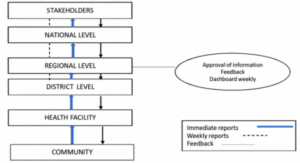
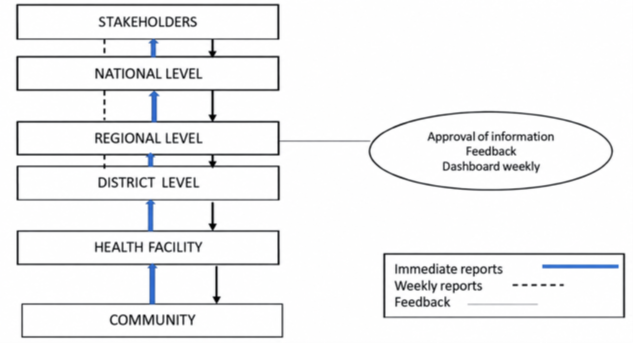
When a maternal death occurs at a health centre or hospital, the nurse on duty in the maternity ward, theatre, casualty or any other department where the death occurred must notify the nurse in charge of the health facility or the matron at the hospital within 24 hours. The nurses complete the deceased patient’s file immediately after the death. One copy of the file is kept at the health centre or ward, while the other is forwarded to the Health Information Office the following morning. A preliminary investigation is conducted by the nurses and doctors who were on duty at the time of death, and the Maternal Death Notification Form is completed within 24 hours. The notification form must be completed in full and forwarded to the Health Information Office for capturing on the District Health Information System (DHIS2) platform. The Health Information Officer updates the Weekly Disease Surveillance report and the summary sheet. Maternal death audits are conducted at the district level within seven days, while the Regional Maternal Death Committee reviews the deaths within two weeks (Figure 1).
Evaluation setting and sampling
Zambezi region is in the North-East part of Namibia. The region consists of one district hospital, three health centres and 25 clinics. It has a population of about 142 683 and a childbearing-age population of 32 746 women. Maternity services are offered at Katima Mulilo Hospital and at the health centres. Zambezi region has a maternity shelter which accommodates expecting mothers from all the villages and townships of Zambezi region.
We selected all 27 members of the maternal death review committee: 12 from the regional committee and 15 from the district committee. These members included nurses from departments involved in maternal deaths, Health Information System officers, in-charges of the three health centres, medical doctors, program officers, and support staff. Furthermore, we selected all health facilities which offer maternity services, namely Bukalo, Sibbinda and Sangwali health centres, together with Katima Mulilo District Hospital, focusing on female and high-care wards.
Data collection process and analysis
With reference to the Centre for Disease Control (CDC) updated guideline for surveillance system evaluation, an interviewer-administered questionnaire was used to collect information on healthcare workers’ knowledge, the usefulness of the surveillance system, and its attributes. Facilities were assessed for stability using an observational checklist. A data extraction tool was used to extract information from medical records to assess usefulness, data quality and timeliness. Quantitative attribute scores were classified as very good (≥80%), good (≥60% to <80%), average (≥40% to <60%) or poor (<40%).
Usefulness
According to the updated CDC guidelines for the evaluation of surveillance systems, a public health surveillance system is useful if it contributes to the prevention and control of adverse health-related events. The evaluation therefore assessed participants and maternal death records, which contained the notification and review forms. Identification of factors contributing to maternal deaths, identification of characteristics of the cases, establishment of the magnitude of the problem were assessed by reviewing the maternal death review forms and coming up with a line list. We ascertained how maternal death data is used and the implementation of recommendations through semi-structured questionnaires. Furthermore, questionnaires were used to establish from participants if the system was useful.
Attributes of the Surveillance system
Simplicity: We measured simplicity by assessing whether the surveillance system structure was easy to understand and to operate in terms of case definition, data collection and analysis. A semi-structured questionnaire was used to assess staff training on maternal deaths and ease of operation of the system.
Stability: Stability refers to the ability of the system to collect, manage, and provide data properly without failure and the ability to be operational when it is needed. We therefore looked at the availability of maternal death guidelines and maternal death forms at the health facilities. We assessed the IDSR reporting form to see if maternal deaths are being captured. We assessed health facilities on the availability of a maternal death focal person, availability of maternal death charts, posters and case definitions displayed on the walls. Stability was further assessed through semi-structured questionnaires to ascertain trainings which have taken place in the use of IDSR reporting tools.
Data quality: Data quality reflects the completeness and validity of the data recorded in the public health surveillance system. We reviewed all 10 available maternal death forms for completeness. Calculations were done for completeness.
Timeliness: We assessed timeliness by reviewing the dates of notification on the notification forms against the date of death to see if the maternal death was reported within the required 24 hours. The maternal death review forms were also reviewed to see if the district conducted the maternal death review within seven days and the region within two weeks. The number of reports submitted in a timely manner was divided by the total number of forms expected and multiplied by 100.
Acceptability: This attribute was evaluated by questioning the participants and also looking at the maternal death forms. Questions on willingness to participate in the maternal death surveillance system were asked, and the forms were reviewed for timeliness and completeness.
Flexibility: Questions were posed to the participants on if the system adapts to change which is introduced.
Ethical approval
This study was reviewed and approved by the Ministry of Health and Social Services Ethics Committee (Reference – 22/3/1/1). Permission was also granted by the Zambezi Regional Health Directorate. Consent to participate was required from the participants through a consent form. Confidentiality was maintained by ensuring that the medical records were de-identified and results were locked in passcode folders.
The evaluation involved 27 maternal death review committee members. The majority of the respondents were female, 21 (77.8%). The highest responding occupation was nurses, 17 (63%); the age groups 31-40 and 41-50 were the majority, with 9 (33.3%) each (Table1). Of the 27 respondents, 22 (81.5%) knew the definition of maternal death; 22 (81.5%) answered correctly that a maternal death is notified from the health facility to the next level within 24 hours of a death occurring (Table 2). Overall knowledge of the participants was very good, with 24 (88.9%) of the 27 respondents having good knowledge (Table 3).
Among the 10 maternal deaths reviewed, seven (70%) occurred among women aged 26–35 years, and four (40%) occurred intrapartum. Six (60%) deaths were classified as direct, three (30%) as indirect, and one (10%) had no type indicated. Obstetric haemorrhage and hypertensive disorder each accounted for two (20%) deaths. Five (50%) deaths were recorded as preventable, one (10%) as not preventable, and preventability was not indicated for four (40%) deaths (Table 3).
Attributes
Timeliness: The surveillance system timeliness was rated good (70%). Of the 10 medical records reviewed, seven (70%) were reported within the required 24 hours after the death occurred from the health facility to the next level and were reviewed within seven days after death occurred at the district level and within two weeks at the regional level.
Data quality: Completeness was classified as very good (≥80%), good (≥60% to <80%), average (≥40% to <60%) or poor (<40%). Of the 10 maternal death review forms assessed, 7 (70%) were filled, indicating good data completeness.
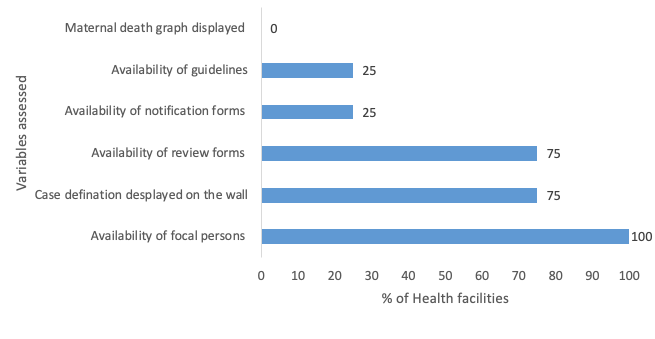
Stability: Availability of guidelines and adequate notification forms were only observed in one (25%) of the four facilities. Of the four facilities assessed, three (75%) had adequate maternal death review forms, and three (75%) of the health facilities had case definitions displayed on the wall. Four (100%) of the health facilities had a maternal death focal person, who is also a member of the district maternal death review committee (Figure 2).
Simplicity: Of the 27 respondents, 23 (85.2%) reported that they had not received training on maternal death in the previous five years, and all 27 (100%) indicated a need for training. Thirteen (48.1%) had previously completed a maternal death review form. Among these 13 respondents, six (46.2%) reported that completing the form took 21-30 minutes.
Acceptability: Of the 27 responses, 25(92.6%) stated that they are willing to continue to participate in the maternal death surveillance system; furthermore, 23 (85.2%) indicated that maternal death activities do not take up their time.
Flexibility: All 27 (100%) respondents indicated that the system adapts to change.
Usefulness: All 27 (100%) respondents regarded the maternal death surveillance system for the Zambezi region as useful. Of the 27 respondents, 21 (77.8%) reported having used maternal death data. The public health action reported as being taken on the basis of this information was mainly the provision of health education.
Most health facilities assessed in our study lacked death notification forms and guidelines. These findings are similar to those reported in Hwange district, where only five of 11 facilities had notification forms, and four had guidelines [7]. In contrast, a study in Morogoro, Tanzania, reported that most facilities had maternal death forms [8, 9]. Limited training on the importance of forms and guidelines and weaknesses in accountability for maintaining these materials are possible explanations, but this evaluation did not establish the reasons for their absence. The lack of notification forms and guidelines may delay maternal death notification to the next level and weaken system stability [7].
Our findings showed that the timeliness of the system was good. The majority of the maternal deaths were reported within the recommended 24 hours and reviewed within the stipulated days. This is comparable to findings in Erongo region, where all maternal deaths were reported within 24 hours, and maternal death review meetings were held for all cases at district and regional level within the expected time. Our findings, however, differ from the findings of a study done in Hwange district, where there was a delay in notifications. Timely notification is essential for prompt investigation and corrective actions. It allows the system to prevent future avoidable loss of life [10-11].
The majority of the respondents stated that they are willing to continue to participate in the maternal death surveillance system and that maternal death activities do not take up their time. These results are similar to the evaluation done in Ghana where 96.4% of the respondents responded to willingness to continue participating in the maternal death surveillance system. Our findings could be attributed to respondents viewing the maternal death surveillance system as useful in reducing preventable deaths [7] and to respondents believing that it is part of their duty to participate in the system [5].
Respondents regarded the maternal death surveillance system in the Zambezi region as useful for guiding public health action to prevent future maternal deaths. Despite its reported usefulness, the system had weaknesses in stability, as most facilities lacked notification forms and guidelines
Limitations
The IDSR reports for the Zambezi region captured 13 maternal deaths from 2021-2024; only ten maternal death medical records were available for the evaluation; three of the maternal death medical records remain missing. Having only ten maternal death cases limits the ability to comprehensively assess all aspects of the Maternal Death Surveillance System Evaluation and reduces the generalizability of the findings. In addition, this study included only 27 participants, which may not be fully representative of all stakeholders involved in the Maternal Death Surveillance System. This hindered the evaluation from providing full information to adequately determine the cause of maternal deaths. Missing records hamper the development of evidence-based interventions, policies and training programs.
The maternal death surveillance system in Zambezi region is useful, simple, timely and acceptable, but its stability and filing system require improvement. To address weaknesses in stability, we recommend regular facility inspections by surveillance and program officers to ensure that facilities have the required forms and guidelines. To improve record retention, program officers should ensure that all maternal death medical records are stored in a lockable cabinet to reduce the risk of records going missing.
What is already known about the topic
What this study adds
The authors of this work declare no competing interests.
Data availability
The dataset upon which the findings are based belongs to the Ministry of Health and Social Services of Namibia under the Epidemiology sub-division. The dataset is publicly available upon request from the corresponding author and with permission from the Ministry of Health and Social Services.
The authors would like to extend their gratitude to the Ministry of Health and Social Services (MoHSS) Research Ethics Committee for allowing us to access the dataset. To the Zambezi region health directorate for allowing us to conduct this study. The University of Namibia and the Epidemiology Division, Emergency Preparedness and Response Sub-division at National Level for their unwavering support.
Conceptualization: Maria Mukoya; Ndeshihafela Sakaria; Loide Ndimulunde; Roswitha Ndjengwa; Maria Kasungo
Methodology: Maria Mukoya
Data Curation: Maria Mukoya; Ndeshihafela Sakaria
Formal Analysis: Maria Mukoya
Supervision: Ndeshihafela Sakaria; Dinah Ewaga; Loide Ndimulunde; Roswitha Ndjengwa; Sylvia Mahoto; Maria Kasungo
Writing- Original Draft: Maria Mukoya
Writing – Review & Editing: Ndeshihafela Sakaria; Dinah Ewaga; Loide Ndimulunde; Roswitha Ndjengwa; Sylvia Mahoto; Maria Kasungo
| Table 1: Demographic characteristics of respondents of maternal death system evaluation in Zambezi region, 2021-2024 | ||
| Variables | Frequency (N=27) | Percentage (%) |
|---|---|---|
| Sex | ||
| Female | 21 | 77.8 |
| Male | 6 | 22.2 |
| Age group (years) | ||
| 20-30 | 4 | 14.8 |
| 31-40 | 9 | 33.3 |
| 41-50 | 9 | 33.3 |
| 51-60 | 5 | 18.6 |
| Occupation | ||
| Nurses | 17 | 63.0 |
| Doctors | 2 | 7.4 |
| Surveillance officers | 3 | 11.1 |
| Health program officers | 3 | 11.1 |
| Support staff | 2 | 7.4 |
| Level | ||
| District | 15 | 55.6 |
| Region | 12 | 44.4 |
| Number of years in service (years) | ||
| < 10 years | 10 | 37.0 |
| 10-20 | 12 | 44.4 |
| 21-30 | 2 | 7.4 |
| 30+ | 3 | 11.1 |
| Table 2: Knowledge on maternal death of key informants in the maternal death surveillance system evaluation for Zambezi region, 2021-2024 | ||
| Variables | Frequency (N=27) | Percentage (%) |
|---|---|---|
| Correctly defined maternal death | ||
| Yes | 22 | 81.5 |
| No | 5 | 18.5 |
| Knew the main objective of maternal death | ||
| Yes | 26 | 96.3 |
| No | 1 | 3.7 |
| Correctly indicated that maternal death is notified within 24 hours | ||
| Yes | 22 | 81.5 |
| No | 5 | 18.5 |
| Correctly indicated that there are two forms of maternal deaths | ||
| Yes | 5 | 18.5 |
| No | 22 | 81.5 |
| Correctly answered two types of maternal deaths | ||
| Yes | 19 | 70.4 |
| No | 8 | 29.6 |
| Overall knowledge score | ||
| Poor knowledge | 3 | 11.1 |
| Good knowledge | 24 | 88.9 |
| Table 3: Demographic, clinical characteristics and factors of maternal deaths in Zambezi region, 2021-2024 | ||
| Variables | Frequency (N=10) | Percentage (%) |
|---|---|---|
| Marital status | ||
| Single | 2 | 20 |
| Married | 5 | 50 |
| Unknown | 3 | 30 |
| Age group (years) | ||
| 15-25 | 1 | 10 |
| 26-35 | 7 | 70 |
| 35+ | 2 | 20 |
| Occupation | ||
| Employed | 0 | 0 |
| Unemployed | 6 | 60 |
| Not indicated | 4 | 40 |
| Antenatal Care (ANC) attending history | ||
| < 4 visits | 7 | 70 |
| 4-8 visits | 1 | 10 |
| 8+ visits | 0 | 0 |
| Not indicated | 2 | 20 |
| Gravidity | ||
| 1 | 1 | 10 |
| 2-4 | 1 | 10 |
| 4+ | 6 | 60 |
| Not indicated | 2 | 20 |
| Timing of death | ||
| Early pregnancy (<20 weeks) | 1 | 10 |
| Late pregnancy (> 20 weeks) | 2 | 20 |
| Intrapartum (during labour or within 12 hours) | 4 | 40 |
| Postpartum < 42 days of delivery | 2 | 20 |
| Not indicated | 1 | 10 |
| Cause of death (direct and indirect) | ||
| Obstetric haemorrhage | 2 | 20 |
| Hypertensive disorder | 2 | 20 |
| Pregnancy with abortive outcome | 1 | 10 |
| Sepsis | 1 | 10 |
| Pulmonary embolism | 1 | 10 |
| Scoliosis (dwarf) | 1 | 10 |
| Type of maternal death | ||
| Direct | 6 | 60 |
| Indirect | 3 | 30 |
| Not indicated | 1 | 10 |
| Was the death preventable | ||
| Yes | 5 | 50 |
| No | 1 | 10 |
| Not indicated | 4 | 40 |
| Four main patient factors | ||
| Delay in seeking care | 4 | 40 |
| Infrequent antenatal care (ANC) | 4 | 40 |
| Declining treatment or admission | 2 | 20 |
| Unsafe termination of pregnancy | 1 | 10 |
| Four main health system factors | ||
| Lack of expertise, training or education | 3 | 30 |
| Delay in initiating critical care | 2 | 20 |
| Lack of transport | 1 | 10 |
| Lack of equipment and specialist | 1 | 10 |
| Four main healthcare worker related factors | ||
| Delay in initiating critical care | 6 | 60 |
| Incorrect diagnosis | 6 | 60 |
| Treatment not provided | 3 | 30 |
| Poor documentation | 3 | 30 |