
Research | Open Access | Volume 9 (Suppl 12): Article 12 | Published: 24 Aug 2026

Views: 3,027
Menu, Tables and Figures
| Case ID | Age (years) | Sex | Epidemiological week of symptom onset | Duration of illness before presentation at the designated LF treatment centre (days) | Initial diagnosis at first facility (primary/secondary) | Key presenting symptoms | Major complications | Epidemiological features | Key management | Outcome |
|---|---|---|---|---|---|---|---|---|---|---|
| 1 | 6 | M | Wk 50 (2024) | 18 days | Malaria | Fever, cough, diarrhoea, bleeding (nose/mouth) | Severe anaemia, respiratory distress | Household rat exposure | Ribavirin, antibiotics, IV fluids, supportive care | Fatal |
| 3 | 17 | M | Wk 52 (2024) | 8 days | Appendicitis | Fever, severe abdominal pain | AKI, hepatic dysfunction | Misdiagnosed acute abdomen, delayed suspicion | Ribavirin, blood transfusion, supportive care | Fatal |
| 5 | 26 | F | Wk 2 (2025) | 5 days | None documented | Fever, multi-site bleeding | Coagulopathy | Late presentation from PHC | Ribavirin, supportive care | Fatal |
| 6 | 45 | M | Wk 3 (2025) | 7 days | Complicated malaria | Fever | AKI, electrolyte derangement | Multiple facility visits | Ribavirin, oxygen, attempted dialysis | Fatal |
| 10 | 10 | F | Wk 3 (2025) | 6 days | Malaria | Fever, headache, vomiting | Anaemia, thrombocytopenia | Household cluster (father infected) | Ribavirin, transfusion, supportive care | Recovered |
| 4 | 24 | F | Wk 2 (2025) | 5 days | None documented | Fever, weakness | None documented | Recent travel from Edo State | Ribavirin, supportive care | Recovered |
| 9 | 25 | M | Wk 3 (2025) | 8 days | Malaria | Fever, headache, weakness | None documented | Rodent exposure at workplace | Ribavirin, supportive care | Recovered |
| 2 | 26 | M | Wk 50 (2024) | 14 days | None documented | Fever, weakness | AKI, anaemia | Delayed referral from private facility | Ribavirin, dialysis, blood transfusion | Recovered |
| 7 | 30 | F | Wk 3 (2025) | 14 days | None documented | Fever, headache, body pain, anorexia | None documented | Household rodent infestation/exposure | Ribavirin, supportive care | Recovered |
| 8 | 40 | M | Wk 4 (2025) | 4 days | Malaria | Fever, diarrhoea, dyspnoea | Possible AKI, bleeding diathesis | Occupational exposure | Ribavirin, IV fluids, supportive care | Recovered |
Note: Case 10 was part of a household cluster; another laboratory-confirmed case from the same household (Case 8) is included in this study.
Abbreviations: AKI = Acute kidney injury; IV = Intravenous; PHC = Primary health centre; M = Male; F = Female
The median age of cases was 25.5 years (range: 6–45 years), with a male predominance. Fatal outcomes were associated with complications, particularly bleeding and AKI, and delays in diagnosis or referral.
Table 1: Demographic, clinical, epidemiological, and outcome characteristics of laboratory-confirmed Lassa fever cases, Ebonyi State, December 2024–February 2025 (n = 10)
Gordon Igbodo1,2, Nneka Chika-Igwenyi3, Oluwole Mathew Temitope2, Umahi Chukwu3, Nnennaya Ajayi3, Nsikan Primus Okon1, Ogbonna Nwambeke 4, Ehiakhamen Odianosen1,5, Olukemi Titilope Olugbade 2,5, Elizabeth Adedire 2,5
1Nigeria Centre for Disease Control and Prevention (NCDC), Abuja, Nigeria, 2Nigeria Field Epidemiology and Laboratory Training Programme (NFELTP), Abuja, Nigeria, 3Alex Ekwueme Federal Teaching Hospital, Ebonyi State, Nigeria, 4Ebonyi State Ministry of Health, Abakaliki, Ebonyi State, Nigeria, 5African Field Epidemiology Network, Abuja, Nigeria
&Corresponding author: Gordon Igbodo, Nigeria Centre for Disease Control and Prevention (NCDC), Abuja, Nigeria. Email: Igbodogordon@gmail.com ORCID: https://orcid.org/0009-0002-3360-1884
Received: 11 Jan 2026, Accepted: 20 Aug 2026, Published: 24 Aug 2026
Domain: Infectious Disease Epidemiology
Keywords: Lassa fever, case series, outbreak, clinical management
©Gordon Igbodo et al. Journal of Interventional Epidemiology and Public Health (ISSN: 2664-2824). This is an Open Access article distributed under the terms of the Creative Commons Attribution International 4.0 License (https://creativecommons.org/licenses/by/4.0/), which permits unrestricted use, distribution, and reproduction in any medium, provided the original work is properly cited.
Cite this article: Gordon Igbodo et al. Clinical and epidemiological characteristics of confirmed Lassa fever cases between December 2024 and February 2025 in Ebonyi State, Nigeria. Journal of Interventional Epidemiology and Public Health. 2026; 9(Suppl 12):12. https://doi.org/10.37432/jieph-d-26-00010
Introduction: Lassa Fever (LF) is an acute viral haemorrhagic illness endemic to West African countries. The disease remains a major public health concern in Nigeria and accounts for most reported global cases annually. Despite improvements in surveillance and case management, mortality remains high. Ebonyi State experiences recurrent outbreaks, yet limited case-level data exist to guide early detection and clinical response.
Methods: A retrospective case series was conducted of laboratory-confirmed LF cases admitted at the designated LF treatment centre in Ebonyi State between December 2024 and February 2025. Data were extracted from hospital records, the Nigeria Centre for Disease Control and Prevention (NCDC) case investigation forms, and state surveillance line lists. The variables included demographic, clinical, and outcome characteristics. Descriptive statistics were summarised using medians and proportions.
Results: Ten laboratory-confirmed cases were identified across multiple LGAs. The median age was 25.5 years (interquartile range: 18.8 – 29.0), and 60% were male. The most common presenting symptoms were fever, headache, and generalised weakness. Five of ten patients (50%) were initially treated for malaria or typhoid before LF was suspected. Severe complications, particularly bleeding and AKI, were observed more frequently among fatal cases. The overall case fatality rate was 40%, with all deaths occurring among patients presenting ≥5 days after symptom onset (median time to presentation: 7.5 days [fatal] versus 7.0 days [recovered]).
Conclusion: Delayed presentation, initial misdiagnosis and severe complications were observed more frequently among fatal cases during the 2024–2025 LF transmission season in Ebonyi State. Early clinical suspicion, prompt referral, and timely initiation of Ribavirin and supportive care are likely important for improving survival, consistent with evidence from similar Lassa fever treatment settings in West Africa. Strengthening clinician awareness, diagnostic capacity, and community health-seeking behaviour remains essential to reducing LF-related mortality in endemic regions.
Lassa fever (LF) is an acute viral haemorrhagic disease of major public health importance in Nigeria and across West Africa. It is caused by the Lassa virus, an Arenavirus transmitted primarily through exposure to urine or faeces of infected Mastomys rodents. Secondary human-to-human transmission can occur through contact with blood or body fluids of infected persons, particularly in healthcare and household settings [1,2]. Nigeria remains one of the most affected countries globally, with annual outbreaks and seasonal peaks typically occurring between January and April, and a smaller secondary peak between September and December [3,4].
Despite improved surveillance and diagnostic capacity, LF continues to cause substantial morbidity and mortality in Nigeria. National data indicate persistent transmission across multiple states, with high case fatality rates (CFR) among hospitalised patients, particularly those presenting late or with severe complications [5,6]. Cumulatively, in 2024, more than one thousand three hundred confirmed cases were reported nationwide with 214 deaths (CFR: 16.3%), with Ebonyi State contributing a significant proportion of the burden [2,6]. These surveillance data highlight the continued endemicity of LF and the urgent need for vigilance at the subnational levels.
Clinically, LF presents with non-specific symptoms such as fever, headache, and weakness, which often mimic malaria or other febrile illnesses [7]. This overlap is frequently associated with misdiagnosis and delays in appropriate referral and treatment. Progression to severe disease may involve haemorrhage, acute kidney injury (AKI), shock, or multi-organ failure, all of which are associated with poor outcomes [8,9]. Evidence from other studies suggests that early suspicion, prompt referral, and timely initiation of Ribavirin, alongside supportive care is associated with improved survival [10,11].
Ebonyi State is located in South-eastern Nigeria and has experienced recurrent outbreaks in recent years. Between December 2024 and February 2025, 40 suspected LF cases were identified in Ebonyi State, including 9 laboratory-confirmed cases and 4 deaths (CFR: 44.4%) [2]. In response, a rapid investigation was undertaken by the National Rapid Response Team (NRRT), during which additional cases were identified and characterised to identify factors influencing outcomes. This case series describes the clinical and epidemiological characteristics of laboratory-confirmed LF cases in Ebonyi State during the 2024/2025 transmission season. The findings aim to improve understanding of disease patterns and outcomes, to inform early detection, case management, and outbreak preparedness in endemic areas.
Study area and setting
The study was conducted at the LF Treatment Centre, Alex Ekwueme Federal University Teaching Hospital, Abakaliki (AEFUTHA), Ebonyi State. The hospital serves as a major referral facility for LF cases from within the state and neighbouring regions. Ebonyi State is endemic for LF in Nigeria, characterised by rural communities where subsistence farming and close human–rodent interaction facilitate transmission. Laboratory confirmation of suspected cases is performed at Nigeria Centre for Disease Control and Prevention (NCDC) accredited laboratories using reverse transcriptase polymerase chain reaction (RT-PCR) methods [11].
Study design
This study was a retrospective case series describing ten laboratory-confirmed LF cases admitted at the designated LF treatment centre in Ebonyi State, Nigeria, between December 2024 and February 2025. The study formed part of an outbreak investigation response following an increase in confirmed cases during the 2024/2025 transmission season. These cases represent patients managed at the designated treatment centre and may not include all confirmed cases in Ebonyi State during the study period.
Case definition and identification
Case classification followed the NCDC 2018 National Guidelines for Lassa Fever Case Management [11]. A confirmed case was defined as a suspected or probable case with laboratory confirmation of Lassa virus infection by RT-PCR, serology (IgM antibody), or epidemiologic linkage to a laboratory-confirmed case. Although suspected and probable cases were routinely identified through surveillance and triaged for testing, only LF cases confirmed by RT-PCR within the study period were included in this case series.
Data sources and collection
Data were obtained from hospital medical records, standard NCDC case investigation forms (CIFs), and line lists maintained by the Ebonyi State Ministry of Health and the outbreak response team. Additional information was verified through interviews with managing clinicians and patients’ relatives. Extracted variables included demographic characteristics, clinical features, epidemiological history, complications, treatment received (including Ribavirin), and outcomes.
Due to the small number of cases, data completeness and accuracy were checked manually. Where discrepancies or missing data were found, clarification was obtained from facility focal persons or outbreak response team members. Data were cleaned in Microsoft Excel and exported to R statistical software (version 4.5.0) [12] for analysis and spatial visualisation.
Data analysis
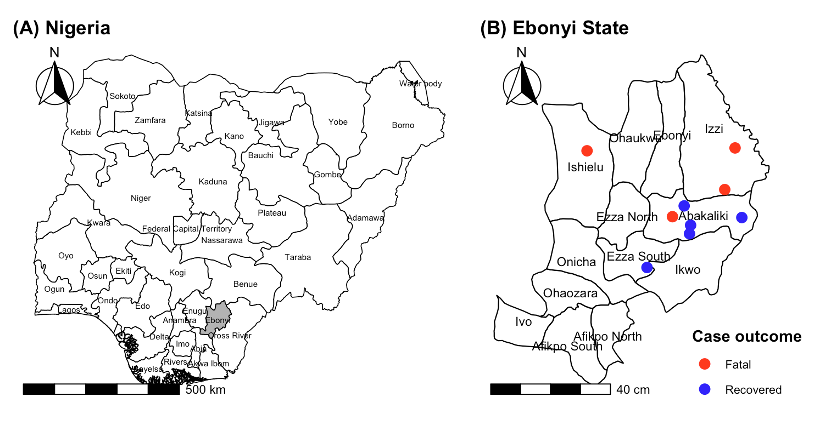
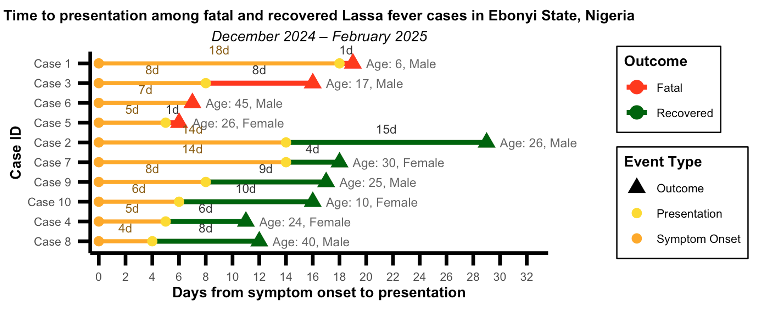
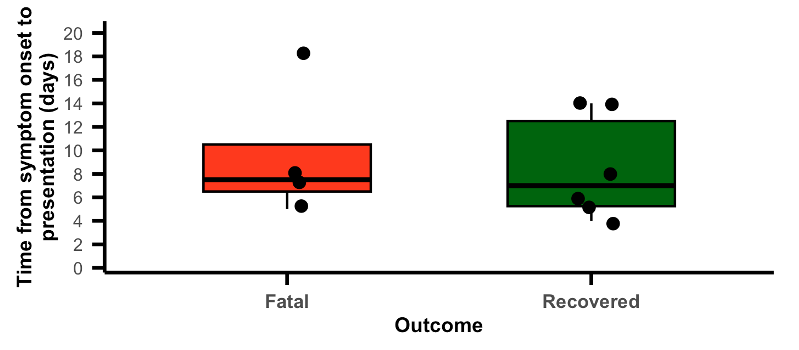
Data were analyzed descriptively. Continuous variables were summarized using medians, interquartile ranges and ranges, where appropriate, while categorical variables such as sex, outcome status, and presence of complications were expressed as counts and simple proportions. Due to the small sample size, no inferential statistics were performed. Cases were stratified by outcome (recovered vs. fatal) to explore trends in presentation, complications, and timing of care. Using R statistical software, three visualizations were generated: a geographical map displaying the distribution of confirmed cases by Local Government Area (LGA); a case timeline illustrating the time from symptom onset to presentation and subsequent outcome for each confirmed case; and a box-and-whisker plot comparing time from symptom onset to presentation between fatal and recovered cases, with median and IQR displayed by outcome.
Ethical considerations
Ethical approval for this research was obtained from the Ebonyi State Health Research Ethics Committee (Protocol No. EBSHREC/023; Committee Assigned No. 2025/0023). The study adhered to national and institutional ethical standards. As a retrospective review of routine outbreak and hospital data, informed consent was waived in accordance with ethics approval. For interviews, verbal consent was obtained from participants or guardians. All data were anonymised before analysis, and confidentiality was strictly maintained throughout.
A total of ten laboratory-confirmed LF cases were reported in Ebonyi State between December 2024 and February 2025, corresponding to epidemiological weeks 1–4 of 2025. All cases were confirmed by RT-PCR. The key demographic, clinical, and outcome characteristics are summarised in Table 1.
Sociodemographic characteristics
The median age of the cases was 25.5 years (interquartile range: 18.8 – 29.0). Six (60%) were male, and four (40%) were female. Both paediatric and adult cases were represented. Cases were distributed across multiple Local Government Areas (LGAs) in the state (Figure 1). Fever was reported in all cases at presentation. Other frequently reported symptoms included headache, generalised weakness, and body pain. Five of ten patients (50%) initially presented to lower-level health facilities or patent medicine vendors, where they were managed for malaria or other febrile illnesses without improvement before referral to designated treatment centres.
One patient was initially treated for an acute abdominal condition before LF was suspected (Table 1).
Severe complications were observed in 7 of 10 patients (70%). Bleeding manifestations (from the nose, mouth, vagina, or venepuncture sites) and AKI were the most common severe features. Bleeding and AKI were observed more frequently among fatal cases compared to recovered cases (Table 1).
Timeliness of presentation and care
There was wide variation in the time from symptom onset to presentation at the designated LF treatment centre. The epidemiological week of symptom onset ranged from Wk 50 (2024) to Wk 4 (2025), indicating that cases occurred across both late 2024 and early 2025. All fatal cases (n = 4) presented five days or more after symptom onset or had already developed severe complications upon arrival. Two of these cases presented 8 and 18 days after symptom onset. In contrast, survivors generally presented earlier and received prompt care, including Ribavirin therapy. The median time from symptom onset to presentation was longer among fatal cases compared to recovered cases (Figure 2). The median time from symptom onset to presentation was 7.5 days (IQR: 6.5–10.5) among fatal cases versus 7.0 days (IQR: 5.3–12.5) among recovered cases (Figure 3).
Treatment and outcomes
All ten cases received supportive care; Ribavirin was administered to patients who presented early enough to benefit from antiviral therapy. Supportive measures such as blood transfusion and renal support were provided as indicated. Of the ten confirmed cases, six (60%) recovered, and four (40%) died, yielding a CFR of 40% (Table 1).
This case series describes the clinical and epidemiological characteristics of laboratory-confirmed LF cases reported in Ebonyi State during the 2024/2025 transmission season. The findings reveal a high CFR (40%), delayed presentation, and frequent complications such as bleeding and AKI. These observations are consistent with previous reports from Nigeria (e.g., Irrua, Edo State [7]) and other West African countries [3, 5, 7, 8, 13, 14] and highlight the persistent challenges in early recognition and management of LF in endemic regions. These findings should be interpreted as descriptive observations rather than predictors of mortality, given the small sample size and study design.
The median age of the ten patients was 26 years (range 6 to 45), indicating that most infections occurred among young and middle-aged adults, a pattern similar to other studies in Nigeria (e.g., Irrua, Edo State) [3, 7]. Three of the cases were adolescents aged 17 years or younger, demonstrating that household and peridomestic transmission remain significant, particularly where food storage is inadequate or waste disposal is poor [6, 15]. Males accounted for 60% of cases, consistent with findings from other Nigerian studies (e.g., Irrua, Edo State) [3, 7]. The slightly higher male proportion may be consistent with occupational exposures such as farming and hunting; however, disease severity and outcomes were comparable across sexes, suggesting that gender is not an independent prognostic factor [13].
The duration of illness before presentation at the designated LF treatment centre was observed to differ between fatal and recovered cases. All four cases with poor outcomes presented five or more days after symptom onset, often with established severe complications, including one case that presented 18 days after onset, whereas more survivors sought care earlier. This aligns with studies from Nigeria (Irrua, Edo State [7]) and Sierra Leone (Kenema [5]) showing that delays beyond five to seven days are associated with increased mortality [5, 7, 11, 14]. Such delays often arise from misdiagnosis, self-medication, distance to treatment centres, or sociocultural factors (e.g., fear of isolation or stigma) that discourage early care-seeking. These delays reflect gaps in referral pathways and limited diagnostic capacity at peripheral health facilities. These findings are consistent with previous studies suggesting that early initiation of Ribavirin, preferably within the first six days of illness, is associated with improved survival [9, 11, 16].
The overall CFR of 40% in this series exceeded the national average of 16.3% reported by the NCDC in 2024 [2]. This difference may be explained in part by the small number of cases and the fact that tertiary facilities often manage the most severe cases. Nonetheless, it highlights systemic challenges such as delayed diagnosis, co-infection with malaria, and limited access to advanced supportive care.
Five of ten patients (50%) were initially managed at lower-level health facilities or by patent medicine vendors, where they received antimalarial or antibiotic therapy before referral. This diagnostic overlap remains a major barrier to early detection and definitive care at the designated LF treatment centre. Misdiagnosis as malaria or typhoid is common because early LF symptoms are nonspecific [7, 8]. Inadequate laboratory capacity and over-reliance on clinical judgment at the primary-care level further delay case confirmation. Strengthening differential diagnosis at peripheral facilities through malaria and Lassa dual testing and improved clinician training is essential to improve early detection and outcomes [10, 11].
Fever was common at presentation, followed by headache and generalized weakness. These findings are consistent with other Nigerian outbreaks (e.g., Irrua, Edo State) [3, 7, 13]. The nonspecific nature of these symptoms makes it difficult to distinguish LF from other febrile illnesses, emphasising the importance of standardized triage algorithms in endemic regions. Bleeding manifestations, documented in three cases, occurred only in advanced disease and were often accompanied by AKI or hypotension, reinforcing that haemorrhagic features are late indicators associated with poor prognosis, as similarly reported in Abakaliki, Ebonyi State, the same setting as this study [9, 15].
Complications were observed in both fatal and non-fatal cases, although they were more severe among those who died. The most common complications were bleeding and AKI, consistent with previous reports, including from Abakaliki, Ebonyi State [13], the same setting as this study, linking multi-organ involvement and renal dysfunction to worse outcomes [9–11,13,15]. AKI has been strongly reported among severe cases and was observed more commonly among fatal cases in this study [10]. Possible contributing mechanisms described in the literature include direct viral injury, systemic inflammatory response, and hypovolaemia. In this series, AKI occurred in several patients, including some who survived following early initiation of renal-supportive care. Dialysis was initiated in selected cases and appeared to be associated with improved recovery among survivors, though this cannot be attributed to dialysis alone given the small sample size. Routine renal monitoring, early correction of electrolyte imbalance, and timely access to renal-supportive therapy, including dialysis where feasible, may help improve outcomes in similar outbreak settings.
Cases were distributed across multiple LGAs (Figure 1), suggesting active community transmission rather than clustering around a single source. This spatial pattern corresponds with ecological risk zones identified for LF in West Africa [6]. Household exposure to rodents through poor sanitation, unprotected food storage, and farming practices may have been associated with transmission risk. These findings reinforce the need for community-based interventions such as rodent control, improved food hygiene, and risk communication and community engagement on prompt care-seeking, especially during the high-transmission seasons of January to April and September to December.
Patients received supportive care, including Ribavirin. Among the six survivors, all received Ribavirin within five days of admission, consistent with previous evidence showing improved outcomes with early therapy [9, 16]. However, delays in presentation may have limited its benefit for others. Maintaining a clear referral network between primary and secondary health centres and designated treatment centres may help reduce future mortality.
Although this study involved a limited number of patients, the findings carry important public-health implications. Persistent diagnostic delays, frequent misclassification as malaria, and incomplete clinical documentation and follow-up highlight gaps in health-system preparedness. Training clinicians to suspect LF in febrile patients unresponsive to antimalarials, improving access to RT-PCR testing, and maintaining a consistent supply of Ribavirin and specialist supportive care remain urgent priorities. In addition, strengthening community awareness, enhancing outbreak preparedness, and reinforcing state-level Integrated Disease Surveillance and Response (IDSR) systems are essential to improve early outbreak detection and reduce mortality.
Limitations
This study has some limitations. As a retrospective case series with a small number of patients drawn from a single state and treatment centre, the findings may not be generalizable to other regions or healthcare settings with different outbreak dynamics or management capacities. Some data were derived from clinical records and interviews, which may have introduced recall or documentation bias. Nonetheless, the inclusion of only laboratory-confirmed cases and verification across multiple data sources enhanced data reliability and validity.
This case series provides important insights into the clinical and epidemiological features of LF in Ebonyi State during the 2024–2025 transmission season. Fatal outcomes were observed more frequently among patients with delayed presentation at the designated LF treatment facility, initial misdiagnosis, and the development of severe complications such as bleeding and AKI. Early clinical suspicion, prompt referral, and timely administration of Ribavirin with supportive care remain critical for improving patient outcomes. Continued investment in clinician training, laboratory capacity, and community engagement may help reduce LF mortality and strengthen epidemic preparedness in Nigeria.
What is already known about the topic
What this study adds
This case series was conducted as part of the official outbreak investigation and public health emergency response to LF in Ebonyi State. Operational activities during the investigation were supported by the World Health Organization (WHO) and the African Field Epidemiology Network (AFENET). No specific funding was received for the data analysis or preparation of this manuscript.
The authors acknowledge the Nigeria Field Epidemiology and Laboratory Training Programme (NFELTP), within which this work was conducted as part of field training and outbreak investigation activities. We thank the AEFUTHA for clinical management support and access to hospital records, the Ebonyi State Ministry of Health for coordination and surveillance support, and the NCDC for laboratory and technical oversight during the outbreak response. The findings and conclusions are those of the authors and do not necessarily represent the official position of the NCDC.
GI conceived the study, led data collection and analysis, and drafted the initial manuscript. CI contributed to clinical interpretation, and supported review of the initial manuscript. OMT and NPO contributed to data acquisition and data analysis. CU, NA, and NO supported outbreak investigation and data verification. EO, OT, and EA contributed to the critical revision of the manuscript for important intellectual content. All authors reviewed and approved the final version of the manuscript.
| Case ID | Age (years) | Sex | Epidemiological week of symptom onset | Duration of illness before presentation at the designated LF treatment centre (days) | Initial diagnosis at first facility (primary/secondary) | Key presenting symptoms | Major complications | Epidemiological features | Key management | Outcome |
|---|---|---|---|---|---|---|---|---|---|---|
| 1 | 6 | M | Wk 50 (2024) | 18 days | Malaria | Fever, cough, diarrhoea, bleeding (nose/mouth) | Severe anaemia, respiratory distress | Household rat exposure | Ribavirin, antibiotics, IV fluids, supportive care | Fatal |
| 3 | 17 | M | Wk 52 (2024) | 8 days | Appendicitis | Fever, severe abdominal pain | AKI, hepatic dysfunction | Misdiagnosed acute abdomen, delayed suspicion | Ribavirin, blood transfusion, supportive care | Fatal |
| 5 | 26 | F | Wk 2 (2025) | 5 days | None documented | Fever, multi-site bleeding | Coagulopathy | Late presentation from PHC | Ribavirin, supportive care | Fatal |
| 6 | 45 | M | Wk 3 (2025) | 7 days | Complicated malaria | Fever | AKI, electrolyte derangement | Multiple facility visits | Ribavirin, oxygen, attempted dialysis | Fatal |
| 10 | 10 | F | Wk 3 (2025) | 6 days | Malaria | Fever, headache, vomiting | Anaemia, thrombocytopenia | Household cluster (father infected) | Ribavirin, transfusion, supportive care | Recovered |
| 4 | 24 | F | Wk 2 (2025) | 5 days | None documented | Fever, weakness | None documented | Recent travel from Edo State | Ribavirin, supportive care | Recovered |
| 9 | 25 | M | Wk 3 (2025) | 8 days | Malaria | Fever, headache, weakness | None documented | Rodent exposure at workplace | Ribavirin, supportive care | Recovered |
| 2 | 26 | M | Wk 50 (2024) | 14 days | None documented | Fever, weakness | AKI, anaemia | Delayed referral from private facility | Ribavirin, dialysis, blood transfusion | Recovered |
| 7 | 30 | F | Wk 3 (2025) | 14 days | None documented | Fever, headache, body pain, anorexia | None documented | Household rodent infestation/exposure | Ribavirin, supportive care | Recovered |
| 8 | 40 | M | Wk 4 (2025) | 4 days | Malaria | Fever, diarrhoea, dyspnoea | Possible AKI, bleeding diathesis | Occupational exposure | Ribavirin, IV fluids, supportive care | Recovered |
Note: Case 10 was part of a household cluster; another laboratory-confirmed case from the same household (Case 8) is included in this study. Abbreviations: AKI = Acute kidney injury; IV = Intravenous; PHC = Primary health centre; M = Male; F = Female, The median age of cases was 25.5 years (range: 6–45 years), with a male predominance. Fatal outcomes were associated with complications, particularly bleeding and AKI, and delays in diagnosis or referral.