
Outbreak Investigation | Open Access | Volume 9 (3): Article 159 | Published: 30 Sep 2026

Views: 55
Menu, Tables and Figures
Table 1: Socio-demographic factors and contact tracing outcomes of meningitis cases at the school, Assin South District, 2020
| Variables | N (population at risk) | Number affected (n) | Attack rate per 100 |
|---|---|---|---|
| Total students | 1,154 | 15 | 1.3 |
| Age | |||
| Median (Range) age | 17 (15-18) | ||
| Sex | |||
| Male | 567 | 2 | 0.4 |
| Female | 587 | 13 | 2.2 |
| Residence status | |||
| Boarding students | 630 | 15 | 2.4 |
| Day students | 524 | 0 | 0.0 |
| Dormitory | |||
| Girls’ Dormitory 1 | 96 | 4 | 4.2 |
| Girls’ Dormitory 2 | 96 | 3 | 3.1 |
| Girls’ Dormitory 3 | 96 | 4 | 4.2 |
| Girls’ Dormitory 4 | 96 | 2 | 2.1 |
| Boys’ Dormitory 1 | 56 | 1 | 1.8 |
| Boys’ Dormitory 2 | 62 | 0 | 0.0 |
| Boys’ Dormitory 3 | 56 | 0 | 0.0 |
| Boys’ Dormitory 4 | 72 | 1 | 1.4 |
| Vaccination | |||
| No (born before April 2012) | 1,154 | 15 | 1.3 |
| Contact tracing | |||
| Close contacts identified (affected dormitories) | 512 | 14 | 2.7 |
| Successfully traced | 512 | 14 | 2.7 |
| Not traced (Boys’ Dormitories 2 & 3) | 118 | 0 | 0.0 |
Table 1: Socio-demographic factors and contact tracing outcomes of meningitis cases at the school, Assin South District, 2020
| Case Classification | Number (n=30) | Percentage (%) |
|---|---|---|
| Laboratory-confirmed | 15 | 50 |
| -CSF culture-positive | 13 | 43.3 |
| -PCR-positive (deceased cases) | 2 | 6.7 |
| Probable cases (clinical + epidemiological link) | 15 | 50 |
Table 2: Classification of pneumococcal meningitis cases (N=30)
Paul Henry Dsane-Aidoo1,2, Anthony Baffour Appiah1, Joshua Billy2,&, Ernestina Esinam Agbemafle1, Felicia Alemna1, Jemima Silas2, Kwabena Sarpong2, Akosua Agyeiwa Owusu-Sarpong2, Betty Wood2, Donne Ameme3, Ernest Kenu1
1Ghana Field Epidemiology and Laboratory Training Program, Accra, Ghana, 2Ghana Health Service, Accra, Ghana, 3African Field Epidemiology Network, Accra, Ghana
&Corresponding author: Joshua Billy, Ghana Health Service, Accra, Ghana, Email: josebilly35@gmail.com ORCID: https://orcid.org/0009-0002-9250-8161
Received: 14 Jan 2025, Accepted: 26 Sep 2026, Published: 30 Sep 2026
Domain: Infectious Disease Epidemiology
Keywords: Bacterial meningitis, Streptococcus pneumoniae, Surveillance, lumbar puncture, Central Region.
©Paul Henry Dsane-Aidoo et al. Journal of Interventional Epidemiology and Public Health (ISSN: 2664-2824). This is an Open Access article distributed under the terms of the Creative Commons Attribution International 4.0 License (https://creativecommons.org/licenses/by/4.0/), which permits unrestricted use, distribution, and reproduction in any medium, provided the original work is properly cited.
Cite this article: Paul Henry Dsane-Aidoo et al., Pneumococcal meningitis outbreak among boarding students in a high school, Central Region, Ghana. Journal of Interventional Epidemiology and Public Health. 2026; 9(3):159. https://doi.org/10.37432/jieph-d-26-00015
Introduction: Meningitis is a central nervous system disease caused by inflammation of the meninges. The objective of the study was to investigate and identify the cause of the outbreak, determine its magnitude, and implement public health control measures following the death of a 19-year-old student from a senior high school in the Assin South District, Central Region of Ghana, on January 24, 2020, after presenting with fever, vomiting, agitation, and neck stiffness.
Methods: We used a descriptive analysis to respond to the outbreak. We conducted interviews, reviewed medical records, and conducted environmental assessments of suspected and probable cases of pneumococcal meningitis at South Senior High School in Assin South. We compiled a case line list and performed lumbar punctures for laboratory confirmation. Statistical analysis was carried out using StataCorp version 17.
Results: The outbreak occurred at a co-educational (mixed-sex) senior high school with 1,154 students at risk, of whom 50.8% (587/1154) were female, and 54.6% (630/1,154) were boarders. Meningitis was confirmed in 50% (15/30) of suspected cases, with Streptococcus pneumoniae isolated in all cases. We recorded 15 confirmed cases among 1,154 students overall (attack rate = 1.3%); among 630 boarding students, the attack rate was 2.4%, with a median age of 17 years. The overall case fatality rate was 13.3% (2/15), with deaths occurring among females. The sex-specific attack rates were 2.2 per 100 population (13/587) among females and 0.4 per 100 population (2/567) among males. We found that poor ventilation and overcrowding affected 96 students living in a 47×24 metre dormitory.
Conclusion: The outbreak was caused by Streptococcus pneumoniae, confirmed as the sole causative organism, and may have been facilitated by overcrowded, poorly ventilated dormitories. Containment involved prompt case management and risk communication, with dormitory decongestion and improved ventilation recommended.
Meningitis is a disease of the central nervous system caused by inflammation of the meninges (the membranes covering the brain and spinal cord) [1]. Bacterial and viral infections predominantly cause it. Infections with fungi and parasites also cause meningitis, while cryptococcal meningitis has an increased preponderance among adults living with HIV [2,3]. Acute bacterial meningitis is caused by four microorganisms: Streptococcus pneumoniae (Pneumococcal meningitis), Neisseria meningitidis (Meningococcal meningitis), Haemophilus influenzae type b (Hib), and Group B Streptococcus. [1,2,4]. The average incubation period is four days, but it can range from two to ten days. Symptoms are initially non-specific, including fever, headache and general weakness. Later, signs of meningism develop, including neck stiffness, photophobia, and vomiting. The patient may progress into an altered mental state and coma [5].
According to the Global Burden of Disease study in 2016, the incidence of meningitis is estimated to have increased from 2.50 million (95% UI 2.19–2.91) in 1990 to 2.82 million (2.46–3.31) in 2016 [2,4]. Around 1 in 6 people who get bacterial meningitis die, while 1 in 5 of them get severe complications. [6]. Although bacterial meningitis is vaccine-preventable, it still causes outbreaks among vulnerable populations, particularly the unvaccinated [2]. While global vaccination programmes have successfully prevented and controlled infectious diseases in children, most adult populations remain unvaccinated.
In Sub-Saharan Africa, Pneumococcal meningitis carried the highest case fatality rate (45%) and sequelae rate (50%), compared to Hib (29% and 40%) and meningococcal disease (8% and 10%) [7]. In the African meningitis belt, Streptococcus pneumoniae causes significant meningitis, especially in older children and adults. Incidence is highest in infants (98/100,000), but ages 5–59 years account for 59% of cases. Serotype 1 causes 59–79% of cases, supporting vaccine use beyond early childhood [8]. Bacterial meningitis epidemiology in five SSA meningitis belt countries highlights that 18,262 suspected meningitis cases were reported from 2015–2017; 92% had Cerebrospinal Fluid (CSF) available [9]
In Ghana, a landmark achievement occurred on April 26, 2012, when the country became the first African nation to simultaneously introduce pneumococcal and rotavirus vaccines into its national immunisation programme to combat pneumonia and diarrhoeal diseases, each accounting for approximately 10% of under-five deaths in the country [10,11]. Although vaccination coverage for children is as high as 99% in 2024, many Ghanaian adults and teenagers remained unvaccinated because there are no clear policies for adult vaccination in the country [10,12]. Ghana lies within the sub-Saharan African meningitis belt, which is a region among 26 countries, with the highest incidence of cases occurring in cyclic epidemics at least once every decade [1,13,14]. Ghana has experienced widespread Pneumococcal and Meningococcal meningitis in recent times [13,15–17]. It was reported in the work of Kaburi et al. (2017) that 1,176 cases of meningitis were recorded between 2010 and 2015 in the Northern Region of Ghana, with up to 114 deaths [18]. Between December 2015 and March 2016, the Brong-Ahafo Region of Ghana recorded 969 cases of Pneumococcal meningitis with a case fatality of up to 9% [13,19]. Country-level interventions include vaccines to control outbreaks.
On January 24, 2020, a 19-year-old female student at a senior high school in the Assin South District of the Central Region of Ghana died following complaints of fever, vomiting, restlessness and neck stiffness. This index case was diagnosed post-mortem. During the following week, five other students from the same school reported to the district hospital with similar symptoms, including fever and neck stiffness. This number exceeded the expected baseline of zero to one such case per week for this school, thereby crossing the epidemic threshold. The regional health directorates notified the National Disease Surveillance Department of the Ghana Health Service. Consequently, a surveillance team launched an investigation to confirm the event, identify the source, determine its magnitude, and implement public health control measures.
Study design
We conducted a descriptive outbreak investigation to characterise the outbreak. The investigation aimed to characterise the outbreak by person, place, and time, identify risk factors for transmission, and guide public health interventions. We conducted the outbreak investigation from 9th February 2020 to 28th February 2020.
Outbreak setting
The investigation was conducted at a senior high school situated in the Assin South District of the Central Region, Ghana. The school has a total student population of 1,154. There are eight dormitories, four of which are designated for female students. The school has 83 teaching and 33 non-teaching staff members. Additionally, it has an infirmary managed by a nurse.
The Assin South District has an estimated population of 105,995 [20]. The district lies approximately 700km south of Ghana’s meningitis belt. It has 110 communities with 25 health facilities. The district is one of 22 administrative districts in the Central Region. Referral cases are made to St. Francis Xavier Hospital (Assin Fosu) [21]. The region hosts a tertiary-level health facility, Cape Coast Teaching Hospital, in the regional capital. This serves as the major referral centre for hospitals in the region. Disease reporting is managed through the Integrated Disease Surveillance and Response (IDSR) framework, complemented by registers that enable efficient data collection, timely responses, and effective outbreak control.
Study population
The study population for this pneumococcal meningitis outbreak investigation in the Assin South district of the Central Region includes individuals with confirmed, probable, or suspected cases of pneumococcal meningitis, as defined by clinical and laboratory criteria. It also comprises close contacts of these cases, such as dormitory mates, classmates, and both teaching and non-teaching staff of the schools. Additionally, the study targeted unvaccinated or partially vaccinated individuals, particularly children and adolescents who are typically most affected by pneumococcal outbreaks, while also considering adults in cases of extended transmission. This diverse population provides a comprehensive basis for assessing the extent and spread of the outbreak.
Case definitions
Based on signs and symptoms, we developed outbreak case definitions as follows:
Suspected Case: Any student at the school with a sudden onset of fever (Temperature >37.50C), and one or more of the following: neck stiffness, altered consciousness, convulsions or other meningeal signs from January 14, 2020, to March 5, 2020.
Probable Case: Any suspected case with either turbid, cloudy, or purulent cerebrospinal fluid (CSF); or with a CSF leukocyte count >10 cells/mm3 or with bacteria identified by Gram stain in CSF; or positive antigen detection in CSF, with or without an epidemiological link to a suspected or confirmed case of meningitis.
Confirmed case: Any suspected or probable case that is laboratory confirmed for Streptococcus pneumoniae by bacterial culture or identified by polymerase chain reaction (PCR), or latex agglutination from CSF.
Laboratory assessments
Clinicians performed lumbar punctures for all suspected cases. We collected about 2ml of CSF into a sterile screw-cap cryotube for Polymerase Chain Reaction (PCR); inoculated 1ml into a trans-isolate bottle for culture, sensitivity, and sero-grouping; and placed 2ml in another sterile cryotube for CSF biochemistry, cell count, and serology. We packaged, labelled, and transported samples within an hour at ambient temperature to the district laboratory and the Public Health Reference Laboratory (PHRL). We performed Gram staining, CSF biochemistry, and CSF microbiology (culture and sensitivity). We performed polymerase chain reaction testing at the PHRL. PCR testing used a multiplex assay targeting the three principal bacterial meningitis pathogens, Streptococcus pneumoniae, Neisseria meningitidis, and Haemophilus influenzae type b, allowing simultaneous detection and differentiation. The latex agglutination panel similarly included antigen-specific reagents for N. meningitidis serogroups and H. influenzae type b alongside S. pneumoniae.
We also collected 10 nasopharyngeal swabs from randomly selected close contacts of cases in the dormitories for slide agglutination serotyping of isolates. We targeted 10 individuals based on the field team’s operational capacity to collect, transport, and process samples within a single day and the laboratory’s availability of serotyping reagents. Results of serotyping, including sample viability, are reported in the Results and Discussion sections. This number was considered sufficient to identify the predominant circulating serotype among contacts and inform outbreak control measures.
After sampling, we placed nasopharyngeal swabs in a transport medium and transported them within one hour at ambient temperature. We sent the completed case investigation forms and all samples to the laboratory. All biosafety protocols were followed for cases and health staff.
Case search and data collection
In our pneumococcal outbreak investigation, we defined contact as anyone with close exposure to a confirmed case of invasive pneumococcal disease (IPD), such as meningitis or bacteremic pneumonia. Given the bacterium’s mode of transmission, particular attention is paid to dormitory/household contacts and to individuals sharing closed living settings (e.g., dormitories). Unlike a brief viral exposure, pneumococcus requires more sustained contact for likely transmission.
Using the case definitions, we conducted passive and active case searches in the school. This was done by engaging students in their dormitories daily to identify those with symptoms, and by reviewing the school infirmary register daily. Both teaching and non-teaching staff were included in the case search. We updated the line list with the following variables: name, age, sex, class, dormitory of residence, travel history, symptoms, signs, laboratory results, treatment received, and outcome.
We conducted contact tracing over 10 days after outbreak confirmation. A close contact was defined as any student who shared a dormitory room with a confirmed case within 7 days before symptom onset. The first three cases originated in Girls’ Dormitory 1 and Girls’ Dormitory 2; therefore, we listed all students in these two dormitories as contacts. Subsequently, cases occurred in all dormitories except Boys’ Dormitory 2 and Boys’ Dormitory 3, so we included all students residing in dormitories with at least one confirmed case (Girls’ Dormitories 1–4 and Boys’ Dormitories 1 and 4) in contact tracing. Identified contacts were followed daily for 10 days to monitor for fever, headache, neck stiffness, or other symptoms consistent with the meningitis case definition, and any contact who developed symptoms was referred to the district hospital for further evaluation.
We interviewed students, teachers, and the school’s infirmary nurse to understand the initial presentation among cases. The district health authority debriefed the outbreak investigation team on prior public health interventions in the school. We reviewed clinical notes from all health facilities to identify clinical presentations and treatments provided. We retrieved records from the outpatient departments of the school infirmary and district health facilities from January 1, 2020, to identify any missed cases during the period. We also reviewed case-based forms and updated the initial line-list developed by the district officers.
Environmental assessment
We conducted an environmental assessment of the school’s boarding facilities to identify factors that may have contributed to transmission. A standardised inspection checklist was used to evaluate the following:
Ventilation: We assessed the presence and operational status of windows and mechanical ventilation systems (e.g., fans). We documented any obstructions to natural airflow, including clothing or other materials covering window frames. Ventilation was classified as inadequate if windows were non-operational, obstructed, or insufficient to provide cross-ventilation in the absence of working mechanical ventilation.
Overcrowding: We measured the dimensions of each dormitory to calculate floor area (in square meters). We recorded the number of students per dormitory and the number of beds per square meter. The spacing between bunk beds was also assessed. For the purpose of this investigation, we defined overcrowding operationally as any of the following:
These thresholds were selected based on previous outbreak investigations of respiratory infections in congregate settings and locally applicable school infrastructure norms [22,23].
Hygiene and cleanliness: We visually inspected dormitories and classrooms for general cleanliness, including evidence of dust, waste accumulation, and sanitation conditions. Findings were documented using a structured data collection form and corroborated through interviews with school administrators and dormitory prefects.
Data analysis
The data were entered into Microsoft Excel, cleaned, and exported into StataCorp version 17 [24] for analysis. We expressed categorical variables as frequencies and continuous variables as means (+/- standard deviation). We described the data by person, place, and time and presented summary statistics as text, tables, and charts. We drew an epidemic curve to describe the outbreak.
We calculated the attack rate to measure the proportion of the at-risk population that developed meningitis during the outbreak. The attack rate was calculated as:
$$ \text{Overall attack rate} = \left( \frac{\text{Total number of confirmed cases}}{\text{Total number of students at risk}} \right) \times 100 $$
$$ \text{Residence-specific attack rate} = \left( \frac{\text{Number of cases among boarding students}}{\text{Total number of boarding students}} \right) \times 100 $$
$$ \text{Dormitory-specific attack rate} = \left( \frac{\text{Number of cases in dormitory}}{\text{Total number of students in that dormitory}} \right) \times 100 $$
We calculated the case fatality rate (CFR) to measure the severity of the outbreak. The CFR was calculated as:
$$ \text{Case fatality rate} = \left( \frac{\text{Number of deaths}}{\text{Total number of cases}} \right) \times 100 $$
Rates were expressed as percentages.
Case management
Cases and patients were managed in accordance with national treatment guidelines [25] and culture and sensitivity results of CSF analysis by the laboratories.
Ethical considerations
This investigation was conducted within the legal and ethical framework established by Ghana’s Public Health Act, 2012 (Act 851), in accordance with the IDSR protocols implemented by the Ghana Health Service. Before the fieldwork, the necessary administrative approvals were secured from the National Disease Surveillance Department (DSD) and the Central Regional Health Directorate.
Ethical participation was ensured by obtaining informed consent directly from all case patients (≥18 years) before interviews. For affected minors (those <18 years of age), consent was provided by parents, guardians, or teachers. All participants were explicitly informed of their right to withdraw from the investigation at any point without consequence. To safeguard confidentiality, all data collected during the investigation was anonymised to remove personal identifiers and stored securely with password protection.
Epidemiological description of the outbreak
This outbreak occurred in a co-educational (mixed sex) school of 1,154 students, all of whom were considered at risk. Of these, 54.6% (630/1,154) were in the boarding facilities on the school premises. Females constitute 50.8% (587/1,154) of the student population (Table 1).
We identified 30 suspected cases over four epidemiological weeks. Among these, 15 (50.0%) were laboratory-confirmed as Streptococcus pneumoniae meningitis. The remaining 15 (50.0%) were classified as probable cases based on clinical presentation and epidemiological links to confirmed cases.
The overall attack rate was 1.3 per 100 population (15/1,154) for four epi-weeks. All cases occurred among students in the boarding house, with a residence-specific attack rate of 2.4 per 100 population (15/630). The sex-specific attack rate for females was 2.2 per 100 population (13/587). The overall case fatality rate (CFR) was 13.3% (2/15), with deaths occurring among only females. The median age of cases was 17 years (range: 15-18) (Table 1).
A total of 512 close contacts were identified from six dormitories: Girls’ Dormitories 1–4 (n=384) and Boys’ Dormitories 1 and 4 (n=128) and were followed up for 10 days. The other 14 confirmed cases identified during the outbreak (except the index case) were all among these 512 contacts, representing an attack rate of 2.7% (14/512) among traced contacts. No additional secondary cases were identified among the remaining 498 contacts during the 10-day follow-up period.
None of the cases (suspected or confirmed) had a history of vaccination against the bacteria. Pneumococcal conjugate vaccine (PCV13) was not part of the routine immunisation schedule for individuals born before April 2012. All study participants were born prior to PCV introduction in Ghana and were therefore not eligible for routine vaccination.
Index case presentation
On January 24, 2020, a 19-year-old female senior high school student reported to the school’s infirmary with weakness and restlessness of 3 days’ duration. She was diagnosed with musculoskeletal pains and managed with analgesics. Two days later, she attended a health centre where she tested positive for malaria and was given antimalarial medication. By the next day, she was behaving abnormally and was taken to the district hospital for admission, where she was investigated for a possible head injury. She became unconscious at the district hospital, from where she was referred to the Cape Coast Teaching Hospital (CCTH).
The case-patient arrived at the tertiary facility 5 days after her first clinic visit. At CCTH, she presented with fever, vomiting, neck stiffness and loss of consciousness. She had no travel history. She was unconscious with a temperature of 37.9 0C, and hyperventilating. A presumptive diagnosis of meningo-encephalitis with aspiration pneumonia was made. Intravenous Ceftriaxone and Metronidazole were started; however, the case-patient died after 19 hours on admission at CCTH. A postmortem lumbar puncture was immediately conducted.
The case was then reported to the District Control Officer of the Assin South District Health Directorate on the 8th February 2020. Within less than 7 hours, the district Disease Control Officer, through the district director, reported it to the Public Health Unit of the Central Regional Health Directorate.
A Cerebrospinal Fluid (CSF) sample was collected for Laboratory examination with support from the District and Regional Health Directorates. Laboratory assessment at CCTH showed Gram-positive diplococci, and the latex agglutination test was positive for Streptococcus pneumoniae.
Evaluation of the outbreak
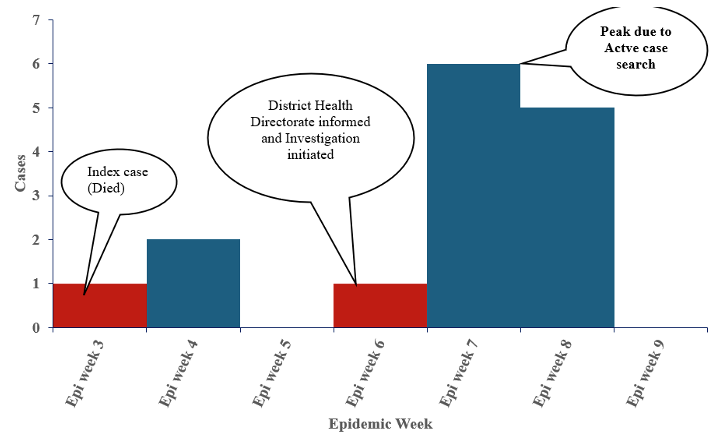
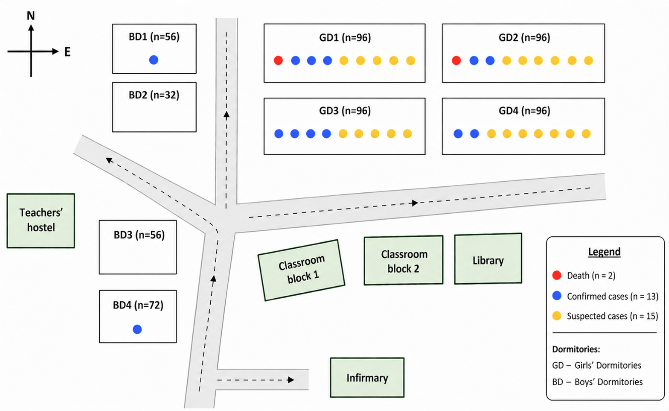
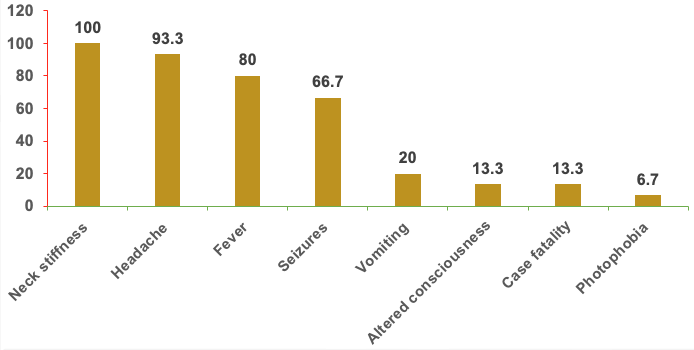
Figure 1 shows the epidemiological curve demonstrating the pattern and magnitude of the outbreak. The index case developed symptoms on January 21, 2020, and reported on January 24, 2020. Two more case-patients developed symptoms within the same epi-week. Notification to the district health authority was delayed by up to 2 epi-weeks following the first case. Public health interventions were initiated at the school during the sixth epi-week. Cases peaked at 4 in the seventh epi-week following active surveillance in the school, then slowly declined with ongoing public health interventions. The last group of cases from the school was identified for treatment on February 20, 2020. No cases were identified after two complete epi-weeks. Figure 2 shows the distribution of cases in boarding facilities. Predominant symptoms included neck stiffness (100%), headache (93.3%), fever (80.0%), and seizures (66.7%) (Figure 3).
Laboratory investigation
We identified 30 suspected cases among the 1,154 at-risk students; 15 were laboratory-confirmed, giving a confirmed-case attack rate of 1.3%. Cerebrospinal fluid (CSF) samples were collected from all 30 suspected cases (Table 1).
Of these, 43.3% (13/30) of the samples were culture-positive for Streptococcus pneumoniae, and the 2 additional samples from the deceased cases were confirmed as S. pneumoniae by polymerase chain reaction (PCR) at the Public Health Reference Laboratory (Table 2). Neisseria meningitidis and Haemophilus influenzae type b were not detected in any CSF sample tested. The 13 culture-confirmed cases occurred during epidemiological weeks four, seven and eight (two in week 4, six in week 7 and five in week 8). The two PCR-confirmed cases occurred in epidemiological weeks 3 and 6.
The remaining 50% (15/30) had negative CSF cultures and were classified as probable cases. These met the clinical case definition for meningitis (fever, neck stiffness, altered consciousness) and had an epidemiological link to laboratory-confirmed cases through shared dormitory residence (Table 2).
We collected ten nasopharyngeal swabs from randomly selected close contacts of confirmed cases for serotyping using slide agglutination. However, nasopharyngeal samples yielded no interpretable results.
Case management
Cases were treated with Intravenous Ceftriaxone according to treatment guidelines. The corpses of the deceased were buried under strict burial procedures by the state to avoid being handled by family members. Other control measures include isolating and treating confirmed cases, chemoprophylaxis for close contacts, active case surveillance, health education, and improved dormitory ventilation.
Environmental assessment
Hygiene and cleanliness
A visual inspection of the boarding facilities revealed poor hygiene. In all dormitories, we observed:
These findings were corroborated through interviews with school administrators and dormitory prefects, who confirmed that regular cleaning schedules were not consistently followed.
Overcrowding
Using the predefined criteria for overcrowding (≥60 students per dormitory, floor area per student <4 m², or bunk bed spacing <1 meter), all dormitories met the definition for overcrowding. The four female dormitories each housed 96 students (exceeding the 60-student threshold) in a 47 × 24 m² space (1,128 m²; 11.75m2 per student), with bunk beds arranged less than 1 meter apart. The male dormitories similarly housed 96 students in a 47 × 28 m² space (1,316 m²; 13.71 m² per student), also with bunk beds spaced less than 1 meter apart. Students hung their clothes on all the window frames in the dormitories, which impeded room ventilation. Although the floor area per student in both dormitory types exceeded the 4 m² threshold, all dormitories met the overcrowding definition based on student density (>60 students per dormitory) and bunk-bed spacing (<1 meter), consistent with the operational definition requiring any one of the three criteria. Dormitories had no working fans, resulting in poor ventilation.
Meningitis remains a public health threat in Ghana, with widely reported community-level outbreaks across several districts. [11,22,23]. We confirmed an institutional bacterial meningitis outbreak at a senior high school in the Assin South District of the Central Region, Ghana. We isolated Streptococcus pneumoniae from CSF samples from tested case patients. In Ghana, apart from Neisseria meningitides, Streptococcus pneumoniae has been identified as one of the most common causes of bacterial meningitis [10, 17, 22-25]. Multiplex testing confirmed S. pneumoniae as the sole causative organism, with no co-circulation of N. meningitidis or H. influenzae type b detected among tested cases.
The outbreak in the school was characterised by misdiagnosis of the index case, leading to a delay in case management and subsequently the death of the initial cases. The index case attended the fourth health facility before being correctly diagnosed, demonstrating a low index of suspicion among health workers at primary healthcare facilities and low sensitivity in the district’s bacterial meningitis surveillance system. Health authorities were notified late, delaying public health interventions. Timely containment of cases and adequate management of meningitis depend on accurate diagnosis and laboratory confirmation of the causative organism . This was demonstrated in a study in northern Ghana by Letsa et al., which indicated that a district with improved meningitis surveillance and adequate management had only half the attack rate of a comparative district with poor surveillance and response [13]. Another study in Ghana evaluating the district-level meningitis surveillance system found the system simple and its case definitions supportive of diagnosis [26]. However, our investigation indicates that identifying, managing, and surveilling meningitis cases remains challenging in some primary health facilities in Assin South District. This suggests a need to build clinicians’ capacity in regional health facilities. The recorded case fatality of 13.3% is consistent with what has been observed in country-wide meningitis outbreaks. Between 2010 and 2015, nationwide case fatality rates ranged from 8.2% to as high as 13.8% [31]. Appropriate diagnosis and management could have prevented the recorded mortalities in this outbreak.
In this study, it took over two epi-weeks for the initial cases to be reported to the district health directorate, triggering a public health response. This shows poor compliance with the Integrated Disease Surveillance and Response (IDSR) guidelines, which require that meningitis cases be reported immediately to the public health authority as a priority disease. [32]. A study across three states in Nigeria found that, on average, it took 3 weeks to detect meningitis outbreaks and notify the Nigerian Centre for Disease Control. These delays were associated with increased morbidity and mortality [33].
The outbreak period strongly indicates the disease’s epidemiology. In the meningitis belt, seasonal outbreaks of meningitis occur between November and April [10, 22–25]. Although the Assin South District is not within the meningitis belt, this period is characterised by hot, dry, windy, and dusty weather conditions typical of the harmattan season [16]. Climate conditions increase the risk of communicable respiratory diseases [10, 22, 24]. These climatic conditions were compounded at the school by overcrowding and poor ventilation in the dormitories. The girls’ dormitories, which recorded a higher number of cases and had deaths, were more crowded. An outbreak investigation in six districts within the Brong-Ahafo Region of Ghana in 2015 demonstrated that overcrowding in rooms and poor ventilation were associated factors contributing to meningitis spread and outcomes [13].
Despite the limitations of the initial surveillance response, staff successfully performed lumbar punctures for all suspected cases. District laboratories also had the capacity to conduct latex agglutination tests, Gram staining, and bacterial culture. Studies in some districts in Ghana have reported a lack of these testing modalities in primary health facility laboratories [34].
Nasopharyngeal samples were collected but experienced delays in transport to the reference laboratory due to logistical constraints. By the time the samples reached the laboratory, bacterial viability was compromised, and overgrowth of commensal flora prevented isolation of Streptococcus pneumoniae for serotyping.
Our investigation highlights the need for an improved meningitis surveillance system within districts. The findings are instructive for establishing appropriate clinical and public health linkages to ensure early diagnosis, notification, and response. Nonetheless, the availability of a district-level, multidisciplinary meningitis outbreak preparedness plan is key to closing gaps in outbreak response during peak seasons in Ghana.
Limitations
Several limitations were identified during the outbreak investigation. First, resource constraints prevented PCR testing of all collected samples; PCR might have increased test positivity. The study was also limited by its descriptive cross-sectional design, with no comparison group. This means we could not statistically measure how strongly factors like overcrowding or poor ventilation contributed to infection risk.
Again, reliance on interviews introduced potential recall bias. The investigation also could not determine with certainty whether the outbreak spread from person to person within the dormitories or originated from a common environmental source. Both possibilities remain.
Finally, we could not establish a clear chain of transmission between individual cases because we lacked whole-genome sequencing and detailed contact tracing. These limitations highlight the need for strengthened laboratory capacity and surveillance systems to improve outbreak preparedness and response.
The outbreak was caused by Streptococcus pneumoniae among boarding students, with all 15 cases occurring among them and fatalities limited to female students. Overcrowding and poor ventilation were plausible contributing factors, worsened by the dry, hot conditions of the harmattan season, which facilitate respiratory transmission. In response, control measures included isolating and treating confirmed cases, chemoprophylaxis for close contacts, active case surveillance, health education, and improved dormitory ventilation. However, delayed diagnosis and case notification (Epidemic week 6) hindered immediate public health action within the district health system. After the outbreak, the district strengthened the capacity of clinicians and surveillance officers through training in case identification and reporting aligned with Integrated Disease Surveillance and Response (IDSR) guidelines. Individual meningitis A vaccination records for the affected cohort were unavailable, and the district had not conducted a mass vaccination campaign targeting this group before the outbreak. Based on these findings, we recommend decongesting dormitories, improving ventilation, strengthening outbreak surveillance for timely notification, and considering pneumococcal and meningitis A vaccination for boarding school entrants in high-risk districts.
What is already known about the topic
What this study adds
We thank the Central Regional Health Directorate and the Assin South District Health Directorate for their technical support and for leading public health interventions to curb the outbreak. We also acknowledge the medical teams at Cape Coast Teaching Hospital, Abura Dunkwa Hospital, and St Francis Xavier Hospital-Fosu for assisting with case management. We acknowledge the headmasters and teachers at the school for their support.
Conceptualization: Paul Henry Dsane-Aidoo, Anthony Baffour Appiah, Joshua Billy, Ernestina Esinam Agbemafle, Felicia Alemna, Jemima Silas, Kwabena Sarpong, Akosua Agyeiwa Owusu-Sarpong, Betty Wood, Donne Ameme, Ernest Kenu
Data curation: Paul Henry Dsane-Aidoo, Anthony Baffour Appiah, Joshua Billy, Ernestina Esinam Agbemafle, Felicia Alemna, Jemima Silas, Akosua Agyeiwa Owusu-Sarpong, Betty Wood, Donne Ameme
Formal analysis: Paul Henry Dsane-Aidoo, Anthony Baffour Appiah, Ernestina Esinam Agbemafle, Akosua Agyeiwa Owusu-Sarpong, Betty Wood
Investigation: Paul Henry Dsane-Aidoo, Anthony Baffour Appiah, Joshua Billy, Ernestina Esinam Agbemafle, Felicia Alemna, Jemima Silas, Kwabena Sarpong, Akosua Agyeiwa Owusu-Sarpong, Betty Wood, Donne Ameme, Ernest Kenu
Methodology: Paul Henry Dsane-Aidoo, Anthony Baffour Appiah, Joshua Billy, Ernestina Esinam Agbemafle, Felicia Alemna, Jemima Silas, Akosua Agyeiwa Owusu-Sarpong, Betty Wood, Donne Ameme, Ernest Kenu
Project administration: Paul Henry Dsane-Aidoo, Kwabena Sarpong
Validation: Paul Henry Dsane-Aidoo, Joshua Billy
Supervision: Kwabena Sarpong, Akosua Agyeiwa Owusu-Sarpong, Donne Ameme, Ernest Kenu
Writing – original draft: Paul Henry Dsane-Aidoo, Anthony Baffour Appiah, Joshua Billy, Ernestina Esinam Agbemafle, Felicia Alemna, Jemima Silas, Kwabena Sarpong, Akosua Agyeiwa Owusu-Sarpong, Betty Wood, Donne Ameme, Ernest Kenu
Writing – review & editing: Paul Henry Dsane-Aidoo, Anthony Baffour Appiah, Joshua Billy, Ernestina Esinam Agbemafle, Felicia Alemna, Jemima Silas, Kwabena Sarpong, Akosua Agyeiwa Owusu-Sarpong, Betty Wood, Donne Ameme, Ernest Kenu
Table 1: Socio-demographic factors and contact tracing outcomes of meningitis cases at the school, Assin South District, 2020
| Variables | N (population at risk) | Number affected (n) | Attack rate per 100 |
|---|---|---|---|
| Total students | 1,154 | 15 | 1.3 |
| Age | |||
| Median (Range) age | 17 (15-18) | ||
| Sex | |||
| Male | 567 | 2 | 0.4 |
| Female | 587 | 13 | 2.2 |
| Residence status | |||
| Boarding students | 630 | 15 | 2.4 |
| Day students | 524 | 0 | 0.0 |
| Dormitory | |||
| Girls’ Dormitory 1 | 96 | 4 | 4.2 |
| Girls’ Dormitory 2 | 96 | 3 | 3.1 |
| Girls’ Dormitory 3 | 96 | 4 | 4.2 |
| Girls’ Dormitory 4 | 96 | 2 | 2.1 |
| Boys’ Dormitory 1 | 56 | 1 | 1.8 |
| Boys’ Dormitory 2 | 62 | 0 | 0.0 |
| Boys’ Dormitory 3 | 56 | 0 | 0.0 |
| Boys’ Dormitory 4 | 72 | 1 | 1.4 |
| Vaccination | |||
| No (born before April 2012) | 1,154 | 15 | 1.3 |
| Contact tracing | |||
| Close contacts identified (affected dormitories) | 512 | 14 | 2.7 |
| Successfully traced | 512 | 14 | 2.7 |
| Not traced (Boys’ Dormitories 2 & 3) | 118 | 0 | 0.0 |
| Case Classification | Number (n=30) | Percentage (%) |
|---|---|---|
| Laboratory-confirmed | 15 | 50 |
| -CSF culture-positive | 13 | 43.3 |
| -PCR-positive (deceased cases) | 2 | 6.7 |
| Probable cases (clinical + epidemiological link) | 15 | 50 |