
Research | Open Access | Volume 9 (3): Article 122 | Published: 23 Jul 2026

Views: 637
Menu, Tables and Figures
| Variables | Frequency (N=782) | Percent |
|---|---|---|
| Sex | ||
| Female | 385 | 49.2 |
| Male | 397 | 50.8 |
| Age (years) | ||
| 18-24 | 107 | 13.7 |
| 25-34 | 256 | 32.7 |
| 35-44 | 232 | 29.7 |
| ≥45 | 187 | 23.9 |
| Education | ||
| Can’t read and write | 55 | 7.0 |
| Diploma and Degree | 345 | 44.1 |
| Read and write | 333 | 42.6 |
| Others | 26 | 3.3 |
| Master and above | 23 | 2.9 |
| Occupation | ||
| Farmer | 83 | 10.6 |
| Government Employee | 198 | 25.3 |
| Housewife | 153 | 19.6 |
| Merchant | 205 | 26.2 |
| Others | 51 | 6.5 |
| Unemployed | 92 | 11.8 |
Table 1: Sociodemographic characteristics of community knowledge, perceptions, and associated factors of mpox participants in selected towns of Ethiopia, August 2025
| Participants responses regarding knowledge of the signs and symptoms of mpox | ||
|---|---|---|
| Signs / Symptoms | Frequency | Percent |
| Fever | ||
| Yes | 333 | 42.6 |
| No | 449 | 57.4 |
| Headache | ||
| Yes | 213 | 27.2 |
| No | 569 | 72.8 |
| Fatigue/exhaustion | ||
| Yes | 81 | 10.4 |
| No | 701 | 89.6 |
| Swollen lymph nodes | ||
| Yes | 68 | 8.7 |
| No | 714 | 91.3 |
| Rash | ||
| Yes | 738 | 94.4 |
| No | 44 | 5.6 |
| Muscle pain | ||
| Yes | 75 | 9.6 |
| No | 707 | 90.4 |
| I don’t know | ||
| Yes | 30 | 3.8 |
| No | 752 | 96.2 |
| Participants’ responses regarding how a person can acquire and transmit mpox | ||
| Skin-to-skin (such as touching or sex and kissing) | ||
| Yes | 600 | 76.7 |
| No | 182 | 23.3 |
| Talking or breathing close to one another | ||
| Yes | 228 | 29.2 |
| No | 554 | 70.8 |
| Pregnancy to the fetus/transplacental | ||
| Yes | 50 | 6.4 |
| No | 732 | 93.6 |
| Physical contact with an animal that carries the virus | ||
| Yes | 209 | 26.7 |
| No | 573 | 73.3 |
| I don’t know about the way of transmission of mpox | ||
| Yes | 130 | 16.6 |
| No | 652 | 83.4 |
| The participants response regarding the action they take to avoid being infected with mpox | ||
| Avoid close contact with anyone who has mpox, including sexual contact. | ||
| Yes | 627 | 80.2 |
| No | 155 | 19.8 |
| Clean your hands frequently with soap and water | ||
| Yes | 347 | 44.4 |
| No | 435 | 55.6 |
| Disinfect hands with chlorine solutions/sanitizer | ||
| Yes | 121 | 15.5 |
| No | 661 | 84.5 |
| Not sharing bedding, clothing, towels, or utensils with sick people | ||
| Yes | 151 | 19.3 |
| No | 631 | 80.7 |
| Perceived threat category | Frequency (n=782) | Percent |
|---|---|---|
| Negative Perceived Susceptibility (SUS) | 288 | 36.8 |
| Neutral Perceived Susceptibility (SUS) | 144 | 18.4 |
| Positive Perceived Susceptibility (SUS) | 350 | 44.8 |
| Negative Perceived Severity (SEV) | 36 | 4.6 |
| Neutral Perceived Severity (SEV) | 194 | 24.8 |
| Positive Perceived Severity (SEV) | 552 | 70.6 |
| Overall Perceived Threat response | ||
| Low Perceived Threat | 429 | 54.9 |
| Positive Perceived Threat | 353 | 45.1 |
| Perceived efficacy category | ||
| Negative Perceived Response Efficacy (RE) | 23 | 2.9 |
| Neutral Perceived Response Efficacy (RE) | 77 | 9.8 |
| Positive Perceived Response Efficacy (RE) | 682 | 87.2 |
| Negative Perceived Self Efficacy (SE) | 24 | 3.1 |
| Neutral Perceived Self Efficacy (SE) | 180 | 23.0 |
| Positive Perceived Self Efficacy (SE) | 578 | 73.9 |
| Overall Perceived efficacy response | ||
| Low Perceived Efficacy | 157 | 20.1 |
| Positive Perceived Efficacy | 625 | 79.9 |
| Variables | Mpox Knowledge | COR | AOR (95% CI) | P value | |
|---|---|---|---|---|---|
| Poor | Good | ||||
| Sex | |||||
| Female | 304 (79.0%) | 81(21.0%) | 0.68 (0.49, 0.95) | 0.81(0.54, 1.19) | 0.28 |
| Male | 286 (72.0%) | 111 (28.0%) | 1 | ||
| Educational Status | |||||
| Can’t read and write | 49 (89.1%) | 6 (10.9%) | 0.08 (0.02, 0.26) | 0.16 (0.05, 0.58) | 0.005* |
| Diploma and Degree | 225 (65.2%) | 120 (34.8%) | 0.34 (0.14, 0.85) | 0.43 (0.17, 1.06) | 0.066 |
| Read and write on formal education | 284 (85.3%) | 49 (14.7%) | 0.11 (0.05, 0.27) | 0.19 (0.07, 0.50) | 0.001* |
| Others | 23 (88.5%) | 3 (11.5%) | 0.08 (0.02, 0.36) | 0.07 (0.01, 0.32) | 0.001 |
| Master and above | 9 (39.1%) | 14 (60.9%) | 1 | ||
| Occupation | |||||
| Farmer | 76 (91.6%) | 7 (8.4%) | 0.18 (0.08, 0.44) | 0.19 (0.08, 0.50) | 0.001* |
| Government Employee | 112 (56.6%) | 86 (43.4%) | 1.51 (0.90, 2.53) | 0.78 (0.43, 1.39) | 0.400 |
| Housewife | 122 (86.3%) | 21 (13.7%) | 0.31 (0.17, 0.59) | 0.27 (0.14, 0.54) | <0.001* |
| Merchant | 169 (82.4%) | 36 (17.6%) | 0.42 (0.24, 0.74) | 0.31 (0.17, 0.57) | <0.001* |
| Others | 40 (78.4%) | 11 (21.6%) | 0.54 (0.24, 1.19) | 0.37 (0.16, 0.86) | 0.021 |
| Unemployed | 61 (66.3%) | 31 (33.7%) | 1 | ||
| Perceived Threat | |||||
| Low Perceived Threat | 342 (79.7%) | 87 (20.3%) | 1 | ||
| Positive Perceived Threat | 248 (70.3%) | 105 (29.7%) | 1.66 (1.19, 2.31) | 1.73 (1.21, 2.47) | 0.003* |
Table 4: Factors associated with mpox knowledge among community members in selected towns of Ethiopia, 2025
Yibeyin Mulualem1, Mohammed Hasen Badeso1,&, Melaku Abebe1, Aemro Yibeltal1, Ketema Misganaw1, Ebsa File1, Yihalem Adamu1, Yonas Hailu2, Ikram Faris1, Girma Hailamariam3, Mesfin Wossen1, Melkamu Abte1
1Ethiopian Public Health Institute, Public Health Emergency Management, Addis Ababa, Ethiopia, 2Ministry of Health-Ethiopia, Health Education and Promotion, Addis Ababa, Ethiopia, 3United Nations Children’s Fund (UNICEF), Risk Communication and Community Engagement, Addis Ababa, Ethiopia
&Corresponding author: Mohammed Hasen Badeso, Ethiopian Public Health Institute, Public Health Emergency Management, Addis Ababa, Ethiopia, Email: mydoc204@gmail.com ORCID: https://orcid.org/0000-0002-4668-9638
Received: 31 Jan 2026, Accepted: 15 Jul 2026, Published: 23 Jul 2026
Domain: Infectious Disease Epidemiology
Keywords: Mpox, Perception, Knowledge, Outbreak, Public Health
©Yibeyin Mulualem et al. Journal of Interventional Epidemiology and Public Health (ISSN: 2664-2824). This is an Open Access article distributed under the terms of the Creative Commons Attribution International 4.0 License (https://creativecommons.org/licenses/by/4.0/), which permits unrestricted use, distribution, and reproduction in any medium, provided the original work is properly cited.
Cite this article: Yibeyin Mulualem et al., Community knowledge, risk perceptions, and determinants of mpox in Ethiopia: An application of the Extended Parallel Process Model. Journal of Interventional Epidemiology and Public Health. 2026; 9(3):122. https://doi.org/10.37432/jieph-d-26-00033
Introduction: Mpox remains a public health threat in Africa, affecting many countries. Ethiopia declared an mpox outbreak on May 26, 2025. Understanding community knowledge and perception is vital for tailoring mpox behavioural interventions. However, there is limited evidence on community knowledge and perceptions of mpox. The Extended Parallel Process Model provides a comprehensive framework for understanding both perceived threat and perceived efficacy. Therefore, this study assessed community knowledge and perceptions of mpox using the Extended Parallel Process Model in Ethiopia, 2025.
Methods: A community-based cross-sectional study was conducted in Ethiopia using multi-stage systematic random sampling. Adult household members (>18 years) were interviewed; health worker households were excluded. Data were collected using interviewer-administered questionnaires on socio-demographics, mpox knowledge, and perceived threat. We used the Extended Parallel Process Model (EPPM) to assess perceived threat and perceived efficacy. Data were analysed with descriptive and inferential statistics (ANOVA, logistic regression) using SPSS v26.
Results: The median age was 35 years (IQR: 28–44), and 50.8% (397/782) were male. Only 24.6% (192/782) had good mpox knowledge. Positive perceived threat was 45.1%, and positive efficacy was 79.9% (625/782). Threat-efficacy interaction significantly predicted knowledge (p<0.001, ηp2=0.022); positive threat (AOR=1.73, 95%CI:1.21-2.47), can’t read/write (AOR = 0.163; 95% CI: 0.046-0.579), read and write on formal education (AOR = 0.192; 95% CI: 0.074-0.501), farmers (AOR = 0.199; 95% CI: 0.079-0.501), and housewife (AOR = 0.274; 95% CI: 0.138-0.543). The preferred sources of information were mainstream media at 62.4% (488/782), followed by social media at 23.3% (182/782).
Conclusions: The Mpox knowledge among the community was low, implying a need for robust public health interventions. Factors such as educational level, occupation, and perceived threat had a significant association with the mpox knowledge of the community. The perceived threat and perceived efficacy interact to shape mpox knowledge. It is recommended that interventions address knowledge and perception gaps, especially considering interventions that reach all audiences, pairing perceived threat with perceived efficacy, and leveraging mass and social media.
Mpox is a re-emerging zoonotic disease caused by the mpox virus, a member of the Orthopoxvirus genus in the family Poxviridae. It is historically endemic in Central and West African countries. However, in recent years, the mpox outbreak has expanded beyond endemic countries. The World Health Organization (WHO) declared the first mpox Public Health Emergency of International Concern (PHEIC) in July 2022, and the Africa CDC declared mpox a Public Health Emergency of Continental Security (PHECS) on August 13, 2024, followed by the second WHO PHEIC declaration on August 14, 2024 [1, 2]. The rising global incidence of mpox underscores the crucial need for effective prevention and response strategies, including enhancing comprehensive public knowledge, accurate risk perception, and confidence in prevention measures and implementation of actions [3,4].
Ethiopia declared an mpox outbreak on May 26, 2025 [5]. This spread beyond historically endemic regions, including Ethiopia, has highlighted the critical need for tailored and effective public health interventions. The robust Risk Communication and Community Engagement (RCCE) interventions are needed to ensure public understanding, reduce fear and stigma, and promote healthy behaviours. So, evidence-based interventions to enhance community knowledge, perception of mpox, and utilise preferred sources of information are critical for effective outbreak prevention and control [6,7].
In Ethiopia, historically, mpox was not reported, and there is an evidence gap about the population’s awareness, perceptions concerning mpox, and trusted information sources. The evidence indicated that the EPPM provides a comprehensive framework for understanding both perceived threat (severity and susceptibility) and perceived efficacy (response effectiveness and self-confidence) [8-10]. It is a fear appeals framework used to explain how individuals process health risk messages and decide whether to adopt protective behaviours [10]. Therefore, understanding communities’ knowledge, perceptions, behaviours, and information sources is essential for: first, to identify what communities know or do not know about mpox; second, to address misinformation and disinformation through mapping the trusted sources of information; and third, to design evidence-based RCCE intervention strategies to control and prevent mpox outbreaks. So, this study aimed to assess community knowledge, perceptions, using the Extended Parallel Process Model, and sources of information regarding mpox in Ethiopia.
Study design and setting
A community-based cross-sectional study was conducted in Ethiopia using multi-stage systematic random sampling. This study was conducted from July 7 to 27, 2025, in seven selected towns of Ethiopia to assess community knowledge and associated factors, perceptions about mpox, and preferred sources of information. The towns included in the study were Adama, Bishoftu, Bahir Dar, Debre Berhan, Jimma, Nekemte, and Hawassa, among the identified areas as high-risk for mpox due to high population mobility.
Study population and participants
The target populations were residents of towns aged 18 years and above living in the selected towns for at least six months. The study participants were household members aged 18 years and above, randomly selected from households within randomly sampled kebeles. Eligible participants were household members aged 18 years or older at selected households who provided consent. The health worker households and those absent after repeated visits were excluded.
Sample size determination
The sample size determination was calculated for both the prevalence of knowledge and perception of mpox, followed by the larger sample size used. We applied the single population proportion formula considering the prevalence of mpox knowledge (p= 33.7%) and perception (p=57.3%) from the study conducted in Bahir Dar town, Northwest Ethiopia [11]. We considered a 95% confidence interval and 5% degree of precision. We considered the design effect for multistage sampling.
The sample size n for the assessment of the magnitude of good knowledge and perception of mpox among the communities within case reporting and high-risk regions was calculated using the sample size calculation formula of
\[ n = \frac{(z_{\alpha/2})^2 p(1-p)}{d^2} \]
Where
n is the sample size,
95% is the confidence level,
Z is the standard normal distribution curve value for the 95% Confidence level (1.96),
marginal error of 5%,
P is the proportion of good level of knowledge and positive attitudes towards mpox, and design effect was considered. Finally, the larger sample size (n=782) was determined.
Sampling
A multistage sampling technique was employed. At the national level, three regions were purposively selected based on the risk priority of mpox. Seven towns were then randomly selected from those identified as high risk for mpox. Following these, from each selected town, two sub-town administrative units were randomly selected. Within each selected sub-town, households were randomly selected using the town mayor’s household list as the sampling frame. From each selected household, one member aged 18 years or older was randomly selected and interviewed. The sample size was proportionally distributed to each town and sub-town based on their administration report’s total number of households in the 2024/25 fiscal year.
Data collection and procedures
Data were collected using structured, interviewer-administered questionnaires on sociodemographic information, mpox transmission, signs/symptoms, prevention and control measures. Perceptions and preferred sources of information were developed from the literature. We used the Extended Parallel Process Model (EPPM) to assess perceived threat (perceived severity and perceived susceptibility) and perceived efficacy (response efficacy and self-efficacy). Guided by the EPPM framework, perceived threat in this study is defined as an individual’s perception assessment of the danger posed by mpox, comprising severity (perceived seriousness of consequences) and susceptibility (perceived likelihood of contracting the virus) [10, 12]. Perceived efficacy is defined as an individual’s evaluation of the recommended protective behaviours, encompassing the response effectiveness (the belief that the recommended preventive actions will successfully prevent the mpox threat) and self-confidence (the individual’s belief in their own capability to successfully perform those preventive behaviours) [8, 10].
The data collectors were trained on the tools before being deployed for data collection. The tools were tested on 5% of the sample size and revised based on the feedback. The data were collected using Kobo Collect and imported into SPSS for analysis.
Statistical analysis
The data were checked for completeness and clarity. Statistical Package for the Social Sciences (SPSS) version 26 was used for data analysis. In this study, a total of 14 items, including six signs and symptoms, four transmissions, and four prevention measures, were used to assess the mpox knowledge of the community. Respondents who correctly answered 50% or more of the questions were classified as having a good level of knowledge. The perceived threat (6-items) and efficacy (6-items) were scored using a Likert scale and computed mean to categorise perception levels as negative perception: mean ≤ 2.5; neutral Perception: 2.6 – 3.5; positive perception: ≥ 3.6, [ 13, 14]. Overall, the mean >3.6 was used to categorise positive perceived threat and positive perceived efficacy. Data cleaning procedures were applied prior to analysis. Binary and multivariate logistic regression analyses were conducted to identify factors influencing participants’ knowledge of mpox. The Shapiro–Wilk, Levene’s and Cronbach’s Alpha tests were conducted and indicated the data were normally distributed (W = 0.961, p < 0.09), had homogeneity of variance across groups (p = 0.193), and had good internal consistency (Cronbach’s α= 0.85), respectively. Multicollinearity was assessed, showing that the maximum variance inflation factor (VIF) value is 2.34, indicating no significant multicollinearity. Model goodness-of-fit was tested and indicated good model fit (χ² = 9.62, p = 0.292). No significant outliers or influential observations were detected based on residual and Cook’s distance analysis. Variables with a p-value <0.25 in the bivariable analysis were considered eligible for inclusion in the multivariable logistic regression model. A candidate variable with adjusted odds ratios (AORs) and 95%CI was calculated to identify variables independently associated with mpox knowledge. The inferential statistics ANOVA was conducted to examine the interaction between perceived threat and perceived efficacy on mpox knowledge, treating knowledge as a continuous composite score for this specific analysis. This approach was used to assess differences in mean knowledge scores across interaction categories, while the primary analysis of factors associated with mpox knowledge was performed using logistic regression with a binary outcome.
Ethical considerations
The Ethiopian Public Health Institute (EPHI) has the mandate to lead and coordinate national public health emergency preparedness, response, and recovery and rehabilitation efforts in Ethiopia. Hence, the EPHI has been legally authorised to implement evidence-based public health emergency response interventions. This work was conducted to provide evidence-oriented interventions during the mpox outbreak in Ethiopia. This study was conducted in accordance with the Declaration of Helsinki. The official approval was obtained from the Ethiopian Public Health Institute (Ref. Number: 4.1/778). Verbal consent was obtained from all participants after describing the consent form, which detailed the purpose and the volunteer for participation. Participants provided verbal agreement to proceed with the interview, and the interviewer documented consent by marking a designated section on the form.
Socio-demographic characteristics
Among the total respondents, 50.8% (397/782) were male, and 32.7% (256/782) age group 25-34 years, followed by the 35-44 years age group, 29.7% (232/782) of respondents. The mean age of respondents was 36.9 +11.9 years, and the median age was 35 years (IQR: 28-44). Regarding the educational status of respondents, 44.1% (345/782) had attained a diploma and/or degree, while only 42.6% (333/782) of respondents had only been able to read and write that attained formal education. The majority of respondents were married, 64.8% (507/782) followed by single, 30.3% (237/782). Also, more than one-fourth of the study participants were merchants, 26.2% (205/782), followed by government employees, 25.3% (198/782) and housewives, 19.6% (153/782) (Table 1).
Knowledge of mpox
The study revealed that only 192 (24.6%) of study participants demonstrated good knowledge of mpox. The majority of respondents, 94.4% (738/782), knew a rash was the sign/or symptom of mpox, and 76.7% (600/782) of respondents identified skin-to-skin contact as a primary method. Regarding the prevention measures, avoid close contact with anyone who has mpox, including sexual contact, reported by 80.2% (627/782) of respondents. Among 782 respondents, 18.7% (146), 27.9% (218) and 41.7% (326) recognised pregnant women, immunocompromised individuals, and children as the high risk for the severity and complication of mpox, respectively.
More than half of the participants, 52.9% (414/782), indicated they have awareness that treatment options exist for mpox. However, 39.4% (308/782) don’t know the existence of treatment for mpox, and 7.7% (60/782) believe that there is no treatment for mpox. The majority of participants, 93.9% (734/782), reported that they would go to a health facility if they themselves or someone else developed signs and symptoms of mpox. But 2.7% (21/782) reported they would stay at home, and 2.3% (18/782) would go to a traditional healer (Table 2).
Perception of mpox disease
Perceived Threat: Perceived susceptibility (SUS) and perceived severity (SEV)
Among respondents, 47.1% (368/782) agreed on the possibility that they will get mpox, whereas 37.1% (290/782) disagreed on the possibility of getting mpox infection. Regarding the risk for getting mpox, 43.6% (341/782) of the participants perceived that they were at risk of getting mpox, and 37.4% (292/782) did not agree on the risk for getting mpox. The majority of participants, 72% (563/782), responded that they believe that mpox is a severe disease that can cause serious health problems. Similarly, 72.2% (564/782) of participants believed that mpox infections often lead to hospitalisation or long-term scarring, but 5.4% (42/782) did not believe in the hospitalisation or long-term scarring of mpox disease. In addition, 65.1% (509/782) of the respondents believe that mpox can be life-threatening for some people, whereas only 6.5% (51/782) did not agree. The overall prevalence of the perceived threat component shows that 45.1% (353/782) of the study participants have a positive perceived threat, and 54.9% (429/782) have a low perceived threat.
Perceived efficacy: Response efficacy (RE) and self-efficacy (SE)
Among respondents, 88.7% (693/782), 86.3% (675/782), and 81.9% (641/782) agreed on the effectiveness of avoiding close contact with infected people, washing hands frequently with soap and water and not sharing bedding, clothing, towels, or utensils with sick people to prevent mpox transmission. Among respondents, 67.8% (530/782), agreed that they are confident in avoiding close contact with mpox cases to prevent themselves, 81.7% (639/782) believe that they have the resources (soap, sanitizer) to wash hands regularly and 73.3% (573/782) believes that they can easily identify and avoid sharing contaminated items (bedding, clothing, towels, or utensils). Overall, the majority of study participants have positive perceived efficacy, 79.9% (625/782), while the rest have low perceived efficacy (Table 3).
Threat–efficacy interaction
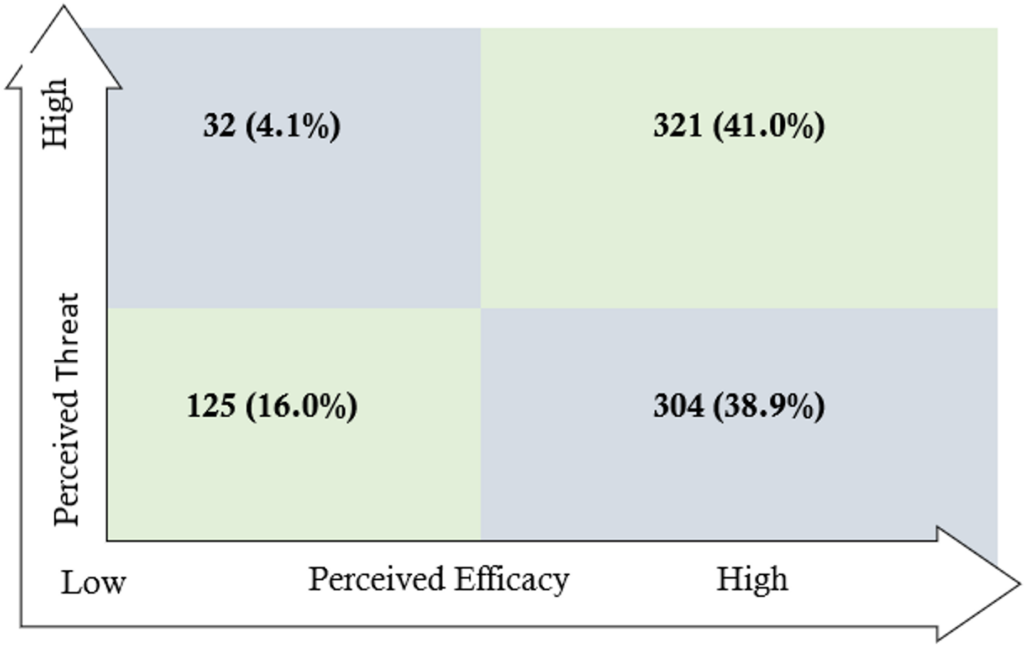
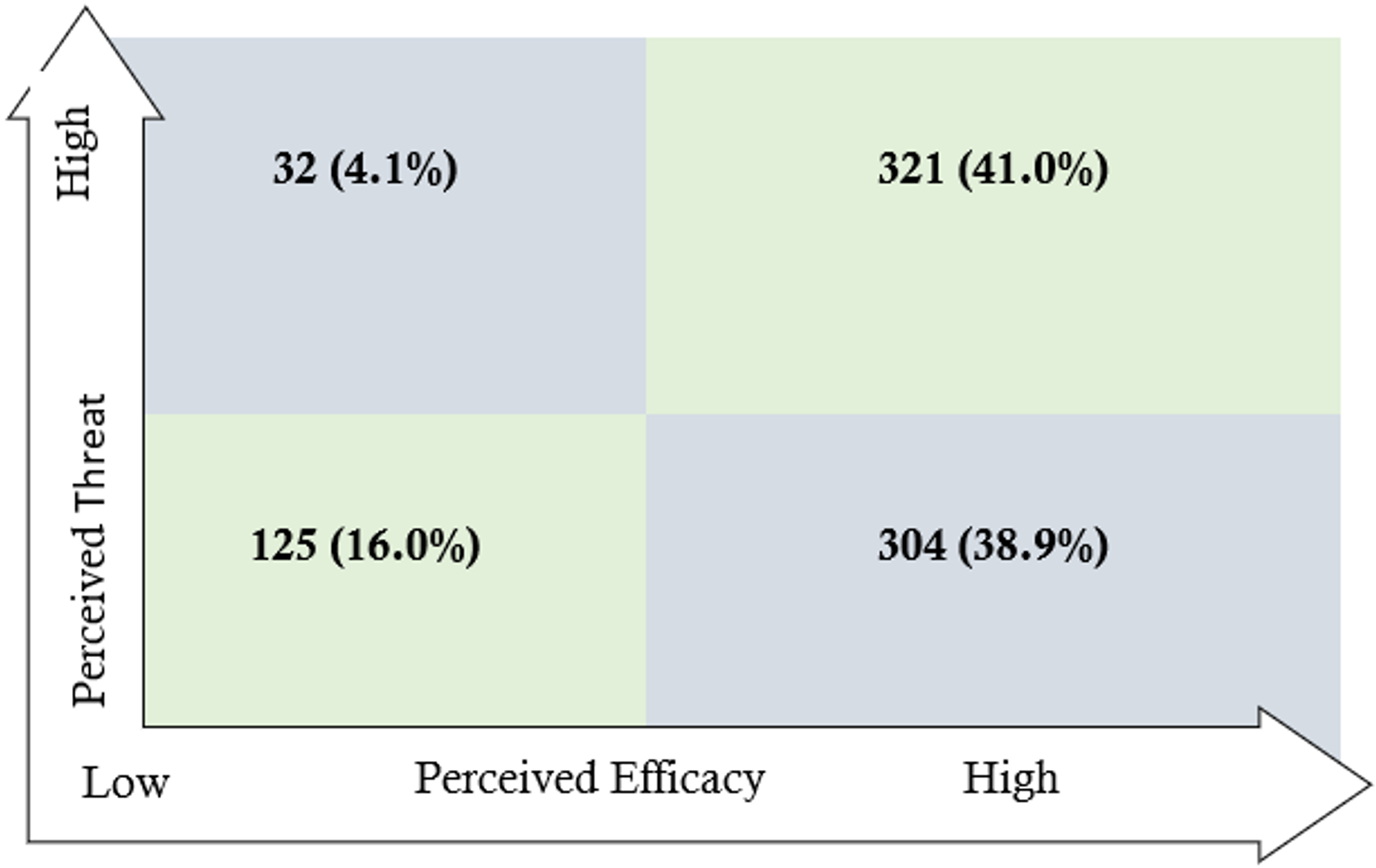
The quadrants of EPPM indicated 321 (41%) respondents fell into the high efficacy and high threat group, 304 (38.9%) were in the high efficacy and low threat category, 125 (16%) fell into low efficacy and low threat, and 4.1% reported low efficacy and high threat (Figure 1). The finding indicated interaction between perceived threat and perceived efficacy on mpox knowledge is statistically significant (F (1,778) =17.89, p<0.001, ηp2=0.022).
Source of information for mpox
The findings showed 85.9% (672/782) of respondents reported using mass media, followed by social media platforms, 41.8% (327/782). Print media is rarely used, with only 4.6% (36/782) of participants. Among social media users, 42% (138/327) reported using Facebook, followed by TikTok 33% (107/327), 14% (45/327) Telegram, and 5% (15/327) WhatsApp. The finding indicated that 62.4% (488/782) mentioned mainstream media, including TV and Radio, as the most preferred, followed by social media 23.3% (182/782), and 13.7% (107/782) health facilities, village health workers, or community health workers. The print media accounts for only 0.6% (5/782) as a preferred source of information.
Factors associated with knowledge of mpox
The bivariate regression analysis indicated that sex, educational level, occupation, and perceived threat were statistically associated with knowledge of mpox. After multivariable logistic regression analysis, educational level, occupation, and perceived threat showed a significant association with mpox knowledge. Regarding educational level, community members who can’t read/write are 83.7% less likely (AOR = 0.163: 95% CI: 0.046-0.579), and those who read and write with formal education are 80.8% less likely (AOR = 0.192: 95% CI: 0.074-0.501) to have good mpox knowledge compared to those with a master’s degree and above. Regarding the occupation, community members who were farmers are 80.1% less likely (AOR = 0.199: 95% CI: 0.079-0.501), being a housewife was 72.6% lower odds (AOR = 0.274: 95% CI: 0.138-0.543) and merchants were 69.0% less likely (AOR = 0.310: 95% CI: 0.170-0.566) to have good mpox knowledge compared to the unemployed. Moreover, community members with a positive perceived threat were almost 2 times (AOR = 1.73: 95% CI: 1.21–2.47) more likely to have good mpox knowledge than those with a low perceived threat (Table 4).
The expansion of the mpox outbreak beyond historically endemic countries, including into Ethiopia, highlights the need to generate evidence to guide evidence-based interventions [5]. Thus, the findings of this study provide valuable insights about community knowledge, perceptions, and associated factors that inform risk communication and community engagement interventions for mpox outbreak response in Ethiopia.
This study found that 24.6% of the community demonstrated good knowledge about mpox. This level of knowledge appears comparatively low when compared to the study among healthcare workers conducted in Gondar, which reported 48.4% [15], a national multi-site study showed 56.5% [16], Debre Tabor presented 28.13% [17], and Injibara indicated 38.5% [18]. This difference may be due to the fact that healthcare professionals are more frequently exposed to mpox-related information through their training and direct involvement in health service delivery. The community-based study in Bahir Dar has highlighted limited knowledge of mpox, which is consistent with our findings [11]. This indicates a substantial knowledge gap in the community regarding mpox, with about three out of every four respondents lacking adequate understanding about mpox. The studies conducted among healthcare workers in Cameroon 42% [19], in Nigeria 52% [20], in Jordan 53.9% [21], and in Turkey 37.7% [22], again suggest better knowledge levels among health professionals compared to the current finding. This implies that the community members may not be adequately reached by mpox awareness activities, highlighting the need for more targeted communication strategies. In addition, the evidence related to the broader community remains insufficient; thus, our study contributed to filling these evidence gaps.
The current study findings indicated that educational status was significantly associated with mpox knowledge; those who cannot read/write are 83.7% less likely (AOR = 0.163: 95% CI: 0.046-0.579) to have good mpox knowledge. This finding is supported by the studies conducted in Ethiopia, Bahir Dar [11], Gondar [15], Injibara [18], Cameron [19], Nigeria [20] and in Congo [23,24], which indicated educational status is associated with mpox knowledge. Additionally, the current study findings indicated occupation was significantly associated with mpox knowledge; being employed had lower odds of having good mpox knowledge compared to being unemployed. This finding is supported by studies conducted in Gondar [15], Cameron [19], and a systematic review [25- 27]. This might be due to unemployed people having more time to follow the media and attend different awareness creation campaigns. Moreover, the current study’s findings indicated that positive perceived threat was significantly associated with good knowledge of mpox. Similarly, studies conducted in Bahir Dar [11], Gondar [15], Injibara [18], Cameroon [19], Nigeria [20], Jordan [21], Turkey [22], and a systematic review [27] are consistent with the current finding. Likewise, the behavioural models indicated that perceived threat is a key motivator driving people to seek health information and improve knowledge during outbreaks [23].
This study applied the Extended Parallel Process Model (EPPM) to understand community perceptions of mpox in Ethiopia. The evidence indicated that the Extended Parallel Process Model (EPPM) provides a comprehensive framework for understanding both perceived threat (severity and susceptibility) and perceived efficacy (response effectiveness and self-confidence) [8-10]
The current finding showed the positive perception of mpox severity, which is consistent with the findings from other infectious disease studies [9, 13, 14], implying that severity is generally easier for individuals to accept [10]. However, the 44.8% susceptibility perceptions indicated that many participants underestimated their personal risk. This finding is consistent with a study conducted on influenza vaccination and HIV prevention, which found that individuals often acknowledge disease seriousness but deny their own vulnerability [9, 13, 14]. This implies it might be decreasing perceived threat, weakening motivation for protective behaviour. The current study indicated encouraging perceived efficacy, as both response efficacy and self-efficacy were high. This is supported by studies conducted on Ebola and COVID-19, which showed communities mostly trust preventive behaviours and feel capable of performing them [14, 23]. Positive efficacy perceptions are crucial, as EPPM predicts that efficacy determines whether individuals engage in constructive danger control or defensive fear control [10].
The EPPM quadrant analysis finding highlights that most respondents (41.0%) are in the high threat/high efficacy groups that are positioned in adaptive action. However, the 38.9% of respondents in the high efficacy/low threat group poses a concern. Although they believe prevention works and feel capable, their low susceptibility perception may result in problems. A similar finding was reported in studies conducted on noise-induced hearing loss prevention and influenza vaccination [8, 9]. This implies the risk communication should emphasise personal susceptibility through local case stories, and tailored key messages to strengthen motivation [25]. The small but important respondents in the low efficacy/high threat group attempt risks and maladaptive fear control responses. Evidence indicated that the interventions for this group should focus on building self-efficacy, simplifying recommended actions, and ensuring access to necessary resources [10]. The current finding showed that the interaction between perceived threat and perceived efficacy affects mpox knowledge. This threat-efficacy interaction finding is consistent with EPPM evidence from COVID-19, Ebola, and influenza outbreaks, which showed that threat perception and self-efficacy interact to influence disease knowledge [12, 26, 28]. This implies that RCCE strategies go beyond simply increasing risk awareness and instead deliver balanced messages that simultaneously highlight the seriousness and susceptibility of mpox while strengthening individuals’ confidence in their ability to take effective preventive actions [12, 28].
Regarding the source of information, this study’s findings indicated that mass media (TV/radio) and social media were the most common sources of information. This highlights the predominant influence of digital sources of information. Mass media remains the most preferred channel for health information, followed by social media. This has almost similar findings to the studies conducted in Bahir Dar City [11], Gondar [15], and Injibara [18]. This might be due to the urban residents having wide access to TV/radio and social media platforms to get health and related information. This implies that mass media and digital platforms are important channels for public health emergency communication in Ethiopia. Additionally, the studies conducted in Cameroon [19], Nigeria [20], and Congo [24] are consistent with the current finding. This implies the critical need for leveraging digital platforms in public health emergency risk communication and community engagement.
Although our research contributes to addressing significant community-level evidence gaps on mpox and informs targeted interventions, it has certain limitations. This study focuses only on urban communities; rural communities may have different perceptions, knowledge and sources of information. Additionally, the inherent limitations of the cross-sectional study design don’t have the assessment of cause-and-effect relationships, and the use of face-to-face interviews may introduce social desirability bias. Households with healthcare workers were excluded to reduce information bias; however, this may limit the representativeness of the findings and might underestimate overall mpox knowledge in the broader population.
Implications for policy and practice
The findings highlight the need for strengthened and informed risk communication and community engagement strategies for mpox in Ethiopia. Public health programs should prioritise improving community knowledge by targeting groups with lower educational status and limited exposure to health information. Risk communication and community engagement strategies should balance increasing perceived threat with reinforcing effective and feasible preventive actions.
Given that mass media and social media are the primary information sources, these platforms should be systematically leveraged for real-time outbreak communication and to enhance the reach of preventive measures. Finally, tailored messaging approaches should be developed for different audience segments to enhance the implementation of protective behaviours during public health outbreaks.
The mpox knowledge among the community was low, implying a need for robust risk communication and community engagement. Factors such as educational level, occupation, and perception were significantly associated with mpox knowledge. The threat perceptions were low, specifically for perceived susceptibility, highlighting the need to bridge the gap in community threat perception of mpox. The perceived threat and perceived efficacy interaction was associated with mpox knowledge. Moreover, this study indicated that community access to a variety of sources of information, but mostly mass media and social media, was a priority and the preferred source of information. We recommend addressing knowledge and perception gaps, especially considering interventions that reach all audiences, pairing perceived threat with perceived efficacy, and leveraging mass and social media. Additionally, we recommend conducting research that includes rural communities to generate further evidence on mpox, as their risks and perceptions may differ from those of urban populations.
What is already known about the topic
What this study adds
We would like to thank the Ethiopian Public Health Institute for the support throughout the process of this study. Additionally, we would like to thank all subnational RCCE experts who supported the data collection process for this study. Finally, we are grateful to the data collectors.
YM and MH equally contributed to the conception of the study, data curation, conducted analysis, draft manuscript, and review and edit the final manuscript. MA, YH, and GH data curation, conducted analysis, drafted the manuscript, and reviewed the final manuscript. AY, KM, EF, IF, and YA conducted analysis, drafted the manuscript, and reviewed and edited the final manuscript. MW and MA overall monitoring, draft manuscript, and review the final manuscript. All authors read and approved the final manuscript.
| Variables | Frequency (N=782) | Percent |
|---|---|---|
| Sex | ||
| Female | 385 | 49.2 |
| Male | 397 | 50.8 |
| Age (years) | ||
| 18-24 | 107 | 13.7 |
| 25-34 | 256 | 32.7 |
| 35-44 | 232 | 29.7 |
| ≥45 | 187 | 23.9 |
| Education | ||
| Can’t read and write | 55 | 7.0 |
| Diploma and Degree | 345 | 44.1 |
| Read and write | 333 | 42.6 |
| Others | 26 | 3.3 |
| Master and above | 23 | 2.9 |
| Occupation | ||
| Farmer | 83 | 10.6 |
| Government Employee | 198 | 25.3 |
| Housewife | 153 | 19.6 |
| Merchant | 205 | 26.2 |
| Others | 51 | 6.5 |
| Unemployed | 92 | 11.8 |
| Participants responses regarding knowledge of the signs and symptoms of mpox | ||
|---|---|---|
| Signs / Symptoms | Frequency | Percent |
| Fever | ||
| Yes | 333 | 42.6 |
| No | 449 | 57.4 |
| Headache | ||
| Yes | 213 | 27.2 |
| No | 569 | 72.8 |
| Fatigue/exhaustion | ||
| Yes | 81 | 10.4 |
| No | 701 | 89.6 |
| Swollen lymph nodes | ||
| Yes | 68 | 8.7 |
| No | 714 | 91.3 |
| Rash | ||
| Yes | 738 | 94.4 |
| No | 44 | 5.6 |
| Muscle pain | ||
| Yes | 75 | 9.6 |
| No | 707 | 90.4 |
| I don’t know | ||
| Yes | 30 | 3.8 |
| No | 752 | 96.2 |
| Participants’ responses regarding how a person can acquire and transmit mpox | ||
| Skin-to-skin (such as touching or sex and kissing) | ||
| Yes | 600 | 76.7 |
| No | 182 | 23.3 |
| Talking or breathing close to one another | ||
| Yes | 228 | 29.2 |
| No | 554 | 70.8 |
| Pregnancy to the fetus/transplacental | ||
| Yes | 50 | 6.4 |
| No | 732 | 93.6 |
| Physical contact with an animal that carries the virus | ||
| Yes | 209 | 26.7 |
| No | 573 | 73.3 |
| I don’t know about the way of transmission of mpox | ||
| Yes | 130 | 16.6 |
| No | 652 | 83.4 |
| The participants response regarding the action they take to avoid being infected with mpox | ||
| Avoid close contact with anyone who has mpox, including sexual contact. | ||
| Yes | 627 | 80.2 |
| No | 155 | 19.8 |
| Clean your hands frequently with soap and water | ||
| Yes | 347 | 44.4 |
| No | 435 | 55.6 |
| Disinfect hands with chlorine solutions/sanitizer | ||
| Yes | 121 | 15.5 |
| No | 661 | 84.5 |
| Not sharing bedding, clothing, towels, or utensils with sick people | ||
| Yes | 151 | 19.3 |
| No | 631 | 80.7 |
| Perceived threat category | Frequency (n=782) | Percent |
|---|---|---|
| Negative Perceived Susceptibility (SUS) | 288 | 36.8 |
| Neutral Perceived Susceptibility (SUS) | 144 | 18.4 |
| Positive Perceived Susceptibility (SUS) | 350 | 44.8 |
| Negative Perceived Severity (SEV) | 36 | 4.6 |
| Neutral Perceived Severity (SEV) | 194 | 24.8 |
| Positive Perceived Severity (SEV) | 552 | 70.6 |
| Overall Perceived Threat response | ||
| Low Perceived Threat | 429 | 54.9 |
| Positive Perceived Threat | 353 | 45.1 |
| Perceived efficacy category | ||
| Negative Perceived Response Efficacy (RE) | 23 | 2.9 |
| Neutral Perceived Response Efficacy (RE) | 77 | 9.8 |
| Positive Perceived Response Efficacy (RE) | 682 | 87.2 |
| Negative Perceived Self Efficacy (SE) | 24 | 3.1 |
| Neutral Perceived Self Efficacy (SE) | 180 | 23.0 |
| Positive Perceived Self Efficacy (SE) | 578 | 73.9 |
| Overall Perceived efficacy response | ||
| Low Perceived Efficacy | 157 | 20.1 |
| Positive Perceived Efficacy | 625 | 79.9 |
| Variables | Mpox Knowledge | COR | AOR (95% CI) | P value | |
|---|---|---|---|---|---|
| Poor | Good | ||||
| Sex | |||||
| Female | 304 (79.0%) | 81(21.0%) | 0.68 (0.49, 0.95) | 0.81(0.54, 1.19) | 0.28 |
| Male | 286 (72.0%) | 111 (28.0%) | 1 | ||
| Educational Status | |||||
| Can’t read and write | 49 (89.1%) | 6 (10.9%) | 0.08 (0.02, 0.26) | 0.16 (0.05, 0.58) | 0.005* |
| Diploma and Degree | 225 (65.2%) | 120 (34.8%) | 0.34 (0.14, 0.85) | 0.43 (0.17, 1.06) | 0.066 |
| Read and write on formal education | 284 (85.3%) | 49 (14.7%) | 0.11 (0.05, 0.27) | 0.19 (0.07, 0.50) | 0.001* |
| Others | 23 (88.5%) | 3 (11.5%) | 0.08 (0.02, 0.36) | 0.07 (0.01, 0.32) | 0.001 |
| Master and above | 9 (39.1%) | 14 (60.9%) | 1 | ||
| Occupation | |||||
| Farmer | 76 (91.6%) | 7 (8.4%) | 0.18 (0.08, 0.44) | 0.19 (0.08, 0.50) | 0.001* |
| Government Employee | 112 (56.6%) | 86 (43.4%) | 1.51 (0.90, 2.53) | 0.78 (0.43, 1.39) | 0.400 |
| Housewife | 122 (86.3%) | 21 (13.7%) | 0.31 (0.17, 0.59) | 0.27 (0.14, 0.54) | <0.001* |
| Merchant | 169 (82.4%) | 36 (17.6%) | 0.42 (0.24, 0.74) | 0.31 (0.17, 0.57) | <0.001* |
| Others | 40 (78.4%) | 11 (21.6%) | 0.54 (0.24, 1.19) | 0.37 (0.16, 0.86) | 0.021 |
| Unemployed | 61 (66.3%) | 31 (33.7%) | 1 | ||
| Perceived Threat | |||||
| Low Perceived Threat | 342 (79.7%) | 87 (20.3%) | 1 | ||
| Positive Perceived Threat | 248 (70.3%) | 105 (29.7%) | 1.66 (1.19, 2.31) | 1.73 (1.21, 2.47) | 0.003* |