
Research | Open Access | Volume 9 (Suppl 14): Article 02 | Published: 11 Aug 2026

Views: 325
Menu, Tables and Figures
Table 1: Socio-demographic characteristics of road traffic accident victims who visited Farafenni General Hospital from January 1, 2020, to December 30, 2024
| Variable | Frequency (n=210) | Percent (%) |
|---|---|---|
| Sex | ||
| Male | 159 | 76 |
| Female | 51 | 24 |
| Age (Years) | ||
| <5 | 5 | 2 |
| 5-14 | 35 | 17 |
| 15-24 | 52 | 25 |
| 25-44 | 88 | 42 |
| 45-64 | 24 | 11 |
| 65+ | 6 | 3 |
| Year | ||
| 2020 | 8 | 4 |
| 2021 | 94 | 45 |
| 2022 | 13 | 6 |
| 2023 | 56 | 27 |
| 2024 | 39 | 19 |
| Time of the Accident | ||
| Day | 138 | 67 |
| Night | 72 | 34 |
| Place of Accident | ||
| Inside Farafenni | 114 | 54 |
| Outside Farafenni | 96 | 46 |
Table 1: Socio-demographic characteristics of road traffic accident victims who visited Farafenni General Hospital from January 1, 2020, to December 30, 2024
Table 2: Types of injury among RTA victims who attended FGH, 2020–2024
| Variable | Frequency | Percentage |
|---|---|---|
| Type of Injury | ||
| Contusion/Bruise | 80 | 38 |
| Laceration | 56 | 27 |
| Fracture | 28 | 13 |
| Internal Injury | 11 | 5 |
| External Bleeding/Wound | 9 | 4 |
| Chest Injury | 8 | 4 |
| No Detectable Injury | 7 | 3 |
| Dislocation | 4 | 2 |
| Loss of Consciousness | 4 | 2 |
| Soft Tissue Injury | 2 | 1 |
| Traumatic Brain Injury | 1 | 1 |
Table 2: Types of injury among RTA victims who attended FGH, 2020 – 2024
Table 3: Bivariate analysis of predictors of mortality among RTA victims in North Bank East Region, The Gambia (January 2020 – December 2024)
| Variable | Category | Fatal n (%) | Non-fatal n (%) | OR (95% CI) | p-value |
|---|---|---|---|---|---|
| Sex | Male | 9 (5.7) | 150 (94.3) | 1 | |
| Female | 8 (15.7) | 43 (84.3) | 3.1 (1.1-8.5) | 0.02 | |
| Time of Accident | Night | 5 (6.9) | 67 (93.1) | 1 | |
| Day | 12 (8.7) | 126 (91.3) | 1.3 (0.4-3.7) | 0.7 | |
| Nationality | Gambian | 15 (7.4) | 188 (92.6) | 1 | |
| Senegalese | 2 (28.6) | 5 (71.4) | 5.0 (0.8-30.4) | 0.04 | |
| Location of Accident | Outside Farafenni | 5 (4.4) | 109 (95.6) | 1 | |
| Inside Farafenni | 12 (12.5) | 84 (87.5) | 3.1 (1.1-9.2) | 0.03 |
Table 3: Bivariate analysis of predictors of mortality among RTA victims in North Bank East Region, The Gambia (January 2020 – December 2024)
Table 4: Multivariate analysis of factors independently associated with death related to road traffic accident victims
| Variable | Category | Fatal n (%) | Non-Fatal n (%) | aOR (95% CI) | P-Value |
|---|---|---|---|---|---|
| Sex | Male | 9 (5.7) | 150 (94.3) | 1 | |
| Female | 8 (15.7) | 43 (84.3) | 4.17 (1.41-12.50)* | 0.01 | |
| Place of Accident | Outside Farafenni | 5 (4.4) | 109 (95.6) | 1 | |
| Inside Farafenni | 12 (12.5) | 84 (87.5) | 4.04 (1.30-12.52)* | 0.02 |
* Statistically significant at p < 0.05.
Table 4: Multivariate analysis of factors independently associated with death related to road traffic accident victims
Demba Jarra1,&, Momodou Kalisa2, Sarja Jarjusey3, Obafemi Joseph Babalola4
1Public and Environmental Health, Ministry of Health, Banjul, The Gambia, 2Epidemiology and Disease Control, Ministry of Health, Banjul, The Gambia, 3Data Manager and Statistics Associate, PATH, The Gambia, 4African Field Epidemiological Network, Plot 42 Lugogo Bypass, Kampala, Uganda.
&Corresponding author: Demba Jarra, Public and Environmental Health, Ministry of Health, Banjul, The Gambia, Email: dembajarra@gmail.com
Received: 10 Feb 2026, Accepted: 09 Aug 2026, Published: 11 Aug 2026
Domain: Non-Communicable Disease Epidemiology
Keywords: Road traffic accident, case fatality, road traffic injuries, Gambia, Farafenni
©Demba Jarra et al. Journal of Interventional Epidemiology and Public Health (ISSN: 2664-2824). This is an Open Access article distributed under the terms of the Creative Commons Attribution International 4.0 License (https://creativecommons.org/licenses/by/4.0/), which permits unrestricted use, distribution, and reproduction in any medium, provided the original work is properly cited.
Cite this article: Demba Jarra et al., Predictors of mortality among road traffic injury patients presenting to Farafenni General Hospital, The Gambia, 2020–2024. Journal of Interventional Epidemiology and Public Health. 2026; 9(Suppl 14):02. https://doi.org/10.37432/jieph-d-26-00044
Introduction: Road traffic accidents (RTAs) cause about 1.35 million deaths annually, mostly among vulnerable road users. In The Gambia, RTAs are a leading cause of injury and death. We assessed predictors of mortality among road traffic accident victims presenting to the emergency department of Farafenni General Hospital, North Bank East Region, 2020-2024, to inform prevention and trauma care.
Methods: We conducted a retrospective analysis of Emergency Department RTA records from January 2020 to December 2024. Variables included outcome (fatality), age, sex, nationality, road-user type, place of accident, and year. Data were analyzed in Epi Info™ 7.2.60 (CDC). Descriptive statistics summarized patient and crash characteristics; chi-square tests compared outcome proportions across groups; and multivariable logistic regression identified independent predictors of death, reporting adjusted odds ratios (aOR) with 95% confidence intervals (α=0.05).
Results: Of 275 RTA records identified, 65 (23.6%) were excluded due to incomplete recording, leaving 210 for analysis. The case-fatality rate (CFR) was 8.1% (17/210). RTA presentations peaked in 2021, while annual CFRs ranged from 7 to 12%, with a lower value in 2022. Young adults (25-44 years) constituted the majority of cases, while the age group 5–14 showed a comparatively higher CFR. Chi-square tests indicated significant associations between fatality and age group, sex, and road-user type. In multivariable analysis, female victims had higher odds of death (aOR: 4.17, 95%CI: 1.41-12.50; P=0.01), compared with male victims. Accidents occurring inside Farafenni were associated with over four-fold higher odds of death (aOR: 4.04, 95%CI: 1.30–12.52; p=0.02), compared with accidents that occurred outside Farafenni.
Conclusion: RTAs remain a major cause of mortality in NBER. Vulnerable road users are disproportionately affected; being female and sustaining an accident inside Farafenni were strong predictors of death. These findings are relevant to the healthcare sector and Road Authorities. Road-safety law enforcement, strengthening emergency referrals, and routine data-quality improvements to better track outcomes are recommended.
Road traffic accidents (RTAs) represent a critical global health crisis, serving as one of the leading causes of mortality and morbidity worldwide [1]. Current estimates indicate that RTAs account for approximately 1.35 million deaths annually, with young populations bearing the highest risk of fatality [1-4]. Projections suggest that if current trends persist, RTAs will ascend to the seventh leading cause of death globally by 2030 [2]. This rise is driven by the high increase in death toll on roads in low and middle-income countries particularly in emerging economies where urbanization and motorization accompany rapid economic growth [5] While the burden is universal, the impact is disproportionately distributed; the risk of dying in a road traffic crash is more than three times higher in low- and middle-income countries (LMICs) compared to high-income nations [6].
In sub-Saharan Africa, the challenge is particularly acute. RTA rates in the region escalated from 41 to 93 per 100,000 population over the fifteen years ending in 2015, and currently, RTAs account for one-third of all trauma-related hospital admissions [7]. In 2013, the regional case fatality rate was estimated at 27 per 100,000 population, reflecting a severe public health deficit. Within the West African sub-region, studies in Ghana have similarly identified RTAs as a primary driver of trauma-related mortality and injury [6-12]. The burden of RTA is often exacerbated by heavy reliance on commercial transportation, as commercial operators form a significant proportion of the road-user population and are central to socioeconomic activity [13].
More than half of the victims of road traffic accidents are in the age group of 20-55 years, who are in the key wage-earning and child-raising age groups. The loss of the breadwinner or head of a household due to death, injury or disability can be catastrophic [14]. Two-thirds of deaths occur among people of working age (18-59 years). Motorcyclists and other powered two- and three-wheeler riders account for 30% of fatalities. Occupants of four-wheeled vehicles account for 25% of deaths Pedestrians account for 21% of deaths and cyclists viii Global status report on road safety 2023 account for 5%. Occupants of vehicles carrying more than 10 people, heavy goods vehicles and “other” users constitute 19% of deaths [15]
Beyond mortality, an additional 20 to 50 million individuals suffer non-fatal injuries annually, many of whom experience long-term disabilities [16]. Vulnerable road users, specifically pedestrians, motorcyclists, and cyclists, are the most frequently affected groups [17]. Evidence suggests that injury severity and crash characteristics vary significantly by environmental conditions and road-user roles; for instance, while 74% of RTAs occur during clear daylight, 25% occur after dark, often with higher severity [15,16]. In The Gambia, RTAs are a major contributor to death, disability, and significant property loss. By 2017, the World Health Organization ranked RTAs as the seventh leading cause of death in the country [1]. Local research at major tertiary centres, such as Edward Francis Small Teaching Hospital and Kanifing General Hospital, found that road traffic-related injuries accounted for 34% of all trauma patients (2,196 out of 6,491) over two years, with 12% of these cases requiring emergency admission [17-20].
Despite this national burden, there is a notable paucity of data regarding the epidemiological characteristics of RTAs in the North Bank East Region (NBER). No prior study has specifically evaluated the factors influencing crash outcomes at Farafenni General Hospital, a major referral point for the region. This study seeks to bridge this gap by exploring the predictors of mortality among RTA victims in the NBER, providing the evidence base necessary to strengthen road safety enforcement, optimise emergency trauma care, and inform targeted prevention strategies.
Study area and source of data
Farafenni is a major commercial town located in the North Bank Region of The Gambia, approximately 120 km east of Banjul. It serves as a strategic transit hub linking the western and eastern parts of the country through the Trans-Gambia Highway and the Farafenni–Banjul route. The town also connects The Gambia to Senegal, making it an important cross-border trade and transport corridor.
The road network in Farafenni consists of primary highways, secondary roads, and urban streets. The main highway passing through the town experiences heavy traffic flow, including commercial vehicles, buses, taxis, motorcycles, and heavy trucks transporting goods across regions and international borders. Poor road conditions in some areas, inadequate pedestrian walkways, limited street lighting, and weak enforcement of traffic regulations contribute to increased road safety risks.
Road traffic accidents (RTAs) are common in Farafenni due to high traffic volume, speeding, poor vehicle conditions, overloading, and limited adherence to road safety measures. The presence of busy markets, schools, and densely populated residential areas along major roads increases pedestrian exposure to traffic-related injuries. Motorcycles are widely used for commercial transportation, often without adherence to road safety measures, further increasing crash risk.
Traffic volume is particularly high during market days, peak business hours, and festive periods, when both local and long-distance travellers converge in the town. The combination of commercial activity, cross-border transport, and limited traffic control measures results in frequent traffic congestion and elevated accident risk.
The study was conducted in the Farafenni General Hospital Accident and Emergency Unit from January 2020 to December 2024. The Hospital, with 250-bed capacity, has a catchment area population of 145,949. It serves as the main referral health facility for accident victims from the town and surrounding districts, making it an appropriate site for studying factors associated with mortality among RTA victims.
Study design
A hospital-based cross-sectional study design was employed to analyse the five-year records of road traffic patients or individuals who presented at Farafenni General Hospital.
Operational definitions
Fatal: road traffic accident that results in the death of the victim at the accident site or death at the Hospital, either on arrival or while admitted.
Non-Fatal: Patients who were temporarily admitted for some days, discharged or referred.
Location of Accident: The physical place or geographical area where the road traffic accident occurred.
Vehicle Type: The category of vehicle involved in the road traffic accident
Victim Type: The category of road user who sustained the injury at the time of the accident.
Type of Injury: The characteristic of the physical injury sustained by the victim as a result of the road traffic accident.
Study population
The records of victims involved in road traffic accidents and treated at the Accident and Emergency department of Farafenni General Hospital from January 1st 2020 to December 31st 2024 were retrieved, reviewed, and those with all variables of interest were included. The dependent variables were fatal and non-fatal, while the independent variables were socio-demographic variables like age, sex, and regions, type of injury, road user type, time of accident, and fatality of accident.
Sampling technique
A census approach was used. All available RTA records of the Hospital from 2020 to 2024 were retrieved from the accident & emergency unit and the Hospital’s record office.
Data collection
Secondary data were extracted from Farafenni General Hospital Road Traffic Accident Record Forms by using a data extraction tool developed based on variables of interest. Variables such as socio-demographic characteristics of victims (age, sex, and address), location of accident, vehicle type, victim type, date and time of the accident, type of injury sustained, fatality, and outcome of the treatment were gathered
Data handling and procedure
The collected data were stored in Microsoft Excel with password protection and a backup copy in case of data loss. The data were only accessible to the people directly involved in the study.
Data processing and analysis
The data were imported into Epi-Info version 7 for analysis. Descriptive statistics were used to summarise sociodemographic characteristics, accident type, and time of accident. A chi-square test was performed to compare measures of association between outcome (death) and independent variables. The variables that were significant at the bivariate level were included in the multivariate logistic regression with 95% confidence intervals (α=0.05). The results were presented in tables and graphs.
Ethical considerations
Approval was obtained from the Director of Health Service, Ministry of Health, The Gambia. The permission letter, referenced DHS/AD/2025/3/(MTN), was endorsed by the Regional Health Director and submitted to the Administrator of Farafenni General Hospital to secure access to the accident record folders. All data were handled confidentially, and no personal identifiers were collected or used. The study adhered to all applicable ethical standards for the use of secondary data.
Of the 210 victims, the mean (SD) age was 28 (±15.2) years. The most affected age group were between 25-44 years old, accounting for 88 (42%), followed by age 15-24 years, 52 (25%). Males accounted for 159 (76%), and more than half of the accidents occurred within Farafenni, 114 (54%, Table 1). Concerning the type of injuries sustained, bruises constituted 80 (38%), lacerations 56 (27%), fractures 28 (13%), and traumatic brain injury 1(1%). About 7 (3%) of the victims reported no injuries (Table 2).
The fatality rates by road user type revealed that cyclists have the highest fatality rate (14.3%), followed by passengers (11.1%) and pedestrians (10.8%). This result indicates that these groups are the most vulnerable in road traffic crashes. Fatalities were also experienced among Motorbike riders; however, this was at a much lower rate (4.9%). In contrast, no (0%) fatality was experienced among drivers, horse/donkey cart users, and pillion passengers during the study period. Overall, the findings suggest that, apart from drivers, non-motorised road users and vehicle occupants face a significantly higher risk of death, highlighting the need for targeted road safety interventions to protect these vulnerable groups.
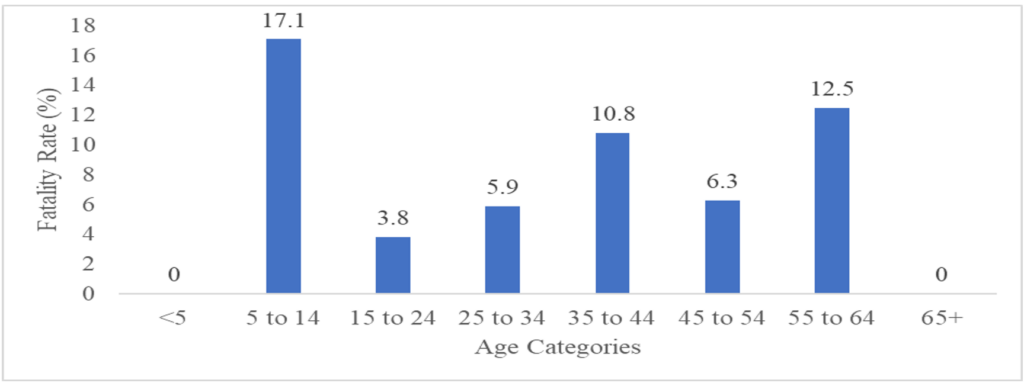
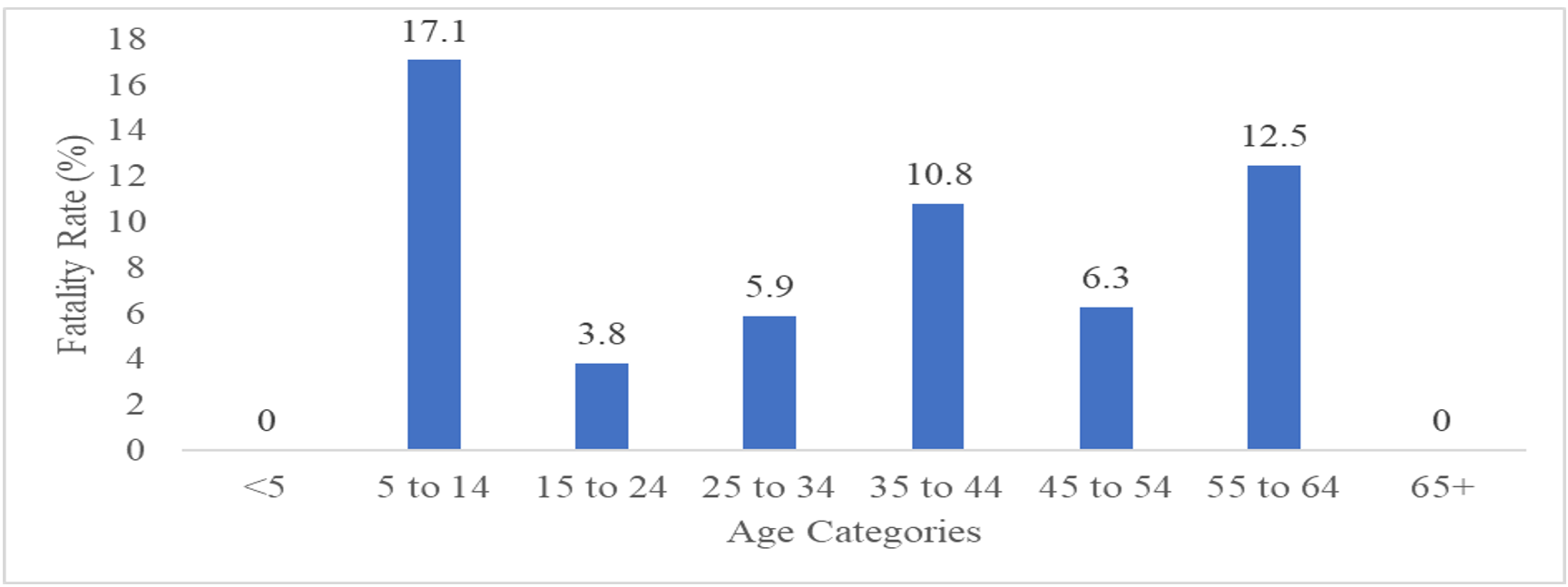
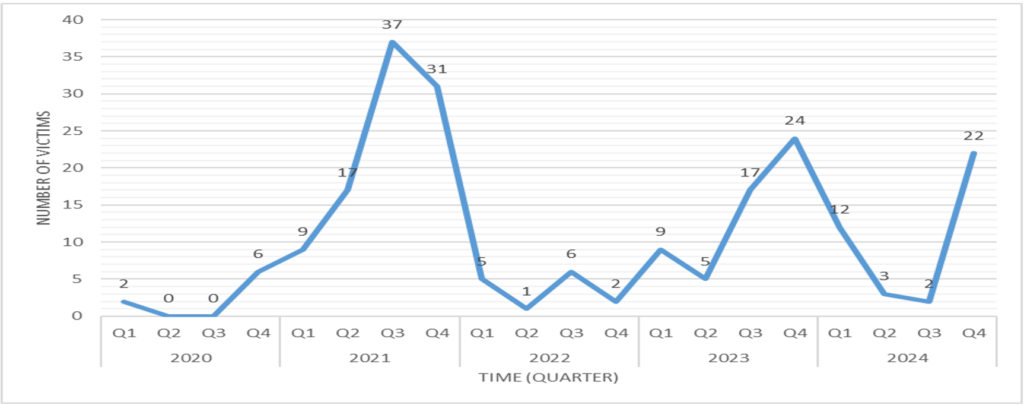
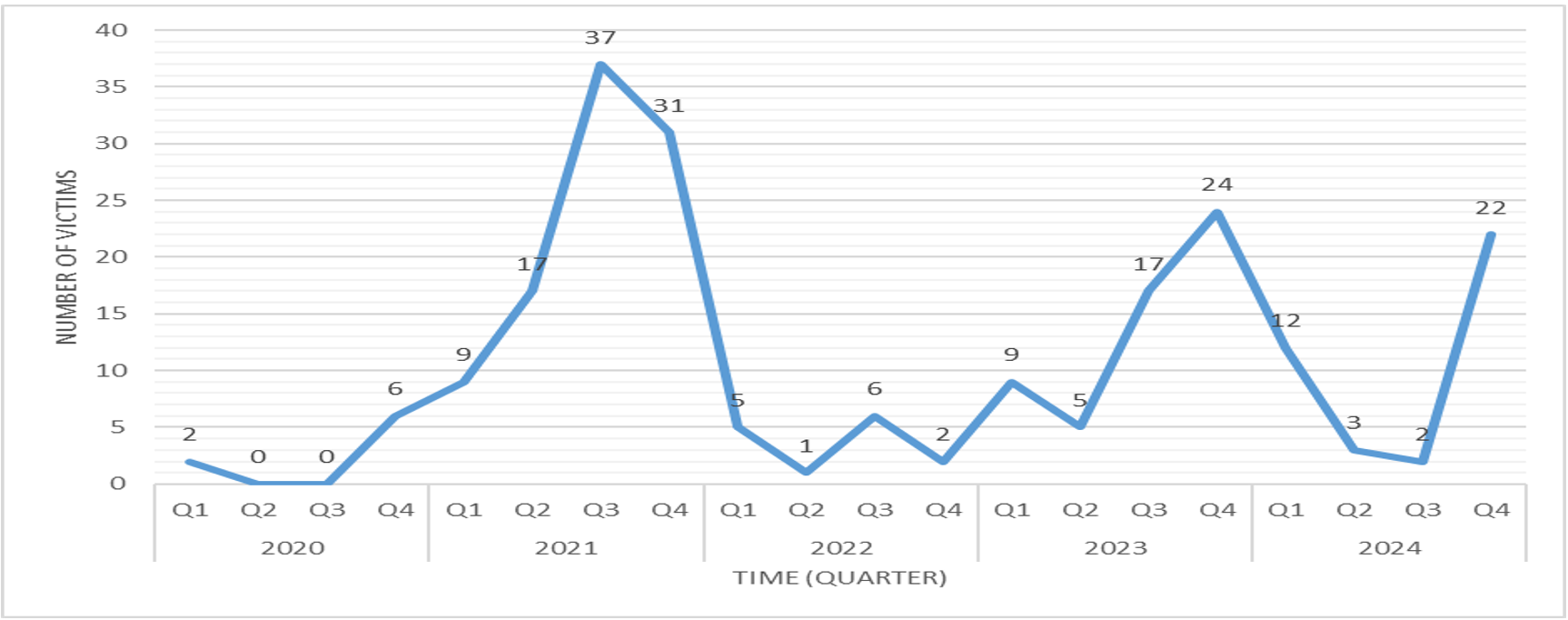
The highest mortality was observed among children aged 5–14 years and adults aged 55–64 years, while no deaths were recorded among children under 5 years and adults aged 65 years and above (Figure 1). The number of victims involved in road traffic accidents varies greatly over the five years, with three clear peaks: one major surge in Q3, 2021(37 cases), a moderate increase in Q4, 2023 (24 cases), and no cases were recorded in the 2nd and 3rd Quarters of 2020 (Figure 2).
In the bivariate analysis of associated factors with fatality among RTA victims in North Bank East Region, the Gambia, there was a statistically significant relationship between fatality and the sex (P value =0.02), being a Gambian national (P value =0.04), and accident inside Farafenni (P value =0.03), while no significant relationship was reported among daytime use of the road (P value = 0.6). This result revealed that victims of road traffic accidents that occurred outside Farafenni were less likely to die compared to victims of road traffic accidents that occurred inside Farafenni. Also, being male and being of Gambian nationality were less likely to die (Table 3). Multivariate analysis showed that the odds of fatality among females were 4 times higher than among males (OR = 4.17, 95% CI: 1.41–12.50, p = 0.01), and victims injured inside Farafenni had 4 times higher odds of death compared to those injured outside the town (OR = 4.04, 95% CI: 1.30–12.52, p = 0.02, Table 4).
This study characterized the epidemiology of Road Traffic Accidents (RTAs) in the North Bank East Region (NBER) of The Gambia, identifying critical demographic and geographic determinants of mortality. As road usage intensifies due to increased reliance on commercial transport, our findings provide a vital evidence base for the Ministry of Health and the National Roads Authority to prioritise life-saving interventions.
Our finding that males constitute the vast majority of RTA victims (76%) is consistent with global trends and specific studies in Iran [20, 21]. This male predominance is typically attributed to higher participation in the transport labour force and increased risk-taking behaviour. Furthermore, the concentration of victims within the 25–40 age group underscores a significant public health crisis; this cohort represents the most economically productive segment of Gambian society. While our findings align with the socio-economic profiles seen in many middle-income settings, they contrast with studies where the majority of victims were under 25 years of age [22-23]. This variation likely reflects regional differences in vehicle ownership, school-related commuting patterns, and the specific prevalence of motorcycle use in NBER.
A striking finding in this study is that despite males representing the bulk of victims, females had more than four times higher odds of a fatal outcome. This divergence from studies in Ethiopia, which reported higher male fatality rates [24], suggests a unique local vulnerability. This “gender paradox” may be driven by variations in injury severity or biological susceptibility to trauma. Alternatively, it may indicate a systemic delay in care-seeking or differences in the mode of transport; for instance, females in this region are often passengers in commercial vehicles that may lack safety restraints, potentially leading to more severe multi-organ trauma upon impact.
The geographic analysis revealed that accidents occurring within Farafenni had higher odds of resulting in fatality compared to other areas. This is counterintuitive given the proximity to Farafenni General Hospital and strongly suggests critical gaps in the “Golden Hour” of trauma care, specifically delays in transit, lack of bystander first-aid knowledge, or congestion that impedes emergency vehicle movement.
Regarding timing, the majority of accidents occurred during daylight hours, a finding supported by data from Iran and Lahore [20, 25]. This peak coincides with maximum road congestion and peak commercial activity. The high visibility of daylight does not appear to mitigate risk, suggesting that road density and human error, rather than poor visibility, are the primary drivers of collisions in this corridor. Furthermore, although not directly assessed in this study, the peak observed in the third and fourth quarters, which indicate the period of rainy season, may be a result of poor visibility and the slippery nature of road surfaces, as well as deteriorating road conditions.
Strengths and limitations
This study provides a rare sub-national analysis of RTA mortality in The Gambia using facility-based data. However, certain limitations must be noted. The deaths that may have occurred after discharge and also after referral of the victim were not captured in this study. Also, the reliance on secondary surveillance data resulted in the exclusion of incomplete records, though this is unlikely to have introduced significant selection bias. Additionally, while we identified factors associated with death, the retrospective nature of the data prevented a deep dive into the behavioural causes of the accidents (speed, alcohol use, or helmet non-compliance).
RTAs remain a leading cause of premature, preventable mortality in the North Bank East Region. Young adults and vulnerable road users bear the heaviest burden, while the female gender and location of the accident serve as significant predictors of mortality. Therefore, we recommend to the Ministry of Health to improve the emergency referral chain and pre-hospital first-aid training for commercial drivers in Farafenni. Also, targeted enforcement of road-safety laws during peak daylight hours by law enforcement officers, and investment in digital health registries by the government to reduce the frequency of incomplete records and allow for real-time surveillance.
What is already known about the topic
What this study adds
| Variable | Frequency (n=210) | Percent (%) |
|---|---|---|
| Sex | ||
| Male | 159 | 76 |
| Female | 51 | 24 |
| Age (Years) | ||
| <5 | 5 | 2 |
| 5-14 | 35 | 17 |
| 15-24 | 52 | 25 |
| 25-44 | 88 | 42 |
| 45-64 | 24 | 11 |
| 65+ | 6 | 3 |
| Year | ||
| 2020 | 8 | 4 |
| 2021 | 94 | 45 |
| 2022 | 13 | 6 |
| 2023 | 56 | 27 |
| 2024 | 39 | 19 |
| Time of the Accident | ||
| Day | 138 | 67 |
| Night | 72 | 34 |
| Place of Accident | ||
| Inside Farafenni | 114 | 54 |
| Outside Farafenni | 96 | 46 |
Table 2: Types of injury among RTA victims who attended FGH, 2020–2024
| Variable | Frequency | Percentage |
|---|---|---|
| Type of Injury | ||
| Contusion/Bruise | 80 | 38 |
| Laceration | 56 | 27 |
| Fracture | 28 | 13 |
| Internal Injury | 11 | 5 |
| External Bleeding/Wound | 9 | 4 |
| Chest Injury | 8 | 4 |
| No Detectable Injury | 7 | 3 |
| Dislocation | 4 | 2 |
| Loss of Consciousness | 4 | 2 |
| Soft Tissue Injury | 2 | 1 |
| Traumatic Brain Injury | 1 | 1 |
Table 3: Bivariate analysis of predictors of mortality among RTA victims in North Bank East Region, The Gambia (January 2020 – December 2024)
| Variable | Category | Fatal n (%) | Non-fatal n (%) | OR (95% CI) | p-value |
|---|---|---|---|---|---|
| Sex | Male | 9 (5.7) | 150 (94.3) | 1 | |
| Female | 8 (15.7) | 43 (84.3) | 3.1 (1.1-8.5) | 0.02 | |
| Time of Accident | Night | 5 (6.9) | 67 (93.1) | 1 | |
| Day | 12 (8.7) | 126 (91.3) | 1.3 (0.4-3.7) | 0.7 | |
| Nationality | Gambian | 15 (7.4) | 188 (92.6) | 1 | |
| Senegalese | 2 (28.6) | 5 (71.4) | 5.0 (0.8-30.4) | 0.04 | |
| Location of Accident | Outside Farafenni | 5 (4.4) | 109 (95.6) | 1 | |
| Inside Farafenni | 12 (12.5) | 84 (87.5) | 3.1 (1.1-9.2) | 0.03 |
Table 4: Multivariate analysis of factors independently associated with death related to road traffic accident victims
| Variable | Category | Fatal n (%) | Non-Fatal n (%) | aOR (95% CI) | P-Value |
|---|---|---|---|---|---|
| Sex | Male | 9 (5.7) | 150 (94.3) | 1 | |
| Female | 8 (15.7) | 43 (84.3) | 4.17 (1.41-12.50)* | 0.01 | |
| Place of Accident | Outside Farafenni | 5 (4.4) | 109 (95.6) | 1 | |
| Inside Farafenni | 12 (12.5) | 84 (87.5) | 4.04 (1.30-12.52)* | 0.02 |
* Statistically significant at p < 0.05.