
Research | Open Access | Volume 9 (4): Article 157 | Published: 29 Sep 2026

Views: 343
Menu, Tables and Figures
Table 1: Characteristics of the 309 households reporting a scabies-compatible presentation, Nyasa District, Tanzania, July to October 2024
| Characteristic | n | % (95% CI) |
|---|---|---|
| Persons reported affected | ||
| Total persons reported affected | 642 | – |
| Aged under 5 years | 219 | 34.1 of 642 |
| Aged 5 years and above | 423 | 65.9 of 642 |
| Households with at least one affected child under 5 years | 171 | 55.3% (49.8–60.8%) |
| Households with two or more affected members | 126 | 40.8% (35.4–46.3%) |
| Persons affected per household, median (IQR) | 1 (1 to 3) | range 1–16 |
| Reported features (n=309) | ||
| Severe itching, worse at night | 236 | 76.4 (71.3–80.8) |
| Visible rash | 235 | 76.1 (71.0–80.5) |
| Excoriation or skin sores | 93 | 30.1 (25.2–35.5) |
| Blisters | 63 | 20.4 (16.2–25.3) |
| Skin thickening or discolouration | 48 | 15.5 (11.9–20.0) |
| Both core features (two-sign criterion) | 181 | 58.6 (53.0–63.9) |
| Body sites reported (n=309) | ||
| Fingers | 185 | 59.9 (54.3–65.2) |
| Finger webs | 139 | 45.0 (39.5–50.6) |
| Feet | 116 | 37.5 (32.3–43.1) |
| Elbows and wrists | 77 | 24.9 (20.4–30.0) |
| Toe webs | 25 | 8.1 (5.5 to 11.7) |
| Soles | 15 | 4.9 (3.0 to 7.9) |
| Reported exposures and household context (n=309) | ||
| Contact with an affected person outside the household: yes | 140 | 45.3 (39.8–50.9) |
| Contact outside the household: no | 114 | 36.9 (31.7–42.4) |
| Contact outside the household: not sure | 55 | 17.8 (13.9–22.4) |
| Household member recently treated for scabies: yes | 152 | 49.2 (43.7–54.7) |
| Recently treated: no | 145 | 46.9 (41.4–52.5) |
| Recently treated: not sure | 12 | 3.9 (2.2 to 6.6) |
| Keeps livestock | 192 | 62.1 (56.6–67.4) |
| Livestock never washed, of 192 livestock keepers | 167 | 87.0 (81.5–91.0) |
| Animal scratching reported, among 192 livestock keepers | 96 | 50.0 (43.0–57.0) |
| Household size, median (IQR) | 4 (3 to 6) | range 1–16 |
| Received at least one referral | 302 | 97.7 (95.3–98.9) |
Percentages are of the 309 households reporting a compatible presentation unless otherwise stated. Feature categories and body sites are not mutually exclusive, so column totals exceed 100%. Features were reported by a household member and were not verified by examination. Household size excludes one record reporting 93 members, treated as a data entry error. Confidence intervals use the Wilson method. IQR: interquartile range.
Ibrahim Twahir Kilagwa1,&, Renfrid Ngolongolo Wiliam2, Mpoki Mwabukusi2, Victor Saturnus Mwingira3, Hafidh Sheha Hassan4, Athumani Msalale Lupindu1, Sharadhuli Iddi Kimera1
1Department of Veterinary Medicine and Public Health, Sokoine University of Agriculture, Morogoro, Tanzania; 2SACIDS Foundation for One Health (SACIDS), Sokoine University of Agriculture, Morogoro, Tanzania; 3National Institute for Medical Research, Amani Medical Research Centre, Muheza, Tanzania; 4Ministry of Health, Zanzibar; Dermatology Unit, Mnazi Mmoja Hospital, Zanzibar, Tanzania
&Corresponding author: Ibrahim Twahir Kilagwa, Department of Veterinary Medicine and Public Health, Sokoine University of Agriculture, Morogoro, Tanzania, Email: ibrahimkilagwa@outlook.com, ORCID: https://orcid.org/0000-0003-4715-2426
Received: 07 Feb 2026, Accepted: 28 Sep 2026, Published: 29 Sep 2026
Domain: Neglected Tropical Diseases
Keywords: Scabies, community-based surveillance, digital health, neglected tropical diseases, household transmission, mass drug administration, Tanzania
©Ibrahim Twahir Kilagwa et al. Journal of Interventional Epidemiology and Public Health (ISSN: 2664-2824). This is an Open Access article distributed under the terms of the Creative Commons Attribution International 4.0 License (https://creativecommons.org/licenses/by/4.0/), which permits unrestricted use, distribution, and reproduction in any medium, provided the original work is properly cited.
Cite this article: Ibrahim Twahir Kilagwa et al., Community-based digital surveillance for scabies-compatible presentations in Nyasa District, Tanzania: A cross-sectional household screening study. Journal of Interventional Epidemiology and Public Health. 2026; 9(3):157. https://doi.org/10.37432/jieph-d-26-00041
Introduction: Scabies is under-detected in rural Tanzania because routine surveillance primarily captures people presenting to health facilities. After a community scabies event in Nyasa District in September 2022, community-based digital surveillance using AfyaData was implemented in selected villages in 2024. This study described household-level scabies-compatible presentations detected through the approach.
Methods: Eight community health workers screened households in eight villages across four wards from July to October 2024 using a structured Kiswahili questionnaire on AfyaData. Households reporting compatible presentations provided information on symptoms, affected persons, household size, recent treatment, and livestock keeping. We assessed associations using chi-square or Fisher’s exact tests with Benjamini-Hochberg adjustment. Generalised estimating equations with village as the clustering unit estimated adjusted odds ratios for within-household clustering.
Results: Of 665 submissions, 663 were analysed; 309 households (46.6%) reported a compatible presentation, but village proportions ranged from 13.1% to 100%, and one village supplied 40.3% of all records; excluding it raised the overall figure to 69.2%. Because one worker covered one village, these differences cannot be separated from worker practice. Household size predicted clustering (adjusted odds ratio 1.35 per additional member, 95%CI: 1.06 – 1.71, p = 0.016) and held across every sensitivity analysis. The crude association with livestock keeping did not survive adjustment. A recently treated member was present in 152 affected households (49.2%).
Conclusion: These findings do not support estimation of district-level scabies prevalence because screening coverage and reporting varied between villages. Household size was associated with within-household clustering. Recently treated members in approximately half of affected households highlight the need to assess and manage household contacts. Further studies should evaluate household-based approaches to scabies detection and treatment.
Scabies is an infestation of the skin by the mite Sarcoptes scabiei var. hominis. The World Health Organization added it to the list of neglected tropical diseases in 2017, and current estimates place the number of people affected at any one time above 200 million [1]. Prevalence is highest in hot, humid, resource-constrained settings where households are crowded, and it falls hardest on children [2]. Untreated infestation is more than an itch; scratching breaks the skin, and the resulting pyoderma opens a route to invasive bacterial disease, acute post-streptococcal glomerulonephritis, and rheumatic heart disease [3]. Transmission is the reason the household is the right unit of observation. The mite passes between people through prolonged skin-to-skin contact, so infestation propagates along the contacts that sleeping arrangements and family life create rather than through casual encounters [4]. Three consequences follow, and they shaped what this study measured. Cases cluster within households, so the count of affected members in one household carries information that a count of individuals attending a clinic destroys. Treatment that reaches one member while leaving the rest untreated permits re-infestation from within, so a household containing a recently treated person who is again symptomatic is evidence about the adequacy of treatment rather than about its absence. And because the animal varieties of S. scabiei are host-adapted and produce only transient dermatitis in humans, livestock ownership should not predict human household clustering once crowding is accounted for [5, 6]. These three propositions were the study’s working hypotheses.
Tanzania has recognized scabies within its neglected tropical disease program, and the current national master plan for 2021 to 2026 lists skin conditions among the diseases requiring attention [7, 8]. Evidence on how much scabies there is and where remains thin. A school-based survey in Rufiji District found infestation in a substantial share of primary school pupils [9], and integrated skin screening under the Post-Exposure Prophylaxis for Leprosy (PEP4LEP) work in northern Tanzania identified scabies among the commonest conditions detected [10]. Both measure what a survey team finds on a single visit, and neither produces the continuous information a district surveillance officer needs in order to act. The routine alternative is the Integrated Disease Surveillance and Response system (IDSR), which counts what health facilities see. For scabies, that is a poor instrument. People with an itchy rash frequently treat themselves, consult a drug shop, or wait; the condition carries social stigma; and outpatient registers in rural districts rarely record it in a form that can be aggregated [11]. Facility data therefore describe care-seeking behaviour at least as much as they describe disease.
Nyasa District, on the Tanzanian shore of Lake Nyasa in Ruvuma Region, has direct experience of this gap. In week 34 of 2022, the district health office verified a community scabies event in Mtupale village through event-based surveillance, having learned of it from community rumor rather than from any routine return [12, 13]. No standing mechanism existed for finding such events at the household level. AfyaData, a mobile reporting application developed for community One Health surveillance in Tanzania, offers one route to such a mechanism [14, 15]. Its use for event reporting has been described [16,17] and digital reporting systems more generally shorten reporting delays and improve completeness in low-income settings. What the published record lacks is an account of what community digital screening reveals about scabies in an affected Tanzanian district.
The general objective was to describe the household epidemiology of scabies-compatible presentations detected by community health workers using AfyaData in Nyasa District. Three specific objectives followed: to quantify the proportion of screened households reporting a compatible presentation and its variation between villages; to identify household characteristics associated with more than one affected member; and to assess whether livestock keeping contributes to that clustering once crowding is accounted for.
Study design and setting
This was a cross-sectional household screening study conducted between 1 July and 8 October 2024 in Nyasa District, Ruvuma Region, in south-western Tanzania. The district lies along Lake Nyasa and borders Malawi and Mozambique. Screening covered eight villages in four wards: Kwambe, Chimate, Mtupale, and Ng’ombo in Chiwanda Ward; Linda and Nangombo in Kilosa Ward; Lundo in Lipingo Ward; and Mkali in Liuli Ward. These wards were selected in consultation with the Council Health Management Team on the basis of prior event-based surveillance signals and reported community concern about skin disease. Reporting follows the STROBE statement for cross-sectional studies.
Study population and household selection
Eight community health workers, one per village, conducted door-to-door visits within their assigned villages. Households were approached consecutively along accessible residential routes during working hours. A household was eligible if an adult member aged 18 years or above was present and gave consent. No sampling frame or village household register was used, and households absent at the visit were not revisited. Because one worker covered one village, worker, village, and geography are completely confounded by design, and no analysis can separate them. This constraint governs the interpretation of every between-village comparison reported below.
Data collection
Data were collected on a structured questionnaire administered in Kiswahili and hosted on the AfyaData application, which each worker operated on an Android device. The instrument opened with ward and village, then asked whether any household member had recently shown signs of scabies. Households answering yes proceeded to questions on the signs observed, the parts of the body affected, the number of persons affected by age group, household size, contact with a person outside the household showing similar signs, whether any household member had recently recovered from scabies treatment, and livestock keeping with its husbandry practices. Households answering no skipped this block. All households were asked about other symptoms present and about referrals issued. This skip logic fixes the denominators: exposure variables exist only for households reporting a compatible presentation, so no comparison of exposures between affected and unaffected households is possible, and no relative risk can be estimated.
Workers received two days of training on the case description, on operating the application, and on the referral procedure. The application recorded a timestamp and geographic coordinates with each submission.
Definitions
A household was classified as reporting a scabies-compatible presentation when the respondent stated that at least one member had recently shown compatible signs. The respondent was a household member and not a clinician, so all features are reported rather than examined, and the composite term “presentation” is used throughout in preference to signs or symptoms. Five categories were recorded: severe itching that worsened at night, visible rash, blisters, excoriation or skin sores, and skin thickening or discoloration. Two derived measures were used. The two-sign criterion was met when a household reported both severe nocturnal itching and visible rash; the pairing of the International Alliance for the Control of Scabies criteria is treated as the core presentation [18,19] . It is an operational construct for surveillance and is not the International Alliance for the Control of Scabies (IACS) diagnostic criteria, which require examination. Within-household clustering was met when two or more members were reported affected. The two measures are reported separately because they answer different questions and because a composite would conceal how each behaves.
Data management and cleaning
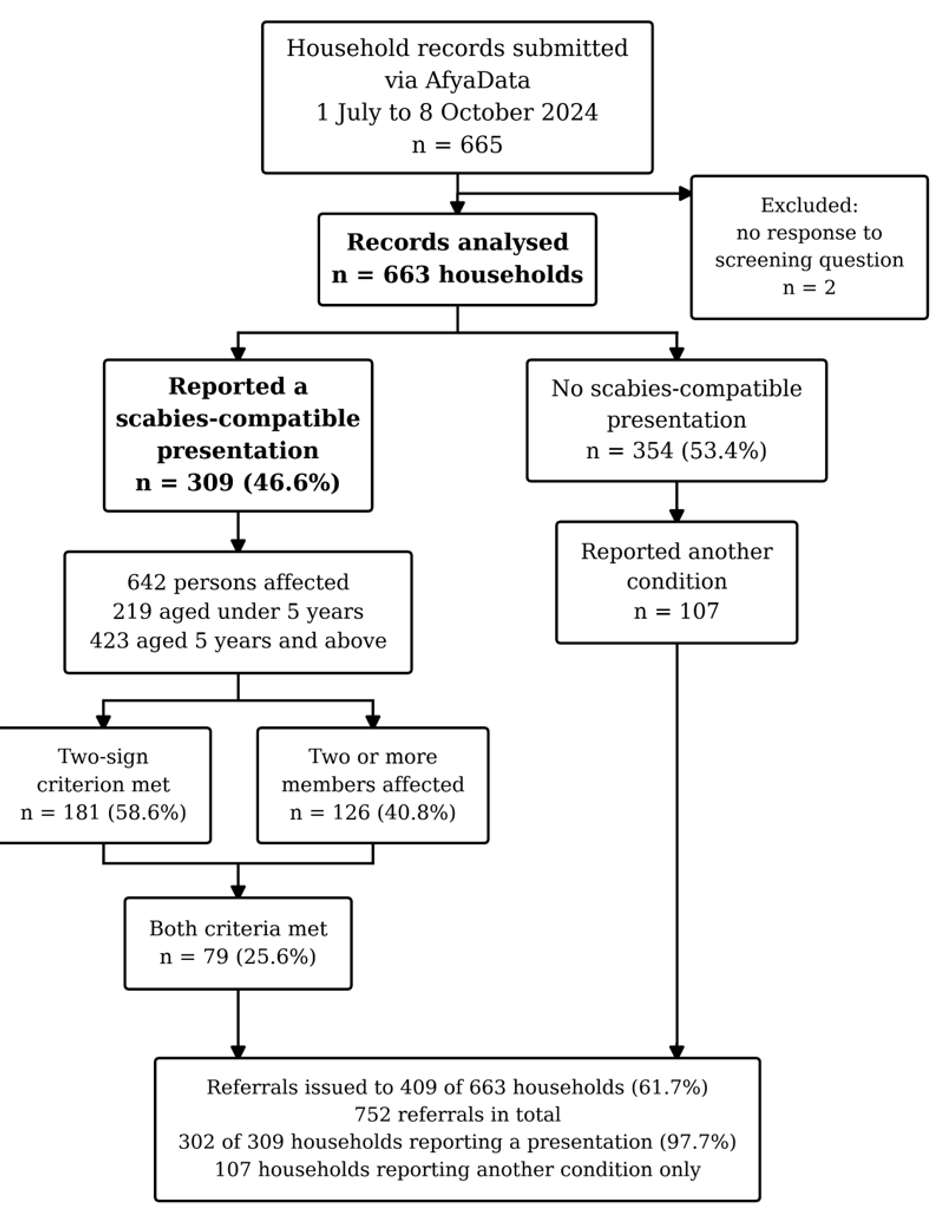
The export contained 665 records. Four cleaning steps were applied. Village names had been entered as free text under 19 spellings, including eight variants of Kwambe, and were mapped to the eight administrative names. One record carried Kihagara as a ward with Chimate as a village; since Chimate lies in Chiwanda Ward, the ward was corrected. One record carried 620,469,873 in the referral field, a telephone number in the wrong column, and was set to missing. One record reported a household of 93 members against a median of 4 and a next-highest value of 16 and was set to missing for household-size analyses only. Two records lacked a screening response and were excluded, leaving 663. Two internal consistency checks passed without exception: the reported total affected equals the sum of the two age strata in all 309 households, and the number affected never exceeded household size. Submission timestamps were valid dates for 450 records, all in July and August 2024. The remaining 213, a single contiguous block at the end of the export, carried numeric values in that field. These records were retained, since the fault lies in one field rather than in the record, and temporal analysis was restricted to the 450 dated records.
Statistical analysis
Analysis used Python 3.12 with pandas, SciPy [20], and statsmodels [21]. Categorical variables are reported as counts and percentages with Wilson 95% confidence intervals; household size and persons affected are reported as medians with interquartile ranges. Proportions were compared using the Pearson chi-square test, or Fisher’s exact test, where any expected cell count fell below five, and the test applied is named against each result. Eleven pairwise comparisons were made, and p-values were adjusted by the Benjamini-Hochberg procedure to control the false discovery rate at 5%; both raw and adjusted values are given.
Households within a village share a worker and an environment, so observations are not independent. Adjusted odds ratios for clustering were estimated by generalized estimating equations with a binomial family, logit link, exchangeable working correlation and village as the clustering unit, adjusting mutually for household size as a continuous term, ward, livestock keeping, reported outside contact, and recent treatment. The estimated within-village correlation was 0.084. With eight clusters, these estimates are exploratory and are reported beside the crude figures. Three prespecified sensitivity analyses were run: excluding Kwambe, which contributed 40.3% of all records; excluding Lundo, where 61 of 64 affected households reported exactly one case; and excluding Ng’ombo, where every household screened reported a compatible presentation. No formal sample size calculation preceded the study, since the analysis was of records generated by a service activity; the 309 affected households give roughly 80% power to detect an odds ratio of 2.0 for a binary exposure of 50% prevalence at alpha of 0.05 under independence, and less once clustering is allowed for.
Ethical considerations
Ethical approval was granted by Sokoine University of Agriculture (SUA/ADM/R.1/8/1168) and the National Institute for Medical Research (NIMR/HQ/R.8a/Vol.IX/4583). Permission was obtained from Nyasa District Council. Written informed consent was obtained from an adult member of each household. Records were anonymized and telephone numbers removed before analysis.
Screening outcome and distribution between villages
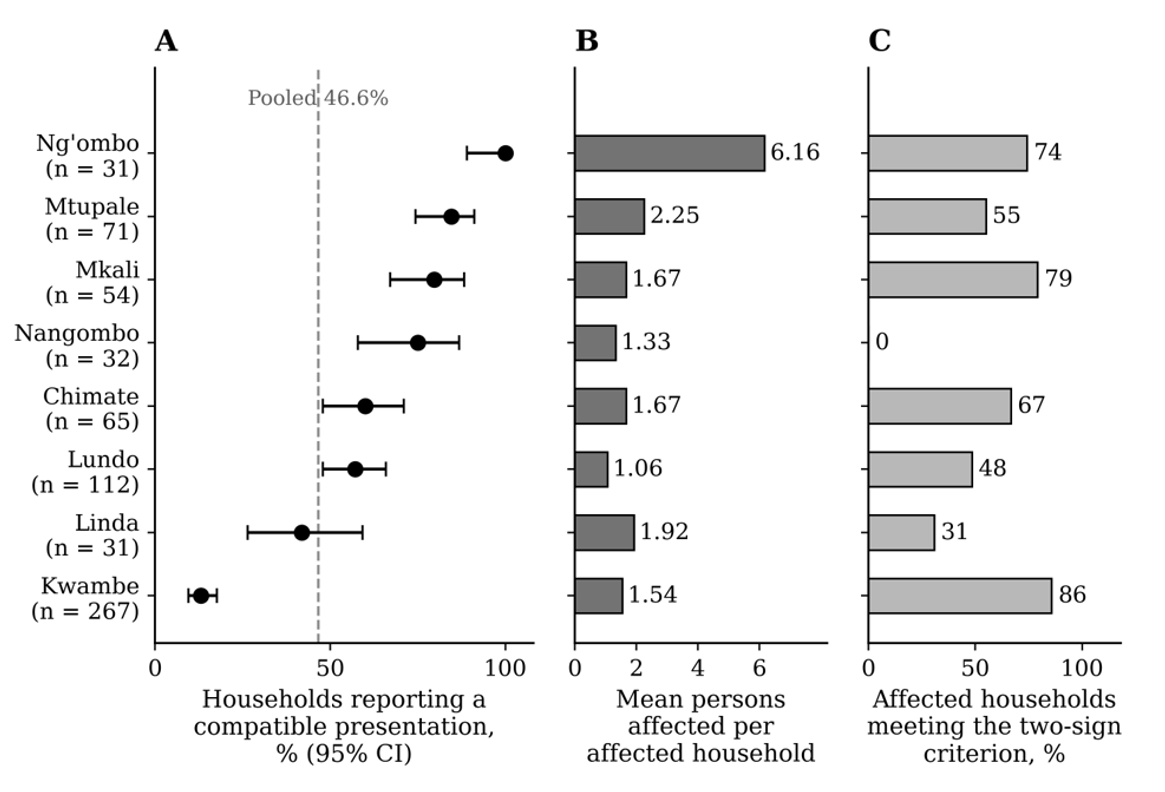
Workers submitted 665 records, of which 663 were analyzed (Figure 1). A scabies-compatible presentation was reported by 309 households (46.6%, 95%CI: 42.8 – 50.4). That single figure is unstable, and the instability is informative. Kwambe alone supplied 267 of the 663 records, 40.3% of the total, and returned the lowest proportion at 13.1%. Excluding Kwambe raises the overall proportion to 69.2% (274 of 396, 95%CI: 64.5 – 73.5). At the other extreme, all 31 households screened in Ng’ombo reported a compatible presentation. The range across the eight villages ran from 13.1% to 100% (Figure 2A), and no summary figure for the district can be defended from these data.
The recording pattern differed as sharply as the burden did (Figure 2B). Mean persons affected per affected household ranged from 1.06 in Lundo, where 61 of 64 households reported exactly one case, and the maximum was three, to 6.16 in Ng’ombo. The proportion meeting the two-sign criterion ranged from 0% in Nangombo, where no household of 24 reported both core features, to 85.7% in Kwambe. Referral coverage ranged from 18.0% of households in Kwambe to 100% in Ng’ombo. Since each village had one worker, these gradients cannot be separated from worker behaviour, and they are more plausibly explained by differences in how workers screened and recorded than by differences in disease.
Households reporting a compatible presentation
The 309 affected households reported 642 affected persons: 219 children under five years and 423 aged five years or above (Table 1). The median household size was 4 (IQR: 3 – 6). Two or more members were affected in 126 households (40.8%), and at least one affected child under five was present in 171 (55.3%).
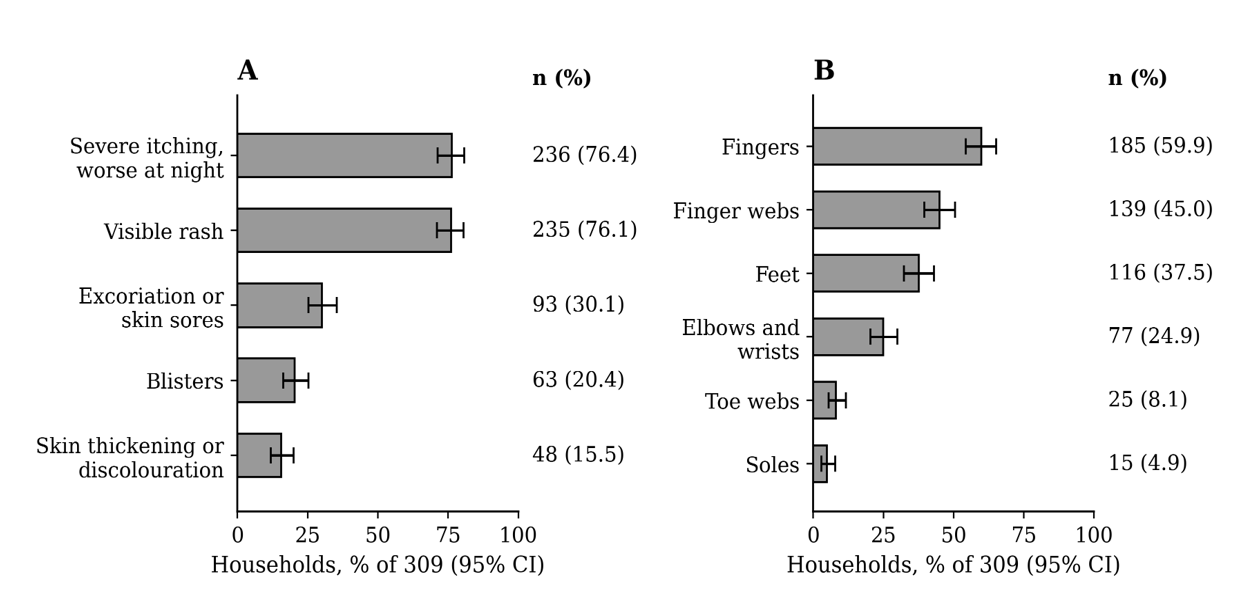
Severe itching worse at night was reported by 236 households (76.4%), and visible rash by 235 (76.1%), with excoriation or skin sores at 30.1%, blisters at 20.4%, and skin thickening or discolouration at 15.5% (Figure 4A). The two-sign criterion was met by 181 households, 58.6% of affected households and 27.3% of all households screened. The fingers were the most commonly affected site at 59.9%, then finger webs at 45.0%, feet at 37.5%, and elbows or wrists at 24.9% (Figure 4B).
Contact with an affected person outside the household was reported by 140 households (45.3%), and 55 (17.8%) were unsure. Recent recovery from scabies treatment within the household was reported by 152 (49.2%). Livestock were kept by 192 (62.1%), most commonly goats, and 167 of these (87.0%) never washed their animals. Scratching in animals was reported by exactly half of livestock keepers.
Factors associated with within-household clustering
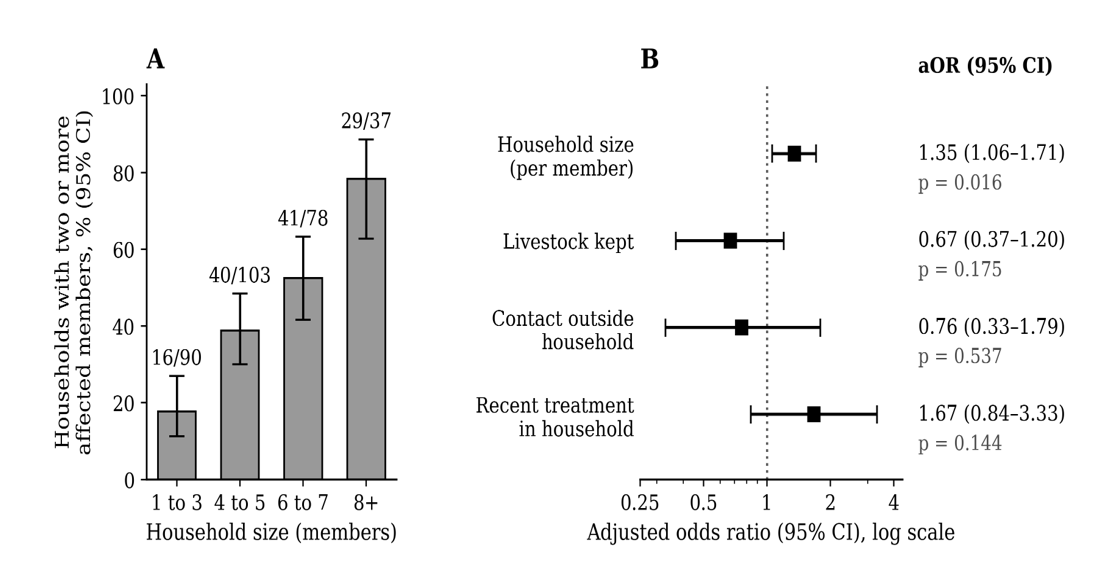
Household size showed the clearest gradient (Figure 3A). Two or more affected members were reported by 17.8% of households with one to three members and by 78.4% of those with eight or more (chi-square 45.98, df 3, raw p < 0.001, adjusted p < 0.001). After mutual adjustment and with standard errors clustered by village, each additional member raised the odds of clustering by 35% (adjusted OR: 1.35, 95%CI: 1.06 – 1.71, p = 0.016; Figure 3B). The estimate held on excluding Lundo (1.34, 95%CI: 1.05 – 1.72) and was strengthened on excluding Kwambe (1.54, 95%CI: 1.24 – 1.90).
Livestock keeping was associated with clustering crudely (50.0% against 25.6%, Fisher’s exact raw p < 0.001, adjusted p < 0.001), and reported animal scratching more strongly still among livestock keepers (69.8% against 30.2%, raw p < 0.001). Neither survived adjustment: livestock keeping returned an adjusted OR of 0.67 (95%CI: 0.37 – 1.20, p = 0.175), and animal scratching 1.38 (95%CI: 0.53 – 3.59, p = 0.504) in a model restricted to livestock keepers. Both crude associations were confounded by household size and ward, since livestock-keeping households were larger and were concentrated where clustering was most common. The finding was stable across all three sensitivity analyses.
Neither outside contact nor recent treatment was associated with clustering after adjustment. Recent treatment did track presentation severity: 68.2% of households containing a recently treated member met the two-sign criterion against 50.3% of those without (Fisher’s exact raw p = 0.002, adjusted p = 0.004).
The ward terms cannot be read epidemiologically. Lipingo returned an adjusted OR of 0.04 (95%CI: 0.01 – 0.14), which reflects the Lundo recording pattern of one case per household rather than any protective feature of that ward, and the ward variables are retained as adjustment terms only.
Referrals and other conditions
At least one referral was issued to 409 households (61.7%), 752 in total, of which 302 of the 309 affected households (97.7%) received one. The remaining 107 recipients had reported another condition rather than a compatible presentation, which accounts for the entire difference. Other conditions were reported by 147 households (22.2%, 95%CI: 19.2 – 25.5), most often diarrhoea (35), cough (27), and abdominal pain (27). Among the 450 dated records, 309 fell in July and 141 in August 2024, with affected proportions of 52.4% and 52.5%.
Household size predicted within-household clustering and was the only variable to survive adjustment and all three sensitivity analyses. Half of the households reporting an active presentation also reported a member who had recently completed treatment. The crude association between livestock and clustering disappeared once crowding and ward were accounted for; in the direction the biology predicts. Against these stands a fourth result that constrains all of them: the between-village differences are indistinguishable from between-worker differences, so this study cannot report a district prevalence.
The household size gradient matches the established account of scabies as a disease of prolonged contact and crowding [2, 22] and is consistent with the Rufiji school survey [9] and with outbreak investigations in Ethiopia [23,24] and Uganda [25]. The reported feature profile, dominated by nocturnal itching and rash at the finger webs, corresponds to the presentation described in the IACS criteria [18] and in Pacific and Southeast Asian mapping work [26] . Where this study departs from the survey literature is in what it cannot claim: prevalence studies using trained examiners with standardised procedures [27, 28] produce estimates that community self-report cannot match, and the numbers here should not be read alongside them.
The treatment finding has important operational implications, although treatment effectiveness was not directly assessed in this study. Approximately half of the households reporting an active presentation also reported a recently treated household member, while these households were more likely to report both core features. This pattern suggests that treatment of individual household members may not be sufficient to interrupt ongoing household-level transmission when other household members remain untreated. Two mechanisms may plausibly contribute: untreated contacts may facilitate continued transmission or re-exposure, while incomplete application or failure to complete recommended repeat treatment may reduce treatment effectiveness. However, the present data cannot distinguish between these mechanisms because treatment adherence, treatment completion, clinical response, and post-treatment follow-up were not directly measured. These findings therefore support consideration of household-level case management and contact treatment, consistent with approaches described in Fiji [29] and the World Health Organization framework [30, 31], particularly in settings with persistent household-level transmission.
The livestock finding provides no evidence in this study of a zoonotic transmission pathway for human scabies. Although livestock ownership was associated with the outcome in crude analysis, this association was not retained after adjustment, suggesting that the observed crude relationship may have reflected differences in household or ward characteristics rather than a direct transmission pathway. Animal husbandry variables can be incorporated into an integrated surveillance platform, but their inclusion should not be interpreted as evidence of zoonotic transmission without epidemiological and clinical evidence supporting such a pathway. In this setting, the principal contribution of integrated surveillance was the establishment of a shared reporting channel and workforce across community and health-system levels.
The comparison with facility reporting should also be interpreted cautiously. This study measured household-reported active presentations, whereas routine facility reporting generally captures consultations or encounters; therefore, the two measures cannot be directly compared as rates or prevalence estimates. During the three-month surveillance period, 309 households reported active presentations, demonstrating the volume of community-level signals captured through the digital surveillance approach. These findings illustrate the potential of community-based reporting to identify suspected scabies signals that may otherwise be missed by facility-based surveillance, but they do not establish the magnitude of under-detection in routine facility reporting.
Several questions remain for future investigation. First, among households reporting a recently treated member and an active presentation, it remains unclear whether the observed pattern reflects inadequate treatment response, incomplete treatment, continued exposure to untreated household contacts, or re-exposure after treatment. A short prospective follow-up study incorporating household-wide clinical assessment, documentation of treatment received and adherence, and follow-up of household contacts could help distinguish these possibilities. This distinction would inform whether programmatic emphasis should be placed on treatment quality and completion, household contact management, or both.
Second, a subsequent surveillance round could establish the proportion of village households represented in the 663 complete surveillance records by linking digital submissions with village household registers and documenting the population covered by participating community health workers. Finally, the extent to which differences between villages reflect variation in suspected scabies occurrence or differences in screening and reporting practices remains uncertain. This could be investigated through standardized screening procedures, worker rotation between villages, or independent screening of the same households by two trained workers.
Strengths and weaknesses
The design covered 663 households in eight villages in three months, at a scale and continuity that a survey visit does not achieve, and it recorded exposure and referral information alongside the case count. Four weaknesses are decisive. Households were approached along accessible routes with no register, so the denominator is unknown, and the proportions describe those screened rather than the villages. One worker per village makes worker, village, and geography inseparable, and the spread of recording patterns in Figure 2B shows that this is not a theoretical concern: a village returning 61 of 64 households with exactly one case, and another returning every household screened as affected, are reporting artefacts of screening practice as much as they are epidemiology. Presentations were reported by a household member without examination, so misclassification in both directions is likely, and recall and social desirability will have shaped answers about treatment. The skip logic confined exposure questions to affected households, which forecloses any comparison with unaffected households.
Household screening by community health workers using a digital platform identified scabies-compatible presentations in 309 of 663 households across eight villages of Nyasa District. The substantial variation between villages highlights the potential influence of differences in screening and reporting practices; therefore, these findings should not be interpreted as a district-level prevalence estimate. Household size was the only factor associated with having more than one affected household member after adjustment, and this association remained across the sensitivity analyses. Livestock keeping was not independently associated with the outcome after adjustment, providing no evidence from this study of a zoonotic contribution.
Approximately half of the households reporting an active presentation also reported a recently treated household member. Because treatment response, adherence, treatment completion, and post-treatment follow-up were not directly assessed, this finding does not establish treatment failure or demonstrate that individual treatment is ineffective. However, it highlights the need for further assessment of household-level transmission, treatment practices, and management of household contacts. Future surveillance should enumerate households from village registers and account for clustering by village and community health worker to improve estimation of the distribution of suspected scabies signals in the district.
What is already known about the topic
What this study adds
The authors thank the eight community health workers of the Kwambe, Chimate, Mtupale, Ng’ombo, Linda, Nangombo, Lundo, and Mkali villages who collected the data and the households that agreed to be screened. The authors thank the Nyasa District Council Health Management Team for permission and field support and the Southern African Centre for Infectious Disease Surveillance for access to the AfyaData platform.
Conceptualization: Ibrahim Twahir Kilagwa, Sharadhuli Iddi Kimera
Data curation: Ibrahim Twahir Kilagwa, Renfrid Ngolongolo William, Mpoki Mwabukusi
Formal analysis: Athumani Msalale Lupindu
Investigation: Ibrahim Twahir Kilagwa, Renfrid Ngolongolo William, Mpoki Mwabukusi, Hafidh Hassan
Methodology: Ibrahim Twahir Kilagwa, Hafidh Hassan, Athumani Msalale Lupindu, Sharadhuli Iddi Kimera
Project administration: Ibrahim Twahir Kilagwa
Resources: Renfrid Ngolongolo William, Mpoki Mwabukusi
Software: Renfrid Ngolongolo William, Mpoki Mwabukusi
Validation: Ibrahim Twahir Kilagwa, Mpoki Mwabukusi, Hafidh Hassan, Victor Mwingira, Athumani Msalale Lupindu, Sharadhuli Iddi Kimera
Supervision: Victor Mwingira, Athumani Msalale Lupindu, Sharadhuli Iddi Kimera
Visualization: Ibrahim Twahir Kilagwa, Athumani Msalale Lupindu
Writing – original draft: Ibrahim Twahir Kilagwa
Writing – review & editing: Ibrahim Twahir Kilagwa, Renfrid Ngolongolo William, Mpoki Mwabukusi, Hafidh Hassan, Victor Mwingira, Athumani Msalale Lupindu, Sharadhuli Iddi Kimera
Table 1: Characteristics of the 309 households reporting a scabies-compatible presentation, Nyasa District, Tanzania, July to October 2024
| Characteristic | n | % (95% CI) |
|---|---|---|
| Persons reported affected | ||
| Total persons reported affected | 642 | – |
| Aged under 5 years | 219 | 34.1 of 642 |
| Aged 5 years and above | 423 | 65.9 of 642 |
| Households with at least one affected child under 5 years | 171 | 55.3% (49.8–60.8%) |
| Households with two or more affected members | 126 | 40.8% (35.4–46.3%) |
| Persons affected per household, median (IQR) | 1 (1 to 3) | range 1–16 |
| Reported features (n=309) | ||
| Severe itching, worse at night | 236 | 76.4 (71.3–80.8) |
| Visible rash | 235 | 76.1 (71.0–80.5) |
| Excoriation or skin sores | 93 | 30.1 (25.2–35.5) |
| Blisters | 63 | 20.4 (16.2–25.3) |
| Skin thickening or discolouration | 48 | 15.5 (11.9–20.0) |
| Both core features (two-sign criterion) | 181 | 58.6 (53.0–63.9) |
| Body sites reported (n=309) | ||
| Fingers | 185 | 59.9 (54.3–65.2) |
| Finger webs | 139 | 45.0 (39.5–50.6) |
| Feet | 116 | 37.5 (32.3–43.1) |
| Elbows and wrists | 77 | 24.9 (20.4–30.0) |
| Toe webs | 25 | 8.1 (5.5 to 11.7) |
| Soles | 15 | 4.9 (3.0 to 7.9) |
| Reported exposures and household context (n=309) | ||
| Contact with an affected person outside the household: yes | 140 | 45.3 (39.8–50.9) |
| Contact outside the household: no | 114 | 36.9 (31.7–42.4) |
| Contact outside the household: not sure | 55 | 17.8 (13.9–22.4) |
| Household member recently treated for scabies: yes | 152 | 49.2 (43.7–54.7) |
| Recently treated: no | 145 | 46.9 (41.4–52.5) |
| Recently treated: not sure | 12 | 3.9 (2.2 to 6.6) |
| Keeps livestock | 192 | 62.1 (56.6–67.4) |
| Livestock never washed, of 192 livestock keepers | 167 | 87.0 (81.5–91.0) |
| Animal scratching reported, among 192 livestock keepers | 96 | 50.0 (43.0–57.0) |
| Household size, median (IQR) | 4 (3 to 6) | range 1–16 |
| Received at least one referral | 302 | 97.7 (95.3–98.9) |
Percentages are of the 309 households reporting a compatible presentation unless otherwise stated. Feature categories and body sites are not mutually exclusive, so column totals exceed 100%. Features were reported by a household member and were not verified by examination. Household size excludes one record reporting 93 members, treated as a data entry error. Confidence intervals use the Wilson method. IQR: interquartile range.