
Research | Open Access | Volume 9 (3): Article 148 | Published: 18 Sep 2026

Views: 83
Menu, Tables and Figures
| Characteristics | Suspect case during investigation | p-value¹ | ||
|---|---|---|---|---|
| Total N = 61 (%) | No N = 31 (%) | Yes N = 30 (%) | ||
| Sex | 0.500 | |||
| Female | 35 (57.4) | 19 (54.3) | 16 (45.7) | |
| Male | 26 (42.6) | 12 (46.2) | 14 (53.8) | |
| Age group | N = 59 0.016 | |||
| 0-9 years | 11 (18.6) | 2 (18.2) | 9 (81.8) | |
| 10-19 years | 11 (18.6) | 3 (27.3) | 8 (72.7) | |
| 20-29 years | 23 (39.0) | 14 (60.9) | 9 (39.1) | |
| 30+ years | 14 (23.7) | 10 (71.4) | 4 (28.6) | |
| District | 0.002 | |||
| Cuamba | 7 (11.5) | 0 (0.0) | 7 (100.0) | |
| Lago | 53 (86.9) | 31 (58.5) | 22 (41.5) | |
| Metarica | 1 (1.6) | 0 (0.0) | 1 (100.0) | |
| Contact with suspected/confirmed case of Mpox | <0.001 | |||
| No | 19 (31.1) | 0 (0.0) | 19 (100.0) | |
| Yes | 42 (68.9) | 31 (73.8) | 11 (26.2) | |
| Signs and symptoms | <0.001 | |||
| Contacts not found | 2 (3.3) | 2 (100.0) | 0 (0.0) | |
| No | 29 (47.5) | 29 (100.0) | 0 (0.0) | |
| Yes | 30 (49.2) | 0 (0.0) | 30 (100.0) | |
| Pearson’s Chi-squared test; Fisher’s exact test | ||||
Table 1: Description of individuals traced during the investigation of the mpox outbreak, Niassa Province, between 8 and 20 July 2025
| Characteristics | Case classification | |||
|---|---|---|---|---|
| Total N = 30 (%) | Confirmed N = 13 (%) | Negative N = 17 (%) | p-value | |
| Sex | >0.900 | |||
| Female | 16 (53.3) | 7 (53.8) | 9 (52.9) | |
| Male | 14 (46.7) | 6 (46.2) | 8 (47.1) | |
| Age group | 0.002 | |||
| 0-9 years | 9 (30.0) | 0 (0.0) | 9 (52.9) | |
| 10-19 years | 8 (26.8) | 3 (23.1) | 5 (29.4) | |
| 20-29 years | 9 (30.0) | 7 (53.8) | 2 (11.8) | |
| 30+ years | 4 (13.3) | 3 (23.1) | 1 (5.9) | |
| Nationality | 0.020 | |||
| Mozambican | 21 (70.0) | 6 (46.2) | 15 (88.2) | |
| Tanzanian | 9 (30.0) | 7 (53.8) | 2 (11.8) | |
| District | 0.005 | |||
| Cuamba | 7 (23.3) | 0 (0.0) | 7 (41.2) | |
| Lago | 22 (73.3) | 13 (100.0) | 9 (52.9) | |
| Metarica | 1 (3.3) | 0 (0.0) | 1 (5.9) | |
| Health Area* | 0.018 | |||
| Chia | 1 (3.3) | 0 (0.0) | 1 (5.9) | |
| Cobue | 4 (13.3) | 2 (15.4) | 2 (11.8) | |
| Cuamba | 6 (20.0) | 0 (0.0) | 6 (35.3) | |
| Lupilichi | 10 (33.3) | 8 (61.5) | 2 (11.8) | |
| Metangula | 7 (23.3) | 3 (23.1) | 4 (23.5) | |
| Metarica | 1 (3.3) | 0 (0.0) | 1 (5.9) | |
| Mnapa | 1 (3.3) | 0 (0.0) | 1 (5.9) | |
| Occupation | N = 20 | 0.300 | ||
| Unemployed | 5 (25.0) | 3 (23.1) | 2 (28.6) | |
| Formal employment | 2 (10.0) | 2 (15.4) | 0 (0.0) | |
| Informal employment | 9 (45.0) | 7 (53.8) | 2 (28.6) | |
| Student | 4 (20.0) | 1 (7.7) | 3 (42.9) | |
| Occupational and Exposure Profile | N = 20 | 0.600 | ||
| Farmer/Fisherman | 2 (10.0) | 1 (7.7) | 1 (14.3) | |
| Shopkeeper/balconist | 3 (15.0) | 3 (23.1) | 0 (0.0) | |
| Prospector | 1 (5.0) | 1 (7.7) | 0 (0.0) | |
| Sex worker | 4 (20.0) | 3 (23.1) | 1 (14.3) | |
| Works in the mine/has contact with miners | N = 20 | 0.070 | ||
| No | 11 (55.0) | 5 (38.5) | 6 (85.7) | |
| Yes | 9 (45.0) | 8 (61.5) | 1 (14.3) | |
| International travel history | >0.900 | |||
| No | 28 (93.3) | 12 (92.3) | 16 (94.1) | |
| Yes | 2 (6.7) | 1 (7.7) | 1 (5.9) | |
| Contact with suspected/confirmed cases | 0.300 | |||
| No | 18 (60.0) | 6 (46.2) | 12 (70.6) | |
| Do not know | 1 (3.3) | 1 (7.7) | 0 (0.0) | |
| Yes | 11 (36.7) | 6 (46.2) | 5 (29.4) | |
| Pearson’s Chi-squared test; Fisher’s exact test *Health areas included in the analysis were distributed across the three districts reporting suspected mpox cases as follows: Lago District (Metangula, Lupilichi, Cobue, and Chia), Cuamba District (Cuamba and Mnapa), and Metarica District (Metarica). | ||||
Table 2: Analysis of the sociodemographic and exposure factors of the suspected mpox cases screened between July 08 and 20, 2025
Izilda Raúl Matimbe1,2,&, Filipe Mateus Murimirgua3, Taiobo Martins Jamal3, Loira Machalele2, Gavinala Mandala4, Cremildo Rajabo5, Osvaldo Piedade6, Banza Wa Banza7, Emídio da Cruz Nhatuve7, Erika Valeska Rossetto1, Denise Chitsondzo Langa2, Áuria Ribeiro Banze1,2
¹Programa de Formação em Epidemiologia de Campo, Moçambique, 2Instituto Nacional de Saúde, Maputo, Moçambique, 3Direcção Nacional de Saúde Pública, Ministério da Saúde, Maputo, Moçambique, 4Laboratório Nacional de Saúde Pública de Lichinga, Instituto Nacional de Saúde, Niassa, Moçambique, 5Departmento de Saúde Pública, Serviço Provincial de Saúde, Niassa, Moçambique, 6Serviço Distrital de Saúde da Mulher e Acção Social, Distrito de Lago, Niassa, Moçambique, 7Departmento de Saúde Pública, Direcção Provincial de Saúde, Niassa, Moçambique
&Corresponding author: Izilda Raúl Matimbe, Programa de Formação em Epidemiologia de Campo, Instituto Nacional de Saúde, Maputo, Moçambique. Email: izilda.matimbe@ins.gov.mz / isismatimbe@gmail.com ORCID: https://orcid.org/0009-0006-6524-4083
Received: 20 Mar 2026, Accepted: 03 Sep 2026, Published: 18 Sep 2026
Domain: Infectious Disease Epidemiology
Keywords: Mpox, Disease, Outbreak, Mozambique, Mining, Border Crossing
©Izilda Raúl Matimbe et al. Journal of Interventional Epidemiology and Public Health (ISSN: 2664-2824). This is an Open Access article distributed under the terms of the Creative Commons Attribution International 4.0 License (https://creativecommons.org/licenses/by/4.0/), which permits unrestricted use, distribution, and reproduction in any medium, provided the original work is properly cited.
Cite this article: Izilda Raúl Matimbe et al. Mpox outbreak associated with mineral extraction activity in Lago District, Niassa Province, Mozambique, July 2025. Journal of Interventional Epidemiology and Public Health. 2026; 9(3):148. https://doi.org/10.37432/jieph-d-26-00094
Introduction: On July 10th, 2025, the Mozambican Ministry of Health declared the country’s first mpox outbreak after confirming three cases in Lago District, Niassa Province, bordering Tanzania. We investigated the outbreak to describe its epidemiological characteristics and propose targeted control measures.
Methods: A descriptive cross-sectional study was conducted from July 8th – 20th, 2025. Suspected cases were identified through active case-finding in health facilities and communities, and real-time Polymerase chain reaction (PCR) testing was performed to confirm them. Data was analyzed using descriptive statistics and Chi-square or Fisher’s exact tests, and the association was considered statistically significant if the p-value < 0.05.
Results: A total of 61 individuals were screened (mean age, 23 years; SD ±13.2), 19 were suspected cases. We identified 42 contacts, of which 11 were symptomatic, and were included as suspected cases, bringing the total number of suspected cases to 30. A total of 13 cases were laboratory-confirmed (positivity rate: 43.33%; 13/30). Most confirmed cases (92.31%; 12/13) were epidemiologically linked to the Lupilichi mining area. Mpox infection showed statistically significant crude associations with age group, nationality, and place of residence (p-value < 0.05).
Conclusion: The outbreak was localized in a mining area near the Tanzanian border, suggesting cross-border transmission. Strengthening surveillance, laboratory capacity, and community engagement in border districts is essential to prevent re-emergence. A limited sample size and a cross-sectional design limited causal inference.
Mpox is a zoonotic disease caused by the Monkeypox virus (MPXV), a member of the Orthopoxvirus genus within the Poxviridae family, with two main clades: clade I (Central and East Africa) and clade II (West Africa). The incubation period ranges from 7 to 21 days [1–4].
Most mpox cases are self-limiting, but severe illness may occur in children, pregnant women, and immunocompromised individuals [2,4]. Typical clinical manifestations include fever, headache, lymphadenopathy, and skin rashes, often affecting the palms and soles [2]. Transmission primarily occurs through direct interpersonal contact, including sexual transmission [5,6].
Worldwide, between January 2022 and August 2024, more than 100,000 laboratory-confirmed mpox cases and 220 deaths were reported across 120 countries, including 103 reporting the disease for the first time. The case fatality rate of the disease ranges from 1 to 10% [3,7].
Although endemic to West and Central Africa, mpox has re-emerged globally since 2022, with outbreaks reported in non-endemic regions such as Europe and the Americas [8,9]. In sub-Saharan Africa, several countries, including Tanzania, Malawi, and the Democratic Republic of the Congo, have reported sustained community transmission [8,9].
In the African region, neighbouring countries that share a border with Mozambique, such as Tanzania and Malawi, recently reported confirmed outbreaks [10,11]. Tanzania confirmed its first mpox case in 2025 in Dar es Salaam. A total of 111 cases were reported, affecting multiple age groups, with no deaths recorded. The country has not yet initiated vaccination, and undetected cases continue to pose a challenge [12].
The first confirmed mpox case in Mozambique was documented in 2022; in 2024, seven additional suspected cases were tested and found negative [13]. On 10th July 2025, Mozambique confirmed its first mpox outbreak in Lago District, Niassa Province, following the Ministry of Health’s receipt of a notification of suspected mpox cases in Niassa Province on 8th July 2025.
Mpox surveillance in Mozambique remains limited. Lago District is characterized by intensive artisanal mining activity and shares an open border with Tanzania, a setting that may facilitate the importation and spread of disease.
Despite this resurgence, few empirical studies have described mpox outbreaks in southern Africa, particularly in border mining areas marked by high mobility and informal trade. This study aimed to describe the first confirmed mpox outbreak in Mozambique, identify risk factors associated with infection, and document the public health response.
Study setting and design
The investigation took place in Lago District, Niassa Province, northern Mozambique. The district spans approximately 6,528 km² and has an estimated population of 128,204 inhabitants. It borders Tanzania to the north, Lichinga District to the south, Sanga District to the east and Lake Niassa to the west [14]. We conducted a descriptive cross-sectional study from 8th – 20th July 2025.
Case definitions
Following adapted national and World Health Organization (WHO) guidelines [4], we defined a suspected case as a person of any age who presents with an unexplained acute rash and one or more of the following signs and symptoms: fever >38.5 °C, headache, lymphadenopathy, myalgia, low back pain, or asthenia. Confirmed case: any suspected case with MPXV detected by PCR or genetic sequencing. Discarded case as a suspected case testing negative by PCR or sequencing. Contact was defined as any person who had physical direct contact (including sexual contact), face-to-face interaction at a distance of less than 2 meters without adequate personal protective equipment (PPE), or contact with contaminated materials (clothing, bedding) of a suspected or confirmed case, during the period between symptom onset and the fall of the last scab. All individuals meeting any of these criteria were included as contacts in this investigation. An epidemiological link to the Lupilichi mining area was defined as a documented history of residence, work, travel, or participation in activities in the Lupilichi mining area, or contact with a confirmed or suspected case linked to that area during the 21 days preceding symptom onset.
Laboratory procedures
Biological specimens (lesion swabs, nasopharyngeal swabs and whole blood) were collected from all suspected cases and transported to Niassa Province Public Health Laboratory for analysis. Lesion swabs were prioritized due to their higher diagnostic sensitivity for mpox, in line with WHO mpox surveillance recommendations, and were used for confirmatory mpox diagnosis and differential diagnosis with varicella (chickenpox).
Nasopharyngeal swabs and whole blood were used for the differential diagnosis of other exanthematous diseases, particularly measles and rubella. The laboratory diagnosis was performed using real-time polymerase chain reaction (RT-PCR), following WHO mpox diagnostic protocols [7], targeting the F3L gene. Internal controls were included for result validation. Additionally, laboratory samples from all confirmed cases underwent genetic sequencing to determine the clade associated with the infection.
Data collection
Two forms were used: (i) a case-investigation form for each suspected case and (ii) a contact-tracing form for identifiable contacts. Data collection was performed in parallel via electronic Open Data Kit (ODK) forms and paper backups. Collected data included sociodemographic variables (sex, age, residence, occupation, dangerous profession); exposure history (international travel, contact with suspect/confirmed case, type of contact); clinical manifestations; and laboratory results.
Data analysis
Data were entered into Open Data Kit (ODK) and analyzed in RStudio version 2025.05.0. Data quality was assured through daily validation of completeness and consistency. Missing data was assessed for all variables, and records with incomplete information for key analytical variables were excluded from the corresponding analyses (complete-case analysis). We calculated attack rates as the number of confirmed cases per 100,000 inhabitants using the combined population of the two affected administrative posts, Cobue (35,492 inhabitants) and Metangula (31,710 inhabitants), as the population at risk (total population: 67,202). The outbreak epidemiology was described using absolute and relative frequencies, mean age ± standard deviation. Associations between mpox occurrence and risk factors were evaluated using Pearson’s chi-square or Fisher’s exact tests, as appropriate, and significance was considered at p < 0.05 and a 95% confidence level. A transmission-chain diagram was prepared to visualize epidemiological links.
Although the study employed a cross-sectional design given the emergency context, efforts were made to strengthen causal inference through triangulation of epidemiological and contact-tracing data. A regression analysis was initially planned but not conducted due to limited statistical power (n=13 confirmed cases).
Ethical considerations
This investigation was carried out by the first rapid response team for mpox as a national public health emergency under the auspices of the International Health Regulations and considered a public-health response activity by the National Institute of Health and Ministry of Health of Mozambique, thereby exempting formal ethics committee approval. Verbal informed consent was obtained from all participants. All data were fully anonymised prior to analysis, and confidentiality was maintained through coded identifiers and restricted access to the research team.
Characteristics of the study population and confirmed cases
Between 8th and 20th July 2025, 61 individuals were screened (mean age: 23 years, SD: ±13.2 years). Females comprised 57.38% (35/61) and 38.58% (23/59) were aged 20–29 years (Table 1). Initially, the 61 individuals were classified into two groups: 19 suspected cases and 42 contacts. During follow-up, 11 of these contacts developed symptoms, bringing the total number of suspected cases to 30. The remaining 31 contacts remained asymptomatic and were classified as non-suspects. The PCR positivity rate among suspected cases was 43.33% (13/30) and among the contacts were 14.29% (6/42). The attack rate in the at-risk population was estimated at 19.34 cases per 100,000 inhabitants.
Of the 13 confirmed cases, 53.85% (7/13) were female, and the most affected age group was 20–29 years (53.85%, 7/13). Geographically, we found that 53.85% (7/13) cases are Tanzanian nationals; although the first case occurred in Metangula, 92.31% (12/13) were recorded in the Cobue Administrative Post, with the Lupilichi locality accounting for 69.23% (9/13) of cases. All confirmed cases (100%) presented with rash as the predominant symptom.
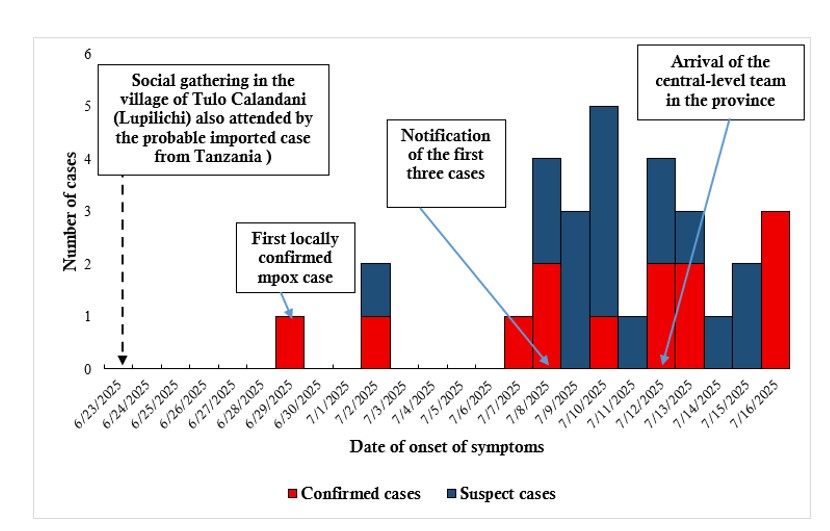
Although the investigation period spanned 8–20 July 2025, the epidemic curve (Figure 1) shows that the earliest cases had symptom onset before the field investigation, with the first case on 29 June. Overall cases occurred from June 29th to July 16th, 2025, peaking on July 10th, coinciding with the confirmation of the first locally confirmed mpox case. All sequenced specimens belonged to a phylogenetic clade Ib MPXV.
Following confirmation, patients were instructed to observe home isolation under the supervision of the District Health Team, which also initiated ring surveillance and monitored 42 contacts for 21 days. By the end of the activities of the first outbreak response team as of July 20th, no new cases were detected, and no additional confirmed mpox cases were identified among the monitored contacts throughout the 21-day follow-up period. No confirmed cases required hospitalisation, and no deaths were reported.
Timeline and chain of transmission
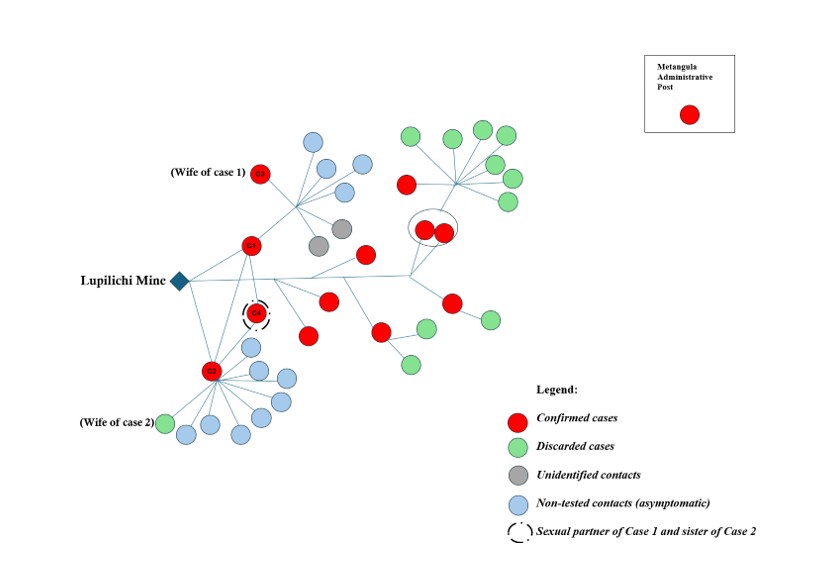
The first locally confirmed mpox case (Case 1), a 25-year-old male truck driver and passenger transporter residing in Metangula, attended a social gathering in Tulo Calandani (Lupilichi). Case 2, a 17-year-old male trader, also attended the event. Three days earlier, a suspected case had arrived from Tanzania to Lupilichi. The initial alert to the Mozambique Ministry of Health occurred on July 8th, and laboratory confirmation was received on July 10th, 2025. The constructed transmission chain revealed a strong epidemiological link between the outbreak and the mining area in Lupilichi: Case 1, Case 2 and their close contacts formed the nucleus of the event. Contact tracing identified the wife of Case 1 and the sexual partner, sister of Case 2, as secondary cases (Figure 2).
The epidemic curve showed that symptoms first appeared between June 29 and July 16, 2025. The first locally confirmed mpox case developed symptoms on June 29, and the highest number of cases that developed symptoms and were subsequently confirmed by laboratory testing occurred on July 16 (Figure 2).
Factors associated with the occurrence of mpox
Statistical analyses showed statistically significant crude associations between mpox infection and age group, nationality, district of residence, and health area (p-value < 0.05). The distribution of confirmed cases differed significantly across these variables, with the highest proportion of confirmed cases observed among individuals aged 20–29 years and among residents of the Cobue Administrative Post and Lupilichi locality (Table 2).
This investigation documents the first confirmed outbreak of mpox in Mozambique, presenting detailed epidemiological characterization and transmission dynamics. Our findings highlight an outbreak scenario distinct from those previously recorded, with important ramifications for public health practice in the country. The high case concentration in Lupilichi, an artisanal mining locality and the strong epidemiological links to mining activities suggest the mining area as the likely epicenter of the outbreak. The concentration of cases in the Lupilichi mining area aligns with findings of an mpox outbreak investigation in the Democratic Republic of the Congo (DRC), which showed that most identified cases (93%) originated from a densely populated mining area in the Kamituga Health Zone, South Kivu Province, eastern DRC [15].
The predominance of Tanzanian nationals among the confirmed mpox cases, which further supports the hypothesis of cross‑border importation. Given the shared border between Mozambique and Tanzania, this finding underscores the importance of strengthening cross-border surveillance through enhanced case detection, investigation, and collaboration to facilitate the early identification and containment of imported mpox cases [12]. Although the overall positivity rate (43.3%) was high, the limited sample size constrains generalization. The cross-sectional design precludes causal inference, and the refusal of HIV testing by several participants limited the assessment of potential coinfection effects. Nevertheless, the integration of field epidemiology, laboratory data, and contact tracing provides descriptive evidence of a localized outbreak likely linked to cross-border mobility. Mining settings are frequently characterized by high population mobility, commercial sex work, and transient labor, creating conditions favorable for infectious disease spread [14].
The documented chain of transmission – involving the wife of Case 1 and the sexual partner of Case 2 – supports interpersonal transmission, including possible sexual transmission, though not definitively established, underscoring the role of intimate relationships in this event. Although the 2022 global outbreak was predominantly among men who have sex with men (MSM), our investigation observed a higher proportion of female cases, likely reflecting the distinct socio-occupational environment (including female sex workers) in this mining context [15].
Due to the small number of confirmed cases, we were unable to adjust for potential confounders. Therefore, the significant associations reported should be interpreted as descriptive statistical findings rather than independent risk factors.
National Recommendations:
Study limitations
This study has several limitations. The small sample size limited statistical power and precluded the use of multivariate models to adjust for confounding, and the reported associations are based on univariable analyses and should be interpreted as unadjusted associations. The cross-sectional design restricts causal interpretation, and incomplete HIV testing reduced the ability to assess comorbidities. In addition, information on exposures was self-reported by suspected cases, which may have introduced recall bias and resulted in misclassification of some epidemiological information. Only symptomatic individuals were tested for mpox, potentially missing asymptomatic or pre-symptomatic infections. Furthermore, restricted access to the mining area, together with the high mobility of individuals working in the Lupilichi mining community, may have limited the completeness of case finding and contact tracing, potentially resulting in underreporting and undetected transmission links.
The first confirmed mpox outbreak in Mozambique was localized in Lago District, with transmission centered in the Lupilichi mining area near the Tanzanian border. The epidemiological evidence points to cross-border introduction and interpersonal transmission, including sexual contact. The predominance of Tanzanian nationals among the confirmed cases further strengthens the hypothesis of cross-border transmission. To prevent re-emergence, Mozambique should strengthen cross-border surveillance, laboratory diagnostic capacity, and health education targeting high-mobility populations and implement vaccination measures in the highest-risk areas. The findings underscore the importance of integrating mpox surveillance into existing systems for viral hemorrhagic fevers and other zoonoses. Future research should include genomic sequencing and longitudinal designs to clarify transmission dynamics and identify risk determinants for mpox in southern Africa.
What is already known about the topic
What this study adds
This study has been supported by the U.S. President’s Emergency Plan for AIDS Relief (PEPFAR) through the Centres for Disease Control and Prevention (CDC) under the terms of NU2GGH002472. The findings and conclusions in this paper are those of the author(s) and do not necessarily represent the official position of the funding agencies.
The authors would like to thank the structures that provided all the technical, scientific and logistical support necessary for this work to be carried out and successfully completed, with special mention to the local team, the Lichinga Public Health Laboratory, the Infection Control Program (ICP) team of the Ministry of Health, Field Epidemiology Training Program and the National Institute of Health and the Ministry of Health.
Conceptualization: Izilda Raúl Matimbe, Erika Valeska Rossetto, Áuria Ribeiro Banze
Data curation: Izilda Raúl Matimbe
Formal analysis: Izilda Raúl Matimbe
Investigation: Izilda Raúl Matimbe, Filipe Mateus Murimirgua, Taiobo Martins Jamal, Loira Machalele, Cremildo Rajabo, Osvaldo Piedade, Banza Wa Banza, Emídio da Cruz Nhatuve, Áuria Ribeiro Banze
Methodology: Izilda Raúl Matimbe, Áuria Ribeiro Banze
Supervision: Filipe Mateus Murimirgua, Denise Chitsondzo Langa, Áuria Ribeiro Banze
Validation: Filipe Mateus Murimirgua, Taiobo Martins Jamal, Loira Machalele, Erika Valeska Rossetto, Denise Chitsondzo Langa, Áuria Ribeiro Banze
Writing – original draft: Izilda Raúl Matimbe, Erika Valeska Rossetto, Áuria Ribeiro Banze
Writing – review & editing: Filipe Mateus Murimirgua, Taiobo Martins Jamal, Loira Machalele, Gavinala Mandala, Cremildo Rajabo, Osvaldo Piedade, Banza Wa Banza, Emídio da Cruz Nhatuve, Erika Valeska Rossetto, Denise Chitsondzo Langa, Áuria Ribeiro Banze
| Characteristics | Suspect case during investigation | p-value¹ | ||
|---|---|---|---|---|
| Total N = 61 (%) | No N = 31 (%) | Yes N = 30 (%) | ||
| Sex | 0.500 | |||
| Female | 35 (57.4) | 19 (54.3) | 16 (45.7) | |
| Male | 26 (42.6) | 12 (46.2) | 14 (53.8) | |
| Age group | N = 59 0.016 | |||
| 0-9 years | 11 (18.6) | 2 (18.2) | 9 (81.8) | |
| 10-19 years | 11 (18.6) | 3 (27.3) | 8 (72.7) | |
| 20-29 years | 23 (39.0) | 14 (60.9) | 9 (39.1) | |
| 30+ years | 14 (23.7) | 10 (71.4) | 4 (28.6) | |
| District | 0.002 | |||
| Cuamba | 7 (11.5) | 0 (0.0) | 7 (100.0) | |
| Lago | 53 (86.9) | 31 (58.5) | 22 (41.5) | |
| Metarica | 1 (1.6) | 0 (0.0) | 1 (100.0) | |
| Contact with suspected/confirmed case of Mpox | <0.001 | |||
| No | 19 (31.1) | 0 (0.0) | 19 (100.0) | |
| Yes | 42 (68.9) | 31 (73.8) | 11 (26.2) | |
| Signs and symptoms | <0.001 | |||
| Contacts not found | 2 (3.3) | 2 (100.0) | 0 (0.0) | |
| No | 29 (47.5) | 29 (100.0) | 0 (0.0) | |
| Yes | 30 (49.2) | 0 (0.0) | 30 (100.0) | |
| Pearson’s Chi-squared test; Fisher’s exact test | ||||
| Characteristics | Case classification | |||
|---|---|---|---|---|
| Total N = 30 (%) | Confirmed N = 13 (%) | Negative N = 17 (%) | p-value | |
| Sex | >0.900 | |||
| Female | 16 (53.3) | 7 (53.8) | 9 (52.9) | |
| Male | 14 (46.7) | 6 (46.2) | 8 (47.1) | |
| Age group | 0.002 | |||
| 0-9 years | 9 (30.0) | 0 (0.0) | 9 (52.9) | |
| 10-19 years | 8 (26.8) | 3 (23.1) | 5 (29.4) | |
| 20-29 years | 9 (30.0) | 7 (53.8) | 2 (11.8) | |
| 30+ years | 4 (13.3) | 3 (23.1) | 1 (5.9) | |
| Nationality | 0.020 | |||
| Mozambican | 21 (70.0) | 6 (46.2) | 15 (88.2) | |
| Tanzanian | 9 (30.0) | 7 (53.8) | 2 (11.8) | |
| District | 0.005 | |||
| Cuamba | 7 (23.3) | 0 (0.0) | 7 (41.2) | |
| Lago | 22 (73.3) | 13 (100.0) | 9 (52.9) | |
| Metarica | 1 (3.3) | 0 (0.0) | 1 (5.9) | |
| Health Area* | 0.018 | |||
| Chia | 1 (3.3) | 0 (0.0) | 1 (5.9) | |
| Cobue | 4 (13.3) | 2 (15.4) | 2 (11.8) | |
| Cuamba | 6 (20.0) | 0 (0.0) | 6 (35.3) | |
| Lupilichi | 10 (33.3) | 8 (61.5) | 2 (11.8) | |
| Metangula | 7 (23.3) | 3 (23.1) | 4 (23.5) | |
| Metarica | 1 (3.3) | 0 (0.0) | 1 (5.9) | |
| Mnapa | 1 (3.3) | 0 (0.0) | 1 (5.9) | |
| Occupation | N = 20 | 0.300 | ||
| Unemployed | 5 (25.0) | 3 (23.1) | 2 (28.6) | |
| Formal employment | 2 (10.0) | 2 (15.4) | 0 (0.0) | |
| Informal employment | 9 (45.0) | 7 (53.8) | 2 (28.6) | |
| Student | 4 (20.0) | 1 (7.7) | 3 (42.9) | |
| Occupational and Exposure Profile | N = 20 | 0.600 | ||
| Farmer/Fisherman | 2 (10.0) | 1 (7.7) | 1 (14.3) | |
| Shopkeeper/balconist | 3 (15.0) | 3 (23.1) | 0 (0.0) | |
| Prospector | 1 (5.0) | 1 (7.7) | 0 (0.0) | |
| Sex worker | 4 (20.0) | 3 (23.1) | 1 (14.3) | |
| Works in the mine/has contact with miners | N = 20 | 0.070 | ||
| No | 11 (55.0) | 5 (38.5) | 6 (85.7) | |
| Yes | 9 (45.0) | 8 (61.5) | 1 (14.3) | |
| International travel history | >0.900 | |||
| No | 28 (93.3) | 12 (92.3) | 16 (94.1) | |
| Yes | 2 (6.7) | 1 (7.7) | 1 (5.9) | |
| Contact with suspected/confirmed cases | 0.300 | |||
| No | 18 (60.0) | 6 (46.2) | 12 (70.6) | |
| Do not know | 1 (3.3) | 1 (7.7) | 0 (0.0) | |
| Yes | 11 (36.7) | 6 (46.2) | 5 (29.4) | |
| Pearson’s Chi-squared test; Fisher’s exact test *Health areas included in the analysis were distributed across the three districts reporting suspected mpox cases as follows: Lago District (Metangula, Lupilichi, Cobue, and Chia), Cuamba District (Cuamba and Mnapa), and Metarica District (Metarica). | ||||