
Research | Open Access | Volume 9 (4): Article 161 | Published: 02 Oct 2026

Views: 45
Menu, Tables and Figures
| Table 1: Characteristics of severe malaria cases and controls, Ola During Children’s Hospital, 2021–2025 | ||||
| Variable | Cases (n=112) n (%) | Controls (n=224) n (%) | cmOR (95% CI) | p-value |
|---|---|---|---|---|
| Age group (matched) | ||||
| <12 months | 48 (42.9) | 96 (42.9) | matched | matched |
| 12–23 months | 43 (38.4) | 86 (38.4) | matched | matched |
| 24–59 months | 21 (18.8) | 42 (18.8) | matched | matched |
| Male sex (matched) | 63 (56.3) | 126 (56.3) | matched | matched |
| Clinical features at admission | ||||
| Coma / Blantyre score ≤2 | 41 (36.6) | 13 (5.8) | 9.6 (4.8–19.2) | <0.001 |
| Multiple convulsions (≥2) | 58 (51.8) | 42 (18.8) | 5.3 (3.1–9.0) | <0.001 |
| Respiratory distress | 38 (33.9) | 29 (12.9) | 3.6 (2.0–6.4) | <0.001 |
| Prostration | 70 (62.5) | 104 (46.4) | 1.9 (1.2–3.1) | 0.006 |
| Jaundice | 19 (17.0) | 14 (6.3) | 3.0 (1.4–6.4) | 0.004 |
| Hyperparasitaemia (≥10%) | 12 (10.7) | 8 (3.6) | 3.2 (1.3–8.1) | 0.013 |
| Laboratory | ||||
| Haemoglobin <5 g/dL | 52 (46.4) | 61 (27.2) | 2.4 (1.5–3.9) | <0.001 |
| Hypoglycaemia (<2.2 mmol/L) | 22 (19.6) | 8 (3.6) | 6.7 (2.8–16.0) | <0.001 |
| Co-morbidities | ||||
| Severe acute malnutrition | 27 (24.1) | 21 (9.4) | 3.1 (1.6–5.8) | <0.001 |
| HIV-positive | 4 (3.6) | 4 (1.8) | 2.0 (0.5–8.2) | 0.33 |
| Care pathway | ||||
| Delay >24 h symptom onset to first formal care | 64 (57.1) | 69 (30.8) | 3.1 (1.9–5.1) | <0.001 |
| No documented pre-ODCH antimalarial treatment | 88 (78.6) | 132 (58.9) | 2.6 (1.6–4.3) | <0.001 |
| >6 h first contact to ODCH admission | 49 (43.8) | 51 (22.8) | 2.7 (1.7–4.4) | <0.001 |
| Provincial residence (>100 km) | 18 (16.1) | 14 (6.3) | 2.9 (1.4–6.0) | 0.005 |
cmOR, crude matched odds ratio from conditional logistic regression;
CI, confidence interval. Matched variables (age band, sex) are shown for descriptive completeness but do not yield independent estimates.
Pre-ODCH antimalarial treatment includes documented rectal or parenteral artesunate, oral artemisinin-based combination therapy, or other antimalarial agent administered before ODCH arrival, including documented self-medication.
Table 1: Characteristics of severe malaria cases and controls, Ola During Children’s Hospital, 2021–2025
| Table 2: Crude and adjusted matched odds ratios for factors associated with in-hospital paediatric malaria mortality, Ola During Children’s Hospital, 2021–2025 | |||
| Variable | Crude amOR (95% CI) | Model A amOR (95% CI) | Model B amOR (95% CI) |
|---|---|---|---|
| Upstream care-pathway variables | |||
| Delay >24 h to first formal care | 3.1 (1.9–5.1) | 4.2 (2.4–7.4) | 5.9 (2.1–16.3) |
| No documented pre-ODCH antimalarial treatment | 2.6 (1.6–4.3) | 3.1 (1.9–5.1) | 4.6 (1.7–12.5) |
| >6 h first contact to ODCH admission | 2.7 (1.7–4.4) | 2.4 (1.4–4.1) | 1.7 (0.7–4.2) |
| Self-presented (vs referred) | 0.4 (0.3–0.7) | 0.6 (0.3–1.0) | 0.7 (0.3–1.6) |
| Admission severity markers | |||
| Coma / Blantyre score ≤2 | 9.6 (4.8–19.2) | – | 12.4 (3.1–49.6) |
| Multiple convulsions (≥2) | 5.3 (3.1–9.0) | – | 9.7 (3.4–27.6) |
| Hypoglycaemia (<2.2 mmol/L) | 6.7 (2.8–16.0) | – | 6.2 (1.8–21.4) |
| Severe anaemia (Hb <5 g/dL) | 2.4 (1.5–3.9) | – | 4.1 (1.9–8.9) |
| Respiratory distress | 3.6 (2.0–6.4) | – | 3.8 (1.6–8.7) |
| Severe acute malnutrition | 3.1 (1.6–5.8) | – | 3.2 (1.4–7.3) |
| Prostration | 1.9 (1.2–3.1) | – | 1.5 (0.7–3.4) |
| Jaundice | 3.0 (1.4–6.4) | – | 1.8 (0.6–5.2) |
| Hyperparasitaemia (≥10%) | 3.2 (1.3–8.1) | – | 1.6 (0.5–5.1) |
| Management variables | |||
| Time to first ODCH artesunate dose >60 min | 1.9 (1.2–3.0) | – | 1.4 (0.7–2.7) |
| Transfusion >4 h among Hb <5 g/dL eligible | 3.5 (1.6–7.6) | – | 2.8 (1.1–7.0) |
amOR, adjusted matched odds ratio from conditional logistic regression;
CI, confidence interval. Model A includes only upstream care-pathway variables.
Model B additionally includes admission severity markers and selected management variables.
– denotes variable not entered into Model A. Adjusted estimates should be interpreted within the prespecified analytic framework rather than as causal effects.
Table 2: Crude and adjusted matched odds ratios for factors associated with in-hospital paediatric malaria mortality, Ola During Children’s Hospital, 2021–2025
| Table 3: Care pathway classification by route of arrival and documented pre-ODCH antimalarial treatment, Ola During Children’s Hospital, 2021–2025 | ||
| Care pathway category | Cases (n=112) n (%) | Controls (n=224) n (%) |
|---|---|---|
| Referred with documented pre-referral antimalarial treatment | 21 (18.8) | 58 (25.9) |
| Referred without documented pre-referral antimalarial treatment | 57 (50.9) | 54 (24.1) |
| Self-presented with documented pre-arrival antimalarial treatment | 3 (2.7) | 34 (15.2) |
| Self-presented without documented pre-arrival antimalarial treatment | 31 (27.7) | 78 (34.8) |
| Total | 112 (100.0) | 224 (100.0) |
ODCH, Ola During Children’s Hospital. Documented pre-ODCH antimalarial treatment includes rectal or parenteral artesunate, artemether–lumefantrine, or any other antimalarial agent recorded in the referral note, the patient-held record, or a credible caregiver history before ODCH arrival, including documented self-medication. Self-presenting children were classified as having no documented pre-arrival treatment unless the medical record or caregiver history documented self-medication or treatment from another provider.
Table 3: Care pathway classification by route of arrival and documented pre-ODCH antimalarial treatment, Ola During Children’s Hospital, 2021–2025
Eric Nzirakaindi Ikoona1,&, Lucy Namulemo2, Mary Magdelene Sinnah1, Mohammad Alex Vandi1, Foday Sahr1
1National Public Health Agency, Freetown, Sierra Leone, 2Lindsey Wilson University, School of Professional Counselling, Columbia, Kentucky, United States of America
&Corresponding author: Eric Nzirakaindi Ikoona, National Public Health Agency, Freetown, Sierra Leone, Email: ikoonae@yahoo.com ORCID: https://orcid.org/0000-0003-3402-1961
Received: 26 Mar 2026, Accepted: 01 Oct 2026, Published: 02 Oct 2026
Domain: Infectious Disease Epidemiology
Keywords: Severe malaria, paediatric mortality, case–control study, Sierra Leone, pre-referral artesunate
©Eric Nzirakaindi Ikoona et al. Journal of Interventional Epidemiology and Public Health (ISSN: 2664-2824). This is an Open Access article distributed under the terms of the Creative Commons Attribution International 4.0 License (https://creativecommons.org/licenses/by/4.0/), which permits unrestricted use, distribution, and reproduction in any medium, provided the original work is properly cited.
Cite this article: Eric Nzirakaindi Ikoona et al., Factors associated with in-hospital paediatric malaria mortality at Ola During Children’s Hospital, Sierra Leone, 2021–2025: A matched case–control study. Journal of Interventional Epidemiology and Public Health. 2026; 9(4):161. https://doi.org/10.37432/jieph-d-26-00130
Introduction: Sierra Leone has a high paediatric malaria burden. We examined factors associated with in-hospital mortality among children under five with severe malaria at Ola During Children’s Hospital (ODCH), the national tertiary paediatric referral centre.
Methods: We conducted an age- and sex-matched 1:2 case–control study using routine records of children aged ≤59 months admitted to ODCH between 2021 and 2025 with World Health Organisation-defined severe P. falciparum malaria. Cases (n=112) were in-hospital deaths and controls (n=224) were matched survivors. Conditional logistic regression was applied in two prespecified models: a care-pathway model (Model A) and a fully adjusted model adding admission severity markers (Model B).
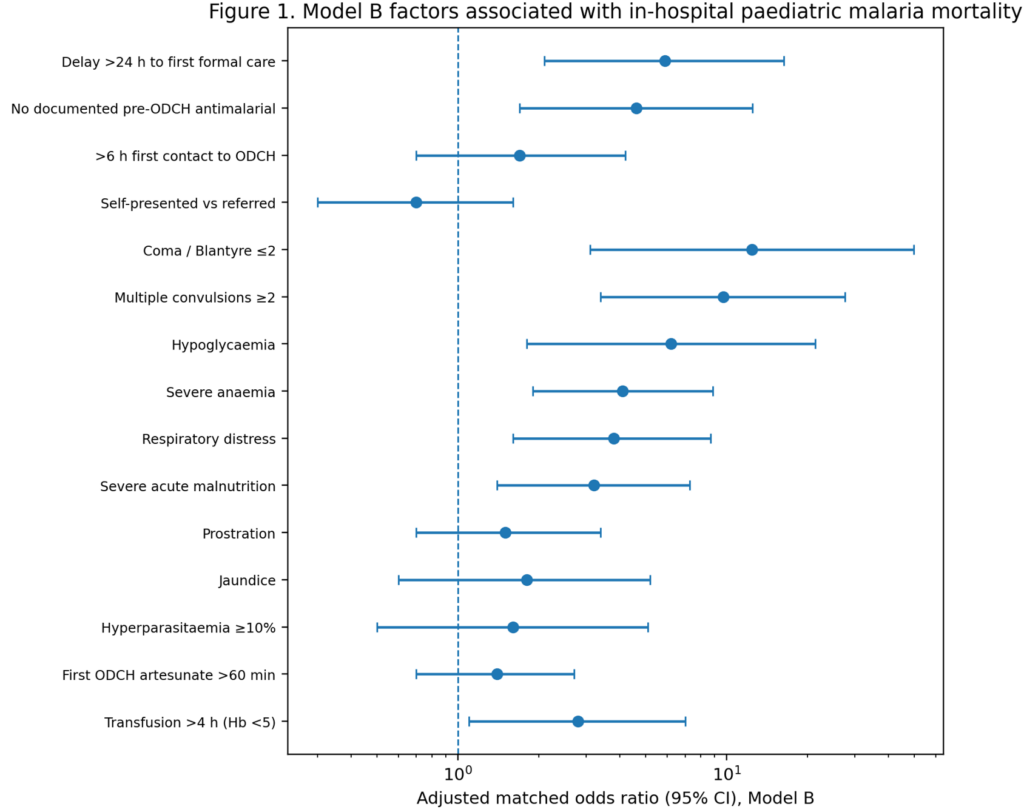
Results: In Model B, mortality was associated with coma or Blantyre score ≤2 (adjusted matched odds ratio [amOR] 12.4; 95% confidence interval [CI]: 3.1–49.6), multiple convulsions (9.7; 95%CI: 3.4–27.6), hypoglycaemia (6.2; 95%CI: 1.8–21.4), severe anaemia (4.1; 95%CI: 1.9–8.9), respiratory distress (3.8; 95%CI: 1.6–8.7), severe acute malnutrition (3.2; 95%CI: 1.4–7.3), delay >24 hours to first formal care (5.9; 95%CI: 2.1–16.3), and absence of documented pre-ODCH antimalarial treatment (4.6; 95%CI: 1.7–12.5). Care-pathway associations remained after adjustment for severity.
Conclusion: In-hospital paediatric malaria mortality at ODCH was associated with advanced clinical severity, including severe acute malnutrition, and referral-pathway gaps. Mortality reduction requires earlier danger-sign recognition, appropriate pre-referral artesunate, and rapid correction of coma, hypoglycaemia, anaemia and respiratory distress.
Malaria remains a leading cause of childhood death in sub-Saharan Africa. The most recent World Health Organization (WHO) World Malaria Report 2025 confirms that the African Region continues to account for the overwhelming majority of global malaria cases and deaths, with children under five bearing a disproportionate share of mortality [1]. Despite scale-up of insecticide-treated nets, rapid diagnostic tests and artemisinin-based combination therapy, in-hospital case-fatality among children admitted with severe disease has remained substantial across the region, with pooled mortality of 8–11% in large multi-country paediatric cohorts [2].
Sierra Leone is holoendemic for Plasmodium falciparum, with transmission peaking during the long rainy season from May to October. The 2021 Sierra Leone Malaria Indicator Survey estimated parasite prevalence among children 6–59 months at approximately 22% nationally [3]. Recent analyses from Port Loko Government Hospital attributed 37.6% of admissions to malaria, with a case-fatality of 17.6% [4]. The National Malaria Control Programme (NMCP) Strategic Plan 2021–2025 aimed to reduce malaria mortality through long-lasting insecticidal net distribution, perennial malaria chemoprevention in infants, community case management by community health workers, and parenteral artesunate at the referral level [5–7].
Severe malaria is defined by WHO as parasitologically confirmed P. falciparum infection accompanied by one or more features of vital-organ dysfunction [8–10]. In African paediatric cohorts, altered consciousness, acidosis and severe anaemia have consistently been identified as the dominant clinical predictors of death [2,11,12].
Ola During Children’s Hospital (ODCH) in Freetown is Sierra Leone’s main tertiary paediatric referral facility. A recent operational analysis reported that, among 735 children under five admitted in 2024 with suspected severe malaria, approximately 10% had unfavourable hospital exit outcomes; underweight status, multiple convulsions and incorrect artesunate dosing were associated with these outcomes [13]. Persistent facility-level case-fatality, against a backdrop of broadly successful national-level malaria control [6,7], suggests that drivers of death at the referral level are not adequately addressed by community-level interventions alone.
Previous regional studies have identified coma, severe anaemia, hypoglycaemia, acidosis and delayed presentation as recurrent correlates of paediatric malaria death [10–16], but the Sierra Leonean literature has focused mainly on prevalence, programmatic coverage, caregiver knowledge and adherence, or aggregate facility outcomes [4,13–15] rather than on a dedicated case–control assessment of in-hospital mortality. To our knowledge, no matched case–control study focused on fatal paediatric malaria has been published from ODCH. We therefore examined clinical, laboratory, nutritional and care-pathway factors associated with in-hospital death among children under five admitted with WHO-defined severe P. falciparum malaria at ODCH from 2021 to 2025.
Study design and setting
We conducted a facility-based, retrospective, age- and sex-matched 1:2 case–control study using routinely collected records of children admitted to ODCH between 1 January 2021 and 31 December 2025. ODCH is a 300-bed tertiary paediatric teaching hospital affiliated with the College of Medicine and Allied Health Sciences, University of Sierra Leone, functioning as the national referral centre for paediatric care. Severe paediatric malaria at ODCH is confirmed by rapid diagnostic test and/or microscopy and managed with intravenous artesunate, supportive care and transfusion where indicated, in accordance with national guidelines aligned to WHO recommendations [6,8,10]. Reporting follows the Strengthening the Reporting of Observational Studies in Epidemiology (STROBE) guidance for case–control studies.
Study population and eligibility
The source population comprised all children aged ≤59 months admitted to ODCH during the five-year study period with a laboratory-confirmed diagnosis of P. falciparum malaria meeting at least one WHO criterion for severe disease. Children with mixed infections involving non-falciparum species, those referred for pre-existing haemato-oncological conditions, and those transferred out of ODCH before outcome determination were excluded. Children whose records lacked a documented admission outcome, danger sign documentation, or baseline haemoglobin were also excluded.
Case and control definitions
Case: a child aged ≤59 months admitted to ODCH between 1 January 2021 and 31 December 2025 with WHO-defined severe P. falciparum malaria who died during the same hospitalisation, regardless of length of stay.
Control: a child aged ≤59 months admitted to ODCH during the same period with WHO-defined severe P. falciparum malaria who survived to discharge.
Sample size and matching
We enumerated all eligible paediatric severe malaria deaths from the hospital mortality register, cross-checked against ward admission registers and medical records. Of 151 candidate deaths, 112 had records sufficiently complete for inclusion as cases. Using the Fleiss formula with continuity correction for matched designs, assuming 80% power, α=0.05, an exposure prevalence of 26% among controls (severe anaemia, based on regional estimates) [16], and a target matched odds ratio of 2.0, we calculated a minimum requirement of 99 cases and 198 controls; the final sample (112 cases; 224 controls) exceeded this threshold.
For each case, two controls were selected from the same study period and matched on age band (<12, 12–23 and 24–59 months) and sex. Within each matched stratum, controls were drawn by simple random sampling without replacement from the pool of admitted survivors meeting the severe malaria definition, using a computer-generated random number sequence in Stata. Age and sex were chosen as matching variables because of the strong age-dependence of paediatric malaria severity [2,9,17].
Data sources and abstraction
Two trained clinical research assistants, supervised by a paediatrician and a field epidemiologist, abstracted data from paper case files and the hospital electronic admission register using a standardized, piloted form. Variables included demographics, care-seeking history (time from symptom onset to first formal contact; time from first contact to ODCH admission; route of arrival; pre-ODCH treatment received), admission clinical features (Blantyre coma score, convulsions and their number, prostration, respiratory pattern, jaundice, mid-upper arm circumference), laboratory values (haemoglobin, blood glucose, parasite density, HIV test result), and management (timing of first parenteral artesunate dose, transfusion, length of stay, documented outcome). Quality control comprised daily review of 10% of completed forms against source documents, with discrepancies resolved by the supervising paediatrician. Record abstraction was completed on 28 February 2026 after closure and reconciliation of the 2025 admission, mortality and ward registers. All records through 31 December 2025 were therefore eligible for capture without a documentation-lag exclusion.
Variable definitions
Severe malaria was defined using WHO criteria [8,10]. Delay in care-seeking was time >24 hours from caregiver-reported symptom onset to first contact with a formally trained provider. Severe anaemia was haemoglobin <5 g/dL, hypoglycaemia was blood glucose <2.2 mmol/L, coma was Blantyre coma score ≤2, and severe acute malnutrition was mid-upper arm circumference <11.5 cm or a documented clinical diagnosis. Multiple convulsions were two or more witnessed convulsions in the 24 hours preceding admission. Hyperparasitaemia was parasite density ≥10%. Time to first ODCH artesunate dose was the interval from emergency unit registration to administration of the first parenteral artesunate dose. Transfusion delay among eligible children was initiation of transfusion later than four hours after admission in a child with haemoglobin <5 g/dL.
The principal treatment-pathway exposure was absence of documented pre-ODCH antimalarial treatment, defined as absence in the medical record of rectal artesunate, intramuscular or intravenous artesunate, artemether–lumefantrine, or any other antimalarial agent administered before arrival at ODCH. Children were classified as having documented pre-ODCH treatment only if a referral note, the patient-held record, or a credible caregiver history specified the agent and route of administration before ODCH arrival, including credible documentation of self-medication. Because self-presenting children had no peripheral referral event, they were classified as having no documented pre-ODCH treatment unless the clinical history or patient-held record documented self-medication or treatment from another provider. Route of arrival (referred versus self-presented) was retained as a separate variable to allow restricted analyses of referred children only. Exact clock time of pre-ODCH antimalarial administration was not recorded consistently enough to support a valid interval analysis; where an agent was documented, the analysis therefore classified receipt before ODCH arrival but did not estimate time from administration to referral or admission.
Statistical analysis
Data were double-entered into a REDCap database hosted at the National Public Health Agency and analysed in Stata version 17.0 (StataCorp, College Station, Texas, USA). Categorical variables were summarized as frequencies and percentages and continuous variables as medians with interquartile range. Bivariable comparisons used conditional logistic regression to respect the matching structure.
For multivariable analysis we prespecified two conditional logistic regression models grounded in a clinical framework that distinguishes upstream care-pathway exposures from admission severity markers. Model A included only upstream care-seeking and treatment-pathway variables: delay >24 hours from symptom onset to first formal care, route of arrival, absence of documented pre-ODCH antimalarial treatment, and time from first formal contact to ODCH admission. Model B added admission severity markers (coma or Blantyre score ≤2, multiple convulsions, hypoglycaemia, severe anaemia, respiratory distress, severe acute malnutrition) and selected management variables (time to first ODCH artesunate dose; transfusion within four hours among children with haemoglobin <5 g/dL). Variables were retained in both models on conceptual grounds rather than by automated stepwise selection. Adjusted matched odds ratios (amOR) with 95% confidence intervals are reported.
Because admission severity markers may lie on the causal pathway between delayed care and death, adjusted estimates for care-seeking and pre-arrival treatment variables in Model B should be interpreted as associations conditional on severity at presentation, not as total causal effects. A prespecified sensitivity analysis was conducted on the subset of referred children, in which the principal exposure was redefined as referral without documented pre-referral artesunate. Multicollinearity was assessed using variance inflation factors. Missing data were <5% for retained variables and handled by complete-case analysis; a parallel sensitivity analysis using multiple imputation by chained equations (m=20) produced consistent estimates. A further sensitivity analysis adjusted for admission year and rainy versus dry season. The retained variables with the greatest item-level missingness were admission blood glucose (16/336; 4.8%), baseline haemoglobin (13/336; 3.9%), and MUAC/nutritional assessment (12/336; 3.6%); missingness for other retained variables was <3% (Supplementary Table S2). The pattern was considered compatible with a missing-at-random assumption for multiple imputation. The imputation model included outcome, matching variables and variables entered in the multivariable models; estimates from the 20 imputed datasets were similar in direction and magnitude to complete-case estimates. Because coma and hypoglycaemia were uncommon among controls, a penalized-likelihood sensitivity analysis was additionally used to assess sparse-data bias. Model B discrimination was summarized using the c-statistic.
Ethical considerations
This study was conducted as part of public health emergency response activities under the authority of Sierra Leone’s National Public Health Agency. The Sierra Leone Ethics and Scientific Review Committee determined that the study constituted routine surveillance and outbreak response and was therefore exempt from individual informed-consent requirements. All data were analysed in de-identified form.
Source population and study flow
During the five-year study period, 11,684 children aged ≤59 months were admitted to ODCH with a malaria-related International Classification of Diseases, 10th Revision (ICD-10) code, of whom 2,137 (18.3%) met WHO criteria for severe P. falciparum malaria. A total of 151 in-hospital deaths attributable to severe malaria were registered; 112 (74.2%) had records sufficiently complete for inclusion as cases. The remaining 39 (25.8%) registered deaths were excluded because they lacked one or more of the predefined inclusion variables: documented admission outcome, danger-sign documentation, or baseline haemoglobin. The in-hospital case-fatality ratio among children admitted with severe malaria was 7.1% (151/2,137). Two hundred and twenty-four matched controls were randomly selected from the pool of 1,986 surviving severe malaria admissions. Available register variables for the 39 excluded deaths were compared with those of the 112 included deaths. By year, included versus excluded deaths were 19 versus 7 in 2021, 22 versus 7 in 2022, 21 versus 10 in 2023, 24 versus 8 in 2024, and 26 versus 7 in 2025. The year distributions did not differ significantly (χ²[4]=1.11, p=0.893). Referral from a peripheral facility was recorded for 78/112 (69.6%) included deaths and 26/39 (66.7%) excluded deaths; 34/112 (30.4%) and 13/39 (33.3%), respectively, self-presented (Fisher’s exact p=0.841). (Supplementary Table S1).
Characteristics of cases and controls
By design, cases and controls were similar in age and sex distribution: 144 (42.9%) were aged <12 months, 129 (38.4%) were 12–23 months and 63 (18.8%) were 24–59 months. Boys accounted for 56.3% of both groups. Residence in Western Area Urban was documented for 71 (63.4%) of cases and 158 (70.5%) of controls; 18 (16.1%) of cases and 14 (6.3%) of controls originated from provincial districts more than 100 km from Freetown. Median household distance to ODCH was 6.4 km (interquartile range 3.2–18.5) for cases and 4.8 km (interquartile range 2.1–9.3) for controls.
Admission clinical, laboratory and nutritional features differed between cases and controls; full descriptive frequencies are presented in Table 1. The most marked between-group differences were in coma or Blantyre score ≤2 (36.6% of cases versus 5.8% of controls), multiple convulsions (51.8% versus 18.8%), hypoglycaemia (19.6% versus 3.6%), respiratory distress (33.9% versus 12.9%), severe anaemia (46.4% versus 27.2%), and severe acute malnutrition (24.1% versus 9.4%).
Care pathway and treatment
Care-seeking and treatment-pathway characteristics also differed (Table 1; care-pathway classification in Table 3). Delay >24 hours between symptom onset and first formal care was reported in 64 (57.1%) of cases and 69 (30.8%) of controls. Referral from a peripheral facility was documented for 78 (69.6%) of cases and 112 (50.0%) of controls; the remaining children self-presented to ODCH. Documented pre-ODCH antimalarial treatment was recorded for 24 (21.4%) of cases and 92 (41.1%) of controls. Among the 78 referred cases, 21 (26.9%) had a documented pre-referral artesunate dose, compared with 58 (51.8%) of the 112 referred controls. Time from first health contact to ODCH admission exceeded six hours in 49 (43.8%) of cases and 51 (22.8%) of controls. Median time from ODCH admission to first parenteral artesunate dose was 58 minutes (interquartile range 35–98) for cases and 42 minutes (interquartile range 22–72) for controls. Among children with haemoglobin <5 g/dL, transfusion was initiated within four hours of admission in 24 (46.2%) of 52 cases and 46 (75.4%) of 61 controls. Among children with haemoglobin <5 g/dL, 28/52 (53.8%) cases versus 15/61 (24.6%) controls had transfusion initiated >4 hours after admission; conversely, 24/52 (46.2%) cases and 46/61 (75.4%) controls were transfused within four hours. The transfusion-timing variable was prespecified as a management variable in Model B. Among the 79 referred children with documented pre-referral artesunate, exact administration time was available for 46 (58.2%) and unavailable for 33 (41.8%); the timing variable was therefore not entered as an independent exposure in the regression models.
Factors associated with in-hospital mortality
Crude and adjusted matched odds ratios are presented in Table 2. In Model A (care-pathway only), delay >24 hours to first formal care (amOR 4.2; 95% CI 2.4–7.4), absence of documented pre-ODCH antimalarial treatment (amOR 3.1; 95% CI 1.9–5.1), and >6 hours from first contact to ODCH admission (amOR 2.4; 95% CI 1.4–4.1) were associated with mortality. In Model B (fully adjusted), eight variables remained associated with death. The strongest association was with coma or Blantyre score ≤2 on admission (amOR 12.4; 95% CI 3.1–49.6), followed by multiple convulsions (amOR 9.7; 95% CI 3.4–27.6). Hypoglycaemia carried an adjusted matched odds ratio of 6.2 (95% CI 1.8–21.4); severe anaemia, 4.1 (95% CI 1.9–8.9); respiratory distress, 3.8 (95% CI 1.6–8.7); and severe acute malnutrition, 3.2 (95% CI 1.4–7.3). Two upstream care-pathway variables retained statistical significance after adjustment for admission severity: delay >24 hours to first formal care (amOR 5.9; 95% CI 2.1–16.3) and absence of documented pre-ODCH antimalarial treatment (amOR 4.6; 95% CI 1.7–12.5). Hyperparasitaemia, jaundice, prostration in isolation, residence in a provincial district, and time to first ODCH artesunate dose did not retain statistical significance after adjustment.
In the prespecified subgroup analysis restricted to referred children (n=190), referral without documented pre-referral artesunate was associated with death (amOR 4.0; 95% CI 1.5–10.7). Sensitivity analyses adjusting for admission year and for rainy versus dry season did not materially change the point estimates. The fully adjusted model showed acceptable fit (conditional likelihood ratio χ²=98.4, p<0.001) without problematic collinearity (variance inflation factor <3 for all retained variables). Penalized-likelihood sensitivity estimates were 10.8 (95% CI 2.9–40.7) for coma/Blantyre score ≤2 and 5.7 (95% CI 1.7–19.3) for hypoglycaemia. The c-statistic for Model B was 0.86 (95% CI 0.82–0.90).
Principal findings
In this matched case–control study of 336 children under five admitted with WHO-defined severe malaria to Sierra Leone’s national tertiary paediatric referral facility, in-hospital death was associated with a coherent set of admission severity markers and upstream care-pathway factors. Coma, multiple convulsions, hypoglycaemia, severe anaemia, respiratory distress and severe acute malnutrition dominated the admission severity profile of fatal cases, while delay >24 hours to first formal care and absence of documented pre-ODCH antimalarial treatment were the principal upstream correlates. The persistence of these care-pathway associations after adjustment for admission severity suggests that upstream gaps may contribute information beyond measured clinical severity at presentation, although causality cannot be inferred from this retrospective design.
Interpretation of admission severity markers
The association between coma and death is consistent in direction with earlier work from Uganda, Rwanda and the multi-country AQUAMAT trial, which have identified altered consciousness as the strongest single prognostic marker in paediatric severe malaria [2,11,16,17]. The independent contribution of multiple convulsions reflects a subgroup in whom cerebral involvement is underway but not yet fully expressed as Blantyre score ≤2; operationally, a child with two or more convulsions in the preceding 24 hours warrants the same triage urgency as a child already in coma [18,19]. Hypoglycaemia is well established in the physiology of severe malaria but frequently under-recognised at admission [9]. Point-of-care glucometry is inexpensive and widely available, supporting routine capillary glucose measurement as a mandatory component of triage for any child with suspected severe malaria, both at ODCH and at referring facilities.
Severe anaemia retained a more than fourfold adjusted association with death even after accounting for other severity markers; mortality is mediated through tissue hypoxia and compensatory cardiac demand [20]. Consistent with this, only 46% of fatal cases with haemoglobin <5 g/dL received transfusion within four hours of admission, compared with 75% of controls. Delays in cross-matching, limited paediatric-specific transfusion protocols, and reliance on family-member donors all contribute. A dedicated paediatric transfusion pathway with pre-positioned packed red cells for emergency use, informed by TRACT trial evidence on immediate transfusion and optimal volumes in African children, is a feasible next step [21,22]. Severe acute malnutrition as an independent correlate aligns with CHAMPS Network surveillance from Sierra Leone, which attributed 42.9% of post-neonatal 1–59-month deaths to malaria in the causal chain, with synergistic bacterial co-infection in a substantial fraction [23]. The Kamara analysis at ODCH similarly found underweight status associated with unfavourable outcomes [13]. Under-five malaria admissions are a logical entry point for integrated nutritional assessment and therapeutic feeding.
Interpretation of care-pathway factors
The two upstream care-pathway variables that retained statistical significance, delay >24 hours to first formal care and absence of documented pre-ODCH antimalarial treatment, are particularly important because they intervene before features that are very difficult to reverse by the time of ODCH admission. The Sierra Leonean community health worker cadre is the principal entry point for paediatric illness in much of the country [5,6], and earlier Sierra Leonean work has documented limited caregiver knowledge of malaria danger signs [14] and persistent gaps in adherence to the full treatment pathway [4,13,15]. Comparable gaps in pre-referral artesunate uptake and referral completion have been described from the CARAMAL study in the Democratic Republic of the Congo, Nigeria and Uganda [24,25]. The almost fivefold adjusted association observed here is consistent with placebo-controlled trial evidence that a single rectal artesunate dose reduces mortality in children unable to reach a referral facility within six hours [26]. Self-presenting children, who by definition had no peripheral referral event, were classified as having no documented pre-ODCH antimalarial treatment unless the medical record or caregiver history documented self-medication or pre-arrival treatment from another provider; this convention is conservative and is likely to bias the principal exposure estimate toward the null where undocumented self-medication occurred. Interpretation of the pre-ODCH exposure requires particular caution. Receipt of an antimalarial before ODCH was not randomized and may be affected by confounding by indication: children recognized as more severely ill may have been more likely to receive an intervention, while children with rapidly progressive illness, poor access, stock-outs, or very short contact-to-transfer intervals may have had less opportunity to receive one. In addition, the composite exposure combines referred children, for whom a formal pre-referral intervention opportunity existed, with self-presenting children, for whom no peripheral referral event necessarily occurred. We therefore regard the referred-only analysis as the more specific test of the pre-referral pathway; the main composite exposure is retained to describe the complete pre-arrival pathway and should not be interpreted as a causal treatment effect.
Implications for ODCH and the National Malaria Control Programme
These findings translate into priorities at four levels. At community level, sustained reinforcement of caregiver and community health worker recognition of paediatric danger signs (persistent fever beyond 24 hours, multiple convulsions, deep breathing and pallor) is needed. At peripheral facility level, reliable stock and documented administration of pre-referral artesunate before transfer, with a structured referral note recording agent, route and time, is essential. At tertiary level, ODCH triage should incorporate routine point-of-care glucose testing, prompt parenteral artesunate, an emergency paediatric transfusion pathway, and routine nutritional assessment. At programmatic level, in-hospital paediatric severe malaria case-fatality is a relevant indicator for Sierra Leone’s ongoing development of the 2026–2030 National Strategic Plan for malaria, formally launched in November 2025 [27].
Strengths
Strengths of this analysis include a five-year enrolment window covering the full post-COVID period, a 1:2 age- and sex-matched design, standardized data abstraction with a quality-assurance subsample, systematic random control selection from a large pool of eligible survivors, and a prespecified two-model analytic framework that separates upstream care-pathway exposures from admission severity markers without reliance on automated variable selection.
Limitations
Several limitations should be considered. First, the study used routinely collected clinical records, which are subject to documentation gaps and to misclassification of exposures such as time to first formal care and pre-arrival treatment; misclassification of pre-ODCH treatment is likely to be non-differential and would bias the principal exposure estimate toward the null. Second, 39 of 151 registered deaths (25.8%) were excluded because of incomplete records. Available year-of-death and route-of-arrival distributions did not differ significantly between included and excluded deaths; nevertheless, selection on unmeasured severity or documentation-related characteristics cannot be excluded. Third, admission severity markers may lie on the causal pathway between delayed care and death; adjusted care-pathway estimates in Model B should therefore be interpreted as associations conditional on severity rather than total causal effects. Fourth, several variables of clinical relevance were inconsistently available in the record, including bedside lactate, blood culture, cerebrospinal fluid findings, socioeconomic status, maternal education and transport barriers; residual confounding cannot be excluded. Fifth, as a single-centre study at a tertiary referral facility, findings generalize to the tertiary-referred population but not to children managed only at peripheral level. Sixth, documentation of pre-arrival self-medication may be incomplete, so some self-presenting children classified as having no documented treatment may have received undocumented antimalarials. Finally, wide confidence intervals around the estimates for coma and hypoglycaemia reflect the relative sparseness of these features among controls. Where register data are available, comparison of included and excluded deaths by year and route of arrival should be used to assess the direction of this potential selection. The validity of multiple imputation depends on the MAR assumption; MNAR related to undocumented terminal severity remains possible. Exact timing of pre-referral artesunate/other antimalarial administration was also not consistently available, limiting assessment of whether the intervention occurred sufficiently early to alter the referral trajectory. Finally, sparse control-group counts for coma and hypoglycaemia produced wide confidence intervals; although the prespecified conditional model converged without separation, these point estimates should be interpreted as imprecise. Exact administration time for the pre-referral intervention was incompletely documented, precluding a reliable analysis of the interval between pre-referral artesunate and ODCH arrival.
In-hospital paediatric malaria mortality at Ola During Children’s Hospital was associated with advanced neurological involvement, hypoglycaemia, severe anaemia, respiratory distress, severe acute malnutrition, delayed first formal care, and absence of a documented pre-ODCH antimalarial intervention. Mortality reduction in this setting will require both earlier care entry and stronger referral-level readiness: reliable pre-referral interventions and documentation, rapid triage glucose testing, timely parenteral artesunate, emergency paediatric transfusion access, and integrated nutritional screening. These findings provide actionable priorities for ODCH quality improvement and for Sierra Leone’s post-2025 malaria control strategy.
What is already known about the topic
What this study adds
We thank the administration of Ola During Children’s Hospital and the paediatric ward nursing and clinical teams for facilitating access to records and for clarifying clinical ambiguities. We acknowledge the Sierra Leone National Malaria Control Programme and the National Public Health Agency for programmatic context and for reviewing the manuscript before submission.
Conceptualization: Eric Nzirakaindi Ikoona
Data curation: Eric Nzirakaindi Ikoona, Lucy Namulemo
Formal analysis: Eric Nzirakaindi Ikoona, Lucy Namulemo, Mary Magdalene Sinnah, Mohamed Alex Vandi
Investigation: Eric Nzirakaindi Ikoona, Lucy Namulemo, Mary Magdalene Sinnah
Methodology: Eric Nzirakaindi Ikoona, Lucy Namulemo, Mohamed Alex Vandi
Project administration: Eric Nzirakaindi Ikoona, Lucy Namulemo, Mary Magdalene Sinnah, Foday Nzirakaindi Sahr
Resources: Eric Nzirakaindi Ikoona, Lucy Namulemo
Software: Eric Nzirakaindi Ikoona
Supervision: Eric Nzirakaindi Ikoona, Lucy Namulemo, Mary Magdalene Sinnah, Mohamed Alex Vandi, Foday Nzirakaindi Sahr
Validation: Eric Nzirakaindi Ikoona, Lucy Namulemo, Foday Nzirakaindi Sahr
Visualization: Eric Nzirakaindi Ikoona, Lucy Namulemo
Writing – original draft: Eric Nzirakaindi Ikoona
Writing – review & editing: Eric Nzirakaindi Ikoona, Lucy Namulemo, Mary Magdalene Sinnah, Mohamed Alex Vandi
| Table 1: Characteristics of severe malaria cases and controls, Ola During Children’s Hospital, 2021–2025 | ||||
| Variable | Cases (n=112) n (%) | Controls (n=224) n (%) | cmOR (95% CI) | p-value |
|---|---|---|---|---|
| Age group (matched) | ||||
| <12 months | 48 (42.9) | 96 (42.9) | matched | matched |
| 12–23 months | 43 (38.4) | 86 (38.4) | matched | matched |
| 24–59 months | 21 (18.8) | 42 (18.8) | matched | matched |
| Male sex (matched) | 63 (56.3) | 126 (56.3) | matched | matched |
| Clinical features at admission | ||||
| Coma / Blantyre score ≤2 | 41 (36.6) | 13 (5.8) | 9.6 (4.8–19.2) | <0.001 |
| Multiple convulsions (≥2) | 58 (51.8) | 42 (18.8) | 5.3 (3.1–9.0) | <0.001 |
| Respiratory distress | 38 (33.9) | 29 (12.9) | 3.6 (2.0–6.4) | <0.001 |
| Prostration | 70 (62.5) | 104 (46.4) | 1.9 (1.2–3.1) | 0.006 |
| Jaundice | 19 (17.0) | 14 (6.3) | 3.0 (1.4–6.4) | 0.004 |
| Hyperparasitaemia (≥10%) | 12 (10.7) | 8 (3.6) | 3.2 (1.3–8.1) | 0.013 |
| Laboratory | ||||
| Haemoglobin <5 g/dL | 52 (46.4) | 61 (27.2) | 2.4 (1.5–3.9) | <0.001 |
| Hypoglycaemia (<2.2 mmol/L) | 22 (19.6) | 8 (3.6) | 6.7 (2.8–16.0) | <0.001 |
| Co-morbidities | ||||
| Severe acute malnutrition | 27 (24.1) | 21 (9.4) | 3.1 (1.6–5.8) | <0.001 |
| HIV-positive | 4 (3.6) | 4 (1.8) | 2.0 (0.5–8.2) | 0.33 |
| Care pathway | ||||
| Delay >24 h symptom onset to first formal care | 64 (57.1) | 69 (30.8) | 3.1 (1.9–5.1) | <0.001 |
| No documented pre-ODCH antimalarial treatment | 88 (78.6) | 132 (58.9) | 2.6 (1.6–4.3) | <0.001 |
| >6 h first contact to ODCH admission | 49 (43.8) | 51 (22.8) | 2.7 (1.7–4.4) | <0.001 |
| Provincial residence (>100 km) | 18 (16.1) | 14 (6.3) | 2.9 (1.4–6.0) | 0.005 |
cmOR, crude matched odds ratio from conditional logistic regression;
CI, confidence interval. Matched variables (age band, sex) are shown for descriptive completeness but do not yield independent estimates.
Pre-ODCH antimalarial treatment includes documented rectal or parenteral artesunate, oral artemisinin-based combination therapy, or other antimalarial agent administered before ODCH arrival, including documented self-medication.
| Table 2: Crude and adjusted matched odds ratios for factors associated with in-hospital paediatric malaria mortality, Ola During Children’s Hospital, 2021–2025 | |||
| Variable | Crude amOR (95% CI) | Model A amOR (95% CI) | Model B amOR (95% CI) |
|---|---|---|---|
| Upstream care-pathway variables | |||
| Delay >24 h to first formal care | 3.1 (1.9–5.1) | 4.2 (2.4–7.4) | 5.9 (2.1–16.3) |
| No documented pre-ODCH antimalarial treatment | 2.6 (1.6–4.3) | 3.1 (1.9–5.1) | 4.6 (1.7–12.5) |
| >6 h first contact to ODCH admission | 2.7 (1.7–4.4) | 2.4 (1.4–4.1) | 1.7 (0.7–4.2) |
| Self-presented (vs referred) | 0.4 (0.3–0.7) | 0.6 (0.3–1.0) | 0.7 (0.3–1.6) |
| Admission severity markers | |||
| Coma / Blantyre score ≤2 | 9.6 (4.8–19.2) | – | 12.4 (3.1–49.6) |
| Multiple convulsions (≥2) | 5.3 (3.1–9.0) | – | 9.7 (3.4–27.6) |
| Hypoglycaemia (<2.2 mmol/L) | 6.7 (2.8–16.0) | – | 6.2 (1.8–21.4) |
| Severe anaemia (Hb <5 g/dL) | 2.4 (1.5–3.9) | – | 4.1 (1.9–8.9) |
| Respiratory distress | 3.6 (2.0–6.4) | – | 3.8 (1.6–8.7) |
| Severe acute malnutrition | 3.1 (1.6–5.8) | – | 3.2 (1.4–7.3) |
| Prostration | 1.9 (1.2–3.1) | – | 1.5 (0.7–3.4) |
| Jaundice | 3.0 (1.4–6.4) | – | 1.8 (0.6–5.2) |
| Hyperparasitaemia (≥10%) | 3.2 (1.3–8.1) | – | 1.6 (0.5–5.1) |
| Management variables | |||
| Time to first ODCH artesunate dose >60 min | 1.9 (1.2–3.0) | – | 1.4 (0.7–2.7) |
| Transfusion >4 h among Hb <5 g/dL eligible | 3.5 (1.6–7.6) | – | 2.8 (1.1–7.0) |
amOR, adjusted matched odds ratio from conditional logistic regression; CI, confidence interval. Model A includes only upstream care-pathway variables. Model B additionally includes admission severity markers and selected management variables. – denotes variable not entered into Model A. Adjusted estimates should be interpreted within the prespecified analytic framework rather than as causal effects.
| Table 3: Care pathway classification by route of arrival and documented pre-ODCH antimalarial treatment, Ola During Children’s Hospital, 2021–2025 | ||
| Care pathway category | Cases (n=112) n (%) | Controls (n=224) n (%) |
|---|---|---|
| Referred with documented pre-referral antimalarial treatment | 21 (18.8) | 58 (25.9) |
| Referred without documented pre-referral antimalarial treatment | 57 (50.9) | 54 (24.1) |
| Self-presented with documented pre-arrival antimalarial treatment | 3 (2.7) | 34 (15.2) |
| Self-presented without documented pre-arrival antimalarial treatment | 31 (27.7) | 78 (34.8) |
| Total | 112 (100.0) | 224 (100.0) |
ODCH, Ola During Children’s Hospital. Documented pre-ODCH antimalarial treatment includes rectal or parenteral artesunate, artemether–lumefantrine, or any other antimalarial agent recorded in the referral note, the patient-held record, or a credible caregiver history before ODCH arrival, including documented self-medication. Self-presenting children were classified as having no documented pre-arrival treatment unless the medical record or caregiver history documented self-medication or treatment from another provider.
| Supplementary Table S1. Comparison of included and excluded registered severe-malaria deaths, ODCH, 2021–2025 | |||
| Characteristic | Included deaths (n=112) | Excluded deaths (n=39) | Statistical comparison |
|---|---|---|---|
| Year of death | χ2(4)=1.11; p=0.893 | ||
| 2021 | 19 (17.0) | 7 (17.9) | |
| 2022 | 22 (19.6) | 7 (17.9) | |
| 2023 | 21 (18.8) | 10 (25.6) | |
| 2024 | 24 (21.4) | 8 (20.5) | |
| 2025 | 26 (23.2) | 7 (17.9) | |
| Route of arrival | Fisher exact p=0.841 | ||
| Referred | 78 (69.6) | 26 (66.7) | |
| Self-presented | 34 (30.4) | 13 (33.3) | |
| Provincial residence (>100 km) | 19 (17.0) | 8 (20.5) | Fisher exact p=0.632 |
ODCH, Ola During Children’s Hospital. Percentages are column percentages. Pearson chi-square was used for the five-category year comparison; Fisher’s exact test was used for binary comparisons.
| Supplementary Table S2. Variable-specific missingness among variables retained in the analysis, ODCH, 2021–2025 | |||
| Variable | Missing, n | Missing, % | Handling in analysis |
|---|---|---|---|
| Admission blood glucose | 16 | 4.8 | Complete-case primary analysis; MICE sensitivity analysis (m=20) |
| Baseline haemoglobin | 13 | 3.9 | Complete-case primary analysis; MICE sensitivity analysis (m=20) |
| MUAC/nutritional assessment | 12 | 3.6 | Complete-case primary analysis; MICE sensitivity analysis (m=20) |
| Other retained variables | — | <3.0 each | Complete-case primary analysis; MICE sensitivity analysis (m=20) |
MUAC, mid-upper arm circumference; MICE, multiple imputation by chained equations. Percentages use the full analytic sample (n=336) as the denominator. Missingness could overlap across variables; variable-specific missing counts should not be summed to estimate the number of incomplete records.