
Review | Open Access | Volume 9 (4): Article 179 | Published: 06 Nov 2026

Views: 277
Menu, Tables and Figures
| Source and setting | Design and study period | Component | Main observation | Key limitation |
|---|---|---|---|---|
| Drabo et al. [20] Burkina Faso | Cross-sectional information-management evaluation Calendar period not established | AFP information management | Feedback and logistics weaknesses | Local assessment; dates not established |
| Gmakouba et al. [21] Togo | Cross-sectional records and staff assessment Calendar period not established | AFP information management | Delayed feedback and documentation gaps | Small local sample; inconsistent denominators |
| Kijera et al. [22] Ghana | Descriptive mixed-methods surveillance evaluation Jan 2017–Dec 2021 | AFP system evaluation | Transport delay despite average AFP benchmark | One municipality; few reported cases |
| Ticha et al. [13] Eight African countries in the three subregions | Observational AVADAR implementation evaluation Aug 2017–Jul 2018 | Community and digital reporting | Additional investigated alerts and AFP notifications | Selected districts; no unconfounded effect |
| Alleman et al. [27] DRC | Descriptive outbreak, response and genetic analysis 2017–2021 | Outbreak and genomic analysis | Multiple cVDPV2 emergence groups | Detection and sampling constrain ascertainment |
| Denegetu et al. [31] Southwest Ethiopia | Uncontrolled comparison of surveillance trends Weeks 1–41 in 2021 and 2022 | AFP and measles indicators | Later-period indicators were higher | Uncontrolled before/after comparison |
| Tushabe et al. [15] Uganda | Descriptive environmental virological investigation 2021 detections | Environmental surveillance | cVDPV2 detected without corresponding AFP | Selected catchments; no population sensitivity estimate |
| AFP, acute flaccid paralysis; cVDPV2, circulating vaccine-derived poliovirus type 2. Study period is distinct from publication year. The full inventory of 29 reports, including periods and limitations, is in Supplementary Table S1. | ||||
Table 1: Selected empirical reports on poliovirus surveillance
| Domain | Empirical or contextual basis | Proposed action and evidence boundary |
|---|---|---|
| Subnational AFP performance | Variation across provinces, reporting sites and states [7–9,30] | Review silent areas and site-level indicators; local coverage assessment is an inference from these findings. |
| Specimen transport and feedback | Local evaluations and national AFP analysis identify process weaknesses [20–23,25] | Track transport intervals and return of results; invest according to the local bottleneck. |
| Environmental surveillance | Complementary detections in Ghana and Uganda [10,15]; method studies [16,17] | Select catchments according to local risk and guidance [4,5]; no pooled sensitivity gain is claimed. |
| Community and digital reporting | Selected implementation settings reported additional alerts or cases [12–14,32] | Evaluate verified AFP yield, investigation workload, cost and sustainability before expansion. |
| Genomic outbreak interpretation | DRC outbreak investigation demonstrates genetic and field linkage [27] | Link sequencing results to response review; timeliness targets follow guidance [4,5]. |
| iVDPV surveillance | A routine AFP analysis included an iVDPV2 case [9]; targeted pathways rely mainly on global evidence [36] | Develop feasible immunodeficiency referral pathways under WHO guidance [4,5]; local effectiveness is uncertain. |
| Integration and continuity | Programme and platform reports [26,35]; contextual reviews and official reports [37–41] | Protect essential functions during integration; financing and cross-border recommendations are guidance-informed [3–5]. |
Table 2: Evidence informing proposed surveillance actions
Wankpaouyare Gmakouba1,&, Labaguibe Gangak2, Pitabinawè Deabalo3, Napo Kpakpassoko4
1Research and Planning Department, Ministry of Health, Public Hygiene and Universal Access to Care, Lomé, Togo, 2National Programme for the Fight Against AIDS and STIs, Lomé, Togo, 3Faculty of Medicine and Allied Health Professions, Université Clermont Auvergne, Clermont-Ferrand, France, 4Research and Planning Department, Ministry of Health and Public Hygiene and Universal Access to Care, Lomé, Togo
&Corresponding author: Wankpaouyare Gmakouba, Research and Planning Department, Ministry of Health, Public Hygiene and Universal Access to Care, Lomé, Togo, Email: makoubafredi@gmail.com ORCID: https://orcid.org/0009-0002-6657-2493
Received: 25 Jul 2026, Accepted: 02 Nov 2026, Published: 06 Nov 2026
Domain: Infectious Disease Epidemiology
Keywords: Poliovirus, acute flaccid paralysis, environmental surveillance, Africa, narrative review
©Wankpaouyare Gmakouba et al. Journal of Interventional Epidemiology and Public Health (ISSN: 2664-2824). This is an Open Access article distributed under the terms of the Creative Commons Attribution International 4.0 License (https://creativecommons.org/licenses/by/4.0/), which permits unrestricted use, distribution, and reproduction in any medium, provided the original work is properly cited.
Cite this article: Wankpaouyare Gmakouba et al. Poliovirus surveillance in West, Central and East Africa post-certification: A structured narrative review. Journal of Interventional Epidemiology and Public Health. 2026; 9(4):179. https://doi.org/10.37432/jieph-d-26-00271
Introduction: Certification of the World Health Organization African Region as free of indigenous wild poliovirus did not remove the need for sensitive surveillance. We conducted a structured narrative review of poliovirus surveillance in West, Central and East Africa, using publications from January 2015 to 20 July 2026.
Methods: Searches covered PubMed/MEDLINE, Global Index Medicus, African Journals Online, Google Scholar, journal websites and reference lists. One reviewer screened records, assessed eligibility and extracted findings. Twenty-nine empirical reports and 12 separately identified normative or contextual sources were retained. Earlier surveillance periods were included to inform post-certification practice. Findings were synthesised thematically without pooled estimates or a formal risk-of-bias assessment.
Results: Acute flaccid paralysis surveillance remained the clinical foundation, but aggregate indicators sometimes concealed subnational gaps in case finding, specimen transport and feedback. Environmental investigations in Ghana and Uganda documented poliovirus detection without corresponding acute flaccid paralysis detection. Community and digital surveillance evaluations reported additional alerts or cases in selected settings, although their observational designs did not establish generalisable causal effects. Laboratory studies supported virus characterisation and outbreak investigation; studies of other enteric viruses provided indirect evidence of the broader use of surveillance specimens.
Conclusion: Limited reporting of search histories, single-reviewer procedures, heterogeneous indicators and incomplete assessment of bias constrain interpretation. The empirical evidence supports attention to subnational performance, transport, feedback and complementary detection. Broader recommendations on sustainable financing, immunodeficiency surveillance and integration are informed principally by normative guidance and require context-specific implementation.
Poliomyelitis is an enteroviral disease transmitted mainly through the faecal-oral route. Most infections are asymptomatic, but a small proportion of infected persons develop irreversible flaccid paralysis and, in severe cases, respiratory failure. Because silent transmission is common, eradication depends on surveillance systems that can detect rare paralytic events, identify environmental circulation and trigger a rapid response [1].
On 25 August 2020, the World Health Organization (WHO) African Region was certified free of indigenous wild poliovirus after four consecutive years without a detected case [2]. This milestone marked a major public-health achievement, but it did not remove the risk of poliovirus transmission. Circulating vaccine-derived polioviruses (cVDPVs), immunodeficiency-associated vaccine-derived polioviruses (iVDPVs), importation risks and large population movements continue to threaten susceptible populations [3–5]. Surveillance therefore remains a strategic pillar of the eradication endgame and of the broader transition agenda.
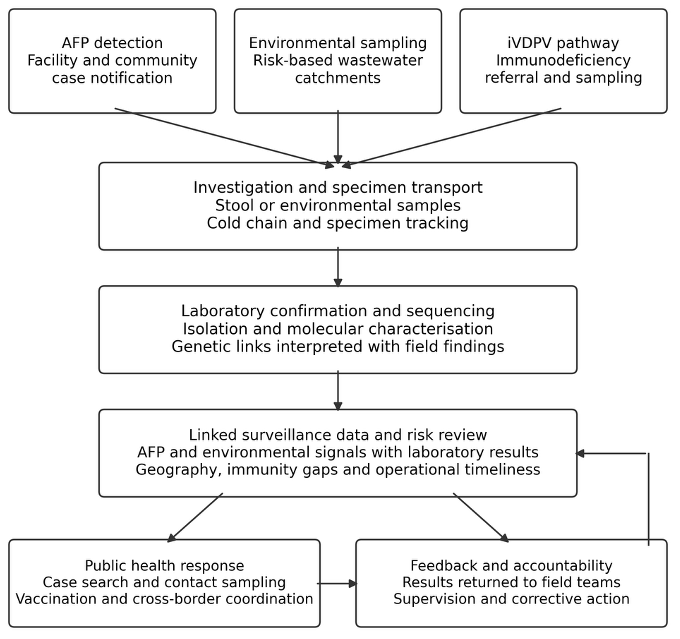
The surveillance architecture is broader than conventional acute flaccid paralysis (AFP) reporting alone. The Global Polio Surveillance Action Plan 2025–2026 links AFP, environmental, laboratory/genomic and iVDPV surveillance with data and information management [4]. AFP remains the clinical foundation [6]. In practice, performance depends on community detection, investigation, stool collection, specimen transport, laboratory turnaround, interpretation and field action.
Several African studies reported differences between national and subnational AFP performance, especially in settings affected by insecurity, transport constraints or incomplete provider coverage [7–9]. Environmental investigations and community or digital surveillance evaluations offer additional perspectives on these gaps [10–17]. These reports differ in their populations, time periods and outcomes; they cannot be interpreted as directly comparable estimates of surveillance sensitivity.
This review aimed to synthesise empirical evidence on poliovirus surveillance in West, Central and East Africa, describe recurrent operational and methodological gaps, and identify implications for surveillance after regional certification. Publications reporting earlier surveillance periods were retained when they informed these objectives. The review therefore concerns the requirements of post-certification surveillance rather than an exclusively post-2020 study population.
Study design and reporting approach
This was a structured narrative review, consistently classified as a narrative review rather than a scoping review, systematic review or meta-analysis. Explicit eligibility criteria and a thematic synthesis were used to make the scope and interpretation transparent. No protocol registration is reported, and prospective prespecification of a dated protocol or piloted extraction form is not documented. These limitations prevent a claim of fully reproducible systematic-review methods.
Information sources and search strategy
The original searches were conducted from 15 to 20 July 2026 in PubMed/MEDLINE, Global Index Medicus, African Journals Online (AJOL) and Google Scholar. They were complemented by searches of the Journal of Interventional Epidemiology and Public Health, Pan African Medical Journal, WHO and WHO Regional Office for Africa websites, and backward citation searching. Disease terms (polio, poliomyelitis and poliovirus), surveillance terms (acute flaccid paralysis, environmental or wastewater surveillance, community surveillance, laboratory or genomic surveillance, AVADAR and information systems), and geographic terms for the three subregions and their countries were combined. English and French equivalents were used. Supplementary Methods S1 gives database-specific reconstructed search expressions and identifies the search-log details that remain undocumented; these expressions are not presented as archived records of the exact searches executed in July 2026.
Inclusion criteria
Reports were eligible if they: (i) contained empirical observations from one or more countries in West, Central or East Africa; (ii) were published from 1 January 2015 to 20 July 2026; (iii) were available in English or French; and (iv) addressed AFP, environmental, laboratory/genomic, immunodeficiency-associated, community-based or digital poliovirus surveillance, information management or related operational performance. Surveillance-based outbreak and risk analyses were eligible when they contained operational surveillance findings. Multicountry reports extending beyond the target subregions were retained for their relevant observations, without treating broader regional totals as estimates for the target subregions. Analyses of non-polio viruses recovered through AFP or environmental surveillance were retained only as indirect evidence about use of the surveillance infrastructure, not evidence of poliovirus detection performance [18,19]. WHO guidance and other contextual literature were classified separately and were not counted among empirical reports.
Exclusion criteria
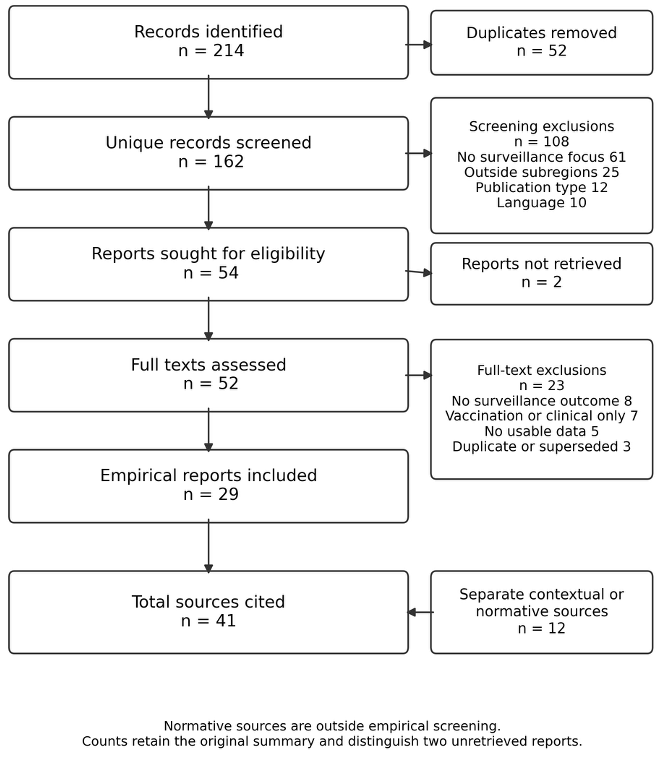
Reports focused solely on vaccine immunogenicity or effectiveness, clinical treatment, rehabilitation, routine immunisation without surveillance findings, or modelling without operational surveillance data were excluded. Editorials, opinion pieces, duplicates, superseded versions and reports outside the geographic, language or publication criteria were also excluded. Reports that could not be obtained were recorded as not retrieved, separately from full-text exclusions in the revised Figure 1.
Screening and study selection
Wankpaouyare Gmakouba performed record compilation, manual deduplication, title/abstract screening, full-text eligibility assessment and data extraction. The co-authors contributed to methodological refinement, interpretation and manuscript revision; independent duplicate screening or extraction was not undertaken. Uncertain title/abstract records were retained for full-text consideration. This conservative rule may reduce premature exclusion but does not eliminate selection or extraction error. No adjudication or inter-reviewer agreement statistics were applicable.
Bibliographic verification during revision used article titles, author lists, publication year, journal, DOI and publisher or bibliographic records to check the 29 cited empirical reports. The report-level inventory is references [7–35], individually listed in Supplementary Table S1. Publisher records were used when DOI registry metadata were incomplete, or the DOI resolver did not retrieve the article. Verification of a cited publication is distinct from validation of its data or independent repetition of screening. The study-selection totals remain those reported in the original summary; no unrecorded second-reviewer procedure or additional search yield is asserted.
Data extraction
The extraction domains were citation and publication year; country or countries; design; surveillance or specimen-collection period; surveillance component; population, reporting units or specimens; reported indicators and their denominators; principal findings; methodological limitations; and operational implications. The expanded reporting matrix in Supplementary Table S1 identifies all 29 empirical reports individually, while Table 1 presents selected examples. Study period is distinguished from publication year. Where a calendar period could not be established from the material verified during revision, it is explicitly marked rather than inferred. The revised matrix documents the synthesis; its preparation does not establish that a piloted form was used prospectively.
Quality appraisal and evidence synthesis
No formal design-specific risk-of-bias tool or certainty-grading framework was applied. This was a limitation of the review approach, not a consequence that necessarily follows from study heterogeneity. A descriptive appraisal considered the data source, clarity of methods, indicator definitions, completeness, geographic coverage, comparators and consistency between findings and conclusions. The limitations column in Supplementary Table S1 records the main interpretive constraints; it is not a validated risk-of-bias score. Findings were organised by subregion and then compared across recurring surveillance functions. Quantitative findings were retained with the source, period, unit of analysis and denominator when available. Percentages with unclear or inconsistent denominators were not used for cross-study numerical comparisons. Counts, rates, case ascertainment, laboratory positivity and alert yield were treated as different outcomes. No pooled proportion, average effect, new inferential test or comparative effectiveness estimate was calculated because designs, definitions, denominators, periods and contexts differed. This reason for not pooling is separate from the decision not to undertake formal risk-of-bias assessment.
Study selection
The original screening summary reported 214 identified records, 52 duplicates removed and 162 unique records screened. Title/abstract exclusions totalled 108: no surveillance focus (61), outside the target subregions (25), ineligible publication type (12) or ineligible language (10). Of 54 reports sought for eligibility assessment, two were not retrieved and 52 were assessed in full text. Twenty-three assessed reports were excluded for no surveillance outcomes (8), vaccination or clinical focus only (7), no usable data (5), or duplicate/superseded analysis (3). Twenty-nine empirical reports remained. This corrects the earlier description of all 54 reports as full-text assessments; it does not add new screening observations. Twelve normative or contextual sources were retained separately, giving 41 references overall. Figure 1 shows the corrected accounting. The original database exports and a citation-level exclusion register are not supplied with the review, so the aggregate screening history cannot be independently reconstructed.
Characteristics of the included evidence
The 29 empirical reports correspond to references [7–35] and are enumerated in Supplementary Table S1. They comprise surveillance evaluations, retrospective record analyses, outbreak investigations, implementation evaluations, laboratory studies and a surveillance-based risk analysis. They are counted as reports, not necessarily independent populations: some national, multicountry or laboratory datasets may overlap. Reports [18,19] concern non-polio viruses and contribute indirect infrastructure evidence; broader geographic analyses [26,33–35] are identified as such. Table 1 summarises selected examples with design, study period and limitations. The evidence does not constitute a census of all countries or a longitudinal comparison of surveillance before and after certification.
Evidence from West Africa
In Burkina Faso, Drabo and colleagues described information management in AFP surveillance in Banfora, including weaknesses in result transmission and logistical support [20]. In Togo, Gmakouba, Tarkpessi and Assonde reported delays in laboratory feedback and weaknesses in documentation and information use in Ogou [21]. Both are local cross-sectional assessments. Their findings identify possible points for district-level improvement but do not establish national performance or the effect of a corrective intervention.
In Ho Municipality, Ghana, a descriptive evaluation covering 2017–2021 reported transport and reporting-completeness weaknesses despite attainment of an average non-polio AFP rate compatible with the basic benchmark [22]. In Western North Region, 27 of 62 surveyed health workers (43.6%) worked in facilities reported to have achieved both core AFP indicators during their service; this is a health-worker-based proportion, not population surveillance sensitivity [23]. Environmental investigations in Ghana documented cVDPV2 in wastewater without an AFP case identified in the investigated setting [10]. A subsequent retrospective evaluation covered environmental surveillance in seven regions during 2018–2022 [11]. These observations support complementary interpretation of clinical and environmental findings without quantifying their relative sensitivity.
In Tillabéri, Niger, Abalo and colleagues evaluated community surveillance introduced in selected insecure districts, using records from 2017–2021 and interviews; reporting improvement during implementation, but the design did not isolate a causal intervention effect [12]. National retrospective analyses in Niger also described variation in stool quality, transport and other AFP indicators [24,25]. In a multicountry AVADAR evaluation covering August 2017–July 2018, 24,142 of 25,032 alerts were investigated (96.44%), yielding 1,414 verified AFP cases [13]. These are alert and AFP case counts within selected implementation districts, not estimates of poliovirus infections prevented or population-level sensitivity. The outcome and denominator differ from the facility-achievement measure in Ghana and were not compared numerically.
Mwengee and colleagues, whose author group included Landoh, described contributions of polio resources to integrated communicable-disease surveillance in several African countries [26]. Laboratory reports from Guinea and other North and West African settings used AFP or environmental specimens to characterise astrovirus or echovirus 11 [18,19]. These reports illustrate broader use of specimens and laboratory networks; detection of a non-polio virus does not itself demonstrate adequate poliovirus surveillance sensitivity or causation of AFP.
Evidence from Central Africa
In the Democratic Republic of the Congo (DRC), a retrospective analysis of AFP data from 2008–2014 identified uneven provincial performance [7]. Alleman and colleagues, including Djawe, analysed cVDPV2 outbreaks and response during 2017–2021 and used laboratory and genetic information to describe multiple emergence groups [27]. Together, these studies support subnational review and linkage of genomic findings to outbreak investigation. They do not establish that sequencing alone shortened response or reduced transmission.
In the Central African Republic, a retrospective laboratory-based analysis documented disruption of AFP surveillance during the 2013–2014 conflict [28]. In Cameroon, analysis of AFP stool specimens from 2015–2020 found no wild poliovirus, but detected vaccine-derived poliovirus type 2 from February 2020 as well as non-polio enteroviruses [29]. The absence of wild poliovirus in tested samples does not prove that the surveillance system detected all transmission; the observed VDPV2 detections underline the continuing need for virological monitoring.
Evidence from East Africa
Retrospective Ethiopian analyses covering 2005–2015 and 2010–2014 described national progress alongside differences between regions and reporting sites [8,30]. An analysis comparing the same surveillance weeks in 2021 and 2022 in Southwest Ethiopia reported higher AFP and measles surveillance indicators after outbreak-related strengthening [31]. The uncontrolled comparison cannot separate the contribution of the response from other changes. In South Sudan, analysis of 2014–2019 records similarly showed national achievement of core AFP indicators alongside state-level variation [9]. Earlier periods inform post-certification vulnerabilities but are not evidence of a change caused by certification.
The CORE Group Polio Project evaluation in South Sudan described community-based case detection in conflict-affected areas [32]. A separate retrospective AVADAR evaluation, covering June 2018–December 2019 in three counties, reported additional AFP notifications within the implementation areas [14]. Both support the feasibility of community reporting while leaving uncertainty about comparative effectiveness and sustainability. In Uganda, environmental surveillance detected cVDPV2 in 2021 without corresponding AFP detection [15]. Kenyan studies assessed feasibility and comparative laboratory detection using bag-mediated filtration, rather than population-wide disease detection or outbreak prevention [16,17]. A broader East and Southern African analysis combined AFP, environmental and other specimen sources to describe VDPV detections over 2010–2021; its regional totals are not estimates for East Africa alone [33].
Recurring surveillance blind spots
Four recurrent issues emerged. First, national AFP indicators sometimes concealed variation between provinces, states or reporting sites [7–9,30]. Second, notification, specimen transport, documentation and return of laboratory results were vulnerable steps [20–23,25]. Third, facility-centred reporting incompletely represented some remote populations or provider types; Ethiopian reporting-site analyses and community evaluations in Niger and South Sudan support examining that coverage locally [12,14,30,32]. Fourth, surveillance findings must be interpreted alongside immunity and response conditions. The DRC outbreak analysis and a broader African surveillance-based risk analysis support this relationship, without implying a causal effect estimated by the present review [27,34]. The DHIS2 implementation report [35] concerns information-system migration and is not cited as evidence that immunity gaps caused cVDPV spread.
Environmental, iVDPV and data-to-action functions
Environmental investigations in Ghana and Uganda provide direct examples of poliovirus detection without corresponding AFP detection [10,15]; the Ghana performance evaluation and Kenyan sampling studies address different aspects of environmental surveillance [11,16,17]. They do not yield a pooled estimate of additional sensitivity. Evidence specifically evaluating iVDPV surveillance in the target subregions was limited: the South Sudan AFP analysis reported an iVDPV2 case, while recommendations on targeted immunodeficiency pathways draw mainly on global evidence and guidance [4,5,9,36]. The DHIS2 migration report describes a platform change across the WHO African Region; it does not demonstrate a measured reduction in missed poliovirus cases [35]. Broader reviews and WHO reports inform interpretation of integration, wastewater coverage and cross-border coordination but remain contextual sources [37–41].
Principal findings
The main empirical pattern is uneven performance across places and steps in the surveillance pathway. AFP evaluations document subnational variation, while environmental investigations in Ghana and Uganda demonstrate complementary detection in specific settings [7–10,15]. Community and digital programmes reported additional notifications or investigated alerts, but most were observational and implemented in selected high-risk areas [12–14,32]. These findings justify attention to coverage and process reliability; they do not establish a common effect size or show that surveillance became more sensitive because the region was certified.
District-level information-management studies in Burkina Faso and Togo highlight documentation and feedback as practical areas for improvement [20,21]. The DRC outbreak analysis illustrates how genetic information can clarify transmission patterns [27], while the regional programme review describes how polio assets supported other surveillance functions [26]. These are complementary forms of evidence with different units of analysis. The integrated pathway in Figure 2 is an author-developed programme framework informed by these observations and WHO guidance [4,5], not a validated intervention model.
Methodological limitations of the included studies
Many included reports used retrospective routine data, with possible missing records, changing denominators and incomplete geographic coverage. Cross-sectional evaluations cannot establish temporal causation. Before/after and programme comparisons may be confounded by outbreak response, site selection, staffing and concurrent investment. Environmental studies are conditional on catchment coverage, wastewater flow and sampling or laboratory methods; negative samples cannot exclude circulation outside the sampled catchment. Sequencing reports describe viruses that were sampled and successfully characterised, not all circulating strains. Laboratory studies of other enteric viruses provide indirect evidence only [18,19]. Community and digital evaluations often reported notifications or verified AFP cases rather than comparative cost, sustainability or poliovirus detection outcomes. These constraints are recorded study by study in Supplementary Table S1; no formal certainty rating is assigned.
Methodological limitations of this review
Single-reviewer screening and extraction increased the possibility of missed studies, extraction errors and subjective interpretation. Retaining uncertain records for full-text review was the documented consistency measure; co-author discussion and manuscript review were not independent duplicate screening or extraction. No protocol registration, dated prospective extraction form, complete original query history or citation-level exclusion register is reported. The reconstructed search expressions improve transparency about the intended search logic but cannot reproduce the original yields. Bibliographic checking during revision verified cited report identities and corrected references; it did not repeat the full search or remedy the absence of independent screening. Restricted databases and languages may have missed relevant reports, and Google Scholar searching is particularly sensitive to ranking and search date. Lack of formal risk-of-bias assessment limits confidence in the synthesis independently of the heterogeneity that prevented pooling.
Limitations of the findings
Evidence was uneven across countries and surveillance modalities, and much of it predated regional certification. Several national and multicountry reports may describe overlapping surveillance populations; no independence of their case counts is assumed. Published programme innovations may be overrepresented, while poorly documented settings may have important unreported gaps. Broader regional studies were interpreted for relevance rather than used to calculate target-subregion totals. The conclusions therefore identify recurring operational concerns and plausible programme priorities, not comparative country rankings, prevalence estimates, causal effects or a definitive inventory of post-certification performance.
Implications for policy and practice
Empirical findings support three immediate priorities: review AFP performance below the national level [7–9,30]; strengthen specimen transport, documentation and return of results [20–23,25]; and interpret clinical surveillance alongside locally appropriate environmental and community signals [10–15,32]. Table 2 links each proposed action to its empirical basis and identifies where guidance extends beyond the reviewed findings. Risk-based environmental site selection, immunodeficiency referral pathways, cross-border information exchange and protection of surveillance financing are broader programme recommendations informed chiefly by WHO guidance and contextual literature [3–5,36–41]. These require local feasibility assessment; the review did not measure their cost-effectiveness or implementation impact.
Empirical reports from West, Central and East Africa identify subnational AFP performance gaps and weaknesses in specimen transport and feedback, while environmental investigations demonstrate complementary detection in specific settings. Community, digital and genomic approaches offer useful operational information, but their comparative benefits remain incompletely established. Post-certification programmes should address documented local gaps and use WHO guidance to plan complementary surveillance and sustainable integration. Prospective comparative and economic evaluations are needed to test these programme choices.
What is already known about the topic
What this study adds
Conceptualization: Wankpaouyare Gmakouba
Data curation: Wankpaouyare Gmakouba
Formal analysis: Wankpaouyare Gmakouba, Pitabinawè Deabalo
Methodology: Wankpaouyare Gmakouba
Project administration: Wankpaouyare Gmakouba
Resources: Wankpaouyare Gmakouba
Software: Wankpaouyare Gmakouba
Supervision: Pitabinawè Deabalo
Validation: Wankpaouyare Gmakouba, Labaguibe of Gangak, Pitabinawè Deabalo
Visualization: Wankpaouyare Gmakouba
Writing – original draft: Wankpaouyare Gmakouba; Labaguibe of Gangak, Pitabinawè Deabalo, Napo of Kpakpassoko
Writing – review & editing: Wankpaouyare Gmakouba, Labaguibe of Gangak, Pitabinawè Deabalo, Napo of Kpakpassoko
Supplementary Files
| Source and setting | Design and study period | Component | Main observation | Key limitation |
|---|---|---|---|---|
| Drabo et al. [20] Burkina Faso | Cross-sectional information-management evaluation Calendar period not established | AFP information management | Feedback and logistics weaknesses | Local assessment; dates not established |
| Gmakouba et al. [21] Togo | Cross-sectional records and staff assessment Calendar period not established | AFP information management | Delayed feedback and documentation gaps | Small local sample; inconsistent denominators |
| Kijera et al. [22] Ghana | Descriptive mixed-methods surveillance evaluation Jan 2017–Dec 2021 | AFP system evaluation | Transport delay despite average AFP benchmark | One municipality; few reported cases |
| Ticha et al. [13] Eight African countries in the three subregions | Observational AVADAR implementation evaluation Aug 2017–Jul 2018 | Community and digital reporting | Additional investigated alerts and AFP notifications | Selected districts; no unconfounded effect |
| Alleman et al. [27] DRC | Descriptive outbreak, response and genetic analysis 2017–2021 | Outbreak and genomic analysis | Multiple cVDPV2 emergence groups | Detection and sampling constrain ascertainment |
| Denegetu et al. [31] Southwest Ethiopia | Uncontrolled comparison of surveillance trends Weeks 1–41 in 2021 and 2022 | AFP and measles indicators | Later-period indicators were higher | Uncontrolled before/after comparison |
| Tushabe et al. [15] Uganda | Descriptive environmental virological investigation 2021 detections | Environmental surveillance | cVDPV2 detected without corresponding AFP | Selected catchments; no population sensitivity estimate |
| AFP, acute flaccid paralysis; cVDPV2, circulating vaccine-derived poliovirus type 2. Study period is distinct from publication year. The full inventory of 29 reports, including periods and limitations, is in Supplementary Table S1. | ||||
| Domain | Empirical or contextual basis | Proposed action and evidence boundary |
|---|---|---|
| Subnational AFP performance | Variation across provinces, reporting sites and states [7–9,30] | Review silent areas and site-level indicators; local coverage assessment is an inference from these findings. |
| Specimen transport and feedback | Local evaluations and national AFP analysis identify process weaknesses [20–23,25] | Track transport intervals and return of results; invest according to the local bottleneck. |
| Environmental surveillance | Complementary detections in Ghana and Uganda [10,15]; method studies [16,17] | Select catchments according to local risk and guidance [4,5]; no pooled sensitivity gain is claimed. |
| Community and digital reporting | Selected implementation settings reported additional alerts or cases [12–14,32] | Evaluate verified AFP yield, investigation workload, cost and sustainability before expansion. |
| Genomic outbreak interpretation | DRC outbreak investigation demonstrates genetic and field linkage [27] | Link sequencing results to response review; timeliness targets follow guidance [4,5]. |
| iVDPV surveillance | A routine AFP analysis included an iVDPV2 case [9]; targeted pathways rely mainly on global evidence [36] | Develop feasible immunodeficiency referral pathways under WHO guidance [4,5]; local effectiveness is uncertain. |
| Integration and continuity | Programme and platform reports [26,35]; contextual reviews and official reports [37–41] | Protect essential functions during integration; financing and cross-border recommendations are guidance-informed [3–5]. |