Research | Open Access | Volume 9 (3): Article 121 | Published: 22 Jul 2026

Views: 738
Menu, Tables and Figures
| Variable | Municipality, n(%) | Chi-Square Test/Fisher’s Exact | ||
|---|---|---|---|---|
| Lawra | Jirapa | χ² | P-Value | |
| Household currently owns a dog | ||||
| Yes, n (%) | 134(67.0) | 154(90.6) | 29.639 | <0.001 |
| No, n (%) | 66(33.0) | 16(9.4) | ||
| Household owned a dog 5 years ago | ||||
| Yes, n (%) | 155(77.5) | 119(70.0) | 2.690 | 0.101 |
| No, n (%) | 45(22.5) | 51(30.0) | ||
| Number of dogs owned by household | ||||
| 1, n (%) | 43(32.1) | 82(53.3) | ||
| 2, n (%) | 41(30.6) | 56(36.4) | ||
| 3, n (%) | 17(12.7) | 10(6.5) | 36.636 | <0.001 |
| 4, n (%) | 16(11.9) | 6(3.9) | ||
| ≥5, n (%) | 17(12.7) | 0(0.0) | ||
| Owners of household dogs | ||||
| Household head, n (%) | 127(69.8) | 135(87.7) | ||
| Spouse, n (%) | 22(12.1) | 2(1.3) | ||
| Son(s), n (%) | 20(11.0) | 6(3.9) | – | <0.001 |
| Daughter(s), n (%) | 8(4.4) | 0(0.0) | ||
| Other, n (%) | 5(2.7) | 11(7.1) | ||
| Source of household dog | ||||
| Offspring of own bitch, n (%) | 24(13.19) | 22(14.3) | ||
| Bought or traded, n (%) | 136(74.7) | 127(82.5) | 8.827 | 0.012 |
| Gift, n (%) | 22(12.1) | 5(3.2) | ||
| Person caring for the dog | ||||
| Household head, n (%) | 84(46.2) | 85(55.2) | ||
| Spouse, n (%) | 44(24.2) | 30(19.5) | ||
| Son(s), n (%) | 25(13.7) | 16(10.4) | 7.8327 | 0.098 |
| Daughter(s), n (%) | 19(10.4) | 8(5.2) | ||
| Others, n (%) | 10(5.5) | 15(9.7) | ||
| Reason for keeping household dog | ||||
| Security, n (%) | 141(77.5) | 131(85.1) | ||
| Service (herding, hunting), n (%) | 18(9.9) | 10(6.5) | ||
| Business (keep to sell), n (%) | 9(4.9) | (0.0) | – | 0.015 |
| Companionship, n (%) | 14(7.7) | 13(8.4) | ||
| Availability of skilled household member for dog care | ||||
| Yes, n (%) | 155(77.5) | 90(52.9) | 24.775 | <0.001 |
| No, n (%) | 45(22.5) | 80(47.1) | ||
| Availability of skilled member in dog caring | ||||
| Household head, n (%) | 79(51.0) | 52(57.8) | ||
| Spouse, n (%) | 49(31.6) | 10(11.1) | ||
| Son(s), n (%) | 18(11.6) | 22(24.4) | 16.243 | 0.001 |
| Daughter(s), n (%) | 9(5.8) | 6(6.7) | ||
| Source of dog care knowledge/expertise | ||||
| Trained by animal health officer, n (%) | 24(15.5) | 26(28.9) | ||
| Taught in school, n (%) | 14(9.0) | 10(11.1) | 7.307 | 0.063 |
| Media (radio, Tv), n (%) | 44(28.4) | 19(21.1) | ||
| Experience, n (%) | 73(47.1) | 35(38.9) | ||
Table 1: Household dog ownership and dog-keeping practices among respondents in Lawra and Jirapa Municipalities, Ghana.
| Variables | Lawra, n (%) | Jirapa, n (%) | P-value |
|---|---|---|---|
| Preferred method for rabies control in dogs | |||
| Treatment | 31 (15.5) | 16 (9.5) | 0.078 |
| Spraying | 3 (1.5) | 0 (0.0) | |
| Isolation | 25 (12.5) | 15 (8.8) | |
| Vaccination | 122 (61.0) | 127 (74.7) | |
| Castration | 5 (2.5) | 2 (1.2) | |
| Others | 14 (7.0) | 10 (5.5) | |
| Place of vaccination | |||
| District veterinary office | 57 (62.6) | 85 (87.6) | <0.001 |
| Private animal health office | 6 (6.6) | 8 (8.3) | |
| Medical health office | 0 (0.0) | 2 (2.1) | |
| RIWA-GH campaign | 28 (30.8) | 0 (0.0) | |
| Don’t know | 0 (0.0) | 2 (2.1) | |
| Evidence of vaccination certificate | |||
| Not seen | 23 (25.3) | 72 (74.2) | <0.001 |
| Seen | 68 (74.7) | 25 (25.9) | |
| Time of first vaccination | |||
| 2012 | 0 (0.0) | 4 (4.1) | 0.002 |
| 2014 | 6 (6.6) | 0 (0.0) | |
| 2015 | 4 (4.4) | 2 (2.1) | |
| 2016 | 7 (7.7) | 6 (6.2) | |
| 2017 | 20 (22.0) | 19 (19.6) | |
| 2018 | 8 (8.8) | 8 (8.3) | |
| 2019 | 13 (14.3) | 22 (22.7) | |
| 2020 | 3 (3.3) | 12 (12.4) | |
| Dog revaccinated after first vaccination | |||
| Yes | 69 (75.8) | 55 (56.7) | 0.006 |
| No | 22 (24.2) | 42 (43.3) | |
| Frequency of vaccination | |||
| Yearly | 81 (89.0) | 70 (72.2) | 0.002 |
| Once every 2 years | 4 (4.4) | 20 (20.6) | |
| More than 2 years | 6 (6.6) | 7 (7.2) | |
| Reason for not vaccinating dog | |||
| There is no need | 14 (15.7) | 12 (21.1) | 0.048 |
| Not aware of vaccination exercise | 34 (38.2) | 26 (45.6) | |
| Difficult to restrain the dog | 15 (16.8) | 2 (3.5) | |
| Dog ran away | 15 (16.8) | 6 (10.5) | |
| No one was available | 9 (10.1) | 11 (19.3) | |
| Vaccine kills dogs | 2 (2.3) | 0 (0.0) | |
Table 2: Attitudes of Dog Owners toward Anti-Rabies Vaccination in Lawra and Jirapa
| Predictor (Reference category) | Knowledge β (95% CI) | p-value | Attitude β s (95% CI) | p-value | Practices β (95% CI) | p-value | Control β (95% CI) | p-value |
|---|---|---|---|---|---|---|---|---|
| Age | 0.019 (-0.005, 0.043) | 0.119 | -0.014 (-0.040, 0.012) | 0.293 | 0.045 (0.009, 0.082) | 0.016 | -0.006 (-0.042, 0.030) | 0.740 |
| Gender (male/female) | 0.138 (0.044, 0.232) | 0.004 | 0.002 (-0.074, 0.078) | 0.956 | -0.123 (-0.249, 0.003) | 0.055 | -0.053 (-0.166, 0.059) | 0.357 |
| Education | 0.009 (-0.008, 0.026) | 0.299 | -0.010 (-0.033, 0.013) | 0.383 | 0.061 (0.025, 0.096) | 0.001 | -0.023 (-0.057, 0.011) | 0.181 |
| Residence (Jirapa/Lawra) | 0.189 (0.097, 0.281) | <0.001 | 0.084 (0.020, 0.149) | 0.010 | 0.088 (-0.018, 0.193) | 0.106 | -0.061 (-0.159, 0.036) | 0.222 |
Note: β = regression coefficient; CI = confidence interval; p-values significant at α = 0.05.
Table 3: Relationship between the Demographic Characteristics and Dog Owners’ Knowledge, Attitudes, Practices, and Rabies Control
Alijata Issah Beninmie1, Benjamin Tetteh Mensah2, Samuel Asumah4, Victor Emmanuel Manieson3, Amos Sarpong Agyei3, Meyir Yiryele Ziekah4, Sylvester Languon5, Samuel Otis Bel-Nono8, Hampton Russell Coombs9, Henry Asigri Abugri3, Benjamin Kissi Sasu1, Suleman Sako1, Bonodong Zongnukuu Guri6,7, Richard Dery Suu-Ire3,&
1Veterinary Services Directorate, Ministry of Food and Agriculture, P. O. Box M161, Accra, Ghana; 2Department of Animal Laboratory Sciences, School of Biomedical and Allied Health Sciences, College of Health Sciences, University of Ghana, P. O. Box KB 143, Accra, Ghana; 3School of Veterinary Medicine, P. O. Box LG 139, University of Ghana, Legon-Accra, Accra, Ghana; 4Wildlife Division of the Forestry Commission of Ghana, P.O. Box M239, Accra, Ghana; 5West African Centre for Cell Biology of Infectious Pathogens, P. O. Box LG 139, University of Ghana, Legon-Accra, Ghana; 6Ghana Atomic Energy Commission, Ministry of Environment, Science, Technology and Innovation (MESTI), Accra, Ghana; 7African Field Epidemiology Network, Kampala, Uganda; 8One Health Institute, University of California, Davis, 1089 Veterinary Medicine Drive, Davis, CA, USA, 9115 Sewells Lane, Brampton, Ontorio, Canada
&Corresponding author: Richard Dery Suu-Ire, School of Veterinary Medicine, P. O. Box LG 139, University of Ghana, Legon- Accra, Accra, Ghana, Email: rdsuu-ire@ug.edu.gh, ORCID: https://orcid.org/0000-0002-3671-4342
Received: 16 Mar 2026, Accepted: 17 Jul 2026, Published: 22 Jul 2026
Domain: One Health
Keywords: Knowledge, attitude, Lawra, Jirapa, rabies, One Health, Ghana
©Richard Dery Suu-Ire et al. Journal of Interventional Epidemiology and Public Health (ISSN: 2664-2824). This is an Open Access article distributed under the terms of the Creative Commons Attribution International 4.0 License (https://creativecommons.org/licenses/by/4.0/), which permits unrestricted use, distribution, and reproduction in any medium, provided the original work is properly cited.
Cite this article: Richard Dery Suu-Ire, et al., Rabies-related knowledge, attitudes, and practices among dog owners in Lawra and Jirapa Municipalities, Upper West Region, Ghana. Journal of Interventional Epidemiology and Public Health. 2026;9(3):121. https://doi.org/10.37432/jieph-d-26-00086
Introduction: Rabies is a neglected zoonotic disease affecting poor and remote human settlements disproportionately relative to urban rich communities. In rural areas, rabies cases often go unreported, as awareness of the disease is low and surveillance is sub-optimal. An understanding of dog ecology has been recognised as a key factor in designing an effective rabies control program in rabies-endemic countries. This study assessed the knowledge, attitudes, and practices (KAP) of rabies control among dog owners in Lawra and Jirapa Municipalities in the Upper West Region of Ghana.
Methods: A quantitative cross-sectional survey was conducted among 370 dog owners aged 18 and above, selected through multistage sampling. Data were collected using structured questionnaires and analysed using descriptive and inferential statistics in Stata 17.0. Composite scores were generated to quantify rabies knowledge, attitudes toward anti-rabies vaccination, dog-bite-related practices, and rabies control measures. As part of the study, dogs in participating households were vaccinated against rabies free of charge.
Results: Rabies awareness was high in both municipalities, with Jirapa at 97.6% and Lawra at 77.0%. Vaccination-related practices scored highly across the 10 assessed domains. Dog bite prevalence was notably higher in Jirapa (44.1%) than in Lawra (20.5%). While most bite victims in Lawra visited health facilities, 38.4% in Jirapa relied on traditional remedies. Associations were found between demographic factors and rabies-related KAP.
Conclusion: The study recommends collaborative engagement of local health authorities, community leaders, and media to translate the high rabies awareness and positive vaccination attitudes into strengthening preventive practices, particularly appropriate responses following dog bites, in both municipalities.
The country has about 2.5 million dogs, serving multiple functions including companionship, security, and hunting [1, 2]. Recent trends suggest an increase in the number of households owning dogs, particularly in urban areas [2]. Socio-demographic factors appear to influence dog ownership patterns; individuals from higher socioeconomic backgrounds and males are more likely to own dogs [3, 4].
Given the close human-dog interaction in both rural and urban settings, the role of dogs in the transmission of zoonotic diseases, particularly rabies, is of significant public health concern. Rabies is endemic in many African countries, including Ghana [5, 6]. The World Health Organization estimates that over 95% of human rabies deaths worldwide result from dog bites, with Africa accounting for a substantial proportion of the global burden—approximately 20,000 deaths annually, more than half of which occur in children under 15 [5, 7]. Additionally, the World Organization for Animal Health (WOAH) reports that up to 1.2 million dogs die from rabies each year in Africa, with an estimated 5 to 7 million people exposed through dog bites [8]. This may be an underestimation due to poor disease surveillance reporting. [9 -11].
A total of 793 suspected cases of rabies were reported in Ghana between 2020 and 2023, with 77 officially confirmed deaths. In 2023 alone, 331 suspected cases were recorded [1,12]. The country has developed a national strategy for rabies prevention and control [13]. This study examined rabies-related knowledge, attitudes, and practices among dog owners in Lawra and Jirapa, Ghana. It assessed awareness of transmission and symptoms, vaccination attitudes, dog bite experiences, and socio-demographic influences. Findings aim to guide community-based rabies prevention strategies within a One Health framework for rural Ghana.
Although several studies have examined rabies awareness and dog ownership practices in parts of Ghana, there remains limited evidence from rural municipalities in the Upper West Region, where veterinary services and public health infrastructure are relatively limited. Understanding rabies-related knowledge, attitudes, and practices in such settings is essential because rural communities often experience closer human–dog interactions and may face barriers to accessing preventive services. This study, therefore examined rabies-related knowledge, attitudes, and practices among dog owners in Lawra and Jirapa municipalities in northern Ghana. By generating context-specific evidence from rural communities, this research contributes to the broader understanding of behavioural and socio-demographic factors influencing rabies prevention in endemic settings. The findings provide insights that can inform community-based rabies control strategies within a One Health framework and contribute to global efforts aimed at eliminating dog-mediated human rabies by 2030.
Study setting and design
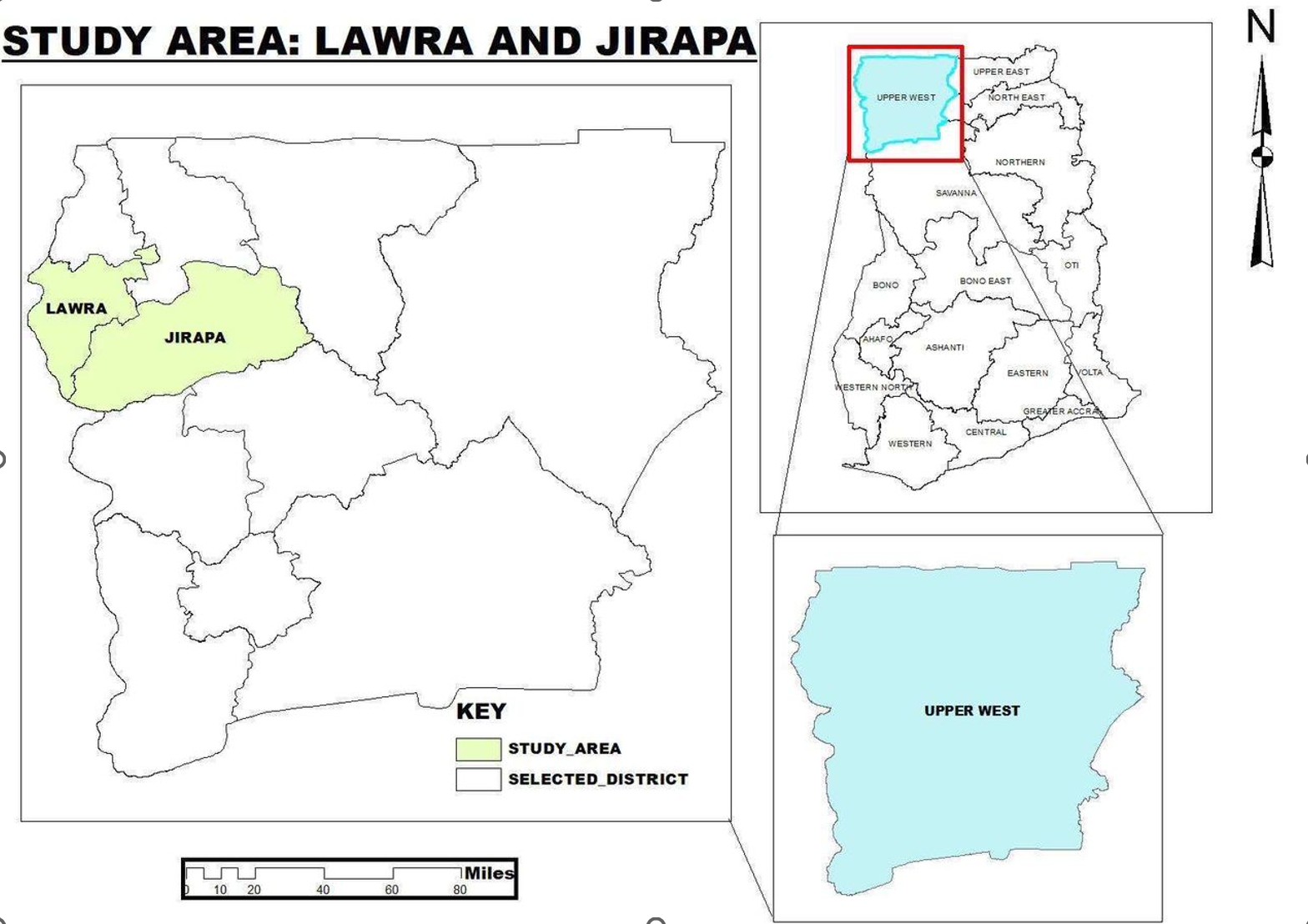
The study was conducted in Lawra and Jirapa municipalities in the Upper West Region of Ghana (Figure 1). They are predominantly rural and characterised by high dependency on agriculture, limited access to veterinary and public health infrastructure, and close human-dog interactions, making them appropriate settings for a rabies KAP study. The study area has a combined population of about 150,000, [14]. A quantitative cross-sectional survey was conducted among dog owners in the Lawra and Jirapa municipalities between 23rd and 29th September 2020. The study population consisted of households that owned dogs within the two municipalities.
Sample size calculation
A sample size of 370 dog owners aged 18 years or older (from 370 households) was used for the study. The sample size was calculated from the sampling frame, which comprised the total number of households (8,300) in the six selected sub‑municipalities of Lawra and Jirapa. The sample size was determined using Cochran’s (1977) formula for finite populations [15]:
Thus; \[ n = \frac{n_0}{1 + \frac{(n_0 – 1)}{N}} \]
Where;
n = sample size,
n0 = sample size derived from equation,
N = Population, and 1 = Constant.
Thus, using the total households (8,300) as the population, at a 95% confidence level and 5% precision (e), the sample size derived from the equation (n0) is 382.
Therefore, \[ n = \frac{n_0}{1+\frac{(n_0-1)}{N}}, n = \frac{382}{1+\frac{(382-1)}{8300}} = 369.96 \approx 370 \]
Sampling procedure
Selection of sub‑municipalities: A simple random sampling technique was used to select three sub‑municipalities from each of the two main municipalities. All sub‑municipalities in Lawra and Jirapa were assigned numbers, and three numbers were drawn randomly by simple balloting. The three numbers selected represented the sub‑municipalities included in the study. For Jirapa municipality Jirapa town, Baazu and Tiboro were drawn. In Lawra municipality Eremon, Tuori and Lawra were drawn.
Household selection: After the sub‑municipalities were selected, a systematic sampling technique was used to select households. The sampling interval of 22 was calculated by dividing the total number of households (8,300) by the target sample size (370). To ensure a random start, the first household was selected by spinning a bottle at a central landmark (The hospital in Jirapa and the municipal Assembly ground in Lawra) identified with the assistance of local opinion leaders. Thereafter, every 22nd household was selected for questionnaire administration.
Respondent selection within households: In each selected household, the owner of the dog(s) was invited to participate. If the primary dog owner was unavailable, the next eligible adult household member involved in dog care was selected. If there were more than one eligible dog owner in a household, a simple random sampling technique (balloting) was used to select one respondent. The use of systematic sampling with a random start was intended to minimise sampling bias.
Assessment of knowledge, attitudes, practices and rabies control
Rabies‑related knowledge, attitudes, practices, and control behaviours were quantified as composite scores. For each domain, responses were coded as correct or appropriate based on established rabies prevention guidelines [5, 6]. Correct or evidence‑based responses received a score of 1; incorrect or inappropriate responses received 0. For questions with multiple correct responses, each correct option contributed one point.
Raw scores for each respondent were summed within each domain and then standardised to a 0–1 scale by dividing the obtained score by the maximum possible score for that domain. Higher scores indicated better knowledge, more positive attitudes, or more appropriate practices.
Rabies knowledge score: Derived from seven domains: transmission to humans, animals associated with rabies, transmission mode to humans, information sources on animal rabies, symptoms in dogs, ability to recognise rabies in humans, and symptoms and information sources on human rabies. Respondents received one point for each correct response (dogs for transmission; dog bites for mode; aggression, biting, drooling, paralysis for dog symptoms; drooling, coma, paralysis or “yes” for human recognition; expert sources such as media, health officers, or RIWA‑GH for information). Cronbach’s α = 0.72. Range: 0–1.
Rabies attitude score: Derived from ten domains related to anti‑rabies vaccination: preferred rabies control method, vaccination history, vaccination place, number of doses, certificate issuance, certificate evidence, first vaccination timing, revaccination, frequency, and vaccinator/reasons for non‑vaccination. Pro‑vaccination responses received 1–2 points (e.g., vaccination preference = 2, yearly frequency = 2); barriers or myths received 0. Cronbach’s α = 0.81. Range: 0–1.
Rabies practices score: Derived from survey questions on dog bite management and prevention, covering bite history, post‑bite steps, time to hospital, precautionary measures, avoidance measures, information sources, and intended actions after a bite. Evidence‑based actions received 1–2 points (e.g., clinic visit = 2); traditional or ineffective actions received 0. Cronbach’s α = 0.68. Range: 0–1.
Rabies control score: Derived from survey questions on actions taken or intended when encountering a suspected rabid dog. Reporting to authorities received 2 points, confinement received 1 point, and killing or other actions received 0. The score was standardised to a 0–1 range. Range: 0–1.
All scores were approximately normally distributed (Shapiro‑Wilk p > 0.05). Missing data (<5% per variable) were imputed using mean substitution; otherwise, cases were excluded listwise. Scores were used as continuous outcomes in multivariable linear regression models, adjusted for municipality of residence and demographic characteristics.
As part of the community outreach accompanying the study, free rabies vaccination was offered to dogs in the two municipalities. Vaccination was conducted only after the questionnaire interview was completed, but this was not part of our study.
Handling of clustering
We note that households are nested within communities and municipalities. To partially account for this, all regression models were adjusted for municipality of residence. Village‑level clustering could not be modelled due to the absence of community identifiers for all households; this is acknowledged as a limitation.
Data Analysis
Data were analyzed using Stata version 17.0. Descriptive statistics, including means, standard deviations, frequencies, and percentages, were used to summarise respondent characteristics and rabies-related knowledge, attitudes, and practices.
Inferential analyses included Chi-square tests, Fisher’s exact tests, and multivariable linear regression analyses to examine associations between socio-demographic characteristics and rabies-related knowledge, attitudes, practices, and rabies control scores. Regression coefficients (β), 95% confidence intervals (CIs), and p-values were reported. Effect sizes (β coefficients) were interpreted as the change in the standardised score (0–1 scale) per unit change in the predictor, with practical relevance assessed by considering the magnitude of β relative to the scale range. Statistical significance was set at p < 0.05.
Prior to regression analysis, model assumptions were assessed. Normality of residuals was evaluated using residual plots and the Shapiro-Wilk test. Homoscedasticity was assessed graphically, while multicollinearity among explanatory variables was examined using Variance Inflation Factors (VIFs). No evidence of problematic multicollinearity was identified (all VIFs < 5). To account for possible clustering effects, regression models were adjusted for municipality of residence.
Ethical Considerations
Ethical approval was obtained from the Catholic University of Ghana and the Department of Public Health. Informed consent was secured from each participant. Confidentiality was maintained, and participation was strictly voluntary, with adherence to guidelines set by the Ghana Health Service and Ministry of Health.
Socio-demographic characteristics of respondents
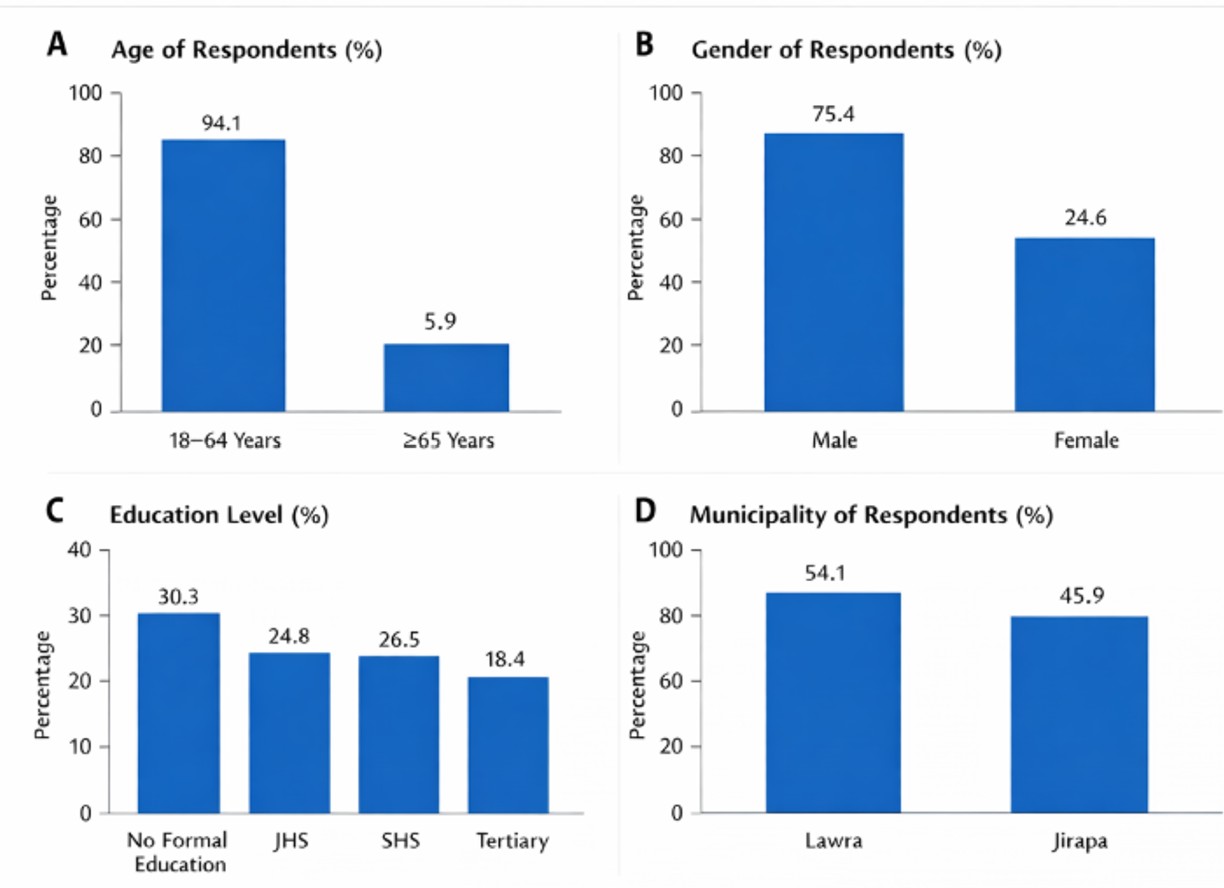
The majority (94.1%) of the respondents were between the ages of 18 and 64, whereas a few (5.9%) were 65 years and older. Most (75.4%) respondents were males, while a few (24.6%) were females. A high number (30.3%) of the respondents had no form of formal education, followed by those who had junior high school (JHS) education (24.8%) and senior high school (SHS) education (18.4%), with the lowest number being those with tertiary education (Figure 2). A large proportion (54.1%) of the respondents were from Lawra Municipality, whereas the remaining respondents (45.9%) were from Jirapa Municipality.
Household Dog Ownership Information and Dog Keeping Practices
More (90.6%) household respondents currently own dogs in Jirapa than in Lawra (67%), and this was statistically significant (χ2 = 29.639, p < 0.001). However, the number of households that owned a dog over the past five years was slightly higher (77.5%) in Lawra than in Jirapa (70%), and this was not statistically significant (χ2 = 2.690, p = 0.101). The number of households that owned at most two dogs was higher (89.7%) in Jirapa than in Lawra (62.7%) in the municipality, and this was statistically significant (χ2 = 36.636, p < 0.001, Table 1).
Although household heads were the majority owners of dogs in both municipalities, the number of household heads who owned a dog in Jirapa was higher (87.7%) than in Lawra (69.8%), and this was statistically significant (p < 0.001). Most households in both municipalities bought their dogs; however, the number of households that bought their dogs in Jirapa (82.5%) was higher than in Lawra (74.7%), and this was statistically significant (χ2 = 8.827, p = 0.012). Household heads are responsible for caring for the dogs in the two municipalities; however, the number of household heads caring for dogs in Jirapa was slightly higher (55.2%) than in Lawra (46.2%), and this was not statistically significant (χ2 = 7.8327, p = 0.098). The majority of respondents in both municipalities keep the dogs for security purposes; however, the number of respondents that keep dogs for security purposes was higher (85.1%) in Jirapa than Lawra (77.5%), and this was statistically significant (p = 0.015). Most of the respondents indicated that they have household members who know about caring for dogs; however, the number of household members who know about caring for dogs in Lawra was higher (77.5%) than in Jirapa (52.9%), and this was statistically significant (χ2 = 24.775, p < 0.001).
While the majority (51%) of the respondents in Lawra had the household head as the person with the skills in caring for dogs, followed by the spouse (31.6%), the majority (57.8%) of the respondents in Jirapa had the household head as the person with the skills in caring for dogs, followed by sons (24.4%), and this was statistically significant (χ2 = 16.243, p = 0.001). Regarding sources of knowledge and skills in dog care, a high proportion of respondents from Lawra (47.1%) and Jirapa (38.9%) municipalities reported personal experience as their main source, and this was not statistically significant (χ2 = 7.307, p = 0.063).
Knowledge of rabies in the Municipalities
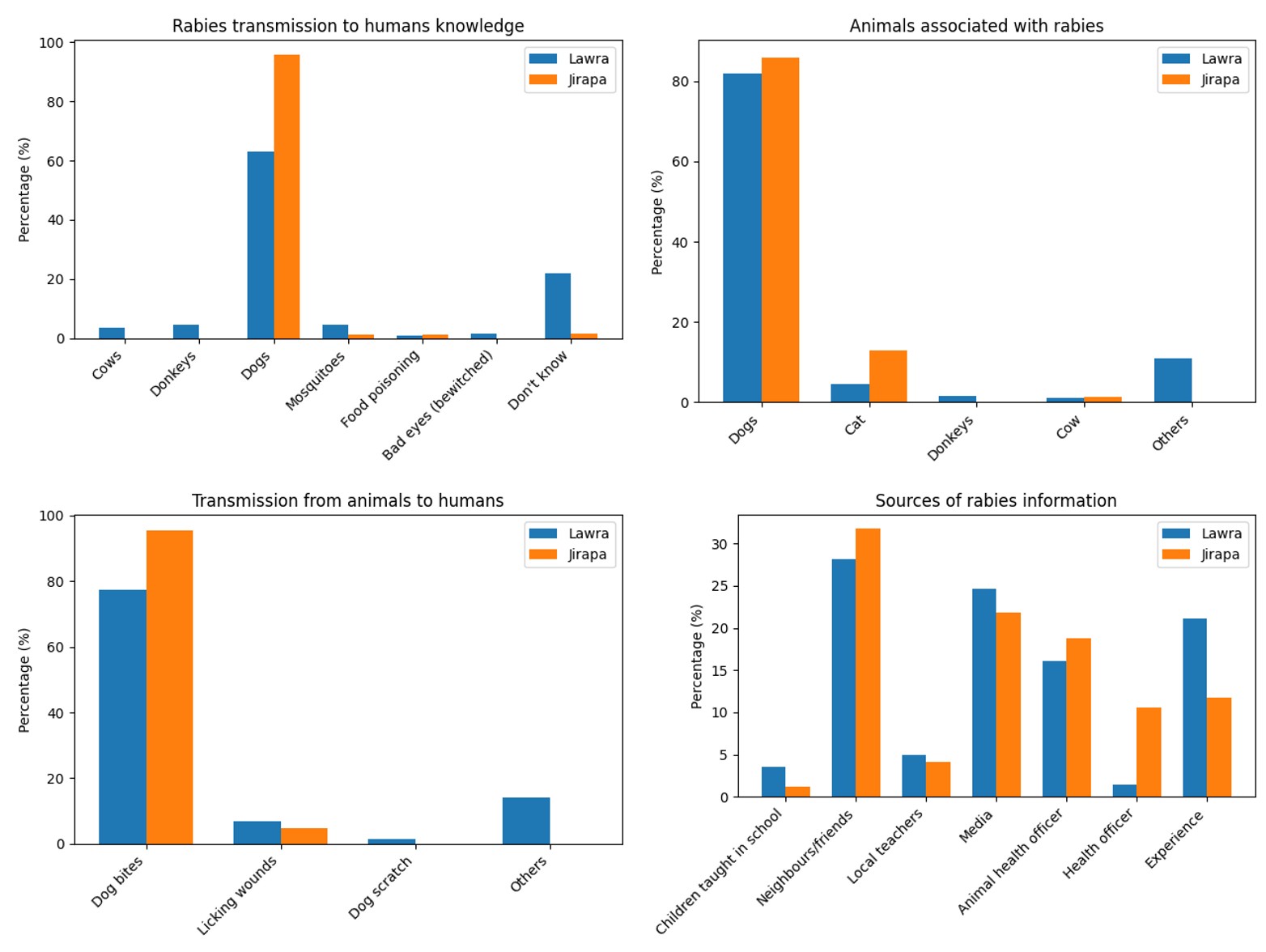
The majority (86%) of the household respondents were aware of rabies; however, the level of households’ rabies awareness was higher in Jirapa Municipality (97.6%) than in Lawra Municipality (77%). Most of the household respondents identified dogs as the reservoirs that transmit rabies; however, the number of household respondents who know that rabies is transmitted to humans by dogs in Jirapa is higher (95.9%) than in Lawra (63%); this was statistically significant (p <0.001). A large proportion of respondents in both municipalities correctly identified dogs as the animal most commonly associated with rabies, with the proportion being higher in Jirapa (85.9%) than in Lawra, and this difference was statistically significant (p < 0.001). Most of the household respondents in both municipalities had their source of information on the mode of rabies transmission as neighbours or friends, followed by the media; however, a higher number of respondents were in Jirapa (31.8%) than those in Lawra (28.1%), and this was statistically significant (p = 0.001, Figure 3).
Attitudes of dog owners toward anti-rabies vaccination
Most respondents vaccinated their dogs against rabies in both municipalities, a positive attitude toward anti-rabies vaccination. The results also revealed that the majority of household respondents from Lawra municipal (61.0%) and Jirapa municipal (74.7%) control rabies in dogs through vaccination, and this was not statistically significant (p = 0.078) between the two municipalities. The majority of household respondents from Lawra (62.6%) and Jirapa (87.6%) vaccinated their dogs at the district veterinary office, and this was statistically significant (p < 0.001) across the two municipalities (Table 2). While the majority of dog owners in Lawra (74.7%) were able to show proof of vaccination certificate, the majority (74.2%) of the household respondents in Jirapa could not show proof of vaccination certificate, and this was statistically significant (χ2 = 45.010, p < 0.001). While a high number of household respondents (22%) in Lawra vaccinated their dogs in 2017, a high number of respondents (22.7%) in Jirapa vaccinated their dogs in 2019. This was statistically significant (p = 0.002). More household respondents (75.8%) in Lawra revaccinated their dogs after the first vaccination than those in Jirapa (56.7%), and this was also statistically significant (χ2 = 7.647, p = 0.006).
Analysis of vaccination frequency showed that in the two study areas, we found that a high number of the respondents (89%) in Lawra vaccinate their dogs annually as compared to those in Jirapa (72.2%), and this was statistically significant (χ2 = 11.365, p = 0.002).
Relationship between the demographic characteristics and rabies-related KAP
Multivariable linear regression analysis was conducted to examine associations between socio‑demographic characteristics and rabies‑related knowledge, attitudes, practices, and control scores (Table 3). Males had knowledge scores 0.138 points higher than females (95% CI: 0.044–0.232). On the original knowledge scale (maximum 7 correct items), this difference corresponds to approximately one additional correct answer (0.138 × 7 ≈ 0.97). Residence in Jirapa (compared to Lawra) was associated with a 0.189‑point higher knowledge score (95% CI: 0.097–0.281), equivalent to about 1.3 additional correct answers out of 7. Age and education had negligible effect sizes (β < 0.02) with confidence intervals crossing zero.
Only the place of residence showed a meaningful association with attitude. Jirapa residents had attitude scores 0.084 points higher than Lawra residents (95% CI: 0.020–0.149), indicating slightly more positive attitudes toward rabies vaccination. Age, gender, and education had effect sizes near zero with wide confidence intervals.
Age and education were associated with better dog bite management practices. Each one‑year increase in age was associated with a 0.045‑point higher practice score (95% CI: 0.009–0.082). On a 0–1 scale, this effect is modest but statistically discernible. Each one‑level increase in education (e.g., from primary to junior high school) was associated with a 0.061-point higher practice score (95% CI: 0.025–0.096), equivalent to approximately half a standard deviation improvement. Gender and residence showed no meaningful associations (confidence intervals included zero, and effect sizes were small).
No socio‑demographic variable showed a meaningful association with rabies control scores. All β coefficients were small (absolute values < 0.07) and confidence intervals crossed zero, indicating that these demographic characteristics do not predict how respondents would handle a suspected rabid dog.
This study assessed rabies-related knowledge, attitudes, and practices among dog owners in two rural municipalities in Ghana’s Upper West Region and identified important gaps relevant to rabies control efforts. Although overall awareness of rabies was high, particularly in Jirapa, this did not consistently translate into appropriate preventive and post-exposure practices, a pattern also reported in other parts of Ghana and sub-Saharan Africa [10, 16]
High rabies awareness observed in this study aligns with findings from rural and urban communities in Ghana, where awareness has increased following periodic public health sensitization campaigns [2, 3]. However, the observed municipal-level differences suggest unequal access to veterinary and health education services. Knowledge gaps regarding rabies transmission pathways and symptom recognition persist, consistent with previous studies reporting partial or inaccurate understanding of rabies despite high awareness [9, 16].
The generally positive attitudes toward dog vaccination observed in this study are encouraging and comparable to findings from other Ghanaian settings [2, 17]. Nevertheless, inconsistencies in vaccination frequency and poor documentation, particularly in Jirapa, reflect broader systemic challenges related to irregular vaccination campaigns, limited access to veterinary services, and weak record-keeping systems. Similar barriers to sustained dog vaccination have been documented across Africa [11, 12]
Associations between education, age, and safer practices observed in this study underscore the role of health literacy in rabies prevention and control. Similar associations have been reported in Ghana and elsewhere, where higher education levels are linked to improved disease prevention behaviours [18-20]. The lack of strong demographic predictors for rabies control practices suggests that structural factors, including service availability and enforcement of dog vaccination regulations, may play a more critical role than individual characteristics.
These findings emphasize that achieving rabies elimination in rural Ghana requires more than awareness creation. Sustained dog vaccination coverage of at least 70%, improved access to post-exposure prophylaxis, and integrated One Health approaches are essential to meet national and global rabies elimination targets [5, 7]. Strengthening collaboration between the Veterinary Services Directorate, Ghana Health Service, local governments, and community stakeholders remains critical for effective rabies control.
Although several socio-demographic variables were associated with rabies-related knowledge and practices, these findings should be interpreted cautiously because the cross-sectional design does not permit causal inference.
The observed associations have practical implications for rabies control. The difference in attitudes between municipalities, though modest in magnitude, suggests that targeted awareness campaigns in Lawra could help close the gap. Furthermore, the positive association between education and appropriate dog bite practices highlights the potential value of integrating rabies education into school curricula. These community‑specific strategies, alongside sustained vaccination and surveillance, offer a practical path toward rabies elimination in rural Ghana. Sustained mass dog vaccination campaigns, improved access to post‑exposure prophylaxis, and strengthened surveillance systems remain essential for achieving the global “Zero by 2030” target for eliminating dog‑mediated human rabies.
Limitations
This study has several limitations that should be considered when interpreting the findings. The cross‑sectional design precludes causal inference. Associations between socio‑demographic characteristics and KAP outcomes should not be interpreted as causal; reverse causality or unmeasured confounding may explain observed relationships. The study relied on self‑reported information, which may be subject to recall bias (e.g., inaccurate recollection of dog bite incidents or vaccination dates) and social desirability bias (e.g., overreporting of positive attitudes or practices). While systematic sampling with a random start was used to enhance representativeness, households with free‑roaming dogs or those temporarily absent may have been missed. Additionally, households were nested within communities and municipalities; although regression models adjusted for municipality of residence, village‑level clustering could not be fully modelled due to the absence of community identifiers for all households. The findings may not be generalisable to urban dog‑owning populations or other regions of Ghana with different cultural and service delivery contexts. The internal consistency of the rabies practices score was modest (Cronbach’s α = 0.68), below the conventional threshold of 0.70. Results for this domain should therefore be interpreted with caution. Summative scoring, while practical, assumes equal weighting of items and may oversimplify complex behaviours, a limitation shared by most composite scoring approaches in KAP research. Despite adjustment for key socio‑demographic variables, unmeasured factors such as household income, cultural beliefs about dog ownership, and prior exposure to rabies education campaigns may influence KAP outcomes and were not captured in this study.
This study demonstrated that while rabies awareness is relatively high among dog owners in Lawra and Jirapa, significant gaps remain in knowledge, preventive practices, and health-seeking behaviours following dog bites. Positive attitudes toward vaccination suggest a willingness to engage in rabies prevention, but persistent barriers such as cost, limited access to veterinary services, and reliance on traditional remedies hinder optimal control measures. Strengthening One Health collaboration between the veterinary and public health sectors, supported by local government authorities, traditional leaders, and community stakeholders, will be essential for sustainable rabies prevention and control in rural Ghana. Targeted community education, improved access to vaccination services and post-exposure prophylaxis, and stronger surveillance systems are necessary to address the identified gaps in rabies prevention practices. Future research should evaluate the effectiveness of targeted rabies awareness interventions and explore socio-cultural factors influencing rabies prevention behaviours in rural communities.
What is already known about the topic
What this study adds
The authors are grateful to the Veterinary Services Directorate of Ghana for its support during the conduct of this study. We sincerely thank the Municipal Veterinary Officers, Environmental Health Officers, traditional authorities, and community leaders in the Lawra and Jirapa Municipalities for their invaluable assistance and cooperation throughout the study. We also express our appreciation to all study participants for their willingness to participate and share their experiences. Finally, we acknowledge the dedication of the field assistants and volunteers whose contributions to data collection were instrumental to the successful completion of this work.
Richard Dery Suu-Ire and Benjamin Tetteh Mensah, conceived and supervised the study. Alijata Issah Beninmie, Samuel Asumah, and Richard Dery Suu-Ire contributed to the study design and methodology. Alijata Issah Beninmie, Samuel Asumah, Meyir Yiryele Ziekah, Sylvester Languon, Bonodong Zongnukuu Guri, Suleman Sako, and Benjamin Kissi Sasu were involved in data collection. Richard Dery Suu-Ire, Benjamin Tetteh Mensah, Victor Emmanuel Manieson, and Amos Sarpong Agyei analysed and interpreted the data. Alijata Issah Beninmie, Benjamin Tetteh Mensah, and Richard Dery Suu-Ire prepared the first draft of the manuscript. Victor Emmanuel Manieson, Amos Sarpong Agyei, Henry Asigri Abugri, Samuel Otis Bel-Nono, Hampton Russell Coombs, Meyir Yiryele Ziekah, Sylvester Languon, Bonodong Zongnukuu Guri, Suleman Sako, and Benjamin Kissi Sasu critically reviewed the manuscript. All authors read and approved the final manuscript.
| Variable | Municipality, n(%) | Chi-Square Test/Fisher’s Exact | ||
|---|---|---|---|---|
| Lawra | Jirapa | χ² | P-Value | |
| Household currently owns a dog | ||||
| Yes, n (%) | 134(67.0) | 154(90.6) | 29.639 | <0.001 |
| No, n (%) | 66(33.0) | 16(9.4) | ||
| Household owned a dog 5 years ago | ||||
| Yes, n (%) | 155(77.5) | 119(70.0) | 2.690 | 0.101 |
| No, n (%) | 45(22.5) | 51(30.0) | ||
| Number of dogs owned by household | ||||
| 1, n (%) | 43(32.1) | 82(53.3) | ||
| 2, n (%) | 41(30.6) | 56(36.4) | ||
| 3, n (%) | 17(12.7) | 10(6.5) | 36.636 | <0.001 |
| 4, n (%) | 16(11.9) | 6(3.9) | ||
| ≥5, n (%) | 17(12.7) | 0(0.0) | ||
| Owners of household dogs | ||||
| Household head, n (%) | 127(69.8) | 135(87.7) | ||
| Spouse, n (%) | 22(12.1) | 2(1.3) | ||
| Son(s), n (%) | 20(11.0) | 6(3.9) | – | <0.001 |
| Daughter(s), n (%) | 8(4.4) | 0(0.0) | ||
| Other, n (%) | 5(2.7) | 11(7.1) | ||
| Source of household dog | ||||
| Offspring of own bitch, n (%) | 24(13.19) | 22(14.3) | ||
| Bought or traded, n (%) | 136(74.7) | 127(82.5) | 8.827 | 0.012 |
| Gift, n (%) | 22(12.1) | 5(3.2) | ||
| Person caring for the dog | ||||
| Household head, n (%) | 84(46.2) | 85(55.2) | ||
| Spouse, n (%) | 44(24.2) | 30(19.5) | ||
| Son(s), n (%) | 25(13.7) | 16(10.4) | 7.8327 | 0.098 |
| Daughter(s), n (%) | 19(10.4) | 8(5.2) | ||
| Others, n (%) | 10(5.5) | 15(9.7) | ||
| Reason for keeping household dog | ||||
| Security, n (%) | 141(77.5) | 131(85.1) | ||
| Service (herding, hunting), n (%) | 18(9.9) | 10(6.5) | ||
| Business (keep to sell), n (%) | 9(4.9) | (0.0) | – | 0.015 |
| Companionship, n (%) | 14(7.7) | 13(8.4) | ||
| Availability of skilled household member for dog care | ||||
| Yes, n (%) | 155(77.5) | 90(52.9) | 24.775 | <0.001 |
| No, n (%) | 45(22.5) | 80(47.1) | ||
| Availability of skilled member in dog caring | ||||
| Household head, n (%) | 79(51.0) | 52(57.8) | ||
| Spouse, n (%) | 49(31.6) | 10(11.1) | ||
| Son(s), n (%) | 18(11.6) | 22(24.4) | 16.243 | 0.001 |
| Daughter(s), n (%) | 9(5.8) | 6(6.7) | ||
| Source of dog care knowledge/expertise | ||||
| Trained by animal health officer, n (%) | 24(15.5) | 26(28.9) | ||
| Taught in school, n (%) | 14(9.0) | 10(11.1) | 7.307 | 0.063 |
| Media (radio, Tv), n (%) | 44(28.4) | 19(21.1) | ||
| Experience, n (%) | 73(47.1) | 35(38.9) | ||
| Variables | Lawra, n (%) | Jirapa, n (%) | P-value |
|---|---|---|---|
| Preferred method for rabies control in dogs | |||
| Treatment | 31 (15.5) | 16 (9.5) | 0.078 |
| Spraying | 3 (1.5) | 0 (0.0) | |
| Isolation | 25 (12.5) | 15 (8.8) | |
| Vaccination | 122 (61.0) | 127 (74.7) | |
| Castration | 5 (2.5) | 2 (1.2) | |
| Others | 14 (7.0) | 10 (5.5) | |
| Place of vaccination | |||
| District veterinary office | 57 (62.6) | 85 (87.6) | <0.001 |
| Private animal health office | 6 (6.6) | 8 (8.3) | |
| Medical health office | 0 (0.0) | 2 (2.1) | |
| RIWA-GH campaign | 28 (30.8) | 0 (0.0) | |
| Don’t know | 0 (0.0) | 2 (2.1) | |
| Evidence of vaccination certificate | |||
| Not seen | 23 (25.3) | 72 (74.2) | <0.001 |
| Seen | 68 (74.7) | 25 (25.9) | |
| Time of first vaccination | |||
| 2012 | 0 (0.0) | 4 (4.1) | 0.002 |
| 2014 | 6 (6.6) | 0 (0.0) | |
| 2015 | 4 (4.4) | 2 (2.1) | |
| 2016 | 7 (7.7) | 6 (6.2) | |
| 2017 | 20 (22.0) | 19 (19.6) | |
| 2018 | 8 (8.8) | 8 (8.3) | |
| 2019 | 13 (14.3) | 22 (22.7) | |
| 2020 | 3 (3.3) | 12 (12.4) | |
| Dog revaccinated after first vaccination | |||
| Yes | 69 (75.8) | 55 (56.7) | 0.006 |
| No | 22 (24.2) | 42 (43.3) | |
| Frequency of vaccination | |||
| Yearly | 81 (89.0) | 70 (72.2) | 0.002 |
| Once every 2 years | 4 (4.4) | 20 (20.6) | |
| More than 2 years | 6 (6.6) | 7 (7.2) | |
| Reason for not vaccinating dog | |||
| There is no need | 14 (15.7) | 12 (21.1) | 0.048 |
| Not aware of vaccination exercise | 34 (38.2) | 26 (45.6) | |
| Difficult to restrain the dog | 15 (16.8) | 2 (3.5) | |
| Dog ran away | 15 (16.8) | 6 (10.5) | |
| No one was available | 9 (10.1) | 11 (19.3) | |
| Vaccine kills dogs | 2 (2.3) | 0 (0.0) | |
| Predictor (Reference category) | Knowledge β (95% CI) | p-value | Attitude β s (95% CI) | p-value | Practices β (95% CI) | p-value | Control β (95% CI) | p-value |
|---|---|---|---|---|---|---|---|---|
| Age | 0.019 (-0.005, 0.043) | 0.119 | -0.014 (-0.040, 0.012) | 0.293 | 0.045 (0.009, 0.082) | 0.016 | -0.006 (-0.042, 0.030) | 0.740 |
| Gender (male/female) | 0.138 (0.044, 0.232) | 0.004 | 0.002 (-0.074, 0.078) | 0.956 | -0.123 (-0.249, 0.003) | 0.055 | -0.053 (-0.166, 0.059) | 0.357 |
| Education | 0.009 (-0.008, 0.026) | 0.299 | -0.010 (-0.033, 0.013) | 0.383 | 0.061 (0.025, 0.096) | 0.001 | -0.023 (-0.057, 0.011) | 0.181 |
| Residence (Jirapa/Lawra) | 0.189 (0.097, 0.281) | <0.001 | 0.084 (0.020, 0.149) | 0.010 | 0.088 (-0.018, 0.193) | 0.106 | -0.061 (-0.159, 0.036) | 0.222 |
Note: β = regression coefficient; CI = confidence interval; p-values significant at α = 0.05.