
Outbreak Investigation | Open Access | Volume 9 (Suppl 12): Article 08 | Published: 23 Jul 2026

Views: 1,502
Menu, Tables and Figures
| Attributes | Indicators | Performance threshold | Result (%) n=25 | Score | Attribute performance |
|---|---|---|---|---|---|
| Simplicity | Knowledge of dengue case definition | ≥ 80% yes | 4(16) | 0 | 0% |
| Knowledge of dengue notification circuit | ≥ 80% yes | 7(28) | 0 | ||
| Knowledge of dengue sample routing circuit | ≥ 80% yes | 2(8) | 0 | ||
| Acceptability | Health staff consider dengue surveillance as part of their job | ≥ 80% yes | 12(48) | 0 | 0% |
| Health staff report suspected cases | ≥ 80% yes | 0(0) | 0 | ||
| Stability | Availability of a focal person for surveillance | ≥ 80% yes | 20(80) | 1 | 20% |
| Sufficient stock of notification forms (more than 30) | ≥ 80% yes | 0(0) | 0 | ||
| Computer dedicated to data surveillance | ≥ 80% yes | 12(48) | 0 | ||
| Access to internet | ≥ 80% yes | 16(64) | 0 | ||
| Means of transportation for samples | ≥ 80% yes | 6(24) | 0 |
Table 1: Surveillance system evaluation of dengue fever, Mfandena I, Cameroon, 2025
Samantha Awoumou1,&, Vanessa Nzalli1, Evaristus Ncham1,2, Flore Balana1,2, Ghislaine Bineli1, Olivier Tatsilong2, Basile Kamgang3, Armel Evouna Mbarga4, Armelle Ngomba2, Linda Esso1,2,5
1Field Epidemiology Training Program, Ministry of Public Health, Yaounde, Cameroon, 2Department of Disease Control, Epidemics and Pandemics, Ministry of Public Health, Yaounde, Cameroon, 3Centre for Research in Infectious Diseases, Yaounde, Cameroon, 4Department of Public Health and Social Sciences, Faculty of Medicine and Pharmaceutical Sciences of Sangmelima, University of Ebolowa, Ebolowa, Cameroon, 5Department of Public Health, Faculty of Medicine and Biomedical Sciences, University of Yaounde, Yaounde, Cameroon
&Corresponding author: Samantha Awoumou, Field Epidemiology Training Program, Ministry of Health, Yaounde, Cameroon, Email: samanthaawoumou97@gmail.com, ORCID: https://orcid.org/0009-0007-0000-1926
Received: 15 Dec 2025, Accepted: 16 Jul 2026, Published: 23 Jul 2026
Domain: Infectious Disease Epidemiology
Keywords: Dengue, outbreak, surveillance, Cameroon
©Samantha Awoumou et al. Journal of Interventional Epidemiology and Public Health (ISSN: 2664-2824). This is an Open Access article distributed under the terms of the Creative Commons Attribution International 4.0 License (https://creativecommons.org/licenses/by/4.0/), which permits unrestricted use, distribution, and reproduction in any medium, provided the original work is properly cited.
Cite this article: Samantha Awoumou et al., Dengue outbreak investigation in Mfandena I Health Area, Cameroon, 2025: Evidence of Aedes vectors and routine surveillance gaps. Journal of Interventional Epidemiology and Public Health. 2026; 9(Suppl 12):08. https://doi.org/10.37432/jieph-d-25-00325
Introduction: In December 2024, a sudden increase in dengue cases was reported in Mfandena I health area (HA), Yaounde, Cameroon. Two confirmed cases that escaped routine surveillance were notified, and little data were available. A multidisciplinary team was deployed to conduct active case-finding, identify potential vectors and their larval habitats, and evaluate the dengue surveillance system.
Methods: We conducted a cross-sectional study in January 2025 (dry season) in Mfandena I HA. Cases were identified through healthcare records reviews and community screening. Suspected cases were people living in Mfandena I HA with fever >38.5°C lasting 2-7 days and at least two of the following symptoms: headache, retro-orbital pain, myalgia, arthralgia, skin rash, hemorrhagic manifestations since November 2024. Immunoglobulin M (IgM) and non-structural protein 1 (NS1) tests were carried out on consenting suspected cases and their contacts. An entomological survey was conducted within a 1 km radius around the case residences. We followed the CDC framework combined with the WHO IDSR approach for surveillance system evaluation.
Results: We identified 46 dengue cases (44 suspected cases and 02 confirmed cases) and 16 contacts, but no additional cases were confirmed. Dengue cases were mostly women aged 21 years or older, with fever, arthralgia, and headache as main symptoms. The confirmed cases were male adults: one residing in Cameroon and one arriving from France, both presenting with fever and a red-spot rash. Among 143 Aedes mosquitoes collected, Ae. albopictus accounted for 88% (126/143). We detected a discarded tyre containing Ae. albopictus larvae as the likely source of infection. The surveillance system exhibited gaps in detection and reporting and was neither simple, acceptable, nor stable. Only 16% (4/25) of staff were familiar with the case definition, no sites had notification forms, and no cases had ever been reported.
Conclusion: This investigation suggests potential dengue transmission in Mfandena I HA and highlights important surveillance gaps that limited timely detection and reporting. Strengthening surveillance capacity and reinforcing routine entomological investigations are essential to improve outbreak detection, response and prevention.
Dengue is an important reemergent viral vector-borne disease transmitted to humans by infected Aedes mosquitoes, notably Ae. aegypti and Ae. albopictus. Viral spread involves both human mobility and vector movement, with mosquito dispersal typically limited to less than 1 km [1]. Disease is usually asymptomatic, but clinical presentation ranges from mild to severe forms with fatal outcomes. Heterologous infections with different serotypes can lead to severe dengue hemorrhagic fever, multiorgan impairments, shock and death [2]. There is no specific treatment, and the use of vaccines remains limited.
Since 2021, the number of dengue cases has risen continuously, reaching 14.1 million in 2024, almost twice the number reported in 2023 and the highest ever recorded. Climate change, urbanisation, and globalisation have contributed to the rapid spread of the disease, and an estimated 5.66 billion people now live in high-risk areas worldwide [3, 4]. In Africa, dengue cases increased approximately ninefold between 2019 and 2023, with West and Central Africa among the most at-risk areas [3, 5]. Despite this situation, a 2022 World Health Organization (WHO) survey indicated that no country in the African region had adequate arboviral surveillance capacity. Moreover, clinical overlap with other endemic febrile illnesses contributes to frequent misdiagnosis [6, 7].
In Cameroon, environmental and demographic conditions sustain favourable conditions for dengue transmission. Previous studies have reported circulation of all four dengue serotypes, with seroprevalence estimates ranging from 12.8% to 45.4%, reflecting substantial transmission across the country [8, 9]. According to the national surveillance guidelines, a single laboratory-confirmed dengue case is sufficient to reach the epidemic threshold. However, no outbreak has been officially reported since 2017. Limited surveillance sensitivity may result in under-detection; therefore, even a small number of confirmed dengue cases may signal a larger, undetected outbreak.
In December 2024, two confirmed cases were detected in the Mfandena I health area (HA) in Yaounde city, Centre Region of Cameroon. These cases escaped the national routine surveillance chain; one was reported abroad after a medical evacuation, and the other by the national reference arboviruses laboratory. This raised concerns about possible ongoing silent transmission and weaknesses in surveillance. Therefore, a multidisciplinary team was deployed to detect additional cases, identify vectors and larval habitats and evaluate the dengue surveillance system in Mfandena I HA.
Study setting
This study was conducted in Mfandena I HA within the Mvog-Ada health district in Yaounde, Cameroon. Yaounde is a densely populated urban setting. The area has an equatorial climate with alternating rainy and dry seasons, creating favourable conditions for Aedes proliferation through water accumulation in artificial containers and inadequate waste management [11]. These factors contribute to seasonal increases in dengue transmission, particularly during the rainy periods, with possible persistence during the dry season due to household water storage practices [12, 13].
Cameroon’s health system is decentralised, with health districts and health areas as the operational level. Mfandena I includes 22 health facilities providing primary care and contributing to routine surveillance through case detection, confirmation and notification. Dengue surveillance is part of the national Integrated Disease Surveillance and Response (IDSR) system, with weekly reporting through the District Health Information System 2 (DHIS2) [10]. However, surveillance remains largely passive, with limited diagnostic capacity and resources [7].
Study design and period
We conducted a descriptive cross-sectional study as part of a dengue outbreak investigation following the identification of confirmed cases. The investigation covered the period from 9 November 2024 to 12 January 2025, corresponding to twice the maximum incubation period prior to symptom onset of the index case to the end of the investigation. Data was collected from 07 to 12 January 2025 during the dry season. This design enabled a rapid assessment of the outbreak, including case identification and evaluation of transmission risk.
Study population and sampling
A convenience sampling approach was used. In health facilities, all individuals recorded during the study period who met the suspected case definition were included. In the community, households within a 1 km radius of confirmed cases’ residences were selected based on the typical dispersal range of Aedes mosquitoes to target areas at highest risk of transmission. In each house, suspected cases and contacts were enrolled. Entomological investigations were conducted within the same selected household, with all potential larval habitats inspected for the collection of mosquitoes. For the surveillance system evaluation, we included the confirmed case, healthcare workers involved in the management of the confirmed case, and surveillance focal persons. The main exclusion criterion was refusal to provide consent.
Case definitions
We applied contextualized case definitions from the third edition of the technical guidelines on integrated disease surveillance and response of Cameroon [10]. Any person presenting with a fever >38.5°C (101.3°F) lasting 2 to 7 days associated with at least two of the following symptoms: headache, retro-orbital pain, myalgia, arthralgia, rash, hemorrhagic manifestations was classified as a suspected case. A positive non-structural protein 1 (NS1) antigen test or immunoglobulin M (IgM) serology confirmed the disease. A contact was defined as any individual living in the investigation area around a confirmed case during the exposure period.
Data collection
Case finding
We conducted case finding in health facilities and the community using the same case definition. In 22 health facilities, we reviewed registries to identify suspected cases. In the community, we conducted door-to-door case finding in 25 households to enrol additional suspected cases and contacts. Blood samples from all consenting participants were collected, maintained below 8 °C and transported within 24 hours for dengue testing (IgM ELISA and NS1 antigen), with additional testing for other arboviruses.
Entomological surveys
We inspected each selected dwelling and its surroundings during daytime for approximately 15 minutes. All water-holding containers were examined, and those with larvae or pupae were recorded as positive and sampled. Adult mosquitoes were collected from outdoor resting sites using a Prokopack aspirator. Specimens were transported to the insectary, knocked down at -20°C, identified under a binocular magnifying glass using standard morphological keys, and conserved per genus. Immature stages of Aedes were reared to adults before identification.
Surveillance system evaluation
We identified surveillance gaps using a case study approach by reconstructing the patient pathway through medical record review and interviews with the confirmed resident case and four caregivers. We evaluated the routine surveillance system by interviewing 25 surveillance focal persons from 22 health facilities, along with observation and record review. The evaluation followed the CDC framework, adapted with WHO IDSR approach. Simplicity was assessed through knowledge of case definition, reporting, and sample referral; acceptability through reporting practices and perceived responsibility; and stability through availability of key resources (staff, tools, internet, transport). Indicators were scored 1 if ≥80% of respondents met the criterion and 0 otherwise. Attribute performance was expressed as percentages of indicators meeting this threshold and classified as satisfactory (≥80%), moderate (60–79%), or poor (<60%). The 80% threshold was used as a pragmatic benchmark commonly applied in public health evaluations consistent with operational feasibility.
Data management and analysis
We used Microsoft Excel for data analysis. The dataset was cleaned to ensure accuracy, completeness, and consistency. Frequencies and percentages were calculated for qualitative variables, while medians and modes were calculated for quantitative variables. The results were presented in tables and figures.
Ethical consideration
The investigation was conducted as part of a public health response with authorisation from the Ministry of Public Health, in accordance with national guidelines. Formal institutional review board approval was not required. All participants provided written informed consent before participation, including for biological sample collection. For minors, consent was obtained from parents or legal guardians. Participation was voluntary, and individuals were free to withdraw at any time without any consequences. Confidentiality was ensured through anonymisation, and data were used solely for public health purposes.
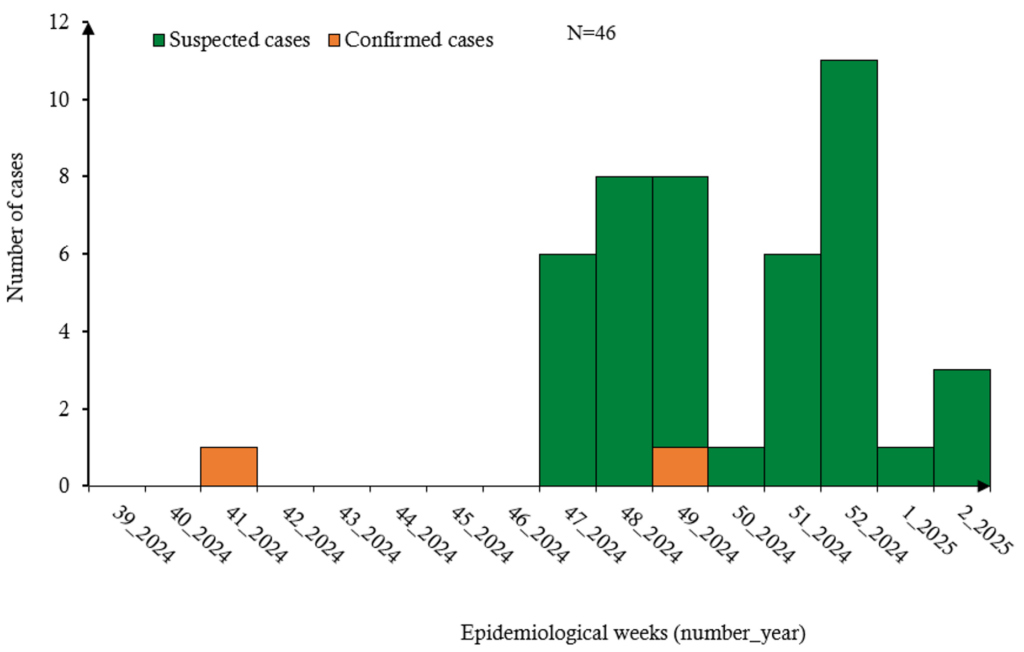
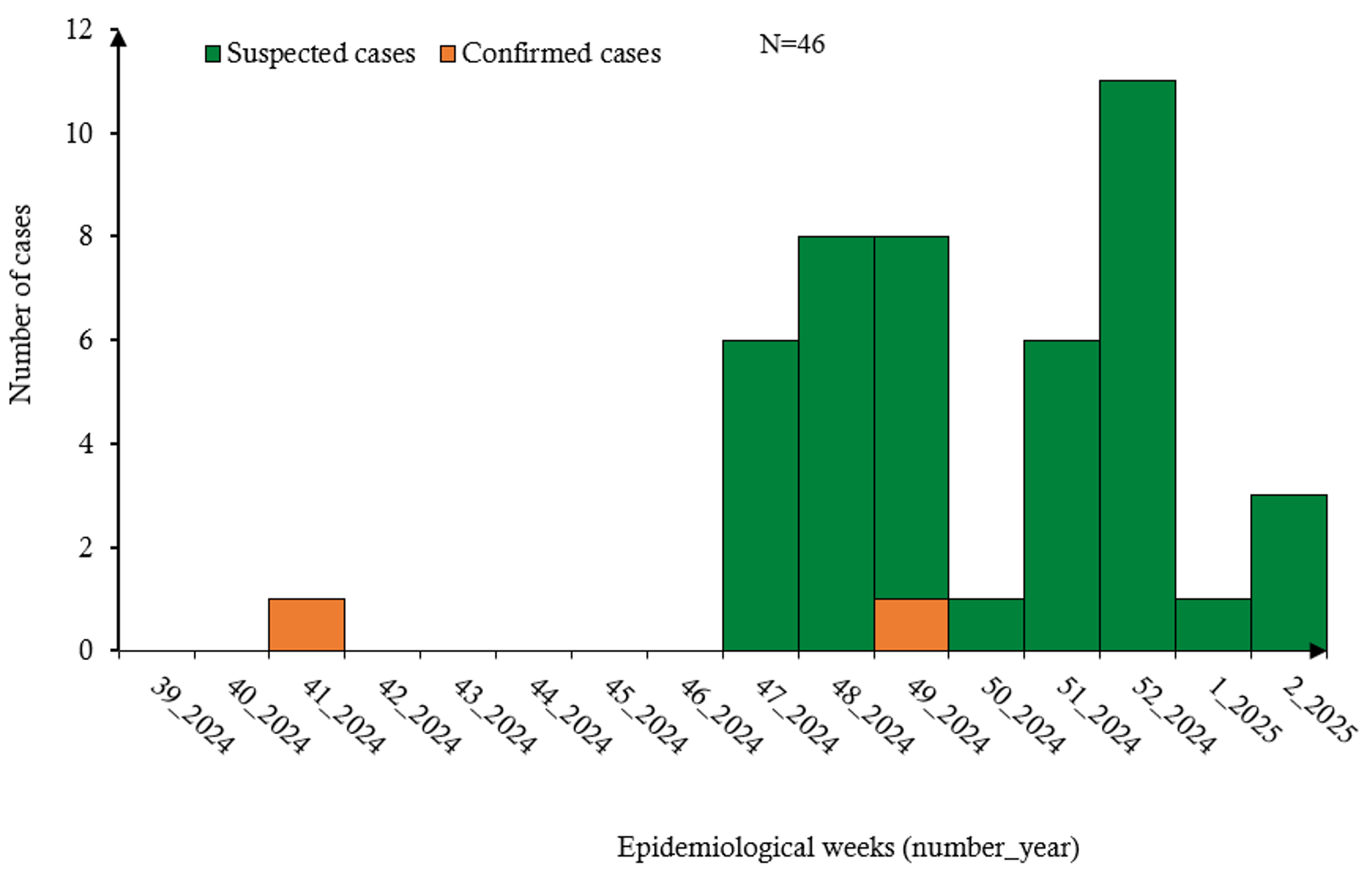
We found 46 dengue cases (44 suspected, 2 confirmed) and 16 asymptomatic contacts. The male-to-female ratio among dengue cases was 0.7, and 73.9% (34/46) were aged ≥21 years, indicating a predominance of adult females. Clinical presentation was dominated by fever (100%), arthralgia (93.5%), and headache (91.3%), reflecting a non-specific febrile syndrome. No additional dengue cases or other arboviral infections were detected. Only 20% (12/60) of participants were tested, while 63% (38/60) could not be traced, and 17% (10/60) declined participation, limiting case confirmation. The epidemic curve (Figure 1) shows peaks between weeks 47–49 and week 52.
Larval habitat and vectors identification
Among the 25 households surveyed, one positive larval habitat was identified, located at the house of the confirmed case. It consisted of a discarded car tyre, containing Ae. albopictus larvae and pupae. No other potential larval habitats were identified in the remaining households.
A total of 502 adult mosquitoes were collected, including 28.5% (143/502) Aedes and 71.5% (359/502) Culex. Aedes albopictus was the predominant Aedes species with 88% (126/143), mainly found in vegetation and discarded containers. The dry season likely limited the detection of larval habitats and the calculation of infestation indices.
Surveillance system evaluation
Outbreak-based evaluation
Two main surveillance gaps affecting case detection and notification were identified from the investigation of the two confirmed cases. In the first case, dengue diagnosis was missed despite a compatible clinical presentation and was only confirmed after medical evacuation abroad by PCR testing, with notification occurring 67 days after symptom onset. In the second case, dengue was detected locally but not reported by the health facilities; notification occurred 11 days after symptom onset and three days after confirmation. Although based on a limited number of cases, this analysis identified key drivers of delayed case detection and reporting, including poor recognition of dengue, limited awareness of notification procedures, and insufficient diagnostic capacity. These findings align with the performance of key surveillance attributes, particularly simplicity and acceptability.
Routine surveillance evaluation
Among participants, women and nursing staff were predominant, both accounting for 76% (19/25). The median age was 32 years, and the median duration of service as a health worker was 5 years. Table 1 presents the performance of simplicity, acceptability and stability.
Simplicity: knowledge of dengue surveillance procedures was low. Only 16% (4/25) of participants correctly stated the case definition, 28% (7/25) reported knowledge of the notification process, and 8% (2/25) were aware of the sample referral procedures. Limited understanding of core surveillance functions indicates that the system is not operationally simple (score = 0%).
Acceptability: Half of the participants (12/25) did not consider dengue surveillance as part of their routine work, and none had ever reported a case, reflecting weak engagement of health workers and poor acceptability (score =0%).
Stability: System stability showed mixed but overall insufficient performance. Although 80% (20/25) reported the presence of a surveillance focal person in their facility, essential operational resources were limited for consistent surveillance functioning, resulting in poor overall stability (score = 20%).
Active case finding did not identify additional confirmed cases. This was limited by a small effective sample size due to low community participation and difficulties in tracing suspected cases. In addition, surveillance system gaps led to delayed detection and a late investigation conducted when some cases may have resolved and viral markers become less detectable. The absence of additional cases may also reflect lower transmission intensity during the dry season, as suggested by the limited number of positive larval habitat indicating reduced vector density. [13]. While the index cases were confirmed by PCR, active case finding for additional infections relied on IgM and NS1 antigen testing, which may have reduced sensitivity and contributed to missed infections, particularly in early or asymptomatic cases [14]. In addition, the non-specific nature of the case definition may have limited accurate case identification.
The entomological investigation identified both Ae. aegypti and Ae. albopictus, with Ae. albopictus being the predominant species. This finding is consistent with previous studies and may indicate suitable conditions for dengue infection in Mfandena I. However, only one positive larval habitat was detected, and standard entomological indices could not be calculated. This is mainly attributable to the limited number of households inspected, the targeted nature of the outbreak investigation, prioritizing rapid case detection and dry season conditions, likely reducing the availability of larval habitats [12]. Overall, these findings are indicative of a potential risk of dengue transmission and highlight the need to strengthen routine entomological surveillance beyond outbreak investigations.
In Cameroon, dengue surveillance is integrated into routine healthcare services. However, this outbreak revealed weaknesses across the 7-1-7 cascade, contributing to delayed detection, notification, and response. Concerning the 7-day detection target, the first case was only identified and confirmed abroad, reflecting failure of early detection linked to poor system simplicity, limited knowledge of dengue, non-specific clinical presentation, and restricted diagnostic capacity [7, 15]. For the notification phase, delays ranged from 11 to 67 days, far exceeding the 1-day target, and no cases followed standard reporting procedures. This is consistent with low acceptability, reflecting limited engagement of health workers, poor awareness of reporting requirements, heavy workload, and prioritisation of more common febrile diseases. Weak system stability, including logistical constraints, further contributed to these delays [7, 16]. As a result, these failures delayed outbreak response, which was initiated several weeks after symptom onset, limiting timely case identification and public health action.
Several limitations may have influenced the findings of this study. These included the small number of confirmed cases, the sampling approach, the delayed investigation, and the absence of PCR testing and dry season conditions. Future studies should include broader case-finding strategies, PCR diagnosis, and repeated entomological surveys across different seasons.
This investigation suggests possible dengue transmission in Mfandena I, supported by the identification of confirmed cases, suspected cases, and Aedes vectors. However, the findings are constrained by the small number of confirmed cases, dry season conditions, and limited diagnostic capacity. Critical surveillance gaps were identified, including limited diagnostic capacity, logistical constraints, insufficient health worker knowledge and engagement. Strengthening diagnostic capacity and entomological investigations, improving health worker training and addressing operational weaknesses are essential to enhance early detection and control of dengue outbreaks.
What is already known about the topic
What this study adds
| Attributes | Indicators | Performance threshold | Result (%) n=25 | Score | Attribute performance |
|---|---|---|---|---|---|
| Simplicity | Knowledge of dengue case definition | ≥ 80% yes | 4(16) | 0 | 0% |
| Knowledge of dengue notification circuit | ≥ 80% yes | 7(28) | 0 | ||
| Knowledge of dengue sample routing circuit | ≥ 80% yes | 2(8) | 0 | ||
| Acceptability | Health staff consider dengue surveillance as part of their job | ≥ 80% yes | 12(48) | 0 | 0% |
| Health staff report suspected cases | ≥ 80% yes | 0(0) | 0 | ||
| Stability | Availability of a focal person for surveillance | ≥ 80% yes | 20(80) | 1 | 20% |
| Sufficient stock of notification forms (more than 30) | ≥ 80% yes | 0(0) | 0 | ||
| Computer dedicated to data surveillance | ≥ 80% yes | 12(48) | 0 | ||
| Access to internet | ≥ 80% yes | 16(64) | 0 | ||
| Means of transportation for samples | ≥ 80% yes | 6(24) | 0 |