Research | Open Access | Volume 9 (3): Article 130 | Published: 06 Aug 2026

Views: 605
Menu, Tables and Figures
| Characteristics | Absolute value (n) | Frequency (%) |
|---|---|---|
| Sex | ||
| Male | 552 | 65.3 |
| Female | 293 | 34.6 |
| Age range | ||
| 18–28 | 32 | 3.8 |
| 29–39 | 113 | 13.4 |
| 30–40 | 385 | 45.6 |
| 41–51 | 206 | 23.4 |
| 52–62 | 103 | 12.1 |
| 63–73 | 6 | 0.7 |
| Education | ||
| Educated | 542 | 64.1 |
| Uneducated | 303 | 35.8 |
| Region of residence | ||
| Urban | 502 | 59.4 |
| Rural | 343 | 40.5 |
| Socio-economic level | ||
| Low | 657 | 77.7 |
| AVERAGE | 103 | 12.1 |
| High | 85 | 10.1 |
Table 1: Sociodemographic characteristics of community members interviewed in the Kédougou SD in November 2022 (n = 845)
| Variables | Absolute value (n) | Frequency (%) |
|---|---|---|
| Information on rabies | 547 | 64.7 |
| Already seen a rabid animal | 388 | 45.9 |
| Who can be affected by rabies | ||
| Man | 163 | 19.3 |
| Dog | 411 | 48.6 |
| Cat | 68 | 8.1 |
| Horse | 1 | 0.1 |
| Donkey | 34 | 4.0 |
| Other | 168 | 19.9 |
| Information on rabies | 547 | 64.7 |
| Rabies is a serious disease | 525 | 62.1 |
| Mode of transmission | 434 | 51.4 |
| Knowledge of prevention | 342 | 40.5 |
| Knowledge of the number of vaccine doses to take | 28 | 3.3 |
| Knowledge of the price of animal rabies vaccine | 48 | 5.7 |
| Knowledge of the point of sale of the rabies vaccine | 214 | 25.3 |
Table 2: Knowledge of community members regarding rabies exposure, prevention, and control in the Kédougou district in 2022 (n = 845)
| Variables | Frequency (n) | Percent (%) |
|---|---|---|
| Owning dogs or cats in the home (N = 845) | 377 | 44.6 |
| Vaccination status of animals (N = 367) | 9 | 2.5 |
| Possession of vaccination records (N = 367) | 9 | 2.5 |
| Financial possibility of purchasing the vaccine (N = 48) | 30 | 62.5 |
| Need to promote rabies prevention practices (N = 845) | 790 | 93.5 |
| Wants to acquire knowledge (N = 845) | 822 | 97.3 |
Table 3: Community members’ attitudes on rabies exposure, prevention and control in Kedougou district in 2022
| Variables | Absolute value (n) | Frequency (%) |
|---|---|---|
| Behavior in front of an individual bitten by your dog | ||
| Bringing to the health structure | 533 | 63.08 |
| Killing the dog | 89 | 10.53 |
| Nothing | 74 | 8.76 |
| Willingness to pay for the vaccine | 574 | 67.93 |
Table 4: Community members’ practices on rabies exposure, prevention and control in the Kédougou district in 2022
| Variables | Rabies Prevention Practice | Adjusted Odds Ratio | 95% CI | P-Value | |
|---|---|---|---|---|---|
| Good N (%) | Low N (%) | ||||
| Place of residence | |||||
| Urban | 44 (8.76) | 458 (91.24) | 1.95 | 1.08–3.70 | 0.027 |
| Rural | 18 (5.25) | 325 (94.75) | |||
| Sex | |||||
| Male | 53 (9.60) | 499 (90.40) | 2.54 | 1.27–5.65 | 0.007 |
| Female | 9 (3.07) | 284 (96.93) | |||
| Age | — | ||||
| Under 30 years of age | 18 (8.07) | 205 (91.93) | 1.04 | 0.55–1.90 | 0.9 |
| More than 30 years | 44 (7.07) | 578 (92.93) | |||
| Education | |||||
| Educated | 49 (9.04) | 493 (90.96) | 0.97 | 0.43–2.39 | 0.9 |
| Uneducated | 13 (4.29) | 290 (95.71) | |||
| Awareness on rabies | |||||
| Yes | 56 (10.22) | 492 (89.78) | 5.57 | 2.46–15.1 | <0.001 |
| No | 6 (2.02) | 291 (97.98) | |||
Table 5 : Factors influencing community-based rabies prevention practices in Kédougou in 2022
Fodé Danfakha1,&, Mamadou Sarifou BA2, Ndeye Mbacke Kane3, Boly Diop3, Moussa Ndiaye4, Matar Ndiaye5, Evariste Jean-Christophe Togut Bassene6, Hamadi Ba7, Ramatoulaye Diop8, Landing Sagna1, Ami Colle Deme1, Marie Noel Sene1, Mbouna Ndiaye2
1Région Médicale de Kedougou – District Sanitaire, Kedougou, Sénégal, 2Programme de formation en épidémiologie de terrain, Dakar, Sénégal, 3Ministère de la santé et de l’action sociale, Dakar, Sénégal, 4Région Médicale de Diourbel – District Sanitaire, Diourbel, Sénégal, 5Région Médicale de Thies – District Sanitaire, Khombol, Sénégal, 6Direction régional de l’élevage, Saint-Louis, Sénégal, 7Région Médicale de Dakar – District Sanitaire, Keur Massar, Sénégal, 8Région Médicale de Louga – District Sanitaire, Linguère, Sénégal
&Corresponding author: Fodé Danfakha, Région Médicale de Kedougou, District Sanitaire, Kedougou, Sénégal, Email: deffode47@gmail.com, ORCID: https://orcid.org/0009-0002-2637-963X
Received: 10 Oct 2024, Accepted: 15 Jul 2026, Published: 06 Aug 2026
Domain: Zoonosis
Keywords: Rabies, zoonosis, neglected tropical disease, bites, Kedougou, Senegal
©Fodé Danfakha et al. Journal of Interventional Epidemiology and Public Health (ISSN: 2664-2824). This is an Open Access article distributed under the terms of the Creative Commons Attribution International 4.0 License (https://creativecommons.org/licenses/by/4.0/), which permits unrestricted use, distribution, and reproduction in any medium, provided the original work is properly cited.
Cite this article: Fodé Danfakha et al., Community knowledge, attitudes and practices regarding rabies prevention in Kédougou, Senegal, 2022. Journal of Interventional Epidemiology and Public Health. 2026; 9(3):130. https://doi.org/10.37432/jieph-d-24-02034
Introduction: Rabies remains a public health problem in Senegal, particularly in the Kédougou region, where one rabies-related death was reported in 2019. The objective of this study was to analyse the knowledge, attitudes and practices (KAP) of communities regarding rabies prevention.
Methods: This cross-sectional study was conducted in the Kédougou district using multistage cluster sampling (n = 845) recommended by WHO. A structured questionnaire was used to collect data on sociodemographic characteristics as well as rabies-related KAP, with a score cut-off of 80%. Frequencies and proportions were presented in tabular form, while odds ratios (ORs), p-values and 95% confidence intervals (CIs) were reported for bivariate analysis. Variables with a p-value less than 0.20 were included in a logistic regression.
Results: Among the 845 participants, 552 (65.3%) were male, with a median age of 40 years [18 to 67 years]. About 25.7% had good knowledge, 19.6% had positive attitudes, and 15.0% reported positive practices towards rabies. Community members who were rabies-aware (aOR = 5.57, CI: 2.46 – 15.1, p = 0.001) and males in the community (aOR = 2.54, CI: 1.27-5.65, p = 0.007) had better rabies preventive practices compared to those who were not rabies aware and their female counterparts.
Conclusion: This study highlighted significant shortcomings in the KAPs in terms of rabies prevention. In order to reduce these gaps, awareness campaigns have been organised, focusing on the communication of the risks associated with this disease. It is therefore essential to design and implement a targeted communication plan geared towards the prevention and effective management of rabies.
Rabies causes approximately 77,000 deaths each year, 44% of which occur in Africa, mostly among children [1]. A person succumbs to this disease every ten minutes, and more than 95% of human rabies cases are caused by bites from infected dogs [2-3]. As a zoonotic disease, rabies control requires close intersectoral coordination at all levels, national, regional and global. The World Health Organization is leading the United Against Rabies initiative, a multi-stakeholder platform to promote the investments needed to control rabies while coordinating global efforts to eliminate rabies with the goal of reducing human deaths from canine rabies to zero by 2030 [4].
The African Rabies Expert Office (AfroREB) estimates that 50 to 60% of victims are under the age of 15 [5]. Economically, the total cost of dog-transmitted rabies is estimated, using a probabilistic model based on a decision tree, at US$8.6 billion (95% confidence interval, between 2.9 and US$21.5 billion) [4].
In Senegal, rabies remains an endemic disease and represents a serious public health problem. Between 1995 and 2017, veterinary services reported 90 cases of canine rabies, while the Fann Infectious Diseases Clinic recorded 80 cases of human rabies in 2017 [6].
In 2018, Senegal designed an integrated action plan to combat rabies, based on the “One Health” approach [7]. In 2020, the Ministry of Health and Social Action reported 3,832 cases of bites [8]. In Kédougou, the situation remains worrying, according to epidemiological surveillance data from the district [9]. Indeed, between 2020 and 2021, 305 cases of exposure to a risk of rabies infection were reported, and one death due to rabies was recorded in the district of Kédougou in 2019 [10], after the victim consulted a health post without having received the rabies vaccine.
Lack of knowledge, attitudes and practices within communities is one of the factors explaining the difficulties in controlling and preventing rabies [10]. Studies have shown that physicians’ knowledge of rabies prophylaxis remains insufficient, especially for the management of suspected cases in humans [11,12]. Knowledge, Attitudes, Practices (KAP) surveys are essential for planning public health awareness campaigns as well as for providing baseline data for the planning, implementation and evaluation of national disease control programmes [13].
Studies conducted in Ethiopia and other African countries show that informal sources play a crucial role in disseminating information about rabies and its importance as a zoonosis within local communities (p<0.05) [14]. In Addis Ababa, the gender of respondents was also significantly associated with the level of KAP (p < 0.05), with men scoring higher. In contrast, other studies report a higher level of KAP in people who are literate and have a university degree or higher [15,16, 17].
The results of this study are intended to guide the planning and implementation of targeted interventions in the study area and other high-risk regions to improve rabies control and animal bite management, both in humans and animals. It is in this context that we decided to assess the knowledge, attitudes and practices of communities in rabies prevention in the Kédougou health district in 2022
Study setting
The health district, located in the department of Kédougou, the capital of the region, is located in the extreme south-east of Senegal. This region covers an area of 9,984 km² and in 2022 had a population of 154,471 inhabitants, or an average density of 11 inhabitants per square kilometre [7, 10].
Study type, time period and population
This cross-sectional and analytical study aimed to assess community knowledge, attitudes and practices regarding rabies prevention. It took place over a period from December 19 to 24, 2022 and targeted heads of households as well as their representatives living in the Kédougou health district at the time of the survey. Any heads of households or their representatives over 18 years of age who had resided for at least six months in the Kédougou health district and who had given informed consent were included in this analytical study. Any head of household or his/her representative over 18 years of age who has refused to participate in the survey or to provide required information was excluded [18,19].
Sample size
The sample size is estimated to ensure representativeness at the district level. Three main factors determined the sample size of our population-based survey [20]:
In our study, the required sample size was
$$N_i = \frac{(1 – p_i) * p_i * (1,96)^2}{(0,05)^2}$$
Where:
\(N_i\): the sample size of the Kédougou district
\(i\): \(i = \text{Kédougou}\);
\(p_i\): the proportion of good knowledge, attitudes and practices in the survey area (estimated here at 50%).
To account for the cluster effect, we multiplied the sample size by 2 to get 768. Taking into account a non-response rate of 10%, the number of individuals \(N\) interviewed is equal to \(N_i + (N_i \times 10\%) = 845\), or 28 persons per cluster. \(N_i\)
Sampling procedure
As part of this study, the survey was carried out among heads of households residing in the health district of Kédougou. In order to ensure a rigorous methodology, the multistaged cluster sampling technique, as recommended by the World Health Organisation (WHO), was applied for the assessment of knowledge, attitudes and practices (KAPs) at the community level [18].
Step 1: Selection of clusters
The first level of sampling consisted of the neighbourhoods, villages and hamlets of the department of Kédougou, based on the cumulative population numbers in 2022. The sampling step was determined by dividing the total cumulative population size by the number of clusters to be selected (30) . Thus, with a total cumulative population of 154,471, the survey phase amounted to 5,149.
The first cluster was identified by a random draw between 1 and the value of the survey stage. The following clusters were determined by systematically adding the survey step to the value of the previous cluster. The cluster selected was the one whose cumulative population contained the number corresponding to this method of calculation. As a result, the first level of selection included the neighbourhoods, villages and hamlets of the department of Kédougou. Of these entities, 30 clusters were selected by lot [19].
Step 2: Selection of concessions
The second stage of sampling involved the selection of 28 concessions per cluster. In order to ensure a random distribution, the interviewer positioned himself in the centre of the neighbourhood or village, then determined a direction at random using a simple method: twirling a pen and dropping it to indicate the direction to follow. Once the direction was selected, the investigator would start with the first house on the right of this path. If no dwelling was on the right, the opposite side was chosen.
The investigator systematically progressed from house to house until he reached the required number of 28 plots per cluster. If the necessary number of concessions was not reached in the initial village, the survey was extended to the neighbouring village until the required quota was obtained.
Step 3: Selection of household
In each selected concession, a household was identified in accordance with the established methodological criteria. When several households coexisted within the same plot, a simple random draw was carried out to determine the target household for the survey. In the absence of this situation, the survey directly focused on the single household residing in the concession [20].
Step 4: Selection of statistical units
In the selected household, the interviewer interviewed the head of household directly. If the latter was absent, a representative was appointed to participate. In the event that the required number of households could not be reached in a village or neighbourhood, the nearest site was incorporated in order to complete the grouping [18,19].
Data collection tools and techniques
Information about community members’ KAP was collected using an electronic questionnaire designed on Google Forms. This tool, composed of open-ended questions and multiple-choice questions on knowledge levels, has been tested and validated before its use. The methodology for this survey was based on one-on-one interviews with heads of households or their representatives, using structured questionnaires focused on the KAP. Active follow-up of responses was carried out through an Excel database hosted on Google Drive, allowing efficient control and centralisation of information [18].
Training of investigators, pretest and data collection
The training was organised for a group of 15 interviewers, of whom 12 were selected for data collection, while the remaining 3 were prepared as replacements in case of the unavailability of the lead investigators. All participants had a minimum of a BEFM level and previous experience in collecting data related to KAP. After the training, the questionnaire was tested at sites not covered by the main survey, revealing a strong internal consistency of the data collected, with a Cronbach’s alpha coefficient of 0.83. The information was collected using tablets equipped with an electronic questionnaire developed on Google Forms, according to a predefined collection plan covering the entire survey period [21].
Data management
The objective of this survey was to measure the knowledge, attitudes and practices of community members regarding rabies, according to the method proposed by Koruk et al. [13] To assess knowledge, a questionnaire consisting of 10 questions was used (Table 1), each of which was weighted equally. A correct answer earned 10 points, while an incorrect answer earned no points.
Knowledge about rabies has been categorised into two levels: good or poor. Consistent with Monje et al., community members were considered to have good knowledge if their answers reached at least 80% of the correct answers in total [22]. Conversely, a score below 80% indicated poor knowledge.
Attitude refers to a person’s mental and emotional state towards an object, idea, situation, or individual, and includes cognitive, affective, and behavioral components. To assess the attitude of community members, five questions were asked, including: dog ownership, willingness to vaccinate pets, use of a vaccination record, reaction to an aggressive dog, and opinion on the contribution of animal vaccination to rabies control in the department of Kédougou. Another question was the effectiveness of rabies awareness efforts.
Responses were analysed according to a binary model (positive or negative), based on an 80% threshold, as recommended by Dhand et al [23]. Individuals with a score of 80% or higher were considered to have a positive attitude, while those with a lower score were classified as having a negative attitude. This part of the questionnaire included five questions on the management of animal bites and the appropriate responses to adopt in such situations.
Rabies-related practices were evaluated according to specific criteria: each correct answer received 20 points, while an incorrect answer earned no points. The practices of community members were categorised in a binary way, either positive or negative. A practice was considered positive if at least 80% of the responses were in line with the recommendations established by the scientific literature on rabies prevention and control. Individuals whose score was below this threshold were considered to have negative practices.
Data analysis
Data collected via the Google forum was cleaned and analysed using version 7.2.5 of EPI-Info and R for multivariate analysis. Descriptive analysis was performed to examine the distribution of quantitative variables using mean and standard deviation, as well as median and range. Qualitative variables were analysed according to their absolute and relative frequencies. Socio-demographic characteristics such as age, sex, address and education level were the independent variables, while knowledge, attitudes and practices about rabies and rabies prevention were the dependent variables. Frequencies and proportions were presented in tabular form [18].
In the bivariate analysis, crude odds ratios (ORs), p-values and 95% confidence intervals (CIs) were used. The Chi2 and exact Fisher tests were applied under the conditions of applicability to identify correlations with a 5% risk of error. A p-value of <0.20 was used to select variables to be included in logistic regression modelling, while age and sex were systematically integrated into the model. Adjusted odds ratios (aOR) were calculated with a 95% confidence interval (CI), with a p-value of <0.05 considered statistically significant [19, 20].
Ethical considerations
Ethics and scientific opinion No. 00242/MSAS/CNERS/Sec, dated December 15, 2022, was obtained to conduct this study. Informed consent from respondents was collected, with a guarantee of anonymity and assurance that their participation was entirely voluntary, with no consequences in the event of refusal. All information collected was treated as strictly confidential. The ethics approval protocol has been communicated to the health authorities, including the Ministry of Health and the medical region, as well as to administrative authorities, such as the prefect.
Socio-demographic characteristics of the community members interviewed
Of the 845 participants in the study, 552 (65.3%) were male. The median age of respondents was 40 years, with extremes ranging from 18 to 67 years. A majority of respondents were educated, i.e. 542 (64.1%) people. The 30 to 40 age group was the most represented, with 385 individuals (45.6%). The majority resided in urban areas, with 502 (59.4%) responding. Socio-economically, a large number of them, 657 (77.7%) people, had a generally low standard of living (Table 1).
Community members’ knowledge of rabies exposure, prevention and control
Of the respondents, the majority, 547 (64.7%), had been sensitised about rabies, while less than half (45.9%) had already observed an animal with this disease. About 411 (48.6%) of the respondents identified dogs as potential vectors of rabies. In addition, 525 (62.1%) of the participants recognised the severity of the disease. While 64.7% of respondents were aware of prevention methods, only 28 (3.3%) people were aware of the number of doses needed after an exposure, and 48 (5.7%) were aware of the price or location of the vaccine (Table 2).
Community members’ attitudes to rabies exposure, prevention and control
In this study, 367 (44.6%) of the participants owned dogs, and 45.9% had ever seen a rabid animal. The majority of respondents would advise seeking medical attention after a suspicious bite or scratch. About 93.5% believe that vaccination of dogs and cats could prevent rabies (Table 3).
Community members’ practices in rabies exposure, prevention and control
In this study, 533 (63.1%) of the participants preferred to bring the person bitten by their dog to the health facility, while 89 (10.5%) preferred to kill the dog, and 574 (67%) preferred to pay for the vaccine for the victim. For a suspicious bite, 570 (67.5%) consulted a doctor, 22 (2.6%) were self-medicating, and 27 (3.2%) were using traditional medicine (Table 4).
Community members’ knowledge, attitudes, and practices scores
The results of this study indicate that 25.7% of participating community members achieved overall scores of good knowledge, 19.6% positive attitudes, and 15.0% positive practices in rabies prevention and control in Kédougou district in 2022 (Table 5).
The factors associated with the KAP of communities with multivariate analysis
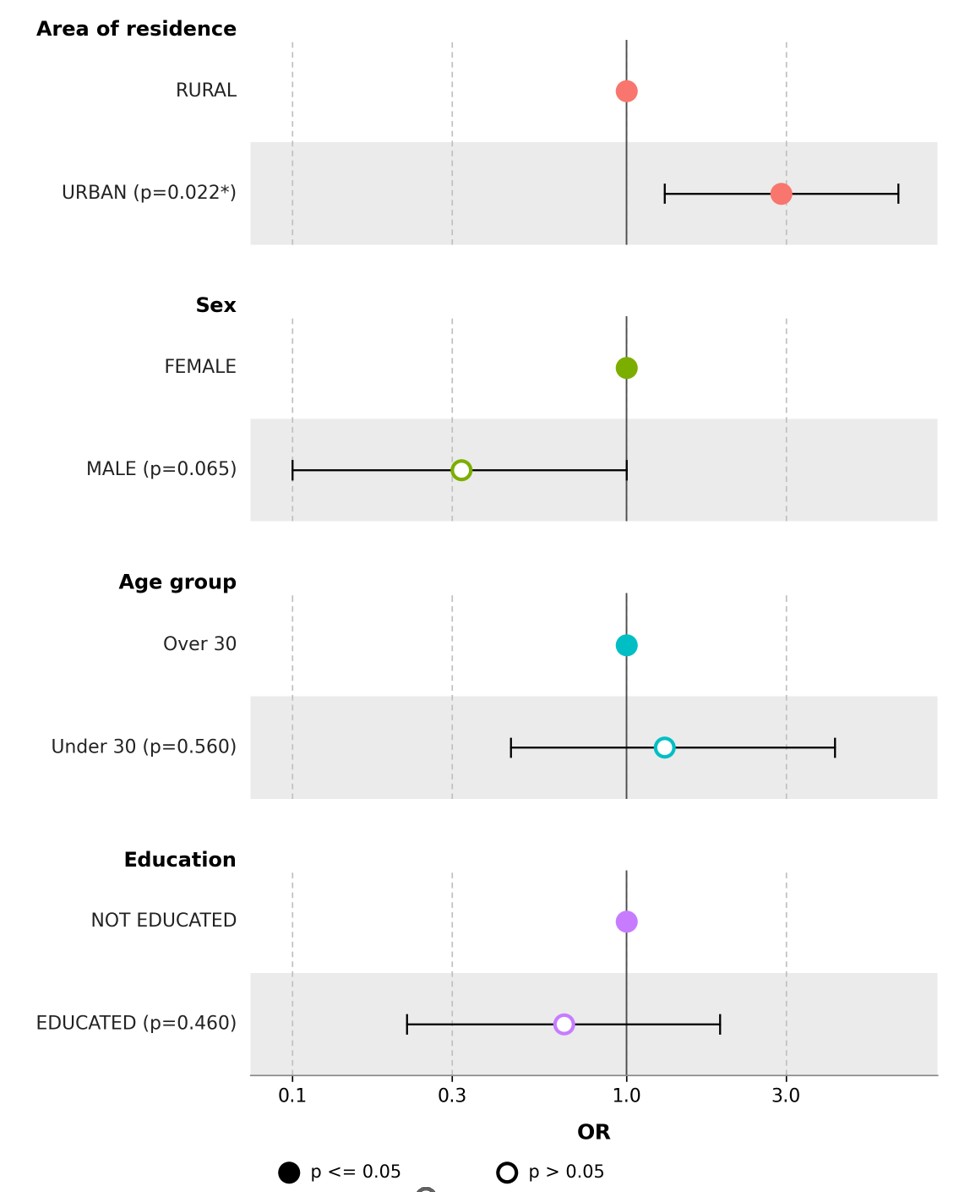
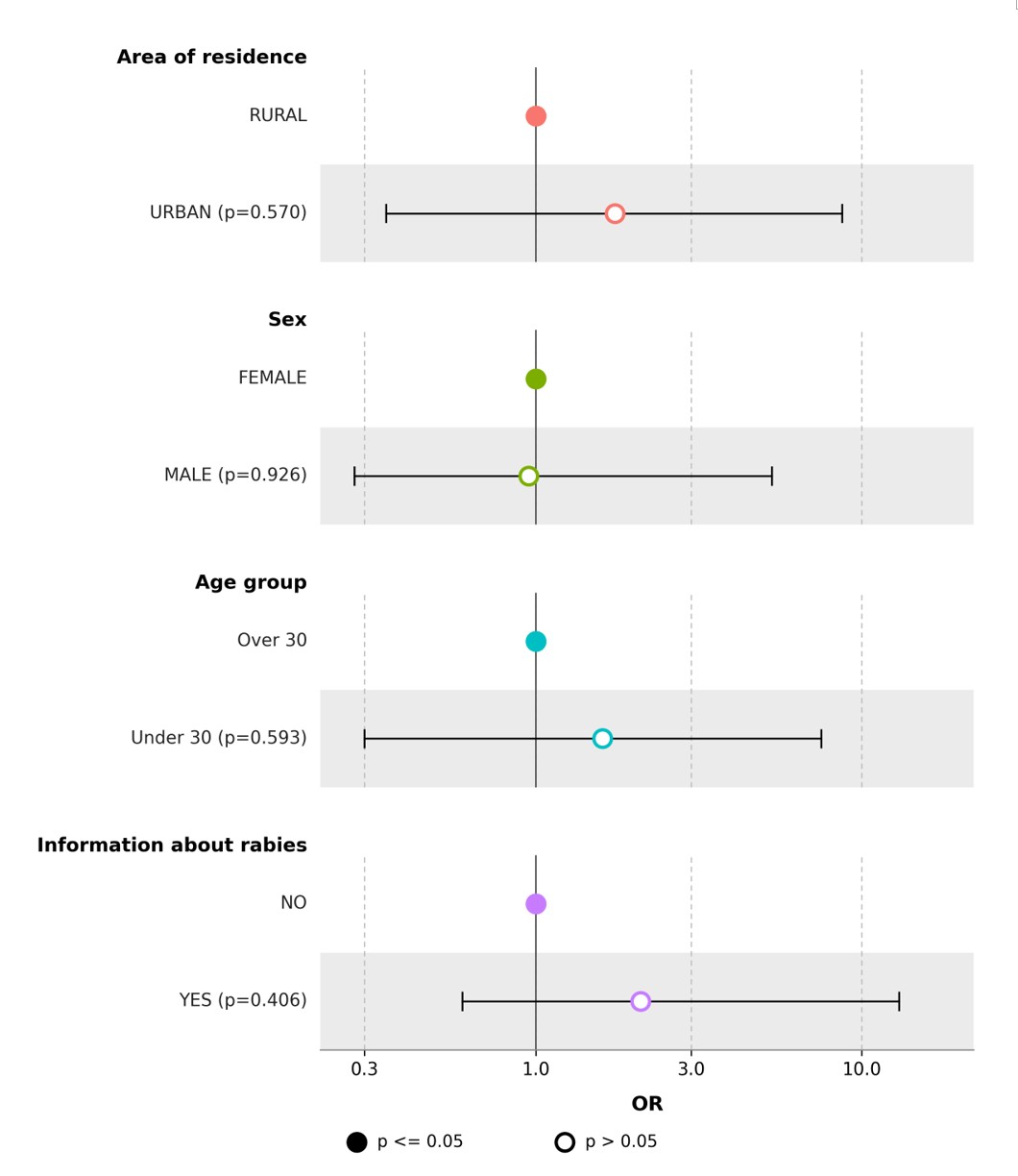
Variables such as place of residence, sex, education level, age group, and rabies sensitisation with a p-value of less than 0.2 in the bivariate analysis were integrated into a multivariate binary logistic regression model. According to our study, age, sex, education level and awareness were not significantly associated with knowledge of rabies prevention in the multivariate analysis. For factors associated with rabies prevention practices, rabies-sensitised respondents were 5.57 times more likely to have good practices with a statistically significant association (p < 0.001) (Table 5). For factors that may influence community members’ attitudes, urban respondents were 1.27 times more likely to have positive attitudes, but the association was not statistically significant, with p-values of 0.7 each (Figure 2).
Finally, for factors associated with community practices, respondents living in urban areas were 1.95 times more likely to have positive practices than those in rural areas, and this association was statistically significant (p = 0.027). Compared to women, men were 2.5 times more likely to adopt positive practices, with a statistically significant association (p = 0.0007). In addition, those who had been sensitised about rabies were 5.5 times more likely to have positive practices, with a statistically significant association (p = 0.001) (Table 5).
Assessing the level of knowledge, attitudes and practices related to rabies prevention and associated factors is essential to controlling the spread of rabies in the community. Although the majority of those interviewed are aware of the existence of rabies and aware of its transmission through dog bites, they are unaware of certain practices and risk factors. Indeed, very few respondents were aware that rabies could be transmitted by species other than domestic dogs. This is consistent with the results of a survey conducted in Thailand, where only 16% of participants knew that all mammals can suffer from rabies [24], and in Tanzania, with only 10% [17]. Educational programmes should indicate that all rabies-infected mammals are susceptible to transmitting the infection, and that carcasses should be incinerated or buried [25]. An essential component of post-exposure prophylaxis (PEP) was immediate washing of the bite with soap and water before going to the hospital [26]. Our results showed that most respondents were not informed about this preventive practice, in line with other studies [17, 27]. Failure to wash wounds increases the risk of developing rabies [28]. Improved awareness of wound management, including prompt flushing with any available fluids, could therefore significantly reduce the likelihood of developing rabies in these communities.
Another important step after exposure was the prompt administration of PEP. In our study, just over a quarter of respondents indicated that they would not seek medical attention, which was slightly higher than the results of studies conducted in Tanzania, where approximately 25% of bite victims did not seek medical attention [28]. This reveals that a significant proportion of the population was at risk of contracting rabies due to poor knowledge of rabies prevention, an area requiring attention to avoid preventable deaths. Of those surveyed who indicated they would seek treatment, more than half would seek the advice of a health care professional.
Improving knowledge, attitudes and practices about rabies depends on gender, level of education and awareness. Uneducated and unaware people were most at risk. Men, who were often more involved in animal management, had better practices than women, perhaps due to their increased access to education and awareness campaigns [29]. These results are consistent with similar studies conducted elsewhere, such as the KAP study carried out in the city of Bahir Dar [28], the region of Arsia [15] and Debark [28]. This could be due to the fact that humans were more involved in the management of animals and bite cases, which allowed them to have information about rabies during consultations. However, social, cultural and educational factors can influence preventive behaviour. Men may have more access to education or awareness campaigns, which may explain a better understanding of prevention measures.
The results showed that the level of education, rabies awareness and area of residence significantly influenced rabies prevention practices. These results were similar to those of the KAP study conducted in the Dedo district of the Jimma region [30]. This indicates that health training and education were important to increase community awareness, resulting in good rabies prevention and control practices.
In terms of communication, the association between awareness and positive practice scores revealed a statistically significant difference; respondents who had received information about rabies were more predisposed to have a positive practice than those who had not received information. This result was similar to that of the study conducted in the district of Laelay-Machew [31]. Awareness-raising interventions to address critical knowledge gaps should therefore target all sectors of the population, including those in the most marginalised communities. Although the value of school-based interventions in improving rabies awareness has been advocated in some contexts [32], our study suggests that these interventions are likely to be more effective if combined with community-based programs involving all community members.
The result of the multivariate analysis of this study revealed that people who were aware of rabies and lived in urban areas had better practices. Targeted educational and community-based interventions are needed to address knowledge gaps and improve preventive behaviours.
The majority of respondents demonstrated limited knowledge of the main aspects of rabies, as well as the necessary control and prevention measures. These shortcomings should be taken into account by the various stakeholders. Targeted awareness campaigns could play a key role in informing people about the dangers of rabies and appropriate practices to reduce these risks. Essential messages to convey could include: “Vaccinate your dogs and cats against rabies,” “Clean any wounds immediately with soap and water, then seek medical attention for post-exposure vaccination,” “All mammals can contract rabies,” and “Incinerate or bury the carcasses of dead animals with rabies.” These messages, disseminated by government and community networks, could significantly improve preventive behaviours within communities. Creating and executing a structured communication plan provides a great opportunity to address these gaps and build awareness.
What is already known about the topic
What this study adds
The authors would like to thank the Chief Medical Commissioner of the Kedougou region, Dr. Ndeye Mbacké Kane, coordinator of the NCD program, Professor Seni Kouanda and Dr. Tieba Millogo of the African Institute of Public Health (Ouagadougou), Dr. Mbouna Ndiaye and Dr. Sarifou Ba of the FETP Senegal program, the head of the department of livestock and pastoralists, all staff and community actors in the Kedougou district, as well as members of the local community, who provided valuable assistance in data collection. We thank the researchers for collecting data, as well as Dr Ndeye Mbacke for the valuable discussions. We would like to thank the Ministry of Health and Social Action and the Ministry of Livestock and Fisheries.
Conceptualization: FD, SK, NMK, MM, MD, SB. Data collection: FD, SK, NMK, MM, MD, SB, LS, ACD, MNS. Data analysis and reporting: FD, SK, NMK, MM, MD, SB. Manuscript writing: FD, SK, NMK, MM, MD, SB, MN, MN. Finalization of the manuscript: FD, SK, NMK, MM, MD, SB, MN, MN, . All authors have read and approved the final version of the manuscript.
| Characteristics | Absolute value (n) | Frequency (%) |
|---|---|---|
| Sex | ||
| Male | 552 | 65.3 |
| Female | 293 | 34.6 |
| Age range | ||
| 18–28 | 32 | 3.8 |
| 29–39 | 113 | 13.4 |
| 30–40 | 385 | 45.6 |
| 41–51 | 206 | 23.4 |
| 52–62 | 103 | 12.1 |
| 63–73 | 6 | 0.7 |
| Education | ||
| Educated | 542 | 64.1 |
| Uneducated | 303 | 35.8 |
| Region of residence | ||
| Urban | 502 | 59.4 |
| Rural | 343 | 40.5 |
| Socio-economic level | ||
| Low | 657 | 77.7 |
| AVERAGE | 103 | 12.1 |
| High | 85 | 10.1 |
| Variables | Absolute value (n) | Frequency (%) |
|---|---|---|
| Information on rabies | 547 | 64.7 |
| Already seen a rabid animal | 388 | 45.9 |
| Who can be affected by rabies | ||
| Man | 163 | 19.3 |
| Dog | 411 | 48.6 |
| Cat | 68 | 8.1 |
| Horse | 1 | 0.1 |
| Donkey | 34 | 4.0 |
| Other | 168 | 19.9 |
| Information on rabies | 547 | 64.7 |
| Rabies is a serious disease | 525 | 62.1 |
| Mode of transmission | 434 | 51.4 |
| Knowledge of prevention | 342 | 40.5 |
| Knowledge of the number of vaccine doses to take | 28 | 3.3 |
| Knowledge of the price of animal rabies vaccine | 48 | 5.7 |
| Knowledge of the point of sale of the rabies vaccine | 214 | 25.3 |
| Variables | Frequency (n) | Percent (%) |
|---|---|---|
| Owning dogs or cats in the home (N = 845) | 377 | 44.6 |
| Vaccination status of animals (N = 367) | 9 | 2.5 |
| Possession of vaccination records (N = 367) | 9 | 2.5 |
| Financial possibility of purchasing the vaccine (N = 48) | 30 | 62.5 |
| Need to promote rabies prevention practices (N = 845) | 790 | 93.5 |
| Wants to acquire knowledge (N = 845) | 822 | 97.3 |
| Variables | Absolute value (n) | Frequency (%) |
|---|---|---|
| Behavior in front of an individual bitten by your dog | ||
| Bringing to the health structure | 533 | 63.08 |
| Killing the dog | 89 | 10.53 |
| Nothing | 74 | 8.76 |
| Willingness to pay for the vaccine | 574 | 67.93 |
| Variables | Rabies Prevention Practice | Adjusted Odds Ratio | 95% CI | P-Value | |
|---|---|---|---|---|---|
| Good N (%) | Low N (%) | ||||
| Place of residence | |||||
| Urban | 44 (8.76) | 458 (91.24) | 1.95 | 1.08–3.70 | 0.027 |
| Rural | 18 (5.25) | 325 (94.75) | |||
| Sex | |||||
| Male | 53 (9.60) | 499 (90.40) | 2.54 | 1.27–5.65 | 0.007 |
| Female | 9 (3.07) | 284 (96.93) | |||
| Age | — | ||||
| Under 30 years of age | 18 (8.07) | 205 (91.93) | 1.04 | 0.55–1.90 | 0.9 |
| More than 30 years | 44 (7.07) | 578 (92.93) | |||
| Education | |||||
| Educated | 49 (9.04) | 493 (90.96) | 0.97 | 0.43–2.39 | 0.9 |
| Uneducated | 13 (4.29) | 290 (95.71) | |||
| Awareness on rabies | |||||
| Yes | 56 (10.22) | 492 (89.78) | 5.57 | 2.46–15.1 | <0.001 |
| No | 6 (2.02) | 291 (97.98) | |||