Research | Open Access | Volume 9 (3): Article 140 | Published: 25 Aug 2026

Views: 698
Menu, Tables and Figures
| Variable | n | % |
|---|---|---|
| Age (years), Mean (SD) | 29.7 (5.1) | – |
| Gestational age at booking (weeks), Mean (SD) | 18.5 (6.8) | – |
| Parity (number of children) | ||
| None | 62 | 24.8 |
| 1–4 | 183 | 73.2 |
| 5 or more | 5 | 2.0 |
| ANC visits in current pregnancy, Mean (SD) | 3.6 (2.0) | – |
| Marital status | ||
| Married | 245 | 98.0 |
| Monthly income | ||
| Less than N70,000 | 134 | 53.6 |
| N70,000–N150,000 | 99 | 39.6 |
| Above N150,000 | 17 | 6.8 |
| Education | ||
| Tertiary | 117 | 46.8 |
| Completed secondary school | 115 | 46.0 |
| Completed primary school | 18 | 7.2 |
Table 1: Socio-demographic and obstetric characteristics of respondents (N = 250)
Table 2. Knowledge, affordability and autonomy indicators (N = 250)
| Indicator | N | % |
|---|---|---|
| Knew SP can prevent malaria in pregnancy | 240 | 96.0 |
| Knew malaria in pregnancy can cause low birth weight | 227 | 90.8 |
| Knew malaria in pregnancy can cause preterm delivery | 226 | 90.4 |
| Knew malaria in pregnancy can cause anaemia | 225 | 90.0 |
| Knew malaria in pregnancy can cause stillbirth | 216 | 86.4 |
| Knew malaria in pregnancy can cause abortion | 206 | 82.4 |
| Correctly identified the monthly dosing interval of four weeks | 188 | 75.2 |
| Knew pregnant women are at increased risk of malaria | 143 | 57.2 |
| Correctly identified a minimum of three doses before delivery | 90 | 36.0 |
| Correctly identified mosquito bites as the cause of malaria | 85 | 34.0 |
| Correctly identified minimum IPTp initiation at 13 weeks | 20 | 8.0 |
| Good knowledge (score ≥7/11) | 192 | 76.8 |
Note: Knowledge score computed from 11 items (0–11). Good knowledge defined as ≥7/11 (≥60%). Autonomy score computed from 4 items (0–4): decision to use SP, decision to attend ANC, ability to afford ANC services, ability to afford SP. High autonomy defined as ≥3/4.
Table 2: Knowledge, affordability and autonomy indicators (N = 250)
Table 3. IPTp-SP service delivery and implementation fidelity indicators (N = 250)
| Indicator | N | % |
|---|---|---|
| SP always available at facility | 179 | 71.6 |
| SP available on visit day | 185 | 74.0 |
| SP administered as DOT | 60 | 24.0 |
| Provider explained why SP was given | 19 | 7.6 |
Note: DOT = directly observed therapy (SP swallowed in front of provider).
Table 3: IPTp-SP service delivery and implementation fidelity indicators (N = 250)
Table 4. Facility-level variation in DOT administration
| Facility | n (total) | DOT (n) | DOT (%) |
|---|---|---|---|
| State Hospital Ede | 46 | 30 | 65.2 |
| State Hospital Ilesa | 67 | 16 | 23.9 |
| State Specialist Hospital, Asubiaro | 137 | 14 | 10.2 |
Note: Substantial facility heterogeneity suggests workflow and supervision differences across sites.
Table 4: Facility-level variation in DOT administration
Table 5. Factors associated with DOT administration for IPTp-SP among pregnant women in Osun State, Nigeria (N = 250)
| Variable | DOT administration (n=60) | DOT not administered (n=190) | cOR (95% CI) | P value | aOR (95% CI) | Adjusted p value |
|---|---|---|---|---|---|---|
| SP available on visit day | ||||||
| No | 44/65 (67.7) | 21/65 (32.3) | 1.00 (reference) | 1.00 (reference) | ||
| Yes | 16/185 (8.6) | 169/185 (91.4) | 0.05 (0.02–0.09) | <0.001 | 0.19 (0.03–1.20) | 0.078 |
| SP always available at facility | ||||||
| No | 47/71 (66.2) | 24/71 (33.8) | 1.00 (reference) | 1.00 (reference) | ||
| Yes | 13/179 (7.3) | 166/179 (92.7) | 0.04 (0.02–0.08) | <0.001 | 0.09 (0.02–0.52) | 0.007 |
| Provider explained purpose of SP | ||||||
| No | 46/231 (19.9) | 185/231 (80.1) | 1.00 (reference) | 1.00 (reference) | ||
| Yes | 14/19 (73.7) | 5/19 (26.3) | 11.26 (3.86–32.86) | <0.001 | 6.46 (1.44–29.01) | 0.015 |
| Good knowledge (score ≥7/11) | ||||||
| No | 25/66 (37.9) | 41/66 (62.1) | 1.00 (reference) | 1.00 (reference) | 0.469 | |
| Yes | 35/184 (19.0) | 149/184 (81.0) | 0.39 (0.21–0.72) | 0.003 | 0.70 (0.26–1.85) | |
| High autonomy (score ≥3/4) | ||||||
| No | 43/158 (27.2) | 115/158 (72.8) | 1.00 (reference) | 1.00 (reference) | ||
| Yes | 17/92 (18.5) | 75/92 (81.5) | 0.61 (0.32–1.14) | 0.121 | 1.07 (0.21–5.54) | 0.937 |
| Able to afford SP | ||||||
| No | 39/131 (29.8) | 92/131 (70.2) | 1.00 (reference) | 1.00 (reference) | ||
| Yes | 21/119 (17.6) | 98/119 (82.4) | 0.51 (0.28–0.92) | 0.026 | 1.74 (0.33–9.19) | 0.511 |
| Age (Per one-year increase) | 29.2 (4.8) | 29.8 (5.2) | 0.97 (0.92–1.03) | 0.386 | 0.96 (0.88–1.06) | 0.428 |
| Gestational age at booking (Per one-week increase) | 17.1 (7.6) | 18.9 (6.5) | 0.96 (0.92–1.00) | 0.079 | 0.98 (0.91–1.04) | 0.480 |
| ANC visits in current pregnancy (Per additional visit) | 3.8 (1.9) | 3.6 (2.0) | 1.04 (0.90–1.21) | 0.559 | 0.92 (0.74–1.14) | 0.431 |
| Parity (Per additional child) | 2.1 (4.4) | 1.5 (1.3) | 1.08 (0.96–1.22) | 0.222 | 1.17 (0.93–1.48) | 0.168 |
| Facility | ||||||
| State Hospital Ede | 30/46 (65.2) | 16/46 (34.8) | 1.00 (reference) | 1.00 (reference) | ||
| State Hospital Ilesa | 16/67 (23.9) | 51/67 (76.1) | 0.17 (0.07–0.38) | <0.001 | 1.53 (0.28–8.43) | 0.628 |
| State Specialist Hospital, Asubiaro | 14/137 (10.2) | 123/137 (89.8) | 0.06 (0.03–0.14) | <0.001 | 1.62 (0.27–9.71) | 0.596 |
| Education | ||||||
| Completed Primary school | 7/18 (38.9) | 11/18 (61.1) | 1.00 (reference) | 1.00 (reference) | ||
| Completed Secondary school | 27/115 (23.5) | 88/115 (76.5) | 0.48 (0.17–1.37) | 0.170 | 1.00 (0.19–5.24) | 0.999 |
| Tertiary Education | 26/117 (22.2) | 91/117 (77.8) | 0.45 (0.16–1.27) | 0.132 | 2.05 (0.37–11.21) | 0.409 |
| Monthly income | ||||||
| 70,000-150,000 | 18/99 (18.2) | 81/99 (81.8) | 1.00 (reference) | 1.00 (reference) | ||
| Above 150,000 | 2/17 (11.8) | 15/17 (88.2) | 0.60 (0.13–2.86) | 0.521 | 1.33 (0.19–9.28) | 0.776 |
| Less than N70,000 | 40/134 (29.9) | 94/134 (70.1) | 1.91 (1.02–3.60) | 0.043 | 1.82 (0.72–4.64) | 0.208 |
Note. aOR = adjusted odds ratio; CI = confidence interval. Model includes service readiness (availability, counselling), knowledge, autonomy, affordability, age, booking gestational age, ANC visits, parity, education, income, and facility fixed effects. Reference categories: education=Completed Primary school; income=70,000–150,000; facility=State Hospital Ede. Statistical significance at p<0.05.
Table 5: Factors associated with DOT administration for IPTp-SP among pregnant women in Osun State, Nigeria (N = 250)
Tosin Orhorhamreru1,2,&, Opeyemi Oladunni2, Adefunke Busola Ogunleye2, Moronke Rachael Orhorhamreru3, Braimah Rasheed Oyeyemi4, Olufemi Oroge4, Adekunle Ganiyu Salawudeen5
1African Field Epidemiology Network, Abuja, Nigeria, 2Department of Public Health, Adeleke University, Ede, Osun State, Nigeria, 3UNICEF Nigeria, 4Malaria Unit, Department of Public Health, Osun State Ministry of Health, Nigeria, 5Department of Public Health, University of Ilorin, Ilorin, Nigeria
&Corresponding author: Tosin Orhorhamreru, African Field Epidemiology Network, Abuja, Nigeria. Email: t.orhorhamreru@gmail.com ORCID: https://orcid.org.0000-0002-8799-8955
Received: 26 Mar 2026, Accepted: 18 Aug 2026, Published: 25 Aug 2026
Domain: Maternal and Child Health
Keywords: IPTp-SP, malaria in pregnancy, antenatal care, directly observed therapy, equity
©Tosin Orhorhamreru et al. Journal of Interventional Epidemiology and Public Health (ISSN: 2664-2824). This is an Open Access article distributed under the terms of the Creative Commons Attribution International 4.0 License (https://creativecommons.org/licenses/by/4.0/), which permits unrestricted use, distribution, and reproduction in any medium, provided the original work is properly cited.
Cite this article: Tosin Orhorhamreru et al., Missed opportunities in IPTp-SP delivery during antenatal care in Osun State, Nigeria. Journal of Interventional Epidemiology and Public Health. 2026; 9(3):140. https://doi.org/10.37432/jieph-d-26-00098
Introduction: Intermittent preventive treatment of malaria in pregnancy with sulfadoxine -pyrimethamine (IPTp-SP) is a World Health Organization (WHO) recommended intervention delivered primarily through antenatal care (ANC) platforms. Nigeria continues to report a persistent gap between ANC attendance and IPTp-SP completion, suggesting missed opportunities at the point of service. This baseline assessment quantified implementation gaps in IPTp-SP delivery and explored socioeconomic differentials that may lead to deficiencies in effective coverage.
Methods: A cross-sectional baseline survey was conducted among 250 pregnant women (18-49 years) attending ANC in three secondary facilities across Osun State (State Specialist Hospital Asubiaro; State Hospital Ede; State Hospital Ilesa). Eligible women had received at least one SP dose in the current pregnancy. Data were collected using an interviewer-administered questionnaire configured in KoBoCollect. Key implementation outcomes included SP availability, directly observed therapy (DOT), and provider counselling. Knowledge was assessed using an 11-item composite score and classified as good knowledge at ≥7/11. Socioeconomic position was proxied by self-reported monthly income categories and autonomy indicators. Descriptive statistics and multivariable logistic regression were used to identify correlates of DOT.
Results: The mean age of the participants was 29.7±5.1 years; mean booking gestational age was 18.5±6.8 weeks; and mean ANC visits were 3.6±2.0. While SP was reported as “always available” by 71.6% and available on the day of visit by 74.0%, DOT was reported by only 24.0% and provider explanation by 7.6%. Facility-level variation was substantial: DOT ranged from 10.2% to 65.2%. Socioeconomic constraints were evident: only 47.6% could afford SP and 36.8% met criteria for high autonomy.
Conclusion: Findings indicate major implementation failures, particularly in DOT and counselling, despite a moderate level of reported SP availability. These gaps are likely to sustain inequities and limit effective coverage. Interventions should prioritise standardised DOT workflows, supervision and job aids, commodity/security mechanisms, and equity-oriented support for women facing cost and autonomy constraints.
Malaria in pregnancy remains a significant public health challenge in sub-Saharan Africa (SSA) and a preventable cause of adverse maternal and neonatal outcomes [1]. In endemic settings, infection during pregnancy contributes to maternal anaemia, placenta malaria, intrauterine growth restriction, preterm birth and low birth weight, thereby increasing morbidity and mortality [2-6]. These risks justify the continued prioritisation of malaria prevention within routine antenatal care services, particularly in countries such as Nigeria where malaria transmission remains high and many pregnant women remain at risk [7-9]. Pregnancy increases susceptibility to malaria because pregnancy-related immunological changes reduce protective immunity, while infected erythrocytes may sequester in the placenta. This sequestration can occur even in asymptomatic infections, making infections difficult to detect without appropriate preventive measures [7-10,11]. These mechanisms contribute substantially to poor maternal and fetal outcomes in malaria-infested areas and reinforce the importance of effective prevention during pregnancy [12,13]. The World Health Organization estimates that there were 249 million cases and 608,000 malaria-related deaths worldwide in 2022, with the African region having an estimated 94% of the cases and deaths [14]. Given Nigeria’s high transmission intensity and large population of women of reproductive age, millions of pregnancies also contribute substantially to low birth weight in Africa, with consequences for neonatal morbidity, childhood development, and infant mortality [15].
To reduce malaria-related morbidity and improve birth outcomes, the World Health Organization recommends intermittent preventive treatment in pregnancy with sulfadoxine-pyrimethamine in areas with moderate to high malaria transmission [14,16]. Pregnant women should receive monthly doses of IPTp SP from the second trimester until delivery through routine antenatal care visits [14,17]. Each dose should be administered through directly observed therapy to improve adherence and maximise protection [14]. Current guidelines recommend at least three doses, referred to as IPTp3+, while permitting additional doses when antenatal care contacts continue before delivery [18]. Women who receive three or more doses have lower risks of low birth weight and neonatal mortality than those receiving fewer doses [19,20,21]. Despite strong evidence of effectiveness, IPTp SP coverage remains inadequate in many sub-Saharan African countries. Although antenatal care attendance has improved, the proportion of women receiving the recommended doses remains below target levels [22,23]. The 2021 Nigeria Malaria Indicator Survey (NMIS) revealed a persistent gap between ANC attendance and the uptake of IPTp-SP [22]. Approximately 63% of women received at least one dose, while only about 32% received three or more doses [24,25]. This difference suggests that increasing ANC attendance may not be enough to achieve optimal malaria prevention during pregnancy.
Effective IPTp-SP coverage requires pregnant women to receive the recommended doses at the appropriate gestational periods under directly observed therapy [15,27,28]. However, SP stock-outs, inadequate counselling, poor provider knowledge, informal payments, and limited DOT resources may prevent proper administration [22,29]. These barriers may disproportionately affect poorer women because transport costs, opportunity costs, informal charges, and household decision-making can reduce uptake despite free SP provision [30,31]. This study therefore examined missed opportunities between antenatal care attendance and effective IPTp-SP delivery in Osun State, with emphasis on DOT compliance and socioeconomic inequalities, to guide targeted interventions.
Malaria in pregnancy remains a significant public health challenge in sub-Saharan Africa (SSA) and a preventable cause of adverse maternal and neonatal outcomes [1]. In endemic settings, infection during pregnancy contributes to maternal anaemia, placenta malaria, intrauterine growth restriction, preterm birth and low birth weight, thereby increasing morbidity and mortality [2-6]. These risks justify the continued prioritisation of malaria prevention within routine antenatal care services, particularly in countries such as Nigeria where malaria transmission remains high and many pregnant women remain at risk [7-9]. Pregnancy increases susceptibility to malaria because pregnancy-related immunological changes reduce protective immunity, while infected erythrocytes may sequester in the placenta. This sequestration can occur even in asymptomatic infections, making infections difficult to detect without appropriate preventive measures [7-10,11]. These mechanisms contribute substantially to poor maternal and fetal outcomes in malaria-infested areas and reinforce the importance of effective prevention during pregnancy [12,13]. The World Health Organization estimates that there were 249 million cases and 608,000 malaria-related deaths worldwide in 2022, with the African region having an estimated 94% of the cases and deaths [14]. Given Nigeria’s high transmission intensity and large population of women of reproductive age, millions of pregnancies also contribute substantially to low birth weight in Africa, with consequences for neonatal morbidity, childhood development, and infant mortality [15].
To reduce malaria-related morbidity and improve birth outcomes, the World Health Organization recommends intermittent preventive treatment in pregnancy with sulfadoxine-pyrimethamine in areas with moderate to high malaria transmission [14,16]. Pregnant women should receive monthly doses of IPTp SP from the second trimester until delivery through routine antenatal care visits [14,17]. Each dose should be administered through directly observed therapy to improve adherence and maximise protection [14]. Current guidelines recommend at least three doses, referred to as IPTp3+, while permitting additional doses when antenatal care contacts continue before delivery [17]. Women who receive three or more doses have lower risks of low birth weight and neonatal mortality than those receiving fewer doses [18,19,20]. Despite strong evidence of effectiveness, IPTp SP coverage remains inadequate in many sub-Saharan African countries. Although antenatal care attendance has improved, the proportion of women receiving the recommended doses remains below target levels [21,22]. The 2021 Nigeria Malaria Indicator Survey (NMIS) revealed a persistent gap between ANC attendance and the uptake of IPTp-SP [22]. Approximately 63% of women received at least one dose, while only about 32% received three or more doses [24,25]. This difference suggests that augmenting ANC attendance might not be enough to reach optimal malaria prevention during pregnancy.
Effective IPTp-SP coverage requires pregnant women to receive the recommended doses at the appropriate gestational periods under directly observed therapy [15,26,27]. However, SP stock-outs, inadequate counselling, poor provider knowledge, informal payments, and limited DOT resources may prevent proper administration [22,28]. These barriers may disproportionately affect poorer women because transport costs, opportunity costs, informal charges, and household decision-making can reduce uptake despite free SP provision [29,23]. This study therefore examined missed opportunities between antenatal care attendance and effective IPTp-SP delivery in Osun State, with emphasis on DOT compliance and socioeconomic inequalities, to guide targeted interventions.
Study design
This facility-level cross-sectional study was conducted in Osun State, southwestern Nigeria. The data were gathered in three secondary-level care hospitals in the three senatorial districts, namely: State Specialist Hospital, Asubiaro (Osun Central); State Hospital, Ede (Osun West); and State Hospital, Ilesa (Osun East).
Study population and eligibility
The study population comprised pregnant women aged 18–49 years who were attending antenatal care (ANC) in the selected secondary health facilities in Osun State. Eligible participants were pregnant women who had received at least one dose of sulphadoxine-pyrimethamine (SP) during the current pregnancy and who provided verbal informed consent. The requirement for prior receipt of at least one SP dose was applied because the baseline assessment focused on IPTp-SP implementation fidelity among women who had already had contact with SP delivery during ANC. This enabled the study to assess service-delivery processes such as SP administration, directly observed therapy, provider counselling and women’s experience with SP use. Women were excluded if they were younger than 18 years, critically ill or unable to participate in the interview, attending their first booking visit without having received SP, or declined consent. It is acknowledged that excluding women who had attended ANC but had not received any SP dose may have omitted an important group who experienced missed opportunities at an earlier stage of the IPTp-SP delivery pathway
Sample size and sampling technique
A sample size of 250 women was targeted based on Fisher’s formula with allowance for non-response, and participants were selected using systematic sampling of ANC attendees guided by clinic registers. Recruitment occurred in quiet consultation spaces to ensure privacy. The sample size was based on Fisher’s formula for calculating sample size for a population greater than 10,000, which states:
$$n = \frac{z^2 pq}{d^2}$$
Where;
n = Minimum sample size
z = Standard normal deviate corresponds to a confidence interval of 95% (1.96)
p = Expected outcome; 11% was the estimated proportion of pregnant women who are knowledgeable and took preventive medication according to the Nigeria Malaria Indicator Survey in 2021 [30].
q = 1-p
d = Precision, which is taken as 5% (0.05)
$$n = \frac{1.96^2 \times 0.11 \times (1 – 0.11)}{0.05^2}$$
$$n = \frac{3.84 \times 0.11 \times 0.89}{0.0025} = \frac{0.3759}{0.0025} = 150$$
Sampling Technique
A facility-based multistage sampling technique was used to select health facilities and respondents for the baseline assessment. The sampling process was implemented in two stages.
Stage 1: Stratification and selection of health facilities: A sampling frame of ANC-providing health facilities in Osun State was developed using the Nigeria District Health Information System (NDHIS). Osun State has 30 Local Government Areas (LGAs), and health facilities providing ANC services were first classified by level of care into tertiary, secondary and primary facilities. This stage was used to define the facility universe and to clarify the level of care from which study facilities would be selected. For the purpose of the parent quasi-experimental study, the baseline assessment was restricted to secondary-level facilities because the planned intervention was designed for routine IPTp-SP delivery within high-volume secondary ANC clinics. Using 2024 DHIS2 ANC attendance records, secondary-level facilities with high ANC attendance were identified. The state recorded 171,072 annual ANC visits across facilities providing ANC services. A small number of facilities contributed a substantial proportion of these visits. High-volume secondary facilities were therefore considered eligible because they provided adequate client flow for baseline assessment, intervention implementation and follow-up evaluation. Primary and tertiary facilities were not included in this baseline sampling frame.
The eligible high-volume secondary facilities were stratified according to the three senatorial districts in Osun State: Osun Central, Osun West and Osun East. This was done to ensure geographical spread across the state while maintaining the study focus on secondary-level ANC facilities. After line-listing the eligible high-volume secondary facilities within the three senatorial districts, one facility was selected from each senatorial district. The selected facilities were State Specialist Hospital, Asubiaro in Osun Central; State Hospital, Ede in Osun West; and State Hospital, Ilesa in Osun East. These facilities served as the baseline sites for the parent quasi-experimental study.
Stage 2: Selection of respondents: The total sample size was allocated proportionately across the three selected facilities based on their average monthly ANC attendance over the preceding 12 months. This ensured that facilities with higher ANC attendance contributed a larger number of respondents to the study sample. Within each selected facility, eligible pregnant women were recruited systematically from ANC clinic attendance registers or clinic flow on each data collection day. The sampling interval was determined separately for each facility based on the expected number of eligible ANC attendees and the allocated sample size for that facility. Depending on the facility attendance volume, every third or fourth eligible woman was approached for participation until the required sample size was achieved.
This sampling approach was appropriate for a pre-intervention baseline assessment within selected high-volume secondary ANC facilities. However, the sample was not intended to provide a state-wide representative estimate for all ANC settings in Osun State. Therefore, the findings should be interpreted as baseline evidence from selected secondary-level facilities, rather than as generalisable findings for all primary, secondary and tertiary ANC facilities in the state.
Data collection
The interviews were conducted by trained female research assistants using interviewer-administered structured questionnaires based on validated questionnaires. The observed data were stored in password-protected Android devices with the help of KoboCollect and then transferred to a safe cloud storage. The interviews were conducted in a secluded section of the ANC clinic to maintain the confidentiality of the information, and ANC cards and registers were used to get information about service delivery.
Measures
Primary implementation indicators at baseline were:
SP availability: “SP always available at ANC” and “SP available during today’s visit”; DOT administration: whether SP was administered as directly observed therapy (woman swallowed SP in front of provider); Provider counselling: whether provider explained why SP was given.
Knowledge and perception indicators: A composite knowledge score (0–11 items) was constructed using responses on malaria causation, risks of malaria in pregnancy, consequences, IPTp-SP use, initiation timing, dosing interval, and minimum recommended doses. Knowledge was assessed using an 11-item composite score covering malaria causation, risk of malaria in pregnancy, consequences of malaria in pregnancy, IPTp-SP use, initiation timing, dosing interval and minimum recommended doses. Each correct response was assigned one point, giving a total score range of 0–11. Respondents who scored ≥7/11, equivalent to ≥60%, were classified as having good knowledge, while those who scored <7/11 were classified as having poor knowledge. Perception was summarised using a Likert scale (1=strongly agree to 5=strongly disagree) across seven perception statements and reported as a mean score (lower is more favourable). Furthermore, Perception was assessed using seven Likert-scale items on malaria in pregnancy, perceived susceptibility, perceived severity, usefulness of SP, possible reactions to SP, perceived benefit of ANC attendance and satisfaction with ANC services. Responses were scored and converted to percentage scores. Using Bloom’s cut-off, respondents scoring ≥80% were classified as having positive perception, while those scoring <80% were classified as having negative perception.
Socioeconomic status: Socioeconomic status was proxied using monthly income categories: <₦70,000, ₦70,000–150,000, and >₦150,000. Women’s autonomy was measured using four items (decision to use SP, decision to attend ANC, ability to afford ANC services, ability to afford SP). A composite autonomy score (0–4) was created; high autonomy was defined as ≥3 affirmative responses.
Data analysis
The analysis of data was done in STATA 17. Categorical variables were summarised through frequencies and percentages, whereas the continuous variables were summarised through means and standard deviations. Delivery differences at the facility level were investigated. Multivariate logistic regression (binomial logit) was used to obtain adjusted odds ratios (aOR) and 95% confidence intervals (CI) of the DOT as the dependent variable. Research variables that were added to the model were service readiness indicators (availability and counselling), knowledge, autonomy, affordability, partner support, and appropriate demographic and obstetric variables (age, parity, gestational age at booking, ANC visits), as well as facility fixed effects. The statistical significance was determined at p<0.05.
Ethical considerations
The review committees of Adeleke University with reference number: AUERC/2026/33PH/011 and Osun State Ministry of Health with the protocol number: OSHREC/PRS/2026/842/01/043 gave ethical approval. Verbal informed consent was obtained to suit different participants due to their literacy levels and was noted in the consent section of the questionnaire before it was administered. No individually identifiable data was gathered; passwords were used on all the devices and files, and access was controlled.
The mean age was 29.7 years (SD = 5.1), while the mean gestational age at antenatal booking was 18.5 weeks (SD = 6.8). Respondents had attended an average of 3.6 antenatal care visits (SD = 2.0) during the current pregnancy. Most respondents, 183 (73.2%), had between one and four children. Sixty-two (24.8%) had no children, while 5 (2.0%) had five or more children. Almost all respondents were married: 245 (98.0%). More than half of the respondents, 134 (53.6%), earned less than ₦70,000 monthly. Ninety-nine (39.6%) earned between ₦70,000 and ₦150,000, while 17 (6.8%) earned above ₦150,000. Regarding education, 117 (46.8%) had tertiary education, 115 (46.0%) had completed secondary education, and 18 (7.2%) had completed primary education. Overall, the respondents were predominantly married, had between one and four children, earned less than ₦70,000 monthly, and had at least secondary education (Table 1).
Knowledge of malaria in pregnancy and intermittent preventive treatment
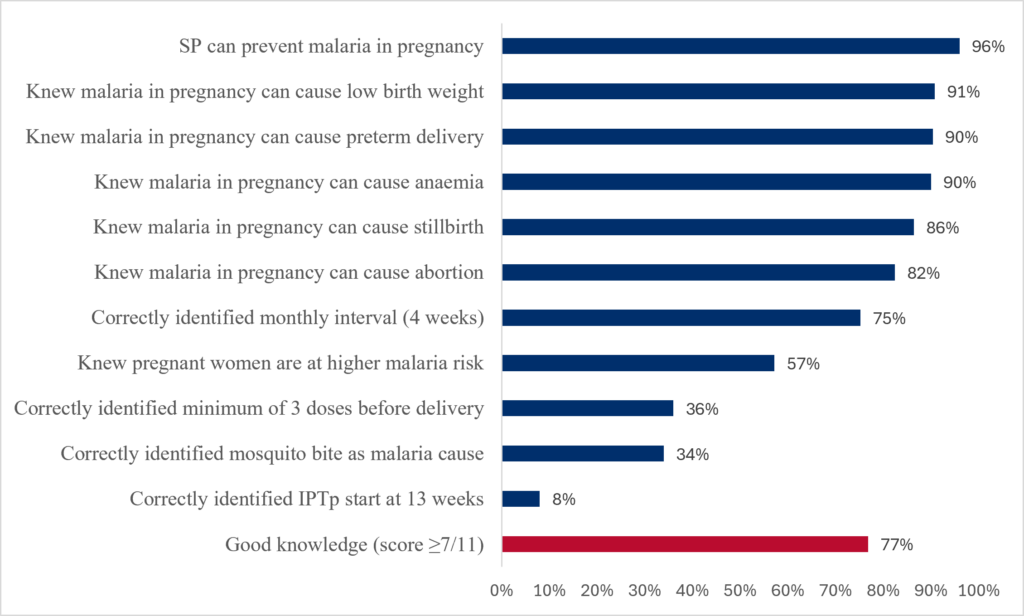
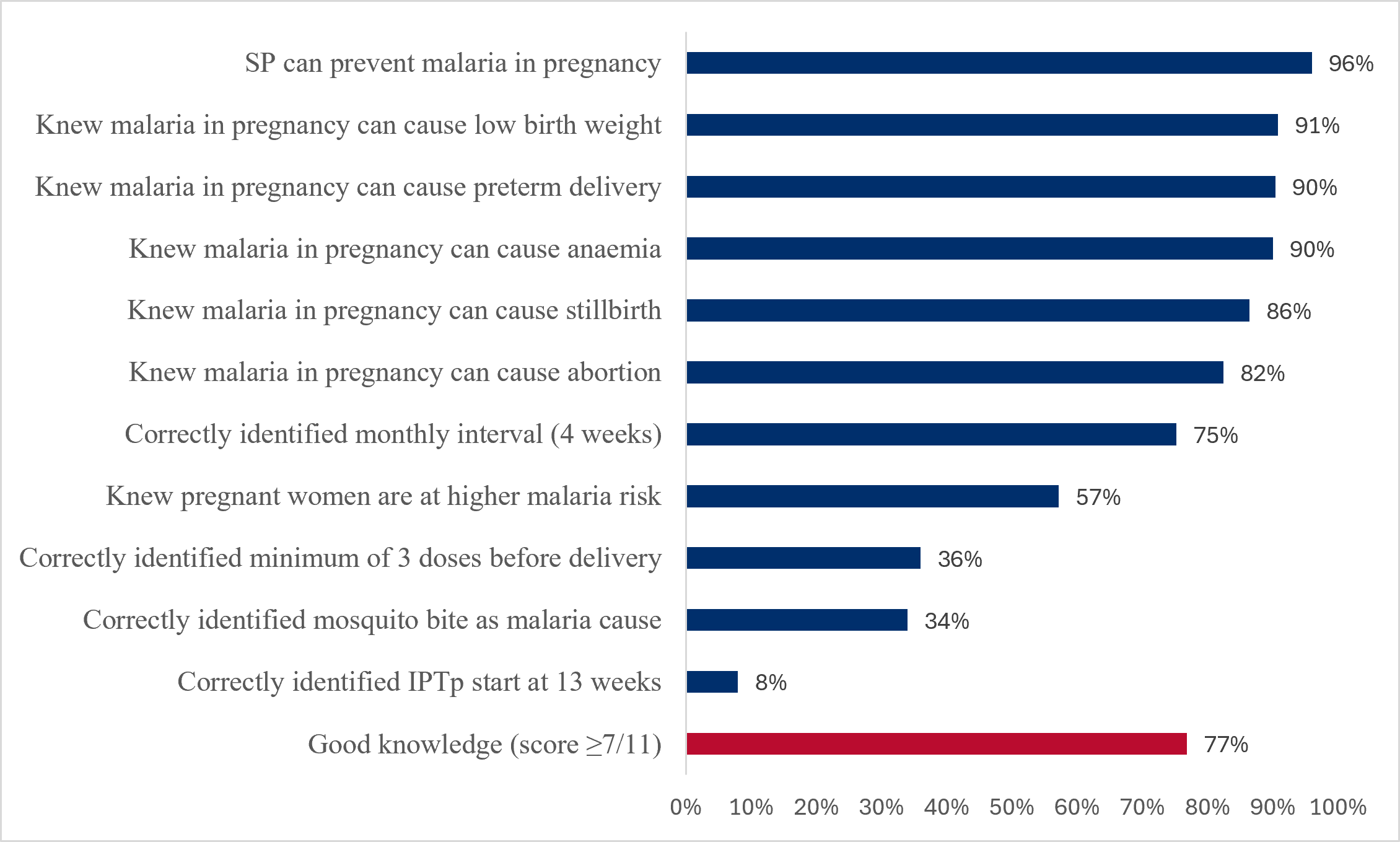
Knowledge was particularly high regarding the preventive role of sulfadoxine-pyrimethamine, reported by 240 (96.0%) respondents. Most respondents also recognised important consequences of malaria in pregnancy, including low birth weight, 227 (90.8%); preterm delivery, 226 (90.4%); anaemia, 225 (90.0%); stillbirth, 216 (86.4%); and abortion, 206 (82.4%). Regarding IPTp administration, 188 (75.2%) correctly identified the four-week dosing interval. However, only 90 (36.0%) knew that pregnant women should receive a minimum of three doses before delivery, while just 20 (8.0%) correctly identified 13 weeks of gestation as the earliest time for IPTp initiation. Knowledge gaps were also observed in basic malaria epidemiology. Although 143 (57.2%) respondents knew that pregnant women are at increased risk of malaria, only 85 (34.0%) correctly identified mosquito bites as the cause of malaria (Table 2 and Figure 1). Overall, 192 (76.8%) respondents had good knowledge of malaria in pregnancy and intermittent preventive treatment for malaria.
Implementation fidelity: SP availability, DOT, and counselling
Although 71.6% (179/250) reported that SP is always available in their facility, and 74.0% (185/250) reported it was available during the day’s visit, only 24.0% (60/250) reported that SP was administered as DOT. Provider counselling was extremely low: only 7.6% (19/250) reported that the provider explained why SP was given (Table 3).
Facility level heterogeneity
Facility comparisons revealed striking variation in both readiness and delivery practice. This pattern suggests that DOT is being practised in some sites even when “SP always available” is not reported; consistent with a plausible operational scenario where women may be asked to purchase SP (or bring it) and take it under supervision, or where perceived availability reflects inconsistent facility stocks (Table 4). Among the 250 respondents, 60 (24.0%) received sulfadoxine pyrimethamine through directly observed therapy, while 190 (76.0%) did not. In the univariable analysis, DOT administration was significantly associated with SP availability, provider explanation, knowledge, affordability, health facility, and monthly income. Respondents who reported that SP was available on the day of the visit had lower crude odds of receiving DOT than those who reported that SP was unavailable, 8.6% versus 67.7%, respectively (cOR = 0.05; 95% CI: 0.02–0.09; p < 0.001). Similarly, respondents who reported that SP was always available at the facility had lower crude odds of receiving DOT than those who reported otherwise, 7.3% versus 66.2% (cOR = 0.04; 95% CI: 0.02–0.08; p < 0.001). Provider explanation was strongly associated with DOT administration. Approximately 73.7% of respondents who received an explanation of the purpose of SP received DOT, compared with 19.9% of those who did not receive an explanation (cOR = 11.26; 95% CI: 3.86–32.86; p < 0.001). Respondents with good knowledge had lower crude odds of receiving DOT than those with poor knowledge (cOR = 0.39; 95% CI: 0.21–0.72; p = 0.003). Likewise, respondents who could afford SP had lower crude odds of DOT administration than those who could not afford it (cOR = 0.51; 95% CI: 0.28–0.92; p = 0.026).
DOT administration also differed significantly across health facilities. Compared with respondents attending State Hospital Ede, those attending State Hospital Ilesa had lower crude odds of receiving DOT (cOR = 0.17; 95% CI: 0.07–0.38; p < 0.001), as did those attending State Specialist Hospital, Asubiaro (cOR = 0.06; 95% CI: 0.03–0.14; p < 0.001). Respondents earning less than ₦70,000 monthly had higher crude odds of receiving DOT than those earning ₦70,000–₦150,000 (cOR = 1.91; 95% CI: 1.02–3.60; p = 0.043).
After adjustment for all variables included in the multivariable model, only the reported continuous availability of SP and provider explanation remained statistically significant. Respondents who reported that SP was always available at the facility had 91% lower adjusted odds of receiving DOT than those who reported that it was not always available (aOR = 0.09; 95% CI: 0.02–0.52; p = 0.007). Conversely, respondents whose providers explained the purpose of SP had more than six times the adjusted odds of receiving DOT compared with those who received no explanation (aOR = 6.46; 95% CI: 1.44–29.01; p = 0.015). SP availability on the visit day did not remain statistically significant after adjustment (aOR = 0.19; 95% CI: 0.03–1.20; p = 0.078). Knowledge, autonomy, ability to afford SP, age, gestational age at booking, number of antenatal care visits, parity, facility, educational attainment, and monthly income were also not independently associated with DOT administration in the adjusted model (Table 5). Most participants had a positive perception, with 214 of 250 respondents (85.6%) classified as having a positive perception, while 36 respondents (14.4%) had a negative perception.
The findings provide evidence of important, missed opportunities in IPTp-SP delivery within selected secondary-level antenatal care facilities in Osun State, Nigeria. The results indicate that there is a significant gap between health-service contact and effective preventive delivery, as seen through moderate reported availability of sulfadoxine-pyrimethamine but very low use of directly observed therapy and provider counselling. These data highlight the potential for significant missed opportunities in the context of regular antenatal care services and support earlier studies that low IPTp coverage in Nigeria is not only a result of women’s access to antenatal care but also of the ineffectiveness of health-system delivery processes and implementation fidelity [28,22,31,32]. Similar data from national surveys tell the same story: IPTp coverage remains lower in Nigeria, although antenatal care attendance is relatively high. According to the 2021 Nigeria Malaria Indicator Survey, only about 31% of pregnant women were taking three or more doses of IPTp -SP [23]. Similar findings have been reported in some studies indicating continued disparities between ANC attendance and IPTp completion in Nigeria, missing out on the opportunities within the standard antenatal care [21,33,34]. The major conclusion reached in this baseline measure is that coverage of directly observed therapy is so low that only approximately a quarter of respondents indicated that they do it. This is especially disturbing since directly observed therapy is one of the primary working elements of the IPTp strategy by the World Health Organization to guarantee that expecting women take sulfadoxine-pyrimethamine at the point of care and get the projected preventive advantage [14]. The lack of direct observation in the administration of SP increases the likelihood that the pills given at the antenatal visit remain untaken [35] and therefore reduce the efficacy of malaria prevention programmes and the validity of routine coverage indicators [36,37]. The same lack of implementation has been reported in sub-Saharan Africa, where pregnant women are often given SP tablets to take home instead of swallowing them under supervision due to overworked providers, inadequate supply, or simple lack of basic logistics like drinking water or cups in the antenatal clinic [38,21].
It was also identified that the provider counselling levels were very low in terms of the purpose of SP, since less than ten out of a hundred women said they were told about the purpose of the medication. Communication between health providers and pregnant women is necessary to ensure that there is an appreciation of the risks of malaria as well as to create adherence to preventive measures during pregnancy [39,40]. Previous qualitative studies in Nigeria show that health workers most likely give less emphasis to preventive counselling during antenatal visits and rather focus more on curative services due to time constraints, heavy workloads, and lack of training on the guidelines of IPTp use [28, 41, 42]. The counselling recorded in this study is thus an indicator of a serious failure in the implementation of the antenatal preventive package and could be one of the key processes that contribute to the act of not completing IPTp uptake [43]. Although the overall knowledge scores revealed a fairly high level of awareness of malaria in pregnancy in the respondents, some significant gaps were also noticed. Only 1 out of 3 correctly recognised mosquito bites as a cause of malaria, and less than half of them knew that at least 3 IPTp doses were required to receive before birth. On the other hand, more women recognised the monthly dosage interval, and less than ten percent knows the prescribed starting point during the second trimester. Such a trend indicates that a number of pregnant women have only partial information on malaria prevention and have no full knowledge of the complete IPTp regimen to be applied for protection [44]. In practical terms, this gives rise to a situation whereby women know that they should take the medication at intervals, but they do not know the desired number of doses they need to take during pregnancy [45]. This interval-accurate but target-imprecise knowledge gap could be one of the factors behind the commonly known reduction in IPTp uptake between the first and second doses. These trends have also been observed in other Nigerian studies, with pregnant women being knowledgeable of malaria risks and preventive medication but familiar with little information on the recommended dose of IPTp [46,21]. These results indicate the significance of making the use of structured health education more prominent during antenatal care visits, especially counselling that clearly presents the purpose of IPTp and the recurrent dosage of the drug during pregnancy.
One of the findings out of the present study is the difference in the directly observed therapy application in health facilities. The rate of women accessing sulphadoxine-pyrimethamine observed was quite different among sites, and this supports a high disparity of operations on service delivery level. This heterogeneity makes the determinants of facility level, such as configuration of workflow, provider behavior, supervisory routine, and the material resources, important factors that determine the compliance of IPTp with the national guidelines [47]. Similar differences in the implementation of IPTp have been documented in other African settings, where facility governance and staff training were found to be defining factors of the coverage rates [37,38,48]. The inconsistency observed in our dataset between the reported availability of SP and the reality of DOT implementation also supports the idea that drug availability alone does not mean efficacious implementation. Although SP is purportedly available in the facility, pregnant women will still need to order it externally due to inconsistent stock supply or unofficial user charges [49]. Similarly, health care workers can issue SP pills without direct observation due to time constraints or insufficient supplies of necessary resources to be used to meet the requirements of the appropriate DOT procedure [50]. These operational barriers underscore the need to have active monitoring of implementation fidelity, which is a measure that attests whether interventions are delivered in accordance with the recommended guidelines and with the required quality to achieve their desired health outcomes [51].
Less than half of the respondents reported being able to afford SP or other ANC-related costs, and only about one-third met the criterion for high autonomy. These findings suggest that financial capacity and household decision making relevant contextual issues for malaria prevention in pregnancy. However, in the adjusted model, neither ability to afford SP nor high autonomy was statistically associated with DOT administration. The findings, therefore, do not support those socioeconomic factors independently predicted DOT in the baseline [52,53]. Rather, they indicate that socioeconomic constraints were present among ANC attendees and may still matter for broader IPTp completion, particularly when SP is unavailable in facilities, when women are asked to purchase medicines externally, or when indirect costs affect repeat ANC attendance. Future intervention and follow-up analyses should therefore examine whether addressing financial and decision-making barriers improves IPTp-SP completion, while recognising that the strongest signals in this baseline analysis relate to provider counselling and facility-level implementation processes [19]. Fiscal obstacles occur when SP is not accessible in public health facilities, thus forcing pregnant women to obtain it in private pharmacies [54], or when the indirect costs of transport, clinic visitation and opportunity costs discourage repeat visits to the clinic [55]. The regional examinations of malaria-control initiatives in West Africa also show that there are deeply rooted socioeconomic variations in the uptake of IPTp, with poor women invariably less inclined to obtain the suggested dose regimen. Therefore, it will be necessary to overcome these economic and social hurdles so as to reap equal benefits in terms of malaria prevention in the context of pregnancy. Generally, the results of this baseline study point to the significance of enhancing the implementation fidelity in the antenatal care service to increase the IPTp coverage. Malaria prevention among pregnant women should be prioritised with interventions aimed at protection of malaria during pregnancy, which should focus on 1) continued provision of SP, 2) strict adherence to directly observed therapy, and 3) increased provider counselling during antenatal visits. Additionally, addressing the financial barriers and enhancing the autonomy of women in decision-making might be used to make sure that the progress in IPTp delivery is used to the benefit of all pregnant women, especially those in socioeconomically disadvantaged families.
Programmatic implications
This baseline analysis has a number of implications for malaria prevention programmes in Nigeria. First, to increase the IPTp coverage, the implementation fidelity in ANC services will require more attention; this will require strict adherence to DOT protocols and regular counselling of IPTp schedules. Second, the noted heterogeneity at the facility level indicates that more effective may be the site-specific quality improvement strategies as compared to general and uniform interventions. Third, it is urgent to alleviate financial and decision-making barriers in order to achieve equal access to malaria prevention in pregnancy. Notably, the overall positive attitude of participants towards malaria prevention means that the increase of the service delivery quality can create significant benefits in IPTp uptake without the necessity to conduct large-scale demand-generating activities.
Strengths and limitations
This study has some strengths. It provides baseline evidence on IPTp-SP implementation gaps within routine ANC services and combines patient-level information with facility-level comparisons to identify operational bottlenecks in SP delivery, DOT administration and provider counselling. However, the findings should be interpreted in light of some limitations. First, the study was conducted in three selected secondary-level facilities with high ANC attendance; therefore, the findings may not be generalisable to all ANC settings in Osun State, particularly primary health centres and tertiary hospitals where service organisation, staffing, commodity supply and patient profiles may differ. Second, eligibility was restricted to pregnant women who had received at least one dose of SP in the current pregnancy. This criterion may have introduced selection bias by excluding women who had attended ANC but had not received any SP dose, who may represent an important group experiencing missed opportunities. Third, some implementation indicators, including SP availability, provider counselling and DOT administration, were based on self-report and may be affected by recall error, misunderstanding of service processes or social desirability bias. Fourth, the cross-sectional baseline design limits causal inference between explanatory variables and DOT administration. Finally, the modest sample size and sparse responses for some covariates limited the stability of some regression estimates. These limitations have been considered in interpreting the findings, and the ongoing intervention phase will incorporate facility audits, provider interviews and follow-up assessments to provide a fuller understanding of IPTp-SP delivery dynamics.
The baseline evaluation shows important, missed opportunities in IPTp-SP delivery during routine antenatal care in Osun State, Nigeria. Although reported SP availability was moderate, directly observed therapy and provider counselling were low, indicating a gap between policy recommendations and routine service delivery. Facility-level variation suggests that workflow, supervision and provider practice may be important influences on effective IPTp-SP delivery. Although affordability and autonomy constraints were observed descriptively, they were not statistically significant predictors of DOT administration in the adjusted model.
Intervention should therefore prioritise strengthening DOT workflows, provider counselling, commodity availability and facility -level implementation fidelity, while also remaining attentive to financial and decision-making barriers that may affect women’s ability to complete IPTp-SP.
Policy-relevant recommendations for the intervention phase (3 core actions):
Standardize DOT as the default ANC workflow (“DOT-by-design”).
In every clinic, a small DOT station must be placed, consisting of cups and a stock of drinkable water; a tick-box must be introduced into the normal registry, which has to force DOT unless otherwise. Moreover, a brief, well-organised counselling script ought to be embraced that emphasises the fact that SP prevents malaria in pregnancy, that the medication must be initiated at 13 weeks gestation, be taken every four weeks and that effective protection is attained with at least three doses.
Strengthen commodity security and eliminate hidden costs through a facility-managed contingency protocol.
The minimum stock levels should be established, as well as monitoring of the stock level per week and quick replenishment signals. In the case of stockouts, a codified procedure must be engaged: checking the possibilities of partner pharmacies, tracking the dose, follow-up, and so that the term prescribed to buy does not turn into a missed dose. This protocol expressly protects low-income women against making devastating out-of-pocket payments.
Target completion messaging and equity support, not just awareness
Sensitisation of the community needs to concentrate on dose targets and dose schedules with current myths and side effects. Reminder tools (dose stamps or markers) should be included in the antenatal cards, and low-cost follow-up (where possible) through SMS or WhatsApp reminders should be included. The involvement of male partners and community leaders is important to alleviate permission and economic obstacles.
What is already known about the topic
What this study adds
T.O-Conceptualization of the study, design the methodology, analyzed the data and wrote the first draft. O.O, A.B.O and M.R.O-participated in the collection of data and writing of the first draft. B.R.O, O.O and A.G.S-Provided logistic support, participated in data collection and analysis. All authors were involved in the review of the final draft of the manuscript.
| Variable | n | % |
|---|---|---|
| Age (years), Mean (SD) | 29.7 (5.1) | – |
| Gestational age at booking (weeks), Mean (SD) | 18.5 (6.8) | – |
| Parity (number of children) | ||
| None | 62 | 24.8 |
| 1–4 | 183 | 73.2 |
| 5 or more | 5 | 2.0 |
| ANC visits in current pregnancy, Mean (SD) | 3.6 (2.0) | – |
| Marital status | ||
| Married | 245 | 98.0 |
| Monthly income | ||
| Less than N70,000 | 134 | 53.6 |
| N70,000–N150,000 | 99 | 39.6 |
| Above N150,000 | 17 | 6.8 |
| Education | ||
| Tertiary | 117 | 46.8 |
| Completed secondary school | 115 | 46.0 |
| Completed primary school | 18 | 7.2 |
Table 2. Knowledge, affordability and autonomy indicators (N = 250)
| Indicator | N | % |
|---|---|---|
| Knew SP can prevent malaria in pregnancy | 240 | 96.0 |
| Knew malaria in pregnancy can cause low birth weight | 227 | 90.8 |
| Knew malaria in pregnancy can cause preterm delivery | 226 | 90.4 |
| Knew malaria in pregnancy can cause anaemia | 225 | 90.0 |
| Knew malaria in pregnancy can cause stillbirth | 216 | 86.4 |
| Knew malaria in pregnancy can cause abortion | 206 | 82.4 |
| Correctly identified the monthly dosing interval of four weeks | 188 | 75.2 |
| Knew pregnant women are at increased risk of malaria | 143 | 57.2 |
| Correctly identified a minimum of three doses before delivery | 90 | 36.0 |
| Correctly identified mosquito bites as the cause of malaria | 85 | 34.0 |
| Correctly identified minimum IPTp initiation at 13 weeks | 20 | 8.0 |
| Good knowledge (score ≥7/11) | 192 | 76.8 |
Note: Knowledge score computed from 11 items (0–11). Good knowledge defined as ≥7/11 (≥60%). Autonomy score computed from 4 items (0–4): decision to use SP, decision to attend ANC, ability to afford ANC services, ability to afford SP. High autonomy defined as ≥3/4.
Table 3. IPTp-SP service delivery and implementation fidelity indicators (N = 250)
| Indicator | N | % |
|---|---|---|
| SP always available at facility | 179 | 71.6 |
| SP available on visit day | 185 | 74.0 |
| SP administered as DOT | 60 | 24.0 |
| Provider explained why SP was given | 19 | 7.6 |
Note: DOT = directly observed therapy (SP swallowed in front of provider).
Table 4. Facility-level variation in DOT administration
| Facility | n (total) | DOT (n) | DOT (%) |
|---|---|---|---|
| State Hospital Ede | 46 | 30 | 65.2 |
| State Hospital Ilesa | 67 | 16 | 23.9 |
| State Specialist Hospital, Asubiaro | 137 | 14 | 10.2 |
Note: Substantial facility heterogeneity suggests workflow and supervision differences across sites.
Table 5. Factors associated with DOT administration for IPTp-SP among pregnant women in Osun State, Nigeria (N = 250)
| Variable | DOT administration (n=60) | DOT not administered (n=190) | cOR (95% CI) | P value | aOR (95% CI) | Adjusted p value |
|---|---|---|---|---|---|---|
| SP available on visit day | ||||||
| No | 44/65 (67.7) | 21/65 (32.3) | 1.00 (reference) | 1.00 (reference) | ||
| Yes | 16/185 (8.6) | 169/185 (91.4) | 0.05 (0.02–0.09) | <0.001 | 0.19 (0.03–1.20) | 0.078 |
| SP always available at facility | ||||||
| No | 47/71 (66.2) | 24/71 (33.8) | 1.00 (reference) | 1.00 (reference) | ||
| Yes | 13/179 (7.3) | 166/179 (92.7) | 0.04 (0.02–0.08) | <0.001 | 0.09 (0.02–0.52) | 0.007 |
| Provider explained purpose of SP | ||||||
| No | 46/231 (19.9) | 185/231 (80.1) | 1.00 (reference) | 1.00 (reference) | ||
| Yes | 14/19 (73.7) | 5/19 (26.3) | 11.26 (3.86–32.86) | <0.001 | 6.46 (1.44–29.01) | 0.015 |
| Good knowledge (score ≥7/11) | ||||||
| No | 25/66 (37.9) | 41/66 (62.1) | 1.00 (reference) | 1.00 (reference) | 0.469 | |
| Yes | 35/184 (19.0) | 149/184 (81.0) | 0.39 (0.21–0.72) | 0.003 | 0.70 (0.26–1.85) | |
| High autonomy (score ≥3/4) | ||||||
| No | 43/158 (27.2) | 115/158 (72.8) | 1.00 (reference) | 1.00 (reference) | ||
| Yes | 17/92 (18.5) | 75/92 (81.5) | 0.61 (0.32–1.14) | 0.121 | 1.07 (0.21–5.54) | 0.937 |
| Able to afford SP | ||||||
| No | 39/131 (29.8) | 92/131 (70.2) | 1.00 (reference) | 1.00 (reference) | ||
| Yes | 21/119 (17.6) | 98/119 (82.4) | 0.51 (0.28–0.92) | 0.026 | 1.74 (0.33–9.19) | 0.511 |
| Age (Per one-year increase) | 29.2 (4.8) | 29.8 (5.2) | 0.97 (0.92–1.03) | 0.386 | 0.96 (0.88–1.06) | 0.428 |
| Gestational age at booking (Per one-week increase) | 17.1 (7.6) | 18.9 (6.5) | 0.96 (0.92–1.00) | 0.079 | 0.98 (0.91–1.04) | 0.480 |
| ANC visits in current pregnancy (Per additional visit) | 3.8 (1.9) | 3.6 (2.0) | 1.04 (0.90–1.21) | 0.559 | 0.92 (0.74–1.14) | 0.431 |
| Parity (Per additional child) | 2.1 (4.4) | 1.5 (1.3) | 1.08 (0.96–1.22) | 0.222 | 1.17 (0.93–1.48) | 0.168 |
| Facility | ||||||
| State Hospital Ede | 30/46 (65.2) | 16/46 (34.8) | 1.00 (reference) | 1.00 (reference) | ||
| State Hospital Ilesa | 16/67 (23.9) | 51/67 (76.1) | 0.17 (0.07–0.38) | <0.001 | 1.53 (0.28–8.43) | 0.628 |
| State Specialist Hospital, Asubiaro | 14/137 (10.2) | 123/137 (89.8) | 0.06 (0.03–0.14) | <0.001 | 1.62 (0.27–9.71) | 0.596 |
| Education | ||||||
| Completed Primary school | 7/18 (38.9) | 11/18 (61.1) | 1.00 (reference) | 1.00 (reference) | ||
| Completed Secondary school | 27/115 (23.5) | 88/115 (76.5) | 0.48 (0.17–1.37) | 0.170 | 1.00 (0.19–5.24) | 0.999 |
| Tertiary Education | 26/117 (22.2) | 91/117 (77.8) | 0.45 (0.16–1.27) | 0.132 | 2.05 (0.37–11.21) | 0.409 |
| Monthly income | ||||||
| 70,000-150,000 | 18/99 (18.2) | 81/99 (81.8) | 1.00 (reference) | 1.00 (reference) | ||
| Above 150,000 | 2/17 (11.8) | 15/17 (88.2) | 0.60 (0.13–2.86) | 0.521 | 1.33 (0.19–9.28) | 0.776 |
| Less than N70,000 | 40/134 (29.9) | 94/134 (70.1) | 1.91 (1.02–3.60) | 0.043 | 1.82 (0.72–4.64) | 0.208 |
Note. aOR = adjusted odds ratio; CI = confidence interval. Model includes service readiness (availability, counselling), knowledge, autonomy, affordability, age, booking gestational age, ANC visits, parity, education, income, and facility fixed effects. Reference categories: education=Completed Primary school; income=70,000–150,000; facility=State Hospital Ede. Statistical significance at p<0.05.