
Research | Open Access | Volume 9 (Suppl 15): Article 3 | Published: 07 Sep 2026

Views: 463
Menu, Tables and Figures
| Sociodemographic characteristic | % (n) |
|---|---|
| Sex (n=539) | |
| Male | 4.5 (24) |
| Female | 95.5 (515) |
| Age group (n=528) | |
| 16-25 | 43.9 (232) |
| 26-35 | 45.5 (240) |
| 36+ | 10.6 (56) |
| Education (n=536) | |
| None | 53.0 (284) |
| Primary | 21.3 (114) |
| Secondary | 22.8 (122) |
| University | 3.0 (16) |
| Profession (n=533) | |
| Merchant | 9.9 (53) |
| Farmer | 5.1 (27) |
| Civil Servant | 2.4 (13) |
| Teacher | 2.4 (13) |
| Craftsman | 6.0 (32) |
| Other | 10.1 (54) |
| Housewife | 64.0 (341) |
| Marital status (n=529) | |
| Single | 1.0 (5) |
| Married | 98.1 (519) |
| Widowed | 0.8 (4) |
| Divorced | 0.2 (1) |
| Place of residence (n=539) | |
| Urban | 27.1 (146) |
| Rural | 72.9 (393) |
| Method (n=548) | |
| Card | 66.6 (365) |
| History | 33.4 (183) |
| Denominators vary because of missing responses for selected respondent characteristics. Sociodemographic characteristics are presented at the respondent/household level, while method of vaccination ascertainment is presented at the child level. | |
Table 1: Sociodemographic characteristics of the respondents in Labe district, August 2019
| Fully vaccinated | n | % | PR (95% CI) |
|---|---|---|---|
| Overall | |||
| Fully Vax | 258 | 47.1 | |
| Sex | |||
| Male | 11 | 45.8 | REF |
| Female | 241 | 46.8 | 1.0 (0.7, 1.5) |
| Age group | |||
| 16-25 | 103 | 44.4 | REF |
| 26-35 | 112 | 46.7 | 1.1 (0.9, 1.2) |
| 36+ | 33 | 58.9 | 1.3 (1.0, 1.7) |
| Education | |||
| None | 131 | 46.1 | REF |
| Primary | 46 | 40.4 | 0.9 (0.7, 1.2) |
| Secondary | 61 | 50.0 | 1.1 (0.8-1.4) |
| University | 12 | 75.0 | 1.6 (1.2, 2.2) |
| Place of residency | |||
| Urban | 50 | 34.2 | REF |
| Rural | 205 | 51.4 | 1.5 (1.1-2.1) |
| Evidence of vaccination | |||
| History | 48 | 26.2 | REF |
| Card | 210 | 57.5 | 2.2 (1.5-3.1) |
| (n=548), Labe district, August 2019 | |||
Table 2: Vaccination status according to sociodemographic characteristics of the child’s respondent (n=548), Labe district, August 2019
| Antigen | n | % (95% CI) |
|---|---|---|
| BCG (n=514) | 493 | 95.9 (94.3-97.5) |
| VPO0 (n=505) | 454 | 89.9 (85.3-94.5) |
| VPO1 (n=499) | 440 | 88.2 (83.8-92.6) |
| VPO2 (n=502) | 384 | 76.5 (69.2-83.8) |
| VPO3 (n=501) | 328 | 65.5 (56.9-74.0) |
| Penta1 (n=507) | 453 | 89.3 (85.2-93.5) |
| Penta2 (n=501) | 409 | 81.6 (76.0-87.2) |
| Penta3 (n=497) | 331 | 66.6 (58.1-75.1) |
| IPV (n=501) | 291 | 58.1 (49.6-66.6) |
| VAR (n=510) | 319 | 62.5 (55.0-70.1) |
| VAA (n=511) | 311 | 60.9 (53.4-68.3) |
Table 3: Vaccine coverage by antigen, Labe district, August 2019
| Table 4: Proportion vaccinated by residency, Labe district, August 2019 | |||
| Antigen | Rural | Urban | PR (95% CI) |
|---|---|---|---|
| % (n) | % (n) | ||
| BCG | 95.4 (353) | 97.0 (131) | 1.0 (1.0-1.0) |
| VPO0 | 89.5 (324) | 91.0 (122) | 1.0 (0.9-1.1) |
| VPO1 | 89.1 (318) | 85.0 (113) | 1.0 (0.9-1.2) |
| VPO2 | 81.7 (294) | 62.4 (83) | 1.3 (1.0-1.7) |
| VPO3 | 69.9 (251) | 52.6 (70) | 1.3 (0.9-1.9) |
| Penta1 | 90.1 (329) | 86.5 (115) | 1.0 (0.9-1.1) |
| Penta2 | 85.3 (308) | 72.0 (95) | 1.2 (1.0-1.4) |
| Penta3 | 70.8 (254) | 54.3 (70) | 1.3 (0.9-1.8) |
| IPV | 60.7 (218) | 49.6 (66) | 1.2 (0.8-1.8) |
| VAR | 66.8 (246) | 50.4 (67) | 1.3 (1.0-1.7) |
| VAA | 65.2 (240) | 48.5 (65) | 1.3 (1.0-1.7) |
Table 4: Proportion vaccinated by residency, Labe district, August 2019
| Reasons related to the system | Urban | Rural | Total |
|---|---|---|---|
| % (n=14) | % (n=39) | % (n=53) | |
| Long wait | 21.4 (3) | 2.6 (1) | 7.5 (4) |
| Far away vaccination place | 28.6 (4) | 1.2.8 (5) | 17.0 (9) |
| Unknown schedule | 0.0 (0) | 7.7 (3) | 5.7 (3) |
| Poor staff attitude | 0.0 (0) | 10.3 (4) | 7.5 (4) |
| Not enough children present to open a vial | 7.1 (1) | 23.0 (9) | 18.9 (10) |
| Non-specified appointment time | 0.0 (0) | 15.4 (6) | 11.3 (6) |
| Vaccine stockout | 28.6 (4) | 20.5 (8) | 22.6 (12) |
| Visit on days where vaccination is not offered | 14.3 (2) | 7.7 (3) | 9.5 (5) |
| Reasons related to the community | % (n=93) | % (n=176) | % (n=269) |
| Sick child | 14.1 (13) | 11.3 (20) | 12.2 (33) |
| Absent or busy parents | 52.7 (49) | 52.3 (92) | 52.4 (141) |
| Not the person deciding | 0.0 (0) | 4.0 (7) | 2.6 (7) |
| Absent personnel | 2.1 (2) | 3.4 (6) | 3.0 (8) |
| Family problems | 2.1 (2) | 2.2 (4) | 2.2 (6) |
| Beliefs about vaccination | 12.9 (12) | 16.0 (28) | 14.9 (40) |
| Negligence | 10.8 (10) | 5.7 (10) | 7.4 (20) |
| Forgetfulness | 2.1 (2) | 1.1 (2) | 1.5 (4) |
| Did not know | 3.2 (3) | 1.7 (3) | 2.2 (6) |
| Delay in beginning of vaccination | 0.0 (0) | 2.2 (4) | 1.5 (4) |
Table 5: Reasons why children are not fully vaccinated, by residency, Labe district, August 2019
Salomon Corvil1,&, Betsy Cadwell2, Doulin Mbadu Senga1, Claude Ngona Mandro1, Jolie Kasongo Kayembe1, Patrick Mavungu Ngoma1, Gbamou Nouonan3, Sakoba Keita3, Lise Martel2
1African Field Epidemiology Network in Guinea, Conakry, Guinea, 2Centers for Disease Control and Prevention, Global Health Centre, Division of Global Health Protection, Atlanta, GA, USA, 3Agence Nationale de Sécurité Sanitaire/Ministry of Health of Guinea
&Corresponding author: Salomon Corvil, African Field Epidemiology Network in Guinea, Conakry, Guinea, Email: salomoncorvils2000@gmail.com ORCID: https://orcid.org/0009-0008-0966-0888
Received: 15 May 2025, Accepted: 01 Sep 2026, Published: 07 Sep 2026
Domain: Vaccine-Preventable Diseases
Keywords: Guinea, Labe district, immunization, vaccination coverage, children 12-23 months
©Salomon Corvil et al. Journal of Interventional Epidemiology and Public Health (ISSN: 2664-2824). This is an Open Access article distributed under the terms of the Creative Commons Attribution International 4.0 License (https://creativecommons.org/licenses/by/4.0/), which permits unrestricted use, distribution, and reproduction in any medium, provided the original work is properly cited.
Cite this article: Salomon Corvil et al., Evaluation of vaccination coverage in children from 12 to 23 months in the district of Labe, Guinea. Journal of Interventional Epidemiology and Public Health. 2026; 9(Suppl 15):03. https://doi.org/10.37432/jieph-d-25-00123
Introduction: A survey was conducted from July 25 to August 3, 2019, in the district of Labe, Guinea, to assess routine vaccination coverage among children aged 12 to 23 months and identify the reasons for non-vaccination.
Methods: This cross-sectional study included households from 37 randomly selected enumeration zones. Socio-demographic characteristics of the respondents, vaccination status based on vaccination cards and history of the children, and reasons for non-vaccination were collected from guardians of children aged 12–23 months using a structured questionnaire. Vaccination coverage was estimated overall, by antigen, and by respondent. Differences by respondent and between rural and urban areas were assessed using prevalence ratios (PR) with 95% confidence intervals (CI).
Results: Among 548 children aged 12–23 months identified in 539 households, 47.1% were fully vaccinated. Children whose caregivers had a university education were more likely to be fully vaccinated (PR = 1.6; 95% CI: 1.22–2.20). Children living in rural areas were also more likely to be fully vaccinated compared with those in urban areas (PR = 1.5; 95% CI: 1.10–2.10). Vaccination coverage ranged from 95.9% for Bacille Calmette-Guérin (BCG) to 58.1% for Inactivated Poliomyelitis Vaccine (IPV). Although children living in rural areas generally had higher vaccination coverage estimates for several antigens compared with those living in urban areas, these differences were not statistically significant. Lack of vaccine availability was cited by over 20% of respondents in the rural settings, while refusal to open a vaccine vial was more frequently reported in rural than urban settings (23.0% vs 7.1%).
Conclusion: While access to early immunization appears relatively equitable, sustaining vaccination throughout the full schedule remains a challenge. Strengthening follow-up systems, improving caregiver awareness, and implementing targeted immunization strategies—particularly in urban settings—may help reduce dropout rates and improve full immunization coverage.
It is estimated that every year, vaccines prevent 2.5 million deaths among children younger than five years old. Still, every 20 seconds, a child dies from a disease preventable by vaccination [1]. Following the eradication of smallpox by vaccination, the World Health Organization (WHO) launched the Expanded Program on Immunization (EPI) in 1974 to reduce infant morbidity and mortality related to six vaccine-preventable diseases (diphtheria, tetanus, pertussis, polio, measles, and tuberculosis) [2]. From 1988 to 1998, vaccines for three other diseases were introduced (yellow fever, hepatitis B virus, and Haemophilus influenzae type b) [2]. In 2016, the WHO estimated global overall immunization coverage at 86%, which is still insufficient to prevent epidemics [3].
From 2013 to 2017, the coverage rate of the third dose of Pentavalent (VPO3) (one of the WHO flagship antigens for vaccine coverage assessment) in West African countries ranged from 73% to 93%, except in Guinea and in Nigeria, where it varied between 34% and 45% [4]. Guinea adopted the EPI in 1988. Since then, the VPO3 coverage, which had risen from 17% in 1990 to 44% in 2013 [4], dropped back to 34% in 2014 during the Ebola epidemic [4, 5]. In 2015, the country developed a vaccination recovery plan and a comprehensive multi-year plan (CMYP) for 2016-2020. One of the objectives of the CMYP was to ensure that at least 80% of children in each of the 38 health districts and 90% nationally were fully immunized [5]. In Guinea, children are considered fully immunized if they received, as scheduled, one dose of Bacille Calmette-Guérin (BCG) against tuberculosis; one dose of hepatitis B vaccine at birth; five doses of polio vaccines (VPO0, VPO1, VPO2, VP3, IPV); three doses of diphtheria, tetanus, pertussis, non-infectious Haemophilus influenzae type b vaccine (DTC-HepB-Hib or Pentavalent); one dose of measles vaccine (VAR); and one dose of yellow fever vaccine (VAA), following a timeline based on WHO recommendations.
According to routine administrative immunization data, the country reached a national coverage of 99% of children fully immunized in 2018, ranging from 76% in the district of Dubreka (Kindia region) to 129% in the district of Kouroussa (Kankan region). Because the number fully immunized according to administrative data could exceed the estimation of target populations [6], estimates for coverage could exceed 100%, as in Kankan. For the district of Labe (Labe region), the coverage was reported as 84% [7]. This sharply contrasted with data from the Demographic and Health Survey (DHS) of December 2018, which—based on vaccination records and statements from parents—indicated only 24% of children were fully vaccinated nationwide, with Labe showing the lowest rate at only 8% [7].
Labe is one of five districts in the Labe region. It includes one urban and 13 rural municipalities. Based on an extrapolation from the population enumeration conducted in 2014, the 2019 population was estimated at 369,652 inhabitants, spread over an area of 3,991 km², resulting in a density of 89 inhabitants per km² [6, 8]. The EPI target population was 14,786 live births and 13,307 surviving children.
In 2018, two sub-districts and the urban commune of the Labe district reported 4 measles epidemics, totaling 45 suspected cases, of which 34 were confirmed by laboratory [9]. Over half of the confirmed cases of the region came from the district of Labe. The DHS data, which include only disaggregated data at the regional level rather than district or municipality level, were insufficient for planning a response. Additionally, the reasons for non-vaccination were unknown.
A cross-sectional study was carried out in the health district of Labe from July 25th to August 3rd, 2019 to estimate the vaccination coverage of children aged 12 to 23 months, by card and history, antigen, and place of residence, to identify the reasons for incomplete or non-vaccination and to estimate the drop-out rate of children who received the first dose but failed to complete the series for an antigen.
Study population and design
The study population included 12- to 23-month-old children living in the district of Labe or having spent the night preceding the survey in the district, a population expected to be fully vaccinated at 12 months according to the routine EPI vaccination schedule of Guinea.
The two-stage random sampling cluster study was designed according to the WHO Cluster Sample Vaccine Coverage Survey Reference Manual [10]. In the first stage, enumeration zones (primary sampling units) were selected by probability proportional to the number of households in the enumeration zone. In the second stage, households with eligible children to be surveyed (secondary sampling units) were selected by systematic random sampling in OpenEpi. If the household had at least one eligible child but the mother or guardian was not home in either of the two attempted visits, another household was selected until 15 eligible children were found in each enumeration zone. The sample size of 547 children was calculated using the OpenEpi software with a 95% confidence interval (CI), a targeted vaccination coverage of 80%, margin of error of 0.05, design effect of 2 [10], and a non-response rate of 11%.
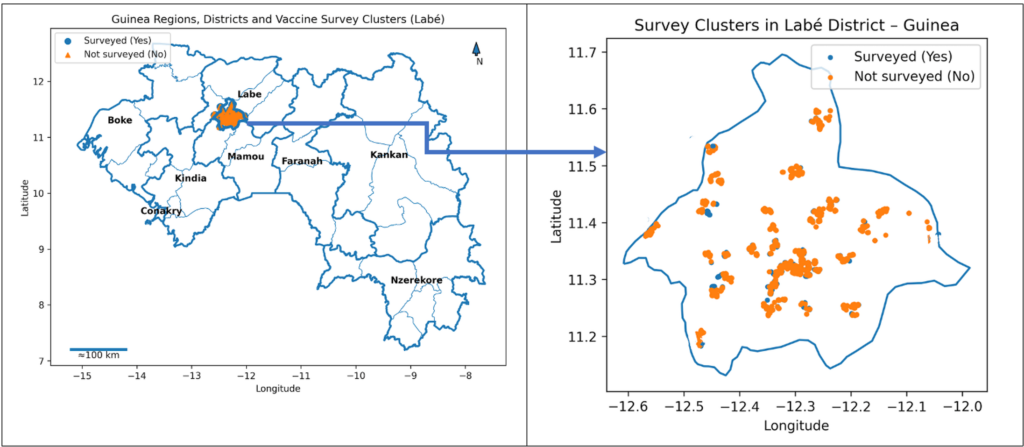
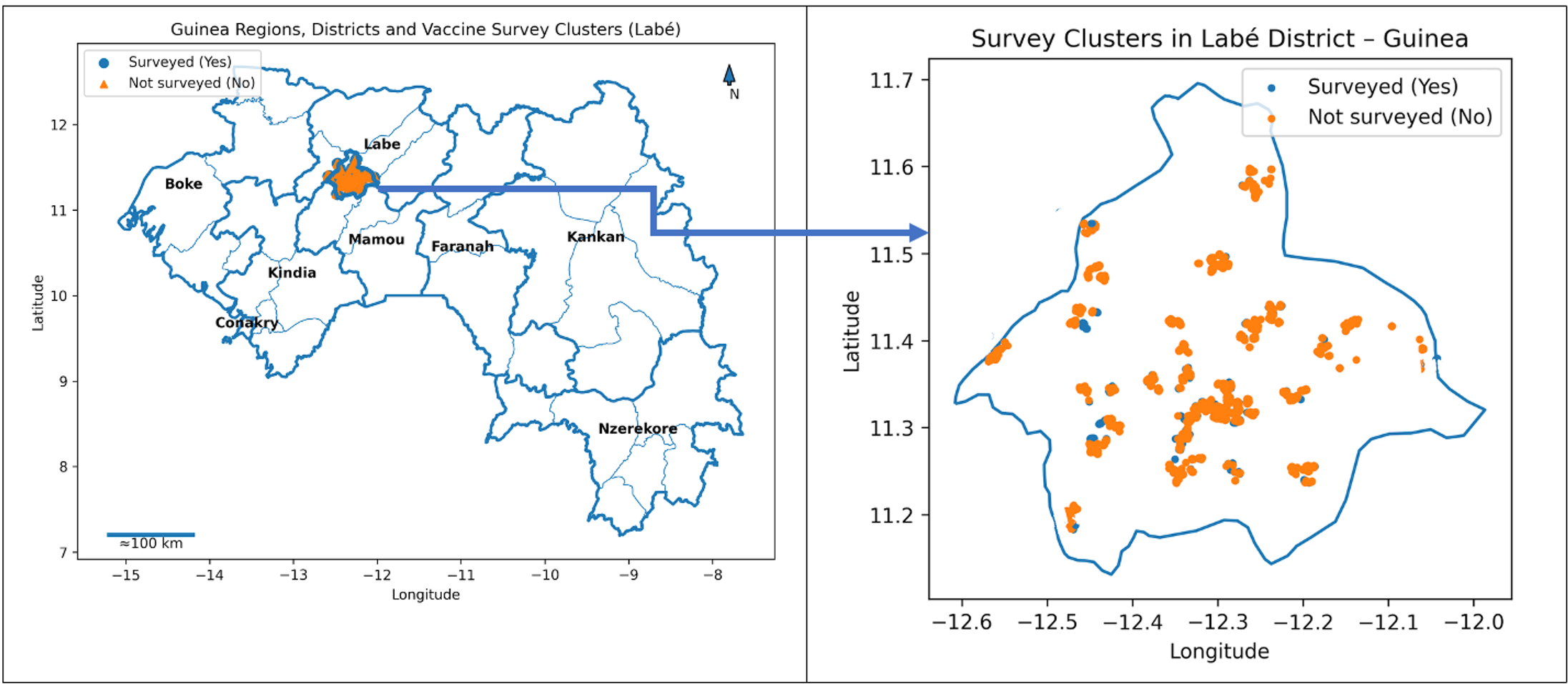
To calculate the number of enumeration zones to sample (n=37) (Map 1), the total number of households (n=56,818) was divided by the number of eligible children (15 children) to be surveyed per enumeration zone. In this study, sampling followed the WHO cluster survey methodology, in which an equal number of eligible children (15) were selected from each cluster.
Definitions
In this paper, “respondent” refers to the person to whom the questionnaire was administered and who answered the survey question. A fully vaccinated child between 12-23 months received all the recommended vaccine doses according to the national immunization schedule, verified by vaccination card or by history. A partially vaccinated child received one or more vaccine doses but had not completed all recommended doses according to the national immunization schedule. A non-vaccinated child did not receive any vaccine dose according to the national immunization schedule.
Data collection
Data were collected in French using a semi-structured questionnaire that had previously been piloted (Supplementary Material). The pilot included enumerating the household in a village and administering the questionnaire to mothers or guardians of children between 12-23 months to detect errors and improve the questionnaire. The questionnaire was deployed on a tablet and administered in person to mothers or caregivers in households by each team of investigators.
Data were collected about all eligible children within each selected household. If a household contained more than one eligible child, information was collected for all of them. The questionnaire included questions related to socio-demographic information, vaccination status of the child by antigen according to the vaccination card and history provided by the respondent, and reasons given for non-vaccination or partial vaccination. Two qualitative questions were used to ensure a good understanding of non-vaccination.
Confirmation of vaccination according to records and history
In addition to the administration of the questionnaire, the investigators reviewed the child’s health card, including the vaccination record and the date the child received the dose, and compared it to the respondent’s provided history. The investigators took pictures of each vaccination record. If the health card was available, the vaccination status was based on its data. In the absence of the health card, the history provided by the mother or guardian was used to estimate the child’s immunization status. The investigator also inspected the outer side of the child’s left arm for a visual confirmation of a BCG scar.
Data management
Two questionnaires (household enumeration and survey) were created in Epi Info 7.2, and data dictionaries were generated. Interviewers entered data in Epi Info until the enumeration was finalised. The data were cleaned in Excel, and the database was used to randomly select the households to be visited (those with children under two years old). After the enumeration was done, the interviewer selected the household to be visited, and a new questionnaire for the survey was used. For the survey, interviewers directly collected answers provided by the respondent using a tablet. Data were cleaned by interviewers at the end of each day. The data included all eligible children. However, in some households, a single respondent provided information for more than one child; all included respondent-level characteristics that were analyzed per child. Qualitative data from respondents were analyzed in French. An inductive codebook was developed by identifying the most frequent terms and phrases that appeared across responses.
Ethical consideration
Verbal informed consent was obtained from each respondent prior to the administration of the questionnaire. Respondents were informed of their free and voluntary participation in the survey, the confidentiality of the information collected, the potential risks of non-vaccination or incomplete vaccination of children, and the benefits of vaccination. This study received a non-research determination by the U.S. CDC Ethics Committee. The study protocol was reviewed and received approval from the ethics committees of the Guinean Ministry of Health.
A total of 539 households were visited, and none were found closed at the time of the survey. All respondents agreed to participate for the 548 children identified to be in the study. Respondents were mostly female (95.5%), married (98.1%), with a mean age of 27 years, and without formal education (53.0%). Sixty-four percent of respondents reported housewife as their occupation, 72.9% resided in rural areas, and 66.6% were able to verify the vaccination status of the child through presentation of a vaccination card (Table 1).
The proportion of children who were fully vaccinated was 47.1% (95% CI: 39.0–55.2). When vaccination coverage was compared across the socio-demographic characteristics of respondents, there were no statistically significant differences by sex and age group; however, confidence intervals for the prevalence ratios were wide and included meaningful differences. Higher coverage was observed for higher levels of education. Children with a respondent who had a university-level education had a prevalence of being fully vaccinated 1.6 times that of those with no education (95% CI: 1.2-2.2). Children of respondents living in rural areas were also more likely to be fully vaccinated than those in urban areas, although the confidence interval for the prevalence ratio contained estimates below the threshold of meaningfulness (PR: 1.5 (1.1-2.1)). Vaccination coverage was also higher when vaccination cards were used as the method of verification (PR: 2.2 (1.5-3.1)) (Table 2).
Table 3 presents the vaccination coverage for each antigen among the children included in the study. Overall, BCG coverage was the highest at 95.9% (95% CI: 94.3–97.5). High coverage was also observed for the first doses of vaccines, including VPO0 (89.9%; 95% CI: 85.3–94.5), VPO1 (88.2%; 95% CI: 83.8–92.6), and Penta1 (89.3%; 95% CI: 85.2–93.5). However, a decline in vaccination coverage was observed for subsequent doses in the immunization schedule. Coverage decreased from VPO1 (88.2%) to VPO2 (76.5%; 95% CI: 69.2–83.8) and further to VPO3 (65.5%; 95% CI: 56.9–74.0). Similarly, coverage for the pentavalent vaccine declined from Penta1 (89.3%) to Penta2 (81.6%; 95% CI: 76.0–87.2) and further to Penta3 (66.6%; 95% CI: 58.1–75.1). The dropout rate between Penta1 and Penta3 was 25.4%. Likewise, the dropout rate between VPO1 and VPO3 was 25.7%. Vaccines administered later in the immunization schedule showed comparatively lower coverage. IPV coverage was 58.1% (95% CI: 49.6–66.6), while VAR coverage was 62.5% (95% CI: 55.0–70.1) and VAA coverage was 60.9% (95% CI: 53.4–68.3).
Table 4 shows the association between children’s place of residence (rural vs. urban) and vaccination coverage by antigen. Overall, vaccination coverage for most antigens was generally higher among children living in rural areas compared with those living in urban areas. Coverage for early vaccines, including BCG, VPO0, VPO1, and Penta1, was similar between the two settings. Although higher coverage estimates were observed in rural areas for later vaccine doses, such as VPO2, VPO3, Penta2, Penta3, IPV, VAR, and VAA, there was no statistically significant association between place of residence and vaccination coverage. These findings suggest a trend toward higher vaccination coverage in rural areas, particularly for vaccines administered later in the immunization schedule, but the differences between rural and urban settings were not statistically significant.
Reasons given for not being fully vaccinated were either system- or community-related. Overall, system-related reasons included vaccine stockouts (n=12; 22.6%), the clinic not having enough children present to justify the opening of a vial (n=10; 18.9%), and the vaccination site being too far (n=9; 17%). The proportion of responses citing distance as a reason in rural settings was less than half that in urban settings (12.8% vs 28.6%). In rural settings, poor staff attitude and lack of a specific appointment time were each cited by over 10% of responses. In urban settings, over 20% of responses cited having to wait a long time, and 14.3% cited visiting the center on days not designated as a vaccination day by the center (Table 5).
This study assessed vaccination coverage among children aged 12–23 months by place of residence and antigen, and also examined the vaccination dropout rate. The overall vaccination coverage was 47.1%, which remains substantially below Guinea’s Comprehensive Multi-Year Plan (CMYP) target of 80% [3]. This finding suggests important gaps in immunization service delivery and highlights inconsistencies between routine administrative immunization data, which reported coverage levels of 84%. Comparable studies conducted in Nigeria among children aged 12–23 months reported a full vaccination coverage of 30.4% [11], which is lower than the coverage observed in the Labe district. In contrast, a study evaluating immunization coverage and determinants of incomplete vaccination among children under two years of age during the COVID-19 pandemic in Sierra Leone reported a coverage of 65.8%, which is higher than that observed in Labe district [12]. These variations across settings may be explained by differences in health system performance, accessibility of vaccination services, community engagement strategies, and the impact of external factors such as public health emergencies. The present study also found that complete vaccination may be associated with rural residence and higher levels of parental education (university level). The higher vaccination coverage observed in rural areas may be partly attributed to the active presence of non-governmental organizations (NGOs) implementing community-based vaccination campaigns and strengthening follow-up mechanisms in rural communities of the Labe region. These initiatives may contribute to improving awareness of immunization and facilitating access to vaccination services. Although further efforts are required to encourage all caregivers to maintain a vaccination card for each child, the proportion of caregivers able to present documented evidence of vaccination, particularly in rural areas, remains encouraging.
The present study found very high coverage for BCG vaccination and relatively high coverage for the first doses of routine vaccines, including VPO0, VPO1 and Penta1 indicating strong uptake of vaccines administered at birth. This finding is consistent with evidence from many countries in sub‑Saharan Africa where BCG, VPO0, VPO1 and Penta1 coverage is typically among the highest within the Expanded Program on Immunization (EPI), largely because it is administered shortly after birth in health facilities. Studies in Ghana and other West African countries have reported BCG coverage levels above 90%, reflecting the relative success of early contact between mothers and health services immediately after delivery [13].
Despite the strong initiation of vaccination observed in this study, coverage declined progressively for subsequent doses. Coverage dropped from VPO1 (88.2%) to VPO2 (76.5%) and further to VPO3 (65.5%), while pentavalent vaccine coverage decreased from Penta1 (89.3%) to Penta3 (66.6%). Similar patterns of declining coverage across vaccine doses have been widely reported in Africa. According to WHO and UNICEF estimates, approximately 80% of infants in the African region receive the first dose of DTP‑containing vaccines, but only about 72% receive the third dose, indicating a substantial dropout between early and later doses [14,15,16].
In this study, the dropout rate between Penta1 and Penta3 (approximately 25%) is considerably higher than the 10% dropout threshold recommended by the World Health Organization, suggesting gaps in follow‑up and continuity of routine immunization services. Similar dropout rates have been documented in Gambia, Sierra Leone, and Liberia. They reported incomplete vaccination coverage and substantial dropout between early and later vaccine doses [17,18].
High dropout rates between initial and later doses of vaccines are often attributed to multiple factors, including barriers to access to health facilities, lack of caregiver awareness regarding vaccination schedules, missed opportunities for immunization, and health system challenges such as vaccine stock‑outs and insufficient follow‑up mechanisms. These challenges remain common in many countries in the WHO African Region, where fragile health systems and socioeconomic inequalities continue to affect immunization coverage [18,19].
In addition to declining coverage for multi‑dose vaccines, the present study found comparatively low coverage for vaccines administered later in the immunization schedule, including IPV (58.1%), VAR (62.5%) and VAA (60.9%). This finding is consistent with evidence from regional and global studies indicating that vaccines scheduled at older ages—such as measles vaccine—often have lower uptake compared with those given earlier in infancy. In the WHO African Region, coverage for the first dose of measles vaccine has been estimated at approximately 69%, which remains below the levels required to achieve herd immunity and prevent outbreaks [14,20].
This study examined the association between place of residence and childhood vaccination coverage. The findings showed no statistically significant association between place of residence (rural vs. urban) and vaccination coverage for either early or later vaccine doses. Coverage for early vaccines, such as BCG, VPO0, and VPO1, was relatively similar between rural and urban settings, suggesting comparable initial access to immunization services across geographic areas. Although vaccination coverage estimates for several later doses, including VPO2, VPO3, Penta2, Penta3, IPV, VAR, and VAA, appeared higher among children living in rural areas, these differences were not statistically significant. The higher vaccine coverage observed for the early vaccines could be explained by the fact that these vaccines are typically delivered through routine maternal and child health services [21].
Much remains to be done to address Labe’s inadequate vaccination through interventions at both the health structure and the community level. The lack of availability of vaccines highlights Guinea’s logistical challenges and would require an overall change in the inventory and distribution system. However, refusal by the health centers to open a vial because not enough children are present should be addressed through better education of health center personnel. In 2019, Guinea’s proportion of vaccine loss for BCG (21%), VPO (5%), IPV (8%), Pentavalent (5%), VAR (12%), and VAA (10%) were all below the allowable proportion stated in the EPI 2019 annual operational plan: 35% for BCG, 10% for VPO and IPV, 5% for Pentavalent, and 20% for VAR and VAA. The higher proportion of respondents citing distance from the health center as a reason for non-vaccination in urban rather than rural areas might seem counter-intuitive, but is reflective of the high cost of public transportation in urban settings and the fact that rural teams benefit from the use of mobile vaccination teams. Providing information sessions on the importance and benefits of vaccination to guardians may help dispel fear and false beliefs about vaccination and encourage guardians to prioritize vaccination in their busy schedule. The higher proportion of fully vaccinated children among more educated parents supports this hypothesis.
Limitations
This study was carried out only in the district of Labe, and its results cannot be generalized to other districts. An additional limitation is that children were selected with equal probability and are therefore self-weighted.
Overall, these findings suggest that while access to early immunization may be relatively equitable, sustaining vaccination through the complete schedule remains a challenge. Strengthening follow-up systems, improving caregiver awareness, and implementing targeted immunization strategies—particularly in urban settings—may help reduce dropout rates and improve full immunization coverage.
What is already known about the topic
What this study adds
The authors of this work declare no competing interests.
Disclaimer
The conclusions, findings, and opinions expressed by authors contributing to this journal do not necessarily reflect the official position of the U.S. Centres for Disease Control and Prevention, or the authors’ affiliated institutions.
We aknowledge the following FETP-I cohort #1 graduates for their role in the data collection: Keita, Karamoko; Camara, Naby; Yattasaye, Bouna; Lama, Etienne; Doumbouya, Fatoumata; Balde, Abdoulaye Sadio; Bah, Mamadou Moustapha; Kaba, N’faly; Camara, Ansoumane; Bilivogui, Pepe; Dore, Matho Tokpa; Barry, Mamadou Billo Aye; Kourouma, Fassou; Camara, Sekou Mohamed; Yaradouno, Elie Yallo; Sylla, Sekou Sidate.
| Sociodemographic characteristic | % (n) |
|---|---|
| Sex (n=539) | |
| Male | 4.5 (24) |
| Female | 95.5 (515) |
| Age group (n=528) | |
| 16-25 | 43.9 (232) |
| 26-35 | 45.5 (240) |
| 36+ | 10.6 (56) |
| Education (n=536) | |
| None | 53.0 (284) |
| Primary | 21.3 (114) |
| Secondary | 22.8 (122) |
| University | 3.0 (16) |
| Profession (n=533) | |
| Merchant | 9.9 (53) |
| Farmer | 5.1 (27) |
| Civil Servant | 2.4 (13) |
| Teacher | 2.4 (13) |
| Craftsman | 6.0 (32) |
| Other | 10.1 (54) |
| Housewife | 64.0 (341) |
| Marital status (n=529) | |
| Single | 1.0 (5) |
| Married | 98.1 (519) |
| Widowed | 0.8 (4) |
| Divorced | 0.2 (1) |
| Place of residence (n=539) | |
| Urban | 27.1 (146) |
| Rural | 72.9 (393) |
| Method (n=548) | |
| Card | 66.6 (365) |
| History | 33.4 (183) |
| Denominators vary because of missing responses for selected respondent characteristics. Sociodemographic characteristics are presented at the respondent/household level, while method of vaccination ascertainment is presented at the child level. | |
| Fully vaccinated | n | % | PR (95% CI) |
|---|---|---|---|
| Overall | |||
| Fully Vax | 258 | 47.1 | |
| Sex | |||
| Male | 11 | 45.8 | REF |
| Female | 241 | 46.8 | 1.0 (0.7, 1.5) |
| Age group | |||
| 16-25 | 103 | 44.4 | REF |
| 26-35 | 112 | 46.7 | 1.1 (0.9, 1.2) |
| 36+ | 33 | 58.9 | 1.3 (1.0, 1.7) |
| Education | |||
| None | 131 | 46.1 | REF |
| Primary | 46 | 40.4 | 0.9 (0.7, 1.2) |
| Secondary | 61 | 50.0 | 1.1 (0.8-1.4) |
| University | 12 | 75.0 | 1.6 (1.2, 2.2) |
| Place of residency | |||
| Urban | 50 | 34.2 | REF |
| Rural | 205 | 51.4 | 1.5 (1.1-2.1) |
| Evidence of vaccination | |||
| History | 48 | 26.2 | REF |
| Card | 210 | 57.5 | 2.2 (1.5-3.1) |
| (n=548), Labe district, August 2019 | |||
| Antigen | n | % (95% CI) |
|---|---|---|
| BCG (n=514) | 493 | 95.9 (94.3-97.5) |
| VPO0 (n=505) | 454 | 89.9 (85.3-94.5) |
| VPO1 (n=499) | 440 | 88.2 (83.8-92.6) |
| VPO2 (n=502) | 384 | 76.5 (69.2-83.8) |
| VPO3 (n=501) | 328 | 65.5 (56.9-74.0) |
| Penta1 (n=507) | 453 | 89.3 (85.2-93.5) |
| Penta2 (n=501) | 409 | 81.6 (76.0-87.2) |
| Penta3 (n=497) | 331 | 66.6 (58.1-75.1) |
| IPV (n=501) | 291 | 58.1 (49.6-66.6) |
| VAR (n=510) | 319 | 62.5 (55.0-70.1) |
| VAA (n=511) | 311 | 60.9 (53.4-68.3) |
| Antigen | Rural | Urban | PR (95% CI) |
|---|---|---|---|
| % (n) | % (n) | ||
| BCG | 95.4 (353) | 97.0 (131) | 1.0 (1.0-1.0) |
| VPO0 | 89.5 (324) | 91.0 (122) | 1.0 (0.9-1.1) |
| VPO1 | 89.1 (318) | 85.0 (113) | 1.0 (0.9-1.2) |
| VPO2 | 81.7 (294) | 62.4 (83) | 1.3 (1.0-1.7) |
| VPO3 | 69.9 (251) | 52.6 (70) | 1.3 (0.9-1.9) |
| Penta1 | 90.1 (329) | 86.5 (115) | 1.0 (0.9-1.1) |
| Penta2 | 85.3 (308) | 72.0 (95) | 1.2 (1.0-1.4) |
| Penta3 | 70.8 (254) | 54.3 (70) | 1.3 (0.9-1.8) |
| IPV | 60.7 (218) | 49.6 (66) | 1.2 (0.8-1.8) |
| VAR | 66.8 (246) | 50.4 (67) | 1.3 (1.0-1.7) |
| VAA | 65.2 (240) | 48.5 (65) | 1.3 (1.0-1.7) |
| Reasons related to the system | Urban | Rural | Total |
|---|---|---|---|
| % (n=14) | % (n=39) | % (n=53) | |
| Long wait | 21.4 (3) | 2.6 (1) | 7.5 (4) |
| Far away vaccination place | 28.6 (4) | 1.2.8 (5) | 17.0 (9) |
| Unknown schedule | 0.0 (0) | 7.7 (3) | 5.7 (3) |
| Poor staff attitude | 0.0 (0) | 10.3 (4) | 7.5 (4) |
| Not enough children present to open a vial | 7.1 (1) | 23.0 (9) | 18.9 (10) |
| Non-specified appointment time | 0.0 (0) | 15.4 (6) | 11.3 (6) |
| Vaccine stockout | 28.6 (4) | 20.5 (8) | 22.6 (12) |
| Visit on days where vaccination is not offered | 14.3 (2) | 7.7 (3) | 9.5 (5) |
| Reasons related to the community | % (n=93) | % (n=176) | % (n=269) |
| Sick child | 14.1 (13) | 11.3 (20) | 12.2 (33) |
| Absent or busy parents | 52.7 (49) | 52.3 (92) | 52.4 (141) |
| Not the person deciding | 0.0 (0) | 4.0 (7) | 2.6 (7) |
| Absent personnel | 2.1 (2) | 3.4 (6) | 3.0 (8) |
| Family problems | 2.1 (2) | 2.2 (4) | 2.2 (6) |
| Beliefs about vaccination | 12.9 (12) | 16.0 (28) | 14.9 (40) |
| Negligence | 10.8 (10) | 5.7 (10) | 7.4 (20) |
| Forgetfulness | 2.1 (2) | 1.1 (2) | 1.5 (4) |
| Did not know | 3.2 (3) | 1.7 (3) | 2.2 (6) |
| Delay in beginning of vaccination | 0.0 (0) | 2.2 (4) | 1.5 (4) |