Outbreak Investigation | Open Access | Volume 9 (Suppl 12): Article 16 | Published: 03 Sep 2026

Views: 1,090
Menu, Tables and Figures
| Variable | Frequency(n= 165) | Percentage (%) |
|---|---|---|
| Age (years; n=158) | ||
| <5 | 4 | 2.5 |
| 5 – 14 | 18 | 11.4 |
| 15 – 24 | 67 | 42.4 |
| 25 – 44 | 50 | 31.6 |
| 45 – 64 | 11 | 7.0 |
| 65+ | 8 | 5.1 |
| Sex | ||
| Female | 78 | 47.3 |
| Male | 87 | 52.7 |
| Laboratory results (n=164) | ||
| Positive | 70 | 42.6 |
| Negative | 94 | 57.3 |
| Clinical Outcome | ||
| Dead | 37 | 22.4 |
| Absconded | 6 | 3.6 |
| Discharged | 26 | 15.8 |
| Referred | 1 | 0.6 |
| Unknown/Missed | 96 | 58.2 |
Table 1: Demographic characteristics of suspected Lassa fever cases in Taraba State, Nigeria, by epidemiological week 1 – 7, 2025
| LGA | Population* | Suspected cases | Confirmed cases | Deaths | CFR (%) | Attack Rate(per 100,000 population) |
|---|---|---|---|---|---|---|
| Ardo-Kola | 138,100 | 20 | 15 | 8 | 53.3 | 10.9 |
| Bali | 332,000 | 35 | 23 | 12 | 52.2 | 6.9 |
| Donga | 209,400 | 7 | 4 | 2 | 50.0 | 1.9 |
| Gashaka | 137,100 | 3 | 2 | 1 | 50.0 | 1.5 |
| Gassol | 385,500 | 13 | 4 | 3 | 75.0 | 1.0 |
| Ibbi | 132,600 | 2 | 1 | 1 | 100.0 | 0.8 |
| Jalingo | 220,700 | 52 | 14 | 7 | 50 | 6.3 |
| Karim-Lamido | 305,100 | 6 | 2 | 1 | 50 | 0.7 |
| Lau | 149,700 | 10 | 2 | 0 | 0 | 1.3 |
| Takum | 211,700 | 2 | 1 | 0 | 0 | 0.5 |
| Wukari | 374,800 | 9 | 2 | 2 | 100 | 0.5 |
| Total | 3,234,600 | 165 | 70 | 37 | 53 | 2.2 |
| *Projected population based on Reference [15]. | ||||||
Table 2: Distribution of suspected cases, confirmed cases, deaths, attack rates, and case fatality rates by affected LGA, Taraba State, Nigeria, Epidemiological Weeks 1–7, 2025
Munzali Shamsu1,2,&, Olukemi Titilope Olugbade1, Lois Oluwatoyin Olajide2, Ahmad Muhammad Aliyu1, Murtala Rabi’u1, Moses Job Tarfa1, Zainab Dambazau1,2, Musa Hassan Muhammad3, Sa’adatu Aliyu Abubakar2, Mustapha Lawal2, Aliyu Hamisu2, Adama Ahmad2, Zayyanatu Nuru Jibril2, Iftihaj Kabir2, Rofiat Ajo Abdulganiyu1,5, Ogunbode Oladipo1,2, Muhammad Shakir Balogun1,4
1Nigeria Field Epidemiology and Laboratory Training Program, Abuja, Nigeria, 2Nigeria Centre for Disease Control and Prevention, Abuja, Nigeria, 3Department of Microbiology and Biotechnology, Faculty of Life Sciences, Federal University, Dutse, P.M.B.7156, Dutse, Jigawa State, Nigeria, 4African Field Epidemiology Network, Asokoro, Abuja, Nigeria, 5Federal Medical Centre Jalingo, Molecular Laboratory, Taraba State, Nigeria
&Corresponding author: Munzali Shamsu, Nigeria Centre for Disease Control and Prevention. Plot 801, Ebitu Ukiwe Street, Jabi, Abuja, Nigeria. Email: munzali.shamsu@ncdc.gov.ng munzalishamsu0@gmail.com, ORCID: https://orcid.org/0009-0005-6238-2870
Received: 31 Dec 2025, Accepted: 02 Sep 2026, Published: 03 Sep 2026
Domain: Infectious Disease Epidemiology
Keywords: Epidemiology, Lassa fever, Community Sensitization, Infection Prevention and Control
©Munzali Shamsu et al. Journal of Interventional Epidemiology and Public Health (ISSN: 2664-2824). This is an Open Access article distributed under the terms of the Creative Commons Attribution International 4.0 License (https://creativecommons.org/licenses/by/4.0/), which permits unrestricted use, distribution, and reproduction in any medium, provided the original work is properly cited.
Cite this article: Munzali Shamsu et al., Descriptive epidemiology of Lassa fever outbreak in Taraba State, Nigeria, 2025. Journal of Interventional Epidemiology and Public Health. 2026; 9(Suppl 12):16. https://doi.org/10.37432/jieph-d-25-00342
Introduction: Lassa fever (LF) is endemic in West Africa, representing a significant public health security threat. While Nigeria bears the highest burden, detailed state-level epidemiological data, particularly in North-Eastern states like Taraba, remain scarce. This study provided a comprehensive descriptive epidemiological pattern of Lassa fever in Taraba State from epidemiological weeks 1 – 7, 2025, addressing a critical evidence gap and informing targeted public health interventions.
Methods: We conducted a descriptive epidemiological study analysing Taraba State surveillance and contact tracing data during the outbreak response from epidemiological week 1 – 7, 2025. A suspected case was defined as any person with malaise, fever, headache, sore throat, cough, nausea, vomiting, diarrhoea, myalgia, chest pain, hearing loss and a history of contact with rodent excreta or with a case of Lassa fever, while a confirmed case was defined as a suspected case that is laboratory-confirmed with Reverse-Transcription Polymerase Chain Reaction. We reviewed response logs, risk communication, and medical supply distribution. Descriptive statistics, including frequencies, proportions, positivity rate, and case fatality rate (CFR), were calculated, and the temporal distribution was analysed.
Results: A total of 165 suspected cases were reported, of which 70 (42.6%) were laboratory-confirmed cases. Three suspected cases (1.8%; 3/165) occurred among healthcare workers. Thirty-seven confirmed cases died, giving a case fatality rate of 52.9%. The 15- 24-year age group accounted for 40.6% (67/165) of suspected cases, and 52.7% (87/165) were male. Bali LGA recorded the highest positivity rate (67.7%; 23/35), accounted for the highest proportion of confirmed cases (32.9%; 23/70) and high CFRs were noted in Ibbi and Wukari LGA (100%), Gassol (75%), Ardo-Kola (53.3%) and Bali (52.2%). The outbreak peaked during epidemiological week 4 (late January 2025).
Conclusion: The Lassa fever outbreak in Taraba State was characterised by a high CFR, concentration of cases among young adult males and the epidemiological week 4 peak necessitated immediate and targeted public health interventions, including strengthening surveillance, implementing intensive community awareness campaigns for high-risk groups, and ensuring prompt access to life-saving treatment in high-burden LGAs.
Lassa fever (LF) is an acute viral hemorrhagic infection caused by the Lassa virus (LASV), endemic in West Africa with known “hotspots” predominantly in Nigeria. LF constitutes a significant clinical, financial, and public health security challenge, confirming LASV as a West African public health priority [1,2]. The disease is primarily transmitted to humans through exposure to food or household items contaminated with the urine or faeces of infected Mastomys natalensis rats [3]. Person-to-person and nosocomial transmissions are frequent, especially in healthcare settings with inadequate infection prevention and control (IPC) procedures [4].
Lassa fever was first identified in 1969 in Lassa town, present-day Taraba State, Nigeria. Since its discovery, recurrent outbreaks and endemic transmission have been reported across several West African countries, including Nigeria, Sierra Leone, Liberia, Guinea, Benin, Ghana, and Mali. It is estimated that between 100,000 and 300,000 Lassa fever infections occur annually in West Africa, resulting in up to 5,000 deaths [5,6]. Human mobility, including trade and cross-border travel, has been implicated in the regional spread of the disease [7].
In Nigeria, Lassa fever outbreaks demonstrate a pronounced seasonal pattern, with peak transmission typically occurring during the dry season from December to April. Young and middle-aged adults are most frequently affected, with a slightly higher incidence reported among males [8,9]. Between 2015 and 2021, over 20,000 suspected cases and more than 3,000 laboratory-confirmed cases were reported nationwide, with case fatality rates (CFRs) varying widely across states and outbreak periods. States with consistently high incidence include Edo, Ondo, Ebonyi, Taraba, Bauchi, Plateau, and Nasarawa [10]. Close to 5,000 LF cases have been confirmed in 34 of Nigeria’s 37 states, including the Federal Capital Territory (FCT), within the last four years, with a CFR reaching up to 71.4% in some localised outbreaks; LF has become an endemic public health crisis in Nigeria [11]. By the end of epidemiological week 52 of 2024, the Nigerian Centre for Disease Control and Prevention (NCDC) reported a total of 1,309 laboratory-confirmed cases and 214 deaths nationally, yielding a CFR of 16.3%(12). More recently, the NCDC reported that Taraba State contributed 301 suspected cases, 112 confirmed cases, and 23 deaths (CFR: 21%) in 2024 [12].
Despite recurrent outbreaks, published epidemiological data specific to Taraba State remain limited. Available information is largely restricted to outbreak summaries and conference abstracts, with limited access to detailed analyses of person, place, and time. Previous reports from the state have suggested high mortality using suspected cases, notable involvement of healthcare workers, and predominance among young adults [13]. However, these findings were often based on suspected cases only rather than laboratory-confirmed results. During outbreak responses, discrepancies in surveillance data and the use of outdated case investigation tools have also been observed.
During the Lassa fever outbreak investigation conducted in Taraba State in early 2025, continued transmission was observed across multiple local government areas (LGAs), alongside cultural and behavioural practices that may increase human–rodent contact. However, a comprehensive state-level descriptive epidemiological analysis was lacking. This study therefore aimed to describe the epidemiological pattern of Lassa fever in Taraba State during epidemiological weeks 1–7 of 2025, using surveillance and contact tracing data, to address critical evidence gaps and inform targeted public health interventions.
Study setting and period
The study was conducted in Taraba State, North-Eastern Nigeria, from Epidemiological Weeks 1 to 7 of 2025. Taraba State comprises 16 Local Government Areas (LGAs) with an estimated projected population of 3,609,843 [14,15]. Lassa fever case management in the state is coordinated through a network of primary and secondary healthcare facilities, with the Federal Medical Centre (FMC), Jalingo, serving as the main referral and treatment centre. During the outbreak, laboratory confirmation was performed at the FMC Jalingo Molecular Laboratory using the Altona RealStar® Lassa Virus RT-PCR Kit 2.0 according to the manufacturer’s instructions. All laboratory confirmations were performed using the routine RT-PCR protocol approved by the Nigerian Centre for Disease Control and Prevention (NCDC). The outbreak response was supported by the Nigerian Centre for Disease Control and Prevention (NCDC), the Taraba State Ministry of Health (SMOH), the World Health Organization (WHO), and the African Field Epidemiology Network (AFENET).
Study design and population
This was a descriptive epidemiological study based on routine surveillance and contact tracing data. The study population included all suspected Lassa fever cases reported in Taraba State during epidemiological weeks 1–7, 2025. A total of 165 suspected cases were line-listed and included in the analysis.
Case definitions
National NCDC Lassa fever case definitions were applied. A suspected case was defined as any individual presenting with compatible clinical symptoms and relevant exposure history or unexplained bleeding. A confirmed case was defined as a suspected case with laboratory confirmation by real-time polymerase chain reaction (RT-PCR), IgM serology, or virus isolation. A contact was defined as any person exposed to a confirmed or probable Lassa fever case or their bodily fluids within 21 days prior to symptom onset.
Inclusion and exclusion criteria
All suspected Lassa fever cases reported during the study period and tested by RT-PCR were included. Duplicate records were excluded. Cases with missing key outcome variables were retained for general descriptive analyses but excluded from specific analyses requiring those variables (e.g., CFR calculation).
Data sources and collection
Data were collected through the routine outbreak surveillance system. Health facilities completed standard NCDC Case Investigation Forms (CIFs) for all suspected cases and submitted them to the Local Government Disease Surveillance and Notification Officers (DSNOs). The DSNOs transmitted the data to the State Public Health Emergency Operations Centre, where line lists were compiled and validated. Members of the National Rapid Response Team and State Response Team conducted active case finding and reviewed hospital medical records, laboratory registers, and contact tracing forms to verify and complete missing information. Daily situation reports and response coordination meeting records were also reviewed.
Statistical analysis
Data were analyzed using Microsoft Excel (version 2013) and Epi Info (version 7.6.2). Categorical variables were summarised using frequencies and proportions, while continuous variables were described using medians and interquartile ranges (IQR) because age was not normally distributed. Attack rates were calculated as the number of confirmed cases per 100,000 population using LGA population projections. Positivity rate was defined as the proportion of tested samples that were laboratory-confirmed. Case fatality rate (CFR) was calculated as the proportion of laboratory-confirmed cases that resulted in death.
Data visualization:
An epidemic curve was constructed to illustrate the temporal distribution of confirmed cases by epidemiological week. Spatial distribution of cases by LGA was visualized using geographic information system (GIS) QGIS version 3.40.11.
Ethical considerations
The investigation and analysis were conducted as part of an official national public health emergency response coordinated by the NCDC and Taraba SMOH. Ethical approval was obtained from the Taraba State Health Research Ethics Committee (TRSHREC) with approval number TRSHREC/2025/006. The outbreak investigation was conducted under the public health mandate for disease surveillance and outbreak response. Only anonymised, aggregated data were used for analysis and dissemination to ensure the confidentiality and privacy of participants.
During epidemiological weeks 1–7 of 2025, a total of 165 suspected Lassa fever cases were reported in Taraba State. Of these, 70 (42.4%) were laboratory-confirmed cases. All 37 reported deaths occurred among 70 laboratory-confirmed cases, corresponding to an overall case fatality rate (CFR) of 52.9% (37/70).
Sociodemographic characteristics
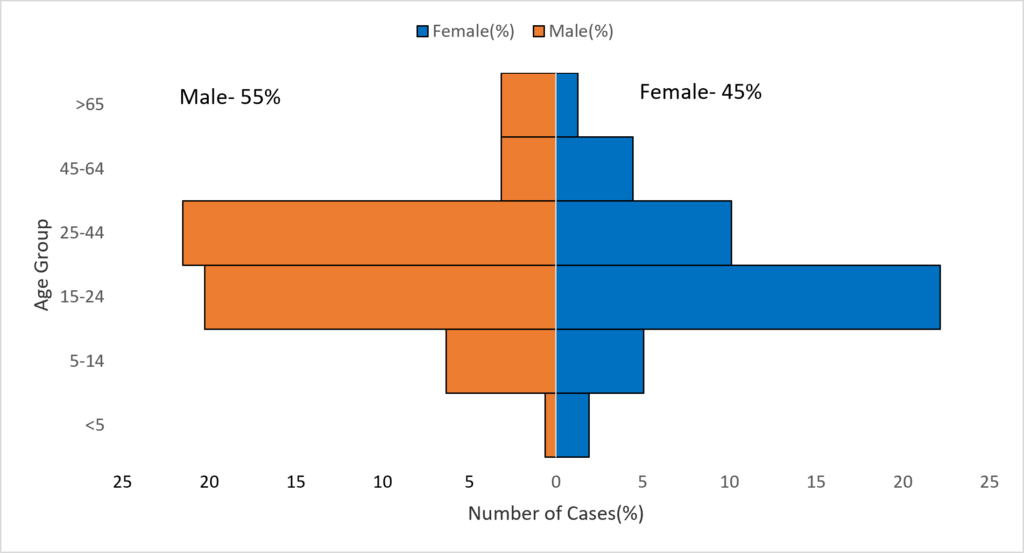
The highest proportion of suspected cases occurred among individuals aged 15–24 years, accounting for 40.6% of cases (Figure 1). The median age was 32 years (IQR: 19 years). Males constituted 52.7% of cases. Healthcare workers accounted for 1.9% (3/165) of suspected cases. Among all suspected cases, 15.8% were discharged alive, while 3.6% absconded from care (Table 1). Most suspected cases of Lassa fever were characterised by acute fever and non-specific symptoms such as headache, diarrhoea, vomiting, sore throat, myalgia, and chest pain. A small proportion of patients experienced unexplained bleeding, and some had a history of contact with confirmed Lassa fever cases or exposure to rodents/rodent excreta. These clinical characteristics led to laboratory confirmation using the Altona RealStar® Lassa Virus RT-PCR Kit 2.0 RT-PCR and were in line with the national case classification for suspected Lassa fever.
Spatial and temporal distribution
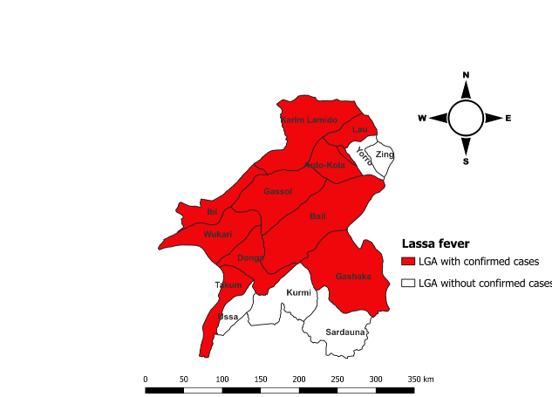
Figure 2 shows the spatial distribution of cases across the LGAs. The index case was reported from Bali LGA, followed by spread to 11 LGAs. The highest numbers of suspected cases were recorded in Jalingo (31.5%), Bali (21.2%), and Ardo-Kola (12.1%). Among confirmed cases, the highest positivity rates were observed in Bali (65.7%), which also accounts for the highest proportion of confirmed cases (32.9%), Ardo-Kola (21.4%), and Jalingo (20.0%; Table 2). Extremely high CFRs were observed in Ibbi and Wukari LGAs, where all confirmed cases resulted in death. Among LGAs with higher case burdens, CFRs exceeded 50% in Ardo-Kola and Bali. The highest attack rate was observed in Ardo-Kola LGA at 10.9 per 100,000 population. The epidemic curve demonstrated a progressive increase in confirmed cases, peaking during epidemiological week 4, followed by a gradual decline towards Week 7 (Figure 3)
This study describes the epidemiological pattern of the 2025 Lassa fever outbreak in Taraba State and highlights a high case fatality rate among laboratory-confirmed cases. Transmission was concentrated in Bali, Jalingo, and Ardo-Kola LGAs, with young adult males disproportionately affected, underscoring the need for targeted risk communication and early case detection strategies [14].
The finding that young adult males were disproportionately affected differs from a previous study in Taraba State, which reported a higher burden among adult females [13]. However, the demographic profile aligns with behavioural practices identified in high-incidence LGAs (Bali and Ardo-Kola), where young adults are commonly involved in Mastomys natalensis hunting for consumption and income, potentially increasing their occupational exposure risk [16].
Three suspected cases occurred among healthcare workers, highlighting the continued occupational risk of Lassa fever during outbreak response. Although the number was small, healthcare worker infections remain an important public health concern because they may indicate gaps in infection prevention and control (IPC) practices, delayed recognition of suspected cases, or exposure during patient care. Strengthening adherence to standard IPC precautions, ensuring the availability and appropriate use of personal protective equipment, and providing regular training for healthcare workers remain essential to reducing healthcare-associated transmission during Lassa fever outbreaks.
The observed peak during epidemiological week 4 is consistent with the established seasonal pattern of Lassa fever in Nigeria, which typically intensifies during the dry season [10]. Increased human–rodent contact during this period likely contributed to sustained transmission. The CFR observed in this outbreak (52.9%) significantly exceeds previously reported state and national averages (16.3% in 2024) [12,13]. This high mortality rate suggests substantial challenges, including delayed health-seeking behaviour, diagnostic delays, limited access to timely Ribavirin treatment, and/or suboptimal supportive care.
The distribution of confirmed cases across multiple LGAs, with hotspots in Jalingo, Ardo-Kola, and Bali, confirms that Lassa fever is endemic and geographically widespread in Taraba State. This pattern contributes significantly to Nigeria’s national burden, like other high-incidence states [10].
While the overall CFR is concerning and exceeds that reported in the 2012 Taraba outbreak [13], a direct comparison is limited because the 2012 study derived its CFR from suspected cases rather than laboratory-confirmed cases, which likely underestimated the true mortality among confirmed infections. The 100% CFRs reported in Ibbi and Wukari LGAs should be interpreted cautiously due to the very small case numbers (one and two confirmed cases, respectively). The particularly high CFRs in high-burden LGAs like Bali, Ardo-Kola, and Gassol are, however, of greater concern and suggest deep-seated issues. The high positivity rate in Bali suggests intense community transmission or late presentation. This observation, coupled with documented poor knowledge of Lassa fever in the LGA [14], supports the hypothesis that low community awareness, weak surveillance, and delayed access to care are critical drivers of the high local mortality observed [17].
The absence of confirmed cases in some LGAs should be interpreted cautiously, as it may reflect under-detection rather than true absence of transmission. Strengthening surveillance, laboratory capacity, and case investigation across all LGAs is therefore essential.
Limitations
This study relied on routine surveillance data, which are subject to underreporting and data quality limitations. Limited access to healthcare facilities in some rural LGAs, variations in IPC practices, and delayed funding release during the outbreak response may have influenced case detection and outcomes. Additionally, the short outbreak duration limited trend analysis.
The Lassa fever outbreak in Taraba State during epidemiological weeks 1–7 of 2025 was characterised by widespread transmission across multiple LGAs and a very high case fatality rate among confirmed cases. Young adult males and residents of Bali, Jalingo, and Ardo-Kola LGAs were disproportionately affected.
Recommendations
Enhanced surveillance, early diagnosis, and timely initiation of ribavirin therapy should be prioritised across all LGAs. Targeted community risk communication addressing high-risk behaviours and strengthened IPC practices in health facilities are urgently needed. Timely release of outbreak response funds and continuous training on updated surveillance tools are critical to reducing mortality in future outbreaks.
What is already known about the topic
What this study adds
This investigation was carried out as part of the official public health emergency response and was supported by operational funding from the World Health Organization (WHO) and the African Field Epidemiology Network (AFENET). No specific funding was received for the analysis or preparation of this manuscript. WHO/AFENET had no role in the study design, data interpretation, or manuscript drafting.
MS designed the outbreak investigation protocol, was responsible for the surveillance data collection, performed the statistical analysis, and drafted the manuscript. All other authors contributed significantly to the data interpretation and critically revised the manuscript for intellectual content. All authors have read and approved the final manuscript.
| Variable | Frequency(n= 165) | Percentage (%) |
|---|---|---|
| Age (years; n=158) | ||
| <5 | 4 | 2.5 |
| 5 – 14 | 18 | 11.4 |
| 15 – 24 | 67 | 42.4 |
| 25 – 44 | 50 | 31.6 |
| 45 – 64 | 11 | 7.0 |
| 65+ | 8 | 5.1 |
| Sex | ||
| Female | 78 | 47.3 |
| Male | 87 | 52.7 |
| Laboratory results (n=164) | ||
| Positive | 70 | 42.6 |
| Negative | 94 | 57.3 |
| Clinical Outcome | ||
| Dead | 37 | 22.4 |
| Absconded | 6 | 3.6 |
| Discharged | 26 | 15.8 |
| Referred | 1 | 0.6 |
| Unknown/Missed | 96 | 58.2 |
| LGA | Population* | Suspected cases | Confirmed cases | Deaths | CFR (%) | Attack Rate(per 100,000 population) |
|---|---|---|---|---|---|---|
| Ardo-Kola | 138,100 | 20 | 15 | 8 | 53.3 | 10.9 |
| Bali | 332,000 | 35 | 23 | 12 | 52.2 | 6.9 |
| Donga | 209,400 | 7 | 4 | 2 | 50.0 | 1.9 |
| Gashaka | 137,100 | 3 | 2 | 1 | 50.0 | 1.5 |
| Gassol | 385,500 | 13 | 4 | 3 | 75.0 | 1.0 |
| Ibbi | 132,600 | 2 | 1 | 1 | 100.0 | 0.8 |
| Jalingo | 220,700 | 52 | 14 | 7 | 50 | 6.3 |
| Karim-Lamido | 305,100 | 6 | 2 | 1 | 50 | 0.7 |
| Lau | 149,700 | 10 | 2 | 0 | 0 | 1.3 |
| Takum | 211,700 | 2 | 1 | 0 | 0 | 0.5 |
| Wukari | 374,800 | 9 | 2 | 2 | 100 | 0.5 |
| Total | 3,234,600 | 165 | 70 | 37 | 53 | 2.2 |
| *Projected population based on Reference [15]. | ||||||