Short Communication | Open Access | Volume 9 (Suppl 14): Article 05 | Published: 16 Sep 2026

Views: 194
Menu, Tables and Figures
Table 1: The frequency of neonatal deaths by characteristic in EFSTH, Banjul, The Gambia, 2021
| Variable | Frequency (N=306) | Percent (%) |
|---|---|---|
| Sex | ||
| Male | 161 | 52.6 |
| Female | 145 | 47.4 |
| Age in days | ||
| <1 | 98 | 32.0 |
| 1-3 | 73 | 23.9 |
| 4-7 | 61 | 19.9 |
| 8-28 | 74 | 24.2 |
| Gestational age | ||
| Pre-term | 174 | 56.9 |
| Term | 102 | 33.3 |
| Post-term | 3 | 1.0 |
| Not indicated | 27 | 8.8 |
| Type of delivery | ||
| Spontaneous Vaginal Delivery | 242 | 79.1 |
| Caesarian section | 57 | 18.6 |
| Breech | 6 | 2.0 |
| Not available | 1 | 0.3 |
| Birth weight | ||
| Very low birth weight | 95 | 31.1 |
| Normal birth weight | 86 | 28.1 |
| Low birth weight | 66 | 21.6 |
| Extreme low birth weight | 28 | 9.2 |
| Not available | 31 | 10.1 |
| Referral | ||
| Yes | 195 | 63.7 |
| No | 111 | 36.3 |
| REGION | ||
| W1 | 154 | 50.3 |
| W2 | 113 | 36.9 |
| NBRW | 23 | 7.5 |
| NBRE | 6 | 2.0 |
| CRR | 4 | 1.3 |
| LRR | 4 | 1.3 |
| URR | 2 | 0.7 |
EFSTH = Edward Francis Small Teaching Hospital; HIE = Hypoxic Ischemic Encephalic; W1 = Western 1; W2 = Western 2; NBRW = North Bank Region West; NBRE = North Bank Region East; CRR = Central River Region; LRR = Lower River Region; URR = Upper River Region.
“`
Bubacarr Jallow1, &, Adebayo Peter Adewuyi2, Amadou Woury Jallow3, Joseph Jatta4, Ebrima Jallow3, Mustapha Bittaye5
1Primary Health Care Unit, Ministry of Health, Banjul, The Gambia; 2Africa Field Epidemiology Network (GamFETP), Banjul, The Gambia; 3Epidemiology and Disease Control Unit, Ministry of Health, Banjul, The Gambia; 4Directorate of Health Research, Ministry of Health, Banjul, The Gambia; 5Ministry of Health, The Quadrangle, Banjul, The Gambia
&Corresponding author: Bubacarr Jallow, Primary Health Care Unit, Ministry of Health, Banjul, The Gambia, Email: jallowbubacarrm@gmail.com, ORCID: https://orcid.org/0000-0001-9602-3466
Received: 13 Dec 2024, Accepted: 14 Sep 2026, Published: 16 Sep 2026
Domain: Maternal and Child Health
Keywords: Neonate, mortality, The Gambia, epidemiology
©Bubacarr Jallow et al. Journal of Interventional Epidemiology and Public Health (ISSN: 2664-2824). This is an Open Access article distributed under the terms of the Creative Commons Attribution International 4.0 License (https://creativecommons.org/licenses/by/4.0/), which permits unrestricted use, distribution, and reproduction in any medium, provided the original work is properly cited.
Cite this article: Bubacarr Jallow et al., Neonatal mortality in Edward Francis Small Teaching Hospital (EFSTH), Banjul, The Gambia, 2021: A need for neonatal mortality surveillance. Journal of Interventional Epidemiology and Public Health. 2026; 9(Suppl 14): 05. https://doi.org/10.37432/jieph-d-24-02044
Introduction: Neonatal mortality surveillance has not been prioritised in The Gambia, despite the global target of the SDGs to reduce the neonatal mortality rate to <12/1000 live births by 2030. The neonatal mortality rate in The Gambia is 29/1000 LBS. We conducted this study to describe the epidemiology of neonatal mortality at Edward Francis Small Teaching Hospital in The Gambia from January to December 2021.
Methods: We conducted a cross-sectional study at EFSTH among neonates who died within the period under study. We extracted data from various sources in the hospital. We analyzed demographic variables, listed sources of data, and determined risk factors for death at a 95% confidence interval.
Results: Of the 306 neonatal deaths in 2021, 161 (52.6%) were males; the median age was 2.4 days, with a range of 0.04-26 days. The neonatal mortality rate in EFSTH for the year was 69/1000 LBS. Spontaneous vaginal delivery was the mode of delivery for 242 (79.1%) of the neonates that died in the hospital. There were more than 174 (56.9%) preterm and 95 (35.3%) very low birth weight babies among the deaths. The leading cause of death was pneumonia among 89 (29.1%), while the least common cause of death was asphyxia, accounting for 22 (7.2%) deaths.
Conclusion: We found that the neonatal mortality rate for the hospital is higher than the national one. More male neonates died, and the majority of mortalities occurred within the first day of life. More deaths occurred in the Western Regions. The leading cause of death among neonates was found to be pneumonia due to meconium aspiration or as a complication leading to respiratory distress syndrome, among others.
The Sustainable Development Goal 3 target 3.2 aims at reducing neonatal mortality to <12 per 1000 live births by 2030 [1]. The first 28 days of life (neonatal period) are very critical, as babies are faced with highest risk of dying, with a global rate of 17/1000 live births in 2020, a reduction of 54% from 37/1000 live births in 1990 (UNICEF data, 2021). Approximately 6,700 neonatal mortalities occur daily, accounting for 47% of all <5 deaths [2]. The African region had the highest number of neonatal deaths in 2020: 27/1000 live births. Babies born in the African region are ten times more likely to die during the neonatal period than those born in high-income countries [2]. The neonatal mortality rate in The Gambia was 22/1000 live births[3], 31/1000 live births[4], showing an increase. In 2019-20, the neonatal mortality was 29/1000 live births [3].
Neonatal mortality surveillance enables a health facility/system to track the trend of mortalities within a period. The facility/system will have a better understanding of the causes of neonatal morbidities and mortality. These guide the design and implementation of interventions that will reduce/mitigate morbidity and mortality among neonates. The progress of implementation of interventions is monitored through the use of prescribed tools.
The Gambia health system operates on a three-tier (Primary, Secondary and Tertiary) system. The primary is comprised of Village Health Services (VHS), Community Clinics and Minor Health Centres. The secondary are Major Health Centres and District Hospitals, and the tertiary; all other hospitals (general and specialised). The primary and secondary levels are managed by Regional Health Directorates, and tertiary by the board. The country is divided into seven health regions headed by a Regional Director of Health Services, in one of which (Western 1) EFSTH is situated. The Ministry of Health is coordinated by a senior management team (SMT). The SMT comprises the Honourable Minister for Health, the Permanent Secretary, the Director of Health Services and heads of various programs and units. They are responsible for formulating policies and resource mobilisation.
As the country’s main tertiary referral facility, Edward Francis Small Teaching Hospital manages a substantial proportion of complex paediatric and neonatal cases referred from across The Gambia. The hospital registered 1605 live births in 2021. Therefore, we conducted this study to describe neonatal mortality epidemiologically in EFSTH, Banjul, The Gambia, from 1st January to 31st December 2021.
Study area and target population
We reviewed records of neonatal deaths that occurred between 1st January and 31st December, 2021, in EFSTH, Banjul, The Gambia. The hospital has a bed capacity of 645, with both general and specialised units. There is a general pediatric unit which also houses the neonates, with 28 beds in the general ward, 9 beds in the pediatric emergency ward and 32 beds in the surgical ward. In the neonatal ward, there are 27 baby cots, 9 (4 functional) incubators, 4 (3 functional) heaters and 7 beds at the kangaroo mother care unit. The unit is also equipped with surgical, laboratory and radiology services. There is also a records unit where all patient records are archived.
Edward Francis Small Teaching Hospital is the biggest and the main referral point for the whole country, especially neonatal cases. The hospital has the largest neonatal unit, more specialised and/or skilled personnel and modern equipment. These informed the decision to conduct the study in EFSTH.
Data source and variables of interest
We extracted the live births from an electronic database of the hospital records department. We reviewed the electronic database from the records office containing neonatal mortality data. We further reviewed the duplicates of death certificates at the records office from which we extracted neonatal mortality data. We further reviewed the personal folders to complete the missing variables of interest from the electronic database and duplicate death certificates. The variables we analysed included sex, age in hours or days, region, cause of death, date of death, birth weight, type of delivery, and place of birth
Definition of terms
Low birth weight: Babies born with less than 2.5 kg (< 2500 g) at birth.
Very low birth weight: Babies born with less than 1.5 kgs (< 1500 g) at birth.
Extremely low birth weight: Babies born with less than 1 kg (<1000g) at birth
Term babies: babies born alive between 37 and 40 weeks of gestation.
Preterm: babies born alive between 28 and 37 weeks of gestation.
Postterm: babies born after 41 weeks of gestation.
Data analysis
We conducted univariate analysis and presented results in numbers and proportions, and bivariate analysis to determine risk factors for dying from infectious or non-infectious causes among the dead neonates. We performed this analysis at a 95% Confidence Interval using Epi Info 7.2 and Microsoft Excel.
We calculated the neonatal mortality rate for the hospital by extracting the total live births of the hospital from the database. After reviewing the neonatal mortalities, we deducted the referred neonatal deaths from the total neonatal deaths and then divided the outcome by the total livebirths for the same period that were born in EFSTH to calculate the neonatal mortality rates per 1000 livebirths.
Ethical consideration
A letter was written to the management of the hospital by the Acting Coordinator of Epidemiology and Disease Control Program for permission to conduct the study. Then we were asked to submit a letter to the ethics committee of the hospital indicating the objectives and the data variables to be collected, which was done. We were then issued a letter of approval for the study by the chairman of the ethics committee of the teaching hospital.
Of the 306 neonatal mortalities that occurred at EFSTH in 2021, 161 (52.6%) were males; the median age at death was 2.4 days. Ninety-eight (32.0%) died within the first day of life, and between days 2-7, there were 134 (43.8%) deaths. Of the deaths, preterm births were 174 (56.9%), 242 (79.1%) were delivered spontaneously, while 95 (31.3%) and 66 (21.6%) were born with very low birth weight and low birth weight, respectively (Table 1).
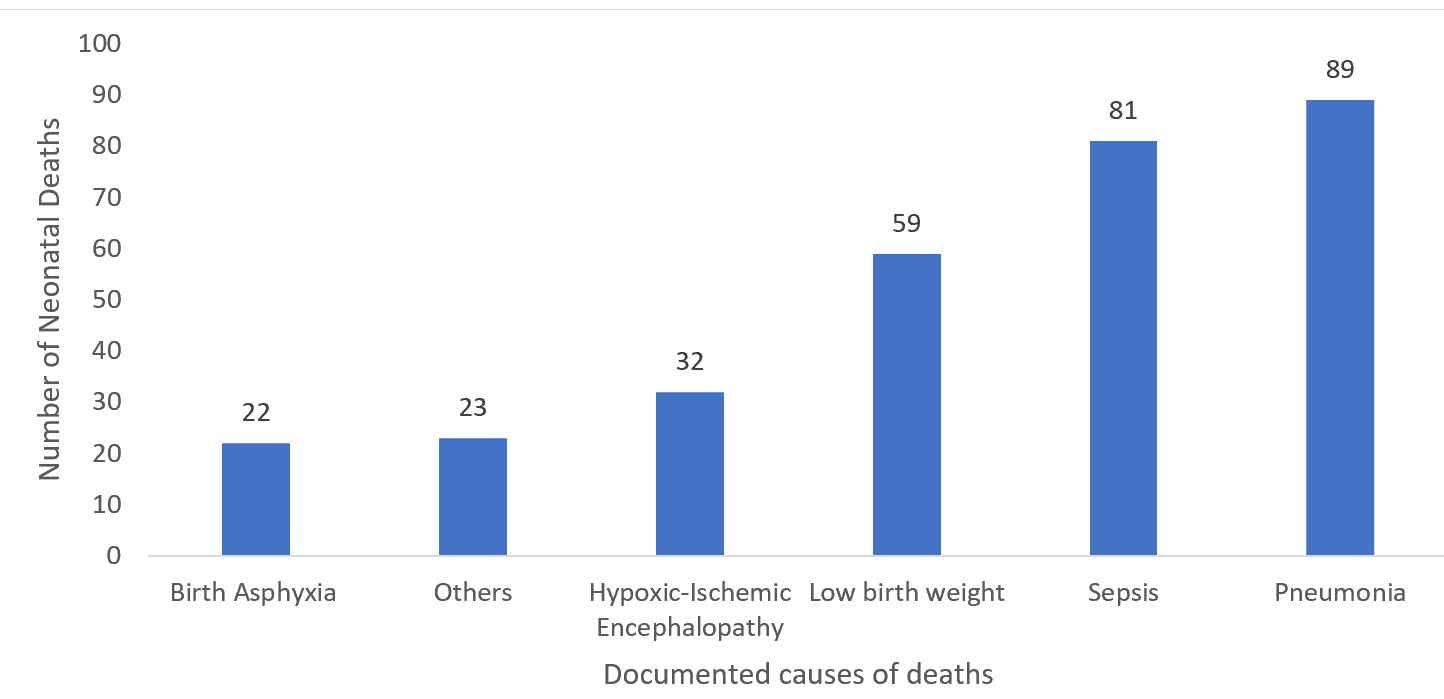
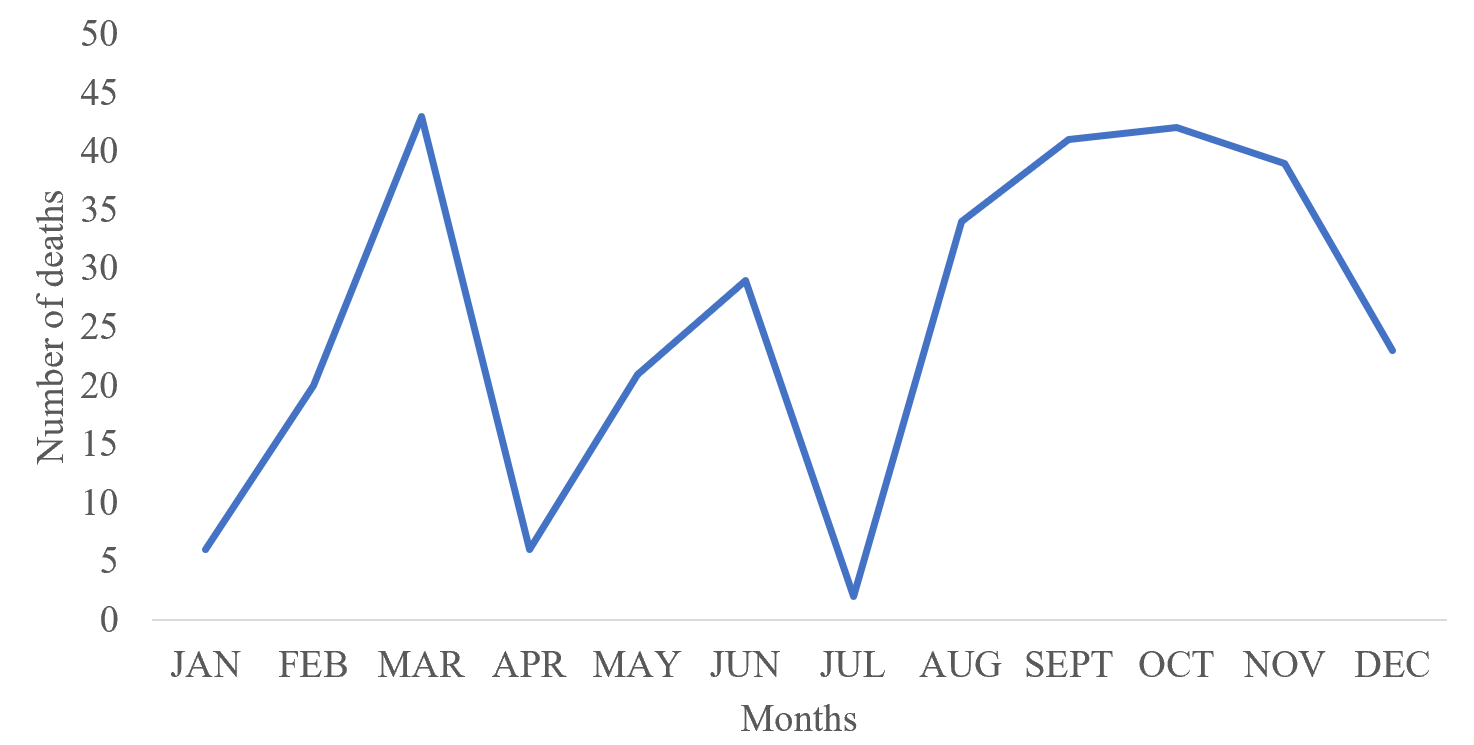
Pneumonia caused 89 (29.1%) of neonatal deaths, followed by sepsis, 81 (26.5%) and low birth weight, 59 (19.3%). The least common cause of death was asphyxia, 22 (7.2%) (Figure 1). The neonatal mortality rate at EFSTH was 69/1000 live births and nationally 29/1000 live births. Among all the neonatal mortalities, 195 (63.7%) were referred from other hospitals and major health centres across the country. There were more neonatal deaths among residents of Western1: 154 (50.3%), Western 2: 113 (36.9%) and North Bank Region West: 23 (7.5%) that died in EFSTH (Table 1). One hundred and fifty-six (51.0%) of the neonatal mortalities occurred between August and November, 2021 (Figure 2).
Neonatal Mortality Rate (NMR) in EFSTH was more than double the national NMR in 2021[3]. However, this could be attributed to mothers referred from other health facilities delivering in EFSTH. More of the mortalities occurred among male neonates. One third of the neonates died during the first day, and about half died between the second and seventh days. Preterm births accounted for over half of the mortalities, and three-quarters of the total mortalities were delivered via Spontaneous Vertex Delivery (SVD), and some of the dead neonates were born with very low birth weight. The main cause of mortality was pneumonia (due to meconium aspiration, respiratory distress and/or secondary to respiratory failure), followed by sepsis (early or late onset of sepsis; that could be attributed to environmental, maternal or personal hygiene) and low birth weight (low birth weights, very low birth weights and extremely low birth weights), whilst the least common cause of mortality was birth asphyxia. Two thirds of the neonatal mortalities were referrals from other health facilities, and half of all neonatal mortalities were residents of the region where the hospital is situated; Western 1 health region. The mortalities were higher in September and October, showing a sharp increase whilst the rest of the months remained stable on almost a flat line.
This study revealed that the majority of neonates die before they are one day old; more than half die within the first three days and about two-thirds die during the first seven days. This could be attributed to prematurity, which makes them vulnerable to infections and harsh environmental conditions. This is similar to studies conducted in Bangladesh and Uganda that found that almost half died within the first 24 hours and the majority of the neonates died during the first week of life, of whom about half died respectively [5] [6].
In this study, the leading causes were pneumonia and sepsis. These could be due to inadequacies in Infection Prevention and Control (IPC) despite the existence of guidelines or policies and a focal person in the hospital. This is inconsistent with the study conducted in Navrongo and Kintampo, Ghana, in 2021, which revealed that neonates died early due to asphyxia, which is the leading cause of deaths among hospital births [7]. This result was similarly found in another Ghanaian study [8]. Similar to our study, where low birth weight was a cause of death, an Ethiopian study in 2021 also revealed that low birth weight babies are more likely to die compared to normal weight babies at birth [9]. Low birth weight could be a result of maternal, environmental and above all nutritional factors. A Senegalese study in 2020 found that babies born via caesarean section are likely to die in the first month of life [10]. This is different from the findings of this study that majority of the neonates that died were delivered via SVD, which is also similar to a study conducted in Eritrea in 2020 that found over three-quarters of neonates that died were delivered via SVD [11].
This study revealed that neonatal deaths occurred more among residents of the Western health regions (Western regions1&2) than those from the rest of the regions. However, it is worth noting that these are the areas where a larger proportion of the population of The Gambia lives (about two-thirds)
We found in this study that the first quarter of the year did not record high numbers of neonatal deaths. However, towards the end of the third quarter and the beginning of the fourth quarter recorded the highest number of mortalities. We opined that the deaths rose in the third quarter because this period is the middle of the rainy season, when farmers are still growing crops, lesser economic activities and increase in infections due to an increase in the number of vectors. In a study conducted in The Gambia in 2021 on risk factors of infant mortality in rural areas of The Gambia, it was revealed that being born within the third and fourth quarter (July-December) has a protective effect against neonatal mortality [12]. Most of the deliveries also occur within this period of the year.
Limitation
The limitations of this study included the unavailability of a civil registry system in the hospital. We recommend that a civil registration system be instituted for the neonatal unit of Edward Francis Small Teaching Hospital. In addition, some of the reviewed records had some variables missing, thus limiting the sample size. Limited funds also contributed to the coverage of this study to only EFSTH. It would have been more representative if more facilities were covered.
We found that the neonatal mortality rate for the hospital is higher than the national one. More male neonates died, and the majority of the deaths occurred within the first day of life. The leading recorded causes of death among neonates were pneumonia and sepsis. More deaths occurred among residents of Western Regions (1&2) and in the third and fourth quarters of the year. Some of the limitations for this study included the unavailability of a civil registry system in the hospital. We recommend that a civil registration system be instituted for the neonatal unit of Edward Francis Small Teaching Hospital.
What is already known about the topic
What this study adds
We sincerely acknowledge the immense contribution of Mr Sainey Beyai, Mr David Mendy and all staff of PHC, staff of Epidemiology and Disease Control Unit, the management and staff of Edward Francis Small Teaching Hospital most especially Mrs. Fanta Sisawo, Senior Records officer, records Office EFSTH and Mrs Rohey Awe, Records clerk, Pediatric Records, EFSTH and Mr. Ngally A Sambou for contributing to the success of this research.
Abbreviations
EFSTH: Edward Francis Small Teaching Hospital
WHO: World Health Organization
UNICEF: United Nations Children’s Fund
GBoS: Gambia Bureau of Statistics
NMR: Neonatal Mortality Rate
SVD: Spontaneous Vertex Delivery
IPC: Infection Prevention and Control
HIE: Hypoxic-Ischemic Encephalopathy
W1: Western 1 (Health Region)
W2: Western 2 (Health Region)
NBRW: North Bank Region West (Health Region)
NBRE: North Bank Region East (Health Region)
CRR: Central River Region (Health Region)
LRR: Lower River Region (Health Region)
URR: Upper River Region (health Region)
Conceptualization: Bubacarr Jallow, Adebayo Peter Adewuyi
Data curation: Bubacarr Jallow, Adebayo Peter Adewuyi, Amadou Woury Jallow, Ebrima Jallow
Formal analysis: Bubacarr Jallow, Adebayo Peter Adewuyi, Joseph Jatta
Investigation: Bubacarr Jallow, Adebayo Peter Adewuyi
Methodology: Bubacarr Jallow, Adebayo Peter Adewuyi
Project administration: Bubacarr Jallow
Resources: Bubacarr Jallow
Software: Bubacarr Jallow
Supervision: Bubacarr Jallow, Adebayo Peter Adewuyi
Validation: Bubacarr Jallow
Visualization: Bubacarr Jallow
Writing – original draft: Bubacarr Jallow, Adebayo Peter Adewuyi
Writing – review & editing: Bubacarr Jallow, Adebayo Peter Adewuyi, Amadou Woury Jallow, Joseph Jatta, Ebrima Jallow, Mustapha Bittaye
Table 1: The frequency of neonatal deaths by characteristic in EFSTH, Banjul, The Gambia, 2021
| Variable | Frequency (N=306) | Percent (%) |
|---|---|---|
| Sex | ||
| Male | 161 | 52.6 |
| Female | 145 | 47.4 |
| Age in days | ||
| <1 | 98 | 32.0 |
| 1-3 | 73 | 23.9 |
| 4-7 | 61 | 19.9 |
| 8-28 | 74 | 24.2 |
| Gestational age | ||
| Pre-term | 174 | 56.9 |
| Term | 102 | 33.3 |
| Post-term | 3 | 1.0 |
| Not indicated | 27 | 8.8 |
| Type of delivery | ||
| Spontaneous Vaginal Delivery | 242 | 79.1 |
| Caesarian section | 57 | 18.6 |
| Breech | 6 | 2.0 |
| Not available | 1 | 0.3 |
| Birth weight | ||
| Very low birth weight | 95 | 31.1 |
| Normal birth weight | 86 | 28.1 |
| Low birth weight | 66 | 21.6 |
| Extreme low birth weight | 28 | 9.2 |
| Not available | 31 | 10.1 |
| Referral | ||
| Yes | 195 | 63.7 |
| No | 111 | 36.3 |
| REGION | ||
| W1 | 154 | 50.3 |
| W2 | 113 | 36.9 |
| NBRW | 23 | 7.5 |
| NBRE | 6 | 2.0 |
| CRR | 4 | 1.3 |
| LRR | 4 | 1.3 |
| URR | 2 | 0.7 |
EFSTH = Edward Francis Small Teaching Hospital; HIE = Hypoxic Ischemic Encephalic; W1 = Western 1; W2 = Western 2; NBRW = North Bank Region West; NBRE = North Bank Region East; CRR = Central River Region; LRR = Lower River Region; URR = Upper River Region.
“`