
Research | Open Access | Volume 9 (3): Article 149 | Published: 22 Sep 2026

Views: 50
Menu, Tables and Figures
| Table 1: Characteristics of the cervical cancer screening program and laboratory dataset used in this study. | |
|---|---|
| Characteristic | Description |
| Study design | Retrospective descriptive molecular surveillance study |
| Study period | January 2018–December 2019 |
| Geographic area | State of Coahuila, northern Mexico |
| Screening program | State Cervical Cancer Screening Program, Secretaría de Salud |
| Sample origin | Women attending routine cervical cancer screening through the State Cervical Cancer Screening Program |
| Specimen type | Clinician-collected cervical specimens placed in HPV transport medium |
| Collection sites | Primary healthcare centers distributed across the eight sanitary jurisdictions of Coahuila |
| Testing laboratory | Laboratorio Estatal de Salud Pública de Coahuila |
| Analytical platform | BD Viper™ LT System |
| Valid screening records analyzed | 9,667 |
| Invalid screening records excluded | 59 |
| HPV results reported | Individual genotypes and genotype pools |
| Analytical unit | Individual HPV laboratory screening record |
| Participant linkage | Not available because the analytical database was fully anonymized |
| Unique women | Could not be confirmed |
| Total initial records | 9,726 |
| Valid screening records | 9,667 |
| Invalid records excluded | 59 |
| HPV-positive records | 1,253 |
| HPV assay-target detection events | 1,506 |
| Retained age information | Age range and mean ± SD from the original analysis |
| Record-level age data | Not retained in the archived analytical materials available for reanalysis |
| Vaccination and clinical variables | Not available |
| Mean age | 45.5 ± 7.45 years |
Table 1: Characteristics of the cervical cancer screening program and laboratory dataset used in this study
| Table 2: Frequency distribution of individual HPV genotype and genotype-pool assay-target detection events among HPV-positive screening records from Coahuila, Mexico. | ||
|---|---|---|
| HPV assay target | Detection events, n | Percentage (%) |
| HPV16 | 205 | 13.6 |
| HPV18 | 73 | 4.9 |
| HPV45 | 94 | 6.2 |
| Pool 1 (HPV33/58) | 154 | 10.2 |
| HPV31 | 150 | 10.0 |
| Pool 2 (HPV56/59/66) | 360 | 23.9 |
| HPV51 | 107 | 7.1 |
| HPV52 | 126 | 8.4 |
| Pool 3 (HPV35/39/68) | 237 | 15.7 |
| Total | 1,506 | 100.0 |
| Percentages were calculated using the total number of individual-genotype and genotype-pool detection events (n = 1,506) as the denominator. The 1,506 events were generated by 1,253 HPV-positive screening records because more than one assay target could be detected in a single record. Pooled assay results do not identify which individual HPV type within the corresponding pool was detected. | ||
Table 2: Frequency distribution of individual HPV genotype and genotype-pool assay-target detection events among HPV-positive screening records from Coahuila, Mexico
Sergio Mancillas-Salas1,&, Patricia Gutiérrez-Molina1, Violeta Salas-de la Vega2
1Laboratorio de Biología Molecular, Laboratorio Estatal de Salud Pública de Coahuila, Saltillo, México, 2Programa de Cáncer, Secretaría de Salud del Estado de Coahuila, Saltillo, México
&Corresponding author: Sergio Mancillas-Salas, Laboratorio de Biología Molecular, Laboratorio Estatal de Salud Pública de Coahuila, Saltillo, México, Email: sergiom.materiales@uadec.edu.mx ORCID: https://orcid.org/0000-0001-8312-7581
Received: 27 May 2026, Accepted: 06 Sep 2026, Published: 22 Sep 2026
Domain: Cancer Epidemiology
Keywords: Human papillomavirus, molecular surveillance, genotype pools, cervical cancer prevention, Mexico
©Sergio Mancillas-Salas et al. Journal of Interventional Epidemiology and Public Health (ISSN: 2664-2824). This is an Open Access article distributed under the terms of the Creative Commons Attribution International 4.0 License (https://creativecommons.org/licenses/by/4.0/), which permits unrestricted use, distribution, and reproduction in any medium, provided the original work is properly cited.
Cite this article: Sergio Mancillas-Salas et al. High-risk human papillomavirus detections in routine screening records from Coahuila, Mexico: A retrospective molecular surveillance study. Journal of Interventional Epidemiology and Public Health. 2026; 9(3):149. https://doi.org/10.37432/jieph-d-26-00167
Introduction: Human papillomavirus (HPV) molecular screening provides valuable information for cervical cancer prevention programs, although routine laboratory databases often contain limited epidemiological and clinical information. This study described HPV screening-record positivity and assay-target detection frequencies in routine cervical cancer screening records from Coahuila, Mexico.
Methods: A retrospective descriptive molecular surveillance study was conducted using anonymized HPV screening records generated in Coahuila during 2018–2019. The analytical unit was the laboratory screening record; because the database was fully anonymized, records could not be linked to confirmed unique women. HPV detection was performed using the BD Viper™ LT system, which individually detected HPV16, HPV18, HPV31, HPV45, HPV51, and HPV52, while reporting HPV33/58, HPV56/59/66, and HPV35/39/68 as pooled assay results.
Results: Among 9,667 valid HPV screening records, 1,253 were positive for at least one HPV assay target, corresponding to a screening-record positivity proportion of 13.0% (95%CI: 12.3–13.6%). Pool 2 (HPV56/59/66) was the most frequent grouped assay result (360 detections), followed by pool 3 (HPV35/39/68) (237 detections). HPV16 was the most frequently detected individual genotype (205 detections).
Conclusion: This study provides a pre-pandemic regional baseline of HPV assay-target detection patterns from routine screening records in Coahuila. Because several HPV types were reported as pooled assay groups and record-level identifiers were unavailable, the findings should not be interpreted as individual genotype-specific prevalence estimates or unique-woman prevalence.
Human papillomavirus (HPV) infection is one of the most frequent sexually transmitted infections worldwide and represents a major public health concern due to its etiological association with cervical cancer and other anogenital and oropharyngeal malignancies [1-3]. Although most HPV infections are transient and are cleared spontaneously, persistent infection with high-risk HPV genotypes can lead to premalignant cervical lesions and invasive cervical cancer [3,4].
More than 200 HPV genotypes have been identified, but only a subset is classified as high risk because of its carcinogenic potential [5,6]. HPV16 and HPV18 are the most frequently associated with cervical cancer worldwide; however, other high-risk genotypes, including HPV31, 33, 35, 39, 45, 51, 52, 56, 58, and 59, also contribute substantially to the burden of cervical disease [7-9]. The relative distribution of these genotypes varies across geographic regions, age groups, screening populations, and vaccination contexts [10, 11].
In Mexico, cervical cancer remains an important cause of morbidity and mortality among women [9, 12]. Therefore, molecular HPV testing and genotype surveillance are relevant tools for strengthening cervical cancer prevention programs [9]. Regional molecular surveillance studies are particularly valuable because they provide baseline information on HPV detection patterns that may differ from national estimates owing to differences in demographic characteristics, screening practices, and laboratory methodologies [13, 14]. These data may support screening policies, risk stratification, and evaluation of vaccine-related changes in HPV circulation.
Mexico progressively introduced HPV vaccination beginning with targeted programs in 2008, followed by nationwide vaccination in 2012 for girls in the fifth grade of primary school and 11-year-old girls not attending school. Vaccination schedules and target populations have subsequently evolved in accordance with national and international recommendations.
As vaccinated cohorts increasingly reach the age of cervical cancer screening, continued regional molecular surveillance is important for monitoring changes in HPV detection patterns [10-15].
The 2018–2019 period was selected because it represented the most recent complete pre-pandemic HPV screening dataset available to the research team. Routine cervical cancer screening and HPV testing activities were subsequently disrupted during the COVID-19 pandemic, when laboratory personnel, infrastructure, and institutional resources were redirected to SARS-CoV-2 diagnostic testing.
At the time of this study, a comparable complete post-pandemic dataset had not been made available for research analysis. Future surveillance studies should evaluate whether screening activity and HPV detection patterns have returned to or differ from the pre-pandemic baseline.
Coahuila is a state in northern Mexico for which regional data on HPV genotype distribution remain limited. Generating local epidemiological evidence may help improve the understanding of HPV circulation in women participating in cervical cancer screening programs. This study, therefore, described the overall HPV screening-record positivity proportion and the frequency distribution of individually detected and pooled high-risk HPV assay results in Coahuila, Mexico, during 2018–2019.
Study design and setting
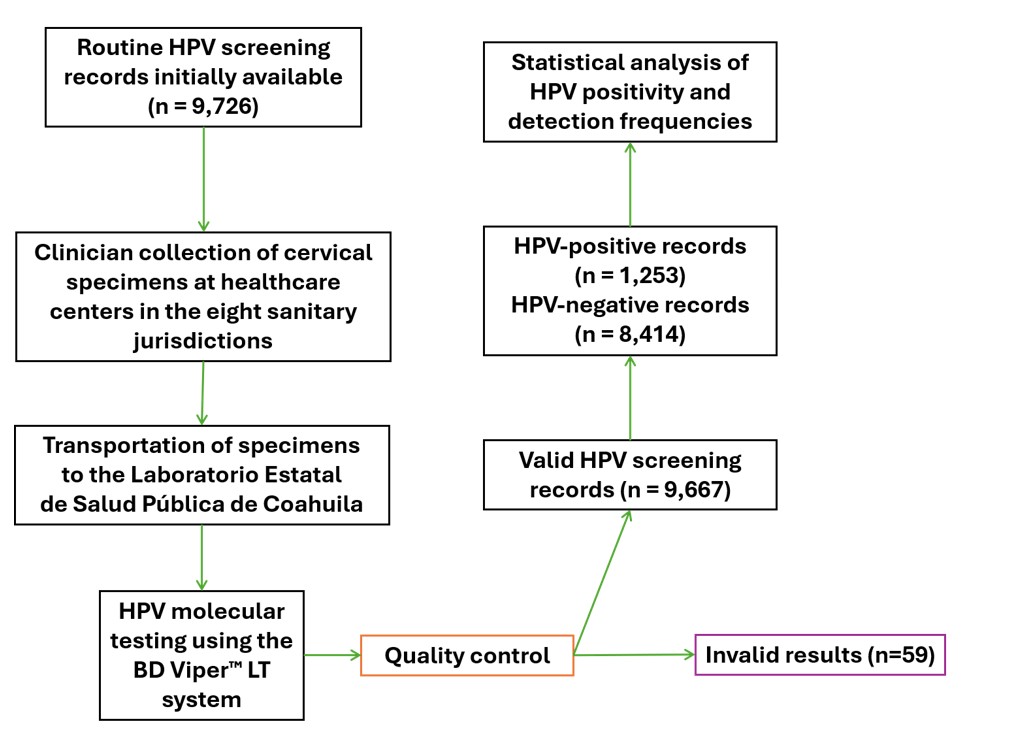
This retrospective descriptive molecular surveillance study was based on anonymized laboratory records generated through the State Cervical Cancer Screening Program coordinated by the Secretaría de Salud del Estado de Coahuila, Mexico. Women voluntarily attended participating primary healthcare centres for routine cervical cancer screening, where cervical specimens were collected by trained healthcare personnel and placed in the transport medium used for HPV molecular testing. Samples from participating healthcare centres were referred to the Laboratorio Estatal de Salud Pública de Coahuila, the public health reference laboratory responsible for molecular HPV testing within the state screening program. All molecular analyses were performed at this laboratory using the same analytical platform and routine standardized procedures throughout the study period. The use of the anonymized laboratory database for research purposes was authorised by the Secretaría de Salud del Estado de Coahuila prior to the development of this study.
The aggregate counts of assay-target detections were retained from the original analysis for each individually reported genotype and pooled assay channel. These retained counts, rather than a currently available participant-level dataset, form the basis of the 1,506 detection events reported in this study. In contrast, the corresponding age-group denominators were not retained among the archived analytical outputs. Thus, aggregate HPV detection frequencies could be reported and verified from the preserved analytical results, whereas age-specific screening-record positivity proportions could not be reconstructed.
Source population and screening context
Coahuila is administratively divided into eight sanitary jurisdictions. Each jurisdiction includes primary healthcare centres where cervical samples are collected as part of routine screening activities. Samples are transported under standardized procedures to the State Public Health Laboratory for molecular analysis.
The study population consisted of women who attended cervical cancer screening services in Coahuila and had a valid HPV molecular test result during the study period. The dataset represents available routine screening records from 2018–2019 and should therefore be interpreted as a screening-based dataset rather than a population-representative sample of all women living in Coahuila.
Women voluntarily attended public primary healthcare centres participating in the State Cervical Cancer Screening Program. Because the anonymized database did not include information describing the invitation pathway for each participant, it was not possible to distinguish organized from opportunistic screening at the individual level.
Study population
The initial database included 9,726 screening records from women aged 23–66 years. Cervical specimens showing excessive blood contamination or not meeting laboratory quality criteria were considered invalid and excluded from the analysis. After exclusions, 9,667 valid HPV screening results were included in the final analysis. Fifty-nine screening records were excluded because the corresponding specimens produced invalid molecular results, mainly due to inadequate specimen quality or blood contamination that interfered with PCR analysis, according to routine laboratory quality-control procedures.
The age range (23–66 years) and summary age statistic (mean ± SD, 45.5 ± 7.45 years) reported in this study were retained from the original analysis performed using the record-level laboratory database. The research materials preserved by the authors after completion of that analysis consisted primarily of aggregated analytical outputs used to prepare the original manuscript rather than a complete copy of the record-level laboratory database. Consequently, individual age values and the total numbers of valid screening records within each age category were no longer available for reanalysis.
Unit of analysis
The analytical unit was the individual HPV laboratory screening record. Each database entry corresponded to one cervical specimen submitted for one HPV molecular test during the study period. The anonymized research database contained no direct personal identifiers or stable encrypted participant identifier that could be used to link records belonging to the same woman.
Consequently, it was not possible to determine whether all 9,667 valid records represented unique women or whether some women underwent more than one test during 2018–2019. All results are therefore reported as screening-record–based findings rather than estimates based on confirmed unique individuals.
HPV detection and genotyping
HPV molecular testing was performed using the BD Viper™ LT automated platform and the HPV assay routinely implemented by the Laboratorio Estatal de Salud Pública de Coahuila. Cervical specimens received in the corresponding transport medium were processed according to the manufacturer’s instructions and the laboratory’s routine standard operating procedures. The automated workflow included nucleic acid extraction, real-time polymerase chain reaction amplification, target detection, and interpretation of the assay signals.
The assay individually reported HPV16, HPV18, HPV45, HPV31, HPV51, and HPV52. Additional assay channels reported grouped detections as pool 1 (HPV33/58), pool 2 (HPV56/59/66), and pool 3 (HPV35/39/68). Consequently, genotype-specific interpretation was possible only for the six individually reported HPV types, whereas a positive pooled channel indicated detection of at least one of the types included in that pool without identifying the specific type responsible for the signal.
Test validity was determined according to the assay’s internal-control signals and routine laboratory acceptance criteria. Results that did not meet the required internal-control or specimen-quality criteria were classified as invalid and excluded from the analysis. The analytical materials retained for the present study did not include cycle-threshold values, reagent lot numbers, instrument run files, or detailed specimen-collection information.
Laboratory quality control
Routine laboratory quality-control procedures were applied during sample reception, molecular processing, and result validation. Specimens with excessive blood contamination, insufficient sample quality, or invalid assay-control signals were not considered valid for interpretation. Of the 9,726 records initially available, 59 were classified as invalid and excluded, leaving 9,667 valid HPV screening records for analysis. Because the analytical materials retained for the present study contained only summarized laboratory outputs, more detailed run-level quality-control information was not available for retrospective analysis.
Multiple HPV assay-target detections
A single HPV-positive screening record could contain more than one positive assay target, including one or more individually reported HPV genotypes and/or genotype pools. Therefore, the 1,253 HPV-positive screening records generated 1,506 genotype or genotype-pool detection events. The number of detection events consequently exceeded the number of positive screening records.
The first analytical level was the screening record, used to calculate overall HPV positivity. The second analytical level was the assay-target detection event, used to describe the relative frequency of individually reported genotypes and pooled channels. Percentages for assay-target detections were calculated using the total number of detection events (n = 1,506) as the denominator. Because participant identifiers and record-level combinations were not retained in the analytical dataset available for this study, co-detection or co-infection patterns could not be reliably reconstructed.
Study variables
The retained analytical variables available for the present descriptive analysis included the overall numbers of valid, invalid, HPV-positive, and HPV-negative screening records; aggregate counts of individually reported HPV genotypes and genotype-pool detections; and summary age information (range and mean ± SD). Record-level age values, participant identifiers, and record-level combinations of assay-target detections were not retained in the archived analytical materials available for the present revision. Table 1 summarizes the variables available and unavailable in the anonymized dataset used for analysis.
Statistical analysis
Descriptive statistics were used to summarize the study data. Continuous age was summarized as mean and standard deviation. Overall HPV screening-record positivity was calculated using the total number of valid screening records as the denominator. Wilson 95% confidence intervals were calculated for the overall HPV screening-record positivity proportion.
Individually reported HPV genotypes and genotype-pool results were summarized as numbers and percentages of the total number of HPV assay-target detection events (n = 1,506). Because a single positive screening record could generate more than one detection event, these percentages do not represent mutually exclusive participant-level prevalence estimates and may not be interpreted as the proportion of women infected with each genotype.
No multivariable or causal analyses were performed because the study objective was descriptive and the database did not include vaccination status, cytology, histopathology, behavioural factors, HIV status, socioeconomic variables, or longitudinal follow-up. Statistical analyses were performed using GraphPad Prism version 8 and Microsoft Excel 2019 (Microsoft Corporation, Redmond, WA, USA).
Ethical considerations
This study involved the retrospective analysis of fully anonymized secondary laboratory records generated during routine public health screening activities. Permission to access and use the anonymized laboratory database for research purposes was granted by the Office of the Undersecretary of Health of the Secretaría de Salud del Estado de Coahuila before the study was initiated. Because the study involved exclusively anonymized secondary surveillance data, without participant contact, intervention, or access to identifiable personal information, no formal Institutional Review Board or Research Ethics Committee review was required under the institutional procedures applicable at that time. Consequently, no ethics approval number or waiver number was issued. The study was conducted in accordance with the principles of the Declaration of Helsinki.
A total of 9,726 HPV laboratory screening records were initially available. Fifty-nine records had invalid molecular results and were excluded, leaving 9,667 valid screening records for analysis. Of these, 8,414 were HPV-negative, and 1,253 were positive for at least one HPV assay target. The overall screening-record positivity proportion was therefore 13.0% (95% CI: 12.3–13.6%). Because participant-level identifiers were unavailable, the 9,667 records cannot be assumed to represent 9,667 confirmed unique women.
The 1,253 HPV-positive screening records generated 1,506 individual-genotype or genotype-pool detection events because more than one assay target could be detected in a single record. Percentages reported for individual genotypes and genotype pools were calculated using these 1,506 detection events as the denominator and not the 1,253 HPV-positive records.
Pool 2 (HPV56/59/66) was the most frequent grouped assay-target detection, accounting for 360 of 1,506 detection events (23.90%). Pool 3 (HPV35/39/68) accounted for 237 detection events (15.74%). Among individually reported genotypes, HPV16 was the most frequently detected, with 205 events (13.61%).
The remaining assay-target detections were pool 1 (HPV33/58), with 154 events (10.23%); HPV31, with 150 events (9.96%); HPV52, with 126 events (8.37%); HPV51, with 107 events (7.10%); HPV45, with 94 events (6.24%); and HPV18, with 73 events (4.85%). The frequency distribution of the 1,506 HPV assay-target detection events is presented in Table 2.
This retrospective molecular surveillance study provides baseline regional information on HPV assay-target detection patterns in routine screening records generated in Coahuila, Mexico, during 2018–2019. Among 9,667 valid screening records, 13.0% were positive for at least one high-risk HPV assay target. Pool 2 (HPV56/59/66) and pool 3 (HPV35/39/68) were the most frequent grouped assay detections, whereas HPV16 was the most frequently reported individual genotype. These findings describe laboratory screening records and assay-target detection events; they should not be interpreted as population prevalence among confirmed unique women or as individual prevalence estimates for the HPV types contained within pooled channels.
The principal strength of this study is the large number of valid HPV screening records obtained through the State Cervical Cancer Screening Program. Furthermore, all samples were analyzed in a single reference laboratory using the same molecular platform and standardised laboratory procedures, minimizing analytical variability.
The overall screening-record positivity proportion observed in the present study was 13.0%, which is broadly comparable with estimates from previous Mexican screening studies. However, direct comparison is limited by differences in study populations, participant-level deduplication, molecular assays, screening practices, and the reporting of pooled versus individually identified HPV types. Campos-Romero et al. analyzed women participating in routine cervical cancer screening across 20 Mexican states and reported HPV16 as the most frequently detected individual high-risk genotype, while also documenting substantial circulation of other oncogenic HPV types. Similarly, García-Gil et al., in a nationwide study including nearly 600,000 women, confirmed HPV16 as the predominant individually detected genotype and highlighted considerable regional variability in HPV distribution across Mexico. Pool 2 cannot be directly compared with HPV16 as though both represented individual genotypes, because pool 2 combines signals from HPV56, HPV59, and HPV66. The appropriate comparison is therefore between HPV16 and the other individually reported genotypes, while pooled channels should be discussed separately as grouped assay results.
Regional studies from Latin America have likewise demonstrated geographic variability in HPV genotype distribution. Differences in the frequency of high-risk HPV types among screened women have been attributed to variations in demographic characteristics, screening coverage, vaccination history, healthcare access, and laboratory methodologies. Therefore, the HPV detection patterns observed in Coahuila should be interpreted within the context of the specific molecular assay and screening population evaluated in the present study.
To the best of our knowledge, no previous statewide molecular surveillance study describing HPV genotype detection patterns among women attending routine cervical cancer screening has been published for Coahuila. Consequently, the present study provides a pre-pandemic regional baseline that may facilitate future comparisons of HPV screening-record positivity and assay-target detection patterns as vaccinated cohorts progressively enter cervical cancer screening programs.
Limitations and interpretation
The present study has several limitations inherent to the retrospective use of a routine laboratory database. First, the analytical unit was the screening record rather than a confirmed unique woman. Because the database was fully anonymized and contained no stable participant identifier, repeated tests belonging to the same woman could not be identified or linked. Consequently, the results may include more than one record from an individual woman, and infection persistence or clearance could not be evaluated.
Second, age information available from the original analysis was limited to retained summary statistics (age range and mean ± SD). Although the original record-level laboratory database necessarily contained age information when the initial analysis was performed, the analytical materials retained by the authors after completion of the study consisted primarily of aggregated outputs and did not preserve individual age values or the total number of valid screening records within each age category. By contrast, aggregate counts for each HPV assay-target category were retained and could therefore be used to report the 1,506 detection events. Consequently, age-specific screening-record denominators could not be reconstructed, and no age-specific positivity proportions or age-related risk interpretations are presented in the revised manuscript.
Third, the study cannot establish the clinical significance of the HPV assay detections because cytology, histopathology, vaccination status, behavioural variables, HIV status, socioeconomic information, infection persistence, and clinical follow-up were unavailable. The findings therefore represent descriptive molecular surveillance results and do not support conclusions concerning lesion progression, cancer risk, determinants of infection, vaccine effectiveness, screening-program effectiveness, or causal relationships.
A further limitation concerns pooled genotype reporting. The assay individually reported HPV16, HPV18, HPV31, HPV45, HPV51, and HPV52, whereas several other HPV types were reported only through grouped assay channels. Therefore, the study cannot determine whether HPV56, HPV59, or HPV66 individually accounted for pool 2, or whether HPV35, HPV39, or HPV68 individually accounted for pool 3. These grouped results should not be interpreted as individual genotype-specific prevalence estimates or directly ranked against individually reported genotypes without explicit qualification.
Public health implications
Despite these limitations, the study provides a pre-pandemic description of high-risk HPV assay results generated through a centralized state screening program. Its principal value is to document screening-record positivity and the relative frequency of assay-target detections while illustrating the interpretive limitations of pooled HPV reporting.
The findings alone do not justify changes in vaccination or screening policy. However, they support the development of more informative surveillance systems that retain secure, de-identified participant linkage and integrate HPV molecular results with age, vaccination history, cytology, histopathology, and clinical follow-up. Comparable post-pandemic analyses would also help determine whether screening activity and HPV detection patterns have returned to or changed from the 2018–2019 baseline.
Among 9,667 valid HPV laboratory screening records generated in Coahuila during 2018–2019, 1,253 were positive for at least one high-risk HPV assay target, corresponding to a screening-record positivity proportion of 13.0%. Pool 2 (HPV56/59/66) and pool 3 (HPV35/39/68) were the most frequent grouped assay detections, whereas HPV16 was the most frequently reported individual genotype.
These results should be interpreted within the limitations of the analytical database. The records could not be linked to confirmed unique women, and the pooled assay channels did not identify the specific HPV type responsible for each grouped result. Age-specific screening-record positivity could not be reconstructed because only summary age statistics, rather than individual age values and age-group screening denominators, were retained from the original analysis. The study therefore provides a limited descriptive pre-pandemic molecular surveillance baseline rather than evidence of genotype-specific predominance, clinical outcomes, vaccine effectiveness, or screening-policy impact. Future studies should incorporate secure participant-level linkage, population and age-specific denominators, vaccination history, cytology, histopathology, and longitudinal follow-up.
What is already known about the topic
What this study adds
The authors of this work declare no competing interests.
Data availability
The original record-level laboratory database analyzed in this study was maintained by the Secretaría de Salud del Estado de Coahuila and is no longer available to the authors. The analytical materials retained by the authors consist of aggregated outputs from the original analysis, including overall screening-result counts, summary age statistics, and aggregate HPV assay-target detection counts. These aggregated data underlie the results reported in the present manuscript. Access to any original institutional record-level data, if still retained by the Secretaría de Salud del Estado de Coahuila, would be subject to institutional authorization and applicable data-governance requirements.
The authors gratefully acknowledge Dr. Martha Alicia Romero Reyna, former Undersecretary of Health of the State of Coahuila, for granting institutional authorization to access and use the anonymized laboratory database analyzed in this study.
Declaration of generative AI and AI-assisted technologies
The initial scientific draft of this manuscript was prepared by the authors. During the subsequent revision process, ChatGPT (OpenAI) was used exclusively as a writing-assistance tool to improve language, readability, organization, and editorial consistency. The AI system was not used to generate, analyze, or interpret research data, formulate scientific conclusions, or make editorial decisions. All AI-assisted text was critically reviewed, verified, and revised by the authors, who assume full responsibility for the content of the manuscript.
Conceptualization:Sergio Mancillas-Salas
Data curation: Sergio Mancillas-Salas
Formal analysis: Sergio Mancillas-Salas
Methodology: Patricia Gutiérrez-Molina
Project administration: Violeta Salas-de la Vega
Investigation: Patricia Gutiérrez-Molina
Validation: Violeta Salas-de la Vega
Supervision: Violeta Salas-de la Vega
Writing – original draft: Sergio Mancillas-Salas
Writing – review and editing: Sergio Mancillas-Salas, Patricia Gutiérrez-Molina, Violeta Salas-de la Vega
Sergio Mancillas-Salas and Patricia Gutiérrez-Molina reviewed and approved the final version of the manuscript and take responsibility for its content. Violeta Salas-de la Vega made substantial contributions to the study before her death but was unable to review or approve the final manuscript. The surviving authors confirm that her contributions met the criteria for authorship and accept responsibility for the integrity of the final version.
| Table 1: Characteristics of the cervical cancer screening program and laboratory dataset used in this study. | |
|---|---|
| Characteristic | Description |
| Study design | Retrospective descriptive molecular surveillance study |
| Study period | January 2018–December 2019 |
| Geographic area | State of Coahuila, northern Mexico |
| Screening program | State Cervical Cancer Screening Program, Secretaría de Salud |
| Sample origin | Women attending routine cervical cancer screening through the State Cervical Cancer Screening Program |
| Specimen type | Clinician-collected cervical specimens placed in HPV transport medium |
| Collection sites | Primary healthcare centers distributed across the eight sanitary jurisdictions of Coahuila |
| Testing laboratory | Laboratorio Estatal de Salud Pública de Coahuila |
| Analytical platform | BD Viper™ LT System |
| Valid screening records analyzed | 9,667 |
| Invalid screening records excluded | 59 |
| HPV results reported | Individual genotypes and genotype pools |
| Analytical unit | Individual HPV laboratory screening record |
| Participant linkage | Not available because the analytical database was fully anonymized |
| Unique women | Could not be confirmed |
| Total initial records | 9,726 |
| Valid screening records | 9,667 |
| Invalid records excluded | 59 |
| HPV-positive records | 1,253 |
| HPV assay-target detection events | 1,506 |
| Retained age information | Age range and mean ± SD from the original analysis |
| Record-level age data | Not retained in the archived analytical materials available for reanalysis |
| Vaccination and clinical variables | Not available |
| Mean age | 45.5 ± 7.45 years |
| Table 2: Frequency distribution of individual HPV genotype and genotype-pool assay-target detection events among HPV-positive screening records from Coahuila, Mexico. | ||
|---|---|---|
| HPV assay target | Detection events, n | Percentage (%) |
| HPV16 | 205 | 13.6 |
| HPV18 | 73 | 4.9 |
| HPV45 | 94 | 6.2 |
| Pool 1 (HPV33/58) | 154 | 10.2 |
| HPV31 | 150 | 10.0 |
| Pool 2 (HPV56/59/66) | 360 | 23.9 |
| HPV51 | 107 | 7.1 |
| HPV52 | 126 | 8.4 |
| Pool 3 (HPV35/39/68) | 237 | 15.7 |
| Total | 1,506 | 100.0 |
| Percentages were calculated using the total number of individual-genotype and genotype-pool detection events (n = 1,506) as the denominator. The 1,506 events were generated by 1,253 HPV-positive screening records because more than one assay target could be detected in a single record. Pooled assay results do not identify which individual HPV type within the corresponding pool was detected. | ||