Research | Open Access | Volume 9 (3): Article 150 | Published: 23 Sep 2026

Views: 125
Menu, Tables and Figures
Table 1: Under 5 (age and sex specific) malaria cases
| Variable/Year | 2018 | 2019 | 2020 | 2021 | 2022 |
|---|---|---|---|---|---|
| Uncomplicated Malaria Suspected | |||||
| Total | 73,825 | 121,128 | 118,441 | 87,641 | 90,901 |
| Total Under 5 | 25,179 | 33,925 | 27,332 | 22,724 | 22,490 |
| % Under 5 | 34.1 | 28.0 | 23.1 | 25.9 | 24.7 |
| % Male | 51.5 | 51.3 | 51.1 | 50.9 | 50.3 |
| % Female | 48.5 | 48.7 | 48.9 | 49.1 | 49.7 |
| Uncomplicated Malaria Suspected Tested | |||||
| Total | 71,359 | 117,572 | 114,485 | 85,267 | 89,762 |
| Total Under 5 | 24,191 | 33,292 | 26,905 | 21,895 | 22,125 |
| % Under 5 | 33.9 | 28.3 | 23.5 | 25.7 | 24.6 |
| % Male | 51.3 | 51.6 | 51.0 | 51.0 | 50.4 |
| % Female | 48.7 | 48.4 | 49.0 | 49.0 | 49.6 |
| Uncomplicated Malaria Tested Positive | |||||
| Total | 35,760 | 51,116 | 40,057 | 28,094 | 36,316 |
| Total Under 5 | 13,955 | 16,987 | 12,020 | 7,912 | 9,492 |
| % Under 5 | 39.0 | 33.2 | 30.0 | 28.2 | 26.1 |
| % Male | 51.7 | 52.3 | 51.5 | 50.8 | 52.0 |
| % Female | 48.3 | 47.7 | 48.5 | 49.2 | 48.0 |
Table 1: Under 5 (age and sex specific) malaria cases
Table 2: Summary of Malaria Admissions, Kintampo North District, 2018-2022
| Year | Total Admissions | % Malaria Admissions | % Children Under 5 years Malaria Admissions | % Above 5 years Malaria Admissions |
|---|---|---|---|---|
| 2018 | 10,119 | 1,630 (16.1) | 1,013 (62.1) | 617 (37.9) |
| 2019 | 10,724 | 1,567 (14.6) | 905 (57.8) | 662 (42.2) |
| 2020 | 9,002 | 970 (10.8) | 488 (50.3) | 482 (49.7) |
| 2021 | 10,380 | 1,222 (11.8) | 564 (46.2) | 658 (53.8) |
| 2022 | 10,231 | 1,426 (13.9) | 666 (46.7) | 760 (53.3) |
| Total | 50,456 | 6,815 (13.5) | 3,636 (53.4) | 3,179 (46.6) |
Table 2: Summary of Malaria Admissions, Kintampo North District, 2018-2022
Isaac Baffoe-Nyarko1,&, Christopher Tamal1, Charles Lwanga Noora1, Donne Ameme1, Paulina Appiah2, Seth Baffoe1, Thelma Teley Aphour1, Shahadu Shemble1, Ernest Kenu1
1Ghana Field Epidemiology and Laboratory Training Program, Accra, Ghana, 2Ghana Health Service, Kintampo, Bono East, Ghana
&Corresponding author: Isaac Baffoe-Nyarko, Ghana Health Service, Disease Surveillance Department, P.O. Box KB 493, Korle-Bu, Accra, Ghana, Email: isaac.baffoe-nyarko@ghs.gov.gh, ORCID: https://orcid.org/0009-0006-8931-5974
Received: 18 Apr 2025, Accepted: 21 Sep 2026, Published: 23 Sep 2026
Domain: Infectious Disease Epidemiology
Keywords: Malaria surveillance; Outbreak detection; CUSUM2; Health information systems; Intermittent preventive treatment (IPTp); Children under five; Ghana
©Isaac Baffoe-Nyarko et al. Journal of Interventional Epidemiology and Public Health (ISSN: 2664-2824). This is an Open Access article distributed under the terms of the Creative Commons Attribution International 4.0 License (https://creativecommons.org/licenses/by/4.0/), which permits unrestricted use, distribution, and reproduction in any medium, provided the original work is properly cited.
Cite this article: Isaac Baffoe-Nyarko et al., Malaria surveillance data analysis in the Kintampo North Municipality, Bono East Region, Ghana, 2018-2022. Journal of Interventional Epidemiology and Public Health. 2026; 9(3):150. https://doi.org/10.37432/jieph-d-25-00094
Introduction: Malaria remains the leading cause of morbidity and mortality in children under 5 years in many tropical countries. The study assessed the prevalence and distribution of malaria in the Kintampo North Municipality from 2018 to 2022.
Methods: We extracted routine malaria data from the District Health Information Management System for the period 2018-2022. Variables included suspected and confirmed malaria cases, testing rates, test positivity and intermittent preventive treatment in pregnancy (IPTp) coverage. Data were analysed as frequencies and proportions. CUSUM2 threshold was applied to determine missed outbreaks.
Results: Over the five-year period, 491,936 suspected uncomplicated malaria cases were recorded, of which 97.3% were tested and 40.0% confirmed positive by microscopy or rapid diagnostic test. Outpatient malaria cases per 1,000 population ranged from 229 in 2021 to 460 in 2019. Children under five accounted for 26.1% of cases, with a positivity rate of 31.5%. Malaria in pregnancy showed a 49.7% positivity rate. IPTp1 coverage declined substantially from 97.3% in 2018 to 63.7% in 2022, with IPTp dropout ranging 13.6%-44.2%. The CUSUM2 analysis indicated that epidemic thresholds were crossed five times during the review period, yet no outbreak was detected.
Conclusion: Malaria remains highly prevalent in the Kintampo North Municipality, though a relative decline in the number of suspected cases was observed between 2019 and 2021. Declining IPTp coverage and missed epidemic signals highlight weaknesses in both preventive services and surveillance systems. Strengthened case definition adherence, systematic use of outbreak detection thresholds, and renewed efforts to improve IPTp uptake are urgently needed.
In many tropical countries, including Ghana, malaria is the leading cause of illness and death in children under 5 years [1]. Malaria, an acute febrile illness, is caused by plasmodium parasites, and transmitted through the bite of an infective female Anopheles mosquitoes. Of the five (5) species of the Plasmodium parasites (Plasmodium falciparum, Plasmodium vivax, Plasmodium ovale, Plasmodium malariae, and Plasmodium knowlesi) that cause malaria in humans, Plasmodium falciparum is the deadliest and most prevalent on the African continent [2,3].
Though malaria can affect persons of all ages, pregnant women and children under 5 years are most vulnerable [4]. Persons infected with malaria may exhibit symptoms including fever, chills, general feeling of discomfort, headache, nausea and vomiting, diarrhoea, abdominal pain, muscle or joint pain [1,5–7].
According to the CDC, about 87 countries and territories accounting for about 50% of the world’s population are at risk of malaria, of which African countries are the most affected due to the complexity of related factors [1]. There were an estimated 241 million clinical cases and 627,000 deaths due to malaria in 2020, of which most were young children from sub-Saharan Africa [1]. According to the WHO, the African Region accounted for about 95% of all malaria cases and 96% of all malaria deaths in 2020 [7].
Ghana was ranked 12th among the 43 countries in the WHO African Region reporting malaria in 2021 [8]. Malaria is holoendemic in all regions of Ghana and continues to be the leading cause of morbidity and mortality in most districts [9]. In 2020, malaria accounted for about 14.0% of the total OPD cases [10].
Malaria accounts for an increased burden to the affected individuals, their relatives, and the country as a whole. To reduce the negative socioeconomic consequences associated with malaria in Ghana, distribution of long-lasting insecticide nets (LLINs), indoor residual spraying (IRS), limited larviciding, Intermittent Preventive Treatment (IPTp), and Seasonal Malaria Chemoprevention (SMC) are the key strategies implemented by the National Malaria Control Programme (NMCP) [11]. Several improvements were observed in the 2020 malaria indicators. These include a decrease of 8.3% in the proportion of OPD cases attributable to suspected malaria and a 3.8% decline in malaria-attributable admissions. Again, the overall testing rate for malaria increased over that of 2019 by 1.7% [12]. Despite these improvements in malaria indicators, the Bono East Region and its districts, including the Kintampo North Municipality, recorded an increase in malaria admissions and deaths [12]. The region, like other regions in the southern sector of Ghana, experiences more than nine months of malaria transmission with minor peaks in June and a major peak from October to November [6]. Although surveillance for malaria is ongoing, there is limited analysis of data to inform decision-making for effective prevention and control measures. We therefore analysed the municipality data from 2018-2022 to determine the incidence and distribution of malaria for effective decision-making. Specifically, we determined the completeness and timeliness of health facility reporting, assessed trends in malaria cases, measured adherence to the “test before treating all malaria cases”, and utilisation of IPTp among pregnant women in the Kintampo North Municipality.
Design
Secondary data analysis of malaria surveillance data reported in the District Health Management Information System II for the Kintampo North Municipality between 2018 and 2022. Malaria datasets were extracted for each sub-district by facility, by month for the period. The study was conducted from 30 October 2022 to 15 January 2023.
Study area
The Kintampo North Municipality is located between latitudes 8º45’N and 7º45’N and Longitudes 1º20’W and 2°1’E with an estimated population of 99,923 in 2022. The municipality is endowed with a lot of water resources, including Fra, Urukwain, Nyamba, Oyoko, Nante, Pumpum and Tanfi Rivers. The vast expanse of flat land especially the northern part makes it suitable for large scale mechanized farming and for the breeding of all species of mosquitoes especially during the rainy season. Located in the transitional zone between the two major climatic regions in Ghana, the district enjoys high rainfall pattern, mean annual rainfall is between 1,400mm-1,800mm and occurs in two seasons: from May to July and from September to October with the minor season (May–July).
Case definitions
We adapted the Ghana Integrated Disease Surveillance and Response (IDSR) 3rd Edition standard case definitions for malaria as follows:
Uncomplicated malaria: Any person with fever or history of fever within 24 hours, without signs of severe disease (vital organ dysfunction), is diagnosed clinically as malaria [13].
Confirmed uncomplicated malaria: Any person presenting with fever or history of fever within 24 hours, and with laboratory confirmation of diagnosis by malaria blood film or other diagnostic test for malaria parasites [13].
Unconfirmed severe malaria: Any patient hospitalised with severe febrile disease with accompanying vital organ dysfunction diagnosed clinically [13].
Confirmed Severe malaria: Any patient hospitalised with P. falciparum asexual parasitaemia as confirmed by laboratory tests with accompanying symptoms and signs of severe disease (vital organ dysfunction) diagnosed through laboratory tests [13].
Testing rate: Proportion of patients with suspected malaria who received a parasitological test (microscopy or rapid diagnostic test (RDT)).
Positivity rate: Proportion of positive results among all tests performed by microscopy or RDT.
IPTp coverage: The percentage of pregnant women living in malaria-endemic areas who receive the recommended doses of Intermittent Preventive Treatment during pregnancy (typically using sulfadoxine-pyrimethamine, or IPTp-SP).
Data collection
The study used data that have been pre-classified into specific Age and Sex categories and entered on the Monthly OPD Summary report on the District Health Information Management System 2 (DHIMS2) platform.
Data extraction
We extracted malaria morbidity and mortality data from the DHIMS2 platform using Microsoft Excel 2019. Age category, sex, case classification, laboratory results, period, facility reporting, and sub-district reporting were the key variables extracted.
Data quality control
Data extracted were assessed for completeness. Missing data for month in which data were not submitted were also ascertained. We assessed adherence to timelines for submission as well as the presence of outliers in the data extracted. The availability and functionality of district data validation team was also ascertained.
Data analysis
We determined the monthly and yearly prevalence and incidence of malaria cases and estimated the relative proportions of OPD and In-patient cases for children under 5. Prevalence was estimated as the total number of cases recorded in the month/year. The monthly/yearly incidence of malaria cases was determined by dividing total number of malaria cases recorded in the respective month/year by the total population of the district (annual population) for the year and multiplying by 1,000 for each category of malaria classification (Suspected, Tested, Confirmed). We estimated the relative proportion of OPD and In-patient cases for children under 5 as the number of malaria cases in children under 5 divided by the total number of malaria cases reported in the respective year (OPD AND in-patient). The completeness and timeliness of malaria data reporting in the district were calculated by dividing the number of reports received timely or completed by the total number of reports received within the period. Facilities achieving a percentage score of completeness and timeliness rates below 75% were considered to have poor reporting [14]. The threshold for malaria was determined using the Cumulative Sum 2 (CUSUM2). To establish the threshold for malaria the Cumulative Sum 2 (CUSUM2) value for each specific month was determined by estimating the mean and standard deviation for the previous seven months, skipping the immediate two months and adding the mean to three standard deviations. The mean and three standard deviations were added to get the CUSUM2 value for each respective month. The CUSUM2 value was plotted as the threshold value. The CUSUM2 was calculated as: mean + 3 standard deviation of 7 past surveillance points prior to a two-month lag. CUSUM 2 was used to set the threshold due to its suitability for sequential data analysis and the relative stability to random noise in data.
Ethical considerations
We obtained permission from the Ghana Health Service through the Ghana Field Epidemiology and Laboratory Training Program (GFELTP) of the University of Ghana. The Regional Health Directorate of the Bono East Region and the Kintampo North Municipal Health Directorate granted permission to analyse the de-identified surveillance data.
From 2018 to 2022, the Kintampo North District demonstrated strong performance in health data reporting, achieving an average completeness rate of 89.2% (2,761 out of 3,096 reports) and a timeliness rate of 86.9% (2,691 out of 3,096). Notably, both completeness and timeliness consistently exceeded 90% across all sub-districts beginning in 2019.
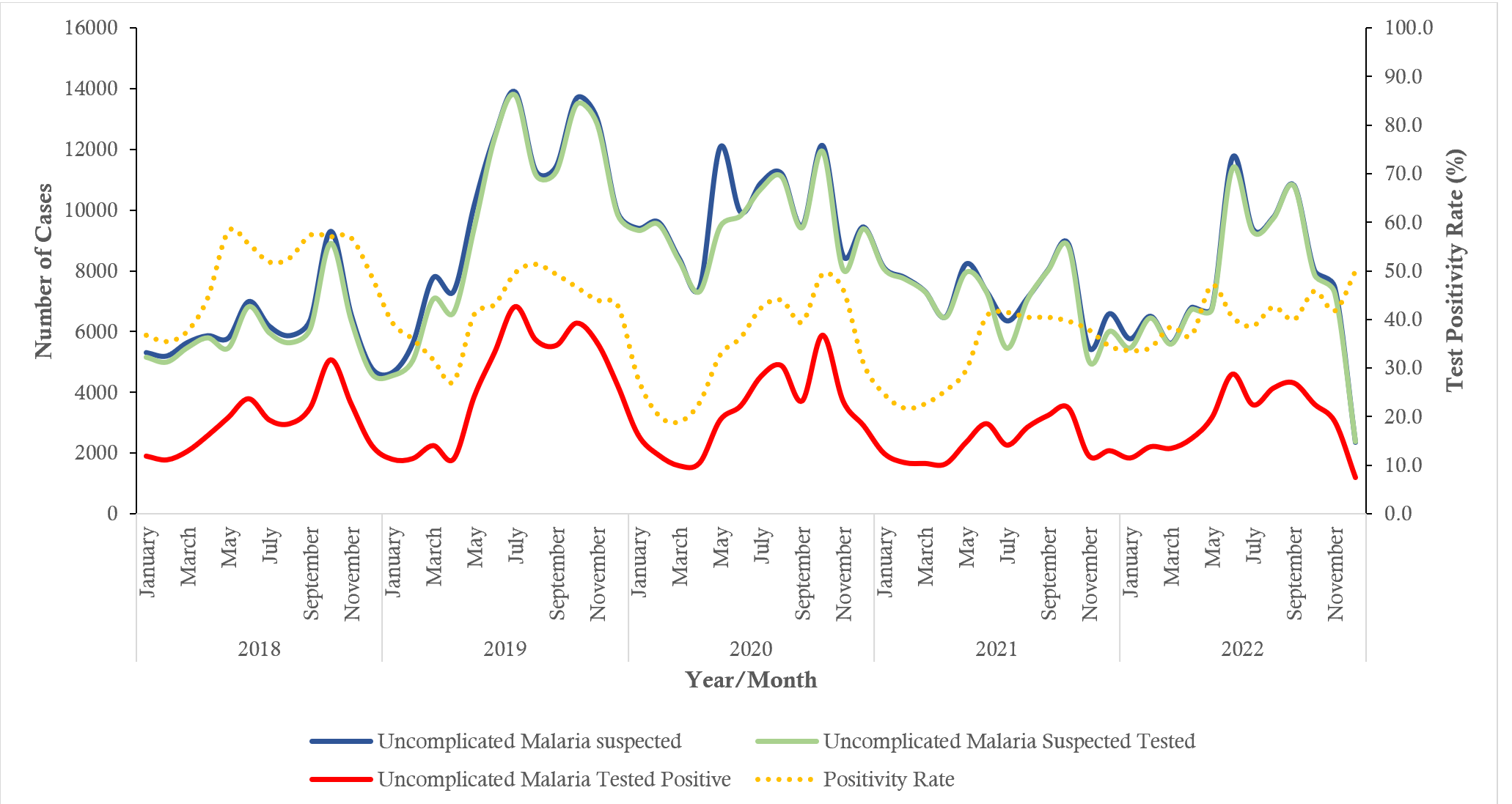
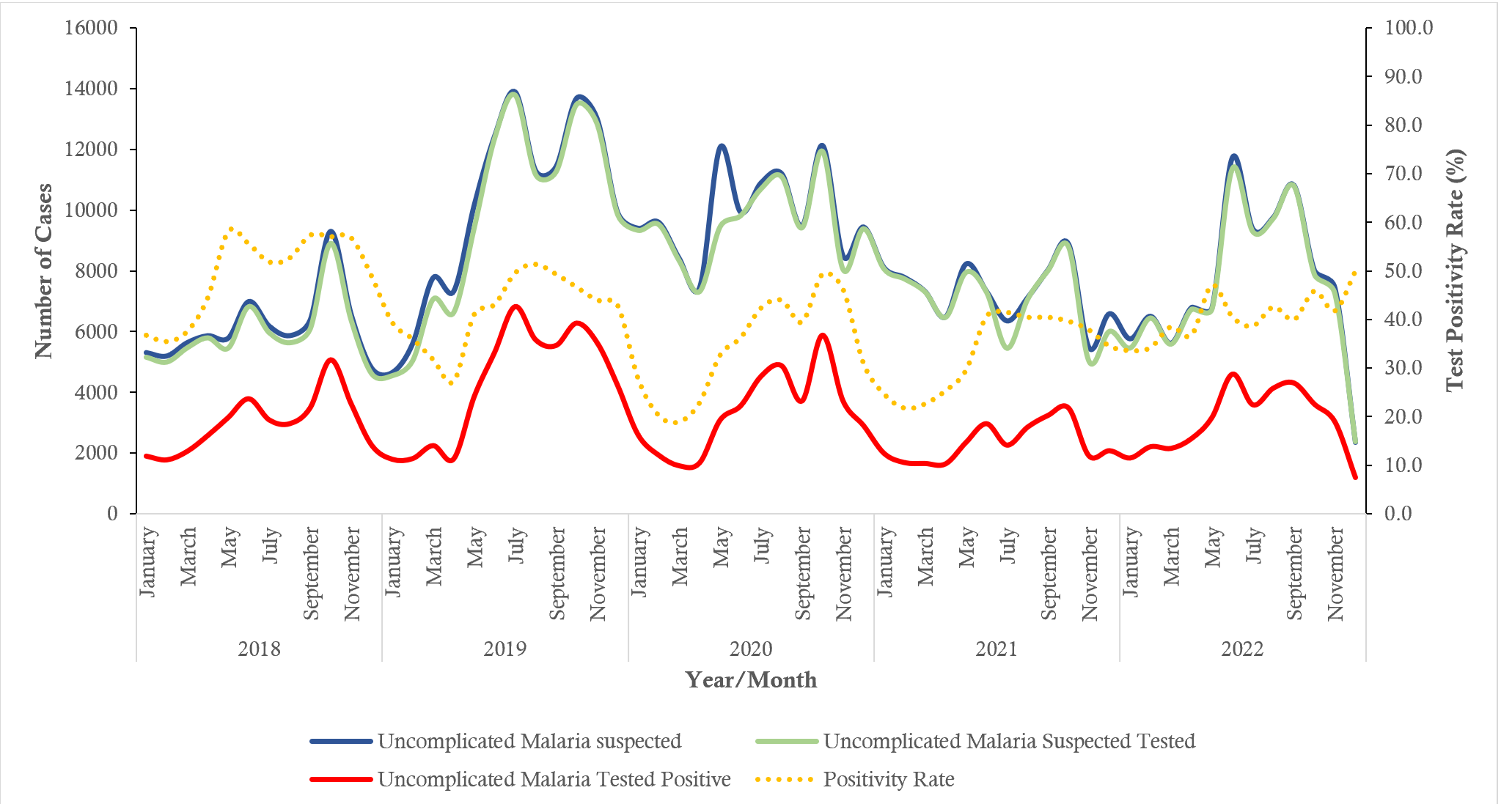
During the five-year period, a total of 491,936 uncomplicated suspected malaria cases were reported. The year 2019 recorded the highest number of suspected cases, accounting for 24.6% (121,128/491,936) of the total, while 2018 recorded the lowest proportion at 15.0% (73,825/491,936). Malaria testing was conducted for 97.3% (478,445/491,936) of suspected cases, with 40.0% (191,343/478,445) confirmed positive through microscopy and rapid diagnostic tests (RDT). In 2022, testing coverage reached its peak at 98.7% (89,762/90,901), whereas the highest positivity rate was observed in 2018 at 50.1% (35,760/71,359).
Outpatient department (OPD) malaria cases per 1,000 population ranged from 229.4 in 2021 to 460.3 in 2019. Similarly, the number of OPD malaria cases tested per 1,000 population varied from 611.2 in 2021 to 1,004 in 2019. The positivity rate declined over time, ranging from 32.9% in 2021 to 50.1% in 2018.
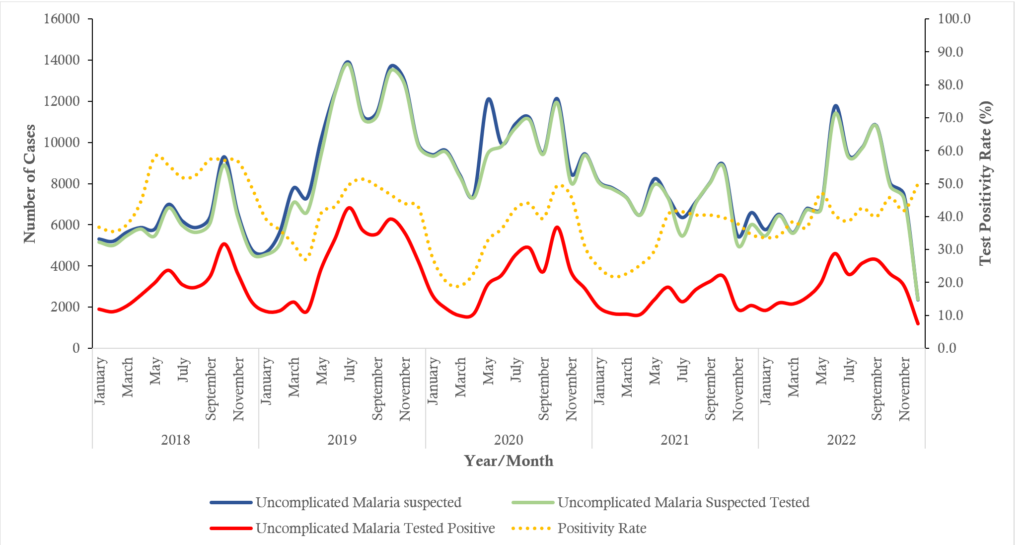
Monthly data were available for the entire five-year period, with an average of 7,535 suspected cases of uncomplicated malaria reported per month (standard deviation ±2,753). The lowest number of cases was recorded in December 2022 (2,355), while the highest occurred in July 2019 (13,883). The district exhibited a minor seasonal peak in May to June and a major peak in October to November. The average number of confirmed cases per month was 3,077 (standard deviation ±1,326), and the positivity rate ranged from 18.9% (March 2020) to 58.1% (May 2018).
Children under five years of age accounted for 26.1% (128,408/491,936) of all suspected uncomplicated malaria cases. Among children under five years with malaria, 52.3% (67,216/128,408) were males. The highest proportion of suspected cases in children under five was recorded in 2018 (34.1%), followed by a gradual decline in subsequent years. The overall positivity rate for this age group was 31.5%, decreasing from 33.9% in 2018 to 26.1% in 2022.
Among pregnant women, 11,987 suspected malaria cases were reported, with 95.4% (11,437/11,987) tested and 49.7% (5,689/11,437) confirmed positive. The highest number of suspected cases was recorded in 2020 (24.6%), while the highest proportion of confirmed cases occurred in 2021 (54.9%). The lowest positivity rate among pregnant women was observed in 2022 (42.6%). Intermittent preventive treatment (IPTp) coverage declined over the years, with IPTp1 coverage dropping from 97.3% in 2018 to 63.7% in 2022. IPTp3 coverage decreased from 66.1% in 2018 to 40.1% in 2020, before rising to 55.0% in 2022. IPTp dropout increased from 32.1% in 2018 to 44.2% in 2020 and declined to 13.6% in 2022.
During the review period, the Kintampo District Hospital admitted a total of 50,456 patients, of which 13.5% (6,815/50,456) were due to malaria. Children under five years old constituted 53.4% (3,636/6,815) of malaria admissions. The year 2018 accounted for the highest proportion of malaria admissions (23.9%) and the highest number of admissions among children under five (27.9%).
Thresholds established using the CUSUM2 method were breached five times during the study period: in June and October 2018, July 2019, and June and August 2022. Notably, no threshold breaches occurred between August 2019 and May 2022, indicating a period of relative stability in malaria case trends.
We analysed the malaria data in the Kintampo North Municipality from 2018 to 2022 to determine the incidence and distribution of malaria and also to determine the timeliness of data reporting in the municipality.
During the period under review, the district attained the reporting completeness and timeliness targets of 90% cumulatively. With the exception of 2018, the district achieved above 90% timeliness and completeness of all monthly reports. The optimal performance of the district in terms of timeliness and completeness of reporting is consistent with that of other rural districts in Ghana [15].
The data analysis indicated two peaks of malaria incidence, minor peaks from May to June and major peaks from October to November, conforming to the rainy season of the district. In a literature review involving 36 studies, Osarfo, Ampofo and Tagbor [16] noted that in the forest-savannah transitional ecological belt of Ghana where the study area lies, malaria transmission peaks in the rainy season. The increase in the number of malaria cases during the period could be attributed to the increase in rainfall in this part of the country during these periods (rainy season) of the year, which provides a conducive environment for mosquito breeding. The district has a mean rainfall averaging 1,250 mm per annum, mainly between April and October [17], allowing water to collect in empty cans and openings that promote breeding of mosquitoes. The district has an estimated 231 and 269 infective mosquito bites per person during the peak transmission season [17], a possible reason for the high malaria incidence. Evidence supports the positive correlation between rainfall and malaria in many malaria endemic countries [18–20].
Though not all cases are tested as directed [21], the district recorded a relatively high testing rate (RDT and microscopy) for all malaria cases suspected during the period of review. The findings of the data analysis are similar to a study conducted in Bongo in the Upper East Region [22] and in the Volta Region [23]. The above studies demonstrated high adherence to the guidelines of “testing all malaria cases before treatment”. In the Bongo District, the challenges were attributed to frequent stock-outs of RDTs at the facility level and the cost of treatment. Though this was not ascertained in the Kintampo North Municipality, it could be a cause of the few cases that were not tested since all facilities receive their RDTs from the same source.
The district recorded a low annual test positivity rate, albeit with monthly and sub-district variations. The low positivity rate indicated above corresponds to the findings reported in a previous study [24] where the malaria parasitaemia among symptomatic individuals in the then Brong-Ahafo region, where the study area is located, was 41.5%. This is contrary to a study conducted in the Mfantsiman District of the Central Region, where it was noted that the positivity among 180 patients was 76.7% [25]. Again, in Uganda, however, a 15-month ecological study observed a total positivity rate of 69.7% ranging from 59.8% to 77.3% among patients with suspected malaria [26], which is relatively higher than the rates recorded in Kintampo. The differences observed in the positivity rates may be due to adherence to the use of the standard case definition of malaria in the different localities. In the Kintampo North Municipality, which is located in the malarious belt of the country, clinicians are more likely to suspect malaria in any febrile illness as compared to the Mfantsiman and other places where other diseases may be suspected. This high index of malaria suspicion, though not verified, may account for the relatively low positivity rate in the Municipality.
We observed a decline in the number of OPD and Inpatient malaria cases in children under 5 and Pregnant women as reported by the NMCP and other studies [16,27]. Despite the decline, malaria in children under 5 years still constituted the majority of all uncomplicated malaria cases reported from 2018-2022. Since 2013, the Malaria Elimination Programme has implemented various measures to reduce the incidence of malaria, particularly in children under five. Notably are the distribution of Long-Lasting Insecticide-Treated Nets, Seasonal Malaria Chemoprophylaxis and IPTp for pregnant women. The Municipality seems to have benefitted from the above strategies, leading to a reduction in the number of cases. In a previous study [16], significant declines in malaria cases have been recorded from various malaria endemic countries due to the massive investments in malaria control.
IPTp recommended dose uptake among pregnant women recorded a decline across the review period, though no increase in the number of cases was reported among pregnant women. A similar decline in the recommended dose was observed in an analysis of the 2011-2015 data of the municipality [28]. Though the district has consistently achieved above 100% ANC coverage since 2018, the percentage of pregnant women attending ANC in the first trimester has consistently been low (below 50%) (DHIMS2). Women who attend ANC later in the pregnancy have limited opportunity to obtain the recommended dose of IPTp, a possible reason for the relative decline in the recommended dose. The district has also reported high teenage registrants at ANC (between 13% and 16%). In the previous study in the Municipality, high pregnancy rate among teenagers accounted partly for the low patronage of IPTp due to the stigma associated with teen mothers [28]. This reason may still apply since the sociocultural characteristics of the Municipality have not changed much over the years.
Using CUSUM2, the data analysis indicated 5 probable malaria outbreaks that were not detected by the district. The outbreaks occurred during June and October 2018, July 2019 and June and August 2022. Reasons for the non-detection may include the limited analysis of malaria data at the district level. Again, since malaria is endemic, limited concentration and attention are given to any increase in the number of cases. The use of a threshold for malaria will inform any sudden changes in malaria case incidence and also inform appropriate decision-making.
There was a relative decline in suspected malaria cases after the 2019 peak, alongside a marked increase in confirmed malaria cases in 2022 compared with 2021. The district recorded acceptable levels of monthly timeliness and completeness of reporting from all sub-districts during the review period, with high adherence to test-before-treatment guidelines. However, IPTp uptake among pregnant women declined, highlighting the need for renewed health education and community engagement to improve IPTp utilisation.
Recommendation
Based on the key findings, we recommend the following:
What is already known about the topic
What this study adds
We are grateful to the Bono East Regional Health Directorate. We appreciate the enormous support of the Regional Surveillance Team and the Kintampo North Municipal Health Directorate. We acknowledge the technical support from the Ghana Field Epidemiology and Laboratory Training Programme.
Conceptualization: Isaac Baffoe-Nyarko, Christopher Tamal, Charles Lwanga Noora, Paulina Appiah, Ernest Kenu
Data curation: Isaac Baffoe-Nyarko, Seth Baffoe, Thelma Teley Aphour, Shadu Shemble
Formal analysis: Isaac Baffoe-Nyarko
Investigation: Isaac Baffoe-Nyarko
Methodology: Isaac Baffoe-Nyarko
Project administration: Isaac Baffoe-Nyarko
Resources: Isaac Baffoe-Nyarko
Visualization: Isaac Baffoe-Nyarko
Supervision: Christopher Tamal, Charles Lwanga Noora, Donne Ameme, Paulina Appiah, Ernest Kenu
Writing – original draft: Isaac Baffoe-Nyarko
Writing – review & editing: Isaac Baffoe-Nyarko, Christopher Tamal, Charles Lwanga Noora, Donne Ameme, Paulina Appiah, Seth Baffoe, Thelma Teley Aphour, Ernest Kenu
| Variable/Year | 2018 | 2019 | 2020 | 2021 | 2022 |
|---|---|---|---|---|---|
| Uncomplicated Malaria Suspected | |||||
| Total | 73,825 | 121,128 | 118,441 | 87,641 | 90,901 |
| Total Under 5 | 25,179 | 33,925 | 27,332 | 22,724 | 22,490 |
| % Under 5 | 34.1 | 28.0 | 23.1 | 25.9 | 24.7 |
| % Male | 51.5 | 51.3 | 51.1 | 50.9 | 50.3 |
| % Female | 48.5 | 48.7 | 48.9 | 49.1 | 49.7 |
| Uncomplicated Malaria Suspected Tested | |||||
| Total | 71,359 | 117,572 | 114,485 | 85,267 | 89,762 |
| Total Under 5 | 24,191 | 33,292 | 26,905 | 21,895 | 22,125 |
| % Under 5 | 33.9 | 28.3 | 23.5 | 25.7 | 24.6 |
| % Male | 51.3 | 51.6 | 51.0 | 51.0 | 50.4 |
| % Female | 48.7 | 48.4 | 49.0 | 49.0 | 49.6 |
| Uncomplicated Malaria Tested Positive | |||||
| Total | 35,760 | 51,116 | 40,057 | 28,094 | 36,316 |
| Total Under 5 | 13,955 | 16,987 | 12,020 | 7,912 | 9,492 |
| % Under 5 | 39.0 | 33.2 | 30.0 | 28.2 | 26.1 |
| % Male | 51.7 | 52.3 | 51.5 | 50.8 | 52.0 |
| % Female | 48.3 | 47.7 | 48.5 | 49.2 | 48.0 |
Table 2: Summary of Malaria Admissions, Kintampo North District, 2018-2022
| Year | Total Admissions | % Malaria Admissions | % Children Under 5 years Malaria Admissions | % Above 5 years Malaria Admissions |
|---|---|---|---|---|
| 2018 | 10,119 | 1,630 (16.1) | 1,013 (62.1) | 617 (37.9) |
| 2019 | 10,724 | 1,567 (14.6) | 905 (57.8) | 662 (42.2) |
| 2020 | 9,002 | 970 (10.8) | 488 (50.3) | 482 (49.7) |
| 2021 | 10,380 | 1,222 (11.8) | 564 (46.2) | 658 (53.8) |
| 2022 | 10,231 | 1,426 (13.9) | 666 (46.7) | 760 (53.3) |
| Total | 50,456 | 6,815 (13.5) | 3,636 (53.4) | 3,179 (46.6) |
“`