
Perspective | Open Access | Volume 9 (3): Article 154 | Published: Sep 26 2026

Views: 96
Menu, Tables and Figures
| Table 1: Barriers to Vaccine Uptake in Remote Communities | |
| Barrier | Description |
|---|---|
| Vaccine hesitancy | Driven by cultural, religious, and informational barriers, such as misinformation, traditional beliefs, and mistrust of health authorities. |
| Limited health education | Lack of awareness of vaccine benefits, schedules, and side effects due to poor outreach. |
| Physical access barriers | Long travel distances, poor roads, seasonal flooding, and mountainous terrain, among other challenges. |
| Inconsistent outreach & stockouts | Irregular immunisation sessions, vaccine shortages, and poor cold-chain reliability. |
Table 1: Barriers to Vaccine Uptake in Remote Communities
| Table 2: Policy Recommendations for Strengthening Measles Immunization | |
| Policy Recommendation | Implementation Approach |
|---|---|
| Prioritize equity in national immunization plans. | Equity-focused strategies, budget allocations for remote communities. |
| Invest in workforce development. | Train and deploy healthcare workers and community health volunteers, ensuring fair compensation and safety provisions. |
| Expand public-private partnerships | Collaborate with NGOs, faith-based organizations, private logistics providers to bridge capacity gaps. |
| Strengthen surveillance and early warning systems | Invest in electronic reporting and train healthcare workers to facilitate the prompt detection and reporting of incidents. |
| Secure sustainable financing | Increase domestic financing, immunization trust funds, or national insurance schemes. |
| Adaptive service delivery model | Institutionalize a flexible mix of fixed, mobile, and outreach services tailored to different geographies. |
Table 2: Policy Recommendations for Strengthening Measles Immunization
Chizaram Onyeaghala1,&, Mark Anum Nortey2,3, Alpha Umar Bai-Sesay4, Abdullahi Hassan5, Ebuka Louis Anyamene6
1Department of Internal Medicine, University of Port Harcourt Teaching Hospital, Rivers State, Nigeria, 2School of Public Health, University of Ghana, Legon, 3AFROMED Academy of Medical Research and Innovation, Lusaka, Zambia, 4Ministry of Health and Sanitation, Freetown, Sierra Leone, 5Federal Medical Centre Keffi, Global Health Institute of Infectious Disease Prevention and Control, Nasarawa State University, Keffi, Nigeria, 6Medix Frontier, University of Nigeria, Enugu Campus, Enugu, Nigeria
&Corresponding author: Chizaram Onyeaghala, Infectious Diseases, University of Port Harcourt Teaching Hospital (UPTH), Port Harcourt, Nigeria, Email: onyeaghalaac@gmail.com ORCID: https://orcid.org/0000-0002-8319-1927
Received: 12 Jul 2025, Accepted: 23 Sep 2026, Published: 26 Sep 2026
Domain: Infectious Disease Epidemiology
Keywords: Measles, vaccine-preventable diseases, vaccine hesitancy, immunisation, Africa
©Chizaram Onyeaghala et al. Journal of Interventional Epidemiology and Public Health (ISSN: 2664-2824). This is an Open Access article distributed under the terms of the Creative Commons Attribution International 4.0 License (https://creativecommons.org/licenses/by/4.0/), which permits unrestricted use, distribution, and reproduction in any medium, provided the original work is properly cited.
Cite this article: Chizaram Onyeaghalaet al., Drivers of measles resurgence in Africa: Strategies to increase vaccine coverage in remote communities. Journal of Interventional Epidemiology and Public Health. 2026; 9(3):154. https://doi.org/10.37432/jieph-d-26-00243
Measles remains a major public health challenge in Africa, despite substantial progress in immunisation and the availability of safe, effective vaccines. Between 2000 and 2024, measles vaccination averted nearly 20 million deaths in Africa, yet persistent immunity gaps continue to permit outbreaks, particularly in remote and underserved communities. In 2024, coverage with the second dose of measles-containing vaccine in the WHO African Region was 55%, substantially below the 95% level required to interrupt transmission. This commentary examines the structural, health system, behavioural, and access-related factors driving persistent measles transmission, including suboptimal routine immunisation, pandemic-related disruptions, health workforce constraints, conflict and displacement, weak surveillance, vaccine hesitancy, geographic barriers, and inconsistent outreach. It proposes context-sensitive strategies centred on strengthening routine immunisation, expanding mobile and outreach services, engaging communities, improving risk communication, using digital tools for immunisation tracking and microplanning, strengthening surveillance, and securing sustainable financing. Closing measles immunity gaps requires more than improving national coverage averages; it requires targeted approaches that identify and address barriers preventing underserved populations from accessing and accepting vaccination. Sustained political commitment, equitable resource allocation, and locally adapted service delivery are essential to advancing measles elimination in Africa.
Measles remains one of the most contagious vaccine-preventable diseases and continues to cause substantial morbidity and mortality despite the availability of a safe, effective, and relatively inexpensive vaccine. Global measles vaccination efforts prevented an estimated 59 million deaths between 2000 and 2024, demonstrating the substantial impact of sustained immunisation investment. Nevertheless, an estimated 95,000 measles-related deaths still occurred in 2024, predominantly among young children in countries with low incomes and weak health infrastructure. Africa remains particularly affected, reflecting persistent gaps in access to and uptake of routine childhood vaccination [1,2].
The African region has made considerable progress in measles prevention. Between 2000 and 2024, measles vaccination was estimated to have averted approximately 19.5 million deaths in Africa, while more than 500 million children were protected through routine immunisation. During the same period, the proportion of children receiving a second dose of measles-containing vaccine (MCV2) increased from 5% to 55% after 44 African countries introduced routine second-dose vaccination. Despite this progress, regional coverage remains substantially below the approximately 95% level required to interrupt measles transmission and maintain population immunity [2,3]. In 2025, Cabo Verde, Mauritius and Seychelles became the first sub-Saharan African countries to achieve measles and rubella elimination status, demonstrating that elimination is achievable when high population immunity and effective surveillance are sustained [2].
Persistent immunity gaps have been compounded by disruptions to routine immunisation services, particularly during the COVID-19 pandemic. In the WHO African region, MCV1 coverage declined from 70% in 2019 to 68% in 2020, while millions of children missed routine vaccination. The disruption was accompanied by declining surveillance performance and delayed or interrupted vaccination activities, creating cohorts of susceptible children and contributing to subsequent outbreaks [4,5,6]. Although immunisation services have progressively recovered, aggregate national coverage can conceal substantial differences between and within countries and between populations.
These inequalities are particularly important in remote, rural, and otherwise underserved communities, where children may face multiple and overlapping barriers to vaccination. Geographic isolation, inadequate transport and health infrastructure, insufficiently regular outreach services, health workforce constraints, insecurity, population displacement, and limited access to reliable health information can all reduce opportunities for timely vaccination. Evidence from recent programmes and regional analyses shows that hard-to-reach populations can remain underserved even when national programmes report substantial progress in overall coverage [7,8,9].
Measles therefore provides an important indicator of both the strength and equity of immunisation systems. Because transmission can resume rapidly when population immunity falls, outbreaks may expose weaknesses in routine vaccination, surveillance, outreach, and health-system capacity before national coverage indicators alone reveal these deficiencies [3,10]. Closing these gaps will require approaches that complement national coverage targets with deliberate identification of populations and locations that remain unreached or insufficiently protected.
This commentary examines the drivers of persistent measles immunity gaps in Africa, with particular attention to remote and underserved communities. It considers health-system, geographic, socioeconomic, behavioural, and contextual barriers and discusses practical, context-sensitive approaches to improving vaccination access, uptake, surveillance, and community engagement. The central argument is that progress toward measles elimination will depend not only on increasing overall coverage, but also on ensuring vaccination strategies reach the children and communities least served by existing systems.
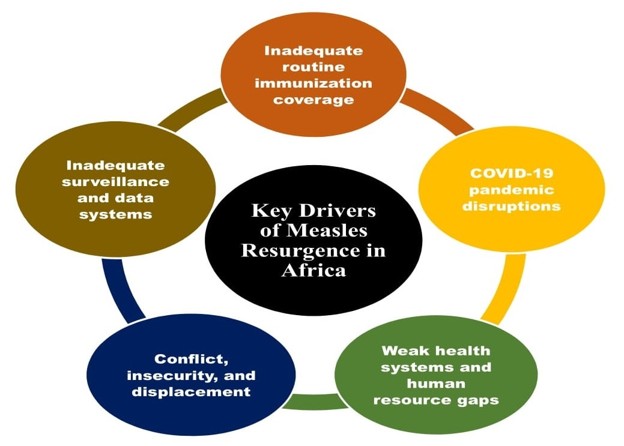
Key drivers of measles resurgence in Africa
A complex interplay of structural, systemic, and behavioural factors fuels measles resurgence in Africa. These factors are often more evident in remote and underserved areas, where fragile health systems and social vulnerabilities converge.
Routine immunisation remains essential to prevent measles, but coverage in the WHO African Region remains below the level needed to interrupt transmission. Although substantial progress has been made, measles cases and deaths in the region declined by 40% and 50%, respectively, between 2019 and 2024, reflecting gains from vaccination and other measles control efforts [1,2]. However, in 2024, regional coverage with the first and second doses of measles-containing vaccine (MCV1 and MCV2) was only 71% and 55%, respectively, with MCV2 coverage remaining 40 percentage points below the ≥95% level recommended to interrupt transmission [3]. The COVID-19 pandemic further disrupted routine immunisation services and measles control activities across the region, contributing to immunity gaps and outbreaks. In 2022, 37 countries experienced large or disruptive measles outbreaks, including 28 in the WHO African Region [7].
These regional averages can mask substantial inequities within countries. Children living in remote rural, nomadic, riverine, and conflict-affected communities are disproportionately likely to remain unvaccinated because of distance to health facilities, population mobility, insecurity, and inconsistent availability of vaccination services [8]. In Nigeria, WHO-supported programmes have identified persistent clusters of zero-dose and under-vaccinated children in hard-to-reach communities, prompting targeted microplanning and outreach approaches. Recent vaccination activities in remote and nomadic communities have shown that mobile and community-based services can reach children missed by conventional service delivery [9]. Thus, national or regional coverage estimates should not be interpreted as evidence of equitable protection; identifying and closing subnational coverage gaps remains essential for measles control.
The COVID-19 pandemic disrupted routine immunisation services across the WHO African Region, affecting fixed-site services, outreach activities, and supplementary immunisation campaigns. Regional MCV1 coverage declined from 70% in 2019 to 68% in 2020, and approximately 7.7 million African children missed their first routine vaccine doses that year [4,6]. These disruptions were accompanied by deterioration in measles surveillance and delays in vaccination activities in several countries. Although routine immunisation services began to recover by 2022, substantial immunity gaps persisted. Measles control subsequently improved, with measles cases and deaths in the African Region declining by 40% and 50%, respectively, between 2019 and 2024. Nevertheless, in 2024, regional MCV1 and MCV2 coverage remained only 71% and 55%, respectively [3,5]. Thus, COVID-19 was not the sole driver of measles resurgence, but it widened pre-existing immunisation gaps and complicated efforts to restore and sustain the high population immunity required for measles elimination.
Weak health systems and shortages of trained health workers continue to constrain routine immunisation delivery, particularly in remote and underserved communities. Although the health workforce in the WHO African Region has expanded substantially, the Region had only about 46% of the workforce needed in 2024 [11]. These gaps can limit immunization programmes’ capacity to sustain fixed-site services, conduct outreach activities, identify and follow up with children who miss vaccination opportunities, and respond quickly to outbreaks. In remote communities, these challenges may be compounded by long travel distances, inadequate transport and logistics, and limited availability of health facilities and trained personnel [8,11].
Strengthening the health workforce and integrating immunisation services into broader primary healthcare systems are therefore important for improving access to vaccination in underserved communities. Investments in trained personnel, reliable vaccine supply and cold chain systems, outreach services, and community-based delivery approaches can help reduce geographic and health system barriers to routine immunisation. These measures are particularly important for reaching zero-dose and under-immunised children in remote communities and sustaining the high vaccination coverage required to prevent measles outbreaks.
Armed conflict, insecurity, and population displacement can disrupt immunisation services by damaging health infrastructure, restricting access for vaccinators, interrupting supply and cold chain systems, and displacing populations from established health services. A recent systematic review found that armed conflict can reduce vaccination coverage by disrupting health services, displacing populations, causing health worker shortages, damaging infrastructure, and disrupting surveillance and supply chains [12]. Evidence from conflict-affected and humanitarian settings indicates that displaced and mobile populations may be missed by conventional fixed-site delivery models [12,13]. In parts of the Sahel, the Lake Chad Basin, and the Horn of Africa, prolonged insecurity and population movements have contributed to persistent gaps in access to vaccination and increased challenges for surveillance and outbreak response [12,14]. In northeastern Nigeria, insecurity has similarly affected access to health services in some communities and created substantial logistical challenges for vaccination activities [15].
Weaknesses in disease surveillance can delay the detection, investigation, and response to measles outbreaks. In remote and underserved areas, limited access to timely reporting, diagnostic, and laboratory systems can delay case notification and create gaps in case documentation [16,17]. Incomplete surveillance data may obscure the geographic and temporal distribution of measles transmission, making it more difficult to identify affected communities and implement timely response measures, including case finding, catch-up vaccination, and outbreak response immunisation activities [16,17]. Under-detection and incomplete reporting may also underestimate the true disease burden and make it harder for programmes to target surveillance and response resources effectively [17,18].
Strengthening case detection, reporting, data quality, laboratory confirmation, and the use of surveillance data for timely public health action is therefore essential for improving measles outbreak preparedness and response. These measures are particularly important in remote communities, where surveillance gaps can compound existing barriers to vaccination access and delay the identification of immunity gaps.
Vaccine hesitancy and access barriers in remote communities
While health system constraints are a significant factor in the resurgence of measles, behavioural and social barriers, especially vaccine hesitancy and physical barriers to access, also significantly hinder immunisation efforts in Africa’s remote communities.
Vaccine hesitancy can contribute to under-immunisation, but its drivers are heterogeneous and context-specific. Among caregivers in African settings, concerns may include perceived adverse effects, misinformation, mistrust of health authorities, religious or cultural beliefs, previous experiences with health services, and uncertainty about vaccine benefits [19,20]. These factors may interact with service delivery barriers; repeated disruptions to vaccination sessions or difficulty accessing services may reduce confidence in immunisation programmes, while poorly adapted communication can leave communities vulnerable to rumours and misinformation [19,21].
Community and religious leaders, traditional authorities, health workers, and other trusted local actors can influence vaccine acceptance. Engagement strategies are therefore more likely to be effective when they are participatory, culturally appropriate, and responsive to locally expressed concerns, rather than relying solely on one-way information dissemination [20,21]. WHO guidance similarly emphasises understanding the behavioural and social drivers of vaccination and engaging communities in designing locally appropriate approaches to improve vaccine uptake [21].
Limited access to reliable information about vaccination can contribute to under-immunisation in remote and underserved communities. Caregivers may have incomplete knowledge of vaccination schedules, the importance of receiving all recommended measles-containing vaccine doses, or the benefits of timely vaccination. Inadequate access to trusted health information may also increase susceptibility to rumours and misinformation, particularly where opportunities for dialogue with health workers and other trusted community actors are limited [19,21].
Beliefs about illness, vaccination and the role of traditional or spiritual explanations may also influence decisions about childhood immunisation in some communities. Evidence from northern Nigeria indicates that cultural and religious beliefs, concerns about vaccine safety, and reliance on traditional health practices can affect vaccine acceptance, while engaging religious, traditional, and community leaders may help address these concerns [20]. Health communication is therefore more likely to be effective when it is locally adapted, delivered through trusted channels, and combined with opportunities for communities to discuss and clarify concerns about vaccination [20,21].
Distance to health facilities can limit access to routine immunisation services in rural and remote communities. Long travel distances, difficult terrain, poor road infrastructure, limited transportation, and seasonal weather conditions can increase the time and cost required for caregivers to reach vaccination services [22,23]. During periods of heavy rainfall and flooding, these barriers may become more pronounced and can disrupt access to health facilities and outreach services in some communities [23].
The indirect costs of seeking healthcare, including transport expenses, time away from income-generating activities, farming, and other household responsibilities, may further reduce use of preventive health services [22,23]. These constraints can disproportionately affect women, who often have primary responsibility for childcare and may face additional financial, mobility, and social barriers when accessing health services for their children [24]. Addressing these barriers requires vaccination strategies that bring services closer to underserved populations through outreach, mobile services, and other locally appropriate delivery approaches [22,23].
In remote and underserved communities, irregular outreach services and interruptions in vaccine availability can create missed vaccination opportunities. WHO identifies difficulty accessing health services, unreliable service delivery, and vaccine stockouts among factors that can result in missed vaccinations [25,26]. When vaccination services are not consistently available, caregivers may need to make repeated journeys to obtain recommended doses, increasing the practical burden of completing vaccination schedules. Mobile health services have also been used to bring healthcare closer to hard-to-reach communities in northern Nigeria [27].
Maintaining reliable outreach services and uninterrupted vaccine availability is therefore essential for reaching underserved populations. Strengthening microplanning, supply chain management, outreach capacity, and community-based delivery can reduce missed opportunities and help ensure children in remote communities receive vaccination when eligible [25,26].
Strategies to improve vaccine uptake in remote communities
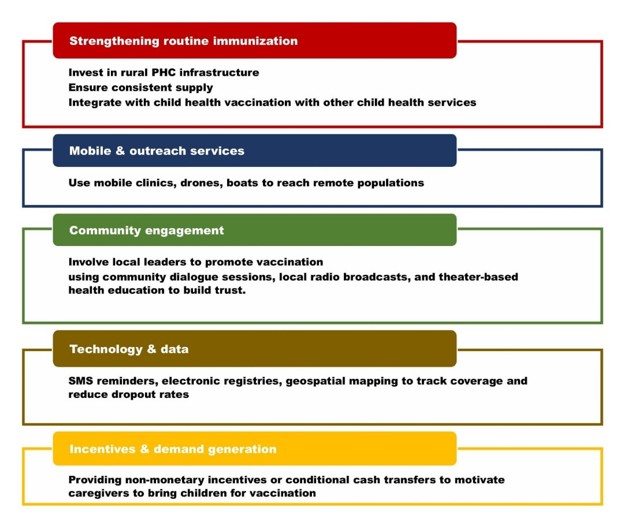
Improving measles vaccine uptake in remote African communities requires a multifaceted approach that addresses both supply-side and demand-side barriers. Strategies should be tailored to local circumstances, culturally appropriate, feasible within existing health systems, and developed with meaningful community participation and local ownership.
Strong routine immunisation services are fundamental to achieving and sustaining high measles vaccine coverage. Greater investment in primary healthcare infrastructure in rural and remote communities, including functional health facilities, adequate staffing, reliable vaccine supply, and effective cold chain systems, is needed to reduce missed vaccination opportunities [11,25,26]. Regularly available services and vaccines can also reduce practical barriers for caregivers who may otherwise need to make repeated journeys to obtain vaccination.
Integrating immunisation with other appropriate primary healthcare and child health services can create additional opportunities to reach children and caregivers, particularly in communities with limited access to health facilities [22,25]. Depending on local needs and programme capacity, immunisation contacts may be linked to services such as nutrition assessment, vitamin A supplementation, growth monitoring, and other child health interventions. Strengthening routine immunisation this way can improve service efficiency and help sustain vaccination beyond periodic campaigns.
Mobile and outreach vaccination services can extend immunisation to populations facing substantial geographic or security barriers to accessing fixed-site services. Outreach teams can use portable cold chain equipment and scheduled vaccination sessions to bring services closer to underserved communities, while adapting delivery approaches to local geography and population mobility [27]. In selected settings, innovative logistics, including drones and water-based transport, have been explored or implemented to overcome difficult terrain and improve the movement of vaccines and other health commodities [28]. These approaches should complement, not replace, reliable routine immunisation services.
Engaging trusted community stakeholders can help reduce vaccine hesitancy and increase acceptance of immunisation. Traditional leaders, religious leaders, teachers, women’s groups, and other respected local actors can support vaccination by communicating accurate information and addressing concerns within their communities [20,21]. Community dialogue, local radio programmes in relevant languages, and other locally appropriate communication approaches can clarify vaccine information, address rumours, and respond to vaccination concerns.
Training and supporting community health workers from within the communities they serve can further strengthen communication and link families with immunisation services. Community health workers can identify children who miss scheduled vaccinations, provide reminders, support follow-up, and help caregivers overcome practical barriers to accessing services [21,27]. These approaches are more likely to be effective when community members are actively involved in design and implementation and when communication is paired with reliable access to vaccination services.
Digital health tools can support immunisation programmes by improving the identification and follow-up of children who miss scheduled doses and enabling more timely use of programme data [29,30]. Electronic immunisation systems can provide health workers and programme managers with longitudinal vaccination records and help identify children who are due or overdue for vaccination. Combined with geospatial information and routine programme monitoring, digital tools may strengthen microplanning and facilitate targeted follow-up in underserved communities [29,30].
Digital approaches should complement, not replace, basic immunisation infrastructure and reliable service delivery. Their usefulness in remote communities depends on appropriate infrastructure, trained personnel, data quality, and integration with routine immunisation systems [29,30].
Incentives and demand-generation approaches may help address some of the opportunity costs associated with childhood vaccination, particularly where transport, time, and household economic constraints contribute to missed vaccination opportunities. Evidence from low- and middle-income countries, including African settings, suggests that financial and non-financial incentives can produce modest improvements in immunization uptake in some contexts, although their effects vary by programme design and local circumstances and may have unintended consequences if poorly implemented [31]. Incentives should therefore be used strategically and transparently, and should complement rather than substitute for reliable vaccine availability, accessible services, and effective community engagement.
Policy Recommendations
Addressing the resurgence of measles in Africa, particularly in remote and underserved communities, requires coordinated policy action at national, regional, and international levels. Key priorities should include the following:
National immunisation plans should explicitly incorporate equity-focused strategies to ensure rural, remote, and marginalised populations are reached. Budgets should account for the additional costs of vaccination in hard-to-reach settings, including transportation, community mobilisation, outreach activities, and cold chain expansion.
Governments should strengthen the recruitment, training, deployment, and retention of healthcare workers and community health workers in underserved areas. Adequate remuneration, continuing professional development, and appropriate safety measures are essential to maintaining a reliable workforce in remote and high-risk settings.
Partnerships with NGOs, faith-based organisations, community groups, and private-sector logistics providers can complement government capacity for vaccine delivery and demand generation. Such partnerships should be integrated into national immunisation plans and supported by clear roles, accountability mechanisms, and performance monitoring.
Timely detection of measles outbreaks requires sensitive surveillance and rapid reporting, particularly in areas with limited access to health facilities. Governments should strengthen community-based surveillance, electronic reporting, laboratory capacity, and cross-border information sharing to facilitate early detection and coordinated outbreak response.
African countries should progressively increase domestic immunisation financing while maintaining strategic engagement with global partners, including Gavi, the Vaccine Alliance. Sustainable financing mechanisms, including protected immunisation budgets and integrating essential vaccines into national health financing arrangements, can reduce vulnerability to funding interruptions and support long-term programme continuity.
Immunisation services should combine fixed sites, outreach, mobile, and other flexible approaches based on local needs. Community microplanning should incorporate seasonal population movement, flooding, difficult terrain, and nomadic or mobile populations to identify appropriate vaccination locations and schedules. Such adaptive approaches can reduce geographic and logistical barriers to vaccination and improve continuity of services in underserved communities.
The resurgence of measles in Africa reflects persistent inequities in vaccine access, gaps in health system capacity, and inconsistent delivery of immunisation services. Despite substantial progress, many children, particularly those living in remote and underserved communities, remain vulnerable to a preventable disease.
Reversing this trend requires sustained investment in equitable routine immunisation, reliable vaccine supply and cold chain systems, adequately supported health workers, community engagement, and flexible service delivery models adapted to local conditions. Strengthening surveillance and addressing vaccine hesitancy through trusted, culturally appropriate communication are equally important.
Measles elimination in Africa will require sustained political commitment, domestic financing, and coordinated action across health systems and communities. Prioritising the populations most likely to be missed is essential to closing immunisation gaps. Ensuring that every child can access timely vaccination, regardless of where they live, will not only accelerate progress towards measles elimination but also strengthen broader efforts towards universal health coverage.
What is already known about the topic
What this study adds
Conceptualization: Chizaram Onyeaghala
Data curation: Chizaram Onyeaghala, Ebuka Louis Anyamene
Methodology: Chizaram Onyeaghala
Validation: Mark Anum Nortey, Alpha Umar Bai-Sesay, Abdullahi Hassan, Ebuka Louis Anyamene
Visualization: Alpha Umar Bai-Sesay, Abdullahi Hassan, Ebuka Louis Anyamene
Supervision: Mark Anum Nortey, Alpha Umar Bai-Sesay
Writing – original draft: Chizaram Onyeaghala
Writing – review & editing: Chizaram Onyeaghala, Mark Anum Nortey, Alpha Umar Bai-Sesay, Abdullahi Hassan, Ebuka Louis Anyamene
| Table 1: Barriers to Vaccine Uptake in Remote Communities | |
| Barrier | Description |
|---|---|
| Vaccine hesitancy | Driven by cultural, religious, and informational barriers, such as misinformation, traditional beliefs, and mistrust of health authorities. |
| Limited health education | Lack of awareness of vaccine benefits, schedules, and side effects due to poor outreach. |
| Physical access barriers | Long travel distances, poor roads, seasonal flooding, and mountainous terrain, among other challenges. |
| Inconsistent outreach & stockouts | Irregular immunisation sessions, vaccine shortages, and poor cold-chain reliability. |
| Table 2: Policy Recommendations for Strengthening Measles Immunization | |
| Policy Recommendation | Implementation Approach |
|---|---|
| Prioritize equity in national immunization plans. | Equity-focused strategies, budget allocations for remote communities. |
| Invest in workforce development. | Train and deploy healthcare workers and community health volunteers, ensuring fair compensation and safety provisions. |
| Expand public-private partnerships | Collaborate with NGOs, faith-based organizations, private logistics providers to bridge capacity gaps. |
| Strengthen surveillance and early warning systems | Invest in electronic reporting and train healthcare workers to facilitate the prompt detection and reporting of incidents. |
| Secure sustainable financing | Increase domestic financing, immunization trust funds, or national insurance schemes. |
| Adaptive service delivery model | Institutionalize a flexible mix of fixed, mobile, and outreach services tailored to different geographies. |