Review | Open Access | Volume 9 (4): Article 167 | Published: 19 Oct 2026

Views: 27
Menu, Tables and Figures
| Evidence family | n (references) | Can establish | Cannot establish | Issuing region |
|---|---|---|---|---|
| Normative instruments | 15 [1, 2, 10-12, 16, 17, 37, 64, 65, 83, 86-88, 97] | Legal obligations, system requirements and standards a jurisdiction must meet | That a named post holder must hold a competency, or that a competency predicts performance | Global 12; South-East Asia 2; North America 1 |
| Operational doctrine and manuals | 14 [6-8, 14, 15, 18-20, 36, 66, 84, 85, 95, 96] | Accepted operating procedure, structures, terminology and product formats | Learner-level competence, or the effectiveness of any teaching method | Global 9; North America 2; Europe 1; Africa 1; South-East Asia 1 |
| Educational program and curriculum-method sources | 16 [9, 21, 22, 24, 32-34, 43, 51, 62, 68-71, 79, 89] | Program structure, development method, sequence and instructional design | Learner outcomes or comparative educational effectiveness | North America 5; Africa 2; Global 2; Europe 2; Eastern Mediterranean 2; Oceania 1; Western Pacific 1; Latin America 1 |
| Competency frameworks | 9 [26, 31, 35, 38, 50, 58, 63, 81, 82] | Expert-endorsed statements of what a workforce should be able to do | That the stated competencies are complete, necessary or predictive of workplace performance | Global 3; North America 2; Oceania 1; Africa 1; Europe 1; Latin America 1 |
| Empirical studies and evaluations | 19 [23, 25, 28-30, 40, 42, 59, 60, 67, 72-78, 90, 94] | Observed roles, measured properties of an instrument and evaluated experience within the studied population | Normative authority, or generalization beyond the studied population and setting | Africa 8; North America 4; multi-country 2; Eastern Mediterranean 2; Europe 2; Global 1 |
| Conceptual and definitional scholarship | 8 [4, 5, 13, 27, 39, 48, 61, 98] | Field definitions, conceptual boundaries and analytic categories | Any empirical or normative claim about competence | North America 6; Africa 1; multi-country 1 |
Global denotes World Health Organization, United Nations and other multilateral issuing bodies. Multi-country denotes academic collaborations without a single national base. The full classification of every source appears in Supplementary File 3. Bracketed numbers refer to the manuscript reference list and identify every source included in each row. Each of the 81 included sources is counted once.
Table 1: Evidence families in the 81-source analytic library, with the claims each family supports and the issuing region of its sources
| Element (0, 1 or 2) | WHO PHEOC resources [6-8, 18] | Africa CDC advanced fellowship [24, 25] | Health EDRM, Sendai and African disaster-risk work [1, 2, 26] | ECDC competencies and HEPSA [35, 36] | CDC capabilities and fellowship [21, 22, 37] | WHO public health intelligence resources [50, 51] |
|---|---|---|---|---|---|---|
| Resource type | Operational manual set | Educational program | Normative framework and competency set | Competency framework and self-assessment tool | Capability standard and educational program | Competency framework and curriculum |
| Competencies | 1 | 2 | 2 | 2 | 2 | 2 |
| Learning objectives | 1 | 2 | 2 | 1 | 1 | 2 |
| Modules or session plans | 2 | 2 | 1 | 1 | 1 | 2 |
| Exercises or simulations | 2 | 1 | 1 | 1 | 1 | 1 |
| Workplace products | 2 | 2 | 0 | 0 | 1 | 0 |
| Assessment tools | 1 | 1 | 0 | 2 | 0 | 1 |
| Facilitator guidance | 1 | 0 | 0 | 1 | 0 | 1 |
| Mentor or supervisor guidance | 0 | 1 | 0 | 0 | 1 | 0 |
| Adaptation guidance | 1 | 0 | 2 | 2 | 1 | 1 |
| Monitoring, revision and version control of the package | 1 | 0 | 2 | 1 | 1 | 1 |
| Total (of 20) | 12 | 11 | 10 | 11 | 9 | 11 |
Each element scores 0 for absent, 1 for partial or implicit and 2 for explicit and substantial. Totals of 15 to 20 indicate complete public documentation, 8 to 14 partial and 0 to 7 limited. All six packages were scored against these element definitions on 31 August 2026 using the current public version of each package. Only materials obtainable without a license or institutional agreement were scored. Totals are interpreted within resource type and describe public documentation alone, leaving program completeness, quality and readiness to separate assessment. Packages carrying an educational program or curriculum are the Africa CDC advanced fellowship, the CDC capabilities and fellowship, and the WHO public health intelligence resources. Element anchors and a worked scoring example appear in Supplementary File 2. CDC, Centers for Disease Control and Prevention; ECDC, European Centre for Disease Prevention and Control; EDRM, emergency and disaster risk management; HEPSA, health emergency preparedness self-assessment tool; PHEOC, public health emergency operations center; WHO, World Health Organization. References in the column headings identify the documents assessed for each resource package.
Table 2: Element-level mapping of publicly documented curriculum components across six major public resource packages, by resource type
| Step | Question answered | Worked example | Basis |
|---|---|---|---|
| 1. System capability | What must the jurisdiction be able to do? | Maintain an emergency operations center able to activate within a defined time and coordinate incident management | Normative requirement [6,11] |
| 2. Occupational function | Which post performs this within the national structure? | PHEOC manager, supported by operations, planning, logistics and information functions | Position profiles in center and incident-management doctrine [7,19] |
| 3. Individual competency | What must that post holder be able to do? | Establish and run center procedures, staffing, information flows, handover and continuity during activation | Design decision; assigned to RP03 and RP04 |
| 4. Learning outcome | What observable performance is taught and assessed? | Domain 12 outcomes on activation, center management, shift handover and continuity, each written as action, object, context and standard | Design decision; recorded in Supplementary File 4 |
| 5. Assessment evidence | What must the learner produce or demonstrate? | Product PP04, a center and incident-management package, with observed performance in a functional exercise | Design decision; rubric in Supplementary File 1 |
PHEOC, public health emergency operations center. RP, role pathway. Steps 3 to 5 reflect the authors’ own design decisions, which go beyond the cited sources.
Table 3: Translation from a system capability to assessable individual competence, with a worked example
| Level | Behavioral descriptor | Decision authority | Assessment evidence | Performance hierarchy |
|---|---|---|---|---|
| P1 Understand | Explains concepts, structures, terminology, standards and assigned responsibilities | None beyond the learner’s own task | Written explanation, structured scenario analysis, oral questioning | Knows and knows how |
| P2 Apply | Performs standard tasks under guidance using approved tools, plans and procedures | Acts within a defined procedure | Product completed to template, observed task performance in simulation | Shows how |
| P3 Coordinate | Coordinates a defined function, team, workstream or operational process | Allocates work and resolves routine conflicts within one function | Observed function performance in a functional exercise, situation reports and action logs | Shows how and does |
| P4 Lead | Leads complex functions, integrates partners and makes accountable decisions under uncertainty | Sets objectives and commits resources across functions | Observed lead or command performance, incident action plan, decision log with rationale, oral defense | Does |
| P5 Govern and evaluate | Governs by setting standards, assigning authority and accepting residual risk; evaluates by assessing systems, assuring quality and improving institutional performance | Approves standards and holds institutional accountability | Governance: authored policy or standard. Evaluation: system evaluation and after-action review with corrective actions and documented follow-through | Does |
The levels are cumulative. The performance hierarchy column refers to the four-level hierarchy for assessing professional performance [53]. Individual assessability differs by level: P1 and P2 outcomes are assessable individually, while P3 to P5 outcomes depend on team, mandate and institutional conditions and accept observed simulation performance when those conditions are absent.
Table 4: Cumulative proficiency levels with behavioral descriptors, decision authority and assessment evidence
1National Public Health Agency, Freetown, Sierra Leone, 2Foothills Community-Based Interventions, Monticello, Kentucky, United States of America, 3African Field Epidemiology Network, Kampala, Uganda, 4Makerere University-Johns Hopkins University Research Collaboration, Kampala, Uganda
&Corresponding author: Eric Nzirakaindi Ikoona, National Public Health Agency, 42A Main Motor Road, Wilberforce, Freetown, Sierra Leone, Email: ikoonae@yahoo.com, ORCID: https://orcid.org/0000-0003-3402-1961
Received: 08 Aug 2026, Accepted: 06 Oct 2026, Published: 19 Oct 2026
Domain: Global Health Security
Keywords: Public health emergency management, disaster risk reduction, emergency preparedness and response, health emergency and disaster risk management, incident management, competency-based education, curriculum
©Eric Nzirakaindi Ikoonaet al. Journal of Interventional Epidemiology and Public Health (ISSN: 2664-2824). This is an Open Access article distributed under the terms of the Creative Commons Attribution International 4.0 License (https://creativecommons.org/licenses/by/4.0/), which permits unrestricted use, distribution, and reproduction in any medium, provided the original work is properly cited.
Cite this article: Eric Nzirakaindi Ikoona et al., A proposed generic open curriculum for public health emergency management: An evidence-informed synthesis for country adaptation. Journal of Interventional Epidemiology and Public Health. 2026; 9(4):167. https://doi.org/10.37432/jieph-d-26-00297
Introduction: Public Health Emergency Management frameworks, fellowships and curricula differ in emergency-cycle coverage, role differentiation and assessment. This paper developed one open, full-cycle curriculum that countries can adapt.
Methods: A structured documentary review was conducted up to 5 October 2026. The search covered PubMed, institutional repositories, training-provider sites and regional sources in four languages across all six World Health Organization regions. The curriculum drew on 81 sources: 27 (33.3%) from global bodies, 20 (24.7%) from North American institutions and 34 (42.0%) from other regions. Six public packages were examined for what they already provide. Curriculum development followed a six-step model. Competencies drawn from the sources were rewritten as observable performance statements.
Results: The curriculum organizes learning in four layers: a universal core, a context-adaptable core, 16 role pathways and optional specializations. Learners advance through five proficiency levels, from understand to govern and evaluate. Twenty-two domains in five clusters carry 132 outcomes, each traceable to its sources. The clusters are foundations and risk reduction, preparedness, incident management, response functions, and recovery and learning. Graduates demonstrate competence through twelve proposed workplace or simulation products. By comparison, none of the three existing educational packages examined combined full-cycle competencies, differentiated role pathways, teaching content, simulation, workplace products, mentor guidance and assessment in one publicly available package.
Conclusion: Ministries and training institutions can adapt one open, traceable specification. It remains a proposal until external content validation, consensus review, country adaptation, field testing and effectiveness evaluation are complete.
Public health emergencies disrupt health, livelihoods, essential services and institutions. They include outbreaks and pandemics, disasters, chemical and radiological events, conflict, displacement, climate hazards and deliberate threats [1,2]. Managing them needs connected capacities for risk reduction, planning, readiness, intelligence, coordination, operations, communication and recovery [1-3].
Public Health Emergency Management (PHEM) applies emergency-management principles, public health science and operational systems to events with serious health consequences [4]. The field covers prevention, mitigation, preparedness and readiness, response, recovery and transition, and continuous improvement [1,2,4,5]. Prevention removes a hazard or blocks an exposure pathway through vaccination, source control, or water and food safety. Mitigation accepts that a hazard may occur and reduces its intensity, exposure, vulnerability or consequences [1,2]. Preparedness builds the people, plans, procedures and exercises needed to act, and readiness verifies that those capabilities activate to standard. Response coordinates action during an emergency, recovery restores services while reducing future risk, and institutional learning converts reviews into corrective action.
A public health emergency operations center (PHEOC) is narrower than the field. The World Health Organization (WHO) defines it as a physical or virtual platform that coordinates information and resources for incident management [6]. WHO guidance places the center inside a wider program covering prevention and mitigation, readiness, surveillance, community engagement, training and plan validation [7,8]. Legal authority, governance, workforce, financing, service delivery and recovery sit outside it [9].
Global instruments shape practice. The Sendai Framework and the WHO Health Emergency and Disaster Risk Management Framework place risk understanding, governance, resilience investment, preparedness and risk-informed recovery in one cycle [1,2]. The International Health Regulations (2005), with amendments adopted in 2014, 2022 and 2024, require capacities for prevention, surveillance, assessment, notification and response, and application of the amended text varies by State Party [10]. The Joint External Evaluation tool and WHO benchmarks convert those obligations into country-capacity assessment, and both grew out of the health-security agenda built around the Regulations [11-13]. Operational instruments add center, alert, grading and pandemic functions [14-20]. Under WHO guidance, national public health agencies design competency-based curricula, in-service training and simulation exercises [16].
Workforce models are also established. The United States Centers for Disease Control and Prevention runs an international PHEM fellowship built on standardized training, mentorship and workplace products [21,22]. Its graduates performed differentiated functions during COVID-19, in planning, operations, logistics, intelligence and communication roles [23]. Africa Centres for Disease Control and Prevention built a six-month advanced fellowship producing three competency domains, ten subdomains and an eleven-course syllabus [24,25]. African work proposed competencies across risk reduction, preparedness and recovery [26]. West African regional bodies coordinate preparedness and workforce development across fifteen states, where a regional assessment mapped field epidemiology capacity and a decadal review found national public health institutes at uneven maturity [27-30]. National frameworks followed in Australia, Europe and China [31-34]. European, United States and Canadian models supply competencies, self-assessment instruments, capability standards and a resilience framework [35-39].
Three problems remain unresolved. First, the instruments carrying most authority describe what systems must be able to do [11,12,37]. A system capability leaves open what an individual post holder must perform, at what level and on what evidence. Second, competency sets are rarely connected to the teaching content, simulation, workplace products, mentor guidance and assessment a credential-bearing program needs. A systematic review found heterogeneous domains across professional groups [40], a European consortium proposed measurable objectives differentiated by managerial level [41], and a worldwide mapping study reported no universally accepted competency set or curriculum [42]. Third, the resources sit in separate documents with different purposes, so a country assembling a program reconciles them without a stated method.
This paper reports the first stage of a linked PHEM curriculum series. Its objective was to develop one open, full-cycle PHEM curriculum that countries can adapt, specifying its competencies, layers, role pathways, learning domains and workplace products. A documentation mapping shows which components public packages already give a country wanting to run a program. The paper delivers the proposed curriculum for external validation and country adaptation, with its complete specification in Supplementary File 1.
Study design and reporting
The curriculum was developed with the six-step curriculum model, and this paper reports its first four steps: problem identification, needs assessment, goals and objectives, and educational strategies [43]. The evidence-gathering component within that method is a structured documentary review. Outcome statements follow competency-based education, in which defined performance, in place of time served, governs progression [44,45]. Consensus development, field testing and effectiveness evaluation belong to the later steps. Throughout, a PHEM system, a PHEOC, an incident management system and Health Emergency and Disaster Risk Management were kept distinct, because the terms name related and non-identical objects [1,4,6].
No EQUATOR reporting guideline covers curriculum development [46]. The review component is reported against the items of the PRISMA extension for scoping reviews that apply to a synthesis of documents, with the completed item table in Supplementary File 2 [47]. The checklist supports transparent reporting of a review that served curriculum construction. The Scale for the Assessment of Narrative Review Articles was retrieved and examined [48]. It appraises published narrative reviews, so the PRISMA extension was preferred for reporting search, extraction and synthesis.
Search period, information sources and language scope
The search ran in three waves. The first closed on 19 July 2026 and covered PubMed and named institutional repositories. The second closed on 31 August 2026 and widened regional and education coverage. The third closed on 5 October 2026 and covered training-provider sites, web search for review and education literature, and author-identified articles.
The search covered PubMed, the publication pages and repositories of WHO headquarters and regional offices, the United Nations Office for Disaster Risk Reduction, CDC, Africa Centres for Disease Control and Prevention, ECDC and FEMA. It also covered peer-reviewed and institutional sources in all six WHO regions, and targeted consensus competency frameworks, national education standards, regional training curricula and program evaluations. Records retrieved and screened by information source appear in Supplementary File 2. Search terms were translated into French, Spanish and Portuguese to extend retrieval beyond English-language sources. Targeted searches emphasised South-East Asia and francophone West Africa because relevant regional and institutional materials from these settings were less consistently represented in the global databases searched.
Backward citation searching ran as a separate step after database and institutional searching. The reference lists of every eligible systematic review, competency study and normative document were examined in full. A cited work became a candidate when its title indicated competencies, curricula, exercises, workplace assessment, program evaluation or emergency-management doctrine, and candidates then passed through the same eligibility criteria as database records. Supplementary File 3 records the evidence family, issuing region, appraisal score and disposition of every candidate record. Search terms were in English, with French, Spanish and Portuguese equivalents. The library includes Spanish-language and French-language regional training and competency resources.
Search strategy
Six concept blocks were combined with Boolean operators. They named the field, its operational systems, education and workforce terms, the risk-reduction and recovery cycle, specialist functions, and digital and emerging practice. Platform-specific strings, the full term list, search dates and translation terms appear in Supplementary File 2.
Eligibility and screening
A source entered full-document screening when it described competencies or role expectations, learning objectives, domains, modules or sequence, or exercises and simulations. A source also entered when it described workplace products, assessment or certification, facilitator or mentor guidance, country adaptation, program monitoring, or curriculum revision. Eligible evidence included normative documents, official competency frameworks and manuals, government or regional training resources, and peer-reviewed curriculum-development studies and program evaluations.
Excluded material comprised promotional and commercial items, single clinical procedures, profession-specific packages without transferable content, inaccessible records and superseded versions. Across the three waves 157 candidate records were registered, 13 duplicate or superseded records were removed, 144 full documents were assessed and 81 entered the analytic library. The reason for each of the 63 full-document exclusions appears in Supplementary Files 2 and 3.
Source appraisal and evidence families
Official and grey literature received an adapted Authority, Accuracy, Coverage, Objectivity, Date and Significance appraisal [49], each dimension scoring zero, one or two points. Totals of 9 to 12 indicated high quality, 6 to 8 moderate and 0 to 5 low. The appraisal screens whether a document is usable for curriculum decisions.
Authority, empirical validity, educational validity and normative status are different properties. Each included source was therefore also classified into one of six evidence families: normative instruments, operational doctrine and manuals, competency frameworks, educational program and curriculum-method sources, empirical studies and evaluations, and conceptual scholarship. The family sets what a source can support, as Table 1 states for each. Universal-core outcomes required support beyond empirical sources, and performance claims required support beyond normative sources.
Documentation completeness of public resource packages
Six major public resource packages received a 10-element documentation completeness score. Three of the packages were the WHO emergency operations center resources [6-8,18], the Africa CDC advanced fellowship [24,25], and the Health Emergency and Disaster Risk Management, Sendai and African disaster-risk competency material [1,2,26]. The others were the ECDC competencies and self-assessment tool [35,36], the CDC capability standards and fellowship [21,22,37], and the WHO public health intelligence resources [50,51]. The elements are competencies, learning objectives, modules or session plans, exercises or simulations, workplace products, assessment tools, facilitator guidance, mentor or supervisor guidance, adaptation guidance, and monitoring and revision of the package. Each element scored zero for absent, one for partial and two for explicit and substantial, giving a range of 0 to 20. Totals of 15 to 20 indicated complete public documentation, 8 to 14 partial and 0 to 7 limited. The analysis maps publicly documented components across resource types. Comparison of program completeness falls outside its purpose. Totals are interpreted within resource type. Workplace products, assessment tools, facilitator guidance and mentor guidance are expected of educational packages. Statements about missing components therefore apply to the three packages carrying an educational program or curriculum.
The scale was built for this work from the components a ministry needs in order to run a program without redeveloping them. The elements and their anchors were written before any package was scored, then piloted on two packages outside the final six. After the pilot, the anchors for assessment tools and for monitoring, revision and version control were reworded.
Public availability determined what could be scored. Materials obtainable without a license or institutional agreement were assessed, so a package scores low when its facilitator guides, rubrics or mentor tools are held internally. The score describes the public record, and an institution may deliver more than it publishes.
Each package was scored against the ten elements on 31 August 2026, using its current public version. Two authors applied the written anchors independently to all ten elements of every package. Exact agreement was 53 of 60 element scores, 88.3%, and the linear weighted kappa was 0.85 (95% CI 0.70 to 1.00). The seven disagreements were reconciled against the source document, one of them after a third author adjudicated. Element-level scores appear in Table 2, and the anchors with a worked example appear in Supplementary File 2.
Translation from system capability to assessable competence
Most authoritative sources state requirements for systems [11,12,37]. Outcomes for individuals were derived through an explicit five-step chain: system capability, occupational function, individual competency, learning outcome and assessment evidence. Table 3 applies the chain to one capability. A capability entered the universal core only when a named post holder performs part of it, and the required performance is teachable and observable.
Outcomes also differ in what one learner can demonstrate alone. Outcomes at the understand and apply levels are individually assessable. Outcomes at the coordinate, lead and govern levels depend on a team, a mandate and institutional conditions; for these outcomes, the curriculum accepts observed simulation performance when workplace assessment is not feasible. All 132 outcomes are terminal at the coordinate level or above, so each carries that assessment context, and Supplementary File 4 records it outcome by outcome.
Competency normalization and outcome derivation
Each candidate competency was rewritten as an observable performance statement with four components: the action, the object acted on, the operational context and the expected standard. The format follows performance-objective conventions in instructional design, under which an objective states what the learner does, under what conditions and to what criterion [43,52]. A terminal competency here means the end-of-domain performance statement that the outcomes of that domain together support.
Semantic duplicates were merged when two statements described the same performance in different institutional vocabulary, and narrow tasks were nested under the terminal competency they serve. Supplementary File 2 gives worked examples showing the source wording, the transformation applied and the resulting outcome.
Decision rules
An item entered the universal core when it described a defining PHEM function, applied across settings and carried concordant support from at least two authoritative sources issued by different bodies. Independence was judged at the issuing organization and parent document, so two WHO documents restating one framework counted once. The rule reduces reliance on a single document and shows convergence across issuing bodies. Necessity and predictive validity are tested in the validation studies.
A context-adaptable core item applied to every program and depended on national law, institutions, hazards, languages or technology. Role-pathway items applied to named emergency functions, and optional specializations depended on national need. Graduation evidence required a workplace product, observed simulation performance or both. Knowledge tests and attendance served as supporting evidence [53,54].
Curriculum development and audit sequence
The curriculum was drafted inductively. Domains, layers, role pathways and outcomes were built from the extracted competencies and organized into the emergency-management cycle. The draft was audited afterward against ten source families. Four were disaster-risk reduction and full-cycle Health Emergency and Disaster Risk Management, law and capacity instruments, hazard terminology and risk assessment, and center, incident-management and exercise doctrine. The remaining six were workforce programs, intelligence, communication, One Health and laboratory standards, digital and artificial-intelligence governance, humanitarian settings, chemical, biological, radiological, nuclear and deliberate threats, and climate policy. The audit ran after the outcome set had been numbered and could reclassify, add or remove an outcome. No domain, outcome or product was renumbered.
The analytic library closed at the end of the synthesis. A separate update check ran afterwards against current hazard-classification and all-hazards strategic risk-assessment resources, testing whether the curriculum had omitted a hazard family or a risk-assessment step [55,56]. Its sources are listed separately in Supplementary Files 1 and 3, outside the analytic library.
Quality control and author roles
In the first two waves, two authors screened all 118 candidate records and assessed all 111 full documents independently. Agreement on full-document eligibility gave a Cohen kappa of 0.83 (95% CI: 0.72 – 0.94), and nine disagreements were settled by discussion, two of them by a third author. Extraction and evidence-family assignment were duplicated in the same way, with eight disagreements and a kappa of 0.86 (95% CI: 0.77 – 0.95). Source appraisal was scored independently by two authors across the 69 sources included from those waves. The two-way random-effects, absolute-agreement, single-rater intraclass correlation coefficient, ICC(2,1), was 0.89 (95% CI: 0.83 – 0.93) [57]. Supplementary File 2 records the remaining quality-control steps and the rules used where sources conflicted.
Ethical considerations
The work used public documents and published literature and involved no human participants, animals or identifiable data. Research ethics review was not required. Planned validation work will involve expert panels, program staff and learners, and ethics approval or exemption with consent procedures will be reported in those studies.
Source profile and evidence families
The analytic library held 81 sources, 12 of them from the third wave. Seventy-two scored high and nine moderate on appraisal, and no low-quality source entered the synthesis. Table 1 gives the six evidence families with counts, supportable claims and issuing region.
Global multilateral bodies issued 27 of the 81 sources (33.3%) and North American institutions 20 (24.7%). Africa contributed 13, Europe six, the Eastern Mediterranean four, South-East Asia and multi-country academic groups three each, Oceania and Latin America two each, and the Western Pacific one [27-34,39,58-79]. No source reports learner outcomes for a full-cycle PHEM curriculum.
Documentation completeness of public packages
Public documentation of the ten components scored 9 to 12 of 20 across the six packages (Table 2). Totals capture what each package documents publicly, within its resource type. Program quality and implementation readiness require separate assessment. The three packages carrying an educational program or curriculum scored 11 for the Africa CDC advanced fellowship, 11 for the WHO public health intelligence resources and 9 for the CDC capability standards and fellowship. None of the three scored two points for mentor guidance or for assessment tools. The operational manual set scored 12, and the two competency and normative sets scored 10 and 11.
Competencies, learning objectives, and modules or session plans are documented best. Mentor guidance, facilitator guidance, workplace products and assessment tools are documented least, and mentor guidance is absent from four of the six packages.
No educational package meeting the predefined criteria was identified within the sources searched. Those criteria were a full-cycle competency set, differentiated role pathways, teaching content, repeated simulation, standard workplace products, mentor guidance and calibration-ready assessment, held in one publicly available package. They describe a complete training package and were applied to the three educational packages.
Curriculum layers, proficiency and role pathways
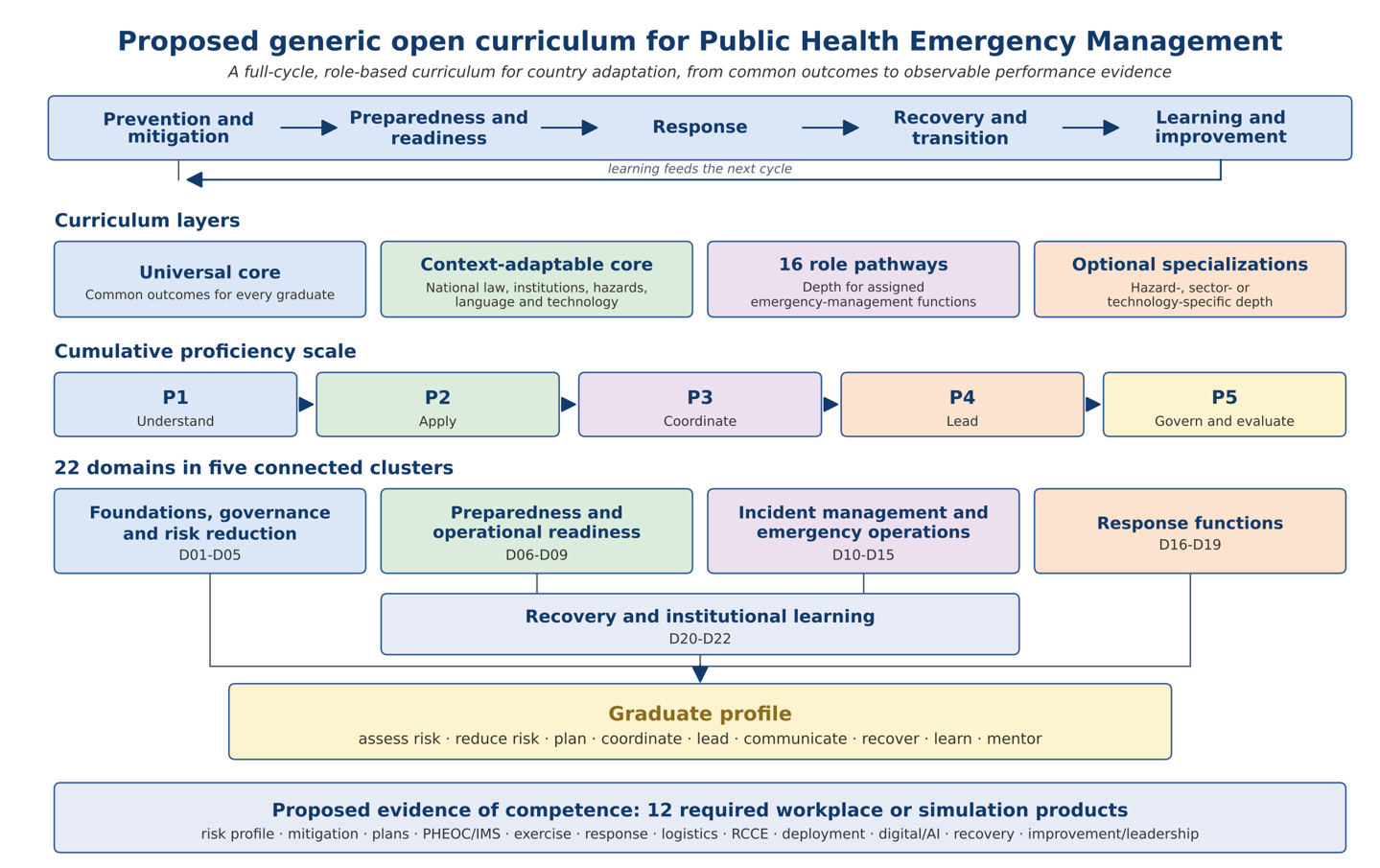
The curriculum contains four layers: a universal core, a context-adaptable core, role pathways and optional specializations (Figure 1). Five cumulative proficiency levels run from understand to govern and evaluate. Table 4 gives the behavioural descriptor, decision authority and assessment evidence for each level, with the corresponding level of the performance hierarchy used in professional assessment [53,80]. The fifth level joins two competencies under one institutional accountability. Governing sets the standard for a function, assigns authority and accepts residual risk. Evaluating measures system performance against that standard and supplies the evidence on which governance acts.
Sixteen coded role pathways carry depth without requiring expertise in every function. Leadership pathways are RP01 strategic leader, RP02 emergency coordinator, RP03 PHEOC manager and RP04 incident manager. Command and general staff pathways are RP05 operations, RP06 planning, RP07 logistics, and RP08 finance and administration. Response-function pathways are RP09 information management and public health intelligence, RP10 risk communication, community engagement and infodemic management, RP11 rapid response team, RP12 clinical and laboratory response coordination, and RP16 infection prevention and medical-countermeasure coordination. Cycle-wide pathways are RP13 recovery and continuity, RP14 exercise planning, control and evaluation, and RP15 risk reduction, mitigation and resilience.
The pathways are educational tracks that remain to be validated as job families. The command and general staff pathways follow incident-management doctrine [18,19,61]. Center and incident-management pathways follow the position profiles in PHEOC guidance [6,7], and intelligence and communication pathways follow function-specific competency frameworks [50,81,82]. Empirical support for differentiation comes from the roles fellowship graduates performed during a large response [23]. RP12 and RP16 separate clinical and laboratory coordination from infection prevention and medical countermeasures, which draw on different technical services and staff. National role titles differ, so countries map pathways to their own posts during adaptation.
Domains, cross-cutting requirements and required evidence
The curriculum contains 22 domains in five clusters holding 132 outcomes (Figure 1). Supplementary File 1 gives the cluster, outcome count and scope of every domain. D17 is a coordination domain. A graduate plans and coordinates clinical, laboratory, infection-prevention and countermeasure operations with the specialists who deliver them. Specialist competence in each field remains with those specialists.
Nine requirements run across all domains: equity, ethics, community participation, One Health, responder safety, mental health and psychosocial support, evidence use, information security, and continuous improvement. Whole-of-society guidance on managing health risks across sectors supports this treatment [83]. Digital systems and artificial intelligence are treated as governed operational tools. Learners must address data quality, validation, bias, uncertainty, privacy, cybersecurity, continuity and accountable human oversight [50,51,84-89].
Twelve workplace or simulation products are proposed as the evidence of competence. The products cover risk profiling, mitigation, preparedness and continuity planning, center and incident management, exercises, response management, logistics, risk communication, deployment, digital appraisal, recovery, and review with leadership and mentorship. Every graduate of a full program provides evidence in all twelve categories, at a depth set by the role pathway. Shorter formats assess a stated subset, and the full credential requires all twelve. Supplementary File 1 specifies the minimum evidence for each product and maps it to domains.
The assessment specification triangulates written products, simulation observation, operational records, oral defense and evidence of use, which follows programmatic assessment [54]. Automatic-failure conditions and rubrics appear in Supplementary File 1. The products serve as proposed evidence formats, providing a foundation for consistent assessment once assessors in more than one region are calibrated.
Traceability and audit findings
All 132 outcomes carry their source anchors in Supplementary File 4. Every outcome is anchored to at least two documents.
The first audit found each of the ten source families represented in at least one domain. The hazard update check confirmed coverage of hazard terminology, cascading-risk language and participatory strategic risk assessment, and changed nothing.
The coverage audit tested the 22 domains against every source in the library and against a set of hazard families and emergency functions drawn from the normative instruments. Two subjects required treatment beyond a single domain. Mental health and psychosocial support carries its own learning domain in a consensus educational framework [58]. A regional workforce strategy lists it among the required disciplines of an emergency workforce [64], and evaluations of emergency leadership training name it as a leader responsibility [59,60]. The subject applies to responders during preparedness, to affected populations during response and to communities during recovery. It is therefore specified as a cross-cutting requirement and in domains D08, D18 and D20. Cross-border interoperability follows the same pattern. Regional workforce sources treat membership of regional response rosters and readiness for cross-border deployment as competences of the individual responder [27,64], and D08 and D18 specify both. Every hazard family and emergency function in the audit set had a mapped outcome. The third wave added no outcome. Five subjects taught in its programs have no named outcome and fall under optional specializations, as Supplementary File 2 lists.
Delivery burden and staged adoption
Institutions can adopt the 22 domains and 132 outcomes in stages. Every graduate completes the universal core, and pathways and specializations follow the posts a country needs to fill. The minimum practice requirement is one supervised workplace improvement project, one multiagency simulation and observed role performance in the chosen pathway. A program at that level needs a host institution and director, facilitators with recent operational experience, a named mentor and workplace supervisor for each learner, tabletop exercise capacity, and product rubrics with assessor calibration. Field testing will establish their delivery cost and workload.
What the evidence establishes and what the authors designed
The objective was to develop one open, full-cycle PHEM curriculum that countries can adapt. The proposed curriculum meets that objective and rests on three things the reviewed evidence establishes. PHEM competency frameworks and educational resources are heterogeneous in scope, depth and purpose [40,42]. Three scoping reviews from the third wave report training programs without a standard curriculum [73,76,77]. Recurring domains cover preparedness, response, recovery, coordination, leadership, communication, intelligence, logistics, center operations, exercises and risk reduction [1,6,26,35,37,38]. Trained personnel perform differentiated functions [23].
Frameworks, fellowships and manuals already carry most of the content, so the unresolved problem is integration and translation. No retrieved educational package carries the connection from full-cycle competencies through role pathways to teaching content, simulation, standard products, mentor guidance and calibration-ready assessment. The four layers, five proficiency levels, 16 role pathways, 22 domains, 132 outcomes, 12 products and the completeness scale reflect deliberate design choices informed by the sources, rather than empirical findings.
Position relative to existing competency and curriculum work
Supplementary File 2 places the curriculum beside the most directly comparable resources by scope and grain. A consensus educational framework for disaster medicine already organizes competencies by learning domain and by three performance levels [58]. This curriculum keeps that logic and extends it to five levels, role pathways and required workplace evidence. The Africa CDC curriculum was developed for one continental fellowship, and the inaugural cohort reported its structure and delivery experience [24,25]. This curriculum is larger because it covers the whole cycle, differentiates sixteen pathways and specifies assessment evidence. Greater granularity raises implementation burden.
A contemporary competency model for the preparedness and response workforce contains ten competencies [38]. The distance between ten competencies and 132 outcomes is a difference of grain, because a competency names an area of capability and an outcome names an assessable performance inside it. The African regional work supplied the risk-reduction, preparedness, response and recovery structure and its profession-neutral framing [26]. Its audience is the health workforce, while the pathways here differentiate by emergency function.
Assessment is the first target for validation. A recent PHEM program assessment tool was built through expert consultation, content validity assessment, factor analysis with 260 professionals and reliability testing, producing a 45-item instrument [90]. That work assesses programs and this curriculum specifies learner evidence, so the two are complementary. Its procedure is the model for validating the twelve products. Consensus methods define the immediate next step for these 132 outcomes [91].
Existing fellowships, diplomas, master’s programs and short courses teach emergency management in separate formats, some with field work or a capstone [24,25,69-71]. These programmes demonstrate the feasibility of combining formal instruction with applied learning, but their differing purposes and publicly documented components limit direct comparison with the proposed full-cycle curriculum.
System capability, individual competence and system conditions
The five-step chain in Table 3 makes the translation from system capability to individual competence visible. Supplementary File 1 maps the four subcapabilities of the WHO public health emergency management capability to named outcomes [16].
Individual performance also depends on system conditions. A practitioner able to manage a center function needs infrastructure, legal authority, information systems and staffing to demonstrate it [9]. Recording the assessment context identifies which outcomes a country can assess at work and which need simulation until conditions change.
Simulation, workplace evidence and transfer
Simulation and workplace products bridge knowledge and operational performance. Technology-enhanced simulation shows large effects on knowledge, skills and behaviors and moderate effects on patient-related outcomes against no intervention [92]. Transfer of training depends on trainee characteristics, training design and a supportive work environment [93], and one feasibility study examined transfer through alignment of training with functional exercises and change in emergency operating plans [94]. The curriculum applies those findings by requiring repeated exercises, workplace products used in a real jurisdiction, and mentor support where the learner works [20,95,96].
Volatile content, feasibility and release conditions
Domains covering artificial intelligence, cybersecurity, digital systems and climate-sensitive hazards change faster than governance, incident management or risk assessment. The curriculum places their detailed content in the context-adaptable core and in optional specializations.
Public release supports country ownership, comparison across programs and revision as evidence changes. An open educational resource requires a stated license, defined adaptation and redistribution rights, version control and a named body responsible for revisions [97]. The complete specification is published with this article and carries the Creative Commons Attribution 4.0 International License under which the journal distributes its content, so any country may adapt and redistribute it with attribution. Supplementary File 1 records the current owner, the version and release dates, the change log, the review cycle and the interim-update rule. Adapted third-party material remains under its original terms.
Strengths, limitations and validation pathway
Every outcome is traceable to its source anchors, the evidence families state what each source can support, and completeness scoring is reported at element level. Another team can dispute a specific decision and locate the evidence behind it.
The search covers all six WHO regions, four languages and West African regional evidence. Sources indexed only in Embase, Scopus, Web of Science, ERIC, CINAHL or PsycINFO, in languages beyond four, or in internal university and ministry curricula were out of reach. The curriculum is global in intended scope, and its sources emphasize globally issued normative material, which aligns it with international standards and leaves regional fit to adaptation studies. The completeness scale is author-developed and weights its ten elements equally, which is a design choice. The curriculum remains to be validated through consensus development, external content validation, field testing and effectiveness evaluation.
A consensus study should test whether the 132 outcomes are necessary, sufficient and correctly assigned [91]. A content-validity study should test the domain and pathway structure with practitioners in more than one region. Calibration studies should test rubric reliability for the twelve products with assessors drawn from more than one region [90]. Adaptation studies in several countries should test whether the context-adaptable core survives different legal systems, hazard profiles and languages. Field testing in one full cohort should measure workload, faculty burden, cost, learner competence and workplace use, reporting relevance, acceptability, feasibility, fidelity and sustainability alongside learner outcomes [98]. Companion papers translate the 22 domains and 132 outcomes into teaching and assessment resources, and specify district-to-national blended delivery.
The proposed curriculum comprises four layers, five proficiency levels, 16 role pathways, 22 domains, 132 outcomes and 12 required products. Existing frameworks and fellowships provide strong foundations for Public Health Emergency Management education, and no educational package meeting the predefined criteria was identified within the sources searched.
The curriculum gives ministries of health, national public health agencies and training institutions one open specification for consensus review, country adaptation and pilot delivery. It represents a structured proposal, intended as a foundation for further validation and refinement toward standardization. Its sources emphasize globally issued material, which aligns it with international standards. Countries are encouraged to adopt it or contextualize it to their law, structures, hazards and role terminology, holding the universal outcomes constant. Pilots will determine which outcomes, pathways and products survive in adopting countries and regions, whose hazards, laws and workforces differ. The next studies are external content validation, field testing, assessor calibration and effectiveness evaluation.
What is already known about the topic
What this study adds
The authors acknowledge the organizations and experts whose publicly available frameworks, curricula and operational resources informed the synthesis.
Abbreviations
CDC: United States Centers for Disease Control and Prevention
ECDC: European Centre for Disease Prevention and Control
FEMA: Federal Emergency Management Agency
PHEM: Public Health Emergency Management
PHEOC: public health emergency operations center
PRISMA-ScR, Preferred Reporting Items for Systematic reviews and Meta-Analyses extension for Scoping Reviews
RP: role pathway
WHO: World Health Organization.
Conceptualization: Eric Nzirakaindi Ikoona, Lucy Namulemo, Foday Sahr
Methodology: Eric Nzirakaindi Ikoona, Lucy Namulemo, Rebecca Sakwa, Vandi Alex Vandi, Foday Sahr
Data Curation: Eric Nzirakaindi Ikoona, Lucy Namulemo, Godfrey Lumbuye Kayita, Rebecca Sakwa, Vandi Alex Vandi, Foday Sahr
Formal Analysis: Eric Nzirakaindi Ikoona, Lucy Namulemo, Godfrey Lumbuye Kayita, Rebecca Sakwa
Investigation: Eric Nzirakaindi Ikoona, Lucy Namulemo, Rebecca Sakwa, Vandi Alex Vandi, Foday Sahr
Funding Acquisition: Eric Nzirakaindi Ikoona, Foday Sahr
Project Administration: Eric Nzirakaindi Ikoona, Lucy Namulemo, Rebecca Sakwa, Vandi Alex Vandi, Foday Sahr
Resources: Eric Nzirakaindi Ikoona, Lucy Namulemo, Rebecca Sakwa, Vandi Alex Vandi, Foday Sahr
Software: Eric Nzirakaindi Ikoona, Lucy Namulemo, Rebecca Sakwa, Foday Sahr
Validation: Eric Nzirakaindi Ikoona, Lucy Namulemo, Rebecca Sakwa, Vandi Alex Vandi, Foday Sahr
Visualization: Eric Nzirakaindi Ikoona, Lucy Namulemo, Godfrey Lumbuye Kayita, Rebecca Sakwa, Vandi Alex Vandi, Foday Sahr
Supervision: Eric Nzirakaindi Ikoona, Lucy Namulemo, Rebecca Sakwa, Vandi Alex Vandi, Foday Sahr
Writing – Original Draft: Eric Nzirakaindi Ikoona
Writing – Review & Editing: Eric Nzirakaindi Ikoona, Lucy Namulemo, Godfrey Lumbuye Kayita, Rebecca Sakwa, Vandi Alex Vandi, Foday Sahr
Supplementary Files
| Evidence family | n (references) | Can establish | Cannot establish | Issuing region |
|---|---|---|---|---|
| Normative instruments | 15 [1, 2, 10-12, 16, 17, 37, 64, 65, 83, 86-88, 97] | Legal obligations, system requirements and standards a jurisdiction must meet | That a named post holder must hold a competency, or that a competency predicts performance | Global 12; South-East Asia 2; North America 1 |
| Operational doctrine and manuals | 14 [6-8, 14, 15, 18-20, 36, 66, 84, 85, 95, 96] | Accepted operating procedure, structures, terminology and product formats | Learner-level competence, or the effectiveness of any teaching method | Global 9; North America 2; Europe 1; Africa 1; South-East Asia 1 |
| Educational program and curriculum-method sources | 16 [9, 21, 22, 24, 32-34, 43, 51, 62, 68-71, 79, 89] | Program structure, development method, sequence and instructional design | Learner outcomes or comparative educational effectiveness | North America 5; Africa 2; Global 2; Europe 2; Eastern Mediterranean 2; Oceania 1; Western Pacific 1; Latin America 1 |
| Competency frameworks | 9 [26, 31, 35, 38, 50, 58, 63, 81, 82] | Expert-endorsed statements of what a workforce should be able to do | That the stated competencies are complete, necessary or predictive of workplace performance | Global 3; North America 2; Oceania 1; Africa 1; Europe 1; Latin America 1 |
| Empirical studies and evaluations | 19 [23, 25, 28-30, 40, 42, 59, 60, 67, 72-78, 90, 94] | Observed roles, measured properties of an instrument and evaluated experience within the studied population | Normative authority, or generalization beyond the studied population and setting | Africa 8; North America 4; multi-country 2; Eastern Mediterranean 2; Europe 2; Global 1 |
| Conceptual and definitional scholarship | 8 [4, 5, 13, 27, 39, 48, 61, 98] | Field definitions, conceptual boundaries and analytic categories | Any empirical or normative claim about competence | North America 6; Africa 1; multi-country 1 |
| Element (0, 1 or 2) | WHO PHEOC resources [6-8, 18] | Africa CDC advanced fellowship [24, 25] | Health EDRM, Sendai and African disaster-risk work [1, 2, 26] | ECDC competencies and HEPSA [35, 36] | CDC capabilities and fellowship [21, 22, 37] | WHO public health intelligence resources [50, 51] |
|---|---|---|---|---|---|---|
| Resource type | Operational manual set | Educational program | Normative framework and competency set | Competency framework and self-assessment tool | Capability standard and educational program | Competency framework and curriculum |
| Competencies | 1 | 2 | 2 | 2 | 2 | 2 |
| Learning objectives | 1 | 2 | 2 | 1 | 1 | 2 |
| Modules or session plans | 2 | 2 | 1 | 1 | 1 | 2 |
| Exercises or simulations | 2 | 1 | 1 | 1 | 1 | 1 |
| Workplace products | 2 | 2 | 0 | 0 | 1 | 0 |
| Assessment tools | 1 | 1 | 0 | 2 | 0 | 1 |
| Facilitator guidance | 1 | 0 | 0 | 1 | 0 | 1 |
| Mentor or supervisor guidance | 0 | 1 | 0 | 0 | 1 | 0 |
| Adaptation guidance | 1 | 0 | 2 | 2 | 1 | 1 |
| Monitoring, revision and version control of the package | 1 | 0 | 2 | 1 | 1 | 1 |
| Total (of 20) | 12 | 11 | 10 | 11 | 9 | 11 |
| Step | Question answered | Worked example | Basis |
|---|---|---|---|
| 1. System capability | What must the jurisdiction be able to do? | Maintain an emergency operations center able to activate within a defined time and coordinate incident management | Normative requirement [6,11] |
| 2. Occupational function | Which post performs this within the national structure? | PHEOC manager, supported by operations, planning, logistics and information functions | Position profiles in center and incident-management doctrine [7,19] |
| 3. Individual competency | What must that post holder be able to do? | Establish and run center procedures, staffing, information flows, handover and continuity during activation | Design decision; assigned to RP03 and RP04 |
| 4. Learning outcome | What observable performance is taught and assessed? | Domain 12 outcomes on activation, center management, shift handover and continuity, each written as action, object, context and standard | Design decision; recorded in Supplementary File 4 |
| 5. Assessment evidence | What must the learner produce or demonstrate? | Product PP04, a center and incident-management package, with observed performance in a functional exercise | Design decision; rubric in Supplementary File 1 |
PHEOC, public health emergency operations center. RP, role pathway. Steps 3 to 5 reflect the authors’ own design decisions, which go beyond the cited sources.
| Level | Behavioral descriptor | Decision authority | Assessment evidence | Performance hierarchy |
|---|---|---|---|---|
| P1 Understand | Explains concepts, structures, terminology, standards and assigned responsibilities | None beyond the learner’s own task | Written explanation, structured scenario analysis, oral questioning | Knows and knows how |
| P2 Apply | Performs standard tasks under guidance using approved tools, plans and procedures | Acts within a defined procedure | Product completed to template, observed task performance in simulation | Shows how |
| P3 Coordinate | Coordinates a defined function, team, workstream or operational process | Allocates work and resolves routine conflicts within one function | Observed function performance in a functional exercise, situation reports and action logs | Shows how and does |
| P4 Lead | Leads complex functions, integrates partners and makes accountable decisions under uncertainty | Sets objectives and commits resources across functions | Observed lead or command performance, incident action plan, decision log with rationale, oral defense | Does |
| P5 Govern and evaluate | Governs by setting standards, assigning authority and accepting residual risk; evaluates by assessing systems, assuring quality and improving institutional performance | Approves standards and holds institutional accountability | Governance: authored policy or standard. Evaluation: system evaluation and after-action review with corrective actions and documented follow-through | Does |
The levels are cumulative. The performance hierarchy column refers to the four-level hierarchy for assessing professional performance [53]. Individual assessability differs by level: P1 and P2 outcomes are assessable individually, while P3 to P5 outcomes depend on team, mandate and institutional conditions and accept observed simulation performance when those conditions are absent.