
Lessons from the Field | Open Access | Volume 9 (Suppl 15): Article 06 | Published: 16 Nov 2026

Views: 536
Menu, Tables and Figures
| Table 1: Socio demographic characteristic of the FETP residents and graduates during the acute hemorrhagic fever outbreaks in Guinea 2020-2021 (n=40) | |
| Sex | n(%) |
|---|---|
| Men | 37 (92) |
| Women | 3 (8) |
| Sector | |
| Human health | 38 (95) |
| Animal health (vet) | 2 (5) |
| FETP Residents and Graduates roles | |
| Head of disease control and prevention | 7 (17.5) |
| Deputy Head of disease control and prevention | 29 (72.5) |
| Head of the investigation unit | 1 (2.5) |
| Research officer unit | 1 (2.5) |
| FETP mentors | 2 (5) |
| Provenance | |
| National | 3 (8) |
| Region | 9 (22) |
| District | 28 (70) |
| Roles played by pillar | |
| Ebola, Lassa outbreaks | 34 |
| Investigators/contact tracers (n=34) | 27 (79) |
| Coordinators (n=34) | 7 (21) |
| Marburg | 6 |
| Investigators/contact tracers (n=6) | 4 (67) |
| Research, analysis and communication unit (n=34) | 1 (3) |
| Vaccination (n=34) | 1 (3) |
Table 1: Socio demographic characteristic of the FETP residents and graduates during the acute hemorrhagic fever outbreaks in Guinea 2020-2021 (n=40)
| Table 2: Number of FETP deployers according to FETP tiers and characteristic of the deployers during the acute hemorrhagic fever outbreaks in Guinea 2020-2021 | ||||
| Outbreak | Number of Individuals Deployed | |||
|---|---|---|---|---|
| Frontline | Intermediate | Advanced | Total | |
| Graduates | Graduates and residents | Graduates | ||
| Yellow fever | 2 | 2 | 0 | 4 |
| Ebola/Lassa fever (same residents and graduates) | 9 | 21 | 4 | 34 |
| Marburg | 2 | 3* | 1* | 2 + (4*) |
| Total | 13 | 23 | 4 | 40 |
| *Individual deployed also in the Ebola/Lassa fever outbreak in N’Zerekore district | ||||
Table 2: Number of FETP deployers according to FETP tiers and characteristic of the deployers during the acute hemorrhagic fever outbreaks in Guinea 2020-2021
| Table 3: Summary of FETP residents and graduates’ contact activities during the acute hemorrhagic fever outbreaks in Guinea 2021 | |||
| Indicators | Outbreak | ||
|---|---|---|---|
| Ebola | Lassa fever | Marburg | |
| n (%) | n (%) | n (%) | |
| Confirmed cases | 15 | 7 | 1 |
| Probable cases | 8 | 0 | 0 |
| Number of clusters | 4 | 3 | 0 |
| Contacts listed | 1110 | 392 | 173 |
| Contacts traced | 988 (89) | 347 (89) | 172 (99) |
| Contacts entered in DHIS-2 | 988 (100) | 347 (100) | 173 (100) |
| Confirmed cases from known contacts | 5 (33) | 6 (100%) | N/A |
Table 3: Summary of FETP residents and graduates’ contact activities during the acute hemorrhagic fever outbreaks in Guinea 2021
| Table 4: FETP residents and graduates roles and response outcomes by disease, in Guinea (September 2020 – December 2021) | ||||
| Response Pillar | Yellow Fever (Sept 2020-Apr 2021) | Ebola Virus Disease (Jan 2021-June 2021) | Lassa Fever (March 2021-September 2021) | Marburg Virus Disease (Aug 2021-Sep 2021) |
|---|---|---|---|---|
| Coordination | FETPs: Deployed upon detection | FETPs: 34 deployed; 7 coordinators held 113 district & 79 regional meetings; daily SitReps | FETPs: Same personnel as Ebola (simultaneous response) | FETPs: 6 deployed upon detection but four of them were also deployed for Ebola and Lassa outbreaks response |
| Surveillance: Capacity | No data available | FETPs: Trained 132 HCWs; equipped 73 facilities; distributed 10,000 alert forms | FETPs: Trained staff on AHF syndromic surveillance | FETPs: Used existing AHF system |
| Surveillance: Investigation | FETPs: 4 investigators Team outcomes: Detected and investigated outbreak. Wrote report and provided recommendations for the targeted vaccinated population. In total 67 suspected, 7 confirmed, 17 deaths. Index detected day 7; confirmed day 49 | FETPs: 27 investigators Team outcomes: 8,786 alerts (94% death validated; 91% live investigated) 4 clusters; 23 cases, 12 deaths 988 contacts: 89% traced, 100% in DHIS2 | FETPs: 27 investigators (joint with Ebola) Team outcomes: 7 cases, 6 deaths 392 contacts: 89% traced, 100% in DHIS2 | FETP role: 4 investigators Team outcomes: 173 alerts (83% live, 77% death investigated) 1 case, 1 death 173 contacts: 99% traced, 100% in DHIS2 |
| Research | N/A | FETPs: Produced 18 weekly analyses, 15 research studies | N/A | FETPs: Conducted serosurvey (4 seropositive) |
| Laboratory | N/A | FETPs: Trained on RDT; read 485 results; supervised & QC | N/A | FETPs: coordinated swabbing; same-day confirmation |
| Vaccination | FETPs: coordinated and supervised vaccination campaign Team outcomes: 141,150/148,578 vaccinated (mass campaign) | FETPs: Provided list of contact and contact of contact for vaccination purpose. Coordinated vaccination teams Team outcome: 11,282 ring vaccinations and entered data into DHIS2 | No vaccine available | No vaccine available |
Abbreviations: FETP, Field Epidemiology Training Program; HCW, Healthcare Worker; DHIS2, District Health Information Software 2; AHF, Acute Hemorrhagic Fever; RDT, Rapid Diagnostic Test; QC, Quality Control; SitRep, Situation Report. Note: FETPs were 20% of 200 deployed responders. Team outcomes reflect entire response team contributions. Ebola/Lassa responses simultaneous with shared FETP personnel. | ||||
Table 4: FETP residents and graduates roles and response outcomes by disease, in Guinea (September 2020 – December 2021)
Salomon Corvil1,&, Gbamou Nouonan2, Patrick Mavungu Ngoma1, Sakoba Keita2, Peter Evans Thomas3, Enogo Koivogui2, Jolie Kasongo Kayembe1, Briana Lucido3, Darby Jane Gallagher3,4, Lise Diane Martel3
1African Field Epidemiology Network in Guinea, Conakry, Guinea, 2Agence Nationale de Sécurité Sanitaire/Ministry of Health of Guinea, Conakry, Guinea, 3Centers for Disease Control and Prevention, Atlanta, GA, USA, 4Association of Schools and Programs of Public Health, Washington DC, United States of America
&Corresponding author: Salomon Corvil, African Field Epidemiology Network in Guinea, Conakry, Guinea, Email: salomoncorvils2000@gmail.com ORCID: https://orcid.org/0009-0008-0966-0888
Received: 08 May 2025, Accepted: 05 Nov 2026, Published: 16 Nov 2026
Domain: Field Epidemiology
Keywords: FETP contribution, hemorrhagic fever outbreak, Guinea, yellow fever, Ebola virus disease, Marburg virus disease, Lassa fever, field epidemiology
©Salomon Corvil et al. Journal of Interventional Epidemiology and Public Health (ISSN: 2664-2824). This is an Open Access article distributed under the terms of the Creative Commons Attribution International 4.0 License (https://creativecommons.org/licenses/by/4.0/), which permits unrestricted use, distribution, and reproduction in any medium, provided the original work is properly cited.
Cite this article: Salomon Corvil et al., Contribution of FETP residents and graduates to hemorrhagic fever outbreak responses during concurrent COVID-19 and poliomyelitis epidemics in Guinea, 2020–2021. Journal of Interventional Epidemiology and Public Health. 2026; 9(Suppl 15):06. https://doi.org/10.37432/jieph-d-25-00114
Introduction: In 2017, Guinea’s Ministry of Health (MoH), along with the U.S. Centres for Disease Control and Prevention and the African Field Epidemiology Network (AFENET), implemented the Guinea Field Epidemiology Training Program (FETP). The FETP strengthens public health professionals’ capacity to detect, investigate, and respond to public health emergencies. During the COVID-19 pandemic response and the 2020-2021 poliomyelitis outbreak, Guinea faced four concurrent acute hemorrhagic fever (AHF) outbreaks. We describe the contributions of 40 FETP residents and graduates to these responses.
Methods: Between September 2020 and December 2021, FETP residents and graduates participated in yellow fever, Ebola, Marburg, and Lassa fever responses, supporting surveillance, investigation, laboratory, contact tracing, data management, vaccination, and coordination activities. Sociodemographic information, FETP responders’ reports, MoH records, and DHIS2 data were collected to assess characteristics and contributions. The 7-1-7 indicators were assessed for each outbreak. Proportions were calculated using Excel.
Results: Forty FETP residents and graduates participated in outbreak responses, with 23 (58%) from the Intermediate FETP tier. Thirty-four (85%) participated in Ebola and/or Lassa fever outbreak responses, while six (15%) participated in the Marburg response, with some participating in multiple. Among the 34 FETP residents and graduates deployed for Ebola and Lassa fever response, 79% served as case investigators, contact tracers, or data managers. They helped train 132 healthcare workers and provided 73 facilities with Ebola case definitions. They contributed to the investigation of 8,786 alerts and the tracing of 89% of contacts for both Ebola and Lassa fever and 99% of contacts for Marburg. They supervised OraQuick test administration, participated in coordinating investigations, and provided contact lists that supported Ebola ring vaccination. Ebola vaccination activities reached 11,282 individuals and yellow fever reached 141,150.
Conclusion: FETP residents and graduates made important contributions to Guinea’s Ebola, Marburg, yellow fever, and Lassa fever outbreak responses through surveillance, investigation, contact tracing, laboratory support, data management, vaccination, and coordination. They supported the implementation of critical response activities and strengthened field epidemiology capacity. Continued integration of trained epidemiologists into emergency response teams can enhance preparedness and response for future public health emergencies.
In 2017, Guinea’s Ministry of Health (MoH), in collaboration with the U.S. Centers for Disease Control and Prevention (CDC) and the African Field Epidemiology Network (AFENET), implemented the Guinea Field Epidemiology Training Program (FETP). FETP is a service-based training program for public health workers at the district, regional, and national levels of the public health system on the principles and practices of field epidemiology. FETP uses a three-tier training model: three-month Frontline, nine-month Intermediate, and two-year Advanced. As of January 2022, 213 Guineans have graduated from FETP-Frontline, 35 from FETP-Intermediate, and ten from FETP-Advanced. Each of the eight regions and 38 health districts of Guinea has at least three government health workers who graduated from the program.
The N’Zerekore region has historically been the most affected by acute hemorrhagic fever (AHF) outbreaks, a group of viral illnesses that affect the body’s ability to control bleeding [1]. Consequently, the region was selected as a focus area for efforts to strengthen the notification of epidemic-prone diseases. Following the completion of FETP Frontline training for at least three government staff members in each district and region, the Ministry of Health, AFENET, and Guinea CDC organised an additional cohort for health facility heads and deputy directors in N’Zerekore to further strengthen these efforts. As a result, N’Zerekore had the highest number of FETP Frontline graduates among all regions. In Guinea, FETP participants are recruited based on their work responsibilities. As part of their routine duties, they are responsible for strengthening surveillance, conducting outbreak investigations, and managing epidemiological data in the District Health Information System 2 (DHIS2).
In Guinea, AHF surveillance is syndromic and includes Ebola, Marburg, Lassa fever, Rift Valley fever, dengue fever, and yellow fever. Between September 2020 and September 2021, Guinea experienced four AHF outbreaks concurrently with the COVID-19 and poliomyelitis epidemics. Apart from the yellow fever outbreak in Koundara, in the Boke region, the other three AHF outbreaks occurred in the N’Zerekore region: the 2021 Ebola outbreak in the N’Zerekore district; the Lassa fever outbreak in the N’Zerekore, Beyla, and Macenta districts; and the Marburg outbreak in the Gueckedou district.
Study design and period
This descriptive case study examines the deployment of Guinea’s FETP trainees and graduates during the AHF outbreak responses. The study was conducted from September 2020 to December 2021 and covered four outbreaks: yellow fever, Ebola, Lassa, and Marburg.
Study population and operation definitions
The study population consisted of FETP residents and graduates responding to AHF outbreaks. In this paper, “resident” is used interchangeably with “trainees”, which describes FETP participants still in training, while “graduate” describes those who have completed their FETP training. “Alerts” were individuals who presented AHF-related symptoms. A “probable case of hemorrhagic fever” was any suspected case that died without laboratory testing. A “confirmed case” was a suspected case verified by PCR or GeneXpert. A “contact” was someone exposed to a suspected, probable, or confirmed case of AHFs within 21 days prior to identification by a surveillance team [1].
Data collection and analysis
This study employed quantitative methods and calculated proportions using Excel. Data were collected on the socio-demographic characteristics of FETP residents and graduates and their participation by outbreak and functional response pillars.
Coordination: We reviewed responders’ reports and MoH records to document their participation in local emergency operations centre (EOC) activities and meetings with MoH, local authorities, CDC, and the World Health Organization (WHO).
Surveillance: We documented FETP residents’ and graduates’ activities by reviewing reports on capacity-building for health facilities regarding AHF alert case definitions. We collected data on staff trained and case definitions provided. We also reviewed alerts and DHIS2 databases to assess investigations of probable and confirmed cases, including 7-1-7 indicators [2]. The investigation team validated alive alerts through preliminary investigations to classify them as suspected or non-suspected cases, confirming that at least one case met the AHF definition and that the context (location, clustering, and timing) had epidemiologic plausibility. We documented FETP involvement in tracing contacts of probable and confirmed cases and calculated the percentage of traced contacts. We reviewed the analysis and communication unit report to assess weekly data analysis and recommendations for interrupting transmission. We also evaluated operational research addressing community resistance to engaging with the investigation team.
Laboratory: We reviewed respondents’ reports on the Oraquick Ebola Rapid Antigen test, validated in Guinea with 84% sensitivity and 98% specificity, used during a 90-day enhanced surveillance period. We assessed the number of tests read and interpreted by residents and graduates to evaluate decision-making and capacity-building skills [3].
Vaccinations: Concurrent with contact identification, ring vaccination using the rVSVΔ-ZEBOV-GP Ebola vaccine was implemented, targeting individuals who had close contact with persons exposed to Ebola, as well as contacts of those individuals [4]. We assessed how FETP surveillance activities supported ring vaccination. Additionally, we assessed the involvement of the FETP in the yellow fever campaign targeting 148,578 individuals aged nine months to 60 years.
Demographics and deployment overview
All FETP residents and graduates were full-time government employees leading the MoH workforce in outbreak responses, representing 20% (40/200) of the workforce deployed for these outbreaks. Deployment was under the FETP Program Director and coordinated by the national EOC of ANSS (National Agency of Health Security), with technical and financial support from AFENET and US CDC. Among the 40 residents and graduates, three (8%) were women, two (5%) were veterinarians, 38 (95%) were physicians; 29 (73%) were deputy heads of disease control and prevention, and 28 (70%) were from the district level (Table 1). Thirty-four (85%) were deployed to the Ebola and Lassa fever outbreaks, and 23 residents and graduates (58%) were from the Intermediate tier (Table 2).
Yellow fever outbreak response (September 2020 – April 2021)
Surveillance, 7-1-7 indicators assessment and vaccination activities
The yellow fever outbreak began on September 24, 2020, and resulted in 67 suspected cases, seven confirmed cases, and 17 deaths. The index case, initially treated for malaria and who first presented symptoms on September 24, was deemed a suspected yellow fever case on October 1, 2020, but was not sampled and died on October 9. The first lab result was available on November 12, and the first confirmed case was identified on December 1, leading to a mass vaccination campaign from December 16 to 24. The outbreak ended in April 2021. FETP residents and graduates were deployed to support the yellow fever outbreak response upon its detection. They investigated the outbreak, prepared the investigation report, and provided recommendations on the population to be targeted for vaccination. A mass vaccination campaign was conducted in February 2021, targeting 148,578 individuals aged nine months to 60 years, with 141,150 successfully vaccinated.
Ebola outbreak (January – June 2021) and Lassa fever outbreak (March to September 2021)
Coordination Activities
Of the 34 FETP residents and graduates deployed for Ebola and Lassa fever response, only 7 (21%) served as coordinators (Table 1). They coordinated meetings for the Ebola/Lassa and Marburg outbreaks, holding 113 district-level meetings and participating in 79 regional meetings from February to September 2021. During these meetings, they presented data on suspected alerts reviewed, suspected cases investigated, isolated suspected cases, and contacts traced. This information was used to prepare daily situation reports (SitReps) for leadership, highlighting response challenges and additional support needed. At the end of each daily meeting, FETP residents and graduates in the local EOC ensured the field team was prepared with necessary logistical supplies for investigations.
Surveillance activities and Ebola / Lassa fever 7-1-7 indicator assessment
The Ebola and Lassa fever outbreaks occurred concurrently in the same areas, with surveillance for both diseases conducted through syndromic hemorrhagic fever monitoring. The Ebola outbreak, which began on January 10, 2021, resulted in 23 cases (15 confirmed and 8 probable) and 12 deaths in the N’Zerekore district. As with the yellow fever outbreak, the Ebola index case was initially treated for malaria at multiple health facilities in the N’Zerekore district. The index case died on January 28 and was subsequently classified as a probable Ebola case. The first confirmed case developed symptoms and was detected on February 9, with laboratory confirmation obtained on February 13. Although the outbreak response began on February 9, the outbreak was officially declared on February 14 and ended on June 16, 2021.
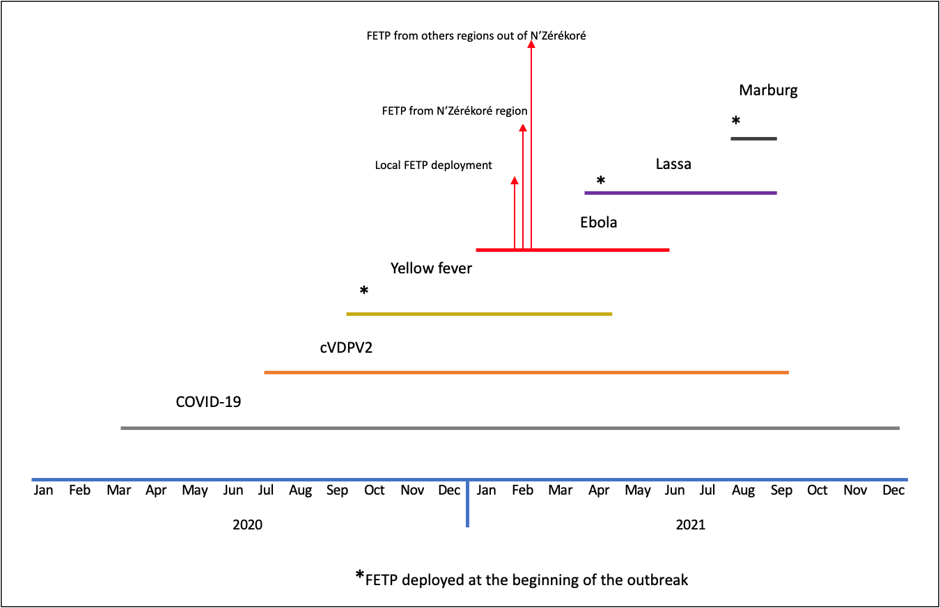
The Lassa fever outbreak, which resulted in seven cases and six deaths in the N’Zerekore, Beyla, and Macenta districts, partially overlapped with the Ebola outbreak response. FETP residents and graduates from the N’Zerekore district were deployed at the start of the Ebola outbreak to conduct preliminary investigations. Three weeks later, additional FETP residents and graduates from N’Zerekore were deployed, followed one week later by FETP residents and graduates from outside the region (Figure 1).
Building surveillance capacity
The FETP residents and graduates trained health personnel on case definitions and the alert process for suspect cases. During the Ebola outbreak, they trained 132 healthcare workers on the Ebola case definition and equipped 73 health facilities with related materials. They mentored health facility heads in identifying EVD suspect cases and distributed 10,000 alert forms while training district staff on their use (Table 4).
Alert validation and case investigation
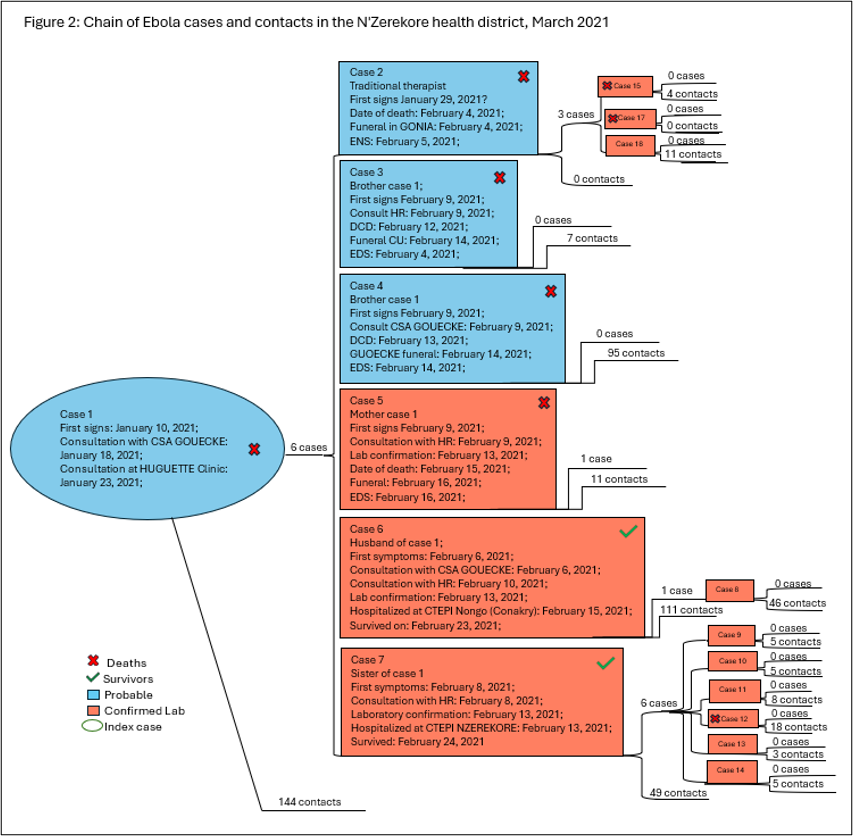
The FETP residents and graduates validated alerts that met the AHF case definition. Upon identifying an alert, they called the alert center for registration. Alerts were sourced from the community, health facilities, and mortuaries, and classified as alive or dead. Death alerts were immediately validated, while alive alerts were classified after review. They contributed to investigating suspected, probable, and confirmed cases, and coordinated their isolation. Four clusters were detected in the Ebola outbreak (Table 3, Figure 2). Of the 34 FETP residents and graduates deployed for Ebola and Lassa fever outbreaks, 27 (79%) of them served as investigators for the Ebola and Lassa outbreaks.
From February 16 to June 30, 2021, there were 8,786 Ebola alerts (742 [8%] deaths and 8,044 [92%] living). FETP residents and graduates contributed to investigating 100% of the death alerts, with 697 (94%) validated and 485 (65%) swabbed. Of the 8,044 live alerts, 7,341 (91%) were investigated; of those investigated, 2,029 (28%) were validated. 432 out of the 2,029 (21%) were sampled, and 286 (14%) were isolated.
Contact tracing
They collected data during health facility visits, active case finding in the community, and contact tracing activities. They gathered contact data on paper and entered them into DHIS2 upon returning to the office. The 27 FETP residents and graduates served as investigators and compiled a comprehensive list of contacts and conducted contact tracing to identify suspected cases. They contributed to tracing 89% of listed contacts, but only five (33%) of the 15 confirmed Ebola cases were from known contacts. For Lassa fever cases in Beyla and Macenta, 347 (89%) of 392 contacts were traced (Table 3).
Laboratory support
Before deployment, FETP residents and graduates participated in training organised by the Guinean MoH, FHI 360, and US CDC. They learned about Ebola biosecurity and biosafety principles, interpretation of OraQuick RDT (Rapid Diagnostic Test) results, the Ebola screening algorithm, RDT quality control, and communication of results to patients. FETP graduates brought OraQuick tests to approved sites, supervised staff using RDTs, and interpreted results. They periodically returned to observe RDT users for quality control and train district staff on OraQuick RDT use through on-site sessions. When not present, test users emailed pictures of results to responders. FETP residents and graduates read 485 OraQuick RDT results and interpreted those read by others (Table 4).
Vaccination
For Ebola, ring vaccinations were organized around each contact, with FETP residents and graduates coordinating between investigation and vaccination teams. Responders provided daily contact lists to the vaccination team, resulting in 11,282 vaccinations by the end of the outbreak.
Data management
All suspected, probable, and confirmed cases were entered into DHIS2. A total of 347 (100%) contacts for Lassa and 988 (100%) for Ebola were entered into DHIS2 by FETP residents and graduates (Table 3). Additionally, the 485 OraQuick RDT results and 11,282 vaccination data were entered into DHIS2 (Table 4).
Research, analysis and communication
The analysis and communication unit, led by one FETP Advanced graduate, produced 18 weekly data analyses and 15 operational research studies (Table 4). One study, titled “Community reasons for not reporting deaths or sick people and not performing swabbing on bodies during the EVD Epidemic in N’Zerekore, May 2021,” informed responders and local health authorities on strategies to reduce community resistance and improve reporting of deaths and suspected cases.
Marburg outbreak response (August – September 2021)
Marburg surveillance activities and 7-1-7 indicator assessment
The Marburg outbreak was detected on August 1, 2021. The only case passed away the next day. The district was notified on August 3, and the body tested positive for Marburg virus via rRT-PCR that same day. The outbreak was officially declared on August 3 and ended on September 16, 2021 (Figure 1). Deployment for Marburg began upon outbreak detection.
Case investigation and alert validation
Of the six FETP residents and graduates deployed for Marburg outbreak response, four (67%) were investigators. During the Marburg outbreak, 173 alerts were reported, including 126 live (73%) and 47 death alerts (27%). FETP residents and graduates contributed to investigating 105 (83%) of the live alerts, validating 104/105 (99%), sampling 52/105 (50%), and isolating 2/105 (2%). They contributed to investigating and validating 36 (77%) of the 47 death alerts and to coordinating swabbing of 33 (92%) of those validated.
Contact tracing, data management, research and serosurvey
For the Marburg case, 173 contacts were listed, and 172 (99%) were traced. All 173 (100%) contacts for Marburg were entered into DHIS2. The third cohort of FETP-Intermediate conducted a Marburg serosurvey to estimate the disease burden in the Gueckedou district. The serosurvey was one of several activities conducted by the FETP during the outbreak response and was conducted with relevant ethical approval. In the present manuscript, it is included only to describe the range of activities undertaken by the FETP and is not the subject of the manuscript. Preliminary results identified four seropositive individuals, all of whom had contact with the confirmed Marburg patient; however, only one was listed as a high-risk contact and monitored during the outbreak.
We described the roles of Guinea FETP graduates and trainees during AHF outbreak responses. This skilled workforce engaged in various response pillars, including coordination, surveillance, laboratory, and vaccination, with most being involved in investigation, contact tracing, and data management. The MoH aimed to strengthen public health systems by training workers in disease surveillance, emergency response, and outbreak investigations. The FETP program implementation enabled FETP responders to participate in these activities, demonstrating alignment with this objective.
Delayed detection and response were important features of the Ebola and yellow fever outbreaks. The Ebola outbreak was recognised substantially later than symptom onset, and the yellow fever event also experienced delays between initial illness, confirmation, and initiation of the response. These delays highlight challenges in the early recognition and timely response to viral hemorrhagic fevers and other epidemic-prone diseases, particularly when initial symptoms may be attributed to malaria. Strengthening community- and facility-level surveillance, clinical suspicion, and access to timely diagnostic testing may facilitate earlier detection and response. A clear algorithm for detecting AHF outbreaks should start with malaria testing; any malaria case without improvement should then be tested for AHF, and the OraQuick Ebola rapid test should be systematically used during clusters of deaths.
As mentioned earlier, during the 2021 response, FETP trainees and graduates contributed to case investigation, contact tracing, surveillance, and data management. Similar contributions by FETPs have been documented in other viral hemorrhagic fever outbreaks in other settings, such as Tanzania [5]. In Tanzania, 70 FETP graduates and residents supported the 2023 Marburg response, with 47 (82.5%) involved in surveillance, including alert investigation, case definition verification, case investigation, contact listing, contact tracing, and 21-day follow-up. They investigated 243 alerts and identified 212 contacts, while also conducting active case searches, supporting data analysis and situational reporting, orienting 685 healthcare workers, and distributing 1,566 surveillance tools. They also contributed to Infection Prevention and Control (IPC) assessments in 144 health facilities, risk communications, points-of-entry screenings, emergency operations coordination, and mortality audits [5]. This example supports that the contributions seen in Guinea may be replicated in similar settings for a broad impact.
The earlier detection and response to the 2021 outbreak, supported by FETP, may have contributed to limiting transmission and reducing case fatality compared with the 2014–2016 Ebola outbreak (67% in 2014–2016 to 52% in 2021); however, these differences should be interpreted cautiously, given the availability of Ebola vaccines in 2021, improvements in clinical management and infection prevention and control, differences in epidemiological and operational contexts, and other factors influencing outbreak outcomes.
In the past five years, US CDC, along with partners RTI and AFENET, helped the Guinea Ministry of Health adopt DHIS2 as a surveillance data platform, enhancing data accuracy for public health decisions. DHIS2 was included in the FETP curriculum to train users. However, 11% of contacts were not traced, and only five (33%) confirmed Ebola cases were from known contacts; for Marburg, only one seropositive participant was a high-risk contact. This underscores the need to strengthen surveillance, data availability and use for effective public health event response.
A key challenge for Guinean FETP residents and graduates was community resistance, which hindered outbreak responses by preventing sampling or isolation of suspect cases. FETP responders, due to their community ties, conducted operational research to understand this resistance and develop strategies to address it. They also monitored suspected malaria cases for three days before isolating those that did not improve.
A limitation of this study is that FETP responders made up only 20% of the deployed workforce; therefore, some results may potentially underrepresent the contributions of other responders. However, their decision-making roles at various levels may enhance their impact beyond these percentages.
The contributions of FETP graduates and participants to the yellow fever, Ebola, Lassa fever, and Marburg outbreak responses helped contain the 2021 Ebola outbreak. They reinforced local MoH capacity and leadership in coordination and surveillance, helping the country achieve its goal of using DHIS2 for managing epidemic-prone disease data and decision-making. By ensuring that all districts have access to FETP graduates; that high-risk areas are especially well-covered; and that the FETP program supports the main goals of the MoH, Guinea and other countries have an opportunity to improve their capacities to detect, prevent, and respond to epidemic-prone diseases.
What is already known about the topic
What this study adds
The authors of this work declare no competing interests.
Disclaimer
Use of trade names and commercial sources is for identification only and does not imply endorsement by the U.S. Department of Health and Human Services. The findings and conclusions in this report are those of the author(s) and do not necessarily represent the official position of the U.S. Centers for Disease Control and Prevention/the Agency for Toxic Substances and Disease Registry.
This publication was supported by Cooperative Agreement Number NU36OE000014-01-00 from the Centers for Disease Control and Prevention and the Association of Schools and Programs of Public Health. The findings and conclusions of this publication do not necessarily represent the official views of CDC or ASPPH.
Conceptualization: Solomon Corvil; Enogo Koivogui; Gbamou Nouonan; Patrick Ngoma Mavungu; Lise Martel
Methodology: Solomon Corvil; Peter Thomas; Enogo Koivogui; Gbamou Nouonan; Patrick Ngoma Mavungu; Jolie Kasongo Kayembe; Briana Lucido; Lise Martel
Data Curation: Solomon Corvil; Enogo Koivogui; Gbamou Nouonan; Patrick Ngoma Mavungu; Briana Lucido
Formal Analysis: Solomon Corvil; Gbamou Nouonan; Patrick Ngoma Mavungu; Jolie Kasongo Kayembe; Briana Lucido; Lise Martel
Investigation: Solomon Corvil; Enogo Koivogui; Gbamou Nouonan; Patrick Ngoma Mavungu; Jolie Kasongo Kayembe
Funding Acquisition: Lise Martel
Project Administration: Solomon Corvil
Resources: Solomon Corvil; Lise Martel
Software: Solomon Corvil; Enogo Koivogui; Gbamou Nouonan; Patrick Ngoma Mavungu; Jolie Kasongo Kayembe
Validation: Solomon Corvil; Sakoba Keita; Peter Thomas; Lise Martel
Visualization: Solomon Corvil; Peter Thomas; Briana Lucido; Darby Gallagher; Lise Martel
Supervision: Solomon Corvil; Sakoba Keita; Peter Thomas; Enogo Koivogui; Gbamou Nouonan; Patrick Ngoma Mavungu; Jolie Kasongo Kayembe; Lise Martel
Writing – Original Draft: Solomon Corvil; Lise Martel
Writing – Review & Editing: Solomon Corvil; Peter Thomas; Briana Lucido; Darby Gallagher; Lise Martel
| Table 1: Socio demographic characteristic of the FETP residents and graduates during the acute hemorrhagic fever outbreaks in Guinea 2020-2021 (n=40) | |
| Sex | n(%) |
|---|---|
| Men | 37 (92) |
| Women | 3 (8) |
| Sector | |
| Human health | 38 (95) |
| Animal health (vet) | 2 (5) |
| FETP Residents and Graduates roles | |
| Head of disease control and prevention | 7 (17.5) |
| Deputy Head of disease control and prevention | 29 (72.5) |
| Head of the investigation unit | 1 (2.5) |
| Research officer unit | 1 (2.5) |
| FETP mentors | 2 (5) |
| Provenance | |
| National | 3 (8) |
| Region | 9 (22) |
| District | 28 (70) |
| Roles played by pillar | |
| Ebola, Lassa outbreaks | 34 |
| Investigators/contact tracers (n=34) | 27 (79) |
| Coordinators (n=34) | 7 (21) |
| Marburg | 6 |
| Investigators/contact tracers (n=6) | 4 (67) |
| Research, analysis and communication unit (n=34) | 1 (3) |
| Vaccination (n=34) | 1 (3) |
| Table 2: Number of FETP deployers according to FETP tiers and characteristic of the deployers during the acute hemorrhagic fever outbreaks in Guinea 2020-2021 | ||||
| Outbreak | Number of Individuals Deployed | |||
|---|---|---|---|---|
| Frontline | Intermediate | Advanced | Total | |
| Graduates | Graduates and residents | Graduates | ||
| Yellow fever | 2 | 2 | 0 | 4 |
| Ebola/Lassa fever (same residents and graduates) | 9 | 21 | 4 | 34 |
| Marburg | 2 | 3* | 1* | 2 + (4*) |
| Total | 13 | 23 | 4 | 40 |
| *Individual deployed also in the Ebola/Lassa fever outbreak in N’Zerekore district | ||||
| Table 3: Summary of FETP residents and graduates’ contact activities during the acute hemorrhagic fever outbreaks in Guinea 2021 | |||
| Indicators | Outbreak | ||
|---|---|---|---|
| Ebola | Lassa fever | Marburg | |
| n (%) | n (%) | n (%) | |
| Confirmed cases | 15 | 7 | 1 |
| Probable cases | 8 | 0 | 0 |
| Number of clusters | 4 | 3 | 0 |
| Contacts listed | 1110 | 392 | 173 |
| Contacts traced | 988 (89) | 347 (89) | 172 (99) |
| Contacts entered in DHIS-2 | 988 (100) | 347 (100) | 173 (100) |
| Confirmed cases from known contacts | 5 (33) | 6 (100%) | N/A |
| Table 4: FETP residents and graduates roles and response outcomes by disease, in Guinea (September 2020 – December 2021) | ||||
| Response Pillar | Yellow Fever (Sept 2020-Apr 2021) | Ebola Virus Disease (Jan 2021-June 2021) | Lassa Fever (March 2021-September 2021) | Marburg Virus Disease (Aug 2021-Sep 2021) |
|---|---|---|---|---|
| Coordination | FETPs: Deployed upon detection | FETPs: 34 deployed; 7 coordinators held 113 district & 79 regional meetings; daily SitReps | FETPs: Same personnel as Ebola (simultaneous response) | FETPs: 6 deployed upon detection but four of them were also deployed for Ebola and Lassa outbreaks response |
| Surveillance: Capacity | No data available | FETPs: Trained 132 HCWs; equipped 73 facilities; distributed 10,000 alert forms | FETPs: Trained staff on AHF syndromic surveillance | FETPs: Used existing AHF system |
| Surveillance: Investigation | FETPs: 4 investigators Team outcomes: Detected and investigated outbreak. Wrote report and provided recommendations for the targeted vaccinated population. In total 67 suspected, 7 confirmed, 17 deaths. Index detected day 7; confirmed day 49 | FETPs: 27 investigators Team outcomes: 8,786 alerts (94% death validated; 91% live investigated) 4 clusters; 23 cases, 12 deaths 988 contacts: 89% traced, 100% in DHIS2 | FETPs: 27 investigators (joint with Ebola) Team outcomes: 7 cases, 6 deaths 392 contacts: 89% traced, 100% in DHIS2 | FETP role: 4 investigators Team outcomes: 173 alerts (83% live, 77% death investigated) 1 case, 1 death 173 contacts: 99% traced, 100% in DHIS2 |
| Research | N/A | FETPs: Produced 18 weekly analyses, 15 research studies | N/A | FETPs: Conducted serosurvey (4 seropositive) |
| Laboratory | N/A | FETPs: Trained on RDT; read 485 results; supervised & QC | N/A | FETPs: coordinated swabbing; same-day confirmation |
| Vaccination | FETPs: coordinated and supervised vaccination campaign Team outcomes: 141,150/148,578 vaccinated (mass campaign) | FETPs: Provided list of contact and contact of contact for vaccination purpose. Coordinated vaccination teams Team outcome: 11,282 ring vaccinations and entered data into DHIS2 | No vaccine available | No vaccine available |
| Abbreviations: FETP, Field Epidemiology Training Program; HCW, Healthcare Worker; DHIS2, District Health Information Software 2; AHF, Acute Hemorrhagic Fever; RDT, Rapid Diagnostic Test; QC, Quality Control; SitRep, Situation Report. Note: FETPs were 20% of 200 deployed responders. Team outcomes reflect entire response team contributions. Ebola/Lassa responses simultaneous with shared FETP personnel. | ||||