
Research | Open Access | Volume 9 (4): Article 186 | Published: 11 Nov 2026

Views: 69
Menu, Tables and Figures
| Table 1: Demographic and clinical characteristics of neonatal tetanus cases, Rawalpindi District, Punjab, Pakistan, 2018–2026 (N=177) | ||
| Characteristic | n | % (95% CI) |
|---|---|---|
| Sex (n = 177; all recorded) | ||
| Male | 119 | 67.2 (59.8–74.1) |
| Female | 58 | 32.8 (25.9–40.2) |
| Age at onset, completed days (n = 127 recorded; 50 not recorded) | ||
| Early onset (≤ 6 days) | 36 | 28.3 (20.7–37.0) |
| Late onset (7–28 days) | 91 | 71.7 (63.0–79.3) |
| Final classification (n = 174 recorded; 3 not recorded) | ||
| Clinically confirmed | 158 | 90.8 (85.5–94.7) |
| Suspected | 16 | 9.2 (5.3–14.5) |
| Outcome (n = 177; all recorded) | ||
| Died | 85 | 48.0 (40.5–55.6) |
| Alive or discharged | 24 | 13.6 (8.9–19.5) |
| Admitted, outcome pending | 27 | 15.3 (10.3–21.4) |
| Other or unresolved | 41 | 23.2 (17.2–30.1) |
| Case fatality among cases with resolved outcome (n = 109) | 85 | 78.0 (69.0–85.4) |
| CI, confidence interval; n, number of cases with a recorded value for the variable; NT, neonatal tetanus; WHO, World Health Organization. Percentages are calculated among cases with a recorded value, with the denominator given in each section heading together with the number not recorded. Confidence intervals are exact binomial (Clopper–Pearson) and reflect case-count uncertainty only. Age at onset is expressed in completed days of life. Two cases classified as clinically confirmed had onset recorded on day 1, outside the day 3–28 onset window of the WHO case definition; classifications were analysed as recorded by the surveillance system and were not re-adjudicated. Cases with an unresolved outcome comprise those admitted with outcome pending and those with an absent or uninterpretable entry. Outcome percentages use all 177 notified cases as the denominator, so the 48.0% recorded as deaths is the proportion of all notified cases and is not a case-fatality estimate; case fatality among the 109 cases with a resolved outcome was 78.0%, with a plausible range of 48.0% to 86.4%. | ||
Table 1: Demographic and clinical characteristics of neonatal tetanus cases, Rawalpindi District, Punjab, Pakistan, 2018–2026 (N=177)
| Table 2: Delivery and maternal immunisation characteristics of neonatal tetanus cases, Rawalpindi District, Punjab, Pakistan, 2018–2026 (N=177) | ||
| Characteristic | n | % (95% CI) |
|---|---|---|
| Maternal tetanus toxoid-containing doses (n = 154 recorded; 23 not recorded) | ||
| Zero doses | 115 | 74.7 (67.0–81.3) |
| One or more doses | 39 | 25.3 (18.7–33.0) |
| Place of delivery (n = 174 recorded; 3 not recorded) | ||
| Home | 83 | 47.7 (40.1–55.4) |
| Health facility | 53 | 30.5 (23.7–38.0) |
| Other community setting | 38 | 21.8 (15.9–28.8) |
| Birth attendant (n = 174 recorded; 3 not recorded) | ||
| Traditional birth attendant | 105 | 60.3 (52.7–67.7) |
| Skilled attendant (doctor, nurse or midwife) | 54 | 31.0 (24.2–38.5) |
| Other person, including relatives | 15 | 8.6 (4.9–13.8) |
| Instrument used to cut the umbilical cord (n = 144 recorded; 33 not recorded) | ||
| Blade | 82 | 56.9 (48.4–65.2) |
| Scissor | 37 | 25.7 (18.8–33.6) |
| Knife | 4 | 2.8 (0.8–7.0) |
| Other or unspecified implement | 21 | 14.6 (9.3–21.4) |
| CI, confidence interval; n, number of cases with a recorded value. Percentages use the denominator given in each section heading; intervals are exact binomial (Clopper–Pearson). These are characteristics reported among identified cases; because the study includes cases only and has no comparison group, they cannot be interpreted as risk factors or used to estimate relative risk. Maternal tetanus toxoid status was recorded for every case notified during 2020–2023 and most in 2018–2019, but none of the 17 notified from 2024 onwards, so these estimates describe 2018–2023. Place of delivery and birth attendant overlap but are distinct: of the 54 skilled-attended deliveries, 48 were in a facility, 5 in another community setting and 1 had no place recorded. The record captures cord-instrument type but not sterility, so type alone does not indicate clean or unclean cord care. | ||
Table 2: Delivery and maternal immunisation characteristics of neonatal tetanus cases, Rawalpindi District, Punjab, Pakistan, 2018–2026 (N=177)
| Table 3: Annual neonatal tetanus case counts and estimated incidence per 1,000 live births, Rawalpindi District, Punjab, Pakistan, 2018–2026 | |||
| Year | Cases (n) | Estimated live births | Incidence per 1,000 live births (95% CI) |
|---|---|---|---|
| 2018 | 17 | 144,807* | 0.12 (0.07–0.19) |
| 2019 | 33 | 149,197* | 0.22 (0.15–0.31) |
| 2020 | 30 | 153,720* | 0.20 (0.13–0.28) |
| 2021 | 17 | 158,380* | 0.11 (0.06–0.17) |
| 2022 | 42 | 163,182 | 0.26 (0.19–0.35) |
| 2023 | 21 | 163,182 | 0.13 (0.08–0.20) |
| 2024 | 6 | 163,182 | 0.04 (0.01–0.08) |
| 2025 | 8 | 164,553 | 0.05 (0.02–0.10) |
| 2026 (weeks 1–25) | 3 | Partial year | Not estimable |
| Total | 177 | ||
| CI, confidence interval; EPI, Expanded Programme on Immunization; WHO, World Health Organization. Incidence = (cases ÷ estimated live births) × 1,000, where estimated live births = district population × 0.026 (Punjab crude birth rate, 26 per 1,000). *District population for 2018–2021 was interpolated between the 2017 census count (5,405,633) and the 2022 programme estimate (6,276,219); the resulting compound growth rate of 3.03% per year is implied by those two official figures rather than assumed, and lies close to the district’s 2.53% intercensal rate between the 1998 and 2017 censuses. Programme estimates were used directly from 2022. All denominators are estimates, so every incidence figure is approximate. Intervals are exact Poisson and reflect case-count uncertainty only, not uncertainty in the estimated denominators. The year 2026 covers weeks 1–25 only and was excluded from incidence and trend estimation. Across 2018–2025 neither counts nor incidence showed a significant trend once overdispersion was accounted for (quasi-Poisson rate ratio 0.90 per year, 95% CI 0.75–1.07, p=0.22 for counts; 0.88, 0.74–1.04, p=0.14 for incidence); restricted to 2022–2025 incidence declined significantly (0.50 per year, 0.40–0.64, p<0.001). Two sensitivity analyses left these conclusions unchanged: the 2.53% intercensal rate altered no estimate by more than 0.01 per 1,000, and the Punjab EPI planning denominator of 35 per 1,000 lowered all estimates proportionally while leaving the rate ratios unchanged. Every estimate remained well below the WHO threshold of 1 per 1,000 live births. | |||
Table 3: Annual neonatal tetanus case counts and estimated incidence per 1,000 live births, Rawalpindi District, Punjab, Pakistan, 2018–2026
Muhammad Mehroz Saleem1,&, Jamshaid Ahmed1, Tariq Saleem1, Naveed Akhtar Malik2, Mufakker Mian1, Kashif Muneer1
1World Health Organization, Lahore, Punjab, Pakistan, 2Expanded Programme on Immunization, Directorate General Health Services, Government of Punjab, Lahore, Pakistan
&Corresponding author: Muhammad Mehroz Saleem, Technical Officer, VPD Surveillance, World Health Organization, Lahore, Punjab, Pakistan. Email: msaleem@who.int ORCID: https://orcid.org/0000-0003-3626-9076.
Received: 08 Jul 2026, Accepted: 09 Nov 2026, Published: 11 Nov 2026
Domain: Infectious Disease Epidemiology
Keywords: Neonatal tetanus, Maternal and neonatal tetanus elimination, Case-based surveillance, Pakistan, Case fatality
©Muhammad Mehroz Saleem et al. Journal of Interventional Epidemiology and Public Health (ISSN: 2664-2824). This is an Open Access article distributed under the terms of the Creative Commons Attribution International 4.0 License (https://creativecommons.org/licenses/by/4.0/), which permits unrestricted use, distribution, and reproduction in any medium, provided the original work is properly cited.
Cite this article: Muhammad Mehroz Saleem et al., Neonatal tetanus in Rawalpindi District, Punjab, Pakistan, 2018–2026: A nine-year descriptive analysis of case-based surveillance data. Journal of Interventional Epidemiology and Public Health. 2026; 9(4):186. https://doi.org/10.37432/jieph-d-26-00229
Introduction: The World Health Organization (WHO) defines maternal and neonatal tetanus elimination (MNTE) as fewer than one neonatal tetanus (NT) case per 1,000 live births per district. Punjab, Pakistan, was validated in 2016. Validation certifies incidence below this threshold, not that transmission has stopped. We described the epidemiology, case characteristics and case fatality of NT detected by routine surveillance in Rawalpindi District.
Methods: We retrospectively analysed case records from Punjab’s vaccine-preventable disease case-based surveillance system for Rawalpindi District, 1 January 2018 to 27 June 2026 (epidemiological week 25). Proportions use recorded-value denominators with exact binomial 95% confidence intervals (CI). Trend was assessed by Poisson regression restricted to the eight complete years 2018–2025, with overdispersion assessed and quasi-Poisson estimates reported. Incidence per 1,000 estimated live births was calculated for 2018–2025; denominators are estimates and confidence intervals reflect case-count uncertainty only.
Results: We identified 177 NT cases; 158 of 174 classified (90.8%) were clinically confirmed. Annual counts fluctuated between 6 and 42 and were markedly overdispersed, with no significant trend across 2018–2025 (quasi-Poisson incidence rate ratio [IRR] 0.90 per year, 95% CI 0.75–1.07, p=0.22). Estimated incidence stayed below 1 per 1,000 live births in all eight years, falling from 0.26 (0.19–0.35) in 2022 to 0.05 (0.02–0.10) in 2025 (IRR 0.50 per year, 0.40–0.64, p<0.001). Among 154 cases with maternal tetanus toxoid status recorded, all from 2018–2023, 115 mothers (74.7%, 95% CI 67.0–81.3) had received no doses. Delivery was at home in 83 of 174 cases with place recorded (47.7%) and a traditional birth attendant assisted 105 (60.3%). Outcome was unresolved for 68 cases (38.4%), concentrated in 2018–2019; among 109 with a resolved outcome, case fatality was 78.0% (95% CI 69.0–85.4).
Conclusion: Estimated NT incidence lay below the elimination threshold every year, yet cases were detected annually, mostly among mothers who had received no tetanus toxoid and delivered outside a facility without skilled assistance. These estimates are approximate and do not independently verify elimination; under-ascertainment and patterned missingness limit interpretation, and a case-only design cannot establish causation. The reported burden underlines the continuing importance of maternal immunisation and clean delivery.
Tetanus remains a preventable cause of neonatal death where maternal immunisation is incomplete and deliveries are unhygienic. Although the global burden fell substantially between 1990 and 2019, it still falls disproportionately on low- and middle-income countries despite an effective toxoid vaccine [1].
WHO defines maternal and neonatal tetanus elimination (MNTE) as fewer than one case of neonatal tetanus (NT) per 1,000 live births in every district, confirmed by independent validation [2]. This is a threshold, not an absence criterion, so a district may hold validated status while still detecting cases; the epidemiology of those residual cases determines whether that status can be sustained. As of mid-2026, several countries had not achieved national elimination [3]. Pakistan is among them. Punjab was validated in 2016, and validation has since extended to Sindh, Islamabad Capital Territory, Pakistan-administered Kashmir and Gilgit-Baltistan. Nationally, 322 NT cases and six deaths were notified in 2024, and WHO assessed that this captures only about three in ten cases [4].
Analytic studies conducted in Pakistan before province-wide validation identified a consistent risk profile. A community-based investigation in Loralai District linked NT mortality to unhygienic delivery, particularly onto a soil surface, alongside paternal illiteracy and household livestock ownership [5]. A case-control study in Karachi’s slums identified absent maternal vaccination, delivery without a skilled attendant and home delivery as independent predictors [6]. Whether cases detected by routine surveillance in a validated province share these characteristics, and how completely surveillance records them, has not been described at district level in Pakistan.
We selected Rawalpindi District for three reasons. It is among Punjab’s most populous districts and yields a case count sufficient for descriptive analysis over several years. It combines dense urban settlement, peri-urban growth and remote rural tehsils, so findings are not confined to one service-delivery environment. It also contains Rawalpindi Cantonment, whose health services are administered by a Cantonment Board rather than the civilian district system, allowing description of case occurrence across two coexisting administrative arrangements.
Our objectives were to describe the annual pattern of NT cases notified in Rawalpindi District between 2018 and 2026 and test for trend; estimate annual incidence against the WHO threshold; describe the demographic, clinical, delivery-related and geographic characteristics of notified cases and the completeness of recording; and quantify case fatality.
Study design and setting
We conducted a retrospective descriptive analysis of routinely collected case-based surveillance data covering 1 January 2018 to 27 June 2026 (epidemiological week 25), the most recent week available at extraction. Rawalpindi District, northern Punjab, had an estimated population of 6,461,882 in 2026 and about 168,000 live births annually [7]. Its nine tehsils are Rawalpindi City, Rawalpindi Cantonment, Rawalpindi Rural, Taxila, Gujar Khan, Kahuta, Kallar Syedan, Kotli Sattian and Murree. It adjoins Islamabad, forming a twin-city conurbation across which residents move freely for care. Health and immunisation services in Rawalpindi Cantonment are delivered by the Cantonment Board, separately from the civilian system serving the other tehsils.
The district health information system records 205 health facilities across the nine tehsils: 137 primary, 45 secondary and 23 tertiary, with 14 tertiary facilities in Rawalpindi Cantonment and Rawalpindi City [8, 9]. Private clinics, Lady Health Workers and community midwives also provide maternal services, and traditional birth attendants still conduct a substantial share of deliveries, particularly in rural and low-income peri-urban areas. Nationally, the 2017–18 Pakistan Demographic and Health Survey recorded that 86% of women received antenatal care from a skilled provider, 69% of births were skilled-attended, and 66% were in a facility [8].
NT is notifiable within Punjab’s vaccine-preventable disease (VPD) case-based surveillance system. Cases are identified by passive reporting from public and private facilities, supported by active case search at designated sites and, where indicated, community search. District surveillance staff investigate reported events using a standard case investigation form, from which demographic, delivery, immunisation and outcome variables are abstracted into a provincial line list maintained by the Punjab Expanded Programme on Immunization (EPI).
Case definitions
Cases were classified using WHO standard case definitions [2]. A suspected case is any neonatal death between days 3 and 28 of life in an infant able to suck and cry normally during the first two days, or any neonate with a tetanus-compatible illness in the first month. A confirmed case additionally requires inability to suck with trismus and either generalised rigidity or spasms, with onset between days 3 and 28. Confirmation is clinical; laboratory confirmation is not performed. Each record carries a final classification assigned by the surveillance system at investigation. We analysed these as recorded and did not re-adjudicate individual records, because the clinical detail needed is not retained in the line list. Two cases classified as clinically confirmed had onset recorded on day 1, outside the day 3–28 window; we retained the recorded classification and flagged the discrepancy.
Records extracted and data management
We extracted every case record on the neonatal tetanus worksheet of the provincial VPD line list for 2018 to 2026 with district of residence Rawalpindi. From each, we took year and month of onset, date of onset where available, tehsil and union council, age at onset, sex, maternal tetanus toxoid doses, place of delivery, birth attendant, cord-cutting instrument, clinical features, final classification and outcome. No other variables and no direct identifiers were extracted.
Records were cleaned before analysis. Tehsil name variants were mapped to a standard set, and records giving only “Rawalpindi” were kept as a separate “tehsil unspecified” category. Free-text outcome entries were classified as died, alive or discharged, or unresolved, the last comprising admissions with outcome pending and entries absent or uninterpretable. Maternal doses were grouped as zero or one or more; place of delivery as home, facility, or other community setting; and attendant as traditional birth attendant, skilled attendant, or other. We screened for duplicates on year, tehsil, union council, sex, age and date of onset; none were identified. The line list records the type of instrument used to cut the cord but not whether it was new or sterile. We therefore report instrument type as recorded and did not classify cord care as clean or unclean, because the field does not support that inference.
Statistical analysis
Analyses were descriptive. Categorical variables were summarised as counts and proportions, using records with a recorded value as the denominator and reporting the number missing; exact binomial 95% confidence intervals (CI) are given. Case fatality uses cases with a resolved outcome as the denominator, with bounds under the assumptions that all unresolved cases survived or died. Confidence intervals throughout reflect uncertainty in observed counts only; they do not incorporate uncertainty in the estimated population and live-birth denominators, which is additional and unquantified.
Trend was assessed by Poisson regression with calendar year as a continuous predictor, restricted to the eight complete years 2018 to 2025; 2026 was excluded because 25 weeks are not comparable with a full year. Overdispersion was assessed by the residual deviance-to-degrees-of-freedom ratio and a goodness-of-fit test; where present, we report quasi-Poisson estimates with a scale parameter from the Pearson chi-square, verified against a negative binomial model. As a sensitivity analysis for the partial year, we compared onsets in the first half of each year from 2020 onwards, with the month of onset being unrecorded in 2018 and 2019.
Annual incidence per 1,000 live births was calculated for the eight complete years 2018 to 2025 as (cases ÷ estimated live births) × 1,000, where estimated live births = district population × crude birth rate. Programme population estimates were available from 2022 onwards. For 2018 to 2021 we interpolated between the 2017 census count and the 2022 estimate; the resulting compound rate of 3.03% per year is implied by those two official figures rather than assumed and lies close to the district’s 2.53% intercensal rate between the 1998 and 2017 censuses [10]. We repeated the calculation at that intercensal rate as a sensitivity analysis. Punjab’s crude birth rate of 26 per 1,000 was applied [7]; district birth registration counts were unavailable, so births are approximated from a province-wide rate that may not match district fertility. We also repeated the calculation using the Punjab EPI planning denominator of 35 per 1,000 [9]. All incidence figures are estimates. Exact Poisson 95% CIs are reported and trend assessed by Poisson regression with the logarithm of estimated live births as an offset. No tests of association between case characteristics and outcome were performed, because the study includes cases only and has no comparison group. Analyses used Python 3.11 with pandas 2.2, statsmodels 0.14 and SciPy 1.13.
Ethical consideration
This analysis used de-identified records from a routine surveillance system operated under the statutory disease-surveillance mandate of the Punjab EPI programme. As custodian of the provincial VPD line list, the programme granted permission for these records to be analysed and determined that the work constitutes routine analysis of public health surveillance data rather than human-subjects research, for which institutional review board approval is not required under national guidance. No separate ethics approval or waiver number was therefore issued. No direct identifiers were extracted, and individual consent was not applicable. Written confirmation can be provided to the editorial office on request.
Case counts, trend and incidence
We identified 177 NT cases resident in Rawalpindi District notified between 1 January 2018 and 27 June 2026. Annual counts were 17 in 2018, 33 in 2019, 30 in 2020, 17 in 2021, 42 in 2022, 21 in 2023, 6 in 2024 and 8 in 2025, with 3 in the partial year 2026 (Table 3). Counts varied more than a Poisson process predicts (residual deviance 41.4 on 6 degrees of freedom, p<0.001), driven mainly by the 2022 peak. After accounting for overdispersion, there was no significant trend across 2018 to 2025 (quasi-Poisson IRR 0.90 per year, 95% CI 0.75–1.07, p=0.22; negative binomial 0.86, 0.63–1.17, p=0.33). A naive Poisson model would have indicated a significant decline (0.90, 0.84–0.96, p=0.001); we report the adjusted estimate.
Estimated incidence ranged from 0.04 per 1,000 live births in 2024 (95% CI 0.01–0.08) to 0.26 in 2022 (0.19–0.35), below the WHO threshold in every year (Table 3). Across 2018 to 2025, the incidence series was overdispersed and showed no significant trend (quasi-Poisson IRR 0.88 per year, 95% CI 0.74–1.04, p=0.14), mirroring the counts. Restricted to 2022 to 2025, incidence fell by about half per year (IRR 0.50, 0.40–0.64, p<0.001) with no material overdispersion. Substituting the Punjab EPI planning denominator of 35 per 1,000 lowered all estimates proportionally, and recomputing the interpolated 2018 to 2021 denominators at the 2.53% intercensal rate altered no estimate by more than 0.01 per 1,000; neither changed the trend estimates or the threshold comparison.
Because 2026 contributed only 25 weeks, it was excluded from trend and incidence estimation. Restricted to onsets in the first half of each year, counts were 15 in 2020, 7 in 2021, 15 in 2022, 9 in 2023, 6 in 2024, 3 in 2025 and 3 in 2026.
Demographic, clinical and outcome characteristics
Of the 177 cases, 119 (67.2%, 95% CI 59.8–74.1) were males, and 58 (32.8%) were females. Age at onset was recorded for 127 (71.8%): 36 (28.3%) at 6 days or earlier and 91 (71.7%, 63.0–79.3) between days 7 and 28. Classification was recorded for 174 cases, of which 158 (90.8%, 85.5–94.7) were clinically confirmed and 16 (9.2%) suspected (Table 1).
Outcome was recorded as death for 85 cases and alive or discharged for 24. The remaining 68 (38.4%) had no resolved outcome: 27 were admitted with outcome pending, and 41 carried an “other” or uninterpretable entry. Unresolved outcomes were concentrated in the earliest years, 13 of 17 cases in 2018 and 28 of 33 in 2019, against 27 of 124 during 2020–2025. Among the 109 cases with a resolved outcome, case fatality was 78.0% (95% CI 69.0–85.4), with bounds of 48.0% and 86.4% under the assumptions that all unresolved cases survived or died. Restricted to 2020 to 2025, when unresolved outcomes were much less frequent (27 of 124), it was 78.4% (95% CI 68.8–86.1) with narrower bounds of 61.3% to 83.1%, indicating the estimate is not an artefact of the years with poor outcome recording.
Delivery and maternal immunisation characteristics, and completeness of recording
Maternal tetanus toxoid status was recorded for 154 of 177 cases (87.0%), but this missingness was not random: it was recorded for every case notified between 2020 and 2023 and most in 2018–2019, yet absent for all 17 notified from 2024 onwards, so the estimates below describe 2018 to 2023. Among the 154 with a recorded value, 115 mothers (74.7%, 95% CI 67.0–81.3) had received no dose and 39 (25.3%) one or more (Table 2).
Place of delivery was recorded for 174 cases: home in 83 (47.7%, 95% CI 40.1–55.4), a facility in 53 (30.5%) and another community setting in 38 (21.8%). Attendant was recorded for 174: a traditional birth attendant assisted 105 (60.3%, 52.7–67.7), a skilled attendant (doctor, nurse or midwife) 54 (31.0%) and another person, usually a relative, 15 (8.6%).
The counts for facility delivery (53) and skilled attendance (54) describe overlapping but distinct groups. Of the 54 skilled-attended deliveries, 48 were in a facility, 5 in another community setting and 1 had no place recorded; of the 53 facility deliveries, 48 had a skilled attendant, 4 a traditional birth attendant and 1 another person. The two variables are therefore not equivalent.
The cord-cutting instrument was recorded for 144 cases (81.4%): a blade in 82 (56.9%, 95% CI 48.4–65.2), a scissor in 37 (25.7%), a knife in 4 (2.8%) and another or unspecified implement in 21 (14.6%). Instrument type was spread across attendant categories rather than confined to unskilled deliveries: among the 54 skilled-attended deliveries a blade was recorded in 26, a scissor in 21 and a knife in 1, with 3 not recorded. Because the line list does not record whether the instrument was new or sterile, these entries describe the implement only.
Geographic distribution
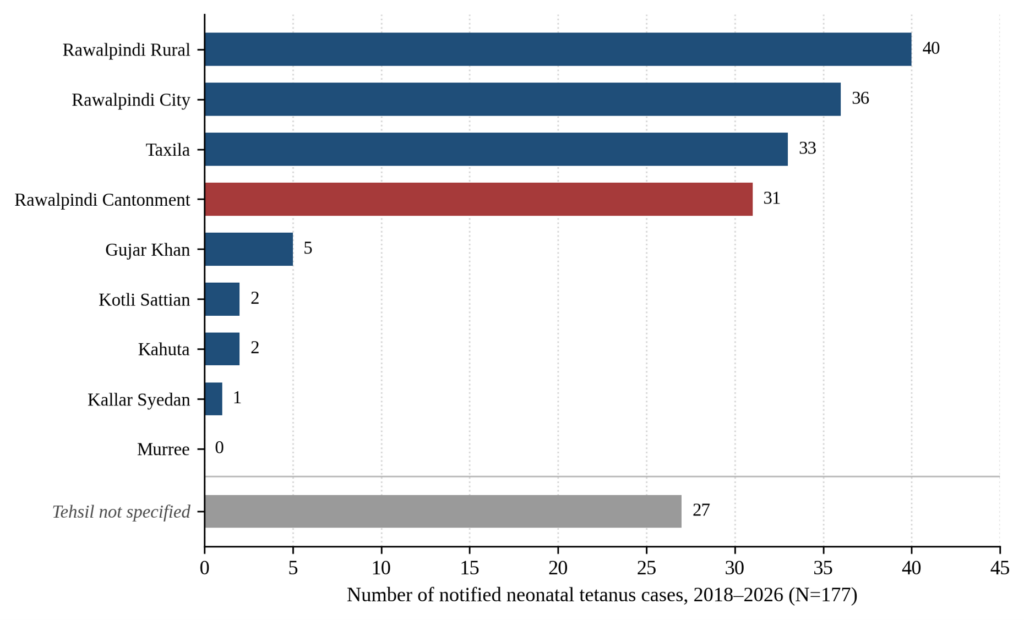
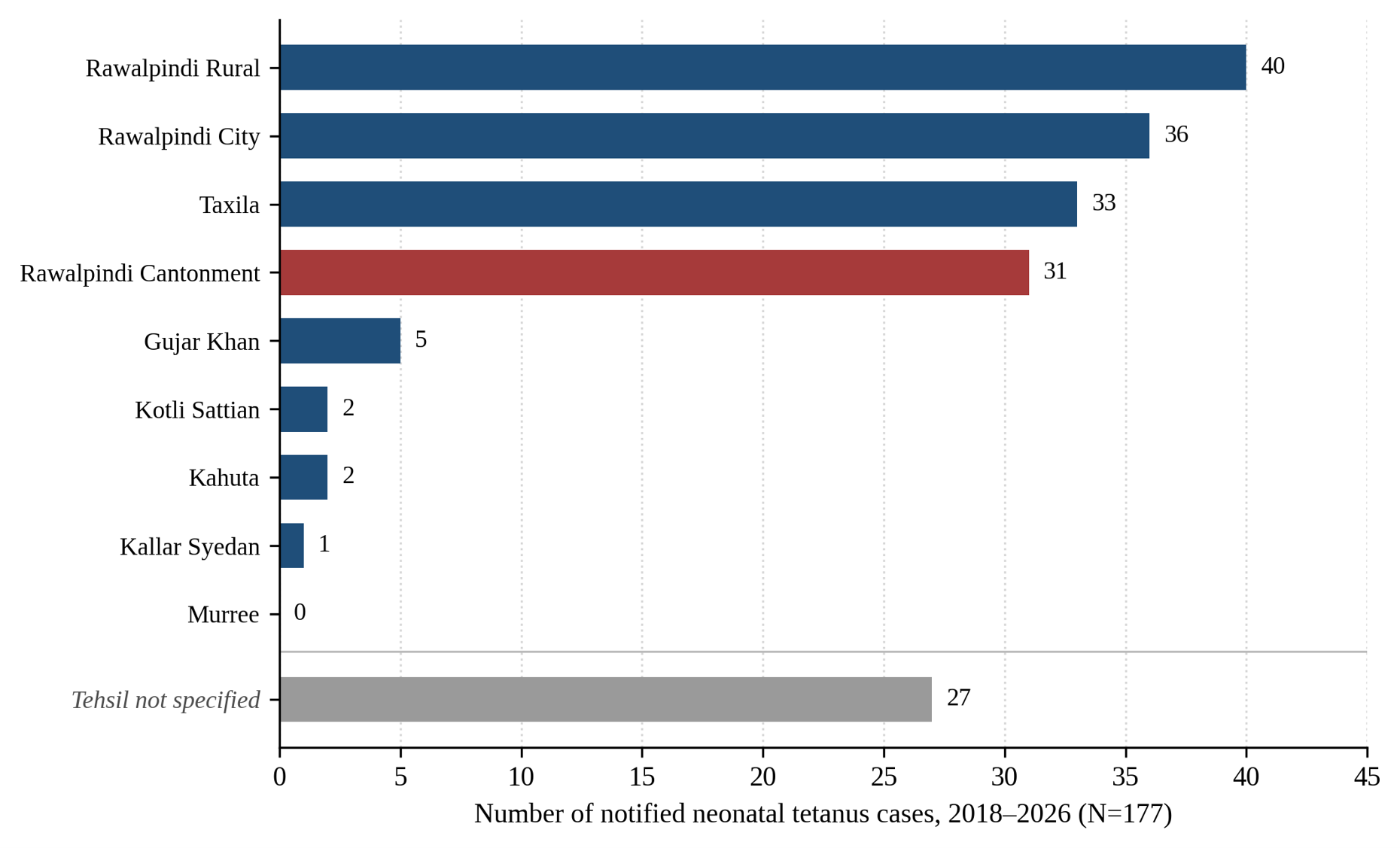
Cases were recorded in eight of the nine tehsils (Figure 1): Rawalpindi Rural (40), Rawalpindi City (36), Taxila (33), Rawalpindi Cantonment (31), Gujar Khan (5), Kotli Sattian (2), Kahuta (2) and Kallar Syedan (1); no case was notified from Murree. A further 18 records specified only the district and 9 had no residence recorded; all 27 were notified in 2018 or 2019, and tehsil was complete from 2020 onwards. Rawalpindi Cantonment accounted for 31 cases (17.5%). Tehsil-level denominators were unavailable, so tehsil-specific incidence could not be calculated; these counts are not rates and are not evidence that risk differed between jurisdictions, since case distribution reflects births and surveillance activity as well as any difference in risk.
Over nine years following Punjab’s 2016 MNTE validation, case-based surveillance in Rawalpindi District detected neonatal tetanus every year. Estimated incidence remained below the WHO threshold throughout and fell by roughly half per year between 2022 and 2025, but did not reach zero; across the full 2018 to 2025 series, both counts and incidence fluctuated without a significant trend once overdispersion was taken into account. The decline is specific to 2022 to 2025 and is measured against an unusually high 2022 count, so describing the full series as a sustained downward trend would overstate these data. Equally, estimated incidence lay well below one case per 1,000 live births in every year assessed. That is what these data show; it is not an independent verification of elimination, which rests on formal WHO validation, and both under-ascertainment and denominator uncertainty limit what the estimate can establish.
The cases surveillance continued to detect shared a recognisable set of characteristics: three-quarters of mothers whose immunisation status was recorded had received no tetanus toxoid dose, nearly half of deliveries occurred at home, and three in five were assisted by a traditional birth attendant. This corresponds closely to what was described in Pakistan before validation, in Loralai [5] and in Karachi, where absent maternal vaccination, home delivery and lack of a skilled attendant were independent predictors [6]. It is also consistent with wider evidence that residual neonatal tetanus after validation concentrates among women beyond the reach of antenatal services [3]. Our data are descriptive; these correspondences indicate the characteristics of notified cases have not changed, not that these factors caused the cases observed.
One observation requires care in interpretation. A blade was the implement most often recorded for cutting the cord, including in 26 of the 54 deliveries attended by a skilled provider. It is tempting to read blade use as unclean cord care and its appearance in skilled deliveries as a service-quality failure. The line list, however, records only the implement type, not whether it was new or sterile. A new, individually packaged razor blade is standard in clean-delivery practice and in home-birth kits, so blade use is not in itself unsafe, whereas a reused scissor may be more hazardous. The paradox largely dissolves once this is recognised, leaving a surveillance limitation rather than an epidemiological finding. Adding a sterility field to the case investigation form would make the variable actionable.
The concentration of cases in particular tehsils invites similar caution. Rawalpindi Rural, Rawalpindi City, Taxila and Rawalpindi Cantonment together accounted for 140 of 177 cases, while Murree reported none. Without tehsil denominators, we cannot say whether this reflects higher risk, larger birth cohorts, or more complete case finding where reporting networks are denser; cases were, however, not confined to the rural periphery. Rawalpindi’s position in a conurbation with Islamabad adds a further consideration, since cases are attributed by residence while care may be sought across the boundary.
The completeness of the surveillance record is itself among the more consequential findings. Maternal tetanus toxoid status, the variable most directly tied to programmatic response, was recorded for every case between 2020 and 2023 but none of the 17 notified from 2024 onwards. The most recent cases therefore cannot be characterised on the exposure that matters most, and the immunisation findings describe 2018 to 2023 rather than the present. Outcome and residence recording improved markedly after 2019. Two indicators improved; the third has lapsed and is readily restored.
That pattern also explains why case fatality warrants restating. Using all notified cases as the denominator yields 48.0%, but this treats 68 cases of unknown outcome as survivors. Among cases with a documented outcome, it was 78.0%, and restricted to 2020–2025, when recording was more complete, almost identical at 78.4%, arguing against the higher figure being an artefact of selective documentation of deaths. The plausible range is 48.0% to 86.4%, consistent with the case fatality above 70% reported from Karachi [6].
Several limitations qualify these findings. Passive and reactive surveillance under-ascertains neonatal tetanus, and WHO’s assessment that Pakistan notifies roughly three in ten cases [4] implies the true burden exceeds what we report; a genuine fall in transmission and a fall in case finding would produce the same curve, so true incidence cannot be established here. Incidence rests on live births derived from a province-wide birth rate and on interpolated populations for 2018 to 2021, so absolute rates are approximate, and their confidence intervals understate total uncertainty. Missing values affect age, immunisation status, cord instrument and outcome and are patterned by year rather than random, so proportions among recorded values may not represent the whole series; missing outcomes widen the plausible range for case fatality. Murree and Kotli Sattian were briefly a separate district between October 2022 and February 2023, which may have affected attribution around the 2022 peak. Ascertainment is clinical, so misclassification cannot be excluded. Finally, this is a case series without a comparison group: it cannot estimate risk, and no causal inference should be drawn.
Within these limits, the findings carry practical implications for this district. A threshold expressed per 1,000 live births can be met while a small number of highly fatal cases continue among women whom antenatal services are not reaching, in circumstances that established public health knowledge indicates are largely preventable. The response indicated is maintenance of routine functions rather than campaign activity: antenatal tetanus toxoid coverage monitoring focused on women delivering outside facilities, engagement with traditional birth attendants including referral linkage and clean-delivery supplies, equivalent surveillance performance across both health administrations, and restored recording of delivery, immunisation and outcome data. A case-control design would be needed to quantify effect sizes.
Neonatal tetanus was detected in Rawalpindi District every year between 2018 and mid-2026, a decade after Punjab was validated for elimination. Estimated incidence stayed below the WHO threshold in each year assessed, but these are approximate estimates from case-only surveillance data and do not independently verify elimination, which rests on formal WHO validation. A below-threshold rate nonetheless coexisted with a small, dispersed and highly fatal burden: case fatality among cases with a documented outcome was 78.0%, and most affected mothers had received no tetanus toxoid and delivered outside a facility without skilled assistance. Because these data are subject to under-ascertainment and patterned missingness, both incidence and case fatality remain uncertain, and the findings should not be generalised beyond this district. They do show where local attention is warranted: maternal tetanus toxoid coverage among women delivering outside facilities, clean delivery, and restored completeness of surveillance recording.
What is already known about the topic
What this study adds
No specific funding was received for this study. The vaccine-preventable disease case-based surveillance system from which these data are drawn is operated by the Government of Punjab through the Expanded Programme on Immunization, with technical support from the World Health Organization. No funder had any role in the design of this analysis, in the collection, analysis or interpretation of data, in the writing of the manuscript, or in the decision to submit it for publication.
Conceptualization: Muhammad Mehroz Saleem
Data Curation: Muhammad Mehroz Saleem; Kashif Muneer
Formal Analysis: Muhammad Mehroz Saleem
Investigation: Tariq Saleem; Mufakker Mian
Supervision: Jamshaid Ahmed; Naveed Akhtar Malik
Writing – Original Draft: Muhammad Mehroz Saleem
Writing – Review & Editing: Muhammad Mehroz Saleem; Jamshaid Ahmed; Tariq Saleem; Naveed Akhtar Malik; Mufakker Mian; Kashif Muneer
| Table 1: Demographic and clinical characteristics of neonatal tetanus cases, Rawalpindi District, Punjab, Pakistan, 2018–2026 (N=177) | ||
| Characteristic | n | % (95% CI) |
|---|---|---|
| Sex (n = 177; all recorded) | ||
| Male | 119 | 67.2 (59.8–74.1) |
| Female | 58 | 32.8 (25.9–40.2) |
| Age at onset, completed days (n = 127 recorded; 50 not recorded) | ||
| Early onset (≤ 6 days) | 36 | 28.3 (20.7–37.0) |
| Late onset (7–28 days) | 91 | 71.7 (63.0–79.3) |
| Final classification (n = 174 recorded; 3 not recorded) | ||
| Clinically confirmed | 158 | 90.8 (85.5–94.7) |
| Suspected | 16 | 9.2 (5.3–14.5) |
| Outcome (n = 177; all recorded) | ||
| Died | 85 | 48.0 (40.5–55.6) |
| Alive or discharged | 24 | 13.6 (8.9–19.5) |
| Admitted, outcome pending | 27 | 15.3 (10.3–21.4) |
| Other or unresolved | 41 | 23.2 (17.2–30.1) |
| Case fatality among cases with resolved outcome (n = 109) | 85 | 78.0 (69.0–85.4) |
| CI, confidence interval; n, number of cases with a recorded value for the variable; NT, neonatal tetanus; WHO, World Health Organization. Percentages are calculated among cases with a recorded value, with the denominator given in each section heading together with the number not recorded. Confidence intervals are exact binomial (Clopper–Pearson) and reflect case-count uncertainty only. Age at onset is expressed in completed days of life. Two cases classified as clinically confirmed had onset recorded on day 1, outside the day 3–28 onset window of the WHO case definition; classifications were analysed as recorded by the surveillance system and were not re-adjudicated. Cases with an unresolved outcome comprise those admitted with outcome pending and those with an absent or uninterpretable entry. Outcome percentages use all 177 notified cases as the denominator, so the 48.0% recorded as deaths is the proportion of all notified cases and is not a case-fatality estimate; case fatality among the 109 cases with a resolved outcome was 78.0%, with a plausible range of 48.0% to 86.4%. | ||
| Table 2: Delivery and maternal immunisation characteristics of neonatal tetanus cases, Rawalpindi District, Punjab, Pakistan, 2018–2026 (N=177) | ||
| Characteristic | n | % (95% CI) |
|---|---|---|
| Maternal tetanus toxoid-containing doses (n = 154 recorded; 23 not recorded) | ||
| Zero doses | 115 | 74.7 (67.0–81.3) |
| One or more doses | 39 | 25.3 (18.7–33.0) |
| Place of delivery (n = 174 recorded; 3 not recorded) | ||
| Home | 83 | 47.7 (40.1–55.4) |
| Health facility | 53 | 30.5 (23.7–38.0) |
| Other community setting | 38 | 21.8 (15.9–28.8) |
| Birth attendant (n = 174 recorded; 3 not recorded) | ||
| Traditional birth attendant | 105 | 60.3 (52.7–67.7) |
| Skilled attendant (doctor, nurse or midwife) | 54 | 31.0 (24.2–38.5) |
| Other person, including relatives | 15 | 8.6 (4.9–13.8) |
| Instrument used to cut the umbilical cord (n = 144 recorded; 33 not recorded) | ||
| Blade | 82 | 56.9 (48.4–65.2) |
| Scissor | 37 | 25.7 (18.8–33.6) |
| Knife | 4 | 2.8 (0.8–7.0) |
| Other or unspecified implement | 21 | 14.6 (9.3–21.4) |
| CI, confidence interval; n, number of cases with a recorded value. Percentages use the denominator given in each section heading; intervals are exact binomial (Clopper–Pearson). These are characteristics reported among identified cases; because the study includes cases only and has no comparison group, they cannot be interpreted as risk factors or used to estimate relative risk. Maternal tetanus toxoid status was recorded for every case notified during 2020–2023 and most in 2018–2019, but none of the 17 notified from 2024 onwards, so these estimates describe 2018–2023. Place of delivery and birth attendant overlap but are distinct: of the 54 skilled-attended deliveries, 48 were in a facility, 5 in another community setting and 1 had no place recorded. The record captures cord-instrument type but not sterility, so type alone does not indicate clean or unclean cord care. | ||
| Table 3: Annual neonatal tetanus case counts and estimated incidence per 1,000 live births, Rawalpindi District, Punjab, Pakistan, 2018–2026 | |||
| Year | Cases (n) | Estimated live births | Incidence per 1,000 live births (95% CI) |
|---|---|---|---|
| 2018 | 17 | 144,807* | 0.12 (0.07–0.19) |
| 2019 | 33 | 149,197* | 0.22 (0.15–0.31) |
| 2020 | 30 | 153,720* | 0.20 (0.13–0.28) |
| 2021 | 17 | 158,380* | 0.11 (0.06–0.17) |
| 2022 | 42 | 163,182 | 0.26 (0.19–0.35) |
| 2023 | 21 | 163,182 | 0.13 (0.08–0.20) |
| 2024 | 6 | 163,182 | 0.04 (0.01–0.08) |
| 2025 | 8 | 164,553 | 0.05 (0.02–0.10) |
| 2026 (weeks 1–25) | 3 | Partial year | Not estimable |
| Total | 177 | ||
| CI, confidence interval; EPI, Expanded Programme on Immunization; WHO, World Health Organization. Incidence = (cases ÷ estimated live births) × 1,000, where estimated live births = district population × 0.026 (Punjab crude birth rate, 26 per 1,000). *District population for 2018–2021 was interpolated between the 2017 census count (5,405,633) and the 2022 programme estimate (6,276,219); the resulting compound growth rate of 3.03% per year is implied by those two official figures rather than assumed, and lies close to the district’s 2.53% intercensal rate between the 1998 and 2017 censuses. Programme estimates were used directly from 2022. All denominators are estimates, so every incidence figure is approximate. Intervals are exact Poisson and reflect case-count uncertainty only, not uncertainty in the estimated denominators. The year 2026 covers weeks 1–25 only and was excluded from incidence and trend estimation. Across 2018–2025 neither counts nor incidence showed a significant trend once overdispersion was accounted for (quasi-Poisson rate ratio 0.90 per year, 95% CI 0.75–1.07, p=0.22 for counts; 0.88, 0.74–1.04, p=0.14 for incidence); restricted to 2022–2025 incidence declined significantly (0.50 per year, 0.40–0.64, p<0.001). Two sensitivity analyses left these conclusions unchanged: the 2.53% intercensal rate altered no estimate by more than 0.01 per 1,000, and the Punjab EPI planning denominator of 35 per 1,000 lowered all estimates proportionally while leaving the rate ratios unchanged. Every estimate remained well below the WHO threshold of 1 per 1,000 live births. | |||