
Research | Open Access | Volume 9 (4): Article 194 | Published: 15 Nov 2026

Views: 39
Menu, Tables and Figures
Table 1: Annual admissions, outcomes and case fatality of suspected VHF/Lassa fever, MAUTHY, 2020–2026
| Year | Admissions, n | Died, n | Transferred or outcome not recorded, n | Known final vital status, n | CFR, % (Wilson 95% CI) | Laboratory-confirmed, n | p vs 2024a |
|---|---|---|---|---|---|---|---|
| 2020 | 1 | 0 | 0 | 1 | 0.0 (0.0–79.3) | 0 | 1.00 |
| 2021 | 3 | 1 | 0 | 3 | 33.3 (6.1–79.2) | 0 | 1.00 |
| 2022 | 12 | 0 | 4 | 8 | 0.0 (0.0–32.4) | 4 | 0.21 |
| 2023 | 11 | 5 | 3 | 8 | 62.5 (30.6–86.3) | 1 | 0.35 |
| 2024 | 13 | 3 | 4 | 9 | 33.3 (12.1–64.6) | 4 | Reference |
| 2025 | 5 | 4 | 0 | 5 | 80.0 (37.6–96.4) | 0 | 0.27 |
| 2026 (January–April) | 7 | 2 | 1 | 6 | 33.3 (9.7–70.0) | 0 | 1.00 |
| Date not determined | 1 | 0 | 0 | 1 | NA | 0 | NA |
| Total | 53 | 15 | 12 | 41 | 36.6 (23.6–51.9) | 9 |
Abbreviations: CFR, case fatality rate; CI, confidence interval; MAUTHY, Madina Academic and Teaching Hospital, Yendi; NA, not applicable; VHF, viral haemorrhagic fever.
a Fisher’s exact test comparing the case fatality rate of each year to that of 2024 (reference year).
Note: CFR was calculated as the number of deaths divided by the number of patients with a known final vital status (excluding those transferred or with outcome not recorded). Wilson 95% confidence intervals are presented for all CFR estimates.
Table 1: Annual admissions, outcomes and case fatality of suspected VHF/Lassa fever, MAUTHY, 2020–2026
Table 2: Patient characteristics and in-hospital death among suspected VHF/Lassa fever admissions, MAUTHY, 2020–2026 (N = 53)
| Characteristic | Admissions, n (%) | Known final vital status, n | Died, n | CFR, % (Wilson 95% CI)a | Exact test pb | Crude OR (95% CI)c | Adjusted OR (95% CI)c | Adjusted pc |
|---|---|---|---|---|---|---|---|---|
| All admissions | 53 (100) | 41 | 15 | 36.6 (23.6–51.9) | ||||
| Sex | 1.00 | |||||||
| Female | 26 (49.1) | 21 | 8 | 38.1 (20.8–59.1) | 1 (reference) | 1 (reference) | ||
| Male | 27 (50.9) | 20 | 7 | 35.0 (18.1–56.7) | 0.88 (0.25–3.06) | 0.89 (0.25–3.14) | 0.85 | |
| Age group, years | 0.77 | |||||||
| 15–29 | 28 (52.8) | 18 | 5 | 27.8 (12.5–50.9) | 1 (reference) | 1 (reference) | ||
| 30–44 | 16 (30.2) | 16 | 7 | 43.8 (23.1–66.8) | 1.94 (0.49–8.04) | 1.88 (0.48–7.72) | 0.36 | |
| 45–59 | 5 (9.4) | 4 | 2 | 2/4 | 2.45 (0.31–20.23) | 2.47 (0.31–20.61) | 0.38 | |
| ≥60 | 4 (7.5) | 3 | 1 | 1/3 | 1.47 (0.12–13.99) | 1.48 (0.12–13.96) | 0.73 | |
| Laboratory status | 1.00d | |||||||
| Laboratory-confirmed Lassa fever | 9 (17.0) | 8 | 3 | 3/8 | ||||
| Tested, not confirmed | 31 (58.5) | 23 | 8 | 34.8 (18.8–55.1) | ||||
| Result not recorded | 13 (24.5) | 10 | 4 | 40.0 (16.8–68.7) | ||||
| Other conditions recorded with the VHF differential | 0.30f | |||||||
| None (VHF/Lassa fever only) | 18 (34.0) | 13 | 3 | 23.1 (8.2–50.3) | ||||
| Any other condition | 35 (66.0) | 28 | 12 | 42.9 (26.5–60.9) | ||||
| Sepsis | 13 | 11 | 3 | 27.3 (9.7–56.6) | ||||
| Kidney involvement (AKI, renal impairment or CKD) | 6 | 4 | 1 | 1/4 | ||||
| Haematological malignancy or marrow failure | 5 | 3 | 3 | 3/3 | ||||
| Hepatic failure or acute hepatitis | 4 | 4 | 3 | 3/4 | ||||
| Obstetric or puerperal condition | 4 | 3 | 1 | 1/3 | ||||
| GI bleeding or bleeding disorder | 4 | 2 | 1 | 1/2 | ||||
| Neurological (encephalitis, stroke, SAH, meningitis) | 3 | 3 | 2 | 2/3 | ||||
| Other liver disease (CLD, ALD, varices) | 3 | 2 | 1 | 1/2 | ||||
| Malaria | 3 | 3 | 0 | 0/3 | ||||
| Weil’s disease (clinical diagnosis only) | 1 | 1 | 1 | 1/1 |
Abbreviations: AKI, acute kidney injury; ALD, alcoholic liver disease; CI, confidence interval; CKD, chronic kidney disease; CLD, chronic liver disease; CFR, case fatality rate; GI, gastrointestinal; MAUTHY, Madina Academic and Teaching Hospital, Yendi; OR, odds ratio; SAH, subarachnoid haemorrhage; VHF, viral haemorrhagic fever.
a Wilson 95% confidence intervals for CFR estimates; where denominators were small (≤4), exact fractions are shown instead of percentages.
b Exact test p-values for comparisons across categories.
c Crude and adjusted odds ratios from logistic regression; adjusted models included sex and age group.
d Exact test p-value for laboratory status comparison.
f Exact test p-value for presence of other conditions recorded with the VHF differential.
Table 2: Patient characteristics and in-hospital death among suspected VHF/Lassa fever admissions, MAUTHY, 2020–2026 (N=53)
Hayatu Ahmad1,&, Ahmad Hayatu2
1Infectious Diseases Unit, Department of Paediatrics, Modibbo Adama University Teaching Hospital, Yola, Adamawa State, Nigeria, 2Department of Haematology, Manchester Royal Infirmary, Manchester University NHS Foundation Trust, Manchester, United Kingdom
&Corresponding author: Hayatu Ahmad, Infectious Diseases Unit, Department of Paediatrics, Modibbo Adama University Teaching Hospital, Yola, Adamawa State, Nigeria. Email: hayatuhmd@mau.edu.ng ORCID: https://orcid.org/0009-0006-1077-057X
Received: 26 Jun 2026, Accepted: 10 Nov 2026, Published: 15 Nov 2026
Domain: Infectious Disease Epidemiology
Keywords: Lassa fever, viral haemorrhagic fever, case fatality rate, Nigeria, Adamawa State
©Hayatu Ahmad et al. Journal of Interventional Epidemiology and Public Health (ISSN: 2664-2824). This is an Open Access article distributed under the terms of the Creative Commons Attribution International 4.0 License (https://creativecommons.org/licenses/by/4.0/), which permits unrestricted use, distribution, and reproduction in any medium, provided the original work is properly cited.
Cite this article: Hayatu Ahmad et al. Epidemiological profile and outcomes of suspected viral haemorrhagic fever and confirmed Lassa fever admissions in Adamawa State, Nigeria, 2020–2026. Journal of Interventional Epidemiology and Public Health. 2026; 9(4):194. https://doi.org/10.37432/jieph-d-26-00198
Introduction: Nigeria reports the largest number of Lassa fever cases worldwide, but facility-level data from Adamawa State, north-eastern Nigeria, are lacking. This study describes suspected viral haemorrhagic fever (VHF) admissions, including laboratory-confirmed Lassa fever, at Modibbo Adama University Teaching Hospital, Yola (MAUTHY).
Methods: We reviewed the MAUTHY isolation ward register (May 2020–April 2026) for admissions with VHF or Lassa fever recorded as a working or differential diagnosis. Case fatality was calculated among patients with known final vital status. Fisher’s exact tests, Wilson 95% confidence intervals (CIs) and Firth penalised logistic regression were used.
Results: Of 330 admissions, 53 (16.1%) were for suspected VHF. Of 40 (75.5%) with a recorded laboratory result, 9 (22.5%) were confirmed Lassa fever. Median age was 28 years; 27 (50.9%) were male. Annual admissions were 1, 3, 12, 11, 13 and 5 in 2020–2025 and 7 in January–April 2026; 34 of 52 dated admissions (65.4%) occurred in January–April. Of 41 patients with known vital status, 15 died (case fatality 36.6%; 95% CI 23.6–51.9); 12 were transferred or had no recorded outcome. Case fatality varied between years (p=0.043) without a linear trend. Age and sex were not associated with death (30–44 vs 15–29 years: adjusted odds ratio 1.88; 95% CI 0.48–7.72).
Conclusion: Suspected VHF was a frequent cause of isolation admission, with high in-hospital mortality, year-to-year variation peaking in 2024 and dry-season clustering. Few patients were laboratory-confirmed, so these findings describe suspected VHF rather than confirmed Lassa fever. Faster Lassa virus testing and complete recording of test results and outcomes are priorities.
Lassa fever is an acute viral haemorrhagic fever (VHF) caused by Lassa mammarenavirus, an arenavirus first described in Lassa, Borno State, Nigeria, in 1969 [1]. Humans are infected mainly through contact with food or household items contaminated by the urine or faeces of the multimammate rat, Mastomys natalensis; person-to-person transmission also occurs, particularly in health care settings [1,2]. About 80% of infections cause no or mild symptoms, whereas one in five results in severe multisystem disease; overall case fatality is about 1%, but approximately 15% of hospitalised patients die [2].
Nigeria reports more Lassa fever cases than any other country. The Nigeria Centre for Disease Control and Prevention (NCDC) recorded 10,098 suspected and 1,309 confirmed cases in 2024 (case fatality rate [CFR] among confirmed cases 16.3%) and 9,389 suspected and 1,148 confirmed cases in 2025 (CFR 18.7%) [3,4]. Between 2018 and 2023, the disease spread from 20 to 34 of Nigeria’s 37 states [5]. In 2025, Ondo, Bauchi, Edo and Taraba States together accounted for 89% of confirmed cases; two of these, Bauchi (26%) and Taraba (12%), are in the north-east [3].
In the LASCOPE prospective cohort of 510 patients with confirmed Lassa fever treated at the Federal Medical Centre, Owo, Nigeria, 12% died within 30 days; age 45 years or older, acute kidney injury, raised alanine aminotransferase, high viral load and a high early-warning score independently predicted death [6]. Ribavirin has been used for treatment since a 1986 study reported lower mortality when it was started within six days of illness onset [7], but a 2022 systematic review concluded that robust evidence for its effectiveness is lacking [8].
Adamawa State is one of the six states of north-eastern Nigeria (Adamawa, Bauchi, Borno, Gombe, Taraba and Yobe) and borders Taraba State. Modibbo Adama University Teaching Hospital, Yola (MAUTHY), the only federal university teaching hospital in the State, is the main referral centre for suspected VHF in Adamawa State and also receives patients from Taraba State. No facility-level description of VHF admissions at MAUTHY has been published.
This study aimed to describe patients admitted to the MAUTHY isolation ward with suspected VHF, including laboratory-confirmed Lassa fever, between May 2020 and April 2026, specifically: their demographic profile and the annual and seasonal distribution of admissions; laboratory testing and confirmation; in-hospital outcomes, case fatality and length of stay; and, as an exploratory analysis, the association of age and sex with in-hospital death.
Study design and setting
This was a retrospective cohort study of routinely collected data from the isolation ward of MAUTHY, Yola, Adamawa State, Nigeria. MAUTHY is a 350-bed federal tertiary hospital serving a State population of about 4.3 million. The isolation ward admits patients with suspected or confirmed notifiable infectious diseases, including COVID-19, VHF, diphtheria and mpox. During the study period, Lassa virus testing was not available on site, and samples were sent to an NCDC reference laboratory.
Data source and study period
Data were extracted from the isolation ward admission register, a paper logbook maintained prospectively by ward staff. All entries from the first (10 May 2020) to the last before data extraction in June 2026 (20 April 2026) were reviewed.
Data extraction and quality control
Data were extracted by one author (HA) into a spreadsheet with predefined variables and coding rules (codebook, Additional file 1). Each register entry was treated as one admission; possible duplicate entries were sought by matching sex, age and admission date, and none were found. Because a single investigator extracted the data, independent double entry was not possible. Consistency checks were run on all records during revision: admission and discharge dates were re-parsed against the register’s day/month/year format after some dates were found to have been transposed to month/day during spreadsheet handling, and lengths of stay that were negative or longer than 180 days were set to missing.
Inclusion criteria and case classification
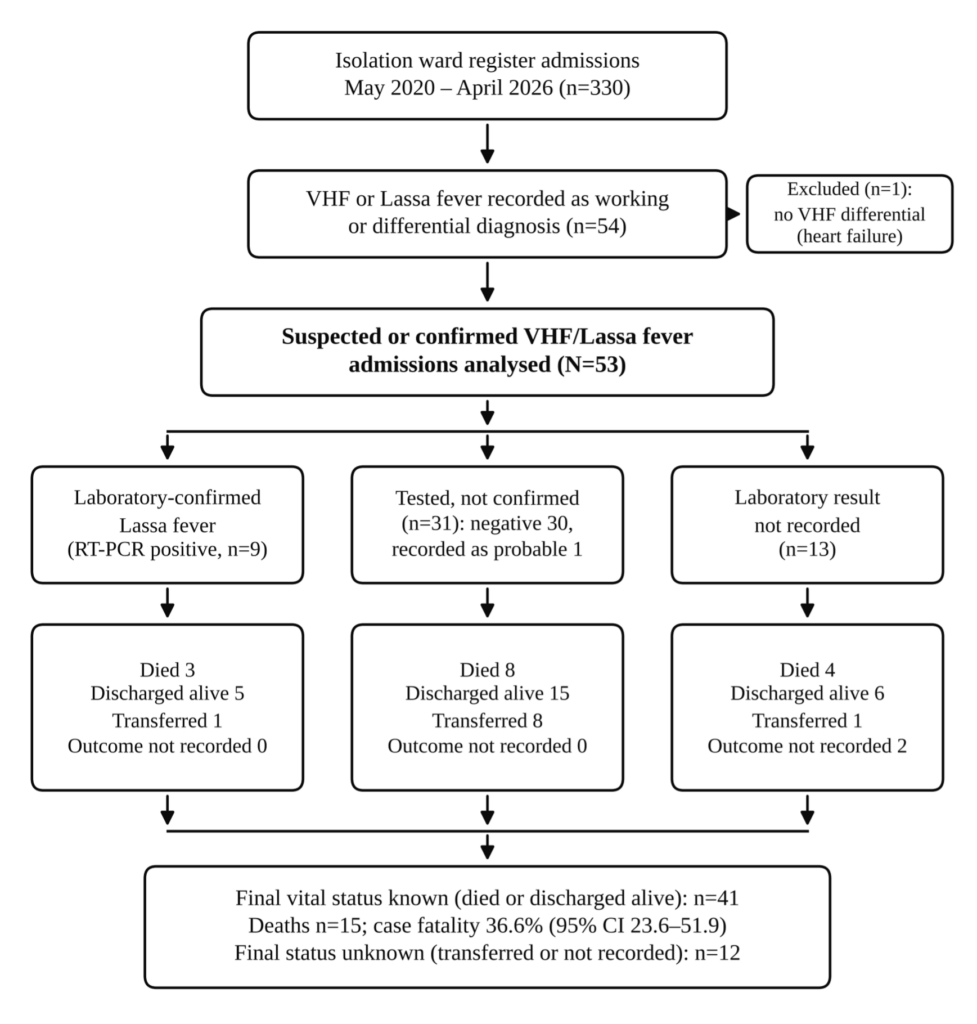
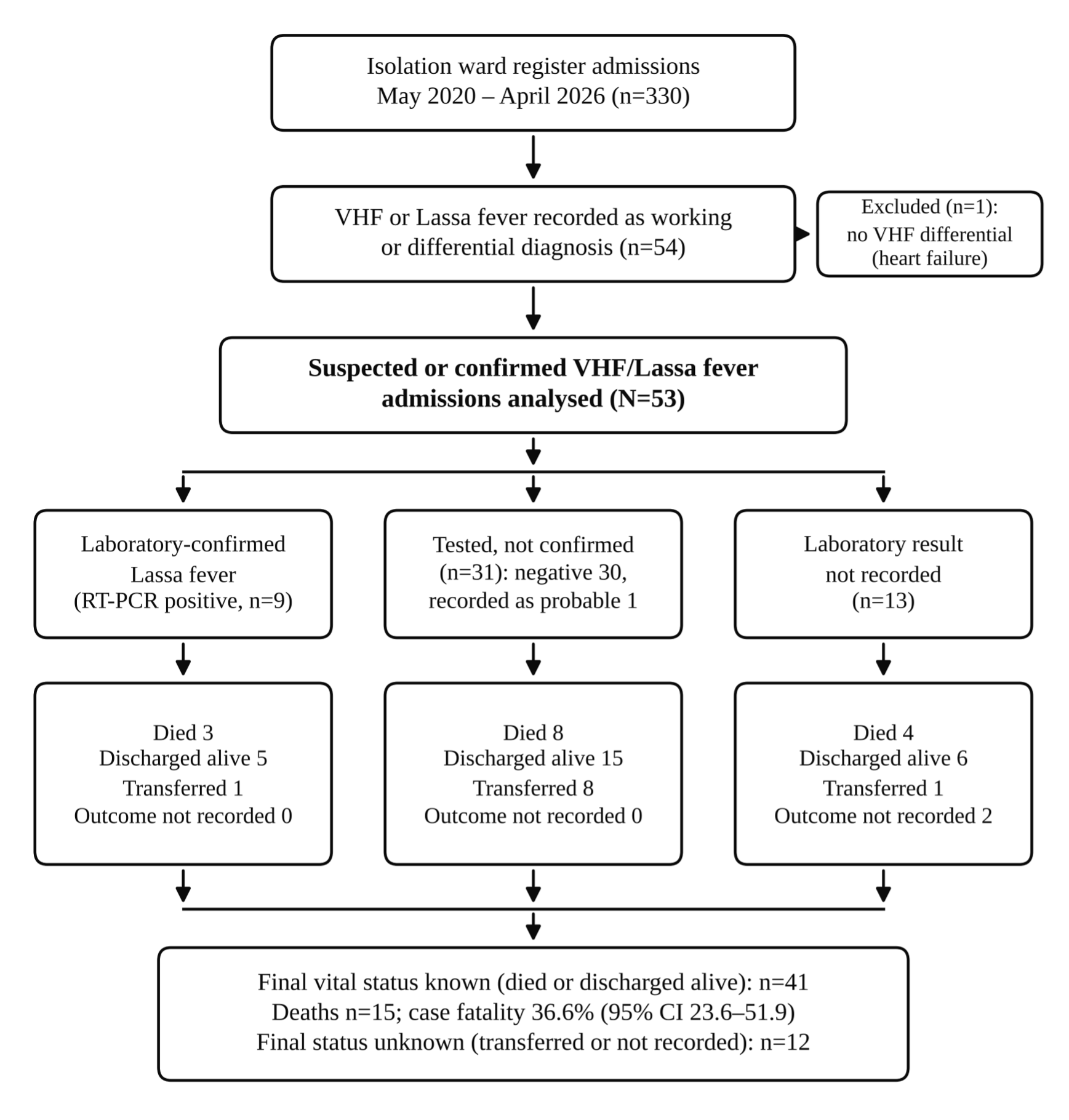
All admissions in which VHF or Lassa fever was recorded as the working or a differential diagnosis (for example ‘?VHF’, ‘rule out Lassa fever’ or ‘keep in view VHF’) were included, whatever the final diagnosis. Diagnoses were taken as recorded by the admitting clinicians; no case definition was applied retrospectively. Entries containing a VHF-like abbreviation were reviewed in full, and one entry recording left ventricular heart failure (‘LVHF’) with no VHF differential was excluded (Figure 1). Included admissions were classified by laboratory status as laboratory-confirmed Lassa fever (positive Lassa virus reverse transcription polymerase chain reaction [RT-PCR] result recorded); tested, not confirmed (negative result, or a result recorded as ‘probable’, which was not treated as confirmation); or result not recorded.
Variables and outcome definitions
Variables were age, sex, admission date, length of stay, diagnosis text, place of residence, laboratory result and ward outcome (died, discharged alive, transferred to another facility, left against medical advice, or not recorded). Patients who died or were discharged alive had a known final vital status. Transferred patients and those without a recorded outcome were not followed up after leaving the ward, so their vital status was unknown. Length of stay was the number of days from admission to discharge, death or transfer. Other conditions recorded in the diagnosis text (for example sepsis, hepatic failure or acute kidney injury) were grouped using prespecified keyword rules (Additional file 1); these were clinicians’ working diagnoses and were not verified by laboratory tests.
Statistical analysis
The primary outcome was in-hospital death. The CFR was calculated as deaths divided by the number of patients with known final vital status, with Wilson score 95% confidence intervals (CIs). Because transferred patients and those without a recorded outcome were excluded from this denominator, the range of possible CFRs was also calculated, assuming that none or all of them died. Proportions were compared with Fisher’s exact test, or the Fisher–Freeman–Halton extension for tables larger than 2×2, because several expected cell counts were below five; the chi-square test was not used. Variation in CFR across years was assessed with one overall exact test, and a linear trend with the Cochran–Armitage test. For completeness, each year was compared with 2024, the year with most admissions, without adjustment for multiple comparisons. Length of stay was compared between patients who died and those discharged alive with the Mann–Whitney U test.
Age group (15–29 [reference], 30–44, 45–59 and ≥60 years; no patient was younger than 15 years) and sex were the only covariates specified before analysis, as they were the only patient characteristics recorded consistently. With 15 deaths, there were fewer than four events per model parameter, so odds ratios (ORs) were estimated by Firth’s penalised-likelihood logistic regression, which reduces small-sample bias and remains finite with sparse data; 95% CIs and p values were obtained from the profile penalised likelihood. No variable selection was performed, and recorded clinical conditions were not modelled because of small numbers. The model was considered exploratory. Conventional maximum-likelihood estimates and a model with age as a continuous variable (per 10 years) were obtained as sensitivity analyses.
All analyses used the available data for each variable, without imputation, and the number of patients contributing to each estimate is reported. Statistical significance was set at p<0.05 (two-sided). Analyses were done in Python 3.13 (pandas 3.0, SciPy 1.18, statsmodels 0.15); the Firth routine was checked against the closed-form solution for a 2×2 table. The dataset and code are provided in Additional files 1 and 2. The report follows the STROBE guideline for cohort studies.
Ethical considerations
The study was approved by the Health Research Ethics Committee of Modibbo Adama University Teaching Hospital, Yola (MAUTHYOLA/HREC/26/437, 26 March 2026), and an amendment extending the approved scope to adult patients was approved on 3 September 2026 (MAUTHYOLA/SUB/S.128/437). Because the study used routinely collected, de-identified records without patient contact, individual informed consent was not sought; the amendment approved by the committee set out this arrangement for all patients in the register. The analysis dataset contains no names, addresses or other direct identifiers; place of residence was summarised only at local government area and State level. The study was conducted in accordance with the Declaration of Helsinki.
Admissions and their distribution over time
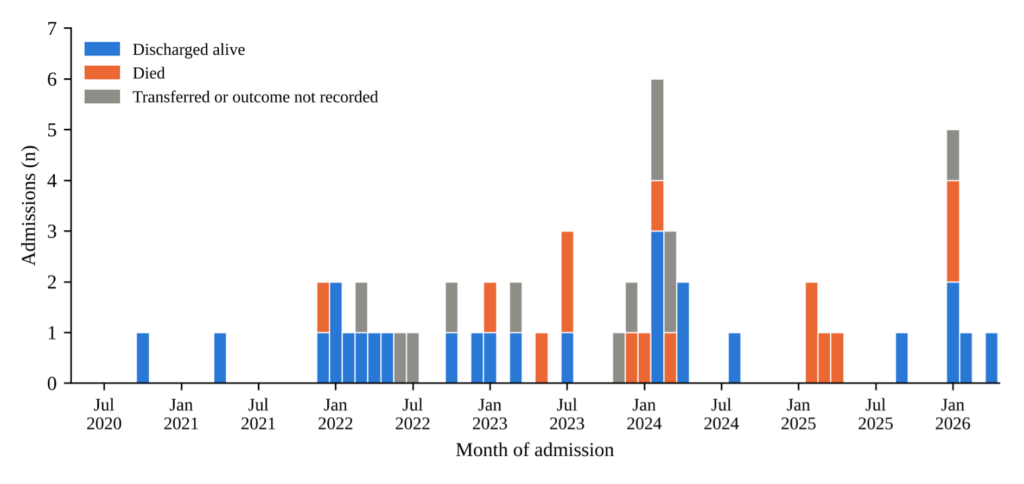
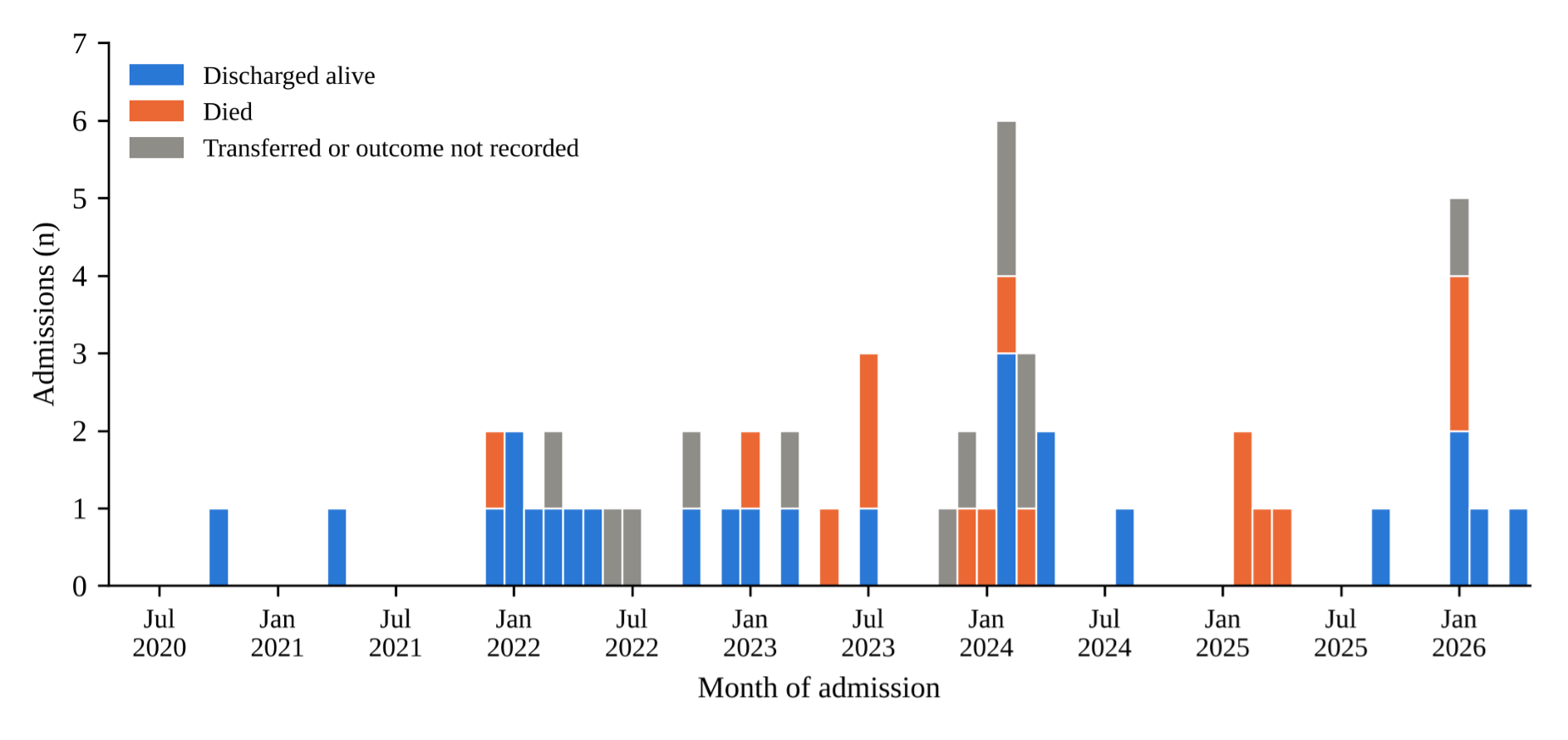
Of 330 register entries, 54 recorded VHF or Lassa fever as a working or differential diagnosis; one was excluded, leaving 53 admissions (16.1% of all isolation admissions; Figure 1). COVID-19 (n=189; 57.3%) and diphtheria (n=61; 18.5%) were more frequent. Annual admissions were 1 in 2020, 3 in 2021, 12 in 2022, 11 in 2023, 13 in 2024, 5 in 2025 and 7 in January–April 2026; the admission date of one patient could not be determined (Table 1). Of the 52 dated admissions, 34 (65.4%) occurred in January–April, and the largest monthly number was 6, in February 2024 (Figure 2).
Patient characteristics and data completeness
Of the 53 patients, 27 (50.9%) were male. Ages ranged from 15 to 70 years (mean 32.0 years [standard deviation 14.4]; median 28.0 years [interquartile range (IQR) 20.0–35.0]); 28 patients (52.8%) were aged 15–29 years (Table 2). Patients came from at least 15 local government areas of Adamawa State, and six were referred from Taraba State. Age and sex were complete, and the admission date was missing for one patient. The laboratory result was not recorded for 13 patients (24.5%), the ward outcome for 2 (3.8%) and length of stay for 5 (9.4%) (Additional file 1).
Laboratory testing
A laboratory result was recorded for 40 patients (75.5%). Nine were positive for Lassa virus (22.5% of those tested; 17.0% of all admissions), 30 were negative and 1 was recorded as probable (Figure 1). The register did not document whether samples were taken for the 13 patients without a result. Seven of the nine confirmed patients were male; their median age was 38 years, and they were admitted in 2022 (n=4), 2023 (n=1) and 2024 (n=4).
Outcomes and case fatality
Fifteen patients (28.3%) died, 26 (49.1%) were discharged alive, 10 (18.9%) were transferred and 2 (3.8%) had no recorded outcome; no patient was recorded as leaving against medical advice. Among the 41 patients with known final vital status, the CFR was 36.6% (15/41; Wilson 95% CI 23.6–51.9). If none of the 12 patients with unknown status had died, the CFR would be 28.3% (15/53); if all had died, it would be 50.9% (27/53). Three of 8 confirmed patients with known status died, compared with 8 of 23 tested patients without confirmation (Fisher’s exact test, p=1.00) and 4 of 10 patients without a recorded result (Table 2).
Annual CFRs were based on 1 to 9 patients with known status per year and ranged from 0 of 8 in 2022 to 4 of 5 in 2025 (Table 1). The overall Fisher–Freeman–Halton test indicated variation between years (p=0.043), but the Cochran–Armitage test showed no linear trend (p=0.13), and no individual year differed significantly from 2024 (Fisher’s exact test, all p>0.20). Deaths occurred in 7 of 20 men and 8 of 21 women (Fisher’s exact test, p=1.00), and in 5 of 18, 7 of 16, 2 of 4 and 1 of 3 patients aged 15–29, 30–44, 45–59 and ≥60 years, respectively (Fisher–Freeman–Halton test, p=0.77). In the Firth model (41 patients, 15 deaths), neither male sex (adjusted OR 0.89; 95% CI 0.25–3.14) nor any age group was associated with death (30–44 vs 15–29 years: adjusted OR 1.88; 95% CI 0.48–7.72; p=0.36), and the model as a whole was not significant (penalised likelihood ratio test p=0.87). The maximum-likelihood model and the model with continuous age (OR per 10 years 1.17; 95% CI 0.75–1.82) gave similar results (Additional file 1).
Recorded clinical conditions and length of stay
Thirty-five patients (66.0%) had at least one other condition recorded with the VHF differential, most often sepsis (n=13), kidney involvement (n=6) and haematological malignancy or marrow failure (n=5) (Table 2). Each category was small. Deaths occurred in 3 of 4 patients with hepatic failure or acute hepatitis, 2 of 3 with neurological conditions and 3 of 3 with haematological malignancy or marrow failure who had known status. Weil’s disease was recorded once, as a clinical working diagnosis alongside fulminant hepatitis with coagulopathy and ‘keep in view VHF, likely Lassa fever’; no leptospirosis or Lassa virus test result was recorded, and the patient died. Deaths occurred in 12 of 28 patients with another recorded condition and 3 of 13 with no other condition (Fisher’s exact test, p=0.30). Length of stay was available for 48 patients (90.6%): median 6 days (IQR 4–10; range 0–80). Patients who died had shorter stays than those discharged alive (median 3 [IQR 1–6] vs 9 [IQR 6–12] days; Mann–Whitney U test, p=0.003); 7 of the 14 deaths with a recorded length of stay occurred within 2 days of admission.
Principal findings
Over six years, suspected VHF accounted for one in six admissions to the MAUTHY isolation ward. Only 9 of these 53 patients had laboratory-confirmed Lassa fever, and a quarter had no recorded test result, so the cohort consists mainly of patients with a VHF differential diagnosis rather than confirmed cases. More than a third of patients with known final vital status died. Admissions varied from year to year, with a peak in 2024, and clustered in January–April. Age and sex were not associated with death, and the numbers with specific complications were too small to assess their prognostic value.
Strengths and limitations
Strengths include six years of consecutive register data from the main referral facility for suspected VHF in Adamawa State, explicit outcome definitions, and release of the analysis dataset and code. The limitations are important. First, the cohort combines suspected and confirmed cases: only nine patients were confirmed, and a quarter had no recorded result, which may reflect samples not sent, results not returned or results not transcribed. Confirmation was therefore incomplete and not random, and results for the whole cohort should not be read as estimates for Lassa fever. Second, final vital status was unknown for 12 patients (22.6%), mostly transfers, so the true CFR may lie anywhere between 28.3% and 50.9%. Third, the register does not record symptom onset, illness severity, comorbidities, laboratory chemistry or ribavirin treatment, so severity and treatment could not be examined. Fourth, with 15 deaths the regression had little power, and non-significant results do not exclude important associations. Fifth, a single investigator extracted the data without double entry, although consistency checks were applied. Finally, as a referral centre, MAUTHY is likely to receive more severe cases, which would raise the CFR.
Comparison with other studies
The CFR in this cohort (36.6%) was higher than the national CFR among confirmed cases in 2024 (16.3%) and 2025 (18.7%) [3,4] and the 30-day mortality in LASCOPE (12%) [6], and similar to the 30% reported among hospitalised confirmed cases in Liberia in 2022–2023 [9]. Small outbreaks have recorded higher figures, such as five deaths among eight confirmed cases in Kaduna State in 2025 [10]. These comparisons need caution. The denominator here is a mixed group of suspected and confirmed cases, many with other serious conditions such as sepsis, leukaemia or liver failure, and a tertiary referral hospital receives sicker patients. The CFR among confirmed patients (3 of 8) is too imprecise for comparison. Differences in access to, and timing of, ribavirin and supportive care may contribute to the difference from LASCOPE, but treatment data were not available in the register, so this remains a hypothesis rather than an explanation.
The age profile, with half the patients aged 15–29 years, resembles national surveillance data, in which people aged 21–30 years are most affected [3,4]. The CFR was numerically highest at 30–44 years, but the difference was not statistically significant and the CIs were wide; it should not be interpreted as an age effect. These data can neither support nor contradict the higher mortality at age 45 years or older reported in LASCOPE [6] or at 40–49 years in Liberia [9], because only nine patients in this cohort were aged 45 years or older.
The rise in admissions to a peak in 2024 coincided with the large national outbreak that year [3,4], and the low numbers in 2020–2021 may reflect reduced use of health services during the COVID-19 pandemic [11]. Both explanations are hypotheses that the register cannot test, and admissions fell in 2025. The clustering in January–April matches the national pattern: in 2025, 645 of 1,148 confirmed cases (56%) had been reported by the end of March [3,12].
Deaths were frequent among patients with hepatic failure, neurological illness or haematological malignancy, which is consistent with the prognostic importance of organ dysfunction in LASCOPE [6]. However, each category contained one to six patients, the conditions were working diagnoses rather than verified complications, and many of these patients may not have had Lassa fever. These observations are descriptive and do not establish prognostic associations.
Implications for practice and public health
Three needs follow directly from these findings. First, few patients were confirmed and results were missing for a quarter; on-site or faster access to Lassa virus RT-PCR would support earlier clinical decisions and more accurate surveillance. Second, the register lacks the information needed to evaluate care; recording symptom onset, test dates and results, treatment and the outcome after transfer would make future evaluation possible. Third, severe coexisting conditions were common, so routine monitoring of kidney and liver function and use of an early-warning score, as in LASCOPE [6], could be considered for all suspected VHF admissions. Recommendations on ribavirin are based on external evidence rather than on these data: it remains in clinical use [2], but the evidence for its effectiveness is uncertain [8], so ensuring availability for early treatment should go together with support for trials of better treatments. More broadly, community rodent control and safe food storage remain the main measures recommended to prevent Lassa fever [2]; this study did not evaluate them.
Unanswered questions and future research
A prospective multicentre study in north-eastern Nigeria that records symptom onset, laboratory confirmation, severity, comorbidities, treatment timing and 30-day outcomes would answer questions this register cannot, including the effect of treatment timing and whether age or specific complications predict death among confirmed cases. Characterisation of the Lassa virus lineages circulating in Adamawa State would also be valuable.
Suspected VHF accounted for 16.1% of isolation ward admissions at MAUTHY between 2020 and 2026, with year-to-year variation, a peak in 2024 and clustering in January–April. More than a third of patients with known outcomes died, but only nine were confirmed Lassa fever and a quarter had no recorded test result, so these findings describe patients admitted with suspected VHF rather than confirmed Lassa fever. Age and sex were not associated with death in this small cohort. These findings support faster access to Lassa virus testing and complete recording of test results, treatment and outcomes, which would also strengthen the hospital’s reporting to NCDC [13].
What is already known about the topic
What this study adds
The authors acknowledge the staff of the Isolation Ward and Medical Records Department of Modibbo Adama University Teaching Hospital, Yola, for their assistance during data collection and retrieval of patient records. The Nigeria Centre for Disease Control and Prevention is acknowledged for making Lassa fever national situation reports publicly available, which provided comparator data for this analysis.
Conceptualization: Hayatu Ahmad, Ahmad Hayatu
Data curation: Hayatu Ahmad
Formal analysis: Hayatu Ahmad
Methodology: Hayatu Ahmad
Supervision: Hayatu Ahmad
Writing – original draft: Hayatu Ahmad
Writing – review & editing: Hayatu Ahmad, Ahmad Hayatu
Supplementary Files
Additional file 1. (1 downloads)
Table 1: Annual admissions, outcomes and case fatality of suspected VHF/Lassa fever, MAUTHY, 2020–2026
| Year | Admissions, n | Died, n | Transferred or outcome not recorded, n | Known final vital status, n | CFR, % (Wilson 95% CI) | Laboratory-confirmed, n | p vs 2024a |
|---|---|---|---|---|---|---|---|
| 2020 | 1 | 0 | 0 | 1 | 0.0 (0.0–79.3) | 0 | 1.00 |
| 2021 | 3 | 1 | 0 | 3 | 33.3 (6.1–79.2) | 0 | 1.00 |
| 2022 | 12 | 0 | 4 | 8 | 0.0 (0.0–32.4) | 4 | 0.21 |
| 2023 | 11 | 5 | 3 | 8 | 62.5 (30.6–86.3) | 1 | 0.35 |
| 2024 | 13 | 3 | 4 | 9 | 33.3 (12.1–64.6) | 4 | Reference |
| 2025 | 5 | 4 | 0 | 5 | 80.0 (37.6–96.4) | 0 | 0.27 |
| 2026 (January–April) | 7 | 2 | 1 | 6 | 33.3 (9.7–70.0) | 0 | 1.00 |
| Date not determined | 1 | 0 | 0 | 1 | NA | 0 | NA |
| Total | 53 | 15 | 12 | 41 | 36.6 (23.6–51.9) | 9 |
Abbreviations: CFR, case fatality rate; CI, confidence interval; MAUTHY, Madina Academic and Teaching Hospital, Yendi; NA, not applicable; VHF, viral haemorrhagic fever.
a Fisher’s exact test comparing the case fatality rate of each year to that of 2024 (reference year).
Note: CFR was calculated as the number of deaths divided by the number of patients with a known final vital status (excluding those transferred or with outcome not recorded). Wilson 95% confidence intervals are presented for all CFR estimates.
| Characteristic | Admissions, n (%) | Known final vital status, n | Died, n | CFR, % (Wilson 95% CI)a | Exact test pb | Crude OR (95% CI)c | Adjusted OR (95% CI)c | Adjusted pc |
|---|---|---|---|---|---|---|---|---|
| All admissions | 53 (100) | 41 | 15 | 36.6 (23.6–51.9) | ||||
| Sex | 1.00 | |||||||
| Female | 26 (49.1) | 21 | 8 | 38.1 (20.8–59.1) | 1 (reference) | 1 (reference) | ||
| Male | 27 (50.9) | 20 | 7 | 35.0 (18.1–56.7) | 0.88 (0.25–3.06) | 0.89 (0.25–3.14) | 0.85 | |
| Age group, years | 0.77 | |||||||
| 15–29 | 28 (52.8) | 18 | 5 | 27.8 (12.5–50.9) | 1 (reference) | 1 (reference) | ||
| 30–44 | 16 (30.2) | 16 | 7 | 43.8 (23.1–66.8) | 1.94 (0.49–8.04) | 1.88 (0.48–7.72) | 0.36 | |
| 45–59 | 5 (9.4) | 4 | 2 | 2/4 | 2.45 (0.31–20.23) | 2.47 (0.31–20.61) | 0.38 | |
| ≥60 | 4 (7.5) | 3 | 1 | 1/3 | 1.47 (0.12–13.99) | 1.48 (0.12–13.96) | 0.73 | |
| Laboratory status | 1.00d | |||||||
| Laboratory-confirmed Lassa fever | 9 (17.0) | 8 | 3 | 3/8 | ||||
| Tested, not confirmed | 31 (58.5) | 23 | 8 | 34.8 (18.8–55.1) | ||||
| Result not recorded | 13 (24.5) | 10 | 4 | 40.0 (16.8–68.7) | ||||
| Other conditions recorded with the VHF differential | 0.30f | |||||||
| None (VHF/Lassa fever only) | 18 (34.0) | 13 | 3 | 23.1 (8.2–50.3) | ||||
| Any other condition | 35 (66.0) | 28 | 12 | 42.9 (26.5–60.9) | ||||
| Sepsis | 13 | 11 | 3 | 27.3 (9.7–56.6) | ||||
| Kidney involvement (AKI, renal impairment or CKD) | 6 | 4 | 1 | 1/4 | ||||
| Haematological malignancy or marrow failure | 5 | 3 | 3 | 3/3 | ||||
| Hepatic failure or acute hepatitis | 4 | 4 | 3 | 3/4 | ||||
| Obstetric or puerperal condition | 4 | 3 | 1 | 1/3 | ||||
| GI bleeding or bleeding disorder | 4 | 2 | 1 | 1/2 | ||||
| Neurological (encephalitis, stroke, SAH, meningitis) | 3 | 3 | 2 | 2/3 | ||||
| Other liver disease (CLD, ALD, varices) | 3 | 2 | 1 | 1/2 | ||||
| Malaria | 3 | 3 | 0 | 0/3 | ||||
| Weil’s disease (clinical diagnosis only) | 1 | 1 | 1 | 1/1 |