Twenty years on: The local and regional impact of Kenya’s Field Epidemiology Training Program [Lessons from the Field]
Maurice Owiny, Jane Githuku, Caren Ndeta, Athman Mwatondo, Bonface Waweru
JIEPH. Volume 9(Suppl 14):06. Published 28 Sep 2026


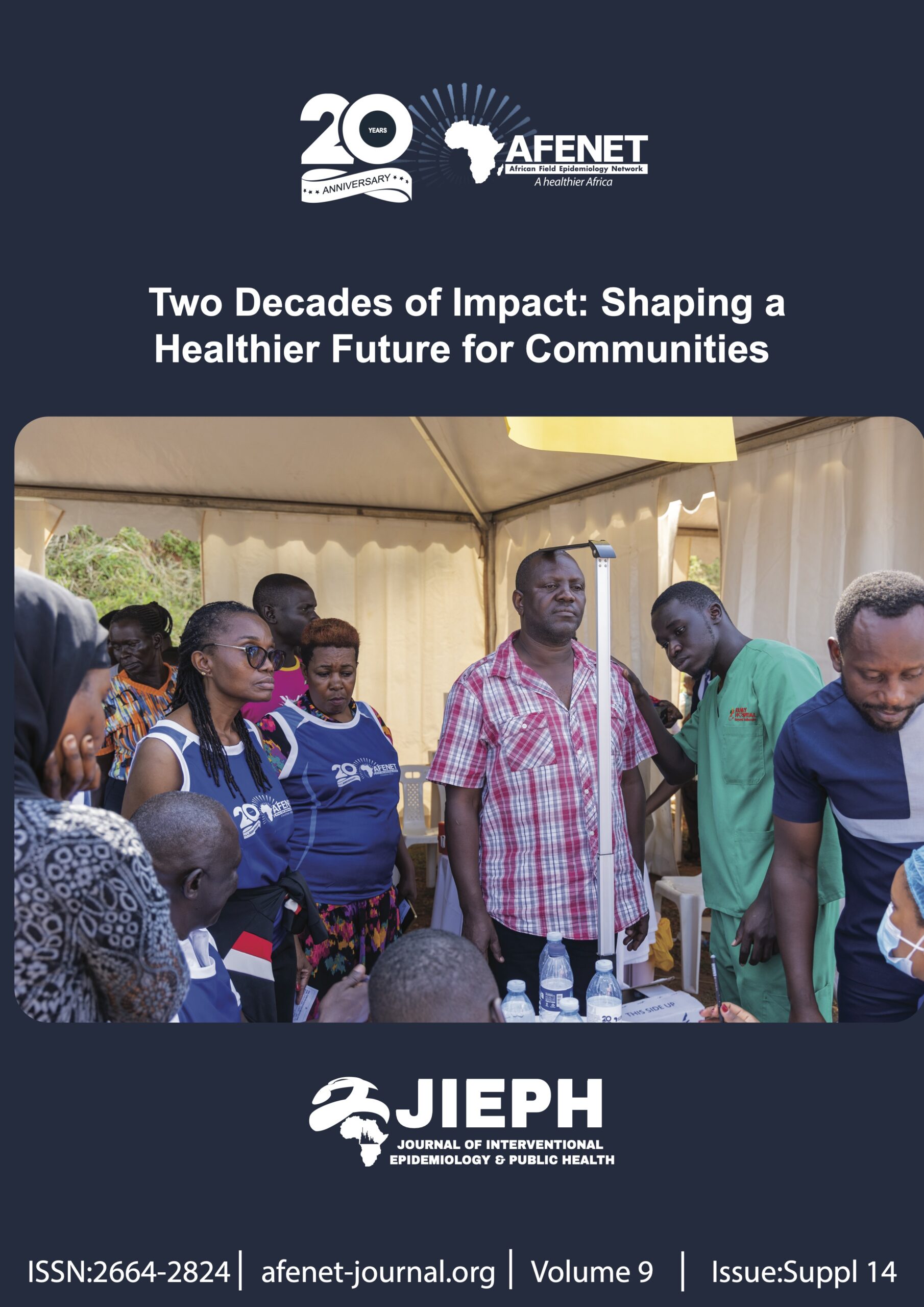 African Field Epidemiology Network (AFENET) was founded in 2005 with the goal of strengthening field epidemiology and public health laboratory capacity to address priority public health challenges. AFENET has evolved into a continental service network supporting countries across Africa to prevent, detect, and respond to public health threats through training, collaboration, research, and technical assistance.
The AFENET at 20 supplement commemorates two decades of sustained contribution to public health workforce development, disease surveillance, outbreak response, operational research, and health systems strengthening across Africa. This supplement provides a fitting platform for documenting AFENET’s scientific and programmatic journey. The collection brings together contributions from member programmes across diverse geographic, linguistic, and epidemiologic contexts, offering an important record of how investments in public health capacity have translated into improvements in health security and population health. The articles highlight several interrelated themes that have defined AFENET’s work over the past twenty years. Central among these is the development of a skilled public health workforce through Field Epidemiology and Laboratory Training Programs (FELTPs and FETPs). These programmes have contributed to strengthening national capacities for surveillance, data analysis, outbreak investigation, emergency response, and evidence-based decision-making.
The supplement also showcases AFENET’s growing contribution to operational research, implementation science, and knowledge generation. Through scientific inquiry conducted in real-world public health settings, member programmes have generated evidence that informs policy, improves programme performance, and strengthens health systems. Several articles highlight innovations in service delivery, surveillance, immunisation, laboratory practice, and emergency preparedness, demonstrating the value of translating research into action.
For researchers, policymakers, practitioners, trainees, and development partners, the supplement provides valuable insights into the long-term impact of investing in people, institutions, and systems. It illustrates how African-led solutions can strengthen health security and improve public health outcomes.
Guest editors:
Contact: Send Email
Dr Chukwuma Umeokonkwo,
Acting Managing Editor, Journal of Interventional Epidemiology and Public Health
Supplement booklet (PDF) not available